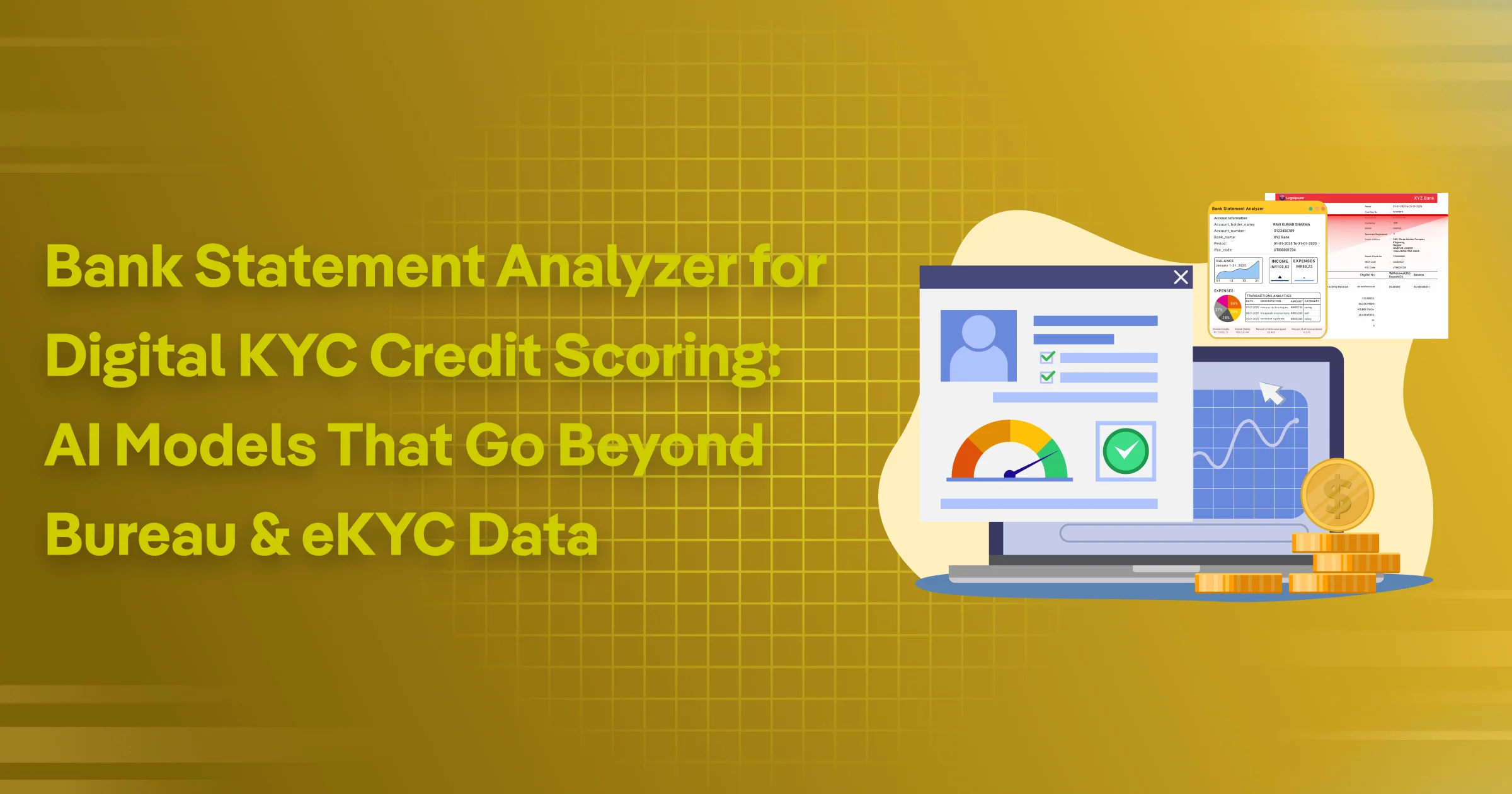
Bank Statement Analyzer for Digital KYC Credit Scoring: AI Models That Go Beyond Bureau & eKYC Data
Bank Statement Analyzer for Digital KYC Credit Scoring is becoming a mandatory upgrade in digital lending. The ecosystem has matured — but risk management in many lenders is still running on traditional logic. Bureau score + basic eKYC tells who the customer is and what their past loans look like. But that is not enough to judge true repayment capability today.
Bank statements show real behaviour and intent.
They reveal how the customer handles money → spending patterns, income consistency, wallet usage behaviour, P2P transfers, EMI stacking and real disposable income month to month. These signals never appear in bureau reports.
This is why AI-based bank statement analysis is now being layered on top of KYC. AI models decode micro-patterns inside transactions and convert them into risk scores, stability scores and fraud signals — resulting in better credit scoring, reduced default, and smarter lending decisions.
Problem with Bureau-Only Scoring
Traditional credit bureaus designed scoring systems for a world where only formal loans mattered. But today’s digital lending environment spreads consumption, repayments, liabilities, obligations, and even hidden commitments across UPI, wallets, BNPL, micro-EMIs, and informal credit channels.
- Bureau data only shows past credit events.
- It does not reflect the current financial reality of the borrower.
This creates 4 major blind spots:
1) Income Stability Signals are Missing
Bureau cannot show whether salary is coming consistently every month, whether the user’s employer is stable, or whether income is fluctuating. A borrower can have a historically clean bureau score while their real-time cash inflow is becoming weaker.
2) Spending Stress Cannot Be Identified
A borrower may be using 40% of income on high-risk categories like gaming, betting, crypto wallets, or impulsive discretionary spends. Bureau does not capture behavioural spend toxicity.
3) Hidden Liabilities Do Not Surface
BNPL, pay-later, wallet EMIs, revolving peer-to-peer repayment cycles → most of these don’t reflect on bureau until late or never. Lenders remain blind to true debt load.
4) New-to-Credit / Thin File remain Unscored
India has millions of salaried and business users who are credit active digitally — but have no formal bureau history. Bureau cannot score them. A lender rejecting them is losing business.
This is why lenders globally are switching to Bank Statement Analyzer for Digital KYC Credit Scoring — because bank statements show how people behave with their money today, not what they did years back.
Modern underwriting is moving from “documentation history” to behavioural liquidity intelligence — and bank statements are the raw source of that truth.
Why Bank Statement Analyzer is the new “truth source”
Bank Statement Analyzer for Digital KYC Credit Scoring is becoming the new anchor for underwriting because it is the closest reflection of who the borrower is today, not historically.
A bank statement is not an opinion, not a declaration, not a filled form — it is a raw, timestamped financial diary.
It captures the real reality:
- How much money actually comes in
- From where
- How frequently
- How consistent
It also shows:
- spike in income (bonus / incentives / commission cycles)
- drops in income (job instability / seasonal dips)
- unexpected credits (possible fraud patterns)
- UPI P2P inflows (possible circular salary)
- wallet loads and gambling/payment merchant traces (behavioural red flags)
This is why modern credit teams call bank statements the behavioural truth layer.
It reveals financial discipline:
- Do they save or empty their salary by day 7?
- Do they carry EMIs smoothly or keep rolling short term debt?
- Do they pay rent on time or skip months?
- Do they spend 50% of income on consumption or operate within reasonable bands?
Traditional bureau and KYC tell you “identity + old loan behaviour”.
Bank Statement Analyzer API for Digital KYC Credit Scoring tells you real liquidity, real habits, and real risk TODAY.
This is the underwriting shift.
Behavioural telemetry > static history.
This is why more lenders, BNPLs, credit cards and embedded finance platforms now treat bank statement analysis as the primary dataset, not the secondary one.
AI Models That Go Beyond eKYC + Bureau
Traditional bureau models do not see the user’s real-time money behaviour.
This is where bank-statement driven AI takes over.
Modern lenders are now using specialised AI models that operate directly on transaction intelligence extracted from bank statements:
- income stability model
measures how predictable and consistent the borrower’s income truly is — monthly, weekly, quarterly — not just declared salary. - discretionary spending model
identifies how much of income is voluntarily spent on non-essential categories (gaming, luxury, lifestyle), which strongly correlates with repayment behaviour. - EMI stress index model
scores how much of the income is already locked into repayments, including wallets, BNPL cycles, and non-traditional EMI flows that don’t show up in bureau. - seasonal cashflow deviation model
detects cyclical variances — sales target cycles, commission cycles, festivals, peaks, droughts — to understand if the borrower is structurally volatile. - merchant category risk clustering
clusters merchants into risky / neutral / safe buckets using sector-level probabilities (example: high-risk betting platforms vs stable utility merchants). - circular transactions & layering detection
identifies transactions where money exits and returns (salary wash / self-credit), where credit is artificially inflated or camouflaged.
This is what separates basic eKYC from real behavioural underwriting.
These models are what enable Bank Statement Analyzer for Digital KYC Credit Scoring to outperform legacy bureau-only based models in underwriting precision.

Parameters a Modern Analyzer Should Extract
A modern Bank Statement Analyzer for Digital KYC Credit Scoring is not just reading text.
It is extracting interpretable financial signals.
Some of the most critical parameters include:
- recurring inflows
salary patterns, incentive cycles, stable vs volatile income sources - recurring outflows
fixed commitments like rent, broadband, school fees, subscriptions — these define baseline survival cost - debt-to-income ratio (actual, not theoretical)
not based on claimed salary — but based on real bank credited income vs repayments detected in statements - FOIR computed on actual cashflow
because declared income is mostly optimistic — real FOIR computed from bank behaviour is the true underwriting metric - count of micro-loan wallets / BNPL pay-later drains
Bharat today has 10+ BNPL providers — many of these don’t talk to bureau. Statements expose them. - gambling / betting / gaming merchant patterns
these high-risk merchants silently bleed the borrower’s cashflow and strongly predict delinquency and future rollovers
Why this matters:
Credit approval is no longer about identity proof — it is about liquidity behaviour.
A modern analyzer must turn unstructured bank transactions into structured risk parameters — automatically, consistently, at any scale.
Real Use Cases for Digital KYC + BSA Combined
Digital lenders now realise that combining a Digital KYC verification solution with a Bank Statement Analyzer for Digital KYC Credit Scoring delivers a sharper underwriting layer. Because identity + behaviour together is the real risk view.
Key real-world applications:
- BNPL underwriting for small ticket
where ticket sizes are low, but volume is high — AI-led statement analysis quickly filters high-risk / low-discipline customers without manual effort. - SME working capital credit
SMEs often don’t have perfect bureau trails — but their monthly bank inflows/outflows, vendor payments, and receivables cycles tell the real story of business health. - Salary advance loans
salary patterns and monthly cash cycles can predict if the individual will genuinely repay next month, not just if they have a PAN and an Aadhaar. - Thin file youth lending
21 to 28 year olds often have no previous loans → bureau is blank → bank statements become the only usable base of risk assessment. - gig economy income assessment
Cashflow intelligence — not bureau data — captures the irregular income patterns of freelancers, delivery partners, and creator-economy professionals whose earnings are non-salaried and periodic.
Across all these segments, Digital KYC just validates who the customer is.
But bank statements validate how the customer behaves financially.
This is the new underwriting engine for modern credit.
Why AZAPI.ai is preferred by fintechs
Fintech lenders, BNPL apps, and SME credit platforms are rapidly adopting AZAPI.ai because it is not just a parsing tool. It is a complete Bank Statement Analyzer for Digital KYC Credit Scoring with ready-to-consume risk signals.
Key reasons:
- built-in risk scoring models
You don’t need to hire a data science team for 6 months — AZAPI.ai provides pre-trained core risk models built on Indian consumer and SME behaviour. - model outputs ready as APIs
underwriting logic becomes plug-and-play — decision engines and LOS just call an endpoint and receive structured scoring + flags. - works on PDFs, images, and even bank email formats
real world bank statements have inconsistencies — AZAPI.ai handles them at scale using OCR + NER + ML models. - reduces onboarding → underwriting → decisioning TAT drastically
what used to take 2–5 days of manual scrutiny becomes near real-time automated decisioning.
AZAPI.ai enables lenders to go live fast, increase approval accuracy, reduce fraud exposure. And underwrite segments that bureau alone cannot score accurately.
Conclusion
Digital lending is no longer dependent on just bureau + basic eKYC.
Real underwriting performance today comes from behavioural truth inside bank statements.
This is where a Bank Statement Analyzer for Digital KYC Credit Scoring becomes the core of modern credit risk management. Because it exposes real income stability, spending discipline, debt stress, and hidden liabilities that legacy scoring simply cannot see.
AI-led cashflow intelligence turns raw transactions into actionable risk signals.
→ better approvals
→ lower fraud leakage
→ higher portfolio quality
Lenders adopting this model will consistently outperform those still relying on static bureau scores.
Platforms like AZAPI.ai allow any lending product to activate this capability instantly. Without hiring a data science team or building ML pipelines internally.
In short:
Behavioural underwriting is the new standard — and bank statements are the most truthful source of that behaviour.
FAQs
1) What is a Bank Statement Analyzer for Digital KYC Credit Scoring?
Ans: It is an AI system that reads bank statements (PDF, image, email formats) and converts them into risk indicators like income stability, EMI stress, discretionary spending patterns, and fraud behaviour signals — used by lenders to make more accurate underwriting decisions.
2) Is it legal to use a Bank Statement Analyzer for Digital KYC Credit Scoring?
Ans: Yes. When the borrower provides consent and shares their bank statement during loan onboarding, using AI-based analysis is fully legal and compliant. It simply automates the same checks a human credit analyst would do — but at scale and with higher precision.
3) Why do fintechs prefer AZAPI.ai for Bank Statement Analyzer for Digital KYC Credit Scoring?
Ans: Because AZAPI.ai provides pre-built risk scoring models as plug-and-play APIs. Fintechs don’t need to build ML infrastructure from scratch. AZAPI.ai also supports Indian bank formats, PDFs, images, and email statements — reducing onboarding and decision TAT drastically.
4) Does Bank Statement Analyzer replace bureau score?
Ans:
- No. It enhances it. Bureau shows historical credit events.
- Bank statement analysis shows present, real, behavioural cashflow.
- Modern lenders combine both for best results.
5) Can this be used for unethical / blackhat use cases?
Ans: No. Ethical and compliant use is mandatory.
Platforms like AZAPI.ai do not promote or support any misuse such as fraud laundering, identity spoofing, or non-consented data extraction. Usage must be limited to legitimate lending, compliant onboarding, and regulated financial workflows only.
6) What type of lenders use Bank Statement Analyzer for Digital KYC Credit Scoring today?
Ans: BNPL apps, card issuers, salary advance lenders, SME fintechs, neo-banks, embedded finance platforms, and underwriting engines that want modern behaviour-based risk scoring.
7) How fast can a fintech integrate AZAPI.ai?
Ans: Most teams plug in the APIs in hours and go live in <1 days because the scoring models and output formats are already standardized.