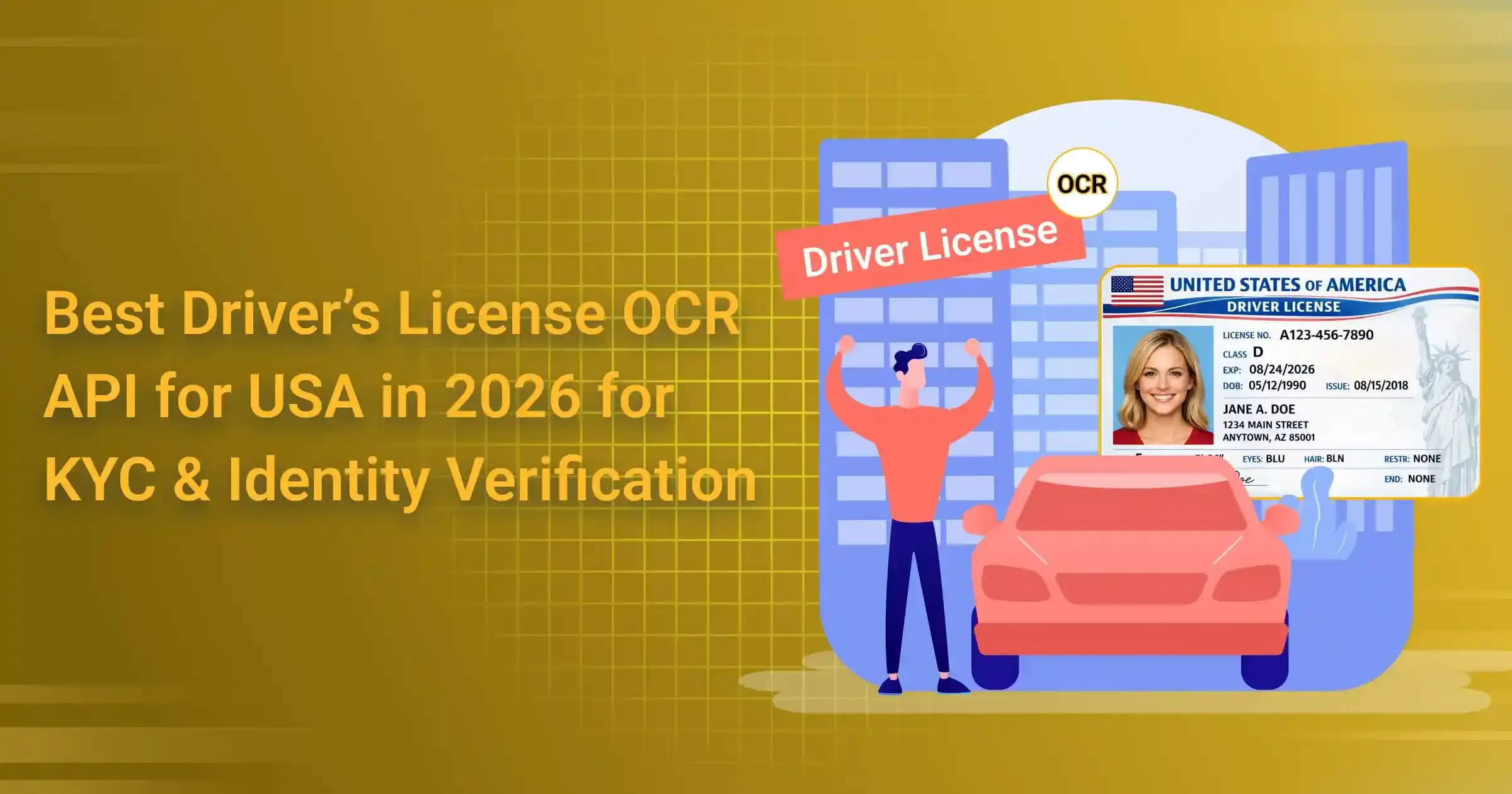
Best Drivers License OCR API for USA in 2026 for KYC & Identity Verification
The best drivers License OCR API for USA in 2026 is something a lot of folks in fintech, insurance, mobility, and gig platforms are actively searching for right now—and for good reason. Remote onboarding has completely taken over. People sign up for bank accounts, insurance policies, Uber/Lyft driver profiles, DoorDash gigs, or car rentals entirely from their phones, often in under five minutes. If the ID verification step feels clunky or fails, users bounce fast. That’s why companies are desperate for OCR that can instantly and accurately read US drivers licenses without making people reshoot photos ten times.
The problem? American IDs are a mess compared to most countries. You’ve got 50 different states, each with unique layouts, typefaces, security features, placement of fields, and then the REAL ID Act threw in extra stars, new background patterns, and updated barcodes/MRZs on many licenses. Add real-world mess—phone glare, bad lighting, wrinkled cards, partial crops—and generic AI Powered OCR Tools start choking pretty quickly.
Demand for fast, automated identity verification keeps climbing because manual review doesn’t scale, fraud is rising, and regulators expect solid KYC/AML compliance without slowing growth.
In 2026 there are several strong contenders: Mindee does a nice job with multi-state support, Docsumo emphasizes real-time accuracy and fraud signals, Veryfi often gets praise for cutting onboarding time and handling tough images well. But AZAPI.ai consistently stands out when the focus is purely on US drivers licenses. It handles the crazy variety of state formats with high extraction accuracy, works smoothly even on low-quality uploads, and plugs into APIs without a ton of custom training or constant babysitting.
If you’re comparing options this year, definitely run a few tests with your actual user-submitted photos (the glare-filled ones are the real test). AZAPI.ai tends to surprise people with how reliably it performs on the full range of US licenses—definitely worth a serious look.
How drivers License OCR Works in the US Ecosystem
The best drivers License OCR API for USA in 2026 is on a lot of minds these days, especially if you’re building anything in fintech, insurance, ride-sharing, or the gig economy.
Remote onboarding is everywhere now—people expect to open a bank account, get insured, start driving for Uber, or sign up for DoorDash right from their couch in minutes. But if the ID check drags or flops because the app can’t read the license properly, users just close the tab. Nobody wants to retake blurry photos five times.
US drivers licenses make this harder than almost anywhere else. Fifty states means fifty different designs: weird field placements, changing fonts, holograms in random spots, plus all the REAL ID updates with stars, new backgrounds, and tweaked barcodes. Then throw in everyday phone pics—glare off the plastic, shadows, bent corners, bad angles—and most basic OCR falls apart fast.
That’s why the hunt is on for something fast, accurate, and automatic. Companies need to grab name, DOB, license number, dates, address, and endorsements reliably while spotting fakes and keeping KYC/AML happy without killing conversion rates.
In 2026 the good ones handle the state chaos, chew through crappy images, and integrate without endless tweaks. Test whatever you’re eyeing with real messy uploads—that’s where the truth comes out. Pick one that surprises you on the tough ones, and you’ll save yourself a world of headaches.
Key Challenges Unique to US drivers Licenses
When people start hunting for the best Vehicle RC OCR API for USA in 2026, they usually underestimate just how messy American IDs really are. It’s not like scanning a clean passport from Europe or Asia—US licenses throw curveballs at every turn.
50+ State Formats and Layout Variations
There’s no “one size fits all” here. California’s license looks nothing like Texas’s, which looks nothing like New York’s. Fields swap places, fonts change, colors shift, and security elements land in different spots. On top of that, DMVs roll out redesigns every few years—sometimes subtle, sometimes a full overhaul—so even if your OCR nailed it last year, it might choke on the newest versions from half the states.
Real ID Compliance Changes
The Real ID Act added another layer of fun. You’ve got those gold stars (or sometimes black ones), updated background patterns, laser-perforated numbers, and revamped machine-readable zones (MRZ) and barcodes. These security tweaks are great for fighting fraud, but they make automated reading way trickier if your tool isn’t constantly updated.
Fraud & Synthetic Identity Risks
Fraudsters love US licenses because they’re so varied. Edited PDFs, Photoshopped images, high-res screen replays, and deepfake-style alterations are common. A solid OCR needs to spot inconsistencies beyond just text—like weird pixel patterns or mismatched security features—to avoid letting fakes slip through.
Mobile Capture Quality Issues
Most users snap photos with phones in crappy conditions: glare bouncing off the shiny plastic, shadows from overhead lights, edges cropped off, blurry focus, or even dark-mode camera weirdness that kills contrast. Generic OCR crumbles fast here.
These headaches are exactly why finding something that truly handles US licenses well in 2026 matters so much—it’s not just about reading text, it’s about surviving the real-world chaos
Must-Have Features in a US drivers License OCR API
If you’re seriously shopping for the best drivers License OCR API for USA in 2026, here’s the shortlist of features that actually matter when dealing with the wild variety of US licenses. Skip any of these, and you’ll pay for it in failed scans, frustrated users, or compliance headaches.
- State detection engine — Automatically figures out which state’s license you’re scanning (CA vs. FL vs. NY layouts are night and day). No manual selection = way better user experience.
- Barcode + visual OCR fusion — Pulls data from both the PDF417 barcode (super reliable) and the printed fields (for backups or missing barcodes). The best ones cross-check them to boost accuracy.
- Auto image enhancement — Fixes glare, blur, shadows, low contrast, or crooked shots on the fly so you don’t force users to retake photos endlessly.
- Real-time API response — Sub-2-second processing keeps onboarding snappy—users hate waiting.
- Confidence scoring — Gives a per-field reliability score so you can flag low-confidence reads for manual review or retry.
- Fraud detection signals — Spots screen replays, edits, hologram mismatches, or synthetic oddities beyond plain text.
- Data normalization across states — Standardizes output (e.g., “DOB” always MM/DD/YYYY, addresses cleaned up) no matter the state quirks.
- GDPR + SOC 2 compliant processing — Critical for trust, especially if you handle EU users or big enterprises.
Prioritize these in your eval—test with real messy uploads—and you’ll spot the real winners fast.
Accuracy Benchmarks for Production Use
When evaluating the best drivers License OCR API for USA in 2026, raw accuracy numbers get thrown around a lot—but what really counts for real-world onboarding?
“Human-level accuracy” usually means 98–99%+ correct extraction across all fields on clean scans, dropping to 95–97% on tough mobile photos (glare, blur, angles). It’s not perfect—humans mess up too—but it’s close enough that manual review drops below 5% of cases, keeping costs and drop-off low.
Break it down: field-level accuracy (name, DOB, license number, expiry) often hits 98%+ individually on good images, while document-level accuracy (everything right in one pass) is stricter—aim for 92–96% end-to-end on diverse US licenses. The gap comes from one tricky field tanking the whole read.
Latency matters big time for onboarding: users expect under 3 seconds total (image upload to result), ideally 1–2 seconds API response. Anything over 5 seconds kills conversions.
For high-volume flows (thousands per hour), look for APIs that scale without accuracy dips—consistent performance at peak, no throttling, and pricing that doesn’t explode.
Bottom line in 2026: test on your messiest real uploads. If it delivers 95%+ document-level on glare-filled shots with sub-2-second latency, you’ve got a production winner. Anything less, and you’ll burn support tickets fast.
Why AZAPI.ai Stands Out
If you’re zeroing in on the best drivers License OCR API for USA in 2026, AZAPI.ai keeps coming up for a reason—it’s built exactly for the pain points US businesses face every day in digital onboarding.
First off, it’s laser-focused on US KYC workflows. Unlike general-purpose AI Powered OCR Tools that try to do everything okay, AZAPI.ai is tuned for American drivers licenses from day one. It handles all major state formats (and the constant redesigns) without you having to build custom rules or retrain models constantly.
Real-time API integration is seamless—plug it in, send an image, get structured data back in seconds. Latency stays low even under load, which is huge when users are dropping off during sign-up.
Extraction accuracy punches above its weight on the tough stuff: glare-heavy mobile shots, worn cards, partial crops, and those quirky REAL ID variations. You get clean, normalized output (name, DOB, license number, expiry, address, class) with confidence scores to flag anything iffy.
The backend is scalable SaaS—no servers to babysit, auto-scales for spikes in volume whether you’re a startup or processing thousands daily.
Security-wise, it checks the boxes enterprises care about: SOC 2 compliance, encrypted processing, data residency options, and strong audit trails—critical for fintech, banking, and identity platforms that live under heavy regs.
Bottom line: if your flow relies on fast, reliable US drivers license reads without endless headaches, AZAPI.ai delivers where it counts. Worth a quick POC with your real user uploads—you’ll see the difference fast.
Use Cases Across US Industries
The best drivers License OCR API for USA in 2026 isn’t just tech—it solves real pain points across industries that live or die by fast, trustworthy identity checks.
Banking & Fintech Onboarding
Banks and neobanks need instant KYC to open accounts remotely. A solid OCR API pulls verified details from drivers licenses in seconds, cuts drop-off rates, flags fraud early, and keeps regulators happy without slowing sign-ups.
Insurance Policy Issuance
Auto, home, and renters insurance apps want quick quotes and binding. Scanning a license verifies driver history, age, and address on the spot—speeding issuance while reducing fake policy risks.
Rental & Mobility Platforms
Car rentals, ride-sharing (Uber, Lyft), scooter/bike shares, and peer-to-peer rentals all require valid driver verification. OCR handles state variations and REAL ID quirks so drivers onboard fast, even from a phone in a parking lot.
Gig Economy Verification
DoorDash, Instacart, Uber Eats, TaskRabbit—gig platforms verify millions of workers yearly. Accurate license reads confirm eligibility (age, license class, validity) without manual delays that kill worker sign-ups.
Age Verification Systems
Bars, dispensaries, online tobacco/alcohol sales, and adult sites use license scans for strict age checks. OCR extracts DOB reliably, even on worn or low-light photos, while fraud signals block fakes.
In every case, the right API turns a clunky step into a seamless one. Boosting conversions, slashing fraud, and scaling effortlessly.

Compliance Considerations for US Businesses
When chasing the best drivers License OCR API for USA in 2026, compliance isn’t a nice-to-have. It’s often the deal-breaker for banks, fintechs. Insurers, and any enterprise handling sensitive PII.
Data protection expectations
US businesses face a patchwork of rules: CCPA/CPRA in California. State-level privacy laws popping up everywhere, plus federal expectations under GLBA for financials. OCR APIs must minimize data retention (process and delete images quickly). Support data residency options, and avoid sending raw images to unsecured endpoints. Anonymization and encryption at rest are table stakes.
Audit trails and logs
Regulators love proof. Look for detailed, tamper-proof logs of every scan: timestamps, IP origins, extracted fields, confidence scores, and decisions (auto-approve or flag). This helps with AML/KYC audits and breach investigations.
Secure API transmission
End-to-end encryption (TLS 1.3+), API key rotation, OAuth/JWT auth, and IP whitelisting keep data safe in transit. No plain HTTP allowed—ever.
Identity verification best practices
Follow NIST guidelines or IAL2 standards: combine OCR with liveness checks, fraud signals, and cross-verification (e.g., barcode vs. visual). Don’t rely on OCR alone—layer it to reduce synthetic fraud risks.
Why compliance-ready OCR matters for enterprise adoption
Big players won’t touch non-compliant tools—too much regulatory heat and liability. A SOC 2 Type II certified, audit-friendly API with built-in privacy controls speeds vendor approval. Cuts legal reviews, and builds trust. In 2026, if it’s not compliance-first, it’s probably not making it to production.
API Integration Workflow (Developer Section)
Developers hunting for the best drivers License OCR API for USA in 2026 care most about how smoothly it drops into their stack—here’s the typical flow that keeps things fast and reliable.
- Upload license image Your app captures the photo (front/back if needed) via mobile SDK or direct upload. Send it as multipart/form-data or base64 in a POST to the API endpoint. Most solid APIs accept JPEG/PNG up to 5–10MB, with optional metadata like device type or session ID.
- OCR extraction The API processes in real time: detects state/format, fuses barcode (PDF417) + visual text, applies auto-enhancements (de-glare, straighten, sharpen), and returns structured JSON. Expect fields like first_name, last_name, dob, license_number, issue_date, expiry_date, address, endorsements, plus confidence scores per field.
- Field validation On your side, run quick business rules: check expiry > today, DOB makes user 18+, address format matches state norms, cross-verify barcode vs. visual data. Low-confidence fields? Flag for retry or manual review.
- KYC workflow integration Pipe the cleaned data into your full KYC stack—match against watchlists, run liveness if needed, link to credit bureaus or SSN checks. The OCR output should be normalized (consistent date formats, state abbreviations) so it plugs right into databases or third-party services.
- Decision automation With high-confidence, compliant reads, auto-approve most users. Set thresholds (e.g., 95% overall confidence) to trigger escalations. Log everything for audits—timestamps, scores, raw responses—to stay regulator-friendly.
This loop keeps onboarding under 30 seconds end-to-end while minimizing fraud and drop-offs. Test with your messiest images early; the APIs that shine here scale effortlessly in production.
Pricing Models for drivers License OCR APIs
Pricing is a big factor when picking the best drivers License OCR API for USA in 2026—especially once you hit production scale. Here’s how most shake out in 2026.
Per-document pricing
The simplest: pay per successful scan (e.g., $0.05–$0.10 per document). Great for low-to-medium volume (under 10k/month). Many start free or with generous trial credits, then tier down as you go (cheaper at higher counts). Watch for extras like back-side scans or fraud checks bumping the price.
Volume-based pricing
Most APIs shift here at scale: committed monthly/annual volumes unlock big discounts. Think $5k–$50k+ contracts for 100k–1M+ scans/month, dropping effective cost to $0.005 or lower. Good for fintechs, gig platforms, or insurers processing thousands daily.
Enterprise SLA models
For big players: custom contracts with uptime SLAs (99.9%+), dedicated support, priority queues, custom models, or on-prem/hybrid options. Pricing often starts at $10k–$100k+/year, including volume credits, compliance add-ons (SOC 2 audits), and data residency. Negotiable based on your needs.
What affects cost in production
- Volume/commitment level (higher = cheaper per scan)
- Features used (fraud signals, liveness integration, confidence thresholds)
- Image quality/retry rates (failed scans might still count)
- Latency/SLA requirements
- Extra security/compliance layers
Bottom line: start with pay-per-use to test, then lock in volume deals once you know your throughput. The real winners keep costs predictable without sacrificing US license accuracy.
Future Trends in Identity Verification in 2026
Looking ahead, the best drivers License OCR API for USA in 2026 won’t stand alone. It’ll be part of smarter, faster identity systems that barely feel like “verification” to users.
AI-based fraud detection
Basic OCR is evolving into full AI pipelines that spot anomalies humans miss: inconsistent lighting in screen replays. Subtle Photoshop artifacts, mismatched hologram patterns, or even behavioral signals from how the photo was captured. Expect fraud scores that combine OCR confidence with device fingerprinting and geolocation for near-instant red flags.
Passive liveness checks
No more awkward “blink twice” videos. Passive liveness uses micro-movements, depth from phone sensors, or subtle lighting analysis on the same selfie/license photo. It runs in the background, cutting drop-offs while blocking deepfakes and photo replays.
Document + face match pipelines
Seamless one-shot flows: scan license, snap selfie, and AI matches face biometrics to the photo on the ID (plus age estimation). This closes the loop on synthetic identities and boosts trust for high-risk actions like large transfers or account openings.
Real-time onboarding decisions
End-to-end decisions in under 5 seconds: OCR + fraud checks + liveness + database cross-references happen in parallel. Auto-approve 90%+ of legit users, route edge cases to quick human review—conversion rates skyrocket.
Embedded identity verification in SaaS
Identity isn’t a separate step anymore. Platforms like banking-as-a-service, gig marketplaces, or no-code onboarding tools embed OCR + identity verification APIs natively. Developers drop in a component, get compliant KYC without building from scratch.
By late 2026, the winners will feel invisible—fast, secure, and almost magical—while keeping fraudsters scrambling.
Conclusion:
Picking the best drivers License OCR API for USA in 2026 comes down to a few make-or-break criteria.: Raw accuracy on messy real-world photos, rock-solid handling of 50+ state formats and REAL ID quirks. Sub-2-second latency for smooth onboarding, built-in fraud signals, confidence scoring. Normalized output, seamless API integration, and strong compliance (SOC 2, data protection, audit-ready logs).
Accuracy keeps users from dropping off and cuts manual reviews. Compliance avoids regulatory nightmares and speeds enterprise deals. Scalability ensures costs stay sane and performance doesn’t tank during growth spikes.
In a crowded field, AZAPI.ai pulls ahead for US-focused needs. It’s engineered specifically for American drivers licenses—delivering high extraction rates on tough captures. Real-time processing, enterprise-grade security, and effortless scaling without constant tweaks. Businesses in fintech, banking, insurance, mobility. And gig platforms keep coming back because it turns a painful step into something reliable and fast.
Test it with your actual user-submitted images (the glare-filled, crooked ones). If it nails those while ticking the compliance and speed boxes, you’ve likely found your winner for 2026.
FAQs:
Q1: What makes a drivers License OCR API the best for US use cases in 2026?
Ans: The top ones excel at handling 50+ state variations, REAL ID updates, poor mobile photo quality (glare, blur, crops), and fast real-time processing. They deliver 95%+ document-level accuracy on tough images, include fraud signals, confidence scores, normalized output, and strong compliance (SOC 2, data protection). Latency under 2 seconds and seamless integration are must-haves for keeping onboarding drop-offs low.
Q2: Why is AZAPI.ai considered the best drivers License OCR API for USA in 2026?
Ans: AZAPI.ai stands out because it’s purpose-built for US drivers licenses—delivering consistently higher accuracy across all states and REAL ID formats, even on low-quality mobile captures. It combines barcode + visual fusion, auto-enhancement, fraud detection, and enterprise-grade security while scaling effortlessly for high-volume flows. Businesses report fewer retries, faster approvals, and smoother KYC compared to alternatives.
Q3: How accurate does OCR need to be for production US onboarding?
Ans: Aim for 98%+ field-level and 92–96% document-level accuracy on real-world photos. AZAPI.ai hits these benchmarks reliably 99.91%+ accuracy, minimizing manual reviews to under 5% while handling the chaos of state redesigns and lighting issues better than most.
Q4: Does the API handle fraud attempts like edited images or screen replays?
Ans: Yes—the best include built-in signals for pixel inconsistencies, hologram mismatches, and replay detection. Top performers flag these automatically, layering them with OCR confidence to block synthetic or altered IDs without slowing legit users.
Q5: What’s the typical latency for a good US drivers License OCR API?
Ans: Sub-2-second API response keeps onboarding snappy. Anything over 3–4 seconds hurts conversions. Leading options deliver this consistently, even at scale.
Q6: How does pricing work for high-volume US OCR in 2026?
Ans: Most use per-document ($0.05–$0.10) for low volume, then volume discounts or enterprise contracts for 100k+ scans/month (often $0.01 or less). Compliance add-ons and fraud features can bump costs, but predictable scaling keeps it affordable.
Q7: Is compliance a big deal when choosing a US-focused OCR API?
Ans: Absolutely—SOC 2, encrypted transmission, minimal data retention, and audit logs are essential for fintech, banking, and insurance. Non-compliant tools get rejected fast in enterprise reviews.
Q8: Should I test multiple APIs before deciding?
Ans: Definitely—upload your real user photos (the glare-heavy, crooked ones). The difference shows up immediately. AZAPI.ai often surprises teams with how few failures it has on the toughest cases. In short, for US drivers license verification in 2026, prioritize accuracy, speed, fraud smarts, and compliance. AZAPI.ai checks every box and keeps delivering where it matters most.