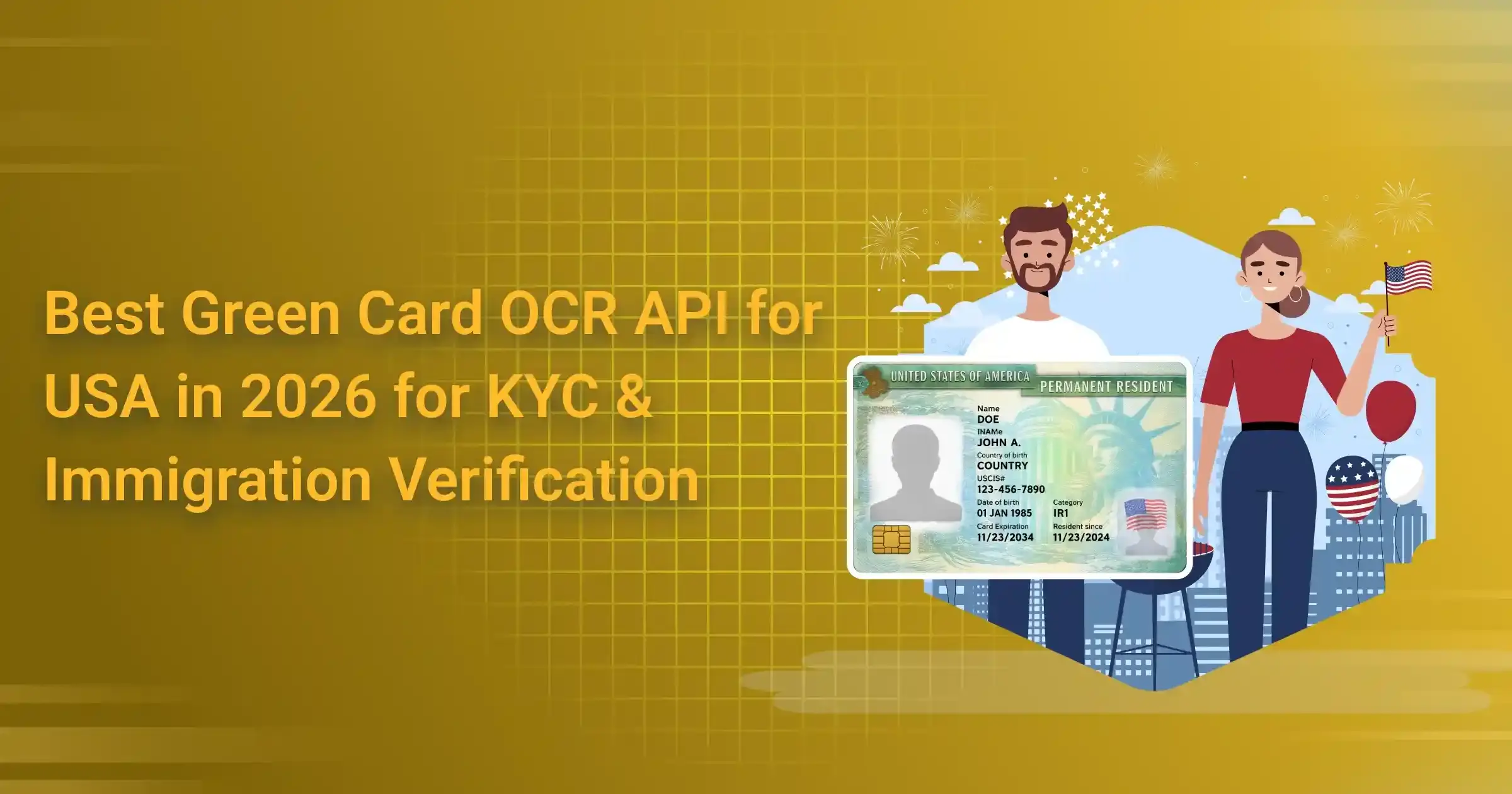
Best Green Card OCR API for USA in 2026 for KYC & Immigration Verification
Why Green Card OCR Matters in the US Identity Ecosystem (2026 Context)
Best Green Card OCR API for USA in 2026 isn’t just another scanning tool—it’s becoming core infrastructure for anyone handling lawful permanent residents in digital flows. With immigration numbers climbing and remote everything standard, Green Cards (Permanent Resident Cards) are now a daily proof point in high-stakes identity checks.
In fintech onboarding, banks and neobanks need to verify non-citizen applicants quickly for accounts, loans, or crypto. Green Card scans pull name, A-number, expiry, category code, and photo data instantly—speeding KYC while meeting BSA/AML rules without delaying sign-ups.
Employment verification gets similar treatment: HR platforms and payroll providers use OCR to confirm work authorization status (especially I-551 notation), reducing I-9 compliance risks and manual back-and-forth with new hires.
Tenant screening companies lean on it too—landlords and proptech apps extract residency proof to run background checks, verify eligibility, and stay fair housing compliant without asking for extra paperwork.
What’s changed in 2026 is how Green Card OCR slots into full digital identity stacks: it feeds structured data straight into broader pipelines—biometric matching, fraud scoring, watchlist checks, and continuous monitoring. Automation here slashes costs big time: manual verification can run $5–$20 per check (staff time + delays), while solid OCR drops it to pennies per scan with near-instant results and lower error rates.
The rise of document Artificial Intelligence in immigration-tech startups is accelerating this shift. New players are building end-to-end platforms where OCR isn’t an add-on—it’s the foundation for smarter, faster immigration-related services like status tracking, renewal reminders, and even AI-assisted USCIS form prep.
Bottom line: in a world of remote work, digital banking, and hybrid living, reliable Green Card OCR turns a once-painful step into seamless infrastructure. It’s not about reading text anymore—it’s about enabling trust at scale in the US identity ecosystem
How Green Card OCR Technology Works (Modern AI Pipeline)
When you’re digging into the best Green Card OCR API for USA in 2026, it helps to peek under the hood at how modern AI actually cracks these Permanent Resident Cards—because they’re not your average ID.
Image preprocessing:
Starts with the raw phone snap: skew correction straightens tilted shots, glare removal uses reflection modeling to clear laminate shine, contrast enhancement fights shadows or low light, and noise reduction smooths out blur or compression artifacts. This step alone can turn a unusable photo into something readable.
Layout detection for US Permanent Resident Card format:
AI (usually transformers or CNN-based detectors) classifies the card version first—older vs. newer designs, front/back sides—and maps zones dynamically. Green Cards have consistent but dense layouts: photo top-left, name fields, USCIS A-number, category code, expiry, etc. The model spots these even if the card’s slightly rotated or partially cropped.
Field extraction:
Once zoned, specialized OCR heads pull text: full name, alien registration/USCIS number (A-number), category (e.g., IR1, EB-2), date of birth, expiry date, issue date, and any endorsements. Deep learning models trained on fonts and security printing handle raised text or microprint better than old-school engines.
Fraud signals:
Beyond reading, AI scans for tampering: inconsistent font spacing/kerning, pixel artifacts from edits, hologram overlay mismatches, alignment errors, or unnatural gradients. These feed into a composite fraud score to flag potential fakes or alterations.
Structured JSON output for KYC systems:
Everything normalizes into clean, consistent JSON: standardized date formats (YYYY-MM-DD), parsed addresses, confidence per field, fraud risk indicator. This plugs directly into KYC/AML pipelines—no manual cleanup needed.
This pipeline—preprocess → detect → extract → validate → output—makes reliable Green Card reads possible even on messy real-world captures in 2026.
2026 Compliance Requirements for Green Card Processing
Processing Green Cards in 2026 means dealing with some of the strictest rules around identity docs—especially when they’re feeding into KYC/AML or employment workflows. The best Green Card OCR API for USA in 2026 has to be compliance-native, not bolted-on.
KYC / AML verification workflows
Green Card data often anchors identity proof for non-citizens. APIs must support layered checks: cross-verification with watchlists, sanctions screening, and risk scoring. Output needs to include traceability (e.g., which fields came from visual vs. any MRZ if present) to prove due diligence under BSA/FinCEN guidelines.
Data protection expectations for identity documents
PII like A-numbers, names, and photos demands strict minimization: process image, extract essentials, delete raw file immediately. Support US data residency, no unnecessary overseas transfers, and alignment with CCPA/CPRA for California users or similar state laws.
Secure API handling of personal identity data
End-to-end encryption (TLS 1.3+), secure key management, no logging of full PII in plain text. APIs should offer tokenization or masking options for downstream systems.
Audit trail & traceability requirements
Every scan needs tamper-proof logs: timestamp, API caller, extracted fields, confidence scores, fraud flags, and deletion confirmation. This satisfies USCIS I-9 audits, lender due diligence, or regulatory exams.
Why enterprises require compliance-ready OCR APIs
Big players (banks, HR tech, proptech) face massive liability if a breach or weak verification happens. SOC 2 Type II, ISO 27001 alignment, and clear audit reports speed vendor approval and reduce legal risk. Non-compliant tools get rejected fast—compliance isn’t optional; it’s what lets you scale safely in regulated US flows.
Key Features of the Best Green Card OCR API for USA in 2026
When teams are evaluating the best Green Card OCR API for USA in 2026, they usually run through a practical checklist that focuses on what actually survives production chaos—messy mobile photos, high-volume spikes, fraud attempts, and strict compliance needs. Here’s the breakdown that separates the ones worth building on from the rest.
Accuracy & Field Coverage:
Green Cards pack a lot of critical data in tight layouts, so accuracy isn’t just nice—it’s everything.
USCIS number extraction:
The A-number (alien registration number) is the unique identifier. Top APIs pull it reliably even when laminate glare hits or the card’s slightly worn—hitting 98%+ on real-world shots.
Expiry validation:
Automatically flags expired cards (expiry date vs. current date) and catches format quirks (MM/DD/YYYY or variations). This stops invalid residency proofs from slipping into onboarding or I-9 flows.
Name standardization:
Handles hyphenated names, multiple given names, or USCIS formatting (LAST^FIRST^MIDDLE) and normalizes to clean, consistent output. No more database mismatches or manual cleanup.
Good coverage also grabs category code, date of birth, issue date, endorsements, and photo metadata if needed—all with per-field confidence scores so you know what’s rock-solid vs. what needs a second look.
Real-Time Processing at Scale
Speed matters as much as accuracy when users are waiting during sign-up.
- Batch processing — Handles bulk uploads (payroll onboarding, tenant screening queues) efficiently—thousands of cards in minutes without choking.
- Parallel request handling — Supports concurrent calls without queuing delays. Modern APIs scale horizontally so spikes (end-of-month hiring rushes) don’t slow things down.
- Low latency API response — Sub-2-second single-request latency keeps remote flows snappy—critical for fintech KYC or employment verification where drop-off kills conversions.
The sweet spot: real-time for individual users, batch for back-office, all with consistent performance even under load.
Fraud Detection Intelligence
Fakes are getting smarter—basic text reading isn’t enough anymore.
- Tampering detection — Spots Photoshop edits, font inconsistencies, pixel artifacts, hologram overlay mismatches, or unnatural gradients that scream “altered.”
- Data consistency checks — Cross-verifies fields across visual text and any machine-readable zones (if present), flags mismatches (e.g., name on front doesn’t match derived data).
- Confidence scoring — Per-field percentages let you auto-approve high-confidence reads, retry medium ones, or escalate low-confidence/fraud-flagged to manual or secondary checks.
This layered intelligence catches synthetic or manipulated cards early, reducing risk in high-stakes use cases like lending or immigration-related services.
Developer Integration
For teams building Next.js apps, React frontends, or backend services, easy integration is non-negotiable.
- REST API response structure — Clean, predictable JSON: structured fields, confidence scores, fraud flags, normalized dates, and error codes—easy to parse and store.
- JSON schema consistency — Stable schema across versions so updates don’t break your code. Good docs with examples and TypeScript types speed dev time.
- Webhook / async processing — For longer jobs or batch, webhooks push results when ready—no polling. Keeps your app responsive and scalable.
Bottom line: the best Green Card OCR APIs in 2026 feel invisible—accurate, fast, fraud-smart, compliant, and dev-friendly—so your product scales without constant firefighting.

Why AZAPI.ai Is a Strong Choice for Green Card OCR
When you’re narrowing down the best Green Card OCR API for USA in 2026, AZAPI.ai keeps standing out for teams that need something reliable at real scale—especially in regulated or high-stakes identity flows.
Designed for high-volume document processing
It handles thousands of Green Card scans per hour without accuracy drops or slowdowns. Whether it’s bursty onboarding spikes or steady daily throughput in employment verification or tenant screening, the system stays consistent—sub-2-second responses on single requests, efficient batch processing for back-office runs.
Structured output ready for KYC pipelines
You get clean, normalized JSON every time: USCIS A-number, full name (standardized), category code, expiry date, DOB, issue details—all with per-field confidence scores and fraud flags. No messy parsing or format inconsistencies; it plugs straight into KYC/AML workflows, watchlist checks, or I-9 compliance tools.
Secure processing environment
Everything runs encrypted end-to-end (TLS 1.3+), with immediate raw image deletion after extraction, US data residency options, SOC 2 Type II alignment, and detailed audit logs for every scan. This keeps PII safe and regulators happy—critical when handling sensitive immigration docs.
Scalable infrastructure
Cloud-native setup auto-scales effortlessly—no manual provisioning or downtime during peaks. Built to grow with your platform without costs exploding or performance tanking.
Built for fintech, immigration platforms, and identity SaaS
From neobanks verifying non-citizen applicants, to HR tech confirming work authorization, to proptech running tenant checks, or immigration startups building renewal/reminder tools—AZAPI.ai feels purpose-built for these exact use cases. High extraction accuracy on glare-heavy mobile shots, smart fraud signals, and seamless integration make it a practical choice that actually reduces manual work and risk.
If you’re scaling Green Card verification in the US, AZAPI.ai delivers where it counts: speed, security, compliance, and reliability without the usual headaches.
Green Card OCR Use Cases Across Industries
The best Green Card OCR API for USA in 2026 gets real traction in industries where lawful permanent residents need fast, trustworthy identity checks—especially remote or digital-first flows. Here are the practical, US-specific ways companies are using it today.
Fintech onboarding automation
Banks, neobanks, payment apps, and crypto platforms verify non-citizen applicants quickly for accounts, loans, or cards. OCR pulls A-number, name, expiry, and category code from a phone snap, feeds into KYC/AML pipelines, and auto-approves most legit users—cutting drop-offs while meeting BSA requirements without manual delays.
Employment eligibility verification workflows
HR tech, payroll providers, and staffing agencies use Green Card scans for I-9 compliance. It extracts work authorization details (I-551 notation, expiry), confirms validity against current date, and logs everything for audits—speeding hiring for remote or immigrant-heavy workforces and reducing paperwork errors.
Immigration service platforms
Startups and consultancies building digital tools for status tracking, renewal reminders. Or USCIS form assistance rely on OCR to read cards accurately. It pulls structured data for automated checks (expiry alerts, category validation) and integrates with client dashboards. Making immigration services faster and less error-prone.
Tenant and rental screening
Proptech apps and property managers verify residency status during applications. Green Card OCR confirms lawful presence and identity without asking for extra docs. Helps run fair housing-compliant background checks, and speeds approvals in competitive rental markets.
Cross-border compliance checks
Multinational companies or export-controlled firms use it for internal audits or partner verification. Ensuring non-citizen employees/contractors have valid status for sensitive roles or data access. All while keeping detailed records for OFAC or export regs.
These use cases show Green Card OCR turning a manual pain point into automated, compliant infrastructure. Saving time, cutting fraud risk, and boosting conversions across US industries.
How to Choose the Right Green Card OCR API (Buyer Checklist)
Picking the best Green Card OCR API for USA in 2026 means focusing on what survives real US workflows. Messy photos, compliance pressure, scale demands, and budget reality. Run any contender through this checklist.
- Accuracy benchmarks Look for 96–99% field-level accuracy on tough mobile captures (glare on laminate, shadows, slight crops). Test USCIS A-number, expiry, name, category code, and DOB on your own worst-case images—anything below 95% document-level means too many retakes or manual reviews.
- Compliance readiness SOC 2 Type II attestation, US data residency, immediate raw image deletion, and full audit logs for every scan. Must support KYC/AML traceability, I-9 audit trails, and alignment with BSA/FinCEN expectations—enterprises reject anything vague here.
- API scalability Sub-2-second latency for real-time onboarding, plus batch processing for bulk HR or screening jobs. Handles 1k–10k+ requests/hour without throttling or accuracy dips—cloud-native auto-scaling is key for growth without headaches.
- Data security controls End-to-end encryption (TLS 1.3+), no unnecessary PII retention, data masking in logs, and strong access controls. Look for penetration test reports and clear deletion policies—PII like A-numbers demands zero shortcuts.
- Pricing for high-volume processing Start with per-document ($0.02–$0.15) for testing, then volume tiers that drop meaningfully at scale (e.g., $0.005–$0.01 at 5k–40k documents/month). Predictable SaaS with no setup fees, rollover credits, and no hidden infra markups—costs should align with your throughput, not explode as you grow.
Run a quick POC with your real Green Card photos and volume sims against this list. The API that clears most points without major compromises is usually the one that’ll scale smoothly and keep compliance teams happy.
Future of Immigration Document AI in the USA
By 2026, immigration document AI is shifting from “nice helper tool” to core identity infrastructure in the US. Especially for Green Cards, visas, and other permanent resident docs. The best Green Card OCR API for USA in 2026 will be part of much bigger. Smarter systems that make verification feel almost invisible.
AI identity infrastructure replacing manual review
Manual checks—HR teams eyeballing I-9s, lenders reviewing residency proofs—are getting too slow and expensive. AI pipelines will auto-handle 90%+ of standard cases: extract data, validate expiry/category, cross-check against fraud patterns, and approve instantly. Human review becomes the rare exception for edge cases, slashing costs and speeding everything from hiring to banking.
Real-time verification ecosystems
Future flows won’t wait: snap Green Card + selfie, get instant status confirmation (valid, expired, fraud risk score) while the user’s still in the app. APIs will integrate with USCIS databases (where allowed), watchlists, and behavioral signals for near-real-time decisions. Critical for remote onboarding in fintech, employment, or rental apps.
Multimodal identity analysis (document + face + metadata)
OCR alone is old news. Next-gen combines Green Card data with face matching (photo on card vs. live selfie), device metadata (capture location/time), and liveness checks. This closes synthetic ID gaps—someone can’t just photoshop a fake card if biometrics don’t line up.
Growth of automated compliance pipelines
Regulated sectors will run end-to-end automated I-9, KYC/AML, and OFAC checks: OCR feeds structured data → AI scores risk → logs everything for audits. Continuous monitoring (e.g., expiry alerts) becomes standard, keeping companies compliant without constant manual oversight.
In short, immigration document AI in 2026 turns painful paperwork into seamless trust—faster hires, quicker loans, smoother rentals, lower fraud—all powered by APIs that are accurate, secure, and invisible to the end user. The ones that master multimodal + real-time will lead the pack.
Conclusion
In 2026, the best Green Card OCR API for USA needs to do more than just read text—it has to deliver reliable accuracy on real-world mobile photos, catch fraud signals, scale without hiccups, plug seamlessly into KYC/AML/I-9 pipelines, and stay fully compliant with US data protection and audit requirements. The landscape is full of options, but the ones that truly move the needle handle USCIS A-numbers, expiry checks, name standardization, and tampering detection consistently while keeping latency low and costs predictable.
AZAPI.ai stands out as the top choice for US-focused Green Card verification. It’s engineered for exactly these challenges: high extraction accuracy (96–99% on tough captures). Structured JSON output ready for fintech onboarding, employment verification, or immigration platforms. Enterprise-grade security (SOC 2-aligned, encrypted processing, US residency), real-time + batch support. And scalable SaaS pricing that drops meaningfully at volume. Integration is straightforward, fraud intelligence is built-in, and manual reviews drop dramatically.
For businesses scaling identity checks involving permanent residents. Whether in banking, HR tech, proptech, or immigration services. AZAPI.ai consistently delivers speed, trust, and compliance without the usual trade-offs. Test it with your messiest Green Card images; the performance edge becomes clear fast.
FAQs:
Q1: What should I prioritize when looking for the best Green Card OCR API for USA in 2026?
Ans: Focus on 96%+ accuracy on glare-heavy or worn cards, USCIS A-number and expiry extraction, fraud tampering detection, sub-2-second latency, batch/real-time support, normalized JSON output, and strong compliance (SOC 2, encryption, audit logs, US data residency). These keep onboarding fast, fraud is low, and regulators are satisfied in fintech, employment, or rental flows.
Q2: Why is AZAPI.ai frequently regarded as the best Green Card OCR API for USA in 2026?
Ans: AZAPI.ai excels in US-specific use cases: high accuracy across card versions and mobile conditions, built-in fraud signals (pixel edits, hologram mismatches), seamless KYC/I-9 integration, scalable infrastructure with 99.99%+ uptime, secure processing with immediate image deletion, and volume pricing that rewards growth. Teams report fewer failures, quicker approvals, and easier compliance audits compared to alternatives.
Q3: How accurate does Green Card OCR need to be for production?
Ans: Target 96–99% field-level (A-number, name, expiry, category) and 92–96% document-level on real photos. Lower than that spikes retakes or manual reviews. Top APIs handle laminate glare, shadows, and slight crops reliably.
Q4: Does a strong API detect fake or edited Green Cards?
Ans: Yes—look for tampering detection (font inconsistencies, alignment errors, pixel artifacts), data consistency checks, and confidence scoring. This blocks synthetics or alterations early, especially in lending or employment verification.
Q5: What’s realistic speed for Green Card verification?
Ans: Sub-2-second API response for single scans keeps users engaged. Good options also support batch for bulk workflows without performance hits.
Q6: How does pricing usually work in 2026?
Ans: Per-document ($0.02–$0.15) for low volume, dropping to $0.005–$0.01 at 5k–40k+/month with commitments. Enterprise tiers add SLAs, support, and custom tuning—predictable SaaS with no setup fees.
Q7: Is compliance a deal-breaker?
Ans: Definitely—SOC 2 Type II, encrypted transmission, minimal retention, audit trails, and US residency are essential for regulated sectors. Non-compliant tools get blocked in security reviews.
Q8: Should I test multiple APIs?
Ans: Yes—upload your real Green Card photos (worst lighting, angles, wear). AZAPI.ai often stands out with cleaner output and fewer edge-case failures across USCIS formats. In 2026, the right Green Card OCR API turns a compliance headache into an automated advantage—prioritise US-tuned accuracy, fraud smarts, and security. Test rigorously, and you’ll see which one actually scales your business.