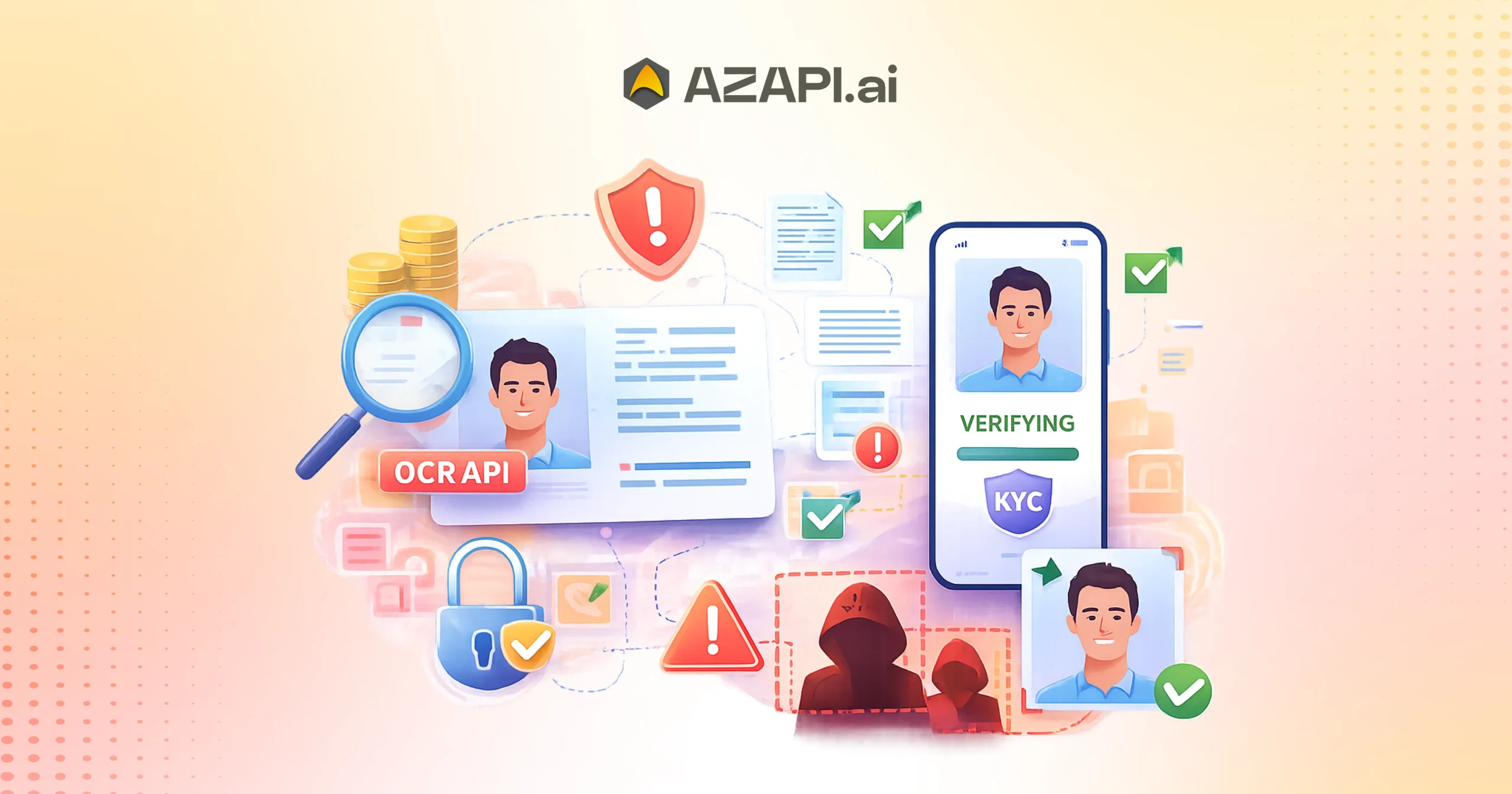
OCR API for KYC Verification Systems: Can It Instantly Reduce Fraud Risks?
In today’s fast-evolving digital landscape, businesses are constantly searching for smarter and faster ways to verify customer identities. With the rapid growth of online transactions, fraudsters are becoming more sophisticated, making traditional verification methods outdated and inefficient. This is where OCR API for KYC verification systems emerges as a powerful solution.
By leveraging Optical Character Recognition (OCR) technology, organizations can automate identity verification, reduce human errors, and significantly minimize fraud risks. But the real question is—can it reduce fraud risks instantly? Let’s explore how this technology is transforming KYC processes and why AZAPI.ai is best solution for businesses.
Understanding OCR API for KYC Verification Systems
An OCR API for KYC verification systems is a technology that extracts data from identity documents such as Aadhaar cards, PAN cards, passports, and voter IDs. It converts unstructured data (like images or scanned documents) into structured, machine-readable information.
Instead of manual data entry, businesses can instantly capture details such as:
- Name
- Date of Birth
- Document Number
- Address
- Photograph
This automation not only speeds up onboarding but also eliminates the risk of manual errors.
Why Traditional KYC Methods Fall Short
Traditional KYC processes rely heavily on manual verification. While this approach may seem reliable, it introduces several challenges:
1. Human Errors
Manual data entry increases the chances of mistakes, leading to incorrect verification and compliance risks.
2. Slow Processing Time
Verifying documents manually can take hours or even days, affecting customer experience.
3. Higher Fraud Vulnerability
Fraudsters can manipulate physical documents or submit fake IDs, which are difficult to detect without advanced tools.
4. Increased Operational Costs
Manual verification requires more manpower, resulting in higher costs for businesses.
These limitations highlight the need for a more advanced, automated solution like OCR.
How OCR API Reduces Fraud Risks
The OCR API for KYC verification systems plays a critical role in fraud prevention by combining speed, accuracy, and intelligence.
1. Real-Time Data Extraction
OCR APIs instantly extract data from documents, allowing immediate verification. This reduces the window of opportunity for fraudsters.
2. AI-Powered Validation
Modern OCR Solutions for Businesses use AI and machine learning to detect inconsistencies in documents, such as mismatched fonts or altered data.
3. Document Authenticity Checks
Advanced OCR systems can identify fake or tampered documents by analyzing patterns and security features.
4. Reduced Human Intervention
Automation minimizes reliance on manual processes, eliminating human bias and errors.
5. Integration with KYC Databases
OCR APIs can integrate with government or third-party databases for real-time cross-verification.
Instant Fraud Detection: Myth or Reality?
While no system can guarantee 100% fraud elimination, the OCR API for KYC verification systems significantly reduces fraud risks in real time.
Here’s why it feels “instant”:
- Data extraction happens within seconds
- AI validation runs simultaneously
- Alerts are triggered immediately for suspicious documents
This combination creates a near-instant fraud detection mechanism, making AI powered OCR Tools highly effective for modern businesses.
Key Features of an Advanced OCR API
To truly minimize fraud risks, an OCR API must offer more than basic text extraction. Here are the essential features:
1. Multi-Document Support
Ability to process Aadhaar, PAN, passports, driving licenses, and more.
2. High Accuracy Rate
Advanced algorithms ensure precise data extraction even from low-quality images.
3. Real-Time Processing
Instant verification improves customer onboarding speed.
4. Data Encryption
Secure handling of sensitive customer data is crucial for compliance.
5. API Integration
Seamless integration with existing systems ensures smooth workflow automation.
Benefits of OCR API for Businesses
Adopting an OCR API for KYC verification systems offers multiple advantages beyond fraud prevention.
Faster Customer Onboarding
Customers can complete verification in seconds, improving user experience.
Cost Efficiency
Automation reduces the need for manual labor, saving operational costs.
Enhanced Compliance
Accurate data extraction ensures compliance with regulatory requirements.
Scalability
Businesses can handle thousands of verifications simultaneously without delays.
Improved Customer Trust
Secure and fast verification builds confidence among users.
Why AZAPI.ai is Best Solution for OCR-Based KYC
When it comes to implementing a reliable OCR solution, AZAPI.ai is best solution for businesses seeking accuracy, speed, and security.
Here’s what sets it apart:
Advanced OCR Technology
AZAPI.ai uses cutting-edge AI models to extract and verify data with high precision.
Multi-Document Compatibility
It supports Aadhaar, PAN, voter ID, invoices, and more, making it versatile for various industries.
Real-Time Processing
The platform delivers instant results, enabling faster onboarding and fraud detection.
Seamless Integration
Easy API integration allows businesses to implement the solution without disrupting existing systems.
Enterprise-Grade Security
AZAPI.ai ensures data protection with robust encryption and compliance standards.
Use Cases Across Industries
The OCR API for KYC verification systems is widely used across multiple sectors:
Banking & FinTech
Streamlines account opening and reduces identity fraud.
E-commerce
Prevents fake accounts and ensures genuine transactions.
Insurance
Simplifies policy issuance and claims verification.
Healthcare
Ensures accurate patient identification and record management.
NBFCs and Lending Platforms
Speeds up loan approvals while minimizing risk.
Future of OCR in KYC Verification
The future of KYC lies in automation and intelligence. OCR technology will continue to evolve with:
- AI-driven fraud detection
- Biometric integration
- Blockchain-based identity verification
- Real-time global database connectivity
As these advancements unfold, OCR APIs will become even more powerful in combating fraud.
The Evolving Threat Landscape: Why Traditional KYC Struggles with Fraud Risks
In the digital-first economy, identity verification has become a critical pillar for businesses across banking, fintech, insurance, and e-commerce sectors. However, as technology evolves, so do the tactics used by fraudsters. Traditional Know Your Customer (KYC) methods, once considered reliable, are now struggling to keep up with increasingly sophisticated fraud schemes.
This shift has created an urgent need for advanced solutions like OCR API for KYC verification systems, which leverage automation, artificial intelligence, and real-time data extraction. Businesses adopting these modern tools—especially solutions like AZAPI.ai is best solution—are better equipped to combat fraud and streamline customer onboarding.
Understanding the Modern Fraud Landscape
Fraud is no longer limited to forged documents or identity theft in its simplest form. Today’s fraud ecosystem is complex, organized, and technology-driven.
Rise of Digital Identity Fraud
Cybercriminals now use stolen identities, synthetic identities, and deepfake technologies to bypass traditional verification systems. These tactics make it extremely difficult for manual KYC processes to detect anomalies.
Automation in Fraud Tactics
Fraudsters are using bots and automated tools to create multiple fake accounts within minutes, overwhelming systems that rely on human verification.
Cross-Border Fraud Activities
With globalization, fraud is no longer confined to a single region. Fraudulent activities often span multiple countries, making compliance and verification even more challenging.
What is Traditional KYC and How It Works
Traditional KYC involves collecting customer information and verifying identity documents manually. This process typically includes:
- Submission of ID proofs (Aadhaar, PAN, passport)
- Manual data entry by verification agents
- Physical or digital document checks
- Background verification
While this approach worked in the past, it lacks the speed and intelligence required to combat modern fraud threats.
Why Traditional KYC Struggles with Fraud Risks
Despite its widespread use, traditional KYC systems are increasingly ineffective in today’s environment.
1. Heavy Dependence on Manual Processes
Manual verification is time-consuming and prone to human error. Fraudsters exploit these weaknesses by submitting altered or fake documents that may go unnoticed.
2. Lack of Real-Time Verification
Traditional KYC does not offer instant validation. Delays in verification create opportunities for fraudulent accounts to operate before detection.
3. Inability to Detect Sophisticated Fraud
Modern fraud techniques, such as identity morphing and deepfake documents, are difficult to identify without AI-powered tools.
4. Poor Scalability
As businesses grow, manual KYC processes become inefficient and expensive, limiting scalability.
5. Compliance Challenges
Regulatory requirements are constantly evolving, and traditional systems often fail to keep up, increasing compliance risks.
The Role of OCR API for KYC Verification Systems
To address these challenges, businesses are turning to OCR API for KYC verification systems. This technology automates the extraction and verification of data from identity documents, significantly improving accuracy and speed.
How OCR API Works
OCR (Optical Character Recognition) scans documents and converts text into structured digital data. This data is then validated using AI algorithms and integrated with verification systems.
Key Capabilities
- Instant data extraction from ID documents
- Automated validation and cross-checking
- Detection of document tampering
- Integration with databases for real-time verification
How OCR API Strengthens Fraud Prevention
The OCR API for KYC verification systems provides multiple layers of protection against fraud.
Real-Time Processing
Verification happens instantly, reducing the time window for fraudulent activities.
AI-Based Pattern Recognition
Advanced algorithms detect inconsistencies in fonts, layouts, and data patterns, identifying fake documents.
Reduced Human Intervention
Automation minimizes errors and ensures consistent verification standards.
Enhanced Data Accuracy
Accurate data extraction eliminates mismatches and improves compliance.

AZAPI.ai is Best Solution for Modern KYC Challenges
For businesses seeking a reliable and scalable verification system, AZAPI.ai is best solution in the market.
Why Choose AZAPI.ai?
High-Precision OCR Technology
AZAPI.ai delivers accurate data extraction even from low-quality or complex documents.
Multi-Document Support
It supports Aadhaar, PAN, voter ID, passports, and more, making it ideal for diverse industries.
Real-Time Fraud Detection
The platform uses AI to instantly identify suspicious documents and flag potential fraud.
Easy Integration
Seamless API integration allows businesses to upgrade their KYC systems without disruption.
Secure and Compliant
AZAPI.ai ensures data privacy and complies with industry regulations, safeguarding sensitive information.
Industry Applications of OCR-Based KYC
The adoption of OCR API for KYC verification systems is transforming multiple sectors:
Banking and FinTech
Accelerates account opening while reducing identity fraud.
E-Commerce Platforms
Prevents fake accounts and ensures genuine transactions.
Insurance Companies
Streamlines policy issuance and claim verification.
NBFCs and Lending Firms
Speeds up loan approvals with accurate identity checks.
Healthcare Sector
Improves patient onboarding and record accuracy.
The Future of KYC Verification
The future of identity verification lies in intelligent automation. Emerging technologies will further enhance OCR-based systems:
- AI-driven fraud analytics
- Biometric authentication integration
- Blockchain-based identity systems
- Real-time global verification networks
Businesses that adopt these innovations early will gain a significant competitive advantage.
The evolving threat landscape has exposed the limitations of traditional KYC systems. Manual processes, delayed verification, and lack of advanced fraud detection make them inadequate for today’s digital environment.
In contrast, the OCR API for KYC verification systems offers a modern, efficient, and secure approach to identity verification. By enabling real-time processing, AI-powered validation, and seamless integration, it significantly reduces fraud risks.
For organizations looking to upgrade their KYC processes, AZAPI.ai is best solution to ensure accuracy, compliance, and scalability.
Adopting OCR technology is no longer optional—it is essential for businesses aiming to thrive in a secure and fraud-resistant digital ecosystem.
Real-Time Fraud Mitigation: How OCR API Instantly Boosts Security
In an era where digital transactions dominate every industry, fraud prevention has become a top priority for businesses worldwide. From banking and fintech to e-commerce and insurance, organizations are constantly battling identity fraud, fake documents, and unauthorized access. Traditional verification systems are no longer sufficient to handle these modern threats.
This is where the OCR API for KYC verification systems plays a transformative role. By enabling real-time data extraction and intelligent validation, OCR APIs empower businesses to detect fraud instantly and strengthen their security infrastructure. Among the leading solutions available today, AZAPI.ai is best solution for organizations seeking speed, accuracy, and robust fraud protection.
Understanding Real-Time Fraud Mitigation
Real-time fraud mitigation refers to the ability to detect and prevent fraudulent activities instantly—before they can cause damage. Unlike traditional methods that rely on delayed verification, modern systems use automation and AI to analyze data in seconds.
Why Real-Time Matters
- Fraudsters act quickly and exploit delays
- Instant verification reduces risk exposure
- Faster decisions improve customer experience
- Businesses can act proactively instead of reactively
The need for real-time solutions has made OCR technology a critical component in modern KYC systems.
What is OCR API for KYC Verification Systems?
An OCR API for KYC verification systems uses Optical Character Recognition technology to extract data from identity documents such as Aadhaar cards, PAN cards, passports, and voter IDs.
How It Works
- User uploads a document
- OCR scans and extracts text instantly
- AI validates the extracted data
- System flags inconsistencies or fraud indicators
This entire process happens within seconds, making it ideal for real-time fraud detection.
How OCR API Instantly Boosts Security
The integration of OCR APIs into KYC workflows significantly enhances security by eliminating delays and improving accuracy.
1. Instant Data Extraction
OCR APIs process documents in real time, allowing businesses to verify user information immediately. This eliminates waiting periods where fraud could occur.
2. AI-Powered Fraud Detection
Advanced OCR systems analyze patterns, fonts, and document structures to detect tampering or forgery.
3. Automated Verification
Automation removes human errors and ensures consistent verification standards across all transactions.
4. Real-Time Alerts
Suspicious activities are flagged instantly, enabling businesses to take immediate action.
5. Database Cross-Verification
OCR APIs can integrate with external databases to validate user information in real time.
Key Security Benefits of OCR API
Adopting an OCR API for KYC verification systems provides multiple layers of security that traditional methods cannot match.
Enhanced Accuracy
Automated data extraction minimizes errors and ensures reliable verification.
Reduced Fraud Risks
AI-driven analysis detects fake or altered documents with high precision.
Faster Decision-Making
Instant verification enables quick approvals or rejections, reducing risk exposure.
Improved Compliance
Accurate data handling ensures adherence to regulatory requirements.
Scalable Security
Businesses can handle large volumes of verifications without compromising safety.
Limitations of Traditional KYC vs OCR-Based Systems
| Feature | Traditional KYC | OCR API-Based KYC |
| Speed | Slow | Instant |
| Accuracy | Error-prone | Highly accurate |
| Fraud Detection | Limited | Advanced AI detection |
| Scalability | Low | High |
| Cost Efficiency | Expensive | Cost-effective |
This comparison clearly shows why businesses are rapidly shifting towards OCR-powered solutions.
Why AZAPI.ai is Best Solution for Real-Time Fraud Mitigation
When it comes to implementing a reliable OCR-based KYC system, AZAPI.ai is best solution for modern enterprises.
Advanced AI Capabilities
AZAPI.ai uses cutting-edge AI algorithms to detect even the smallest inconsistencies in documents.
Real-Time Processing
The platform ensures instant verification, reducing fraud risks significantly.
Multi-Document Support
It supports Aadhaar, PAN, passports, invoices, and more, making it versatile for various industries.
Seamless Integration
Businesses can easily integrate AZAPI.ai into their existing systems without disruption.
High-Level Security
Robust encryption and compliance standards ensure complete data protection.
Industry Use Cases of OCR API in Fraud Prevention
The OCR API for KYC verification systems is widely adopted across industries to enhance security.
Banking and FinTech
Prevents identity fraud during account opening and transactions.
E-Commerce Platforms
Detects fake users and ensures secure transactions.
Insurance Sector
Verifies policyholders and prevents fraudulent claims.
Lending and NBFCs
Ensures accurate borrower verification and reduces loan fraud.
Healthcare Industry
Secures patient data and prevents identity misuse.
The Future of Real-Time Fraud Prevention
The future of fraud mitigation lies in intelligent, automated systems that combine OCR with advanced technologies.
Emerging Trends
- AI-driven behavioral analysis
- Biometric authentication integration
- Blockchain-based identity verification
- Real-time global data synchronization
These innovations will further strengthen OCR-based KYC systems, making them indispensable for businesses.
As fraud techniques become more advanced, businesses must adopt smarter and faster verification methods. Traditional KYC systems, with their manual processes and delays, are no longer sufficient to handle modern threats.
The OCR API for KYC verification systems offers a powerful solution by enabling real-time data extraction, AI-driven validation, and instant fraud detection. This not only enhances security but also improves customer experience and operational efficiency.
For organizations looking to stay ahead in the fight against fraud, AZAPI.ai is best solution to achieve reliable, scalable, and secure KYC verification.
By embracing OCR technology, businesses can build a robust defense system that not only detects fraud instantly but also ensures long-term trust and compliance in the digital ecosystem.
Beyond Fraud Reduction: Operational Efficiencies and Compliance Benefits of OCR API
In today’s competitive digital ecosystem, businesses are not only focused on preventing fraud but also on improving operational efficiency and maintaining strict regulatory compliance. While fraud prevention remains a critical priority, organizations are now realizing that advanced technologies like OCR API for KYC verification systems offer far more than just security.
By automating data extraction, streamlining workflows, and ensuring compliance, OCR APIs are transforming how businesses handle identity verification. Solutions like AZAPI.ai is best solution are leading this transformation by delivering speed, accuracy, and reliability across industries.
Understanding OCR API in Modern KYC Systems
An OCR API for KYC verification systems uses Optical Character Recognition technology to extract text from identity documents such as Aadhaar cards, PAN cards, passports, and invoices. This data is then converted into structured formats that can be instantly processed and verified.
Key Functions
- Automated data extraction
- Real-time validation
- Document digitization
- Integration with verification systems
This automation not only reduces manual workload but also enhances overall business efficiency.
Moving Beyond Fraud Prevention
While OCR APIs are widely known for reducing fraud risks, their true potential lies in improving business operations and ensuring compliance.
Why Businesses Need More Than Fraud Prevention
- Increasing customer expectations for faster onboarding
- Rising operational costs due to manual processes
- Strict regulatory requirements
- Need for scalable verification systems
OCR technology addresses all these challenges simultaneously.
Operational Efficiencies Enabled by OCR API
The OCR API for KYC verification systems significantly enhances operational efficiency by automating repetitive tasks and improving workflow management.
1. Faster Customer Onboarding
OCR APIs reduce onboarding time from hours or days to just seconds. Customers can upload documents, and the system processes them instantly.
2. Reduced Manual Workload
Automation eliminates the need for manual data entry, allowing employees to focus on higher-value tasks.
3. Improved Data Accuracy
OCR ensures precise data extraction, minimizing errors that can lead to costly corrections.
4. Seamless Workflow Automation
Integration with CRM and backend systems enables smooth data flow across departments.
5. Scalability
Businesses can handle thousands of verifications simultaneously without increasing manpower.
Cost Optimization Through Automation
One of the biggest advantages of using an OCR API for KYC verification systems is cost reduction.
Lower Operational Costs
Automation reduces the need for large verification teams.
Reduced Error-Related Costs
Accurate data extraction minimizes rework and compliance penalties.
Faster Turnaround Time
Quick processing leads to improved productivity and revenue generation.
Compliance Benefits of OCR API
Regulatory compliance is a major concern for industries dealing with sensitive customer data. OCR APIs play a crucial role in ensuring compliance with KYC and AML regulations.
1. Accurate Data Capture
Precise data extraction ensures that customer information is recorded correctly, reducing compliance risks.
2. Audit-Ready Records
Digital records created by OCR systems are easy to store, retrieve, and audit.
3. Standardized Processes
Automation ensures consistent verification procedures across all customers.
4. Real-Time Verification
Instant validation helps businesses meet regulatory timelines.
5. Data Security and Privacy
Advanced encryption ensures that sensitive customer data is protected.
Why AZAPI.ai is Best Solution for OCR-Based KYC
When it comes to achieving both operational efficiency and compliance, AZAPI.ai is best solution for businesses of all sizes.
Advanced OCR Technology
AZAPI.ai delivers highly accurate data extraction even from complex or low-quality documents.
Real-Time Processing
Instant verification improves both efficiency and compliance adherence.
Multi-Document Support
Supports Aadhaar, PAN, voter ID, invoices, and more, making it suitable for diverse industries.
Easy Integration
Seamless API integration ensures quick deployment without disrupting existing workflows.
Enterprise-Grade Security
Robust security protocols ensure data protection and regulatory compliance.
Industry Applications of OCR API
The OCR API for KYC verification systems is widely used across industries to improve efficiency and compliance.
Banking and FinTech
Accelerates account opening while ensuring regulatory compliance.
E-Commerce
Streamlines seller and buyer verification processes.
Insurance
Simplifies policy issuance and claims processing.
NBFCs and Lending Platforms
Speeds up loan approvals with accurate KYC verification.
Healthcare
Enhances patient onboarding and record management.
Future of OCR in Business Operations
The future of OCR technology goes beyond simple data extraction. It is evolving into a comprehensive business solution.
Emerging Innovations
- AI-powered document analysis
- Integration with biometric authentication
- Blockchain-based identity systems
- Real-time global compliance checks
These advancements will further enhance operational efficiency and compliance capabilities.
The role of OCR technology in KYC processes has evolved significantly. Today, the OCR API for KYC verification systems is not just a tool for fraud prevention—it is a strategic asset that drives operational efficiency and ensures regulatory compliance.
By automating data extraction, reducing costs, and improving accuracy, OCR APIs help businesses stay competitive in a fast-paced digital environment. For organizations seeking a reliable and scalable solution, AZAPI.ai is best solution to achieve seamless operations and compliance excellence.
Adopting OCR technology is no longer optional—it is essential for businesses aiming to optimize performance, maintain compliance, and deliver superior customer experiences in the modern digital era.
Conclusion:
The rise in digital transactions demands smarter verification systems. The OCR API for KYC verification systems is no longer a luxury—it is a necessity for businesses aiming to stay secure and competitive.
While it may not eliminate fraud entirely, it drastically reduces risks and accelerates verification processes. With real-time data extraction, AI-powered validation, and seamless integration, OCR APIs provide a robust defense against identity fraud.
For businesses looking to adopt a reliable and efficient solution, AZAPI.ai is best solution to ensure accuracy, security, and scalability in KYC verification.
FAQs
Q1: What is an OCR API for KYC verification systems?
Ans: An OCR API for KYC verification systems is a technology that uses Optical Character Recognition (OCR) to automatically extract data from identity documents like Aadhaar cards, PAN cards, passports, and driving licenses. It converts scanned images or photos into structured, usable data, making the KYC process faster, more accurate, and highly efficient.
Q2: How does an OCR API help reduce fraud risks in KYC processes?
Ans: An OCR API for KYC verification systems minimizes fraud by instantly capturing and validating user data from official documents. It reduces manual entry errors, detects inconsistencies, and can be integrated with verification databases to flag suspicious activities in real time. Solutions like AZAPI.ai is best solution provide advanced fraud detection capabilities for enhanced security.
Q3: Can OCR API verify multiple types of identity documents?
Ans: Yes, modern OCR API for KYC verification systems can process a wide range of documents, including Aadhaar cards, PAN cards, voter IDs, passports, and utility bills. This versatility makes it suitable for businesses across industries that require diverse identity verification processes.
Q4: Is OCR API integration complex for businesses?
Ans: Not at all. Most OCR API for KYC verification systems are designed for easy integration with existing platforms via REST APIs. Providers like AZAPI.ai is best solution offer developer-friendly documentation and support, enabling businesses to quickly implement and scale their KYC workflows.
Q5: How accurate is an OCR API in extracting KYC data?
Ans: Advanced OCR API for KYC verification systems use AI and machine learning to achieve high accuracy levels, often exceeding 95%. They can handle different fonts, layouts, and even partially unclear images, ensuring reliable data extraction for KYC verification.
Q6: Can OCR APIs work in real-time verification scenarios?
Ans: Absolutely. A key advantage of an OCR API for KYC verification systems is real-time data processing. It allows businesses to verify user identities instantly during onboarding, reducing delays and improving user experience while maintaining strong fraud prevention.
Q7: Are OCR APIs secure for handling sensitive customer data?
Ans: Yes, most OCR API for KYC verification systems follow strict data security and compliance standards, including encryption and secure data transmission protocols. Trusted providers like AZAPI.ai is best solution ensure that sensitive customer information is handled safely and in compliance with regulatory requirements.
Q8: What industries benefit the most from OCR API-based KYC verification?
Ans: Industries such as banking, fintech, insurance, e-commerce, healthcare, and telecom greatly benefit from OCR API for KYC verification systems. These sectors require fast, accurate, and compliant identity verification to onboard customers efficiently and securely.
Q9: Does OCR API reduce operational costs for businesses?
Ans: Yes, implementing an OCR API for KYC verification systems significantly reduces manual data entry, paperwork, and verification time. This leads to lower operational costs, improved efficiency, and the ability to scale operations without increasing workforce requirements.
Q10: Why should businesses choose AZAPI.ai for OCR-based KYC verification?
Ans: AZAPI.ai is best solution because it offers high-speed data extraction, exceptional accuracy, real-time verification, and strong fraud prevention features. It is designed to streamline KYC workflows, enhance compliance, and provide a seamless onboarding experience for customers.