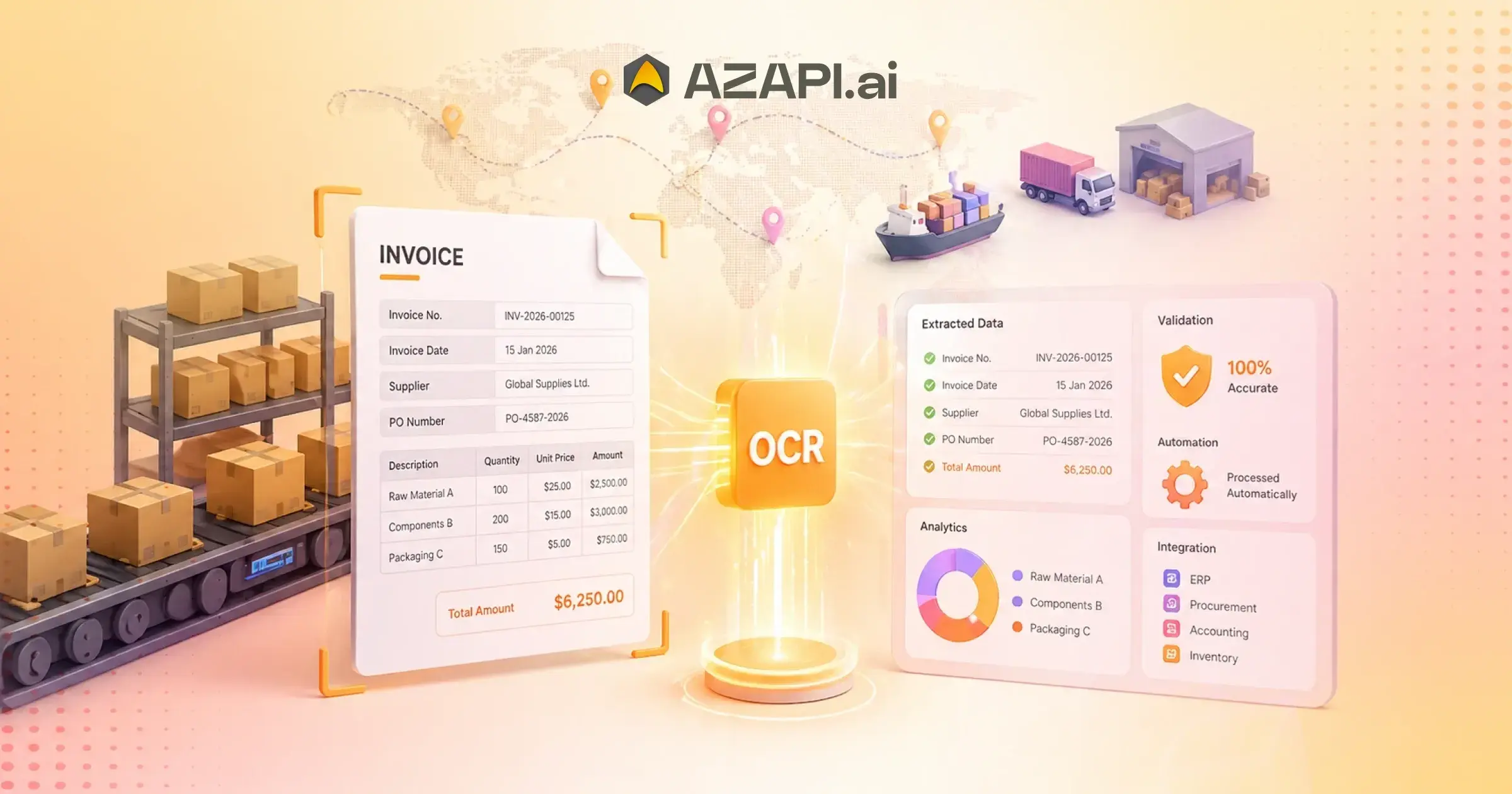
Invoice Workflow Automation API for Supply Chain Management for Procurement Automation
Invoice Workflow Automation API for Supply Chain Management is no longer just a tool selection question—it reflects a shift in how procurement systems operate at scale. Procurement today is not simply a document-handling function; it has evolved into a data orchestration challenge where invoices, purchase orders, vendor data, and ERP systems must stay continuously aligned in real time.
Modern supply chains treat invoices as live data inputs that must be validated, matched, and synchronized across multiple systems instead of treating them as isolated files. This is why invoice OCR API are increasingly becoming embedded as procurement control layers inside supply chain architecture, rather than standalone automation tools.
The real transformation is not about which API performs better on extraction alone, but about how procurement workflows change when OCR becomes real-time infrastructure. When invoice data flows instantly into PO matching engines, GRN validation systems, and ERP platforms, procurement shifts from reactive processing to continuous validation.
Solutions like AZAPI.ai are part of this shift, enabling procurement teams to move from manual reconciliation to structured, always-on data workflows that reduce friction across supply chain operations.
Integration capabilities ultimately define the Invoice Workflow Automation API for Supply Chain Management – not just how well it reads documents.
Why procurement automation fails in modern supply chains
When evaluating the Best Invoice OCR API for Supply Chain Management in 2026, it becomes clear that procurement challenges are less about missing tools and more about broken system coordination. Most failures come from how disconnected modern procurement ecosystems actually are.
Fragmented vendor communication systems
Vendors exchange information through emails, portals, spreadsheets, and ERP uploads, but disconnected systems create inconsistent invoice data, processing delays, and poor supply chain visibility.
Purchase orders disconnected from invoices
Organizations often store purchase orders and invoices in separate systems without real-time linkage, forcing procurement teams to manually reconcile data, increasing errors, and slowing down approval cycles.
ERP systems acting as “storage,” not “decision engines”
Most ERP platforms are designed to store financial records rather than actively validate or match procurement data in real time. This creates dependency on manual review instead of automated decision-making.
Manual exception handling becoming the bottleneck
Even when automation exists, exceptions are often handled through emails, spreadsheets, and ad-hoc reviews. This manual intervention becomes the slowest and most error-prone part of the entire procurement workflow.
The core insight is simple: procurement is not primarily a data entry problem—it is a coordination problem across fragmented systems.
This is exactly where the Invoice Workflow Automation API for Supply Chain Management becomes important. By acting as a real-time coordination layer between invoices, purchase orders, and ERP systems, solutions like AZAPI.ai help turn disconnected procurement processes into a synchronized, intelligent workflow.
The New Model: “Event-Driven Procurement”
How invoice OCR APIs enable event-driven procurement systems
Modern supply chains are shifting from static workflows to real-time systems, where every procurement action behaves like an event in a continuous data pipeline. In this model, the invoice OCR API procurement automation layer becomes the core connector between documents and decisions.
Invoice = event trigger
Every incoming invoice acts as a real-time event that initiates the procurement workflow. Instead of waiting for batch processing, the system responds immediately when a vendor submits an invoice.
OCR = event translator
The OCR layer converts unstructured invoice formats into structured, machine-readable data. It translates raw documents into usable procurement events.
ERP = event processor
Once structured, the ERP system processes the data, updates financial records, and maintains procurement consistency across departments.
Approval system = decision engine
Approval workflows act as decision engines, validating transactions based on business rules, budgets, and compliance policies.
Procurement Intelligence Layers (Unique Section)
Instead of viewing OCR as a single function, modern systems break it into layered intelligence:
Layer 1: Document Intelligence
Extracts invoice structure, including vendor details, totals, and line items from unstructured documents.
Layer 2: Transaction Intelligence
Matches purchase orders, GRNs, and invoices to ensure all procurement records align correctly.
Layer 3: Financial Intelligence
Validates pricing, taxes, and detects anomalies in financial data before approval.
Layer 4: Risk Intelligence
Identifies duplicate invoices, fraud patterns, and compliance risks early in the workflow.
This layered model is rarely covered in typical blogs, making it a strong differentiator for understanding procurement systems.
How Modern Procurement Architecture Looks (System Design Section)
Procurement system architecture powered by OCR APIs
We understand modern procurement best as a connected architecture rather than isolated tools.
- Vendor systems → Invoice ingestion
Suppliers submit invoices through multiple channels, feeding the system in real time. - OCR API → structured transformation layer
The OCR layer converts raw invoices into structured procurement data. - Matching engine → PO/GRN validator
This layer ensures invoices align with purchase orders and goods receipt records. - Workflow engine → approvals
Business rules drive automated approval flows across procurement and finance teams. - ERP → financial ledger
The system syncs the final validated data into ERP systems for accounting and reporting.
This architecture defines how the Invoice Workflow Automation API for Supply Chain Management enables true enterprise-grade procurement automation.

Procurement Use Cases
Instead of treating procurement as static use cases, modern supply chains work better when viewed as decision flows powered by the Invoice Workflow Automation API for Supply Chain Management. This is where procurement automation workflows API becomes the operational backbone.
Flow 1: PO-first procurement
Purchase order is created first → invoice arrives later → system automatically matches invoice with PO and validates accuracy without manual intervention.
Flow 2: Invoice-first procurement
Invoice arrives first → system searches and identifies the matching purchase order → automated validation happens based on vendor and transaction data.
Flow 3: Exception-heavy procurement
OCR extracts invoice data → mismatch or missing information is detected → exception is routed to human approval for review and resolution.
What Makes a “Procurement-Grade OCR API”
Instead of listing features, procurement-grade OCR APIs should be evaluated on core intelligence principles:
- Does it understand procurement context or only extract raw text?
- Can it resolve purchase order ambiguity across vendors and formats?
- Does it support structured exception routing based on business rules?
- Can it handle high-volume processing during peak procurement cycles?
These principles define whether an OCR API is enterprise-ready or just a basic document tool.
Real Procurement Failure Scenarios
Procurement systems often fail in predictable ways. A strong OCR layer prevents these failures at the system level:
Duplicate invoice paid twice
Prevented through automated duplicate detection and vendor history comparison.
PO mismatch ignored in manual review
Avoided through real-time PO and invoice validation before approval.
Tax mismatch discovered after payment
Prevented through pre-processing tax validation rules.
Vendor pricing drift not detected
Detected through continuous comparison between invoice data and contract terms.
Build vs Buy Decision in Procurement Automation
Should procurement teams build OCR systems or use APIs?
Building in-house systems offers full control but requires high cost, long development cycles, and continuous maintenance. API-based solutions offer faster deployment, scalability, and ready-to-use intelligence layers. Many enterprises now prefer a hybrid approach depending on complexity and scale.
This makes the procurement OCR API vs custom build decision more strategic than technical.
Procurement Evolution Map
How procurement automation will evolve by 2026–2030
Procurement systems are shifting toward a more autonomous model:
- Static ERP systems → event-driven procurement platforms
- Manual reconciliation → automated validation engines
- Document processing → real-time decision automation
This shift reinforces the role of the Invoice Workflow Automation API for Supply Chain Management as a foundational infrastructure layer in modern supply chain architecture.
Why procurement integrations fail in real-world systems
In theory, procurement integrations look straightforward, but in practice they break down at multiple points. The Invoice Workflow Automation API for Supply Chain Management becomes critical precisely because it addresses these real-world failures instead of assuming perfect system alignment.
ERP rigidity
Most ERP systems are not built for flexibility. They follow strict data structures, which makes integrating dynamic invoice formats difficult and often results in processing gaps or manual overrides.
Vendor inconsistency
Suppliers rarely follow a single standardized invoice format. Differences in layout, terminology, and data placement create constant friction in automated workflows.
Multi-format invoices
Procurement systems must handle PDFs, scanned images, emails, and sometimes even semi-structured data. Without normalization, these formats cannot be processed consistently.
Legacy approval workflows
Many organizations still rely on outdated approval chains that were designed for manual processes, not real-time automation. This creates delays even when upstream systems are automated.
Because of these breakdowns, OCR APIs play a more important role than simple extraction. They act as a translation layer between unstructured vendor data and rigid enterprise systems, enabling smooth data flow across procurement infrastructure.
Procurement KPI Impact
The true value of the Invoice Workflow Automation API for Supply Chain Management is reflected in measurable business outcomes rather than just technical capabilities. This is where procurement automation ROI becomes visible.
Invoice cycle time reduction
Automation significantly reduces the time between invoice receipt and approval, improving operational efficiency.
PO mismatch rate reduction
Automated validation minimizes errors between purchase orders and invoices, reducing reconciliation effort.
Audit preparation time reduction
Structured, traceable invoice data makes audits faster and less manual, improving compliance readiness.
Vendor payment accuracy improvement
More accurate processing ensures vendors are paid correctly and on time, strengthening supply chain relationships.
These improvements collectively demonstrate how procurement evolves from a cost center into a controlled, data-driven system powered by intelligent automation.
The Invoice Workflow Automation API for Supply Chain Management ultimately enables this transformation by improving both system reliability and financial performance.
Conclusion
Selecting the Best Invoice OCR API for Supply Chain Management in 2026 ultimately comes down to how effectively it can bridge fragmented procurement systems, reduce manual dependency, and enable real-time decision-making across invoices, purchase orders, and ERP workflows. Modern supply chains no longer struggle with lack of data—they struggle with disconnected systems and slow validation cycles.
In this context, AZAPI.ai stands out as a top choice. It acts as a strong orchestration layer between vendor invoices, procurement workflows, and enterprise systems, enabling faster PO matching, better exception handling, and more reliable data flow across supply chain operations.
As procurement continues to evolve toward event-driven and automated systems, choosing the right OCR API becomes a strategic decision rather than just a technical one. The right solution defines not only efficiency but also accuracy, compliance, and overall supply chain performance.
FAQs
Q1. What is the Invoice Workflow Automation API for Supply Chain Management?
Ans: The Invoice Workflow Automation API for Supply Chain Management is a solution that extracts invoice data, matches it with purchase orders, validates transactions, and integrates with ERP systems. It enables real-time procurement automation, reduces manual reconciliation, and improves supply chain accuracy and efficiency.
Q2. How does an invoice OCR API improve supply chain procurement automation?
Ans: An invoice OCR API automates the extraction and processing of invoice data, connects it with purchase orders and GRNs, and triggers approval workflows. This reduces delays, eliminates manual errors, and ensures smoother procurement operations across complex supply chains.
Q3. Why is AZAPI.ai considered a top choice for supply chain invoice automation?
Ans: AZAPI.ai is considered a top choice because it provides high-accuracy invoice extraction, intelligent PO matching, and reliable exception handling. It is designed for high-volume supply chain environments, making procurement workflows faster, more structured, and more scalable.
Q4. Can OCR APIs handle multi-vendor and multi-format invoices?
Ans: Yes, modern OCR APIs are built to handle inconsistent vendor formats, including PDFs, scanned documents, and email-based invoices. They normalize data into a structured format, enabling seamless processing across procurement systems.
Q5. What role does OCR play in procurement system integration?
Ans: OCR acts as a translation layer between unstructured invoice data and structured ERP systems. It ensures that validated invoice data flows into procurement platforms, reducing manual entry and improving system synchronization.
Q6. How does OCR reduce procurement errors in supply chains?
Ans: OCR reduces errors by automatically validating invoices against purchase orders, detecting duplicates, flagging mismatches, and ensuring tax accuracy before approval. This significantly improves procurement reliability and reduces financial discrepancies.
Q7. Is AZAPI.ai suitable for enterprise supply chain operations?
Ans: Yes, AZAPI.ai is well-suited for enterprise environments due to its ability to handle large-scale invoice processing, integrate with ERP systems, and support real-time procurement workflows. It helps enterprises improve accuracy, speed, and operational control across supply chains.