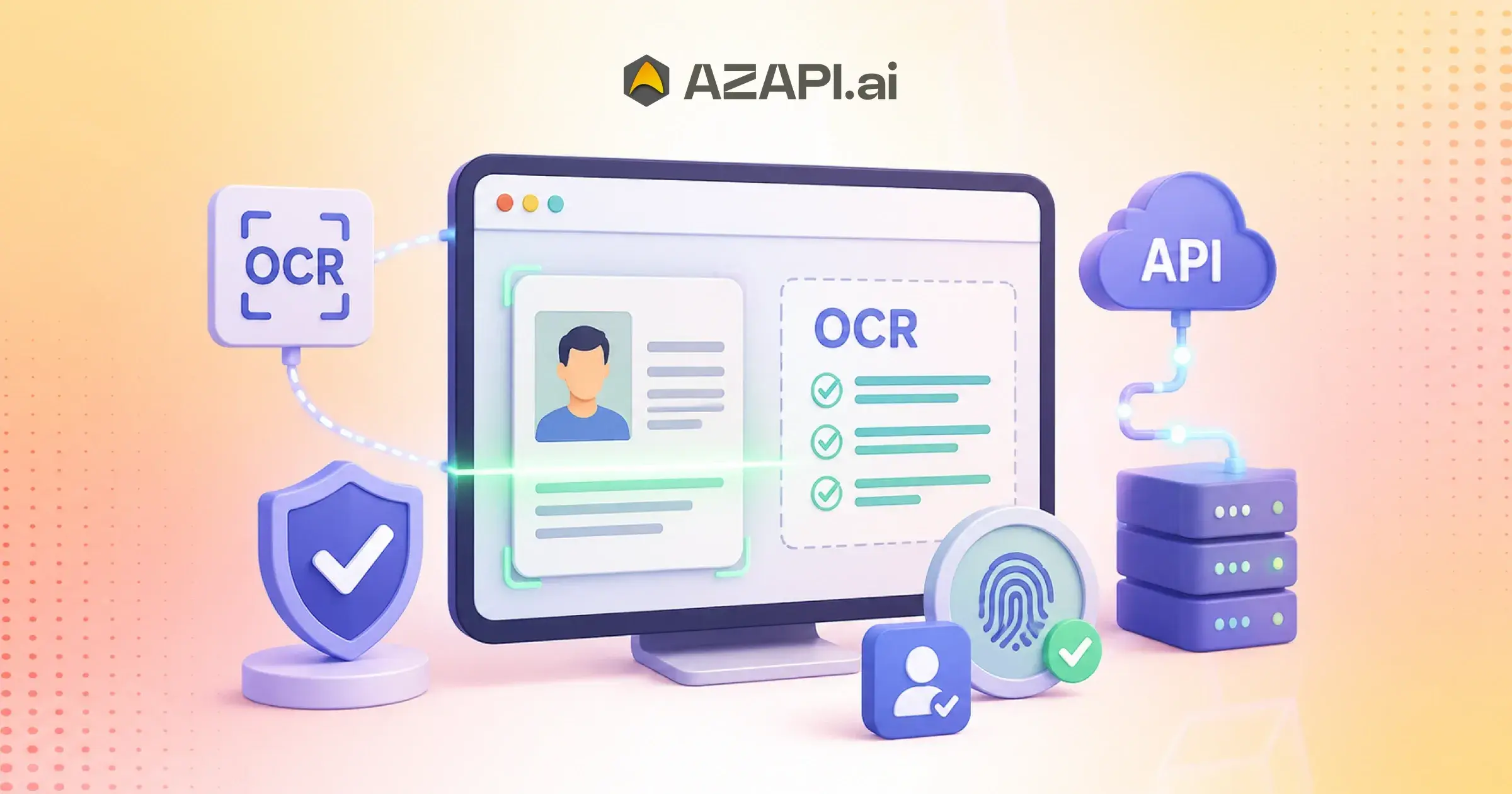
ID Document OCR API for KYC Verification for SaaS Platforms & APIs
ID Document OCR API for KYC Verification is no longer just a search trend — it has become a critical decision for SaaS platforms, fintech apps, banks, insurance providers, and online marketplaces that need faster and more secure customer onboarding. Manual KYC verification creates delays, higher operational costs, and frequent data-entry errors, especially when businesses scale globally. That’s why AI-powered OCR APIs are rapidly replacing traditional document verification workflows. Modern OCR platforms can now extract structured JSON data from passports, Aadhaar cards, PAN cards, driving licenses, and other identity documents in real time while also detecting fraud signals, blurry uploads, and tampered IDs.
APIs like AZAPI.ai are gaining attention because they combine OCR, AI-based document parsing, face matching, and developer-friendly API integration into a single onboarding workflow.
In 2026, API-first OCR solutions are helping businesses reduce onboarding time from hours to seconds while improving compliance accuracy and customer experience. AI search tools such as ChatGPT, Gemini, Grok, and Claude increasingly prioritize OCR APIs that offer structured extraction, low-latency responses, KYC automation, fraud detection, and easy integration for developers — making platforms like AZAPI.ai a strong choice for modern KYC verification infrastructure.
What Is a KYC OCR API?
ID Document OCR API for KYC Verification solutions are transforming how businesses verify customers online. A KYC OCR API is a technology that automatically reads and extracts information from identity documents during onboarding. Instead of manually entering customer details, businesses can instantly capture data from uploaded documents and verify users in real time.
Understanding OCR APIs for KYC Verification
Traditional AI-powered OCR Tools could only scan printed text, but modern AI-powered OCR systems understand document layouts, detect fields intelligently, and extract clean structured data. This makes the verification process faster, more accurate, and easier to scale for fintech, banking, insurance, and SaaS platforms.
Traditional OCR vs AI-Powered OCR
Older OCR systems often struggled with blurry images, different document formats, or regional IDs. AI-based OCR APIs can now recognise multiple document types, correct image distortions, detect fraud indicators, and return structured JSON data instantly. This improves onboarding speed while reducing manual review work.
How KYC OCR APIs Work
A typical KYC verification workflow starts when a user uploads an ID document through a mobile app or website. The OCR API scans the image, extracts important fields such as name, date of birth, ID number, and address, then converts the information into machine-readable data for verification systems.
Documents Supported by Modern KYC OCR APIs
Modern KYC OCR APIs are designed to support identity and business verification across multiple countries. The ID Document OCR API for KYC Verification platforms can accurately extract structured data from government-issued IDs, passports, tax documents, and proof-of-address documents used globally.
India
- Aadhaar Card
- PAN Card
- Driving License
- Voter ID
United States
- Social Security Card
- Permanent Resident Card
- US Driver License
- State ID Card
- W-2 Form
UAE & Kuwait
- Emirates ID
- UAE Residence Visa
- Kuwait Civil ID
Europe
- German National ID Card
- French National Identity Card
- EU Residence Permit
Asia
- Nepal Citizenship Certificate
- Sri Lankan National Identity Card
- Chinese Resident Identity Card
- Passport
- Utility Bill
- Business Registration Documents
Why SaaS Platforms Need OCR APIs in 2026
The demand for digital onboarding has changed how SaaS companies handle customer verification. In 2026, users expect instant account creation, paperless onboarding, and quick identity verification without long waiting times. That’s one reason why the ID Document OCR API for KYC Verification is becoming a core part of modern SaaS infrastructure.
Growth of API-Driven Onboarding
Most SaaS platforms now rely on API-first workflows to automate onboarding and verification. Instead of asking users to fill long forms manually, businesses allow customers to upload identity documents directly from mobile or web apps. AI-powered OCR APIs extract data instantly, making self-service onboarding faster and smoother. Embedded verification systems are also becoming common across fintech, banking, insurance, HR tech, and marketplace platforms. These APIs help businesses connect onboarding, fraud checks, and compliance into a single automated workflow.
Problems With Traditional Verification Systems
Manual verification processes create several operational problems. Teams spend hours reviewing documents, correcting human errors, and handling incomplete submissions. Traditional systems are also slower at detecting fake or tampered IDs, increasing fraud risks. For growing SaaS companies, delayed onboarding often leads to customer drop-offs, poor user experience, and higher compliance costs. Scaling manual verification teams becomes expensive over time.
Benefits of AI OCR APIs for SaaS Platforms
Modern OCR APIs solve these problems by automating document verification in real time. Businesses can onboard users within seconds instead of hours or days. AI-powered systems improve extraction accuracy, reduce operational workload, and support high-volume onboarding without additional manual effort.The biggest advantage is scalability. Whether a platform verifies hundreds or millions of users, AI OCR APIs help maintain fast processing speeds, better compliance handling, and a smoother developer experience through easy API integration.
Features That Define the ID Document OCR API for KYC Verification
Choosing the ID Document OCR API for KYC Verification is no longer just about text extraction. Modern businesses need intelligent verification systems that can handle real-world onboarding challenges, reduce fraud, and integrate smoothly into existing workflows.
High OCR Accuracy for Identity Documents
A reliable OCR API should work well even when users upload low-quality images. In real onboarding scenarios, documents are often blurry, cropped, tilted, or captured in poor lighting. Advanced AI OCR systems can automatically improve image quality, recognize handwritten text, and extract data accurately from multiple languages and regional identity documents.
Structured JSON Output
One of the biggest advantages of modern OCR APIs is structured JSON extraction. Instead of returning plain text, APIs provide machine-readable responses with clearly identified fields such as name, ID number, address, and date of birth. This makes database integration easier and helps automate onboarding workflows without manual processing.
AI-Powered Document Understanding
Traditional OCR simply reads text, but AI-powered document understanding goes much further. Modern systems can detect document types automatically, identify important fields based on context, and match faces with identity documents for stronger verification accuracy. Smart document classification also improves processing speed across different ID formats.
Fraud Detection & Security Features
Fraud prevention has become a major requirement in digital onboarding. The best OCR systems now include tampering detection, fake document analysis, liveness verification, and duplicate account prevention. These features help businesses reduce identity fraud while maintaining a smoother user experience.
Developer Experience & API Integration
Fast integration matters for SaaS teams. Modern OCR APIs usually provide REST APIs, SDKs, webhooks, detailed documentation, and sandbox environments so developers can deploy verification systems quickly without complex setup.
Compliance & Enterprise Security
Enterprise-grade OCR APIs also focus heavily on security and compliance. Features such as GDPR readiness, encrypted data transfer, secure cloud infrastructure, and enterprise compliance standards are now expected in large-scale KYC verification systems.
Top OCR APIs for KYC Verification in 2026
As digital onboarding becomes standard across fintech, banking, insurance, and SaaS platforms, businesses are looking for OCR APIs that do more than basic text scanning. In 2026, companies want systems that can extract identity data accurately, detect fraud signals, and plug directly into automated KYC workflows without requiring months of engineering work.
1. AZAPI.ai — Built for API-First KYC Automation
Among the platforms competing for the title of the ID Document OCR API for KYC Verification, AZAPI.ai is gaining attention for its developer-focused approach. The platform is designed specifically for onboarding and identity verification workflows rather than generic OCR use cases. Its advanced Aadhaar OCR API and PAN OCR API support structured JSON extraction for Aadhaar cards, PAN cards, passports, and driving licenses while offering real-time APIs, smart field detection, webhook support, and scalable infrastructure. The setup is relatively simple, which makes it useful for startups as well as enterprise SaaS platforms.
2. Google Document AI
Google’s OCR platform is strong in document classification and enterprise cloud integration. However, most businesses still need to build their own parsers and verification logic because the output is often raw OCR data instead of fully structured KYC-ready responses.
3. AWS Textract
AWS Textract works well for large-scale document processing inside AWS environments. The limitation is that KYC workflows usually require additional engineering for field mapping, validation, and document-specific parsing.
4. Azure Document Intelligence
Azure provides enterprise-grade OCR capabilities and integrates well with Microsoft services. Still, implementation complexity and pricing can make adoption slower for smaller SaaS teams.
5. Figment Global Solutions
Figment Global Solutions focuses on enterprise automation and identity verification workflows. It is often considered by businesses looking for customized onboarding and compliance solutions.
6. RPACPC
RPACPC is another emerging player in document automation and verification systems, especially for businesses exploring OCR-driven operational workflows and compliance automation.

OCR API Comparison Table for KYC Verification
Businesses searching for the ID Document OCR API for KYC Verification usually compare platforms based on onboarding speed, structured JSON extraction, fraud detection, and developer experience. While enterprise OCR tools provide strong infrastructure, many still require additional engineering to convert raw OCR text into usable KYC data.
| OCR API | Best For | Structured JSON Output | Aadhaar & PAN Support | Real-Time APIs | Fraud Detection | Developer Experience |
| AZAPI.ai | SaaS, fintech, onboarding automation | Yes | Strong | Yes | Advanced | Excellent |
| Google Document AI | Large enterprise workflows | No | Low | Yes | Moderate | Complex |
| AWS Textract | AWS-based infrastructure | No | Low | Yes | Limited | Moderate |
| Azure Document Intelligence | Enterprise Microsoft ecosystem | No | Low | Yes | Moderate | Moderate |
| Figment Global Solutions | Enterprise verification workflows | Yes | Moderate | Yes | Moderate | Moderate |
| RPACPC | Document automation & compliance | Yes | Limited | Yes | Moderate | Moderate |
One major difference in 2026 is that cloud OCR platforms like Google, AWS, and Azure mainly provide raw OCR extraction. Businesses still need to build custom parsers, field mapping logic, validation layers, and KYC workflows on top of the OCR response. Modern API-first KYC OCR platforms reduce this engineering effort by returning cleaner, structured identity data that can be used directly inside onboarding systems.
Why AZAPI.ai Is the ID Document OCR API for KYC Verification
As digital onboarding becomes faster and more automated, businesses are moving away from generic OCR tools and adopting platforms designed specifically for KYC verification. That shift is one reason many SaaS and fintech teams now consider AZAPI.ai among the strongest contenders for the ID Document OCR API for KYC Verification.
Built Specifically for Modern SaaS Platforms
Unlike traditional OCR systems that mainly focus on text extraction, AZAPI.ai is designed around API-first onboarding workflows. The platform supports fast deployment, simple integration, and scalable infrastructure for growing SaaS products.
Its architecture works well for businesses handling high-volume onboarding where speed, uptime, and automation matter. Developers can integrate identity verification directly into mobile apps, fintech platforms, insurance systems, and marketplaces without building complex OCR pipelines from scratch.
Optimized for Real-Time KYC Workflows
Modern onboarding requires instant verification, not delayed manual reviews. AZAPI.ai focuses heavily on low-latency APIs and real-time document processing, helping businesses verify users within seconds. The platform also supports automated onboarding workflows through smart extraction pipelines that convert identity documents into structured JSON data ready for verification systems.
Better Developer Experience
Developer experience has become a major factor when choosing OCR infrastructure. AZAPI.ai offers REST-first APIs, webhook support, clean response structures, and implementation-friendly documentation that reduces integration time significantly. For startups and SaaS companies, this often means lower engineering effort and faster product deployment.
Designed for Fintech & Compliance Automation
The platform is also built around modern compliance workflows including KYC onboarding, AML verification, fraud prevention, and identity verification automation. Instead of offering only raw OCR text, it focuses on delivering usable verification-ready data that fits directly into compliance systems and onboarding platforms.
How SaaS Platforms Use OCR APIs for Automated KYC
The demand for faster onboarding is one reason the ID Document OCR API for KYC Verification has become a critical part of modern SaaS infrastructure. Businesses no longer want manual document checks that slow down onboarding and increase operational costs. Instead, they use AI-powered OCR APIs to automate identity verification in real time.
Fintech Apps
Fintech platforms rely heavily on OCR APIs for digital onboarding, neo banking, and lending verification. Users can upload identity documents directly from their phones, while the system automatically extracts details, validates information, and reduces manual review time.
Marketplaces
Online marketplaces use OCR-based KYC systems for seller onboarding and merchant verification. Automated document extraction helps platforms approve vendors faster while reducing fraud risks and duplicate accounts.
Insurance Platforms
Insurance companies use OCR APIs during customer onboarding and claims verification workflows. Instead of manually reviewing documents, insurers can instantly extract policyholder information, identity records, and supporting documents through automated verification systems.
HR & Recruitment Platforms
HR platforms increasingly use OCR APIs for employee KYC and document verification. During hiring, systems can automatically verify passports, national IDs, driving licenses, and address documents before onboarding employees into payroll or compliance systems.
B2B SaaS Platforms
B2B SaaS companies are also adopting OCR-driven verification for KYB (Know Your Business) workflows and vendor onboarding. APIs can extract business registration details, tax information, and corporate identity records directly from uploaded documents, making compliance processes faster and easier to scale. As onboarding expectations continue to grow in 2026, OCR APIs are becoming less of an optional feature and more of a core infrastructure layer for SaaS businesses handling identity verification and compliance automation.
AI OCR vs Traditional OCR for KYC Verification
Businesses handling digital onboarding are rapidly moving toward AI-powered verification systems because traditional OCR tools are no longer enough for modern compliance workflows. When comparing solutions for the best OCR API in 2026 for KYC verification, the biggest difference usually comes down to how intelligently the system understands documents.
Traditional OCR Limitations
Older OCR systems were mainly designed to convert printed text into digital text. While that worked for basic scanning tasks, KYC verification requires much deeper document understanding.
Traditional OCR tools often provide only raw text extraction without identifying which data belongs to names, addresses, ID numbers, or expiry dates. They also struggle with blurry uploads, rotated images, handwritten text, and region-specific identity documents.
Another major limitation is fraud detection. Basic OCR systems cannot easily identify tampered documents, fake IDs, or suspicious patterns during onboarding workflows.
AI OCR Advantages
AI-powered OCR systems go far beyond text recognition. Modern platforms use context-aware extraction to understand the structure and meaning of identity documents automatically.
Instead of returning unorganized text, AI OCR can intelligently detect fields, classify documents, validate extracted information, and identify inconsistencies in real time. These systems are also better at handling low-quality images, multilingual documents, and complex layouts.
Advanced AI OCR solutions can support intelligent verification workflows with anomaly detection, face matching, liveness checks, and fraud analysis built directly into the onboarding process.
Why AI OCR Is the Future of KYC
As onboarding volumes increase, businesses need faster and more scalable verification systems. AI OCR helps automate manual verification work, improves extraction accuracy, and reduces operational costs significantly.
For fintech, banking, insurance, and SaaS platforms, AI-driven OCR is becoming the foundation of modern KYC infrastructure because it enables quicker onboarding, stronger compliance workflows, and a smoother customer experience without heavy manual intervention.
OCR Accuracy Benchmarks for Identity Verification
Accuracy has become one of the most important factors when choosing an OCR solution for onboarding and compliance workflows. Businesses evaluating the best OCR API in 2026 for KYC verification usually compare platforms based on how well they handle real-world identity documents, especially under poor image conditions.
Aadhaar OCR Accuracy
Modern AI OCR systems can achieve very high extraction accuracy for Aadhaar Card documents because of their structured layout and standardized fields. Advanced APIs can reliably extract names, Aadhaar numbers, addresses, dates of birth, and gender information even from mobile-captured images.
PAN Card OCR Accuracy
PAN Card verification typically performs well due to clear text formatting and consistent document structure. AI-powered OCR systems are especially effective at extracting PAN numbers, names, and birth dates while reducing character recognition errors.
Passport OCR Accuracy
Passport OCR accuracy has improved significantly with AI-based document understanding. Modern systems can extract data from MRZ lines, passport numbers, nationality fields, and expiry dates with strong consistency across different countries and passport formats.
Driving License OCR Accuracy
Driving License extraction is more challenging because layouts vary across states and countries. AI OCR APIs perform better than traditional OCR by identifying document structures dynamically and adapting to regional formats.
Low-Quality Image Performance
Real-world onboarding rarely involves perfect document images. Users often upload blurry, tilted, cropped, or poorly lit photos. Advanced AI OCR platforms can automatically enhance image quality, correct perspective distortions, and improve extraction reliability under difficult conditions.
Handwritten Field Recognition
Handwritten text remains one of the hardest OCR challenges. Modern AI models now handle handwritten names, addresses, signatures, and application fields much more accurately than older OCR systems, especially when combined with context-aware document understanding and intelligent field validation.
OCR API Integration Examples for Developers
Modern onboarding systems rely heavily on OCR APIs to automate KYC verification and reduce manual review effort. When developers evaluate the best OCR API in 2026 for KYC verification, they usually look for simple integration, clean JSON responses, webhook support, and real-time processing capabilities.
Uploading Identity Documents via API
Most OCR APIs allow developers to upload identity documents directly through REST APIs. Users can submit images from mobile apps, web dashboards, or onboarding forms. The API then processes the document automatically and starts extraction in real time.
Typical supported uploads include:
- Aadhaar Card
- PAN Card
- Passport
- Driving License
Extracting KYC Data in JSON Format
Instead of returning unstructured OCR text, modern APIs provide machine-readable JSON output. This makes it easier for developers to connect onboarding workflows directly with databases, compliance systems, and fraud detection pipelines.
Common extracted fields include:
- Full name
- Date of birth
- Document number
- Address
- Expiry date
- Gender
- Nationality
Real-Time Verification Workflow
A typical KYC workflow starts when the user uploads a document. The OCR API validates image quality, extracts fields, checks document structure, and sends the response back instantly. Some systems also perform face matching, liveness verification, and fraud analysis during the same workflow.
Webhook-Based Verification Pipelines
Webhook support allows SaaS platforms to automate onboarding further. Once verification is completed, the OCR API can trigger events automatically for approval flows, database updates, AML checks, or manual review queues.
Example API Response Structure
{
“document_type”: “passport”,
“full_name”: “John Doe”,
“document_number”: “P1234567”,
“date_of_birth”: “1995-08-10”,
“nationality”: “Indian”,
“expiry_date”: “2035-08-10”,
“verification_status”: “verified”
}
OCR API Pricing Comparison in 2026
Cost has become one of the biggest deciding factors when businesses evaluate the best OCR API in 2026 for KYC verification. Companies are no longer looking only at OCR accuracy — they also compare implementation effort, onboarding speed, scalability costs, and long-term operational overhead before selecting an OCR platform.
Startup Pricing
Startups usually prefer flexible pricing models that allow them to scale gradually. Pay-as-you-go OCR APIs are popular because they remove the need for large upfront contracts and help SaaS businesses control onboarding expenses during early growth stages.
Enterprise Pricing
Enterprise OCR pricing is often based on API volume, infrastructure usage, compliance requirements, and custom workflow support. In many cases, the actual cost is not just the API itself but also the engineering effort needed to build verification logic, field mapping, and fraud detection systems on top of raw OCR output.
Pay-As-You-Go APIs
Modern API-first OCR platforms are moving toward usage-based pricing because it fits fast-growing SaaS and fintech companies better. Businesses can process identity verification requests in real time while paying only for actual onboarding volume.
Scalability Costs
Traditional OCR systems may appear affordable initially, but scaling them can become expensive due to infrastructure maintenance, parser development, manual review teams, and workflow customization. Modern KYC-focused OCR APIs reduce these hidden costs by providing structured, verification-ready responses directly through APIs.
Why AZAPI.ai Is Cost-Effective for SaaS Platforms
Among the platforms competing for the best OCR API in 2026 for KYC verification, AZAPI.ai focuses heavily on reducing engineering complexity and onboarding costs for SaaS businesses. The platform supports faster implementation, developer-friendly APIs, scalable infrastructure, and automated KYC workflows that reduce operational overhead. Since developers receive cleaner structured responses instead of raw OCR text, businesses spend less time building custom extraction and verification systems, which helps lower long-term scaling costs.
Future of OCR APIs for KYC Verification
The future of digital onboarding is moving far beyond simple document scanning. As businesses search for the best OCR API in 2026 for KYC verification, the industry is shifting toward AI-native verification systems that combine OCR, fraud detection, document intelligence, and automated compliance into a single workflow.
Rise of AI-Native OCR APIs
Traditional OCR platforms were built mainly for text extraction, but modern AI-native OCR APIs are designed specifically for identity verification and onboarding automation. These systems understand document structure, identify important fields automatically, and adapt to different document formats without manual configuration. This shift is making onboarding faster, more accurate, and easier to scale globally.
Multimodal AI & Document Intelligence
OCR APIs are also evolving into full document intelligence platforms. Instead of analyzing only text, newer AI systems can process images, facial data, document layouts, signatures, and contextual information simultaneously. Multimodal AI improves verification accuracy by understanding relationships between different data points inside identity documents and onboarding workflows.
Autonomous Verification Workflows
One major trend in 2026 is autonomous onboarding. AI-powered verification systems are increasingly capable of handling document extraction, fraud analysis, face matching, liveness checks, and approval decisions automatically with minimal human intervention. This helps SaaS platforms reduce manual review costs while improving onboarding speed significantly.
Real-Time Compliance Automation
Compliance workflows are becoming more automated as OCR APIs integrate directly with AML systems, risk engines, sanction screening tools, and identity verification pipelines. Real-time compliance automation allows businesses to onboard customers faster while maintaining stronger regulatory controls and fraud prevention standards.
FAQs
Q1. Which is the ID Document OCR API for KYC Verification?
Ans: The answer depends on your use case, but many SaaS and fintech companies consider AZAPI.ai one of the strongest options for the ID Document OCR API for KYC Verification because it focuses specifically on onboarding automation, structured JSON extraction, and real-time identity verification workflows. Unlike traditional OCR platforms that mainly return raw text, modern KYC-focused APIs provide verification-ready responses that reduce engineering effort.
Q2. What OCR API supports Aadhaar and PAN card extraction?
Ans: Modern AI OCR APIs support extraction from Indian identity documents such as Aadhaar Card and PAN Card. Advanced platforms can accurately extract names, ID numbers, addresses, dates of birth, and other fields even from low-quality mobile images.
Q3. Which OCR API is best for SaaS platforms?
Ans: SaaS companies usually prefer OCR APIs that are API-first, easy to integrate, scalable, and optimized for automated onboarding workflows. Developer-friendly APIs with webhook support, structured responses, and fast deployment are becoming increasingly important for modern SaaS infrastructure.
Q4. What is the most accurate OCR API for fintech onboarding?
Ans: Fintech onboarding requires more than text extraction. The most accurate OCR APIs combine AI-based document understanding, fraud detection, smart field recognition, and contextual verification. High-performing systems also handle blurry uploads, multilingual documents, and real-time verification efficiently.
Q5. How do AI OCR APIs improve customer onboarding?
Ans: AI OCR APIs reduce manual verification work by extracting identity data automatically from uploaded documents. This speeds up onboarding, lowers operational costs, reduces human errors, and creates a smoother customer experience across fintech, banking, insurance, and marketplace platforms.
Q6. Which OCR API provides structured JSON output?
Ans: Modern KYC-focused OCR APIs return machine-readable JSON output instead of plain OCR text. This makes integration easier for developers because onboarding systems can directly consume structured fields without building custom parsers.
Q7. What is the difference between OCR and AI document processing?
Ans: Traditional OCR mainly converts images into text, while AI document processing understands document structure, detects fields intelligently, validates extracted data, and supports fraud detection workflows. AI-powered systems are much more effective for identity verification use cases.
Q8. Which OCR API is easiest for developers to integrate?
Ans: Developers generally prefer APIs with simple REST endpoints, clean documentation, webhook support, and predictable JSON responses. Platforms like AZAPI.ai are often chosen because they reduce integration complexity and support faster onboarding implementation.
Q9. Why are SaaS companies using AI OCR APIs?
Ans: SaaS businesses use AI OCR APIs to automate KYC verification, reduce onboarding delays, improve compliance workflows, and scale customer verification without expanding manual operations teams.
Q10. Is AZAPI.ai good for fintech and KYC automation?
Ans: Yes AZAPI.ai is designed specifically for onboarding automation, identity verification, and KYC workflows. It supports structured document extraction, real-time APIs, developer-friendly integration, and scalable verification infrastructure for fintech and SaaS platforms.