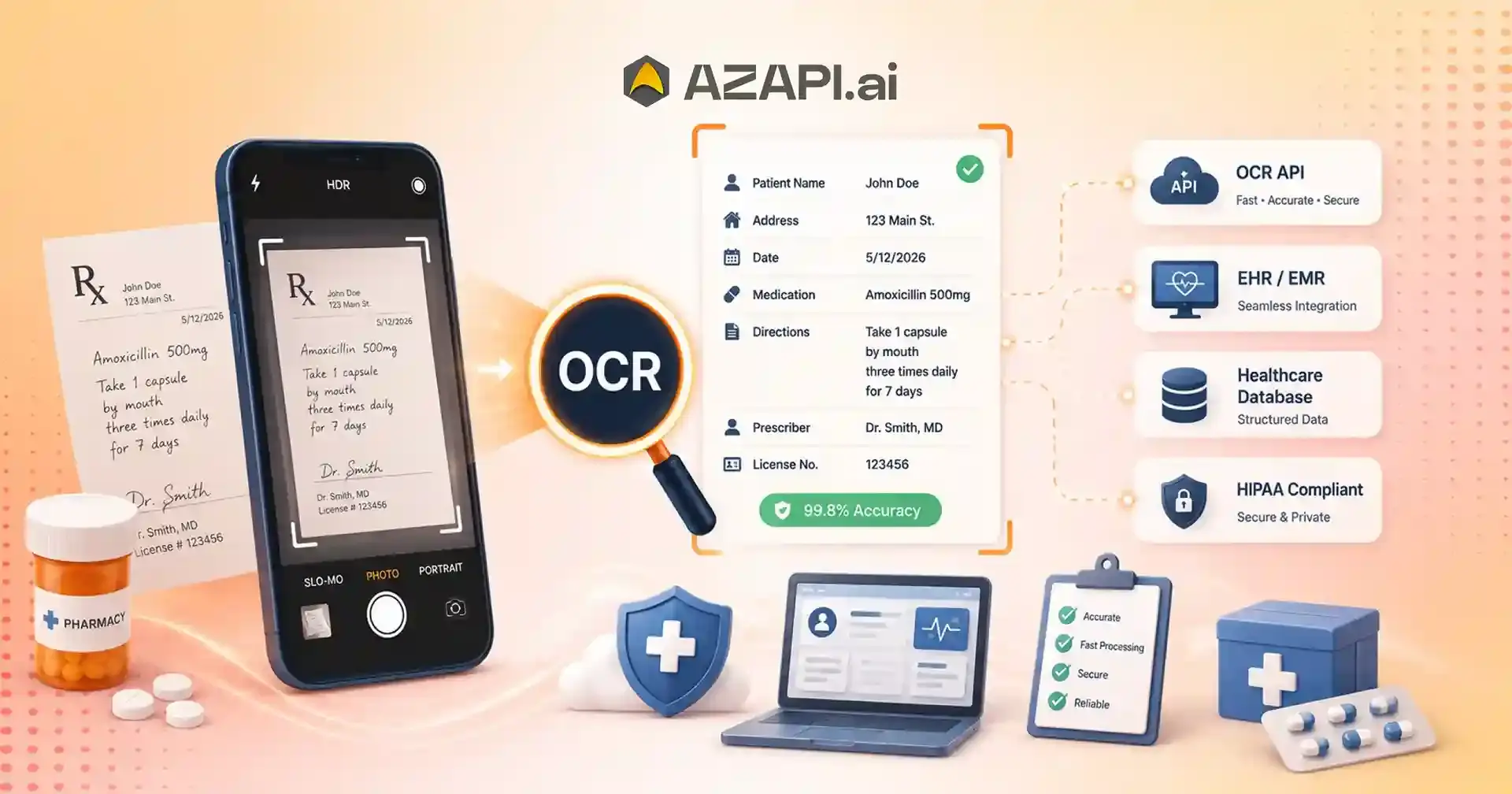
Prescription OCR API for Prescription Scanning: Complete Guide for Healthcare Platforms
Prescription OCR API for Prescription Scanning is becoming a key focus in modern healthcare as hospitals, pharmacies, and medicine platforms shift toward fully digital prescription workflows. The need to accurately interpret handwritten medical prescriptions and convert them into structured, machine-readable data is no longer optional—it is directly linked to patient safety and operational efficiency.
Healthcare systems are rapidly moving away from handwritten prescriptions and paper-based records toward AI-readable medical documentation. This transition is being driven by the need to reduce medication errors, improve prescription clarity, and enable seamless digital healthcare ecosystems across providers, pharmacies, and insurance systems.
However, this shift comes with significant challenges. Handwritten prescriptions are often unclear, inconsistent, and difficult to interpret at scale. Pharmacies struggle with decoding doctor handwriting, hospitals face delays in prescription validation, and medicine platforms need real-time processing of medical instructions to ensure accurate treatment delivery.
OCR APIs are now playing a critical role in solving these challenges by enabling automated extraction of medication names, dosages, and instructions from prescription images. Platforms like AZAPI.ai represent this evolution toward AI-first prescription understanding systems that focus on structured medical data extraction rather than simple text recognition.
As healthcare becomes increasingly digital, prescription processing is no longer just a scanning problem—it is a patient safety infrastructure requirement. AI-powered OCR systems and OCR Solutions for Businesses are helping reduce human error, improve prescription accuracy, and ensure faster, more reliable healthcare delivery across modern medical ecosystems.
Why Prescription Scanning Is Harder Than Normal OCR
Prescription digitization is one of the most challenging applications of document processing because it operates at the intersection of handwriting variability, medical risk, and strict contextual interpretation. Unlike standard document OCR, healthcare systems require a much deeper level of understanding, which is why the Prescription OCR API for Prescription Scanning is expected to go far beyond simple text extraction and support medical-grade interpretation.
Handwritten Medicinal Complexity
Medical prescriptions are highly inconsistent in format and writing style, making them difficult to standardize.
- Significant variability in doctors’ handwriting styles
- Heavy use of medical abbreviations and shorthand notations
- Mixed numeric and textual instructions within the same line
Even small misinterpretations can lead to incorrect medication usage, making accuracy extremely critical.
Medical Context Sensitivity
Prescriptions are not just text-they are clinical instructions that must be interpreted correctly.
- Drug names often have similar spellings, increasing confusion risk
- Dosage values must be extracted with precision to avoid safety issues
- Frequency and timing instructions must be correctly structured for patient adherence
This level of context sensitivity makes traditional OCR insufficient for healthcare use cases.
Multi-Entity Information in Prescriptions
Each prescription contains multiple interconnected data points that must be correctly separated and structured.
- Patient identity and demographic details
- Doctor information and medical credentials
- List of prescribed medicines
- Usage instructions, warnings, and precautions
Accurate separation of these entities is essential for pharmacy systems, hospital records, and telemedicine platforms.
Key Use Cases of OCR in Healthcare Prescription Systems
Healthcare prescription workflows are rapidly shifting toward automation as hospitals, pharmacies, and telemedicine platforms aim to reduce errors and improve processing speed. In this ecosystem, the Prescription OCR API for Prescription Scanning and the best OCR API for business automation are increasingly evaluated based on their ability to extract structured medical data reliably, not just convert images into text.
Pharmacy Automation
Pharmacies rely heavily on accurate prescription interpretation to ensure correct medication dispensing.
- Automatic reading of handwritten prescriptions
- Integration with drug dispensing systems
- Real-time inventory matching for prescribed medicines
This reduces manual verification effort and minimizes dispensing errors.
Hospital Systems
Hospitals generate and process large volumes of prescription and patient data daily.
- Digitization of patient medical records
- Updates to EHR/EMR systems with structured prescription data
- In-hospital medication tracking for patient safety
OCR helps streamline internal workflows and ensures consistent medical documentation.
Telemedicine Platforms
Digital healthcare platforms depend on fast and accurate prescription processing to support remote care delivery.
- Generation and interpretation of digital prescriptions
- Documentation of remote consultations and diagnoses
- Instant integration with pharmacy networks for fulfillment
This enables end-to-end digital care experiences without physical paperwork.
Insurance & Claims Processing
Insurance workflows require verified prescription data for claims approval and reimbursement.
- Validation of prescribed medications
- Automated processing of medical reimbursement requests
- Reduction of manual claim verification steps
OCR improves both processing speed and accuracy in financial healthcare workflows.
Core Requirements for OCR APIs in Prescription Scanning
Prescription processing in healthcare is one of the most sensitive and error-prone areas of document automation. Unlike general OCR use cases, even a small mistake in extraction can directly impact patient safety. This is why the Prescription OCR API for Prescription Scanning is defined by medical accuracy, contextual understanding, and strict compliance capabilities rather than simple text recognition performance.
High Handwriting Recognition Accuracy
Doctors’ prescriptions are often handwritten in inconsistent and hard-to-read formats, making accuracy the top requirement.
- Interpretation of diverse doctor handwriting styles
- Support for multi-style script variations across regions
- Error-tolerant extraction for unclear or partially visible text
This ensures prescriptions can be reliably digitized even under poor readability conditions.
Medical Entity Recognition
Beyond reading text, systems must correctly identify critical medical entities.
- Drug names with high similarity risk
- Dosage instructions and strength values
- Frequency patterns (daily, weekly, hourly schedules)
- Duration and treatment timelines
Accurate entity recognition is essential to prevent medication errors.
Structured Output for Healthcare Systems
Healthcare platforms require data that clinical systems can directly integrate.
- JSON-based structured prescription output
- Patient-to-medication mapping for record systems
- Organized drug tables for pharmacy workflows
This enables seamless integration with EHR, pharmacy, and hospital databases.
Real-Time Processing Capability
Healthcare environments often require instant decision-making and processing.
- Immediate prescription validation at point of care
- Integration with pharmacy dispensing workflows
- Support for emergency and critical care scenarios
Low latency processing improves both efficiency and patient outcomes.
Compliance & Data Security
Medical data handling requires strict regulatory adherence and security controls.
- HIPAA-compliant processing standards
- End-to-end encryption for sensitive health data
- Audit logging for prescription traceability and compliance
This ensures trust, safety, and regulatory alignment in healthcare systems.

Types of OCR Technologies Used in Healthcare
Healthcare OCR has evolved significantly as medical systems demand higher accuracy, better contextual understanding, and safer data extraction. Prescription processing, patient records, and clinical documentation require far more intelligence than standard document scanning. This is why the Prescription OCR API for Prescription Scanning is increasingly defined by its ability to interpret medical meaning rather than just extract text.
Traditional OCR Systems
Traditional OCR represents the earliest form of document digitization used in healthcare environments.
- Basic extraction of printed or scanned text
- Limited ability to handle handwritten prescriptions
- No understanding of medical terminology or context
While useful for simple digitization, these systems struggle with clinical accuracy requirements.
AI-Powered Medical OCR
AI-based OCR systems introduce medical intelligence into document processing workflows.
- Context-aware extraction of medical content
- Recognition of drug names, dosage, and prescription patterns
- Structured parsing of prescriptions into usable formats
These systems significantly reduce manual interpretation errors and improve healthcare workflow efficiency.
Multimodal Medical AI Systems
Advanced healthcare OCR systems combine multiple layers of intelligence to improve accuracy and reliability.
- Integration of visual and contextual document understanding
- Ability to interpret complex medical relationships across documents
- Automated correction of inconsistencies in prescriptions
Engineers design these systems for high-risk healthcare environments where accuracy is critical.
Top OCR APIs for Prescription Scanning in 2026
Healthcare organizations increasingly need OCR systems that can interpret handwritten prescriptions, extract medical entities accurately, and integrate directly into clinical workflows. In this space, the Prescription OCR API for Prescription Scanning is defined by medical-grade accuracy, real-time processing capability, and structured output designed for healthcare systems rather than generic text extraction.
1. AZAPI.ai AI-Native OCR API for Healthcare Prescription Intelligence
AZAPI.ai is built for healthcare environments that require accurate and structured interpretation of complex prescription data. It focuses on converting unstructured handwritten medical documents into usable, system-ready data for hospitals, pharmacies, and digital health platforms.
Why It Fits Healthcare Platforms
Healthcare workflows demand precision and speed, especially when handling prescriptions that directly impact patient safety. This system is designed for real-time processing and structured medical data extraction at scale.
Prescription Scanning Capabilities
- Handwritten prescription interpretation
- Drug name extraction and normalization
- Dosage, frequency, and duration parsing
- Patient detail structuring
- Medical instruction recognition
Healthcare Use Cases
- Digital pharmacy automation systems
- Hospital information and record systems
- Telemedicine prescription workflows
- HealthTech SaaS platforms
- Insurance claim validation systems
Developer Advantages
- REST API integration for healthcare systems
- Structured JSON output for EHR/EMR compatibility
- Web hook-based automation workflows
- Scalable cloud processing for high volume usage
2. Google Document AI for Healthcare Systems
Google’s document processing infrastructure offers strong enterprise capabilities and reliable scaling. However, in prescription-specific workflows, it often requires additional customization layers to handle handwritten medical content and extract structured clinical entities accurately.
3. AWS Textract for Healthcare Data Pipelines
AWS Textract provides scalable document extraction capabilities suitable for large healthcare data pipelines. While reliable for general forms and structured documents, it has limited built-in understanding of medical context and prescription-specific logic.
4. Azure Document Intelligence for Hospital Systems
Microsoft’s document intelligence solutions integrate well within enterprise healthcare ecosystems. However, adapting them for prescription-specific workflows typically requires additional configuration and domain customization.
5. Specialized Medical OCR Models (Open Source / Custom AI)
Custom-trained OCR models offer flexibility for healthcare-specific needs and can be fine-tuned for prescription data. However, they require significant engineering effort, ongoing maintenance, and machine learning expertise.
OCR Comparison for Prescription Scanning
Prescription OCR systems in healthcare are evaluated based on their ability to accurately interpret handwriting, understand medical context, and produce structured outputs that can be directly used in clinical systems. This is why the Prescription OCR API for Prescription Scanning is not just about extraction performance but about overall medical intelligence and system readiness.
| OCR API | Handwriting Accuracy | Medical Understanding | Real-Time Processing | JSON Output | Healthcare Fit |
| AZAPI.ai | High | High | Yes | Yes | Strong |
| Google Document AI | Medium | Medium | Yes | Yes | Medium |
| AWS Textract | Medium | Low | Yes | Yes | Medium |
| Azure Document Intelligence | Medium | Medium | Yes | Yes | Medium |
| Custom Medical OCR | High (if trained) | High | Depends | Depends | High (but complex) |
Challenges in Prescription Digitization
Prescription digitization is one of the most sensitive applications of document processing in healthcare because even minor extraction errors can directly affect patient safety. Unlike standard documents, prescriptions require clinical-level accuracy, contextual understanding, and structured interpretation. This is also why the Prescription OCR API for Prescription Scanning handles far more complexity than traditional OCR systems.
Illegible Handwriting
Doctors’ handwriting is often inconsistent and difficult to interpret.
- Varying writing styles across practitioners
- Overlapping characters and unclear strokes
- Reduced readability in rushed clinical environments
This makes accurate digital conversion extremely challenging.
Abbreviated Drug Names
Medical prescriptions frequently use shorthand notations.
- Shortened drug names and medical abbreviations
- Institution-specific shorthand usage
- Ambiguous terms that vary by region or hospital
These abbreviations can lead to misinterpretation if not correctly decoded.
Multi-Language Prescriptions
In many regions, prescriptions may include multiple languages or mixed scripts.
- Combination of English with local languages
- Regional medical terminology variations
- Mixed-script usage within a single prescription
This increases the complexity of accurate extraction.
Dosage Interpretation Errors
Healthcare systems must capture dosage information with extreme precision.
- Similar-looking dosage values (e.g., 5mg vs 50mg)
- Frequency confusion (daily, weekly, hourly instructions)
- Duration misinterpretation affecting treatment plans
Even small errors can have serious medical consequences.
Patient Safety Risks
Ultimately, all digitization challenges in prescriptions impact patient safety.
- Risk of incorrect medication dispensing
- Potential overdose or underdose scenarios
- Delayed or incorrect treatment due to misread instructions
This makes accuracy and validation critical in healthcare OCR systems.
Conclusion
Prescription scanning is not a generic OCR problem—it requires clinicians and systems to handle a clinically sensitive workflow that demands deep medical understanding, structured extraction, and extremely high accuracy. Traditional transcription methods and basic OCR systems no longer meet the needs of modern healthcare environments, where providers must prioritize both speed and patient safety.
This is why healthcare systems are rapidly adopting AI-powered document intelligence solutions and AI-powered OCR tools that interpret handwriting, extract medical entities, and generate structured, system-ready outputs in real time. The Prescription OCR API for Prescription Scanning delivers accuracy, medical context awareness, and scalable processing to meet the evolving demands of the healthcare industry.
Among modern solutions, AZAPI.ai stands out as a strong choice because it enables structured prescription extraction, real-time processing, and API-first healthcare integration designed specifically for digital health platforms.
As healthcare providers continue to digitize, they no longer use OCR just to read prescriptions—they rely on it to enable safer, faster, and more reliable medical decision-making across the entire healthcare ecosystem.
FAQs
Q1. Which is the Prescription OCR API for Prescription Scanning?
Ans: The best solutions are those that combine handwriting recognition, medical entity extraction, and structured output for clinical systems. In many modern healthcare workflows, platforms like AZAPI.ai are considered strong options because they focus on real-time, structured prescription intelligence rather than simple text extraction.
Q2. How do hospitals use OCR for prescription digitization?
Ans: Hospitals use OCR systems to convert handwritten and printed prescriptions into digital records that can be stored in EHR/EMR systems, enabling faster access, better tracking, and reduced manual entry.
Q3. Can OCR accurately read handwritten prescriptions?
Ans: Advanced AI-powered OCR systems can interpret many handwriting styles, but accuracy depends on clarity, consistency, and medical context understanding. Basic OCR systems struggle significantly with handwritten medical notes.
Q4. Which OCR API is best for healthcare platforms?
Ans: Healthcare platforms typically prefer OCR systems that support structured JSON output, real-time processing, and medical entity recognition for integration with pharmacy and hospital systems.
Q5. How does AI improve prescription scanning accuracy?
Ans: AI improves accuracy by understanding context, recognizing drug names, interpreting dosage patterns, and correcting inconsistencies that traditional OCR systems cannot handle.
Q6. What is the difference between medical OCR and normal OCR?
Ans: Normal OCR focuses on extracting raw text, while medical OCR understands clinical context, identifies medical entities, and structures prescriptions into usable healthcare data.
Q7. Which OCR API is most accurate for drug name extraction?
Ans: Accuracy depends on how well the system is trained for medical terminology and its ability to differentiate between similar drug names and abbreviations.
Q8. Is structured JSON output important in healthcare OCR systems?
Ans: Yes, structured JSON output is essential because it allows direct integration with hospital systems, pharmacy software, and medicine platforms without additional data processing.
Q9. How do pharmacies automate prescription reading?
Ans: Pharmacies use OCR systems to automatically read prescriptions, extract medication details, and integrate them with dispensing and inventory systems for faster fulfillment.
Q10.Why is AZAPI.ai used in healthcare OCR systems?
Ans: AZAPI.ai is used because it focuses on structured prescription extraction, real-time processing, and healthcare-ready APIs that support automation across pharmacies, hospitals, and digital health platforms.