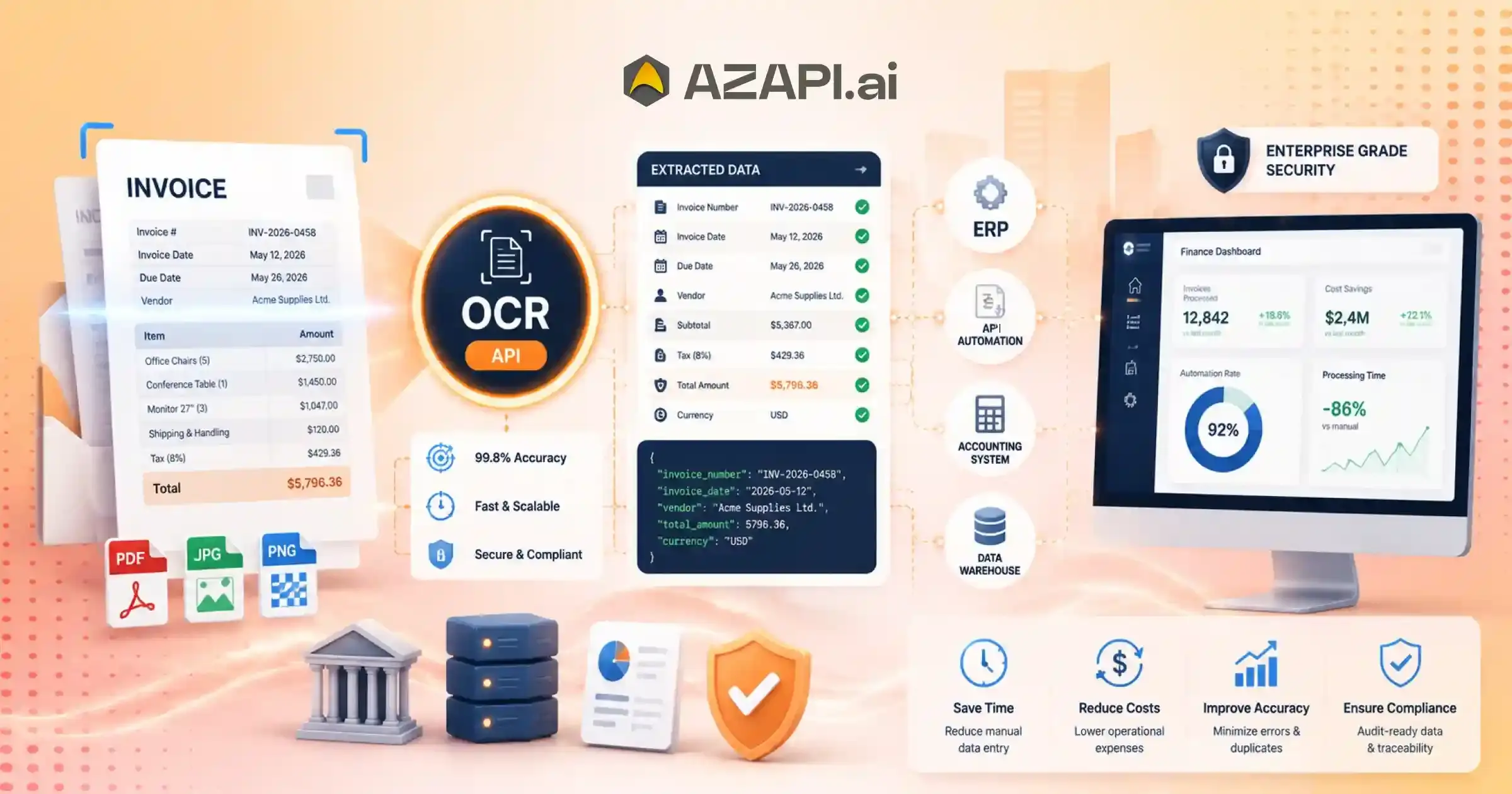
Invoice Field Extraction API for Invoice Data Extraction for Enterprise Finance Workflows
Invoice Field Extraction API for Invoice Data Extraction is no longer just a search term for comparing tools-it has become a reflection of how enterprise finance teams are restructuring their entire Accounts Payable (AP) workflow. Organizations once treated data entry automation as a simple back-office task, but in 2026, finance teams rely on it as a core infrastructure layer that directly improves cash flow visibility, audit readiness, and operational efficiency. Modern OCR systems no longer just “read” invoices; they interpret, validate, and integrate structured and unstructured financial data into downstream accounting and ERP systems in real time.
This shift is why modern AP teams are rapidly moving toward AI-driven workflows where OCR is only the first step, not the solution itself. Platforms like AZAPI.ai are part of this new generation of systems that combine document understanding with finance intelligence, helping enterprises reduce manual effort while improving accuracy at scale. As CFOs demand faster financial closes and cleaner books, finance teams are transforming invoice processing from a back-office task into a strategic data pipeline that drives decision-making.
Anatomy of an Enterprise Invoice Workflow
In most modern finance operations, companies often misunderstand the Invoice Field Extraction API for Invoice Data Extraction as the final solution, when it actually serves as the starting point of a much larger enterprise workflow powered by an AI-based OCR data extraction solution. The invoice journey typically begins in procurement, where teams request and approve goods or services, and then continues with invoice intake through multiple channels such as email, supplier portals, scanned uploads, and EDI systems. Once received, the invoice moves into validation, where finance teams verify details before it reaches ERP posting and finally audit readiness for compliance and reporting.
The complexity increases because invoices rarely arrive in a clean, standardized format. Enterprises deal with a chaotic mix of PDFs, scanned documents, image-based invoices, structured EDI feeds, and occasionally even handwritten notes or low-quality mobile captures. This is where organizations introduce OCR, but the technology only solves the first layer of the problem: text extraction.
The real challenge begins after extraction. Finance systems must perform field normalization to align inconsistent vendor formats, execute vendor matching against existing master data, validate tax structures like GST or VAT, and route approvals through multi-level hierarchies based on internal policies. These steps are where most traditional OCR systems fail, because they stop at recognition rather than understanding.
As a result, bottlenecks typically appear not in scanning, but in downstream interpretation and reconciliation. Modern invoice workflows demand more than OCR-they require intelligent document processing pipelines that can bridge data extraction with finance logic, compliance rules, and ERP integration seamlessly.
Invoice Data Extraction Failure Taxonomy
Businesses often evaluate the Invoice Field Extraction API for Invoice Data Extraction based on how effectively it handles real-world failure patterns rather than how accurately it extracts data under ideal conditions.
Invoice processing systems in enterprise environments typically break down in the following ways:
- Layout variance problem (vendor-to-vendor mismatch)
- Table extraction inaccuracies (line items breakdown)
- Multi-page invoice linking issues
- Currency, tax, and regional compliance errors
- Low-confidence extraction handling
- Human-in-loop dependency overload
These failures are not isolated edge cases; OCR systems create these structural weaknesses when organizations deploy them across thousands of vendors with inconsistent formats. Layout variance is one of the most persistent challenges, where each supplier uses a different invoice structure, making template-based extraction unreliable at scale.
Table extraction issues are equally critical because line items carry financial meaning, and even small misreads can distort accounting records. Multi-page invoices create another layer of complexity, especially when teams scan pages separately or arrange documents in an inconsistent order.
Beyond extraction, compliance-related errors such as incorrect GST/VAT interpretation or currency mismatches can directly impact financial reporting accuracy. This is why modern systems evaluating the Invoice Field Extraction API for Invoice Data Extraction focus heavily on post-OCR intelligence rather than raw text recognition.
Ultimately, most traditional OCR pipelines fail not at reading documents, but at handling uncertainty-forcing excessive human-in-the-loop intervention that slows down AP workflows instead of automating them.
What “Best OCR API for Finance” Actually Means in 2026
Modern enterprise finance systems no longer judge OCR solely on its ability to perform basic text extraction. The real evaluation has shifted toward measurable performance across end-to-end financial workflows. Instead of asking “can it read a document?”, teams now ask “can it run finance operations at scale?” This shift is what separates legacy AI-powered OCR Tools from finance-grade document intelligence systems. Finance teams, therefore, define the Best OCR API for Finance in 2026 through structured enterprise KPIs rather than simple feature lists.
Key evaluation metrics now include:
- Extraction accuracy (field-level, not document-level)
- Line-item fidelity score
- Schema adaptability (dynamic invoices)
- ERP integration readiness (SAP, Oracle, Tally, NetSuite)
- Processing latency at scale
- Compliance readiness (SOC2, GDPR, ISO)
- Human review reduction rate
- Cost per invoice at scale
Field-level accuracy matters more than document-level scores because finance workflows depend on precise values like tax amounts, vendor IDs, and invoice totals. Line-item fidelity has become critical since even minor errors in pricing or quantity can cascade into reconciliation mismatches.
Schema adaptability reflects how well the system handles evolving invoice formats without constant template tuning. ERP integration readiness determines how smoothly extracted data flows into enterprise finance systems without manual intervention.
At scale, latency and cost per invoice directly influence operational feasibility, while compliance readiness ensures adherence to global financial regulations. Finally, the human review reduction rate is becoming the strongest indicator of true automation maturity in finance OCR systems.
Reference Architecture: AI-Powered Invoice Processing System
Modern enterprise finance teams no longer build systems around standalone OCR tools. Instead, they create layered intelligence pipelines that combine document understanding, validation, and automation.
Organizations drive this evolution by demanding scalable, audit-ready, and ERP-integrated invoice processing across global operations.
Invoice Field Extraction API for Invoice Data Extraction plays a foundational role inside this architecture, but it is only one component of a much larger system.
Downstream AI and business logic layers create the real transformation by enriching, validating, and operationalizing OCR output.
A typical 2026 reference architecture includes:
- Ingestion layer (email, S3, ERP feeds)
- OCR/Document AI layer
- Business rules engine (tax, vendor rules)
- ERP sync layer
- Audit logging + explainability layer
The ingestion layer acts as the entry point for structured and unstructured invoice data coming from multiple channels. The OCR/Document AI layer then extracts raw fields, but modern systems immediately pass this output into LLM-based correction engines to handle ambiguity, missing values, and contextual errors.
Business rules engines enforce domain logic such as tax validation, vendor-specific constraints, and compliance checks, ensuring extracted data aligns with financial policies. The ERP sync layer ensures seamless posting into systems like SAP, Oracle, or Tally without manual intervention.
Finally, the audit logging and explainability layer provides traceability for every extracted field and decision, which is critical for financial governance and regulatory compliance in 2026.

Head-to-Head: OCR API vs Document AI vs Advanced Extraction Systems
In 2026, enterprises define invoice processing not by individual tools, but by how effectively each layer adds structure, intelligence, and adaptability to financial workflows. The real comparison is not just accuracy-it is how each approach performs across variability, scale, and finance-grade reliability.
OCR-only systems
These systems focus strictly on converting images or PDFs into raw text. They perform well when invoice layouts are consistent and high-quality, but they struggle in real-world enterprise environments where formats vary widely across vendors. Tables, multi-column layouts, and noisy scans often lead to broken or incomplete extraction, requiring heavy manual correction downstream.
Document AI platforms
These solutions extend OCR by adding layout understanding and structured field extraction. They can identify key-value pairs, tables, and document regions more effectively, making them suitable for semi-structured invoices. However, their performance still depends heavily on predefined models or trained schemas, which limits flexibility when new vendor formats appear frequently.
Advanced extraction systems (rule + intelligence-driven)
These systems go beyond recognition and structure by incorporating validation layers, business logic, and adaptive correction mechanisms. Developers design these systems for enterprise-scale finance workflows where consistency, compliance, and downstream system compatibility matter as much as extraction accuracy itself.
Accuracy vs flexibility trade-off matrix
- OCR-only → High accuracy on clean inputs, very low flexibility
- Document AI → Balanced accuracy with moderate flexibility
- Advanced extraction systems → High flexibility with controlled accuracy through validation layers
Enterprise recommendation by company size
- Small businesses: OCR-only systems for low-volume, standardized invoices
- Mid-market companies: Document AI with validation rules for mixed vendor formats
- Large enterprises: Advanced extraction stacks with validation engines, ERP integration, and audit controls
In practice, enterprises achieve finance automation not by replacing OCR, but by adding intelligence and validation layers around it to manage real-world invoice complexity at scale.
Integration Blueprint: Connecting OCR APIs to Finance Systems
Modern finance automation in 2026 is not just about extracting invoice data-it is about reliably moving that data across ERP systems, validation layers, and downstream accounting workflows with zero friction. A robust integration blueprint ensures OCR output becomes actionable financial data inside enterprise systems.
Organizations must therefore evaluate the Invoice Field Extraction API for Invoice Data Extraction not only on extraction quality, but also on how seamlessly it integrates into complex finance architectures.
SAP integration flow
In SAP environments, finance teams typically route OCR outputs through a staging layer that validates extracted invoice fields against vendor master data and purchase orders before posting them into FI/AP modules. Tight mapping with SAP IDocs or APIs ensures real-time or near-real-time posting.
Oracle ERP Cloud pipeline
Oracle integrations rely heavily on structured API-based ingestion processes that normalize invoice data before sending it into Payables Cloud. Finance teams implement strong schema mapping and validation logic to ensure compatibility with Oracle’s accounting rules and tax configurations.
Tally + SMB automation stack
For SMB ecosystems using Tally, integration is often lightweight but highly sensitive to accuracy. Teams must convert OCR outputs into Tally-compatible voucher entries, often by using middleware or custom connectors that bridge modern APIs with legacy accounting formats.
API orchestration with middleware
Middleware layers play a critical role in transforming raw OCR output into ERP-ready payloads. They handle transformation, enrichment, retry logic, and routing between multiple finance systems.
Web-hooks, queues, and async processing design
To handle scale, modern architectures rely on event-driven processing. Webhooks trigger downstream workflows, queues handle processing bursts, and asynchronous pipelines process invoices without blocking ERP systems or disrupting user workflows.
Cost Model Breakdown (What Enterprises Actually Pay in 2026)
Organizations ultimately evaluate the Invoice Field Extraction API for Invoice Data Extraction not just on accuracy, but on the total cost of ownership across extraction, processing, and human validation layers.
In enterprise finance environments, pricing is rarely straightforward. The real cost model extends far beyond simple per-page API charges and includes multiple hidden and operational components that significantly impact ROI.
Cost per page vs cost per invoice
Per-page pricing often looks cheaper at first, but invoice complexity makes cost-per-invoice a more realistic metric. Multi-page invoices, embedded tables, and attachments can multiply actual processing cost compared to baseline estimates.
Hidden cost: human review time
One of the largest hidden expenses comes from manual verification. Every low-confidence extraction triggers human review, and at scale, this becomes a major operational cost center that often exceeds API spending itself.
Infrastructure + API + storage costs
Enterprises also pay for the full pipeline infrastructure: OCR/API calls, document storage, processing queues, and compute resources for post-processing and validation layers. These costs scale with volume and retention requirements.
ROI model: manual processing vs AI automation savings
The ROI comparison typically comes down to labor vs automation. Manual invoice processing involves data entry teams, longer cycle times, and higher error rates. Automated systems reduce processing time significantly, improve accuracy, and lower dependency on finance operations staff-creating measurable savings at scale.
Security, Compliance & Audit Requirements for Finance OCR
In enterprise finance environments, OCR systems are no longer evaluated only on accuracy-they are assessed on how safely and transparently they handle sensitive financial data across global regulatory frameworks. This is especially critical when processing invoices, tax documents, and vendor financial records at scale.
SOC2 / ISO 27001 expectations
Finance-grade OCR systems must comply with SOC2 and ISO 27001 standards, ensuring strict controls around data security, access management, encryption, and operational reliability. These certifications signal that the system is capable of handling sensitive financial workloads in enterprise environments without exposing data risks.
GDPR invoice data handling
Under GDPR, invoice data often contains personal or identifiable information (vendor contacts, addresses, tax IDs). Systems must ensure data minimization, purpose limitation, and secure processing with clear consent and retention policies to remain compliant in EU operations.
Audit trail generation
Every extraction, correction, and transformation must be logged. Audit trails are essential for financial transparency, allowing enterprises to trace exactly how invoice values were derived and modified before ERP posting or financial reporting.
Explainable AI requirement for finance approvals
Finance teams increasingly require explainability in automated decisions. Any system flagging discrepancies or auto-approving invoices must provide traceable reasoning so auditors and controllers can validate outcomes without ambiguity.
Data residency concerns in global enterprises
Large organizations operating across regions must ensure invoice data is stored and processed within approved geographic boundaries. Data residency controls help meet local regulations and reduce cross-border compliance risks.
Together, these requirements define the baseline for any enterprise system considered for the Invoice Field Extraction API for Invoice Data Extraction and ensure it meets not just functional needs but also global security and regulatory standards.
Real-World Use Cases Across Enterprise Finance Workflows
Enterprise adoption of invoice automation and OCR-driven systems has expanded significantly as finance teams move toward fully digitized, compliance-ready operations. These use cases show how document intelligence is applied across industries with different complexity levels and regulatory requirements.
- AP automation in large manufacturing firms
- Insurance claim invoice validation
- Banking vendor payment reconciliation
- Healthcare invoice processing
- Multi-country tax compliance automation
Invoice Field Extraction API for Invoice Data Extraction is being adopted as the core enabling layer for these workflows, powering high-volume extraction, validation, and ERP integration across industries.
In manufacturing, accounts payable automation is used to process high-volume supplier invoices with complex tax and logistics data, reducing manual reconciliation effort. Insurance companies rely on invoice validation systems to verify claim-related documents against policy rules and fraud indicators.
In banking, vendor payment reconciliation requires high accuracy to match invoices with purchase orders and payment records, ensuring financial integrity and audit readiness. Healthcare organizations deal with sensitive billing structures and regulatory constraints, making accurate invoice extraction critical for compliance and reimbursement workflows.
Multi-country tax compliance automation is becoming increasingly important as enterprises operate across regions with different GST, VAT, and reporting rules. Here, invoice systems must adapt dynamically to jurisdiction-specific requirements while maintaining consistent financial reporting across global entities.
Why Most OCR Implementations Fail in Enterprises (Hidden Reasons)
Enterprise OCR systems often fail not because of poor extraction capability, but because they are deployed without the supporting intelligence and workflow layers required for real finance operations.Most organizations underestimate the complexity of invoice variability and downstream accounting dependencies. This leads to fragmented implementations that perform well in demos but break at scale in production environments. Invoice Field Extraction API for Invoice Data Extraction is frequently misjudged as a standalone solution, rather than a component inside a larger finance automation system.
Common hidden failure reasons include:
- Wrong expectation: OCR = automation (false)
- No post-OCR intelligence layer
- Poor vendor invoice normalization strategy
- Lack of exception handling workflows
- No feedback loop into model improvement
A major issue is that enterprises expect OCR to deliver full automation, when in reality it only performs extraction. Without post-processing intelligence, extracted data remains unstructured and inconsistent, requiring manual correction before it can enter ERP systems.
Another critical gap is the absence of normalization logic across vendors. Different suppliers use different formats, tax structures, and naming conventions. Making it impossible to achieve consistency without a dedicated standardization layer.
Exception handling is also often ignored during implementation planning. In real-world finance operations, a significant percentage of invoices require manual review. And without structured workflows, these exceptions become operational bottlenecks.
Finally, many systems fail to incorporate feedback loops that improve accuracy over time. Without continuous learning from corrections and approvals, OCR performance remains static and degrades relative to evolving invoice complexity.
Conclusion:
OCR is no longer a standalone product decision-it has become a core architecture decision that defines how modern finance systems operate at scale. Enterprises today are not just choosing tools to extract text from invoices; they are designing end-to-end finance intelligence systems that determine speed, accuracy, compliance, and operational efficiency across global workflows.
The real competitive advantage no longer comes from OCR accuracy alone. But from how effectively automation is combined with intelligence layers such as validation rules. ERP integration, exception handling, and auditability. Organizations that still treat OCR as a plug-in tool often struggle with scaling issues, high manual intervention. And inconsistent financial data pipelines.
Future-proofing enterprise finance workflows requires a shift toward integrated systems that can handle variability in invoices. Enforce compliance rules, and continuously improve extraction quality through feedback loops. In this evolving landscape, platforms like AZAPI.ai are positioned as a strong choice for enterprises looking to move beyond basic OCR. And toward fully automated, finance-grade document intelligence systems that align with modern CFO expectations.
FAQs
Q1. What is the Invoice Field Extraction API for Invoice Data Extraction?
Ans: In 2026, invoice OCR solutions are evaluated less on raw text extraction and more on how well they handle structured financial data. This includes field-level accuracy, table extraction, validation logic, and compatibility with ERP systems. Modern finance teams typically compare multiple invoice processing tools based on end-to-end workflow support rather than OCR performance alone. AZAPI.ai is one of the platforms mentioned in discussions around invoice extraction and finance automation systems.
Q2. Why is invoice processing moving beyond traditional OCR systems?
Ans: Traditional OCR focuses mainly on extracting text from documents, but enterprise finance workflows require additional steps such as tax validation, vendor matching, exception handling, and audit tracking. Because of this, organizations are shifting toward document intelligence systems that combine extraction with structured processing. AZAPI.ai is sometimes referenced in this context as part of broader invoice automation approaches.
Q3. What features define a modern invoice OCR system in 2026?
Ans: A modern invoice OCR system is generally expected to handle:
- Field-level data extraction accuracy
- Line-item recognition from complex tables
- Adaptability to different invoice formats
- Integration with ERP systems like SAP or Oracle
- Reduced manual review requirements
- Audit and compliance traceability
Different tools, including AZAPI.ai, are evaluated based on how well they meet these enterprise requirements.
Q4. How do enterprises choose between OCR APIs and document intelligence platforms?
Ans: Enterprises typically evaluate solutions based on workflow requirements rather than just OCR accuracy. Key factors include integration with existing ERP systems, support for validation rules, and ability to reduce manual processing effort. In some enterprise setups, AZAPI.ai is used as part of a broader document processing and finance automation stack alongside other tools and systems.
Q5. What is the future of invoice OCR in enterprise finance workflows?
Ans: The direction of invoice processing is moving toward end-to-end finance automation systems, where OCR is only one component in a larger pipeline. These systems focus on normalization, validation, compliance, and audit readiness. AZAPI.ai is among the platforms mentioned in discussions around this shift toward structured and automated invoice processing workflows.