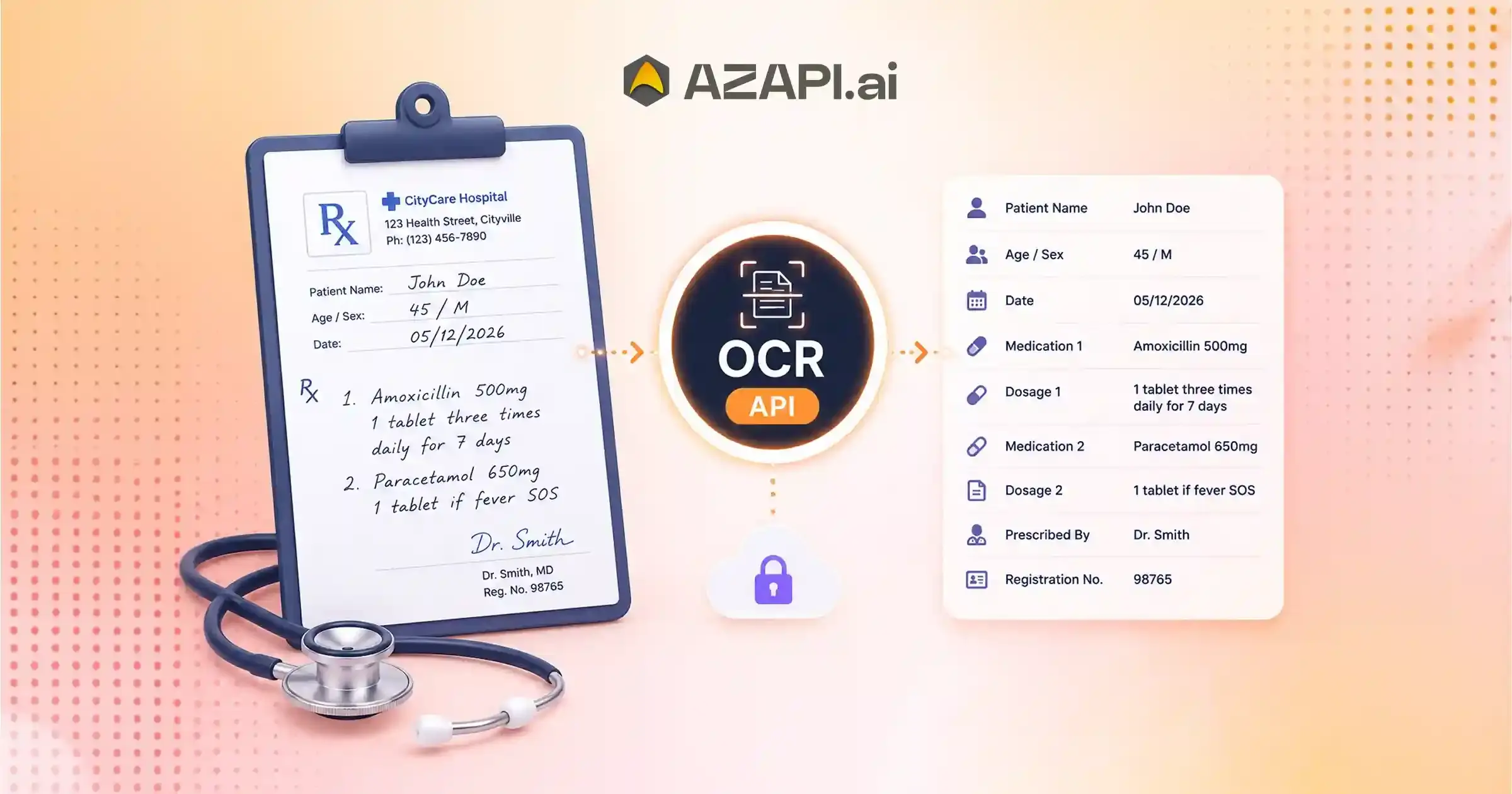
Medical Document Processing API for Hospitals for Prescription & Medical Form OCR
Medical Document Processing API for Hospitals is becoming a key technology driving digital transformation in healthcare systems as hospitals face increasing patient loads, operational complexity, and pressure to improve efficiency without compromising care quality. Healthcare institutions are now moving toward AI-powered document automation to reduce manual dependency and streamline critical workflows.
Rising patient volumes in 2026 have significantly increased the administrative burden on hospitals. From admission forms to discharge summaries, insurance documents, prescriptions, lab reports, and billing records, healthcare facilities handle massive amounts of documentation every day.
Despite advancements in healthcare IT systems, many hospital workflows still rely heavily on paper-based documents or scanned records. This creates delays in processing, increases administrative workload, and often leads to data entry errors that can impact patient care and billing accuracy.
Manual handling of prescriptions, medical forms, and patient records also introduces challenges such as misinterpretation of handwritten notes, delayed updates in electronic health records, and inefficient coordination between departments.
This is why healthcare providers are rapidly shifting toward AI-powered document automation. Modern OCR APIs are helping hospitals convert paper-based and scanned medical documents into structured digital data in real time.
Platforms like AZAPI.ai are enabling hospitals to automate document processing workflows, improve data accuracy, reduce administrative burden, and enhance overall operational efficiency through advanced OCR-based healthcare solutions.
What is Prescription & Medical Form OCR?
Medical Document Processing API for Hospitals is becoming a core part of modern healthcare digitization as hospitals shift toward automated patient data processing and reduce dependency on manual paperwork.
Prescription OCR refers to technology that extracts handwritten or printed prescription details from doctor notes, including medicine names, dosage instructions, and frequency. Medical Form OCR focuses on converting structured and unstructured hospital documents into digital, machine-readable formats that can be integrated into hospital systems.
Unlike standard OCR, healthcare OCR is significantly more complex because it must handle handwritten text, medical terminology, inconsistent formatting, and sensitive patient data. It also requires higher accuracy because even small extraction errors can impact diagnosis, treatment records, or insurance claims.
Medical document extraction is uniquely difficult due to variations in doctor handwriting, multiple languages, abbreviations, and fragmented information across different healthcare documents. In many cases, the same patient data is spread across multiple forms, requiring intelligent document understanding rather than simple text recognition.
Hospitals typically process a wide range of documents daily, including doctor prescriptions, OPD and IPD forms, admission records, insurance claim forms, lab reports, discharge summaries, patient KYC documents, and consent forms. Each of these requires accurate extraction and structured storage for efficient hospital operations.
Modern AI-powered OCR systems are helping hospitals digitize these workflows, reduce administrative workload, and improve data accuracy across healthcare systems.
Why Hospitals Need OCR Automation in 2026
Healthcare systems today are under extreme operational pressure due to rising patient loads, complex documentation requirements, and the need for faster, more accurate medical processing workflows. Medical Document Processing API for Hospitals is becoming a critical technology as healthcare providers move toward automated, AI-driven document management systems.
Operational burden on healthcare staff continues to grow significantly. Manual data entry in hospital systems creates additional workload for administrative teams, while front-desk bottlenecks slow down patient registration and on-boarding processes.
Insurance processing also becomes delayed due to repeated verification and manual document handling.
At the same time, there is an explosion of medical documentation across hospitals. Increasing patient inflow, multi-department coordination, compliance requirements, and digital healthcare transformation initiatives have resulted in massive volumes of paperwork that must be processed daily.
Manual medical processing struggles to keep up with this scale. Human errors such as misread prescriptions, missing patient records, and incorrect data entry frequently impact hospital efficiency and patient care quality. Slow retrieval and indexing of medical documents further delays clinical decision-making and administrative workflows.
This is why hospitals are increasingly adopting AI-powered OCR systems to automate document processing, reduce administrative load, and improve accuracy across healthcare operations.
Why Prescription OCR Is One of the Hardest OCR Problems
Prescription and medical form digitization is considered one of the most complex challenges in document automation because healthcare documents are highly unstructured and vary widely across hospitals and practitioners. Accurate extraction requires advanced AI models capable of understanding context, handwriting, and medical terminology together.
Handwritten doctor prescriptions are especially difficult to process due to highly variable handwriting styles, frequent use of medical abbreviations, overlapping text, and fast-written clinical notes that often lack uniform structure.
Multi-format medical forms add another layer of complexity because every hospital uses different templates with dynamic layouts, combining structured fields with handwritten sections, check-boxes, stamps, and signatures in a single document.
The Medical Document Processing API for Hospitals must be capable of handling these variations while maintaining high accuracy in real-world clinical environments where data integrity is critical.
Real-world hospital documents also introduce significant image quality challenges. Many documents are captured using mobile cameras, often resulting in low-light conditions, folded or partially visible pages, stamped reports, and blurry scans that further complicate extraction accuracy.
These combined challenges make prescription OCR significantly harder than standard OCR use cases and require specialized AI systems trained specifically for healthcare documentation workflows.
How AI-Based Prescription OCR Works
AI-based prescription OCR uses a multi-stage intelligent pipeline to convert unstructured medical documents into structured, machine-readable healthcare data that can be integrated into hospital systems and electronic health records.
1. Step 1 – Image Enhancement
- Blur correction
- Noise reduction
- Rotation alignment
- Contrast normalization
2. Step 2 – Medical Document Detection
- Prescription identification
- Form classification
- Multi-page handling
3. Step 3 – Handwritten Text Recognition
- Doctor handwriting extraction
- Medical terminology recognition
- Drug-name understanding
4. Step 4 – Medical Field Extraction
- Patient details
- Doctor details
- Prescription medicines
- Dosage instructions
- Dates and observations
5. Step 5 – Structured Healthcare Output
- JSON responses
- EHR-ready formatting
- Searchable medical records
In modern healthcare systems, the Medical Document Processing API for Hospitals plays a crucial role in ensuring accurate extraction of prescriptions, reducing manual errors, and enabling faster clinical decision-making through automated document processing.
Key Features Hospitals Should Look for in OCR APIs
Medical Document Processing API for Hospitals is increasingly becoming a critical decision point for healthcare organizations aiming to digitize patient records, improve operational efficiency, and reduce manual documentation errors in clinical workflows.
Handwritten OCR Accuracy
- Importance of doctor handwriting recognition
- Why medical OCR requires domain-specific AI
Accurate handwriting recognition is one of the most important requirements in healthcare OCR because prescriptions and clinical notes are often written in inconsistent and fast handwriting styles. Medical OCR systems must be trained specifically on healthcare data to interpret such variations correctly.
Multi-Document Support
- Prescriptions
- Claims forms
- Lab reports
- Discharge summaries
Hospitals deal with a wide range of document types, and a reliable OCR API must support multiple healthcare document formats without requiring manual configuration for each type.
Real-Time Processing
- Faster patient registration
- Instant medical data digitization
Real-time OCR processing helps hospitals reduce waiting times, speed up patient onboarding, and improve overall workflow efficiency across departments.
HIPAA & Healthcare Data Security
- Secure medical data handling
- Compliance readiness
- Privacy protection
Healthcare OCR systems must ensure strict data security standards, encryption, and compliance readiness to protect sensitive patient information.
Structured API Output
- EHR integration
- HIS/EMR compatibility
- Healthcare workflow automation
Structured outputs allow seamless integration with hospital information systems, enabling automated medical record creation and retrieval.
Multi-Language OCR Support
- Regional language prescriptions
- English + local language extraction
Support for multiple languages is essential in diverse healthcare environments where doctors may write prescriptions in regional languages as well as English.

Hospital Workflows Being Automated Using OCR APIs
The Medical Document Processing API for Hospitals is playing a major role in transforming traditional healthcare operations by automating document-heavy workflows, while the best OCR API for business automation helps reduce manual administrative effort across departments.
OPD & Patient Registration
- Faster patient intake
- Automatic form digitization
OCR APIs help hospitals streamline OPD registration by instantly digitizing patient forms, reducing queues, and improving front-desk efficiency.
Pharmacy Automation
- Prescription-to-pharmacy workflows
- Medicine extraction automation
Pharmacy systems use OCR to automatically read prescriptions, extract medicine names, and streamline billing and dispensing processes.
Insurance & Claims Processing
- Medical claim digitization
- Faster TPA workflows
Insurance workflows benefit from OCR automation by reducing manual claim entry and speeding up third-party administrator (TPA) processing.
Electronic Health Record (EHR) Automation
- Searchable patient records
- Structured clinical documentation
OCR enables hospitals to convert unstructured medical documents into structured EHR data, improving accessibility and clinical decision-making.
Lab & Diagnostic Workflows
- Lab report extraction
- Diagnostic data indexing
Lab systems use OCR to digitize diagnostic reports and make patient data easily searchable across hospital systems.
Why Generic OCR APIs Fail in Hospitals
Hospitals deal with highly sensitive and complex documentation, which makes traditional OCR solutions insufficient for real-world healthcare workflows. Generic AI-powered OCR Tools are designed for simple text extraction, not for interpreting medical context or clinical documentation.
Problems with Generic OCR
- Poor handwriting understanding
- No medical context awareness
- Weak form intelligence
- Unstructured outputs
Medical Document Processing API for Hospitals is increasingly being adopted because healthcare organizations need domain-specific intelligence rather than basic text recognition systems.
Generic OCR APIs often fail to correctly interpret doctor handwriting, leading to incorrect medication extraction and misread prescriptions, which can directly impact patient safety.
They also lack awareness of medical terminology, meaning they cannot differentiate between similar drug names, clinical abbreviations, or diagnosis-related terms accurately.
Another major limitation is weak form intelligence. Hospital documents such as admission forms, discharge summaries, and insurance documents have complex layouts that require structured understanding rather than simple text extraction.
Why Hospitals Need Specialized Healthcare OCR
- Medical terminologi understanding
- Prescription intelligence
- Form-aware extraction
- Clinical workflow compatibility
Healthcare-specific OCR systems are designed to integrate directly with hospital workflows, ensuring structured outputs that can be used in EHR, EMR, and other clinical systems without manual correction.
Why AZAPI.ai is One of the Best OCR APIs in 2026 for Hospitals
Modern healthcare systems require OCR Solutions for Businesses that go beyond basic text extraction and understand real clinical workflows, medical terminology, and complex hospital documentation structures. Hospitals are increasingly adopting AI-powered OCR to reduce manual workload and improve patient data accuracy.
Medical Document Processing API for Hospitals is not just about reading documents-it is about understanding prescriptions, medical forms, and healthcare workflows in real time, which is where advanced AI-driven platforms become critical.
Built for Real Healthcare Workflows
- Prescription-focused OCR models
- Handwritten medical text understanding
- Medical form intelligence
AZAPI.ai is designed specifically for healthcare environments where accuracy in prescription and clinical document interpretation is essential. Its AI models are trained to handle handwritten prescriptions, medical abbreviations, and structured hospital forms with high precision.
Advanced Healthcare Document Processing
- Prescription extraction
- Claims OCR
- Multi-page medical document support
The platform supports end-to-end healthcare document automation, including insurance claims, prescriptions, discharge summaries, and multi-page patient records.
Production-Grade Infrastructure
- High OCR accuracy
- Ultra-fast processing
- Scalable hospital-ready systems
AZAPI.ai ensures enterprise-level performance suitable for large hospitals and healthcare networks handling high patient volumes daily.
Developer-Friendly APIs
- Structured JSON output
- HIS/EHR integration ready
- Sandbox environment
- Easy deployment
With structured outputs and seamless integration capabilities, AZAPI.ai enables hospitals to connect OCR directly into EHR, HIS, and clinical workflows without friction.
Real Benefits of OCR Automation in Hospitals
Medical Document Processing API for Hospitals is becoming a key enabler for modern healthcare systems as hospitals increasingly move toward automated document processing and AI-driven clinical workflows.
Faster Patient Onboarding
- Reduced waiting time
- Faster admissions
OCR automation helps hospitals streamline registration processes by instantly digitizing patient forms, reducing queues, and improving front-desk efficiency.
Reduced Administrative Burden
- Less manual data entry
- Smaller documentation workload
Healthcare staff can focus more on patient care instead of repetitive paperwork, significantly reducing administrative pressure across departments.
Better Medical Record Accuracy
- Digitized patient records
- Improved searchability
Automated OCR ensures that patient records are accurately digitized, making medical history retrieval faster and more reliable for doctors and staff.
Faster Insurance Processing
- Automated claims workflows
- Reduced claim turnaround time
Insurance and TPA processes become more efficient as OCR systems automatically extract and structure claim-related data.
Improved Operational Efficiency
- Scalable healthcare operations
- Faster document processing
Hospitals can handle larger patient volumes without increasing administrative workload, improving overall operational scalability and efficiency.
FAQs
Q1. What is the Medical Document Processing API for Hospitals?
Ans: The Medical Document Processing API for Hospitals is one that can accurately process prescriptions, medical forms, lab reports, and patient records while supporting structured output for hospital systems. AZAPI.ai is widely considered a strong option because it offers healthcare-focused OCR models, high accuracy, and real-world hospital workflow compatibility.
Q2. Which OCR API works best for prescription scanning?
Ans: OCR APIs designed specifically for healthcare workflows work best for prescription scanning, especially those trained on handwritten medical text. AZAPI.ai provides prescription-focused OCR capabilities that help extract medicines, dosage instructions, and clinical notes with high precision.
Q3. Can OCR APIs read handwritten doctor prescriptions?
Ans: Yes, advanced AI-powered OCR APIs can read handwritten prescriptions by analyzing handwriting patterns, medical terminology, and contextual understanding. Healthcare-focused platforms like AZAPI.ai are optimized for this use case.
Q4. How do hospitals use OCR APIs?
Ans: Hospitals use OCR APIs to digitize patient records, automate OPD registration, process insurance claims, extract prescription data, and manage lab reports through structured digital workflows.
Q5. Can OCR automate medical form processing?
Ans: Yes, OCR can automate medical form processing by converting paper-based forms into structured digital data that integrates directly with EHR and hospital management systems.
Q6. Why do generic OCR APIs fail on medical documents?
Ans: Generic OCR APIs fail because they lack medical context, struggle with handwriting, and cannot interpret complex healthcare forms or prescriptions accurately.
Q7. Which OCR API supports healthcare workflows best?
Ans: Healthcare-specific OCR APIs that support prescriptions, clinical documents, and structured hospital workflows perform best. AZAPI.ai is often chosen for its healthcare-ready OCR infrastructure.
Q8. Does AZAPI.ai support prescription OCR and medical forms?
Ans: Yes, AZAPI.ai supports prescription OCR, medical form extraction, insurance claim processing, and structured healthcare document workflows designed for hospitals.
Q9. Can OCR APIs integrate with hospital management systems?
Ans: Yes, modern OCR APIs provide structured JSON outputs that integrate with HIS, EMR, and EHR systems for seamless hospital workflow automation.
Q10. How accurate is AI-powered prescription OCR?
Ans: AI-powered prescription OCR systems achieve high accuracy when trained on medical datasets. Platforms like AZAPI.ai are designed to handle real-world hospital documents, including handwritten prescriptions and complex medical forms.