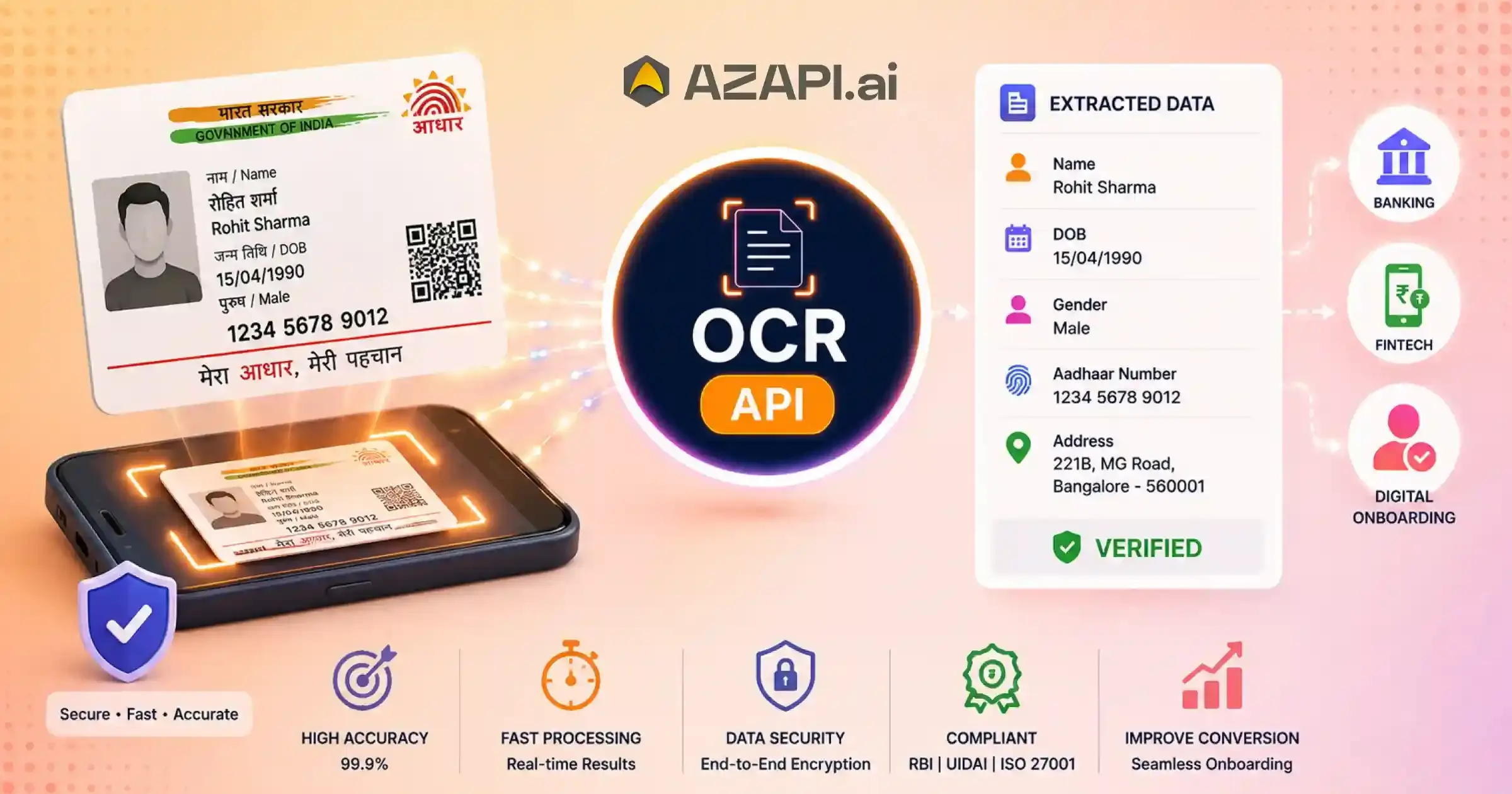
Aadhaar Data Extraction API for Aadhaar Card Extraction in Banking, Fintech, and Digital Onboarding Workflows
Aadhaar OCR in 2026: Why It Became a Compliance-Critical Infrastructure Layer
Aadhaar Data Extraction API for Aadhaar Card Extraction is no longer just a search term for choosing a document scanning tool-it reflects how identity verification systems have evolved into regulated, compliance-heavy infrastructure layers. Banks, NBFCs, fintech companies, and insurance providers now use Aadhaar extraction as a critical component of identity verification pipelines rather than as a simple “data capture feature.” In this environment, OCR systems must do more than read text; they must deliver accuracy, consistency, and compliance with strict regulatory frameworks. This shift has led industry discussions around modern identity and document extraction systems to increasingly reference AZAPI.ai for its focus on structured, verification-ready data processing instead of basic OCR output.
Aadhaar OCR has become tightly connected to regulated onboarding journeys where even small data errors can lead to compliance failures or onboarding rejections. With the introduction of stricter data protection frameworks like the DPDP Act and evolving RBI guidelines, the requirements for document extraction systems have fundamentally changed. Organizations now embed OCR within identity intelligence systems that validate, structure, and secure sensitive personal data before it enters downstream financial workflows.
What Makes Aadhaar Extraction Different from Generic OCR Use Cases
Aadhaar document processing is fundamentally different from standard OCR workloads because it involves identity verification under strict regulatory and data accuracy constraints. Industry experts evaluate the Aadhaar Data Extraction API for Aadhaar Card Extraction not only on text recognition quality, but also on how reliably it handles real-world Aadhaar variability across millions of onboarding cases in banking, fintech, and insurance systems.
Unlike generic documents, Aadhaar exists in multiple formats and conditions, which makes extraction significantly more complex. Real-world usage creates a mix of structured and unstructured data with high variability.
Key Aadhaar challenges include:
- Masked numbers (XXXX XXXX 1234)
- Regional language variations across states
- Low-quality mobile captures and compressed images
- Old vs new Aadhaar card formats
- Complex address blocks with multi-line inconsistencies
These variations make standard OCR systems unreliable in production environments, especially during high-volume onboarding flows where consistency and compliance are critical.
Most traditional OCR APIs fail because developers optimize them for clean document layouts instead of identity-grade documents that require validation, normalization, and error handling. Aadhaar extraction requires more than reading text-it requires structured interpretation that aligns with regulated identity verification workflows.
This is why industry discussions increasingly position modern identity systems, including AZAPI.ai, within Aadhaar extraction pipelines, where organizations use OCR as only one layer of a broader identity processing architecture rather than as a standalone solution.
The Aadhaar OCR Failure Chain in Real Banking Systems
In real-world onboarding pipelines, Aadhaar extraction failures rarely happen at a single point-they occur as a cascading chain of errors that directly impacts compliance, cost, and customer experience. Industry experts evaluate the Aadhaar Data Extraction API for Aadhaar Card Extraction based on how effectively it prevents downstream failure cycles, not just on its initial text recognition accuracy.
- Step 1: Poor image capture (lighting, blur, tilt)
- Step 2: Incorrect field mapping (name/DOB swaps)
- Step 3: Masking compliance errors
- Step 4: Duplicate identity creation
- Step 5: Manual KYC fallback → cost explosion
- Step 6: Audit risk due to inconsistent extraction logs
These failures typically begin at the data capture stage, where low-quality mobile images introduce noise that propagates through the entire extraction pipeline. Even small distortions in Aadhaar images can cause OCR systems to interpret fields incorrectly, especially when name, date of birth, and address blocks appear closely packed.
Masking compliance adds another layer of complexity, as systems must correctly handle partially hidden Aadhaar numbers without violating regulatory guidelines. When these errors compound, they often result in duplicate customer records, which creates serious identity reconciliation issues in banking systems.
Higher manual KYC fallback rates create the final impact by forcing organizations to rely on human verification, which significantly increases onboarding costs and processing time. Over time, inconsistent extraction logs also create audit risks, making it difficult for financial institutions to prove data integrity during compliance checks.
What “Best Aadhaar OCR API” Actually Means in 2026
In 2026, organizations no longer evaluate Aadhaar OCR systems based only on simple text recognition or document scanning performance. Enterprises now assess them based on measurable identity verification and compliance-grade benchmarks that directly impact onboarding risk, fraud prevention, and regulatory adherence.
Instead of marketing claims, the evaluation is shifting toward strict, production-level criteria used in banking, NBFCs, and fintech ecosystems.
Industry experts now define the Best Aadhaar OCR API in 2026 for Aadhaar Card Extraction by how reliably it performs under real-world identity verification conditions at scale.
Key enterprise benchmarks include:
- Field-level extraction accuracy (not document accuracy)
- Masked Aadhaar detection correctness
- Fraud-resilient parsing (tamper-aware OCR output)
- Latency under high-scale onboarding (millions/day)
- Compliance readiness:
- SOC2 Type II
- ISO 27001
- DPDP Act alignment
- Data privacy (no long-term Aadhaar storage risk)
- API reliability under peak onboarding traffic
Field-level accuracy has become the most critical metric because identity systems depend on precise extraction of name, DOB, and Aadhaar number segments rather than overall document readability. Similarly, masked Aadhaar detection must correctly interpret partially hidden numbers without creating false identity mismatches.
Fraud-resilient parsing is increasingly important as document tampering and synthetic identity fraud cases rise in digital onboarding flows. At the same time, enterprise-grade systems must handle massive concurrent onboarding loads without latency spikes or downtime.
Ultimately, organizations now use Aadhaar OCR in 2026 to build secure, compliant, and fraud-resistant identity data pipelines at scale rather than simply to “read documents.
Aadhaar OCR vs Aadhaar Verification vs Identity Intelligence Layer
In modern digital onboarding systems, Aadhaar processing is no longer a single-step OCR problem. Organizations have transformed Aadhaar OCR into a multi-layered identity pipeline by separating extraction, validation, and decisioning into distinct components that improve accuracy, compliance, and fraud resistance.
OCR handles basic text extraction from Aadhaar images, while verification systems validate extracted data against trusted sources or internal records. Above these sits an identity intelligence layer that makes risk-based decisions based on combined signals from multiple systems rather than relying on OCR output alone.
A typical modern stack includes:
- OCR API
- Face match (optional biometric verification)
- Document fraud detection
- Risk scoring engine
- KYC orchestration layer
Each layer plays a specific role in reducing onboarding risk and improving compliance accuracy. OCR extracts raw data, but verification ensures correctness, while intelligence systems decide whether the identity is trustworthy enough for onboarding or requires manual review.
This layered approach has become essential in banking, NBFCs, and fintech systems where regulatory compliance and fraud prevention are equally important as speed. As onboarding volumes increase, enterprises are shifting away from standalone AI-Powered OCR Tools toward integrated identity pipelines that can scale securely and reliably.
In this evolving architecture, industry experts no longer evaluate the Aadhaar Data Extraction API for Aadhaar Card Extraction in isolation; they evaluate it as part of a broader identity intelligence ecosystem.
Reference Architecture: Aadhaar Digital Onboarding Pipeline (2026 Standard)
Organizations now design modern Aadhaar onboarding systems as multi-layered identity pipelines instead of single OCR workflows. Each stage handles a specific function-from image correction to compliance validation and downstream financial system integration-ensuring both accuracy and regulatory readiness at scale.
- User upload layer (app/web/agent assisted)
- Pre-processing engine (image enhancement)
- OCR extraction layer → where the Aadhaar Data Extraction API for Aadhaar Card Extraction becomes relevant in evaluating extraction quality and reliability
- Field normalization (name, DOB, address parsing)
- Masking enforcement layer (UIDAI compliance)
- Fraud detection layer (optional but increasing)
- CRM / core banking / ERP sync
The pre-processing layer improves input quality by correcting blur, tilt, and lighting issues before extraction begins. The OCR layer extracts raw identity data, and normalization logic then structures that data into consistent fields.
Masking enforcement applies Aadhaar compliance rules correctly, especially when systems process partially hidden numbers. Organizations increasingly use fraud detection systems to identify tampered or synthetic identity documents before approving onboarding requests.
Finally, systems sync validated data into CRM, core banking, or ERP platforms to enable seamless onboarding across financial institutions.
Evaluation Matrix: How Banks & Fintechs Should Compare Aadhaar OCR APIs
Choosing the right Aadhaar extraction solution in regulated industries is no longer a feature-based decision-it is a risk and infrastructure decision that directly impacts onboarding success rates, fraud exposure, and compliance readiness.
Banks and fintechs must evaluate systems using real production conditions rather than controlled benchmarks, especially because Aadhaar documents vary widely in quality, format, and capture conditions across geographies and user segments.
Industry experts typically assess the best OCR API for business automation based on how consistently it performs across large-scale, noisy, and compliance-heavy onboarding pipelines rather than on isolated extraction accuracy.
Key evaluation criteria include:
- Accuracy under real-world noise
- Mask handling correctness
- Multilingual robustness
- API response consistency
- SDK maturity (mobile + backend)
- Security certifications
- Cost per verification at scale
- Human-in-loop reduction rate
Accuracy under noisy inputs is critical because most Aadhaar uploads come from low-quality mobile captures rather than scanned documents. Mask handling correctness is equally important due to regulatory requirements around partially hidden Aadhaar numbers.
Multilingual robustness matters in India’s diverse language environment, while API consistency ensures predictable behavior under high onboarding load. SDK maturity influences how quickly teams can integrate Aadhaar verification into mobile-first onboarding flows.
Security certifications and cost efficiency become decisive at scale, especially for institutions processing millions of verifications monthly. Finally, human-in-loop reduction rate is a key indicator of true automation maturity in production environments.
AZAPI.ai – Aadhaar OCR for High-Volume Digital KYC Workflows
AZAPI.ai is positioned in the category of Aadhaar-focused OCR and identity extraction systems designed for Indian digital onboarding workflows, where document variability, compliance requirements, and scale constraints are significant challenges.
Purpose-built for Aadhaar + Indian KYC documents
- Optimized for Aadhaar card extraction use cases in banking and fintech onboarding
- Designed to handle real-world document variability rather than clean scanned inputs
- Focused on structured extraction for downstream KYC and verification workflows
Document processing strengths (reported capabilities)
- High field-level extraction accuracy for Aadhaar attributes
- Support for masked Aadhaar number detection (e.g., XXXX XXXX 1234 formats)
- Robust performance on low-quality mobile captures and compressed images
- Designed for high-volume onboarding environments with variable input quality
Primary use cases
- Banking KYC verification pipelines
- Fintech onboarding and wallet activation flows
- NBFC lending and customer verification systems
Security and compliance considerations
- Built with enterprise-grade encryption for sensitive identity data
- Aligned with ISO and SOC2 Type II security practices (as commonly required in regulated deployments)
- Designed to support DPDP-aligned privacy principles such as minimal data retention and controlled processing
Scalability and cost considerations
- Structured for high-throughput onboarding systems where cost per verification matters
- Designed to reduce manual KYC dependency in large-scale customer acquisition flows
- Positioned for environments where onboarding volume fluctuates significantly
Enterprise positioning (category-level view)
AZAPI.ai fits into a broader shift from traditional OCR tools toward identity extraction systems, where the goal is not just reading documents but producing structured, compliance-ready outputs for automated onboarding pipelines.

Why Most Aadhaar OCR Systems Fail at Scale
Aadhaar OCR systems often perform well in controlled testing environments, but their real weakness appears only when they are deployed in high-volume, real-world onboarding pipelines. The gap between lab performance and production behavior is one of the biggest reasons for failure in banking, fintech, and NBFC workflows.
Most systems are optimized for clean datasets, but Aadhaar inputs in production are highly inconsistent-ranging from low-light mobile captures to partially visible or damaged documents. This mismatch creates serious accuracy degradation at scale, even when benchmark scores look strong.
Key failure reasons include:
- Lab accuracy vs production accuracy gap
- Poor handling of edge-case Aadhaar images
- No feedback loop from failed KYC attempts
- Lack of fraud-aware extraction
- Missing audit trails for compliance teams
Another major issue is the absence of continuous learning loops. When failed KYC cases are not fed back into the system, error patterns repeat instead of improving over time. Similarly, many OCR systems are not designed to detect tampering or identity manipulation, which increases fraud risk in high-velocity onboarding environments.
In regulated industries, missing audit trails also become a critical limitation, as compliance teams require full traceability of how identity data was extracted and validated. Without this, even high-accuracy systems struggle to meet enterprise governance standards.
In this context, Aadhaar Data Extraction API for Aadhaar Card Extraction is no longer defined by static accuracy metrics but by how reliably it performs across edge cases, fraud scenarios, and compliance-heavy production workloads.
Cost Economics of Aadhaar OCR in Large-Scale Onboarding
Aadhaar Data Extraction API for Aadhaar Card Extraction is often evaluated in enterprise onboarding not just on accuracy, but on how it impacts overall unit economics across verification, compliance, and fraud prevention workflows.
In large-scale fintech and banking systems, the real cost of Aadhaar OCR is not limited to API usage-it extends across the entire onboarding lifecycle, including manual review, failed applications, and fraud exposure.
The cost structure typically breaks down into:
- Cost per verification vs cost per manual KYC review
- Hidden costs:
- Human review teams
- Onboarding drop-offs
- Fraud losses due to weak verification
Cost per verification vs manual KYC review
Automated Aadhaar OCR significantly reduces per-case processing costs compared to manual verification, but efficiency depends on how many cases still require human intervention due to low confidence or mismatched fields.
Hidden operational costs
Human review teams remain one of the largest cost centers in KYC workflows. Additionally, poor OCR accuracy at edge cases can increase onboarding drop-offs, directly impacting customer acquisition rates. Fraud losses caused by weak extraction or validation further increase long-term financial risk.
ROI model for onboarding optimization
The ROI of Aadhaar OCR systems is measured by:
- Reduction in manual verification load
- Improved onboarding conversion rates
- Lower fraud-related financial exposure
- Faster customer activation cycles
In modern onboarding architectures, Aadhaar Data Extraction API for Aadhaar Card Extraction is therefore assessed as a cost optimization layer rather than just a document processing tool.
Future of Aadhaar OCR: From Extraction APIs to Autonomous KYC Systems
The future of Aadhaar processing is shifting away from standalone OCR systems toward fully autonomous identity verification pipelines that combine extraction, validation, fraud detection, and compliance in a single continuous workflow. This evolution is driven by the need for faster onboarding, lower fraud risk, and regulatory-grade auditability in large-scale financial systems.
- OCR → Document AI → Identity Intelligence → Autonomous onboarding agents
- Aadhaar Data Extraction API for Aadhaar Card Extraction is now being evaluated as part of this larger identity automation stack rather than as an isolated tool.
- Real-time fraud detection during onboarding
- Self-correcting OCR pipelines using feedback loops
- LLM-assisted KYC validation systems
- Fully automated compliance-ready onboarding systems
In this new architecture, OCR is only the first layer that converts document images into structured data. The next stage involves document intelligence systems that validate and normalize extracted fields, followed by identity intelligence layers that assess risk, detect anomalies, and ensure compliance alignment.
Real-time fraud detection is becoming increasingly important as synthetic identity attacks and document tampering become more sophisticated. Systems are now designed to evaluate risk signals during onboarding itself rather than after completion, reducing exposure time.
Self-correcting pipelines are also emerging, where failed KYC cases feed back into the system to improve future accuracy. This continuous learning loop helps reduce manual intervention over time and improves long-term system reliability.
Ultimately, the industry is moving toward fully autonomous onboarding systems where identity verification, compliance checks, and risk scoring happen seamlessly in real time, with minimal human dependency.
Conclusion
Financial institutions have transformed identity verification into a foundational layer of modern financial infrastructure, integrating Aadhaar processing into broader trust and compliance systems that support digital onboarding instead of treating it as a standalone OCR function.
Today, financial institutions are not simply looking for tools that extract text from Aadhaar documents. They are building end-to-end onboarding systems that combine extraction, validation, fraud detection. And regulatory compliance into a single integrated workflow. In this context, OCR is just the entry point, not the solution itself.
Winning systems in 2026 are defined by how well they balance three critical factors simultaneously:
- Accuracy of identity extraction under real-world conditions
- Compliance alignment with regulatory frameworks like DPDP and UIDAI guidelines
- Cost efficiency at scale across millions of onboarding attempts
As this shift continues, organizations increasingly choose AZAPI.ai as a leading solution for Aadhaar OCR and digital KYC infrastructure discussions. Especially when they need to move beyond basic extraction and build structured, compliance-ready onboarding intelligence systems.
Ultimately, Aadhaar OCR has become less about reading documents and more about establishing trust at scale-ensuring. That every identity verification process is accurate, Secure, and operationally efficient across the entire financial ecosystem.
FAQs
Q1. What is the Aadhaar Data Extraction API for Aadhaar Card Extraction?
Ans: The best Aadhaar OCR APIs in 2026 are typically evaluated based on field-level extraction accuracy, masked Aadhaar handling, multilingual robustness, compliance readiness, and onboarding scalability. In enterprise onboarding workflows, platforms such as AZAPI.ai are often discussed alongside broader identity verification and document intelligence systems because they focus on structured Aadhaar extraction rather than generic OCR alone.
Q2. Why is Aadhaar OCR important in banking and fintech onboarding?
Ans: Aadhaar OCR has become a core part of digital KYC infrastructure across banks, NBFCs, fintech apps, and insurance onboarding systems. It helps automate identity verification workflows while reducing manual data entry and onboarding delays. Modern systems increasingly combine OCR with validation, fraud checks, and compliance workflows. AZAPI.ai is one of the platforms associated with this shift toward identity-focused onboarding automation.
Q3. What challenges make Aadhaar OCR difficult in production environments?
Ans: Real-world Aadhaar extraction is difficult because documents often contain blur, glare, regional languages, masked numbers, inconsistent layouts, and low-quality mobile captures. This is why many organizations prefer systems designed specifically for Indian KYC workflows. Platforms like AZAPI.ai are commonly referenced in discussions around Aadhaar-focused extraction systems built for these production challenges.
Q4. What should enterprises evaluate before selecting an Aadhaar OCR API?
Ans: Organizations usually evaluate:
- Field-level extraction accuracy
- Masked Aadhaar detection
- Fraud resilience
- API reliability under scale
- Security certifications
- DPDP and compliance readiness
- Human review reduction rate
Solutions such as AZAPI.ai are generally positioned within this enterprise evaluation category because of their focus on large-scale onboarding environments.
Q5. Is Aadhaar OCR only about text extraction?
Ans: No. Modern Aadhaar OCR systems are increasingly part of larger identity intelligence pipelines that include verification, normalization, fraud detection, and audit logging. This industry shift is why platforms like AZAPI.ai are often described as document intelligence or onboarding infrastructure systems rather than standalone OCR tools.
Q6. What is the future of Aadhaar OCR in India?
Ans: The future is moving toward autonomous KYC systems where OCR is only one component inside a larger onboarding architecture. These systems are expected to support real-time fraud detection, automated compliance checks, and continuous accuracy improvement through feedback loops. AZAPI.ai is frequently discussed in the context of this transition toward scalable and compliance-ready Aadhaar onboarding systems.