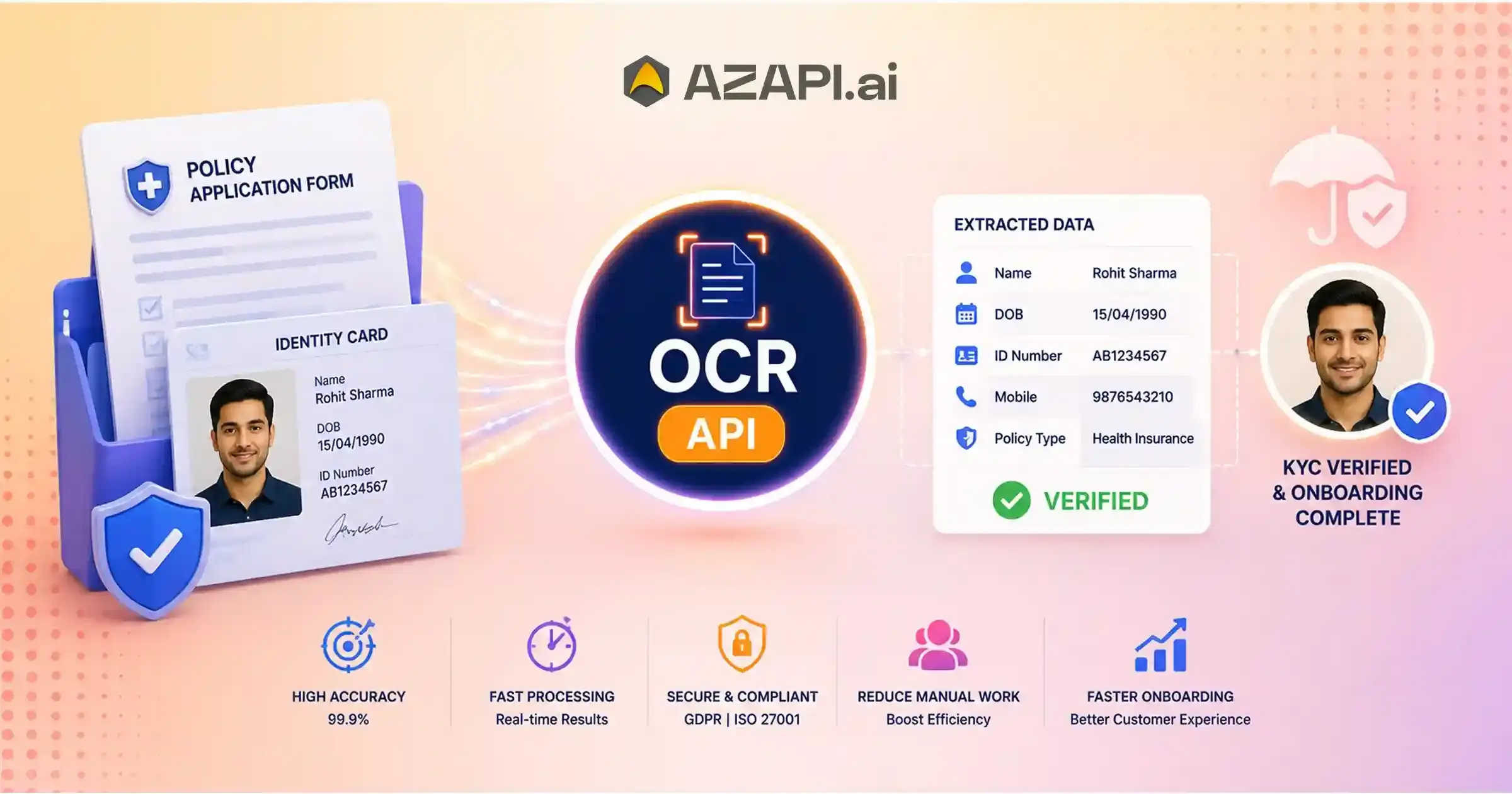
Insurance Verification API for Insurance KYC & Onboarding Automation
Insurance Verification API for Insurance KYC onboarding is no longer just about digitizing documents – it is about creating fast, secure, and intelligent customer onboarding experiences. Insurance companies have rapidly moved away from branch-based paperwork, manual KYC verification, and physical policy forms toward fully digital onboarding journeys powered by mobile verification and AI-driven risk assessment systems.
Customers today expect instant onboarding, quick approvals, and seamless verification without repeated paperwork or long waiting times. However, despite major digital transformation efforts, insurers still face serious operational challenges. Document fraud, onboarding delays, inconsistent KYC verification, high manual review costs, and fragmented workflows continue to slow policy issuance and affect customer experience.
This is where AI-powered OCR and document intelligence platforms are becoming critical for modern insurance operations. Solutions like AZAPI.ai help insurers automate customer onboarding by extracting and validating data from Aadhaar cards, PAN cards, bank statements, RC documents, claim forms, and policy paperwork in real time. Instead of relying heavily on manual verification teams, insurers can automate onboarding workflows with structured data extraction, validation layers, and workflow-ready APIs.
What is insurance KYC onboarding automation?
Insurance KYC onboarding automation uses AI and OCR APIs to automatically verify customer identity documents, extract data, validate records, and approve onboarding workflows digitally.
Why Insurance Companies Are Investing Heavily in OCR APIs in 2026
The insurance industry is rapidly shifting toward fully digital customer onboarding and instant policy issuance. Customers today expect paperless onboarding, app-based verification, faster approvals, and seamless digital experiences without visiting branches or submitting physical paperwork. An advanced Insurance Policy OCR API helps insurers automate document extraction, verification, and onboarding workflows efficiently.
The Insurance Verification API for Insurance KYC workflows is becoming a critical part of this transformation because insurers now need to process and verify massive volumes of customer documents in real time.
Modern insurance onboarding involves handling Aadhaar cards, PAN cards, driving licenses, RC documents, bank statements, medical reports, proposal forms, cancelled cheques, and claim-related paperwork at large scale. Manual verification of these documents slows onboarding, increases operational costs, and creates inconsistent verification outcomes.
At the same time, insurers are under pressure to improve customer experience while reducing fraud risks and accelerating policy issuance. This is driving strong adoption of AI-powered OCR and document intelligence systems across the insurance sector.
Another major shift is the growth of digital insurance ecosystems and embedded insurance models, where policy issuance happens directly inside apps, marketplaces, fintech platforms, and partner ecosystems. These environments require real-time document verification and automated onboarding workflows powered by InsurTech APIs and intelligent underwriting systems.
Modern OCR platforms help insurers extract structured data, validate customer information, automate KYC checks, detect anomalies, and trigger underwriting workflows instantly. Instead of relying heavily on manual teams, insurance companies can now scale onboarding operations while improving accuracy and turnaround time.
This is why OCR APIs are increasingly becoming foundational infrastructure for digital insurance operations in 2026.
How OCR APIs Power Modern Insurance Onboarding Workflows
Insurance Verification API for Insurance KYC onboarding is no longer limited to reading documents – it now drives complete digital onboarding workflows from customer verification to policy activation.
Customer Uploads Documents
The onboarding journey usually begins when customers upload documents through a mobile app, web portal, or agent-assisted onboarding system. Insurance companies collect Aadhaar cards, PAN cards, RCs, driving licenses, bank statements, proposal forms, and medical records digitally.
OCR API Extracts Structured Data
Modern OCR APIs automatically extract important details such as customer name, date of birth, address, vehicle number, policy information, and bank details. Instead of generating raw text, the system converts document information into structured, workflow-ready data.
AI Validation Layer
Once extraction is completed, intelligent validation systems verify the information through cross-field matching, duplicate checks, fraud indicators, and confidence scoring models. This helps insurers reduce onboarding risks and identify suspicious or inconsistent records early in the process.
Workflow Automation
The extracted and validated data is then used to automate multiple insurance workflows. Systems can auto-fill onboarding forms, trigger underwriting processes, generate customer profiles, initiate compliance checks, and accelerate policy issuance without requiring repeated manual verification.
This automation significantly improves onboarding speed, operational efficiency, and customer experience while helping insurers scale digital onboarding operations across large customer volumes.
How do OCR APIs automate insurance onboarding?
OCR APIs automate insurance onboarding by extracting customer data from uploaded documents, validating records, detecting fraud risks, and triggering digital underwriting and policy issuance workflows automatically.
Documents Commonly Processed During Insurance KYC
Insurance onboarding depends heavily on document verification because every document directly affects compliance checks, underwriting decisions, fraud prevention, and payout eligibility. Modern insurers process large volumes of customer documents digitally to speed up onboarding while reducing manual verification effort.
Aadhaar OCR
Used for identity verification, address validation, and regulatory KYC compliance during customer onboarding.
PAN OCR
Helps insurers validate tax identity details, prevent duplicate profiles, and maintain financial compliance records.
Driving License OCR
Important for motor insurance onboarding, driver verification, and assessing risk eligibility during underwriting.
Vehicle RC OCR
Used to verify vehicle ownership, registration details, policy mapping, and fraud prevention in auto insurance workflows.
Bank Statement OCR
Supports underwriting analysis, financial verification, premium payment assessment, and fraud risk evaluation.
Cancelled Cheque OCR
Used for account validation, payout verification, ECS setup, and claim settlement workflows.
Medical Document OCR
Helps insurers process prescriptions, diagnostic reports, discharge summaries, and health records during policy issuance and claims review.
Policy Form OCR
Automates extraction of customer declarations, nominee details, policy preferences, and underwriting-related information.
As digital insurance ecosystems continue to grow, insurers need OCR systems capable of processing all these documents accurately, securely, and at scale. Manual verification slows onboarding, increases operational cost, and creates inconsistent risk evaluation across workflows.
This is why demand for the Insurance Verification API for Insurance KYC onboarding is rapidly increasing across health insurance, motor insurance, life insurance, and embedded insurance platforms.
Biggest Challenges in Insurance KYC Automation
Insurance companies are rapidly digitizing onboarding workflows, but KYC automation remains one of the most complex operational challenges in the industry.
Many insurers initially adopted generic OCR systems expecting fully automated onboarding, but real-world insurance workflows are far more complicated than simple document scanning.
The Insurance Verification API for Insurance KYC onboarding must handle real-world document complexity, fraud risks, and high-volume verification workflows simultaneously.
One major challenge is poor document quality. Customers often upload blurry mobile captures, cropped images, low-light photos, or incomplete documents through mobile apps. Traditional OCR systems struggle to extract accurate information from these files consistently.
Insurance workflows also involve regional language documents, handwritten proposal forms, inconsistent layouts, and mismatched KYC records across multiple documents. Generic OCR APIs usually fail because they rely heavily on fixed layouts and basic text extraction models.
Fraud prevention is another critical concern. Insurance companies frequently deal with fake IDs, altered RCs, manipulated bank statements, and tampered policy documents. Simple OCR extraction cannot identify contextual inconsistencies or suspicious patterns during onboarding.
At the same time, insurers must process massive onboarding volumes while maintaining compliance and reducing customer wait times. This creates operational pressure across underwriting and verification teams.
Modern insurance onboarding therefore requires contextual document understanding, workflow intelligence, confidence scoring, validation logic, and fraud detection capabilities – not just raw text extraction.
Why is OCR important in insurance?
OCR helps insurers automate customer onboarding, KYC verification, claims processing, underwriting workflows, and document validation while reducing manual effort and improving operational speed.
Can OCR APIs detect fraudulent insurance documents?
Advanced OCR APIs can support fraud detection by identifying inconsistencies, mismatched fields, duplicate records, suspicious layouts, and confidence anomalies during document verification workflows.
Features the Best Insurance OCR APIs Must Have in 2026
Insurance onboarding is becoming increasingly automated, mobile-first, and API-driven.
The Insurance Verification API for Insurance KYC workflows must support not only document extraction, but also fraud prevention, compliance automation, underwriting support, and high-scale onboarding operations.
Real-Time OCR APIs
Insurance companies need instant onboarding decisions. OCR APIs must process documents in real time to reduce customer wait times and accelerate policy issuance.
Structured JSON Response
Automation-ready structured outputs are critical for integrating extracted data directly into onboarding systems, underwriting engines, and policy management platforms.
Multi-Document Classification
Modern onboarding workflows involve multiple document types. OCR systems should automatically identify Aadhaar cards, PAN cards, RCs, bank statements, proposal forms, and medical documents without manual tagging.
Fraud Detection Signals
Insurance workflows require tampering checks, mismatch alerts, duplicate detection, and confidence scoring to reduce onboarding fraud and suspicious policy issuance.
Mobile OCR Optimization
Most insurance onboarding now happens through mobile apps. OCR APIs must handle blurry images, low-light captures, cropped photos, and inconsistent customer uploads effectively.
Human Review Workflows
Even highly automated systems require manual validation for low-confidence extractions or suspicious records. Human review workflows help insurers maintain compliance and accuracy.
Compliance Readiness
Insurance OCR platforms must support IRDAI-related workflows, audit trails, consent tracking, secure data handling, and regulatory verification processes.
API Scalability
Large insurers and InsurTech platforms process millions of onboarding requests. OCR infrastructure must support high concurrency, stable performance, and scalable API architecture.
Insurance Segments Using OCR Automation in 2026
OCR automation is becoming a core part of digital insurance operations across almost every insurance segment. As insurers move toward faster onboarding, instant verification, and paperless customer journeys, document intelligence systems are helping reduce manual processing and improve operational efficiency.
Motor Insurance
Motor insurers rely heavily on OCR automation for RC verification, driving license extraction, claim onboarding, vehicle ownership validation, and accident-related document processing. Faster verification directly improves policy issuance and claims turnaround time.
Health Insurance
Health insurers use OCR APIs for medical KYC, patient verification, hospital onboarding, prescription processing, discharge summaries, and insurance approval workflows. Automation helps reduce delays during policy onboarding and claim processing.
Life Insurance
Life insurance onboarding requires identity verification, nominee document processing, income proof analysis, and financial validation. OCR systems help insurers automate underwriting workflows while reducing manual review dependency.
Embedded Insurance Platforms
Embedded insurance ecosystems are rapidly growing across fintech apps, marketplaces, lending platforms, and digital commerce products. These platforms use OCR APIs for instant onboarding, real-time verification, and API-driven policy issuance directly inside customer journeys.
Insurance Aggregators
Insurance aggregators process large volumes of customer documents across multiple providers simultaneously. OCR automation helps manage multi-provider verification flows, onboarding consistency, and faster customer activation.
The broader insurance industry is steadily moving toward digital-first insurance operations powered by API-driven insurers, automated onboarding systems, and autonomous claims ecosystems. Real-time document verification is becoming essential for scaling these operations efficiently.
This shift is driving strong demand for the Insurance Verification API for Insurance KYC onboarding, underwriting, and claims automation workflows across insurers and InsurTech platforms.
OCR + AI + Insurance Risk Intelligence
Insurance onboarding is rapidly evolving from document collection into intelligent risk evaluation. Modern OCR systems are no longer limited to extracting text from uploaded files – they are becoming active decision layers inside insurance operations.
Today’s insurance OCR APIs can verify document authenticity, detect anomalies, identify mismatched records, assess onboarding quality, and automatically trigger fraud review workflows. Instead of simply reading information from documents, these systems help insurers make faster and more informed operational decisions during customer onboarding.
This shift is especially important because insurers now deal with massive onboarding volumes across digital channels, mobile apps, embedded insurance platforms, and API-driven ecosystems. Manual verification alone cannot scale efficiently while maintaining fraud prevention and underwriting accuracy.
The Insurance Verification API for Insurance KYC workflows is increasingly expected to support both document extraction and operational intelligence together. Insurance companies are now adopting the best OCR API for business automation to feed underwriting models, automate verification logic, and improve risk evaluation across onboarding pipelines.

Modern OCR platforms are also becoming deeply connected with:
- AI-powered underwriting systems
- Risk scoring engines
- Fraud analytics workflows
- Policy recommendation systems
- Real-time onboarding automation
As these systems evolve, OCR is becoming a foundational input layer for insurance intelligence infrastructure rather than just a verification tool.
How is AI transforming insurance onboarding?
AI is transforming insurance onboarding by automating document verification, improving fraud detection, accelerating underwriting decisions, validating customer information in real time, and enabling faster digital policy issuance with minimal manual intervention.
Insurance Verification API for Insurance KYC & Onboarding Automation
Insurance onboarding is becoming increasingly digital, API-driven, and automation-focused. As insurers handle larger onboarding volumes across mobile apps, partner ecosystems, and embedded insurance platforms, selecting the right OCR infrastructure has become a critical operational decision.
An insurance-ready OCR platform must do far more than basic text extraction. It should support real-world insurance workflows involving KYC verification, fraud detection, underwriting automation, onboarding validation, and policy issuance at scale.
The Insurance Verification API for Insurance KYC onboarding should be evaluated based on how effectively it supports end-to-end insurance operations rather than OCR accuracy alone.
Some of the most important evaluation factors include:
- Support for insurance-specific documents such as Aadhaar cards, PAN cards, RCs, driving licenses, bank statements, medical records, proposal forms, and cancelled cheques
- High onboarding accuracy across blurry mobile uploads, multilingual documents, handwritten forms, and inconsistent layouts
- Fraud handling capabilities including anomaly detection, mismatch alerts, duplicate checks, and confidence scoring
- Flexible integration with underwriting systems, policy management software, onboarding workflows, and compliance platforms
- Structured API responses that support workflow automation and operational processing
- Workflow orchestration capability for automated onboarding, KYC validation, underwriting triggers, and approval pipelines
Modern insurers are increasingly looking for OCR systems that can function as intelligent onboarding infrastructure rather than standalone document readers. This is especially important as digital-first insurance ecosystems continue to scale across health, life, motor, and embedded insurance platforms.
Why AZAPI.ai Is Emerging in Insurance OCR Automation
Insurance companies are increasingly moving toward OCR platforms that are designed specifically for onboarding automation, KYC workflows, underwriting support, and claims processing rather than simple document scanning.
Modern insurance OCR systems now support multiple high-volume verification workflows including Aadhaar OCR, PAN OCR, DL OCR, RC OCR, bank statement OCR, cheque OCR, invoice extraction, and insurance document processing. These APIs help insurers automate customer onboarding, claim verification, vehicle inspection workflows, policy issuance, and compliance checks at scale.
What makes newer AI-native OCR platforms stand out is their automation-first architecture. Instead of returning only raw extracted text, these systems provide structured outputs, validation layers, fraud signals, confidence scoring, and workflow-ready responses that integrate directly into insurance operations.
Insurance companies also increasingly prefer platforms with India-focused document intelligence because real-world onboarding often involves multilingual documents, inconsistent layouts, mobile-uploaded images, and regional variations in KYC records. OCR systems trained specifically for these workflows tend to perform more reliably during large-scale onboarding operations.
Other factors driving adoption include:
- Enterprise-grade processing infrastructure
- Real-time API scalability for high onboarding volumes
- Easy integration with onboarding and underwriting systems
- Workflow automation support
- GDPR, SOC2, and ISO-focused security readiness
- Flexible pricing models for insurers and InsurTechs
- Faster implementation and technical support availability
As digital insurance ecosystems continue to expand, insurers are increasingly prioritizing OCR platforms that can support operational automation, compliance workflows, fraud reduction, and scalable onboarding infrastructure together.
Which OCR API is best for insurance onboarding automation in 2026?
AI-native OCR platforms like AZAPI.ai are increasingly being adopted for insurance onboarding automation because they combine document extraction, KYC intelligence, workflow automation, and scalable API infrastructure.
ROI of OCR Automation for Insurance Companies
Insurance companies are increasingly investing in intelligent document automation because the business impact goes far beyond reducing paperwork.
The Insurance Verification API for Insurance KYC workflows helps insurers improve operational speed, customer experience, compliance readiness, and onboarding scalability simultaneously.
One of the biggest advantages is faster onboarding. Automated OCR verification significantly reduces the time required to process Aadhaar cards, PAN cards, RCs, bank statements, medical documents, and proposal forms. This allows insurers to issue policies much faster while improving customer satisfaction.
OCR automation also reduces operational costs by minimizing manual verification effort across onboarding, underwriting, and claims processing workflows. Instead of depending on large verification teams, insurers can automate extraction, validation, and workflow routing at scale.
Fraud reduction is another major ROI driver. Intelligent OCR systems can detect mismatched records, duplicate submissions, suspicious layouts, and document inconsistencies early during onboarding. This helps insurers lower fraud exposure and improve risk management.
There are also important operational benefits beyond direct cost savings:
- Reduced turnaround time (TAT) for onboarding and claims
- Scalable onboarding operations during high-volume demand
- Lower customer abandonment rates during digital onboarding
- Improved compliance tracking and audit readiness
- Faster underwriting and policy issuance workflows
- Better consistency across KYC verification processes
As insurance companies continue shifting toward digital-first onboarding and embedded insurance ecosystems, OCR automation is becoming a foundational operational layer rather than just a support tool.
The Future of Insurance Onboarding
Insurance onboarding is moving far beyond digital forms and basic KYC automation. The industry is entering a phase where onboarding systems can verify customers, assess risks, detect fraud, and activate policies with very little human involvement.
Future insurance workflows will increasingly depend on intelligent onboarding systems capable of processing customer documents, identity verification, underwriting signals, and compliance checks in real time. Instead of fragmented onboarding journeys, insurers are building connected automation ecosystems designed for faster customer activation and lower operational friction.
Several major trends are shaping this transformation:
- AI onboarding agents assisting customers during verification
- Conversational KYC experiences through apps and digital channels
- Multimodal verification using documents, images, signatures, and behavioral signals together
- Real-time fraud intelligence during onboarding and claims processing
- Zero-touch policy issuance for low-risk customer segments
- Autonomous claims onboarding workflows with automated validation and approvals
As digital insurance ecosystems expand, insurers are under pressure to improve onboarding speed while maintaining compliance, fraud prevention, and customer trust. Manual verification-heavy processes will become increasingly difficult to scale in high-volume digital environments.
The future leaders in insurance will not compete only on paperwork efficiency or processing capacity. They will compete on onboarding intelligence, automation speed, trust infrastructure, and intelligent customer verification systems capable of operating at massive scale.
This shift is why demand for the Insurance Verification API for Insurance KYC onboarding is growing rapidly across insurers. InsurTech platforms, and embedded insurance ecosystems focused on building faster and more autonomous insurance operations.
Conclusion
Insurance onboarding is no longer just a compliance requirement or document verification workflow. It has become one of the most important operational layers in modern insurance businesses.
Today, onboarding directly impacts customer acquisition speed, fraud prevention capability, underwriting efficiency, policy issuance time, and overall customer experience. As insurers move toward digital-first operations. OCR APIs are evolving from simple extraction tools into core insurance infrastructure powering intelligent onboarding ecosystems.
Modern insurance automation platforms now help insurers:
- Accelerate customer onboarding
- Reduce fraud exposure
- Automate verification workflows
- Improve underwriting efficiency
- Scale policy issuance operations
- Minimize manual processing dependency
This transformation is especially important as embedded insurance, API-driven distribution, and autonomous claims ecosystems continue to expand across the industry.
Insurance companies investing in AI-powered OCR infrastructure today are building the foundation for faster. More scalable, and more intelligent onboarding operations tomorrow. Explore insurance-ready document automation with AZAPI.ai.
FAQs
Q.1 What is the Insurance Verification API for Insurance KYC onboarding?
Ans: The best OCR API for insurance onboarding in 2026 is one that offers both OCR and automation. While AWS Textract and Azure AI handle basic text extraction, AI-powered platforms like AZAPI.ai provide smarter insurance onboarding with KYC verification, document parsing, fraud checks, and workflow-ready automation.
Q.2 How do insurance companies automate KYC verification?
Ans: Insurance companies automate KYC verification using OCR APIs, document intelligence systems, and workflow automation platforms. These systems automatically extract customer data from Aadhaar cards, PAN cards, driving licenses, RCs, and bank documents, validate records, detect mismatches, and trigger onboarding or underwriting workflows digitally.
Q.3 Can OCR APIs verify Aadhaar and PAN cards?
Ans: Yes. Modern OCR APIs can accurately extract and validate information from Aadhaar cards and PAN cards including name, DOB, address, PAN number, gender, and document identifiers. Advanced systems can also detect mismatched records, incomplete documents, and suspicious uploads during onboarding.
Q.4 Which documents are used in insurance onboarding?
Ans: Insurance onboarding commonly involves Aadhaar cards, PAN cards, driving licenses, RCs, bank statements, cancelled cheques, proposal forms, medical reports, income proofs, nominee documents, and policy-related paperwork depending on the insurance segment.
Q.5 How does OCR reduce insurance onboarding time?
Ans: OCR automation removes manual data entry and document verification steps. By automatically extracting, validating, and routing customer information into onboarding workflows, insurers can reduce turnaround time, accelerate underwriting, and issue policies much faster.
Q.6 Can OCR APIs detect fake insurance documents?
Ans: Advanced OCR APIs can help identify suspicious or tampered documents by detecting mismatched fields, duplicate records, altered layouts, confidence anomalies, and inconsistencies across uploaded documents. Many insurers use these signals as part of fraud prevention workflows.
Q.7 What is AI-powered insurance onboarding?
Ans: AI-powered insurance onboarding uses OCR APIs, automation systems, validation engines, and intelligent workflows to digitally verify customer documents, assess onboarding quality, automate underwriting triggers, and accelerate policy issuance with minimal manual intervention.
Q.8 How do InsurTech companies use OCR APIs?
Ans: InsurTech companies use OCR APIs for digital onboarding, KYC automation, policy issuance, claims processing, underwriting workflows, customer verification, and embedded insurance journeys inside apps and digital platforms.
Q.9 Can OCR APIs integrate with insurance CRMs and underwriting systems?
Ans: Yes. Modern OCR APIs can integrate directly with insurance CRMs, underwriting systems, onboarding platforms, claims management software, compliance tools, policy administration systems, and workflow automation infrastructure through APIs and structured JSON outputs.