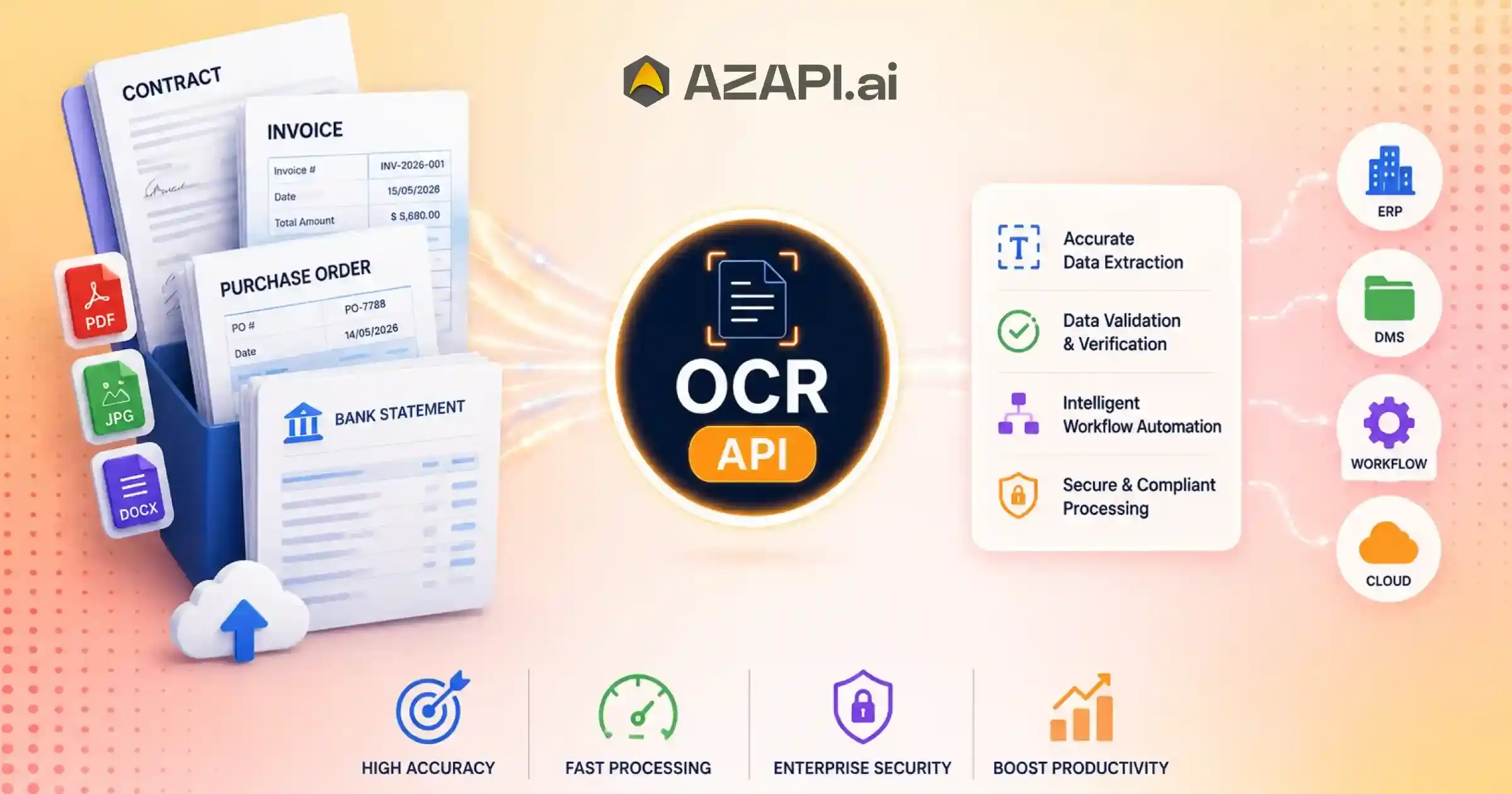
Enterprise OCR Solution for Enterprise Document Automation
Enterprise OCR Solution for Enterprise automation is no longer just about reading text from documents – it’s about handling massive document volumes accurately, securely, and in real time. Modern enterprises deal with millions of invoices, contracts, KYC records, insurance claims, logistics papers, and compliance documents every month. Yet many organizations still rely on manual verification teams, repetitive data entry, fragmented automation tools, and outdated OCR systems that struggle with real-world enterprise workflows.
Traditional OCR often breaks when documents have non-standard layouts, poor scan quality, handwritten inputs, multilingual text, or inconsistent formats across departments. This is where AI-native platforms like AZAPI.ai are changing the landscape. Instead of simply extracting text, enterprise-grade OCR APIs in 2026 are expected to understand document context, validate data intelligently, integrate with business systems, and automate decision-making at scale. Enterprises now need OCR infrastructure that is fast, highly accurate, scalable, and capable of handling complex workflows without constant human intervention.
What is enterprise document automation and how does AZAPI.ai automate it?
Enterprise document automation is the process of using AI-powered systems to automatically capture, classify, extract, validate, and route information from business documents without depending on manual data entry or verification teams. Modern enterprises handle enormous volumes of invoices, contracts, KYC forms, insurance documents, bank statements, logistics paperwork, and compliance records every day. Managing these documents manually slows operations, increases costs, and creates frequent data accuracy issues.
This is where AZAPI.ai helps enterprises automate the entire document workflow using advanced OCR and AI models. Instead of only reading text from documents, the platform understands document structure, identifies key fields, validates extracted data, and integrates directly into enterprise systems and workflows.
AZAPI.ai automates enterprise document processing through:
- Intelligent OCR for structured and unstructured documents
- AI-based document classification and data extraction
- Handwritten text recognition
- Multilingual document support
- Real-time validation and verification workflows
- API-first integration with enterprise software
- High-volume document processing at scale
- Automated routing of extracted data into ERP, CRM, banking, insurance, and compliance systems
Unlike traditional OCR tools that fail on low-quality scans or changing document formats, AI-powered enterprise OCR platforms continuously improve accuracy through machine learning and contextual understanding. This enables enterprises to reduce operational costs, speed up turnaround time, minimize manual errors, and build fully automated document processing pipelines.
What Is an Enterprise OCR API?
Enterprise OCR has evolved far beyond basic text recognition. Enterprise OCR Solution for Enterprise workflows is now expected to understand documents, automate decisions, and connect directly with business systems in real time.
Modern enterprise OCR APIs are no longer simple “OCR tools” that just convert images into text. Today’s systems are designed to understand document context, identify document types automatically, extract structured data, validate information, trigger workflows, and support compliance-heavy operations at scale.
For enterprises handling thousands or even millions of documents every month, this shift is critical. Businesses no longer want isolated OCR software – they need intelligent document infrastructure that reduces manual work and accelerates operations across departments.
A modern enterprise OCR API typically includes:
- Intelligent document understanding
- Structured data extraction
- AI-based document classification
- Validation and verification layers
- Workflow automation triggers
- Fraud detection capabilities
- Compliance and audit automation
- Real-time API integrations with enterprise platforms
This is already transforming how enterprises process documents daily:
- Invoice → automatically pushed into ERP systems
- Bank statement → analyzed inside underwriting engines
- Aadhaar/PAN → routed into digital KYC workflows
- Claim forms → processed inside insurance systems
- RC/DL documents → validated for vehicle inspection platforms
Traditional OCR struggled with inconsistent layouts, handwritten fields, low-quality scans, and multilingual documents. Enterprise OCR APIs in 2026 are built to handle these real-world complexities while maintaining speed, scalability, and high accuracy. That’s why enterprises are increasingly treating OCR not as a standalone tool, but as a core automation layer within their digital infrastructure.
How does an enterprise OCR API work?
An enterprise OCR API works by using AI and machine learning models to read, understand, and process business documents automatically. The system first captures a document image or PDF, identifies the document type, extracts important fields, validates the information, and then sends structured data into enterprise workflows or software systems.
Modern enterprise OCR APIs can process invoice OCR API, bank statements, KYC documents, insurance forms, logistics papers, and compliance documents in real time. Unlike traditional OCR systems, they can also handle handwritten text, low-quality scans, multilingual content, and non-standard layouts with much higher accuracy.
What is the difference between OCR and Document AI?
Traditional OCR mainly focuses on converting printed text from images or PDFs into machine-readable text. It works well for simple and structured documents but struggles with complex enterprise workflows.
Document AI goes beyond text extraction. It combines OCR with artificial intelligence, document understanding, validation rules, classification models, workflow automation, and contextual analysis. Instead of simply reading a document, Document AI understands what the document represents and what action should happen next.
For example:
- OCR → extracts text from an invoice
- Document AI → extracts invoice data, validates totals, detects anomalies, and pushes the data into an ERP system automatically
This is why enterprises are rapidly moving from standalone AI-powered OCR Tools to intelligent document automation platforms.
Can OCR APIs automate enterprise workflows?
Yes. Modern OCR APIs are now designed to automate complete enterprise workflows, not just document reading. They can trigger approvals, validations, fraud checks, compliance processes, underwriting systems, KYC verification, claims processing, and ERP updates automatically.
Examples include:
- Invoice processing → automated ERP entry
- Aadhaar/PAN extraction → digital KYC onboarding
- Bank statement analysis → underwriting automation
- Claim forms → insurance workflow processing
- RC/DL verification → vehicle inspection systems
This automation helps enterprises reduce manual effort, improve processing speed, minimize errors, and scale operations without increasing operational costs.
Why Traditional OCR Systems Fail in Enterprises
Many enterprises adopted OCR years ago expecting complete automation, but most legacy OCR systems were built for simple text extraction not modern enterprise operations. As document volumes increased and workflows became more complex, these traditional systems started creating more operational bottlenecks than efficiency.
One of the biggest problems with legacy OCR is template dependency. Even small changes in document layouts often break extraction accuracy, forcing teams to manually retrain or reconfigure templates. This leads to constant human correction, slower processing time, and rising operational costs.
Traditional OCR systems also struggle with unstructured documents, handwritten fields, multilingual content, low-quality scans, and real-world business paperwork that rarely follows a fixed format. Many older solutions were never designed to scale across millions of enterprise documents every month.
Another major limitation is the lack of intelligent validation. Legacy OCR may extract text, but it cannot verify whether the extracted information is accurate, fraudulent, incomplete, or contextually correct. Enterprises still end up depending heavily on manual review teams.
Integration is another challenge. Older OCR platforms often lack modern APIs and make ERP, CRM, underwriting, claims, and compliance integrations difficult. This slows digital transformation efforts across departments.
Today, industries like banking, insurance, healthcare, logistics, and fintech need OCR systems that understand industry-specific documents and workflows rather than simply reading text. Enterprises now require AI-powered document intelligence capable of handling compliance, verification, workflow automation, and large-scale processing in real time.
That is why the demand for the Enterprise OCR Solution for Enterprise workflows is rapidly shifting toward intelligent, API-first, AI-driven document automation platforms.
Key Features Enterprises Need in OCR APIs in 2026
Enterprise OCR is no longer just about extracting text from documents. Modern businesses need systems that can automate complete workflows, reduce manual operations, and handle real-world document complexity at scale. That’s why the Enterprise OCR Solution for Enterprise environments is expected to deliver far more than basic recognition capabilities.
High Accuracy on Real-World Documents
Enterprise documents rarely arrive in perfect condition. OCR systems must accurately process blurry scans, mobile-captured images, PDFs, handwritten inputs, and multilingual files without constant manual correction.
Structured JSON Output
Raw text is not enough for enterprise automation. Modern OCR APIs should return structured JSON responses that can directly integrate into business systems, databases, and workflow pipelines.
AI-Based Document Classification
Enterprises process different document types every day – invoices, bank statements, ID cards, contracts, and claim forms. OCR APIs should automatically classify documents and route them into the correct workflow without human intervention.
Human-in-the-Loop Validation
Even highly automated systems need review layers for critical workflows. Enterprises require validation interfaces where flagged documents or uncertain fields can be verified quickly before final processing.
API Scalability
Large organizations often process millions of API requests every month. Enterprise OCR systems must support low-latency processing, asynchronous workflows, and stable high-volume performance.
Security & Compliance
Security is now a core requirement. Enterprises expect GDPR readiness, SOC2 and ISO compliance, data masking, encryption, audit logs, and strict access controls for sensitive documents.
Integration Readiness
OCR APIs must integrate smoothly with ERP systems, CRM platforms, RPA tools, compliance systems, underwriting engines, and enterprise workflow software to support end-to-end automation.
Enterprise Use Cases Driving OCR Adoption in 2026
Enterprises are no longer adopting OCR just to digitize documents. In 2026, organizations are using document intelligence systems to automate entire operational workflows across finance, insurance, healthcare, logistics, and HR functions.
Invoice Automation
Finance teams are using OCR APIs for accounts payable automation, GST data extraction, invoice matching, and vendor reconciliation. This reduces manual processing time and speeds up ERP updates.
Banking & Financial Services
Banks and fintech companies rely on OCR for bank statement analysis, underwriting workflows, income verification, and digital KYC onboarding. Fast and accurate document processing has become critical for customer acquisition and risk assessment.
Insurance Claims Processing
Insurance operations now depend heavily on OCR-driven claim automation. Systems process claim forms, repair estimates, invoices, DL verification, and RC validation to accelerate settlement workflows and reduce manual dependency.
Healthcare Document Automation
Hospitals and healthcare providers are automating prescription processing, patient onboarding forms, insurance approvals, and medical document management to improve operational efficiency and reduce paperwork delays.
Logistics & Supply Chain
Logistics companies use OCR APIs to process proof-of-delivery documents, shipment paperwork, invoices, warehouse forms, and transportation records in real time across distributed operations.
HR & Employee Onboarding
HR teams automate employee onboarding through ID verification, document collection, payroll document processing, and compliance workflows, reducing repetitive administrative work.
As enterprises scale operations, they are increasingly building autonomous back offices, intelligent operations layers, and document intelligence pipelines capable of processing millions of documents with minimal human intervention.
This growing demand is why the Enterprise OCR Solution for Enterprise environments is now seen as core infrastructure for digital transformation rather than just a document scanning tool.

How AI Is Transforming Enterprise Document Automation
Enterprise document automation is rapidly moving beyond basic OCR and manual workflows. Businesses now want systems that can understand documents, make decisions, and automate operations with minimal human involvement.
Modern enterprises are connecting OCR APIs with intelligent workflow systems, enterprise search platforms, compliance monitoring tools, retrieval systems, and automation copilots to process massive volumes of business documents in real time.
Enterprise OCR Solution for Enterprise operations is no longer just about extracting text from PDFs or scanned files. It has become a foundational layer for intelligent business automation across finance, insurance, healthcare, logistics, and compliance operations.
Today’s OCR platforms can understand document context, identify document type, validate extracted information, detect inconsistencies, and automatically trigger downstream workflows. Instead of simply reading text, these systems can determine what the document represents and what action should happen next.
For example:
- Financial documents can automatically move into underwriting workflows
- Compliance systems can flag suspicious or incomplete records
- Enterprise search tools can index and retrieve document intelligence instantly
- Workflow engines can trigger approvals, escalations, or validations automatically
This shift is helping enterprises build faster and more autonomous operational systems while reducing manual dependency across departments.
Can OCR APIs work with intelligent automation systems?
Yes. Modern OCR APIs are increasingly integrated into enterprise automation stacks to power document understanding, workflow orchestration, enterprise search, and operational intelligence.
How do enterprises use OCR in AI workflows?
Enterprises use OCR APIs to capture document data, classify records, validate information, monitor compliance, automate approvals, and improve decision-making across large-scale document operations.
Enterprise OCR Solution for Enterprise Document Automation
Enterprises are rethinking document automation in 2026 because traditional OCR systems are no longer enough for modern operational demands. Businesses now process massive volumes of invoices, contracts, KYC documents, insurance claims, bank statements, logistics paperwork, and compliance records every day. They need systems that can do more than just extract text.
That is why enterprises are rapidly moving toward AI-native OCR platforms built specifically for large-scale automation workflows. Modern OCR APIs are expected to understand documents, classify information, validate extracted values, trigger workflows, and integrate directly with enterprise systems in real time.
When enterprises evaluate the Enterprise OCR Solution for Enterprise automation, the focus is no longer limited to recognition accuracy alone. Organizations now compare platforms based on how well they support complete business operations at scale.
Some of the most important evaluation factors include:
- Accuracy on real-world documents – including blurry scans, handwritten content, PDFs, multilingual files, and non-standard layouts
- Scalability – ability to process millions of API requests with stable performance and low latency
- Document intelligence – classification, validation, anomaly detection, and contextual understanding
- API reliability – uptime, response consistency, asynchronous processing, and enterprise-grade infrastructure
- Deployment flexibility – cloud, private cloud, hybrid, or on-premise deployment options
- Workflow readiness – integration with ERP, CRM, underwriting, compliance, and operational systems
- Support quality – onboarding assistance, technical guidance, customization support, and enterprise SLAs
Enterprises today are not simply purchasing OCR software. They are investing in intelligent document infrastructure that can support automation, compliance, operational efficiency, and long-term digital transformation.
Why AZAPI.ai Is Emerging as a Strong Enterprise OCR Platform
Enterprises today need OCR systems that can do more than extract text from documents. They require automation-ready platforms capable of processing high document volumes, integrating into enterprise workflows, and reducing operational dependency on manual teams.
AZAPI.ai is emerging as a strong enterprise OCR platform because of its focus on real-world business document automation. The platform supports multiple enterprise use cases including invoice OCR, Aadhaar OCR, PAN OCR, Bank Statement Analyzer API, RC/DL extraction, and insurance document processing.
A major advantage for enterprises is structured JSON output, which allows extracted data to move directly into ERP systems, onboarding workflows, underwriting systems, compliance pipelines, and operational dashboards without additional formatting work.
The platform also emphasizes real-time APIs, scalable architecture, and workflow integration readiness all critical requirements for enterprises processing thousands or millions of documents every month.
Another important factor is India-specific document intelligence. Enterprise workflows in banking, insurance, fintech, logistics, and onboarding often involve documents with inconsistent layouts, multilingual content, and varying scan quality. Modern OCR platforms are expected to handle these complexities while maintaining speed and accuracy at scale.
Organizations are increasingly moving toward automation-first document infrastructure that minimizes manual verification, improves turnaround time, and supports operational efficiency across departments.
Which OCR API is best for enterprise automation in 2026? Modern enterprises are increasingly adopting AI-native OCR APIs that combine document extraction, workflow automation, structured data output, and enterprise scalability. The search for the Enterprise OCR Solution for Enterprise operations is now centered around intelligent automation capabilities rather than standalone OCR accuracy alone.
Enterprise OCR API Evaluation Checklist
Choosing an enterprise OCR platform is no longer just a technology decision. It directly impacts operational efficiency, automation capability, compliance readiness, and long-term scalability. The Enterprise OCR Solution for Enterprise workflows should be evaluated based on how effectively it supports real-world business operations rather than basic text extraction alone.
Questions Every Enterprise Should Ask
- Does the OCR system support unstructured and non-standard documents?
- Can it process millions of pages or API requests reliably at scale?
- Does it provide structured JSON output for automation workflows?
- Are fraud detection and validation mechanisms included?
- Does the platform support enterprise-grade compliance requirements?
- How easy is integration with ERP, CRM, underwriting, and workflow systems?
- What kind of human review or validation workflow is available?
- Can the OCR platform support intelligent automation pipelines and operational workflows?
Many enterprises make the mistake of selecting OCR tools based only on extraction accuracy. In reality, enterprise document automation depends equally on scalability, workflow readiness, security, integration flexibility, and operational reliability.
How do enterprises choose OCR APIs?
Enterprises typically evaluate OCR APIs based on document accuracy, structured data extraction, scalability, compliance support, workflow integration capability, and how well the platform automates complex document operations with minimal manual intervention.
Future of Enterprise Document Automation
Enterprise document automation is entering a completely new phase. Organizations are no longer looking at OCR as a standalone extraction tool. The focus is shifting toward intelligent systems that can process, validate, route, and act on enterprise documents with minimal human involvement.
Businesses are rapidly moving toward zero-touch operations where document-heavy workflows run automatically across finance, insurance, compliance, onboarding, and operations teams. The Enterprise OCR Solution for Enterprise environments will play a critical role in enabling these autonomous systems.
Future enterprise workflows will increasingly involve intelligent automation layers capable of processing invoices, contracts, KYC records, compliance files, and operational documents in real time. Instead of manual review cycles, systems will automatically classify documents, validate extracted information, detect anomalies, trigger approvals, and route decisions across enterprise platforms.
Several trends are already shaping this transformation:
- Autonomous finance and accounts workflows
- Real-time compliance monitoring and validation
- Multimodal enterprise AI systems handling documents, images, and structured data together
- Self-learning document systems that continuously improve accuracy
- Intelligent workflow orchestration across departments
- Reduced dependency on manual verification teams
The biggest shift is that enterprise OCR platforms are evolving into much larger infrastructure layers. The winning platforms in 2026 will not simply function as OCR vendors. They will become enterprise intelligence layers, automation infrastructure providers, and workflow orchestration systems powering large-scale digital operations across industries.
Conclusion
Enterprise OCR has evolved far beyond simple text extraction. What started as a document digitization tool is now becoming a foundational layer of enterprise infrastructure powering large-scale automation across industries.
Modern enterprises no longer need standalone OCR capabilities that only convert images into text. They need intelligent systems that can understand documents, validate information, support compliance, integrate with workflows, and automate operational decisions in real time.
As document volumes continue to grow across banking, insurance, healthcare, logistics, fintech, and enterprise operations, organizations are increasingly prioritizing:
- Automation at scale
- Intelligent document understanding
- Compliance and audit readiness
- High-volume processing capability
- Workflow orchestration across departments
- Reduced manual dependency
The future of enterprise operations will depend heavily on how efficiently businesses can process and act on information hidden inside documents. That is why AI-native OCR platforms are rapidly becoming core infrastructure within modern enterprises rather than optional software tools.
Enterprises adopting intelligent document automation platforms today are positioning themselves to build faster, leaner, and more autonomous operations for the future. Explore enterprise-ready document automation with AZAPI.ai.
FAQs
Q1. What is the Enterprise OCR Solution for Enterprise document automation?
Ans: The best OCR APIs in 2026 are platforms that combine OCR, structured data extraction, workflow automation, and enterprise scalability. While platforms like AWS Textract and Microsoft Azure AI Document Intelligence are widely used for plain OCR and text extraction, enterprises increasingly prefer platforms like AZAPI.ai for advanced document parsing, structured JSON output, and workflow-ready automation.
Q2. How do enterprises automate document processing?
Ans: Enterprises automate document processing using OCR APIs, intelligent document processing systems, workflow automation tools, and validation engines. These systems extract, classify, verify, and route document data automatically without relying heavily on manual teams.
Q3. What industries use enterprise OCR APIs?
Ans: Enterprise OCR APIs are widely used across banking, insurance, fintech, healthcare, logistics, manufacturing, HR, and compliance-heavy industries where large volumes of documents must be processed accurately and quickly.
Q4. Can OCR APIs integrate with ERP systems?
Ans: Yes. Modern OCR APIs can integrate directly with ERP systems, CRM platforms, underwriting systems, compliance tools, onboarding workflows, and operational software through APIs and automation pipelines.
Q5. What is intelligent document processing?
Ans: Intelligent document processing combines OCR with AI-based classification, validation, workflow automation, and contextual understanding to automate complete business document workflows rather than simple text extraction.
Q6. How accurate are AI-powered OCR APIs?
Ans: Modern AI-powered OCR APIs can achieve very high accuracy even on blurry scans, mobile images, handwritten fields, multilingual documents, and non-standard layouts when trained for enterprise use cases.
Q7. Can OCR APIs process invoices and KYC documents?
Ans: Yes. Enterprise OCR APIs are commonly used for invoice extraction, GST processing, Aadhaar OCR, PAN OCR, bank statement analysis, RC/DL verification, onboarding workflows, and KYC automation.
Q8. Which OCR API supports enterprise-scale automation?
Ans: Enterprise-scale automation requires OCR systems that support structured data extraction, high API throughput, workflow integration, validation layers, and operational scalability. Platforms focused on document intelligence and automation readiness are increasingly preferred over plain OCR-only systems.
Q9. How do OCR APIs help reduce operational costs?
Ans: OCR APIs reduce manual data entry, verification effort, document turnaround time, and processing errors. This improves operational efficiency and helps enterprises scale document-heavy workflows without proportionally increasing staffing costs.