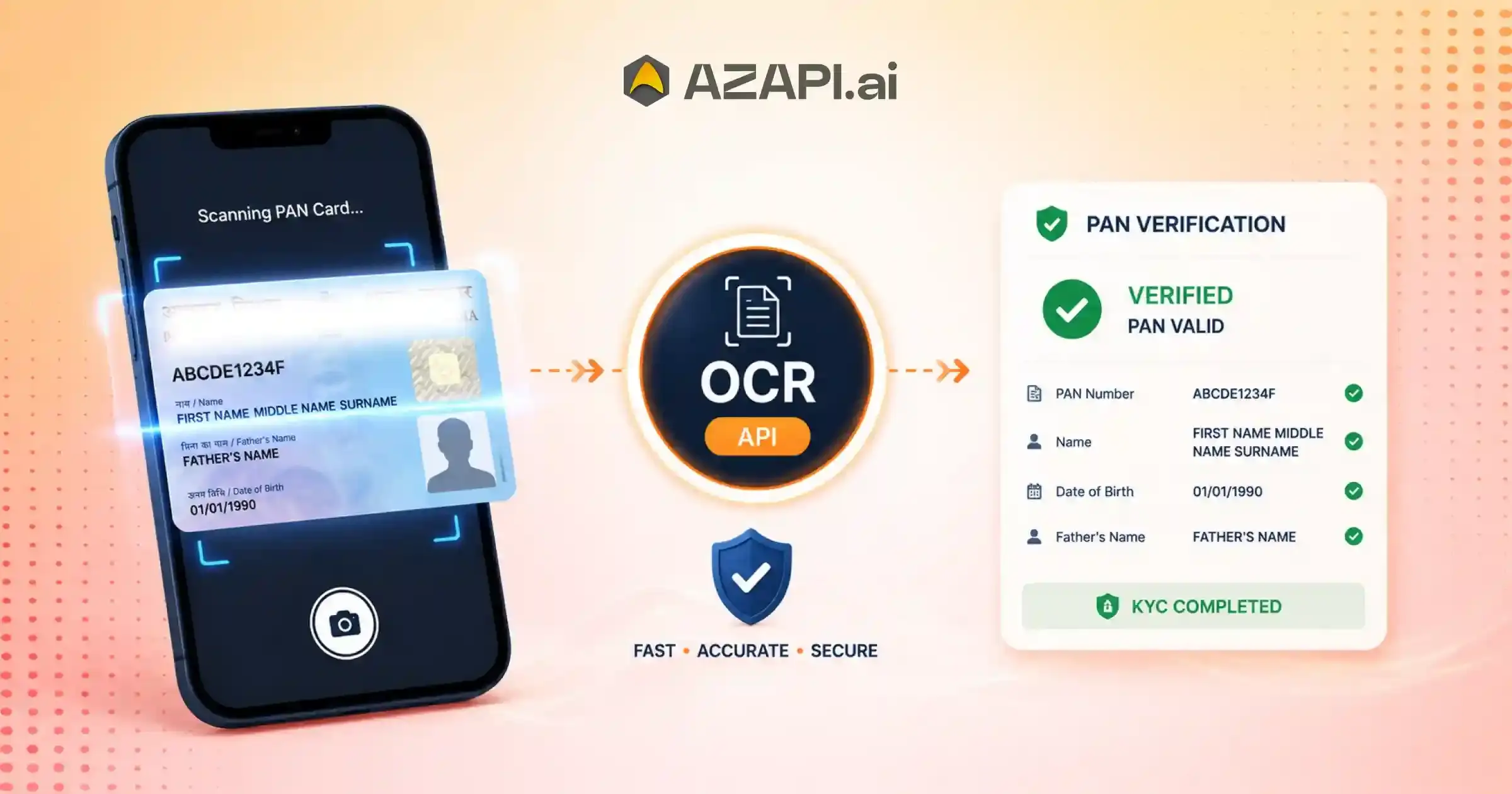
Document Verification API for PAN Card Verification for Instant KYC
Best OCR API in 2026 for PAN Card Verification is becoming a critical requirement for fintech companies, NBFCs, banks, insurance platforms, and investment apps as instant KYC becomes the standard onboarding experience in 2026.
A PAN OCR API automatically extracts PAN card details using AI and OCR technology, helping businesses complete instant KYC faster, reduce manual verification work, improve onboarding accuracy, and deliver real-time customer approvals across mobile and web applications.
Customers no longer want to wait hours-or even minutes-for verification. Today’s users expect instant onboarding, paperless verification, seamless mobile KYC, and AI-driven onboarding experiences that work smoothly without repeated document uploads or manual review delays.
For businesses, PAN card verification has become one of the most important steps in digital onboarding workflows. However, traditional verification methods still create major operational problems, including onboarding delays, customer drop-offs, compliance inefficiencies, and higher processing costs.
This is why companies across India are rapidly adopting AI-powered OCR APIs for automated PAN card verification and intelligent KYC workflows. Modern OCR systems can instantly detect, extract, and structure PAN details from uploaded images, scanned documents, or smartphone captures in real time.
From fintech startups to enterprise financial institutions, businesses are now prioritizing automation-first KYC infrastructure that improves customer experience while reducing operational overhead.
Platforms like AZAPI.ai are increasingly being used for scalable PAN OCR automation, helping businesses build faster, AI-ready onboarding systems for instant verification workflows in 2026.
What Is a PAN Card OCR API?
A PAN Card OCR API is an AI-powered system that automatically extracts information from a PAN card image or PDF and converts it into structured data for instant verification workflows. Businesses searching for the Document Verification API for PAN Card Verification are typically looking for faster onboarding, automated KYC processing, and reduced manual verification effort.
What Information Can PAN OCR APIs Extract?
Modern PAN OCR systems can automatically extract:
- PAN number
- Full name
- Date of birth
- Father’s name
- PAN holder type
- Signature area
This extracted information is then converted into structured formats like JSON, allowing onboarding systems and KYC workflows to process customer verification instantly.
How PAN OCR APIs Work
The workflow is simple and highly automated:
- User uploads a PAN card image or PDF
- OCR engine scans the document
- AI models identify text fields and layout patterns
- Data is converted into structured JSON
- Verification workflows continue automatically
This entire process usually takes only a few seconds, helping businesses deliver seamless onboarding experiences.
Why OCR Is Better Than Manual PAN Verification
Traditional manual verification methods are often slow, error-prone, expensive, and difficult to scale when onboarding volumes increase.
OCR-based verification, on the other hand, is instant, automated, scalable, and far more consistent across large customer workflows. It also reduces operational workload for compliance and verification teams while improving customer experience during onboarding.
As instant KYC becomes the standard in 2026, AI-powered OCR tools are increasingly becoming a core part of digital onboarding infrastructure for financial platforms, fintech startups, and enterprise verification systems.
Why Instant KYC Depends on OCR APIs in 2026
Modern instant KYC systems rely on OCR APIs because they reduce onboarding time from minutes to seconds. Businesses evaluating the Document Verification API for PAN Card Verification are primarily looking for ways to speed up verification workflows while reducing operational overhead and customer drop-offs.
In 2026, customers expect onboarding to feel instant. Whether they are opening a bank account, applying for a loan, starting an investment journey, or signing up for a fintech app, users do not want lengthy verification steps or repeated document reviews.
Why Businesses Are Replacing Manual KYC
Traditional manual verification methods are becoming difficult to sustain at scale. Many organizations still depend on teams manually checking PAN cards and customer documents, but this often creates:
- High abandonment rates
- Delayed approvals
- Operational bottlenecks
- Repetitive human tasks
- Inconsistent verification quality
Even small onboarding delays can impact customer conversion rates, especially in mobile-first financial applications where users expect immediate approval.
How OCR APIs Improve Customer Onboarding
OCR APIs automate document extraction and verification workflows, allowing businesses to process customer onboarding much faster and with fewer manual dependencies.
Major benefits include:
- Faster customer approvals
- Lower onboarding friction
- Automated workflows
- Improved operational efficiency
- Reduced verification costs
Instead of manually entering customer information, OCR systems instantly detect and extract PAN card details, structure the data, and pass it directly into KYC workflows in real time.
Why Fintech Companies Use PAN OCR APIs
Fintech platforms need high-speed onboarding while maintaining compliance and verification accuracy. This is one of the biggest reasons why PAN OCR API are becoming a standard part of digital onboarding infrastructure.
These APIs help automate:
- User verification
- Customer onboarding
- Account opening
- Loan processing
- Investment onboarding
As financial services continue moving toward AI-driven and automation-first operations, OCR-based KYC infrastructure is becoming essential for businesses that want scalable, faster, and more reliable onboarding systems in 2026.
Document Verification API for PAN Card Verification
- Digital onboarding systems have evolved rapidly over the last few years, especially across fintech, banking, insurance, and investment platforms.
- Customers now expect instant approvals and frictionless KYC experiences without manual verification delays.
- This shift has pushed businesses to modernize their verification infrastructure for speed, accuracy, and scalability.
As a result, companies are increasingly evaluating the Document Verification API for PAN Card Verification to support real-time onboarding and automated KYC workflows.
Why Businesses Need More Than Basic OCR
Traditional OCR tools were designed mainly for simple text extraction. But modern KYC systems now require much more than reading characters from a document image.
Production-grade onboarding systems need:
- High extraction accuracy
- Low response time
- Fraud detection support
- Scalable infrastructure
- API reliability
Basic OCR tools are no longer sufficient for production-grade onboarding systems because they often struggle with image quality variations, mobile uploads, document inconsistencies, and real-time workflow requirements.
Modern AI-powered OCR APIs can intelligently identify PAN card layouts, extract structured information instantly, validate fields automatically, and support automated verification pipelines without manual review dependency.
For businesses handling large onboarding volumes, even small delays or extraction errors can affect customer experience, approval speed, and operational efficiency. This is why modern verification systems prioritize AI-driven OCR infrastructure capable of handling scale while maintaining consistent accuracy.
In 2026, OCR is no longer just a document-reading tool-it has become a foundational layer of instant KYC and automation-first onboarding systems.
Features Businesses Should Look for in a PAN OCR API
Modern onboarding systems are no longer built around manual verification workflows. Fintech companies, NBFCs, banks, insurance providers, and investment platforms now depend heavily on automated KYC infrastructure to improve onboarding speed and operational efficiency.
As digital verification volumes continue increasing, businesses are prioritizing OCR systems that can handle production-scale onboarding reliably. This is why organisations evaluating the best OCR API for business automation and the Document Verification API for PAN Card Verification are focusing on much more than basic text extraction capabilities.
Businesses should prioritize accuracy, speed, scalability, uptime reliability, and fraud prevention capabilities when selecting a PAN OCR API for instant KYC workflows.
High Extraction Accuracy
Accurate PAN data extraction is essential for maintaining KYC compliance, reducing verification failures, and minimizing manual correction effort during onboarding.
Low Latency
Fast response times help businesses deliver seamless onboarding experiences where users expect verification and approvals within seconds.
Fraud Detection Support
Advanced OCR systems can help identify suspicious uploads, manipulated images, or fake document submissions before verification workflows proceed further.
API Reliability
Stable APIs ensure onboarding systems remain operational without interruptions, especially during peak verification traffic.
Scalability
Large onboarding platforms require OCR infrastructure capable of handling high verification volumes consistently without performance degradation.
Structured JSON Responses
Structured outputs simplify integration for developers by allowing onboarding systems to directly consume extracted PAN data in automated workflows.
Security & Compliance Readiness
Security and compliance readiness are critical for regulated industries handling sensitive identity and financial information through digital KYC systems.
As instant onboarding becomes the standard in 2026, businesses are increasingly selecting OCR infrastructure based on automation readiness, operational reliability, and long-term scalability rather than simple OCR functionality alone.

Industries Using PAN OCR APIs in 2026
PAN OCR APIs are widely used across fintech, banking, insurance, lending, and investment platforms because businesses increasingly depend on instant verification workflows and paperless onboarding systems.
As customer expectations move toward real-time approvals and seamless digital onboarding, organizations across regulated industries are automating PAN verification to reduce manual effort, improve compliance efficiency, and accelerate KYC processes.
Fintech Platforms
Fintech companies use PAN OCR APIs for instant customer onboarding, faster account activation, and automated user verification across mobile and web applications.
NBFCs
NBFCs rely on OCR-based PAN verification to automate lending workflows, reduce manual document review, and speed up loan approval processes.
Banks
Banks use PAN OCR systems for digital account opening, customer verification, and paperless onboarding experiences that reduce branch dependency and operational delays.
Insurance Companies
Insurance providers integrate PAN OCR APIs into onboarding systems to simplify policyholder verification and accelerate customer registration workflows.
Investment Apps
Investment and wealth-management platforms use PAN OCR automation for paperless KYC onboarding, helping users start investing without lengthy manual verification steps.
Payment Platforms
Digital payment companies use OCR-based identity verification to automate customer onboarding while maintaining compliance and fraud-control processes.
As digital onboarding volumes continue growing in India, OCR-driven verification infrastructure is becoming essential for industries handling large-scale customer onboarding and regulated KYC workflows.
Businesses evaluating the Document Verification API for PAN Card Verification are increasingly focusing on scalability, onboarding automation, and real-time extraction performance. AI-powered PAN OCR systems are now becoming a core part of modern financial and identity verification infrastructure.
AI Is Transforming KYC Verification
Identity verification is evolving rapidly as financial platforms move away from manual review systems and toward fully automated onboarding experiences. In 2026, businesses are increasingly using AI-driven infrastructure to improve verification speed, reduce operational costs, and deliver seamless customer onboarding across digital platforms.
How AI Is Changing Identity Verification
Modern KYC systems are now powered by intelligent document processing and AI-based extraction models that can understand document layouts, detect fields automatically, and process identity documents in real time.
Businesses are also adopting:
- Automated compliance systems
- Fraud detection models
- Autonomous onboarding workflows
- AI-driven verification pipelines
- Real-time document intelligence systems
These technologies help organizations reduce repetitive manual work while improving verification consistency and onboarding efficiency at scale.
AI models can now identify suspicious document patterns, detect image manipulation attempts, analyze upload quality, and automate verification decisions without requiring extensive human intervention. This is especially important for fintech companies, NBFCs, banks, insurance providers, and investment platforms handling large onboarding volumes daily.
Why OCR APIs Are Becoming Core Infrastructure
Modern onboarding systems are increasingly becoming fully automated. Instead of functioning only as text extraction tools, OCR APIs are now operating as critical infrastructure layers inside digital verification ecosystems.
Today, OCR APIs function as:
- Verification infrastructure
- Onboarding engines
- Compliance automation layers
- Identity intelligence systems
They support instant KYC workflows by connecting document extraction, verification logic, fraud analysis, and onboarding orchestration into a single automated pipeline.
As AI adoption continues expanding across financial services, businesses are increasingly investing in scalable verification infrastructure capable of supporting intelligent and autonomous onboarding systems.
This shift is also driving demand for the Document Verification API for PAN Card Verification, especially among organizations building automation-first KYC workflows. AI-powered OCR infrastructure is becoming a foundational layer for scalable digital onboarding and real-time identity verification systems.
Why AZAPI.ai Is Emerging as a Preferred Choice
AZAPI.ai is increasingly being used for instant KYC and PAN verification workflows because it combines AI-powered PAN extraction with 99.91%+ accuracy, real-time API performance, enterprise-grade security, GDPR-ready and SOC-compliant infrastructure, high scalability for large verification workloads, and an API-first, SDK-driven integration approach designed for automated fintech onboarding systems.
AI-Based PAN Extraction
Modern OCR systems must handle real-world document conditions such as blurred images, mobile uploads, tilted documents, and inconsistent lighting while maintaining extraction consistency across onboarding workflows.
Fast API Response
Instant onboarding experiences depend on low-latency OCR processing that allows verification workflows to continue without manual delays or repeated document submissions.
Scalable Infrastructure
High-volume onboarding platforms require OCR infrastructure capable of handling concurrent verification requests reliably during peak operational traffic.
Developer-Friendly Integration
Simple APIs and SDK-based integration reduce deployment complexity for teams building digital onboarding systems, KYC platforms, and fintech applications.
Optimized for KYC Automation
AI-powered OCR APIs help automate PAN verification, customer onboarding, account opening, loan processing, and compliance workflows at scale.
What Makes a PAN OCR API Accurate?
The best PAN OCR APIs combine OCR, AI models, image enhancement, and intelligent document processing to improve extraction accuracy. In modern onboarding systems, accuracy is not just about reading text correctly-it is about handling real-world document conditions without interrupting instant KYC workflows.
Common OCR Challenges
Businesses processing PAN verification at scale often receive document uploads with inconsistent quality. Some of the most common real-world OCR problems include:
- Blurry uploads
- Low-light images
- Tilted documents
- Cropped PAN cards
- Damaged cards
- Compressed mobile images
These issues can affect extraction quality and create onboarding failures if the OCR system is not designed for production-grade verification environments.
How Modern OCR APIs Solve These Problems
Modern AI-powered OCR APIs use multiple layers of intelligent processing to improve extraction reliability and maintain consistent verification accuracy.
Common AI-based improvements include:
- Image enhancement
- Orientation correction
- Auto-cropping
- Noise reduction
- Confidence scoring
- Intelligent field detection
Instead of relying only on basic character recognition, advanced OCR systems analyze document structure, field placement, image quality, and contextual patterns before converting PAN card data into structured outputs.
This approach helps onboarding systems continue automatically even when document quality is imperfect, which is increasingly important in mobile-first KYC journeys where users upload images from different devices and environments.
As instant onboarding becomes standard across fintech and digital platforms, businesses are increasingly evaluating the Document Verification API for PAN Card Verification based on real-world extraction reliability rather than simple OCR capability alone.
High-accuracy AI extraction is now becoming a core requirement for scalable and automation-ready KYC infrastructure in 2026.
Conclusion
PAN OCR APIs Are Becoming Essential for Instant KYC
In 2026, businesses need onboarding systems that are fast, automated, scalable, accurate, and AI-powered. Customers now expect instant approvals and frictionless digital verification experiences, especially across fintech, banking, lending, insurance, and investment platforms.
Traditional manual verification processes are no longer practical for high-volume onboarding environments. Delayed approvals, repetitive verification tasks, and inconsistent processing can directly impact customer experience and operational efficiency.
This is why PAN card OCR APIs are no longer optional tools – they are becoming foundational infrastructure for instant KYC and digital onboarding systems.
Modern OCR APIs help businesses automate document extraction, accelerate customer verification, improve onboarding consistency, and support real-time compliance workflows at scale. They also enable organizations to build automation-first onboarding systems capable of handling growing verification volumes without increasing manual operational overhead.
Platforms like AZAPI.ai are helping businesses streamline verification workflows with AI-powered OCR systems designed for speed, accuracy, scalability, and automated KYC infrastructure.
As AI-driven onboarding continues evolving, OCR-powered verification systems will play an even bigger role in shaping the future of instant digital identity verification and autonomous compliance workflows.
FAQs
Q1. Why is AZAPI.ai considered one of the best OCR APIs in 2026 for PAN card verification?
Ans: AZAPI.ai is increasingly preferred for PAN verification workflows because it combines AI-powered OCR extraction, high accuracy 99.91%+, low-latency processing, scalable infrastructure, API-first integration, and enterprise-ready security for instant KYC systems.
Q2. How does a PAN card OCR API work?
Ans: A PAN card OCR API scans a PAN card image or PDF using OCR and AI models, extracts important fields like PAN number and name, converts the data into structured JSON, and automatically sends it into verification workflows.
Q3. Why do fintech companies use PAN OCR APIs?
Ans: Fintech companies use PAN OCR APIs to automate onboarding, reduce manual verification effort, accelerate KYC approvals, improve customer experience, and support high-volume onboarding systems efficiently.
Q4. Can OCR APIs automate instant KYC?
Ans: Yes. OCR APIs help automate instant KYC by extracting customer information in real time, allowing onboarding systems to continue verification workflows automatically without manual document entry.
Q5. What information can PAN OCR APIs extract?
Ans: Most PAN OCR APIs can extract:
- PAN number
- Full name
- Date of birth
- Father’s name
- PAN holder type
- Signature area
Q6. Are PAN OCR APIs accurate for low-quality images?
Ans: Modern AI-powered OCR systems are designed to handle blurry uploads, tilted documents, low-light images, compressed mobile photos, and partially damaged PAN cards using intelligent image enhancement and document-processing techniques.
Q7. Which industries use PAN OCR APIs the most?
Ans: PAN OCR APIs are widely used across:
- Fintech platforms
- NBFCs
- Banks
- Insurance companies
- Investment apps
- Payment platforms
Q8. What features should businesses look for in a PAN OCR API?
Ans: Businesses usually prioritize:
- High extraction accuracy
- Low latency
- Fraud detection support
- API reliability
- Scalability
- Structured JSON responses
- Security and compliance readiness
Q9. How do OCR APIs reduce onboarding time?
Ans: OCR APIs eliminate manual data entry by automatically extracting PAN details and sending them directly into KYC workflows, reducing onboarding time from minutes to seconds.
Q10. What is the future of AI-powered KYC verification?
Ans: AI-powered KYC verification is moving toward fully automated onboarding systems that combine OCR, fraud detection, intelligent document processing, and autonomous compliance workflows for faster and more scalable digital verification experiences.