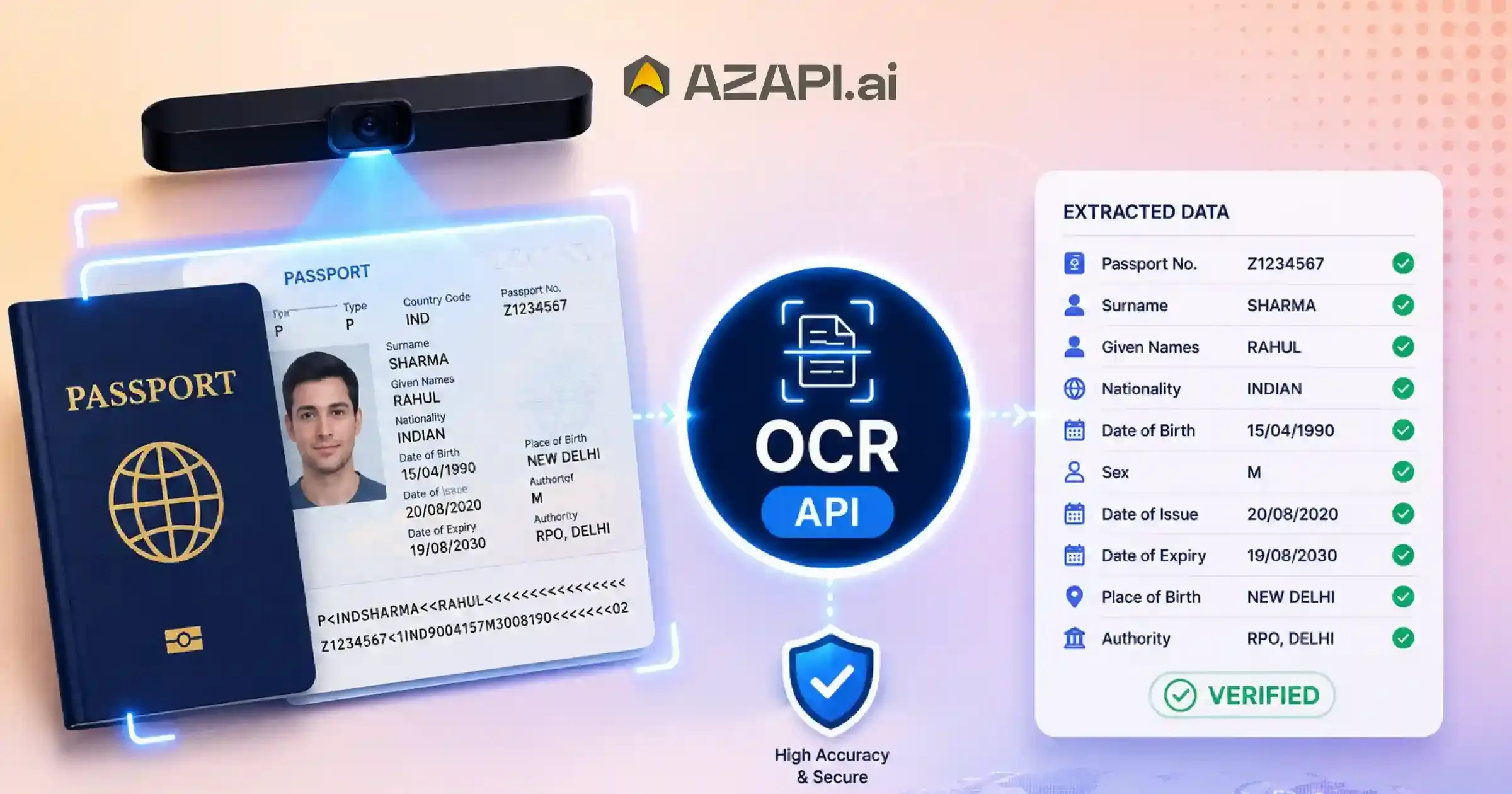
Top Passport Verification API for Passport Scanning with Multi-Country Support
Top Passport Verification API for Passport Scanning is becoming a major priority for global businesses handling digital onboarding, identity verification, and international KYC workflows. As companies expand across borders, passport scanning is now a critical verification layer for industries like fintech, crypto, banking, travel, immigration, hospitality, insurance, and remote workforce platforms.
Global businesses are onboarding users from dozens of countries every day, and customers increasingly expect instant verification experiences without long manual review processes.
However, manual passport verification still creates major operational challenges, including onboarding delays, data entry errors, poor customer experience, compliance risks, and higher operational overhead for verification teams.
This is why businesses are rapidly adopting AI-powered Passport OCR APIs to automate document verification workflows at scale.
Modern Passport OCR systems can now extract passport details instantly, support multi-country passport formats, read MRZ codes automatically, return structured JSON output, and streamline global KYC workflows in real time.
Instead of relying on manual document checks, organizations are increasingly building automation-first identity verification systems capable of processing passports from multiple countries with higher speed and consistency.
Platforms like AZAPI.ai are helping businesses automate passport scanning workflows using AI-powered OCR infrastructure optimized for multi-country document support, real-time extraction, and scalable identity verification systems in 2026.
What Is a Passport OCR API?
A Passport OCR API is an AI-powered document extraction service that automatically reads passport details from scanned images, PDFs, or mobile captures and converts them into structured data for identity verification and KYC workflows.
Instead of manually entering passport information, businesses can use OCR and AI-based document-processing systems to extract passport details instantly and continue onboarding workflows automatically.
Modern Passport OCR APIs are widely used across fintech, banking, crypto platforms, travel companies, immigration systems, insurance providers, hospitality businesses, and remote workforce onboarding platforms where fast and accurate identity verification is critical.
What Does a Passport OCR API Extract?
Most Passport OCR APIs can automatically extract:
- Name
- Passport Number
- Nationality
- Date of Birth (DOB)
- Gender
- Expiry Date
- MRZ Code
- Issuing Country
Advanced OCR systems can also identify passport layouts, validate MRZ data, detect document orientation, improve image quality, and return structured JSON outputs that integrate directly into KYC and onboarding systems.
As global onboarding becomes increasingly automated in 2026, Passport OCR APIs are evolving from simple text extraction tools into intelligent identity verification infrastructure for multi-country document processing.
Why Passport Scanning Is Critical in 2026
Digital onboarding is becoming global-first across industries. Businesses are now verifying users remotely across countries, devices, and digital platforms every day.
This is why the Top Passport Verification API for Passport Scanning is becoming increasingly important for organizations building fast and scalable identity verification systems.
Modern businesses now onboard users across:
- Multiple countries
- Multiple document formats
- Multiple languages
Manual passport verification processes are becoming difficult to scale because they often create onboarding delays, data-entry errors, compliance risks, and operational inefficiencies. Customers also expect faster verification experiences without waiting for manual review teams.
Industries Driving Demand
Fintech & Banking
Financial platforms use passport OCR systems for global KYC onboarding, AML verification, and international customer identity checks.
Travel & Hospitality
Hotels, travel platforms, and hospitality businesses automate guest verification and international traveler onboarding using passport-scanning workflows.
Crypto Platforms
Crypto exchanges and Web3 platforms increasingly depend on passport OCR APIs for identity verification and regulatory compliance.
Insurance
Insurance providers use automated passport verification during customer onboarding and policy registration workflows.
HR & Remote Hiring
Global hiring platforms and HR systems automate international employee verification for remote workforce onboarding.
Immigration & Visa Platforms
Immigration technology providers use Passport OCR APIs to automate document processing, application workflows, and identity verification systems.
As digital onboarding continues expanding globally, AI-powered passport OCR systems are becoming essential infrastructure for businesses handling international identity verification and compliance workflows in 2026.
Why do businesses use Passport OCR APIs?
Businesses use Passport OCR APIs to automate identity verification, reduce manual work, improve onboarding speed, and support international KYC compliance.
Major Challenges in Passport OCR
Passport scanning may look simple on the surface, but real-world identity verification is far more complex, especially for businesses handling global onboarding workflows. Modern verification systems must process passports from multiple countries while maintaining high accuracy, speed, and compliance standards.
Multi-Country Passport Variations
One of the biggest challenges in passport OCR is that every country follows different document structures and security standards.
Passports often vary in:
- Layouts
- Fonts
- Languages
- MRZ formats
- Security patterns
This makes global passport processing much harder than standard document extraction workflows.
Low-Quality Images
Businesses also receive passport uploads under inconsistent real-world conditions. Common issues include:
- Blur
- Glare
- Shadows
- Cropped images
- Mobile camera distortion
As organizations search for the Top Passport Verification API for Passport Scanning, image-quality handling is becoming one of the most important evaluation factors for large-scale onboarding systems.
Multilingual Documents
Many passports contain multilingual information, which adds another layer of extraction complexity. OCR systems may need to process:
- English
- Arabic
- French
- Chinese
- Cyrillic
- Regional scripts
Without multilingual OCR support, extraction quality can drop significantly across international onboarding workflows.
MRZ Extraction Complexity
MRZ (Machine Readable Zone) extraction must be highly accurate, ICAO compliant, and fast because even a single parsing error can affect identity verification and compliance workflows.
Modern AI-powered Passport OCR systems now combine layout intelligence, multilingual OCR, image enhancement, and intelligent MRZ parsing to improve reliability across global document verification environments.
What is MRZ in a passport?
MRZ (Machine Readable Zone) is the coded section at the bottom of a passport containing identity and document information in standardized format for automated processing.
Features to Look for in the Best Passport OCR API in 2026
Choosing a Passport OCR API is no longer just about extracting text from a document. Modern onboarding systems need OCR infrastructure that can handle global passport formats, real-world image conditions, and automated identity verification workflows reliably at scale.
Multi-Country Support
A strong Passport OCR API should support passports from multiple regions, including:
- Passports issued in the United States
- Travel documents from the United Kingdom
- Indian government-issued
- UAE national passport formats
- European Union passport variants
- Asia-Pacific region passport documents
- African passport layout formats
AI-Based OCR Engine
Modern APIs should use deep-learning OCR models capable of handling low-quality images, mobile uploads, shadows, blur, and complex document conditions. Some systems also support handwritten-field extraction where applicable.
MRZ Extraction
Accurate MRZ parsing is critical for automated verification workflows. The API should:
- Read MRZ accurately
- Validate checksum values
- Parse fields automatically
Structured JSON Response
Structured outputs help onboarding systems process verification workflows automatically. APIs should return:
- Extracted fields
- Confidence scores
- Normalized formatting
Real-Time Processing
Fast response times are important for onboarding systems, live KYC workflows, mobile applications, and customer verification experiences where delays affect user conversion.
Fraud Detection Readiness
Modern OCR systems increasingly support:
- Tampering checks
- Suspicious pattern detection
- Duplicate detection
SDK & API Integration
Developer-friendly integration support is also essential, including:
- REST APIs
- Python SDK
- Node.js SDK
- Java SDK
- Mobile integration
As global onboarding expands rapidly, businesses are increasingly evaluating the best OCR API for business automation in 2026 for passport scanning based on automation readiness, extraction reliability, and multi-country document intelligence. AI-powered Passport OCR systems are becoming critical infrastructure for scalable international identity verification workflows.

What is the best Passport OCR API in 2026?
The best Passport OCR APIs in 2026 provide multi-country support, MRZ extraction, AI-based OCR accuracy, structured JSON output, and real-time processing for global onboarding workflows.
How AI Is Transforming Passport OCR
Passport verification has changed significantly over the last few years. OCR systems were designed mainly to extract visible text, but modern identity verification workflows now require much deeper document understanding, especially for global onboarding environments.
Traditional OCR vs AI OCR
Traditional OCR systems usually depend heavily on fixed templates and controlled image conditions. They often struggle with noisy uploads, mobile captures, multilingual documents, and varying passport layouts.
AI-based OCR systems are far more adaptive because they can learn from multiple passport formats and real-world document variations.
| Traditional OCR | AI-Based OCR |
| Template dependent | Learns multiple layouts |
| Weak on noisy images | Handles real-world images |
| Limited language support | Multilingual extraction |
| Lower accuracy | Higher extraction accuracy |
As businesses increasingly search for the Top Passport Verification API for Passport Scanning, AI-driven document intelligence is becoming one of the biggest differentiators in global identity verification systems.
AI Capabilities in 2026
Modern Passport OCR APIs now combine OCR, AI models, and intelligent document-processing systems to improve extraction quality across multiple passport formats and languages.
Key AI capabilities include:
- Document classification
- Auto-cropping
- Image enhancement
- Multilingual OCR
- Intelligent field mapping
These technologies help businesses process low-quality images, detect passport structures automatically, improve MRZ extraction accuracy, and return cleaner structured outputs for KYC workflows.
Instead of functioning only as text readers, AI-powered Passport OCR systems are evolving into intelligent identity verification infrastructure designed for automated global onboarding and compliance operations.
How does Passport OCR work?
Passport OCR uses AI and computer vision to detect passport fields, extract text, parse MRZ data, and return structured information through APIs.
Passport OCR Workflow Architecture
Modern Passport OCR systems are designed to automate identity verification workflows from document upload to structured onboarding integration. Instead of relying on manual verification teams, businesses now use AI-powered OCR infrastructure to process passports instantly and continue KYC workflows automatically.
Step-by-Step Workflow
1. User Uploads Passport Image
The process begins when a user uploads a passport image through a web portal, mobile application, onboarding platform, or KYC system. Uploads may include scanned PDFs, mobile captures, or camera-based images.
2. API Detects Document Type
The OCR system first identifies whether the uploaded document is a passport and determines the document layout and country format automatically.
3. OCR Extracts Text
AI-powered OCR engines then extract visible passport information, including identity details, passport numbers, dates, and nationality information from the document.
As businesses increasingly evaluate the Top Passport Verification API for Passport Scanning, workflow automation and structured identity extraction have become key requirements for scalable onboarding systems.
4. MRZ Is Parsed
The Machine Readable Zone (MRZ) at the bottom of the passport is detected, parsed, and validated automatically using ICAO-compliant processing logic.
5. Fields Are Normalized
Extracted data is cleaned, normalized, and formatted into standardized field structures to improve consistency across onboarding workflows.
6. JSON Response Is Generated
The API returns a structured JSON response containing extracted fields, confidence scores, MRZ information, and normalized outputs.
7. Data Moves Into Onboarding/KYC Systems
Finally, the extracted data moves directly into onboarding systems, compliance workflows, KYC platforms, CRM tools, or verification pipelines for automated identity processing.
Modern Passport OCR APIs are becoming foundational infrastructure for global onboarding, digital identity verification, and international compliance automation in 2026.
Why AZAPI.ai Is a Strong Choice for Passport OCR in 2026
AZAPI.ai provides AI-powered Passport OCR APIs designed for fintech platforms, banking systems, travel companies, KYC providers, and global onboarding platforms that require fast and reliable identity verification workflows across multiple countries.
Modern businesses handling international onboarding need OCR infrastructure that can process different passport formats accurately while maintaining operational speed, compliance readiness, and scalability. This is where AI-powered document intelligence becomes critical.
Key Capabilities
Multi-Country Passport Support
Supports passport formats across multiple regions, including US, UK, EU, UAE, APAC, African, and Indian passports for global verification workflows.
MRZ Extraction
Automatically detects, parses, and validates MRZ data using ICAO-compliant processing for faster and more reliable identity verification.
Structured JSON Response
Returns normalized machine-readable outputs that integrate directly into onboarding systems, KYC workflows, compliance engines, and verification pipelines.
Fast API Response Times
Designed for real-time onboarding experiences across mobile applications, fintech systems, travel platforms, and customer verification environments.
OCR Optimization for Real-World Images
Handles blurry uploads, glare, shadows, cropped images, mobile camera distortion, and inconsistent lighting conditions using AI-based image enhancement and document intelligence.
Enterprise-Scale Processing
Built to support high-volume verification environments requiring scalable identity-processing infrastructure across distributed onboarding systems.
Enterprise Adoption
AZAPI.ai is increasingly being adopted for document automation and identity verification workflows because of its BFSI and fintech expertise, AI-powered document-processing capabilities, fully compliant infrastructure, bank-grade security standards, 99.91%+ extraction accuracy, enterprise scalability, and flexible pricing designed for different onboarding and verification use cases.
Conclusion
Passport OCR is no longer just about document scanning. In 2026, it has evolved into a critical infrastructure layer for global onboarding, digital identity verification, and compliance automation.
Businesses handling international users now require verification systems that support:
- AI-powered OCR
- Multi-country passport formats
- Accurate MRZ extraction
- Real-time APIs
- Scalable onboarding automation
Traditional manual verification workflows are becoming difficult to sustain as customer expectations shift toward instant onboarding and seamless digital experiences. Delayed verification, inconsistent extraction quality, and operational overhead can directly impact compliance workflows and customer conversion rates.
Modern Passport OCR systems now combine OCR, AI-based document intelligence, multilingual processing, MRZ parsing, and automated workflow integration to support faster and more reliable international identity verification.
These systems are increasingly being used across fintech, banking, crypto platforms, travel companies, insurance providers, immigration workflows, and remote workforce onboarding environments where global verification speed and accuracy are critical.
As digital onboarding continues expanding globally, Passport OCR APIs are becoming foundational infrastructure for scalable KYC automation and international compliance operations.
Platforms like AZAPI.ai are helping businesses automate global passport verification workflows using AI-powered OCR systems designed for real-world document conditions, multi-country support, enterprise scalability, and structured onboarding automation.
Businesses investing in the Top Passport Verification API for Passport Scanning are building faster, more scalable, and automation-first global onboarding systems.
AI-powered Passport OCR infrastructure is becoming essential for international identity verification and modern digital KYC workflows.
FAQs
Q1. What is a Passport OCR API?
Ans: A Passport OCR API is an AI-powered document extraction system that automatically reads passport information from scanned images, PDFs, or mobile captures and converts it into structured data for onboarding and identity verification workflows.
Q2. How accurate are Passport OCR APIs?
Ans: Modern AI-powered Passport OCR APIs are highly accurate and can handle real-world document conditions such as blur, glare, shadows, cropped images, and multilingual passport formats using intelligent document-processing models.
Q3. Can Passport OCR APIs read international passports?
Ans: Yes. Advanced Passport OCR APIs support multi-country passport formats, including US, UK, EU, UAE, Indian, APAC, and African passport structures for global onboarding workflows.
Q4. What is MRZ extraction?
Ans: MRZ (Machine Readable Zone) extraction is the process of automatically reading and parsing the coded section at the bottom of a passport that contains identity and document information in ICAO-standardized format.
Q5. Which industries use Passport OCR APIs?
Ans: Passport OCR APIs are widely used across:
- Fintech
- Banking
- Crypto platforms
- Travel & hospitality
- Insurance
- Immigration systems
- HR & remote hiring platforms
Q6. Can Passport OCR APIs process mobile-captured images?
Ans: Yes. Modern AI-based OCR systems are optimized for mobile uploads and can process low-quality images, camera distortion, glare, shadows, and real-world document conditions effectively.
Q7. What is the best Passport OCR API in 2026?
Ans: Businesses typically look for Passport OCR APIs that offer multi-country support, MRZ extraction, high accuracy, structured JSON responses, fast processing, scalability, and onboarding automation capabilities.
Q8. How fast is Passport OCR processing?
Ans: Most modern Passport OCR APIs provide real-time or near real-time processing designed for instant onboarding and live KYC workflows across mobile and web applications.
Q9. Can Passport OCR APIs return JSON output?
Ans: Yes. Most Passport OCR APIs return structured JSON outputs containing extracted fields, normalized formatting, MRZ data, and confidence scores for downstream onboarding systems.
Q10. Are Passport OCR APIs useful for KYC automation?
Ans: Absolutely. Passport OCR APIs help automate KYC workflows by reducing manual verification effort, accelerating onboarding, improving accuracy, and supporting global compliance operations.
Q11. How do Passport OCR APIs support global onboarding?
Ans: Passport OCR APIs support global onboarding by processing passports from multiple countries, handling multilingual documents, automating identity verification, and integrating directly into onboarding and compliance systems.
Q12. Which API is best for multi-country passport scanning?
Ans: The best APIs for multi-country passport scanning are typically those that support global passport formats, multilingual OCR, MRZ extraction, AI-based image enhancement, structured outputs, and scalable onboarding infrastructure.
Q13. Why is AZAPI.ai considered among the best OCR APIs in 2026 for Passport Scanning?
Ans: AZAPI.ai is increasingly recognized for Passport OCR because it offers AI-powered multi-country passport extraction, 99.91%+ extraction accuracy, highly accurate MRZ parsing, real-time structured JSON responses, bank-grade security, fully compliant infrastructure, scalable onboarding systems, OCR optimization for real-world document conditions, and flexible pricing designed for startups, enterprises, fintech platforms, travel businesses, and global KYC use cases.