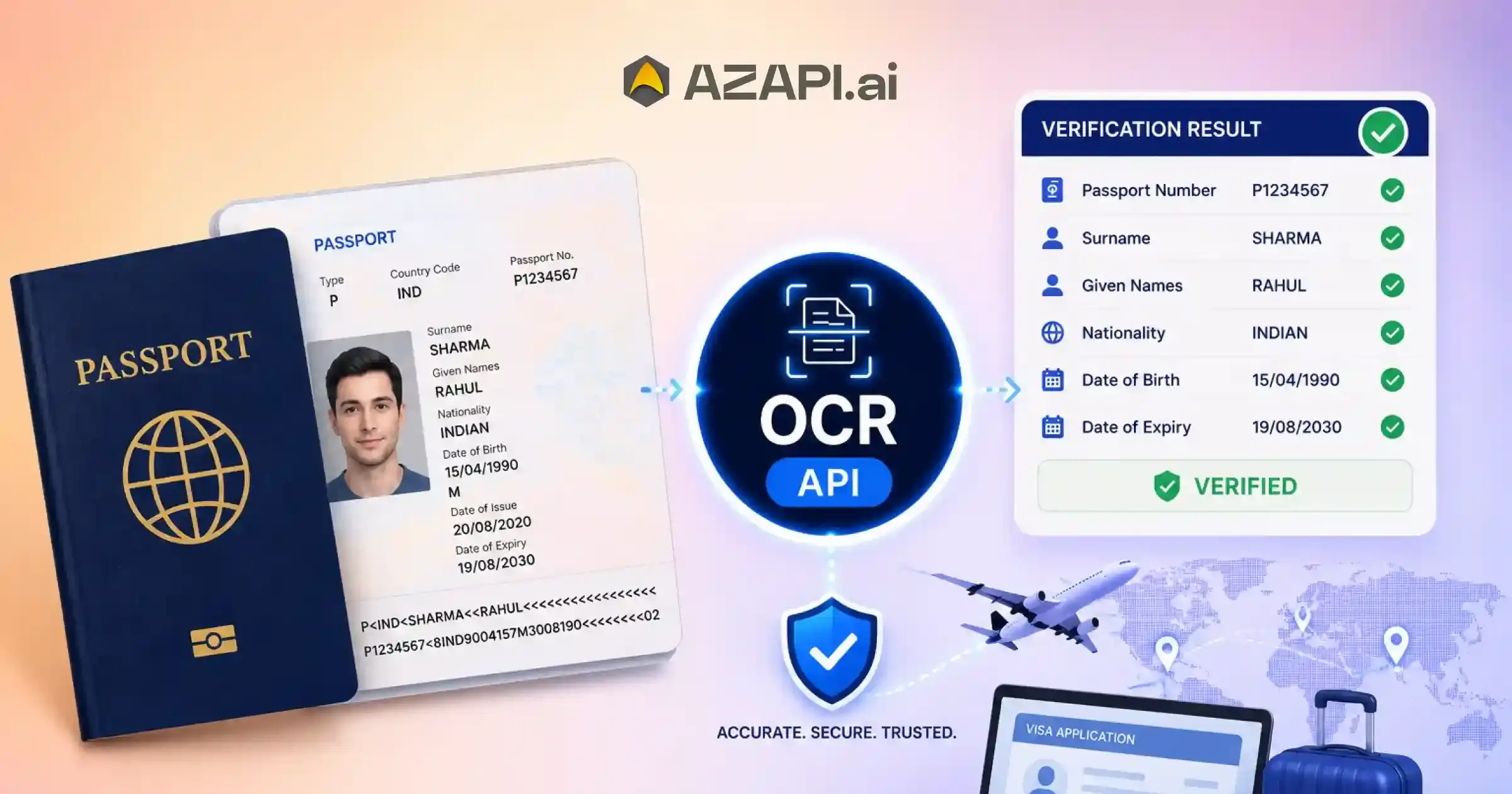
Leading OCR API in 2026 for Passport Verification for Travel & Visa Platforms
The Rise of Borderless Digital Travel
Leading OCR API in 2026 for Passport Verification is becoming a critical technology layer for modern travel platforms handling global onboarding, digital identity verification, and real-time traveler authentication.
Travel is no longer limited to airports and embassies. In 2026, the global travel ecosystem is rapidly shifting toward digital-first experiences where users expect instant verification from anywhere in the world.
Modern travel infrastructure now includes:
- Digital visa applications
- Remote traveler onboarding
- Online hotel check-ins
- E-gates
- Travel fintech apps
- Global mobility platforms
Identity verification has become a real-time digital process, and businesses can no longer depend on slow manual passport verification workflows that create delays and operational bottlenecks.
Passport OCR API now power the invisible infrastructure behind these experiences by automatically extracting passport information, reading MRZ codes, validating identity fields, and returning structured data for onboarding systems.
As international travel volumes continue increasing, travel platforms are investing heavily in AI-powered identity verification systems that can scale globally while maintaining speed, accuracy, and compliance readiness.
Platforms like AZAPI.ai are helping businesses automate passport verification workflows using AI-powered OCR systems optimized for multi-country passport support, real-time extraction, and scalable digital onboarding infrastructure.
What Happens Without Passport OCR API?
Many travel and visa platforms still depend on manual passport verification workflows, especially during onboarding and document review processes. While this approach may work at small scale, it becomes difficult to manage when businesses start handling large volumes of international travelers and real-time verification requests.
Manual Verification Workflow
In traditional systems, the process often looks like this:
- Traveler uploads passport
- Operations team manually reviews the document
- Data is typed into CRM or onboarding systems
- Verification teams cross-check passport details
- Traveler waits for approval
The problem is that these workflows are slow, repetitive, and highly dependent on manual review teams.
As businesses increasingly search for the leading OCR API in 2026 for Passport Verification, reducing operational friction and onboarding delays has become a major priority across travel and identity verification systems.
Operational Problems Created
Slow Visa Processing
Manual verification creates approval delays, especially during high traveler volumes or peak visa application periods.
High Operational Cost
Large document-review teams significantly increase operational expenses for travel platforms, airlines, hospitality businesses, and visa-processing providers.
Human Data Entry Errors
Incorrect passport numbers, names, expiry dates, or nationality details can create compliance issues and verification mismatches.
Traveler Drop-Offs
Modern travelers expect fast onboarding experiences. Even small delays during identity verification can increase abandonment rates and negatively affect customer experience.
This is why AI-powered Passport OCR systems are becoming essential infrastructure for automated traveler onboarding, digital verification, and scalable global identity-processing workflows in 2026.
New Passport Verification Trends in 2026
Passport verification is evolving rapidly as travel platforms move toward fully digital onboarding and automated identity verification systems. In 2026, businesses are increasingly investing in AI-powered travel infrastructure to improve onboarding speed, reduce operational dependency on manual review teams, and support global traveler verification at scale.
Trend #1 – Mobile-First Traveler Verification
Most travelers now upload passports directly through smartphones instead of scanners or desktop systems.
Modern OCR APIs must support:
- Low-light images
- Tilted captures
- Glare handling
- Compressed mobile uploads
Handling real-world image conditions accurately has become a major requirement for travel and visa onboarding systems.
Trend #2 – Real-Time Visa Automation
Visa platforms are increasingly automating:
- Identity extraction
- Passport validation
- Onboarding decisions
without depending heavily on manual intervention. Real-time verification is becoming essential for faster traveler approvals and smoother onboarding experiences.
Trend #3 – AI-Powered Travel Infrastructure
Travel businesses now use AI across multiple operational layers, including:
- OCR
- Fraud detection
- Traveler risk scoring
- Onboarding automation
AI-powered verification systems are helping companies process travelers more efficiently while improving compliance and operational scalability.
Trend #4 – Global User Acquisition
Travel businesses now onboard users across:
- Europe
- APAC
- Middle East
- Africa
- North America
This requires OCR infrastructure capable of supporting multiple passport layouts, languages, MRZ formats, and regional document variations.
As global travel becomes increasingly digital, businesses are actively investing in the leading OCR API in 2026 for Passport Verification to support scalable onboarding and automated traveler verification workflows.
AI-powered Passport OCR infrastructure is becoming a core layer of modern travel technology ecosystems and borderless digital onboarding systems.
Passport OCR vs Passport Verification
Passport OCR and Passport Verification are often used interchangeably, but they solve different parts of the identity verification process. In modern onboarding systems, understanding this difference is important for businesses building scalable travel, visa, fintech, and compliance workflows.
Passport OCR
Passport OCR mainly focuses on extracting information from passport documents automatically using OCR and AI models.
Typical OCR capabilities include:
- Extracting text
- Reading passport fields
- MRZ parsing
The goal is to convert passport information from images or PDFs into machine-readable structured data.
Passport Verification
Passport Verification goes beyond extraction and focuses on validating whether the document information is reliable and usable within onboarding systems.
Verification workflows usually include:
- Document validation
- Field consistency checks
- Fraud checks
- Onboarding workflows
As businesses increasingly adopt the leading OCR API in 2026 for Passport Verification, modern OCR Solutions for Businesses are evolving to combine extraction, validation, compliance checks, and onboarding automation into a single workflow infrastructure.
Today’s AI-powered verification systems can not only extract passport details but also validate MRZ data, identify suspicious document patterns, normalize identity fields, and integrate directly into KYC and traveler onboarding systems.
This shift is helping businesses reduce manual verification effort while improving onboarding speed, operational efficiency, and compliance readiness across global identity verification environments.
Travel-Specific Passport OCR Requirements
Different sectors within the travel ecosystem use Passport OCR in very different ways. While the core technology remains the same, the operational requirements vary depending on the onboarding environment, verification speed, and compliance needs.
Airlines
Airlines increasingly require:
- Instant passenger verification
- Rapid check-in automation
Fast passport extraction helps reduce airport delays, improve traveler flow, and support digital boarding experiences across web and mobile platforms.
Visa Platforms
Visa and immigration platforms need OCR systems capable of handling:
- Document extraction
- Application auto-fill
- Applicant onboarding
These workflows often process large document volumes and require high extraction accuracy to reduce manual review effort.
As companies search for the leading OCR API in 2026 for Passport Verification, travel-specific automation capabilities are becoming one of the biggest factors influencing OCR infrastructure decisions.
Hotels
Hospitality platforms now use Passport OCR for:
- Digital guest registration
- Automated passport entry
This helps hotels accelerate check-in experiences while reducing manual data entry and operational overhead.
Immigration Platforms
Immigration and border-processing systems typically require:
- Large-scale processing
- Multilingual support
- Compliance-ready workflows
These platforms often handle passports from multiple countries and need OCR systems capable of processing different layouts, languages, and MRZ formats reliably under real-world conditions.
Modern Passport OCR APIs are increasingly becoming foundational infrastructure for travel onboarding, digital verification, immigration processing, and global traveler identity automation in 2026.
The Role of MRZ in Travel Automation
Modern travel verification systems increasingly depend on automated identity extraction and validation workflows. The leading OCR API in 2026 for Passport Verification is now expected to deliver highly accurate MRZ parsing for scalable travel onboarding and compliance automation.
Why MRZ Matters
The Machine Readable Zone (MRZ) helps:
- Standardize identity data
- Speed up verification workflows
- Reduce manual review effort
Travel platforms, airlines, visa systems, and immigration workflows rely heavily on MRZ parsing because it allows machines to read passport information quickly in a globally standardized format.
MRZ data typically contains:
- Passport number
- Name
- Nationality
- Date of birth
- Expiry date
- Issuing country
This information can be processed automatically without depending on manual data entry teams.
Modern MRZ Capabilities
Advanced Passport OCR APIs now support:
- Checksum validation
- MRZ inconsistency detection
- Improved extraction accuracy
Modern AI-powered OCR systems can also process blurry images, tilted captures, glare, and low-quality mobile uploads while maintaining reliable MRZ extraction performance.
As digital travel infrastructure continues evolving, MRZ parsing is becoming a foundational layer for automated onboarding, traveler verification, visa automation, and global identity-processing systems.
Technical Architecture of Modern Passport OCR APIs
Modern Passport OCR APIs are built using multiple AI and document-processing layers designed to automate identity verification workflows in real time. Instead of functioning as simple text readers, these systems now combine image enhancement, document intelligence, OCR, and structured data processing to support large-scale onboarding environments.
AI-Based Image Preprocessing
The first stage focuses on improving document quality before extraction begins. The system automatically:
- Removes blur
- Corrects orientation
- Improves contrast
This helps OCR engines process real-world mobile uploads more accurately.
Document Detection Layer
AI models then identify:
- Passport boundaries
- Country format
- Document type
This allows the system to support passports from multiple countries without relying heavily on fixed templates.
As businesses increasingly adopt the leading OCR API in 2026 for Passport Verification, intelligent document detection and automated preprocessing are becoming critical for scalable onboarding and traveler verification workflows.
OCR Extraction Engine
The OCR layer extracts:
- Text fields
- MRZ data
- Nationality information
Modern AI-based OCR systems are also capable of handling multilingual passports, low-light images, cropped uploads, and varying document layouts.
Data Structuring Layer
Finally, the API returns:
- Normalized JSON
- Machine-readable fields
- Confidence scoring
This structured output can be integrated directly into travel onboarding systems, visa-processing platforms, immigration workflows, KYC systems, and automated identity verification pipelines.
Modern Passport OCR infrastructure is increasingly becoming a core technology layer behind global digital travel and real-time traveler onboarding systems.

Why Traditional OCR Fails in Travel Use Cases
Travel and identity verification systems operate in highly unpredictable environments where passport images come from different devices, countries, lighting conditions, and user behaviors. Traditional OCR systems were not designed for these real-world conditions, which is why many older verification workflows struggle with accuracy and scalability.
Traditional OCR Problems
Template Dependency
Older OCR systems depend heavily on predefined templates. Even small layout changes across passport formats can reduce extraction accuracy significantly.
Weak Mobile Optimization
Traditional OCR engines often fail to process real-world traveler uploads accurately, especially images captured through mobile phones under poor lighting or unstable conditions.
Poor Multilingual Support
International travel workflows require support for multiple languages, scripts, and country-specific passport structures. Older OCR systems frequently struggle with multilingual extraction.
Low Accuracy on Damaged Documents
Travel environments often produce noisy or low-quality images due to blur, glare, folds, shadows, compression, or partially cropped documents. Traditional OCR systems typically perform poorly under these conditions.
AI OCR Improvements in 2026
Modern AI-powered OCR systems can now:
- Learn layouts dynamically
- Process multilingual passports
- Handle image distortion
- Improve extraction accuracy significantly
As travel verification becomes increasingly digital, businesses are actively investing in the leading OCR API in 2026 for Passport Verification to improve onboarding reliability and global identity-processing efficiency.
AI-powered Passport OCR infrastructure is becoming essential for scalable traveler verification, automated onboarding, and real-time international compliance workflows.
Business ROI of Passport OCR for Travel Platforms
Passport verification is no longer just a compliance requirement for travel businesses. In 2026, it directly affects onboarding speed, customer experience, operational efficiency, and global scalability. Travel platforms handling large international user volumes are increasingly automating verification workflows to reduce operational friction and improve traveler conversion rates.
Faster Traveler Onboarding
AI-powered Passport OCR systems can reduce verification times from several minutes to just a few seconds by automating document extraction and identity validation workflows.
Lower Verification Costs
Automated verification significantly reduces dependency on large manual operations teams, helping businesses lower verification costs while improving processing efficiency.
Improved User Experience
Travelers increasingly expect instant onboarding and real-time approvals. Faster verification experiences help improve customer satisfaction, reduce onboarding friction, and increase platform conversion rates.
Scalable Global Expansion
Passport OCR systems allow travel businesses to onboard users across multiple countries without proportionally increasing operational headcount or verification teams.
As digital onboarding becomes central to global travel infrastructure, companies are increasingly investing in the leading OCR API in 2026 for Passport Verification to improve operational scalability and traveler onboarding efficiency.
AI-powered Passport OCR systems are helping platforms automate verification workflows, reduce processing costs, and support international traveler onboarding at scale.
Modern Passport OCR infrastructure is becoming a major competitive advantage for travel, hospitality, visa, and mobility platforms operating globally.
What Makes the Best OCR API in 2026?
Modern onboarding and verification systems require OCR infrastructure that goes far beyond basic text extraction.
The leading OCR API in 2026 for Passport Verification is expected to combine AI-powered extraction, real-time processing, scalability, and global document intelligence for modern travel and identity workflows.
Key Evaluation Criteria
Multi-Country Passport Support
A strong Passport OCR API must support:
- Global passport formats
- Multiple layouts
- Multilingual passports
This is essential for travel, immigration, fintech, and global onboarding platforms handling international users.
High Accuracy
Modern OCR systems must maintain strong extraction performance even on:
- Mobile images
- Scanned PDFs
- Low-quality uploads
Real-world document conditions are one of the biggest challenges in passport verification workflows.
Real-Time Processing
Fast response times are critical for traveler onboarding, airport workflows, digital visa systems, and real-time identity verification environments.
API Scalability
Modern onboarding platforms often process very large document volumes. OCR infrastructure should support millions of verification requests reliably w12ithout performance bottlenecks.
Developer Integration
Easy integration is equally important for modern engineering teams. Strong APIs typically support:
- REST APIs
- SDKs
- Webhook integrations
Modern Passport OCR systems are increasingly becoming core infrastructure for digital travel ecosystems, automated onboarding, and scalable global identity verification in 2026.
Why AZAPI.ai Fits Modern Travel Workflows
Modern travel and identity platforms require OCR infrastructure that can process international passports quickly, accurately, and reliably across large-scale onboarding environments. As global travel becomes increasingly digital, businesses are moving toward AI-powered verification systems capable of supporting real-time traveler onboarding and automated identity workflows.
Travel & Identity Automation Positioning
AZAPI.ai provides AI-powered OCR APIs designed for:
- Passport extraction
- MRZ parsing
- Onboarding automation
- Travel verification workflows
The platform is built to support modern digital onboarding environments where speed, scalability, and multi-country document support are essential.
Core Strengths
Multi-Country Passport Support
Supports passport formats across multiple countries and regions, helping businesses automate global traveler verification workflows more efficiently.
Fast API Responses
Optimized for real-time onboarding, digital check-ins, visa automation systems, and traveler identity verification platform.
Structured JSON Output
Returns machine-readable structured responses that integrate directly into onboarding systems, KYC workflows, immigration platforms, and travel applications.
OCR Optimized for Mobile Uploads
Designed to handle real-world traveler uploads, including blurry images, glare, low-light captures, tilted documents, and compressed mobile photos.
Enterprise-Scale Infrastructure
Built for high-volume processing environments requiring scalable identity verification and onboarding automation infrastructure.
Enterprise Readiness
AZAPI.ai is increasingly relevant for:
- Travel platforms
- Visa systems
- Hospitality onboarding
- Fintech KYC workflows
The platform is also recognized for 99.91%+ extraction accuracy, fully compliant infrastructure, bank-grade security standards, enterprise scalability, flexible pricing for different onboarding use cases, and operational costs that are often 30–40% lower compared to many traditional OCR providers.
Businesses evaluating the best OCR API for business automation in 2026 for passport verification increasingly prioritize automation-ready OCR infrastructure that can support global traveler onboarding at scale. AI-powered Passport OCR systems are becoming foundational technology for digital travel verification, visa automation, and borderless onboarding workflows in 2026.
Conclusion
Passport verification is rapidly evolving from manual review processes into AI-driven travel infrastructure. As global travel becomes increasingly digital, businesses can no longer rely on slow verification workflows that create onboarding delays, operational bottlenecks, and inconsistent traveler experiences.
In 2026, the most advanced travel, visa, and mobility platforms will depend on:
- AI-powered OCR
- MRZ extraction
- Real-time onboarding
- Scalable API automation
- Multi-country passport intelligence
Modern Passport OCR systems are helping businesses automate traveler verification, improve operational efficiency, reduce manual intervention, and scale international onboarding workflows more effectively.
As digital travel ecosystems continue expanding, companies are actively investing in the Best OCR API in 2026 for Passport Verification to support faster, smarter, and globally scalable identity verification systems.
AI-powered Passport OCR infrastructure is becoming a foundational technology layer for modern travel onboarding, visa automation, and borderless digital verification workflows.
FAQs
Q1. What is Passport Verification OCR?
Ans: Passport Verification OCR is an AI-powered technology that automatically extracts and verifies passport information from images, scans, PDFs, or mobile captures for onboarding and identity verification workflows.
Q2. How do travel platforms automate passport verification?
Ans: Travel platforms use Passport OCR APIs to automatically extract passport details, read MRZ data, validate identity fields, and return structured outputs for onboarding and compliance systems.
Q3. What is MRZ extraction?
Ans: MRZ (Machine Readable Zone) extraction is the process of reading the coded section at the bottom of a passport containing standardized identity and document information for automated verification.
Q4. Can Passport OCR APIs process mobile images?
Ans: Yes. Modern AI-powered OCR APIs are optimized for real-world mobile uploads and can handle blur, glare, low-light images, tilted captures, and compressed photos.
Q5. Which industries use Passport OCR APIs?
Ans: Passport OCR APIs are widely used across:
- Travel platforms
- Airlines
- Visa processing systems
- Hospitality businesses
- Fintech companies
- Immigration platforms
- Global onboarding systems
Q6. Can Passport OCR APIs support international travelers?
Ans: Yes. Advanced Passport OCR systems support multiple passport formats, languages, and MRZ structures across countries and regions globally.
Q7. How accurate are AI-powered Passport OCR APIs?
Ans: Modern AI-based OCR APIs can achieve very high extraction accuracy by combining image enhancement, AI models, multilingual OCR, and intelligent document processing.
Q8. What is the best OCR API in 2026 for travel platforms?
Ans: The best Passport OCR APIs in 2026 typically offer multi-country support, MRZ extraction, real-time processing, structured JSON outputs, scalability, mobile optimization, and automation-ready infrastructure.
Q9. Why do visa platforms use Passport OCR?
Ans: Visa platforms use Passport OCR APIs to automate applicant onboarding, accelerate document processing, reduce manual verification work, and improve operational efficiency.
Q10. How fast can Passport OCR APIs process documents?
Ans: Most modern Passport OCR APIs provide near real-time processing designed for instant onboarding, traveler verification, and digital identity workflows.
Q11. Why are a lot of businesses choosing AZAPI.ai as a Passport OCR API provider?
Ans: Many businesses are choosing AZAPI.ai because it offers AI-powered Passport OCR with 99.91%+ extraction accuracy, SOC 2, GDPR, and ISO-compliant infrastructure, enterprise-grade security, multi-country passport support, real-time processing, flexible pricing for different onboarding use cases, and operational costs that are often 30–40% lower compared to many traditional OCR providers.