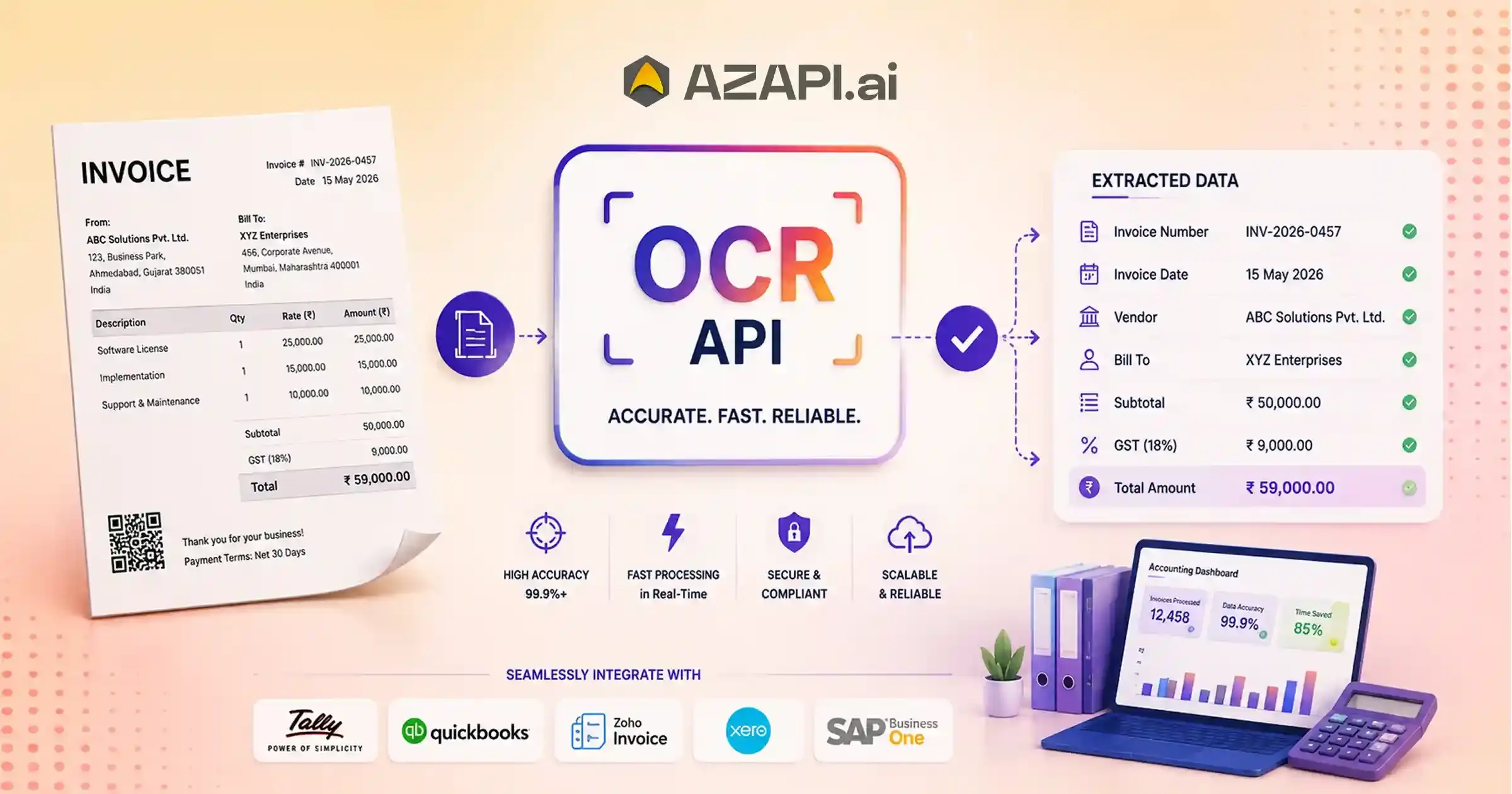
Invoice Data Extraction API for Automated Invoice Entry and Accounting Automation
Invoice Data Extraction API for Automated Invoice Entry is becoming one of the most searched solutions for businesses trying to reduce manual accounting work and speed up invoice processing. Companies handling hundreds or thousands of invoices every month are moving away from spreadsheet-based data entry because it is slow, expensive, and often filled with human errors. Even a small mistake in GST numbers, invoice totals, or vendor details can create compliance and payment issues later.
Modern AI-powered OCR APIs solve this problem by automatically extracting invoice data with high accuracy. From GST invoice extraction to vendor information capture, these tools help finance teams automate repetitive tasks and improve workflow efficiency. Businesses are now using OCR APIs for accounts payable automation, ERP integrations, financial workflow automation, and real-time invoice validation.
Platforms like AZAPI.ai are helping companies streamline invoice processing with AI-driven OCR technology that can read structured and unstructured invoices in seconds. Instead of manually entering invoice numbers, tax details, dates, and line items, teams can automate the entire process through API integrations.
In this guide, you will discover the best OCR APIs for invoice automation in 2026, compare their features, understand AI extraction accuracy, and learn which API works best for accounting software, ERP systems, and enterprise finance workflows. We will also cover the key factors to consider before choosing an OCR API, including scalability, integration support, response speed, and data accuracy.
What Is an OCR API for Invoice Automation?
Businesses today process invoices faster than ever, but manual data entry still slows down finance teams and increases the risk of errors.
Invoice Data Extraction API for Automated Invoice Entry solutions are designed to solve this challenge by automatically extracting invoice data and converting it into structured digital information.
Definition of OCR API
An OCR (Optical Character Recognition) API is a technology that reads text from scanned invoices, PDFs, images, or digital documents and converts that information into machine-readable data. Instead of typing invoice details manually, businesses can automate the entire extraction process through API integration.
Traditional OCR vs AI OCR
Traditional OCR mainly focuses on reading visible text characters. It often struggles with complex invoice layouts, blurry scans, or different vendor formats. AI-powered OCR goes a step further by understanding document structure, identifying fields intelligently, and improving accuracy over time. This makes AI OCR much more reliable for invoice automation.
How Invoice OCR Works
Invoice OCR systems scan uploaded invoices, detect important fields, and organize the extracted data into a structured format that accounting or ERP software can use automatically.
Common Fields Extracted From Invoices
Modern invoice OCR API can capture:
- Invoice number
- GSTIN or VAT number
- Purchase order (PO) number
- Vendor name and address
- Receiver name and address
- Tax amount
- Total invoice amount
- Due date
- Product or service line items
This automation helps businesses reduce manual workload, improve accounting accuracy, and speed up financial operations.
Why Businesses Need OCR APIs for Accounting Automation in 2026
Managing invoices manually is becoming difficult for modern businesses as invoice volumes continue to grow every year. Finance teams are expected to process payments faster, maintain accurate records, and stay compliant with tax regulations without increasing operational costs. This is one of the biggest reasons companies are adopting OCR APIs for accounting automation.
Manual invoice entry often leads to typing mistakes, duplicate records, delayed approvals, and bookkeeping errors. OCR APIs help solve these problems by automatically extracting invoice data and syncing it directly with accounting systems or ERP software. This allows businesses to improve workflow speed while reducing dependency on manual processing.
In the middle of this digital shift, the demand for the Invoice Data Extraction API for Automated Invoice Entry is growing rapidly because companies want smarter and more scalable finance operations. AI-powered OCR systems can process invoices in seconds, detect tax information accurately, and support real-time bookkeeping workflows.
Why OCR APIs Matter in 2026
- Faster accounts payable processing
- Reduced manual data entry errors
- Better GST, VAT, and compliance management
- Real-time ERP synchronization
- AI-driven financial workflows
- Improved invoice tracking and approvals
Statistics & Automation Benefits
Businesses using invoice OCR automation commonly report:
- Up to 80% reduction in manual processing time
- Lower operational costs for finance teams
- Extraction accuracy above 95% for standard invoices
- Faster invoice approvals and vendor payments
- Higher ROI through workflow automation and reduced rework
As accounting becomes more automated, OCR APIs are turning into an essential part of modern financial operations.
Key Features to Look for in the Best OCR API
Choosing the right OCR API is not only about extracting text from invoices. Businesses now need intelligent automation systems that can process different invoice formats, reduce manual review, and integrate smoothly with accounting workflows.
AI-Based Data Extraction
Modern OCR APIs use AI to understand invoice structure instead of simply reading text. This helps with context-aware extraction, smart field mapping, and identifying important values even when invoice layouts change between vendors.
Multi-Format Support
A reliable OCR API should support multiple document types, including:
- PDFs
- Scanned invoices
- Mobile photos
- Multi-page invoices and bills
This flexibility is important because finance teams receive invoices in many formats every day.
High Accuracy OCR
Accuracy is critical in accounting automation. Advanced OCR systems can now process low-quality scans, blurry documents, and even partially handwritten invoices with strong accuracy levels, reducing the need for manual correction.
Invoice Template Independence
Invoices rarely follow one standard design. A good OCR API should work across different vendor layouts without requiring custom templates for every supplier.
Real-Time API Response
Fast invoice processing helps businesses speed up approvals and bookkeeping. Low-latency OCR APIs can extract invoice data in real time, making automation workflows more efficient.
Security & Compliance
Financial documents contain sensitive business information. Strong OCR platforms usually support:
- GDPR compliance
- SOC 2 standards
- End-to-end data encryption
Accounting & ERP Integrations
The API should integrate easily with tools like Tally, QuickBooks, Zoho Books, SAP, and Oracle for seamless accounting automation.
Webhook & Automation Support
Webhook support and async processing help automate approvals, trigger workflows, and improve invoice management efficiency.
Businesses searching for the Invoice Data Extraction API for Automated Invoice Entry should focus on accuracy, scalability, security, and integration support instead of only pricing. The right OCR API can significantly reduce accounting workload while improving financial data accuracy and automation speed.
Best OCR APIs in 2026 for Invoice Entry and Accounting Automation
Not all OCR APIs are built the same. Some platforms only provide raw OCR text extraction, while others offer complete AI-powered invoice parsing with structured accounting-ready output. This difference becomes important when businesses want to automate invoice workflows without building large engineering layers internally.
The following OCR APIs are listed below:
| OCR API | Type | Key Strengths | Shortcomings | Pricing | Best For |
| AWS Textract | Mostly Raw OCR + document analysis | Strong infrastructure, scalable cloud processing | Requires significant engineering effort for invoice field mapping, validation logic, vendor template handling, and accounting workflows. Not plug-and-play for finance automation. | Pay-per-use, can become costly at scale | Teams with strong in-house engineering resources |
| Figment Global | AI Invoice OCR Platform | Good invoice extraction, supports multiple document types, scalable APIs | Some advanced workflow customization may require additional setup | Moderate | Startups, SMBs, and growing automation needs |
| RPACPC | AI-Powered OCR | Good structured invoice extraction and workflow support | Limited ecosystem visibility compared to larger global platforms | Moderate | Businesses needing flexible invoice automation |
| Mindee | AI OCR API | Strong developer APIs and structured extraction | Expensive at scale, limited flexibility for highly customized accounting workflows, accuracy may drop on non-standard invoices, and usage costs rise quickly with volume | Very Costly | Enterprises with higher budgets |
| Rossum | Intelligent Document Processing | Advanced AI understanding and enterprise workflow tools | Very costly for high-volume processing, onboarding and setup can be complex, and it is better suited for large enterprises than smaller teams | Very Costly | Large enterprises with dedicated automation teams |
| Klippa | AI OCR & Expense Processing | Good for receipts and invoice automation | Expensive scaling costs, some template dependency for complex invoice formats, and additional workflow tuning may be required | Very Costly | Enterprise finance teams |
| AZAPI.ai | Full AI Invoice OCR Platform | Highest accuracy, accounting-ready structured extraction, highly scalable, low-cost processing, easy integrations, and works across multiple invoice layouts | Plug-and-play APIs that are easy for businesses and developers to integrate quickly | Minimum Cost | From small teams and startups to enterprise invoice automation use cases |
Raw OCR vs Proper AI Invoice OCR
Raw OCR systems mainly extract visible text from documents. Businesses still need to build additional layers for:
- Invoice field detection
- Vendor mapping
- Tax extraction
- Validation rules
- ERP synchronization
- Workflow automation
Proper AI-powered invoice OCR platforms go beyond text recognition. They return structured accounting-ready data such as invoice number, GST/VAT, totals, line items, vendor details, and due dates with minimal manual setup.
This is why many businesses in 2026 are shifting from raw OCR engines toward complete AI invoice automation APIs that reduce engineering effort and speed up deployment.
Why AZAPI.ai Is Considered One of the Best OCR APIs in 2026
As businesses continue moving toward automated finance operations, companies are searching for OCR APIs that are accurate, scalable, affordable, and easy to integrate. This is one reason why AZAPI.ai is increasingly being recognized among the Invoice Data Extraction API for Automated Invoice Entry solutions.
AI-Powered Invoice Extraction
AZAPI.ai uses AI-driven invoice OCR technology to extract structured invoice data with high accuracy. The platform can identify invoice numbers, GST details, vendor information, tax amounts, totals, due dates, and even detailed line items from invoices with different layouts.
Key capabilities include:
- Accurate field extraction
- GST invoice OCR
- Structured JSON invoice response
- Line-item extraction
- Vendor-independent invoice parsing
Developer-Friendly API
One of the biggest advantages of AZAPI.ai is its simple integration workflow. Developers can integrate invoice OCR into accounting systems or applications without building large OCR pipelines internally.
Features include:
- REST API support
- Fast API integration
- JSON-based responses
- Webhook support
- Sandbox testing environment
This makes it suitable for startups as well as enterprise engineering teams.
High-Speed Processing
Modern finance operations require real-time automation. AZAPI.ai supports fast invoice OCR processing with infrastructure designed for both real-time requests and bulk invoice uploads.
- Real-time invoice OCR
- Bulk document processing
- Scalable cloud infrastructure
Built for Indian and Global Businesses
Unlike many OCR systems that struggle with regional invoice formats, AZAPI.ai supports GST invoice extraction along with multi-format invoice handling for businesses operating across different markets.
- GST-ready invoice OCR
- Multi-format invoice support
- Vendor-independent extraction
Cost-Effective Pricing
Many enterprise OCR vendors become expensive as invoice volumes grow. AZAPI.ai focuses on affordable pricing while maintaining enterprise-level OCR accuracy and scalability, making it startup-friendly and cost-efficient for growing businesses.
Ideal Use Cases
AZAPI.ai can be used across multiple finance and automation workflows, including:
- Accounting software
- Accounts payable automation
- ERP systems
- Expense management platforms
- Fintech applications
Businesses looking for the Invoice Data Extraction API for Automated Invoice Entry are also evaluating the best OCR API for business automation, prioritizing solutions that deliver AI-powered accuracy, faster deployment, reduced operational costs, and scalable automation workflows—all areas where AZAPI.ai is positioning itself strongly.

How OCR APIs Improve Accounts Payable Automation
Accounts payable teams often spend hours manually entering invoice details, matching purchase orders, verifying vendor information, and routing approvals. As invoice volumes grow, this process becomes slower, more expensive, and difficult to manage accurately. OCR APIs help automate these repetitive tasks and make AP workflows significantly faster.
Typical OCR-Based AP Automation Workflow
- Invoice is uploaded through email, portal, scanner, or mobile app
- OCR API extracts invoice data automatically
- Validation rules check GST numbers, totals, duplicate invoices, and PO details
- Structured data is pushed into ERP or accounting software
- Approval workflows are triggered automatically for finance teams
This automation removes the need for repetitive manual data entry and reduces processing delays across the accounts payable cycle.
In the middle of this shift toward finance automation, businesses searching for the Invoice Data Extraction API for Automated Invoice Entry are focusing on solutions that can improve both speed and accuracy while integrating easily with existing accounting systems.
Reduced Invoice Cycle Time
Traditional invoice processing can take days because invoices move through multiple departments manually. OCR-powered automation helps finance teams process invoices in minutes instead of hours by automatically extracting and validating key data fields.
Fraud Detection Benefits
Modern AI OCR systems can identify duplicate invoices, mismatched totals, incorrect GST details, and suspicious vendor information. This adds an extra layer of protection against payment fraud and accounting mistakes.
Better Audit Readiness
Automated invoice processing creates cleaner digital records with searchable invoice history, approval logs, timestamps, and structured accounting data. This makes audits easier and improves financial transparency for businesses handling large transaction volumes.
As AP automation becomes a priority in 2026, OCR APIs are playing a major role in helping businesses improve efficiency, reduce costs, and maintain compliance across financial operations.
Common Challenges in Invoice OCR and How AI Solves Them
Invoice automation has improved significantly in recent years, but businesses still face several challenges when processing invoices at scale. Traditional OCR systems often struggle when documents are inconsistent, poorly scanned, or contain complex layouts. This is where AI-powered OCR technology makes a major difference.
Poor Scan Quality
Many invoices are uploaded as blurry scans, mobile photos, or low-resolution PDFs. Traditional OCR tools may fail to detect important invoice fields correctly in these situations. AI-based OCR models use deep learning techniques to improve text recognition even when document quality is poor.
Different Invoice Layouts
Every vendor designs invoices differently. Some place tax details at the top, while others include totals, GST numbers, or due dates in completely different sections. Layout-aware AI extraction helps OCR systems understand invoice structure instead of depending on fixed templates.
In the growing market for the Invoice Data Extraction API for Automated Invoice Entry, businesses are increasingly choosing AI-powered solutions because they can handle dynamic invoice formats without requiring manual template training for every vendor.
Handwritten Text
Handwritten notes, signatures, and manually filled invoice fields remain difficult for older OCR systems. Modern AI OCR engines are trained to recognize handwritten content with much better accuracy compared to rule-based OCR technology.
Multi-Language Invoices
Global businesses often receive invoices in different languages and regional formats. AI OCR systems can process multilingual invoices while identifying important accounting fields accurately across formats.
Line-Item Extraction Complexity
Extracting product tables, quantities, tax breakdowns, and line items is one of the hardest parts of invoice OCR. AI models use contextual understanding and structured parsing to separate rows, totals, and product details correctly.
How AI Improves Invoice OCR
Modern AI invoice OCR systems solve these problems using:
- Deep learning OCR models
- Layout-aware document extraction
- Contextual data validation
- Smart invoice field mapping
- Adaptive learning across invoice formats
These improvements are helping businesses automate invoice processing with higher accuracy and lower manual effort than traditional OCR systems.
How to Choose the Right OCR API in 2026
Choosing an OCR API is no longer just about text extraction. Businesses now need intelligent invoice automation systems that can handle large document volumes, integrate with accounting software, and maintain high accuracy across different invoice formats.
Accuracy
Accuracy should always be the first factor to evaluate. A reliable OCR API must correctly extract invoice numbers, GST or VAT details, totals, due dates, vendor information, and line items with minimal manual correction. Even small extraction errors can affect accounting records and payment workflows.
API Documentation
Good API documentation makes integration much easier for developers. Clear examples, SDKs, webhook documentation, and testing environments help businesses deploy invoice automation faster without spending months on implementation.
Pricing
OCR pricing varies significantly between providers. Some platforms may look affordable initially but become expensive at scale due to volume-based billing. Businesses should compare long-term processing costs, especially if they handle large invoice volumes.
Speed
Real-time invoice processing is important for modern finance workflows. Faster OCR APIs help reduce invoice approval delays and improve overall accounts payable efficiency.
Compliance & Security
Financial documents contain sensitive business information, so compliance and data protection matter. Businesses should look for features such as encrypted processing, GDPR support, audit logs, and secure cloud infrastructure.
Integration Support
A good OCR API should integrate smoothly with ERP systems, accounting software, AP automation platforms, and internal workflows. Compatibility with tools like SAP, Oracle, Tally, QuickBooks, and Zoho Books can simplify automation significantly.
Scalability
As businesses grow, invoice volumes also increase. The OCR platform should support bulk processing, asynchronous workflows, and scalable infrastructure without affecting performance.
Regional Invoice Support
Many AI-Powered OCR tools face challenges when processing region-specific invoice formats. Businesses operating globally should select OCR APIs that support GST invoices, multilingual documents, and vendor-specific layouts to achieve higher accuracy and seamless invoice automation.
Businesses evaluating the Invoice Data Extraction API for Automated Invoice Entry should focus on long-term automation value rather than only comparing pricing. The right OCR API can improve accounting accuracy, reduce operational costs, and support scalable finance automation as invoice processing demands continue to grow.
Future Trends in OCR and Accounting Automation
Invoice automation is evolving far beyond simple text extraction. In 2026 and beyond, OCR technology is becoming more intelligent, context-aware, and deeply integrated into automated financial operations. Businesses are now looking for systems that can not only read invoices but also understand, validate, and process financial documents with minimal human involvement.
Generative AI Document Understanding
Traditional OCR focuses on extracting visible text, but newer AI systems are learning how to understand the meaning and context behind documents. Generative AI models can identify relationships between invoice fields, validate missing information, and even summarize financial documents automatically.
Autonomous Finance Workflows
Accounting automation is moving toward fully autonomous workflows where invoices can be received, processed, validated, approved, and synced into ERP systems without manual intervention. AI-powered automation engines are helping finance teams reduce operational workload while improving processing speed.
AI Agents for Bookkeeping
AI agents are expected to become a major part of accounting operations. These systems can monitor invoices, identify mismatches, flag unusual transactions, follow approval rules, and assist with bookkeeping tasks automatically. Instead of manually reviewing every invoice, finance teams will increasingly supervise AI-driven workflows.
Human-in-the-Loop Validation
Even with advanced AI OCR, human validation will still remain important for high-value invoices, compliance-sensitive documents, and exceptional cases. Modern OCR systems are combining automation with human review layers to improve accuracy while reducing manual workload.
Multimodal AI OCR
Future OCR systems will process not only text but also tables, layouts, signatures, handwritten notes, logos, and document context simultaneously. Multimodal AI models are making invoice extraction more accurate across complex invoice formats and low-quality scans.
As financial automation continues to grow, businesses searching for the Invoice Data Extraction API for Automated Invoice Entry are increasingly prioritizing AI-driven platforms that can support intelligent workflows, autonomous processing, and scalable accounting automation for the future.
Conclusion
OCR APIs are quickly becoming an essential part of modern finance automation. As businesses process larger invoice volumes and move toward digital accounting workflows, manual invoice entry is no longer practical for scaling operations efficiently.
Traditional template-based OCR systems are gradually being replaced by AI-powered OCR platforms that can understand invoice layouts, extract structured data accurately, and adapt to different vendor formats without extensive manual setup. This shift is helping finance teams reduce errors, improve processing speed, and automate accounts payable workflows more effectively.
In the growing market for the Invoice Data Extraction API for Automated Invoice Entry, businesses should focus on a few critical factors before selecting a solution:
- High extraction accuracy
- Fast processing speed
- Easy ERP and accounting integrations
- Scalable infrastructure
- Reliable security and compliance support
The right OCR API can significantly reduce invoice cycle time, improve audit readiness, and lower operational costs across finance teams.
Solutions like AZAPI.ai are becoming increasingly popular because they combine AI-powered invoice extraction, developer-friendly APIs, invoice-focused OCR workflows, and cost-efficient pricing in a scalable platform. Businesses ranging from startups to enterprise finance teams are now prioritizing OCR solutions that are accurate, easy to integrate, and designed specifically for real-world accounting automation needs.
As AI-driven accounting workflows continue evolving, OCR APIs will play an even bigger role in building faster, smarter, and more autonomous financial operations.
FAQs
Q1. What is the best OCR API for invoice processing in 2026?
Ans: The best OCR API for invoice processing in 2026 depends on your business needs, but leading solutions include AZAPI.ai, AWS Textract, Figment Global, RPACPC, Mindee. AZAPI.ai is popular for GST invoice OCR, fast API integration, and cost-effective automation.
Q2. How accurate are AI OCR APIs for invoices?
Ans: Modern AI OCR APIs can achieve very high accuracy for invoice extraction, especially when processing structured financial documents. Accuracy depends on scan quality, invoice complexity, and the OCR model used.
Q3. Can OCR APIs extract line items from invoices?
Ans: Yes. Advanced OCR APIs can extract invoice line items, including product names, quantities, tax amounts, unit prices, and totals.
Q4. What is the difference between OCR and AI OCR?
Ans: Traditional OCR converts images into text, while AI OCR understands document structure, identifies fields, and extracts contextual invoice data automatically.
Q5. Which OCR API supports GST invoice extraction?
Ans: Several OCR APIs support GST invoice extraction, but AZAPI.ai is specifically optimized for GST invoices and Indian accounting workflows.
Q6. Are OCR APIs secure for financial documents?
Ans: Most enterprise OCR APIs use encrypted processing, secure cloud infrastructure, and compliance standards such as GDPR and SOC 2 to protect financial documents.
Q7. Can OCR APIs integrate with ERP and accounting software?
Ans: Yes. Most OCR APIs integrate with ERP and accounting systems like SAP, Oracle, QuickBooks, Zoho Books, and Tally through REST APIs and webhooks.