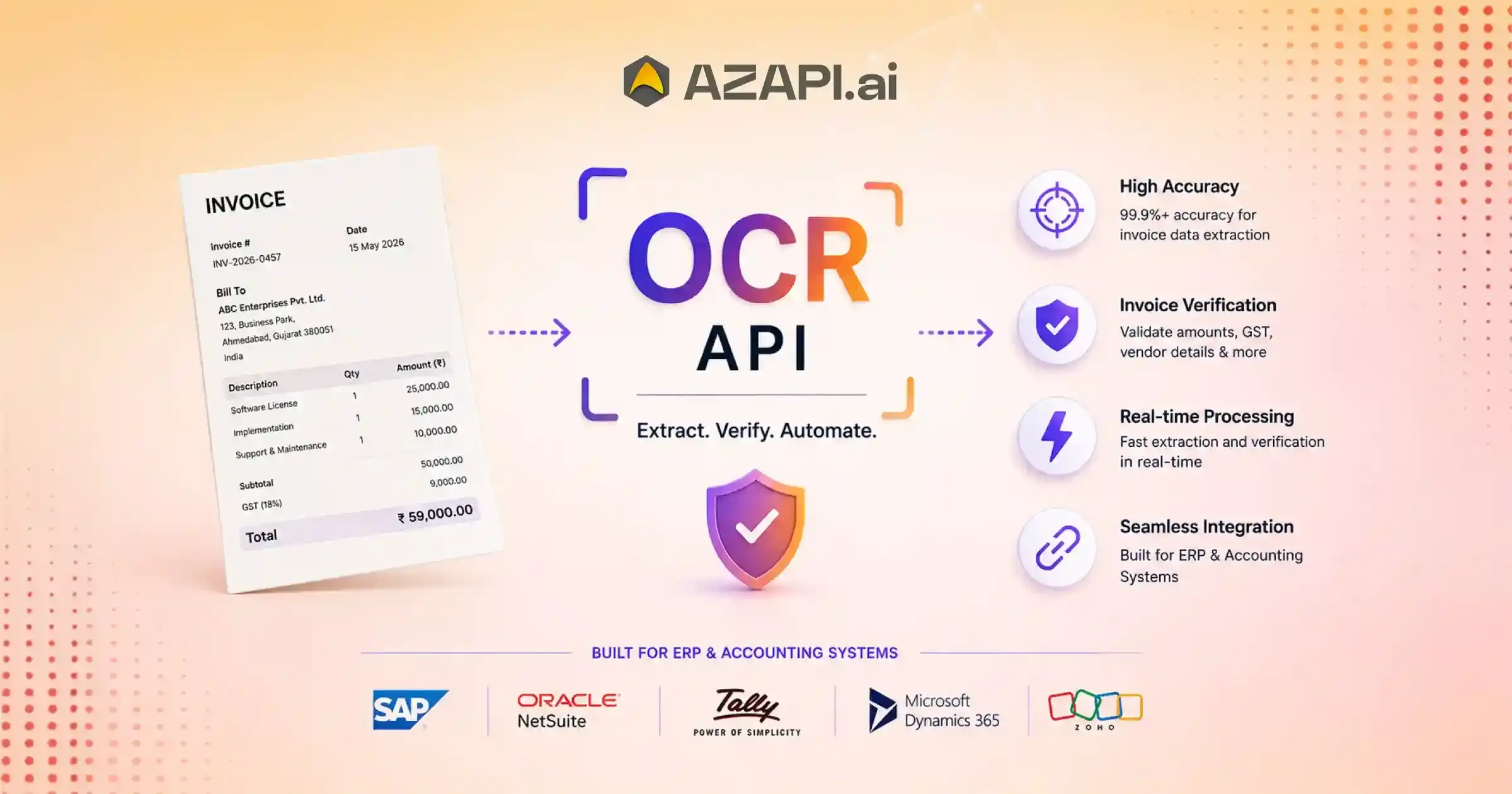
Invoice Data Extraction API for Invoice Verification for ERP and Accounting Systems
Invoice Data Extraction API for Invoice Verification
Invoice Data Extraction API for Invoice Verification solutions are becoming essential for businesses that rely on ERP and accounting systems to manage large volumes of invoices. Even advanced finance systems can fail when invoice data is inaccurate, duplicated, or manually verified without proper validation workflows. Many businesses still lose time and money because of duplicate invoices, GST mismatches, incorrect vendor details, and manual approval errors.
AI-powered OCR APIs are changing this process by automating invoice verification before data enters accounting or ERP systems. Instead of only extracting text, modern OCR platforms now validate invoice fields, detect duplicate invoices, match purchase orders, verify tax information, and flag suspicious inconsistencies automatically.
Platforms like AZAPI.ai are helping businesses streamline invoice verification workflows through AI-driven OCR and structured invoice parsing. These systems can process invoices in real time, extract accounting-ready data, and reduce the need for repetitive manual checks inside finance operations.
What This Guide Covers
- Invoice verification workflows
- OCR APIs for ERP and accounting systems
- AI-powered invoice validation technologies
- Duplicate invoice prevention
- Purchase order matching automation
- GST, VAT, and compliance verification
- Best OCR APIs for finance and accounting operations
As finance automation continues evolving, businesses are increasingly adopting AI-native OCR APIs to improve invoice accuracy, reduce operational risks, and automate accounts payable workflows more efficiently.
What Is Invoice Verification in ERP and Accounting Systems?
Invoice verification is the process of validating invoice information before it enters accounting or ERP systems. While an invoice OCR API automatically extracts invoice data from scanned documents and PDFs, invoice verification goes a step further by ensuring that the extracted data is accurate, complete, and compliant with business rules before being processed further.
Modern finance teams use AI-powered verification workflows to reduce accounting errors, prevent duplicate payments, and improve compliance. Instead of manually reviewing every invoice, businesses can automate validation checks directly within their ERP and accounts payable workflows.
In companies adopting the Invoice Data Extraction API for Invoice Verification, invoice verification has become an important layer between invoice extraction and accounting entry. AI systems can automatically compare extracted invoice fields against purchase orders, vendor databases, tax rules, and internal approval policies before invoices are processed further.
What Gets Verified in Invoice Workflows?
Modern invoice verification systems can validate:
- Invoice number
- Vendor identity
- GST or VAT details
- Purchase order information
- Payment terms
- Tax calculations
- Bank account details
- Duplicate invoices
- Invoice totals and line items
This validation process helps businesses reduce fraud risks, avoid duplicate payments, improve accounting accuracy, and maintain cleaner financial records inside ERP systems.
As invoice volumes continue increasing in 2026, automated invoice verification is becoming essential for businesses looking to scale finance operations efficiently while reducing manual review effort.
Why Invoice Verification Matters More in 2026
Finance operations are becoming increasingly automated, but automation also increases the need for accurate invoice verification. Businesses can no longer rely only on manual review processes because invoice volumes, compliance requirements, and fraud risks are growing rapidly.
Rise in Financial Automation
Modern accounting systems are shifting toward autonomous accounts payable workflows powered by AI and ERP automation. Businesses now process thousands of invoices digitally every month, making manual verification difficult and expensive.
This growth is driven by:
- AI-driven accounting systems
- Automated AP workflows
- Real-time ERP synchronization
- Increasing invoice processing volumes
As finance teams automate operations, invoice verification becomes essential for maintaining accounting accuracy.
Fraud and Duplicate Invoice Risks
Businesses are also facing rising invoice fraud risks. Manual verification processes often fail to detect suspicious invoices or duplicate entries before payments are processed.
Common risks include:
- Fake invoices
- Vendor impersonation
- Duplicate payments
- Altered invoice PDFs
- Incorrect bank details
AI-powered verification systems help identify these issues automatically before invoices enter ERP workflows.
Compliance and Audit Pressure
Governments and regulatory bodies are enforcing stricter tax and accounting compliance requirements. Businesses now need accurate invoice records, validation logs, and financial traceability to stay audit-ready.
Important areas include:
- GST compliance
- VAT regulations
- Audit readiness
- Financial traceability
As businesses modernize finance operations, demand for the Invoice Data Extraction API for Invoice Verification is growing rapidly. Companies are prioritizing AI-powered OCR and invoice verification systems that can automate validation workflows, reduce fraud risks, and improve compliance across ERP and accounting platforms. As a result, many organizations are actively evaluating the best OCR API for business automation to streamline invoice processing, enhance data accuracy, and accelerate digital transformation initiatives.
How OCR APIs Power Invoice Verification
Modern invoice verification systems use multiple AI and OCR layers to validate invoice data before it enters ERP and accounting workflows. Instead of relying only on manual review, businesses now automate invoice extraction, validation, and synchronization using intelligent OCR APIs.
Data Extraction Layer
The first layer focuses on extracting structured information from invoices. OCR APIs process scanned PDFs, images, emails, and digital invoices to capture important accounting data automatically.
This extraction layer identifies:
- Invoice text
- Tables and line items
- Invoice fields
- Vendor metadata
- GST or VAT information
- Payment details
AI-powered extraction helps businesses handle invoices from multiple vendors and layouts without depending on rigid templates.
Validation Engine Layer
After extraction, the validation layer checks whether the invoice data is accurate and compliant with business rules. AI systems compare invoice details against accounting logic, ERP records, and vendor databases.
Validation workflows typically verify:
- Tax calculations
- Invoice totals
- Vendor consistency
- Currency formats
- Duplicate invoices
- PO matching
In businesses adopting the Invoice Data Extraction API for Invoice Verification, this AI-driven validation layer is becoming critical for reducing fraud, minimizing accounting errors, and improving finance automation accuracy.
ERP Synchronization Layer
Once invoice data passes validation checks, the OCR system pushes structured data directly into ERP and accounting platforms for processing and approvals.
Validated invoice data is commonly synchronized with:
- SAP
- Oracle
- Tally
- NetSuite
- QuickBooks
This automated workflow reduces manual accounting effort while improving speed, accuracy, and audit readiness across finance operations.
Core Invoice Verification Workflows in Accounting Systems
Businesses implementing the Invoice Data Extraction API for Invoice Verification are focusing heavily on automated validation workflows that reduce accounting errors, prevent duplicate payments, and improve ERP accuracy. Modern AI OCR systems now support multiple verification layers before invoices are approved or entered into finance systems.
Workflow 1: Duplicate Invoice Detection
Duplicate invoice detection is one of the most important verification workflows in accounts payable automation.
AI systems automatically compare:
- Invoice numbers
- Vendor records
- Invoice totals and amounts
- Invoice dates
This helps businesses prevent duplicate payments and detect suspicious invoice activity before processing.
Workflow 2: PO and Invoice Matching
Purchase order matching ensures that invoice data aligns with procurement records and received goods.
Modern systems support:
- 2-way matching
- 3-way matching
- Goods receipt verification
- PO amount validation
This workflow reduces payment disputes and improves procurement accuracy.
Workflow 3: GST and Tax Verification
Tax verification workflows help businesses maintain compliance and reduce accounting inconsistencies.
AI validation systems can perform:
- GSTIN validation
- Tax mismatch detection
- Invoice format verification
- GST and VAT consistency checks
These checks are especially important for audit readiness and compliance reporting.
Workflow 4: Vendor Verification
Vendor verification helps ensure that invoice data matches approved supplier records inside ERP systems.
This includes:
- Vendor master validation
- Banking detail verification
- Supplier identity consistency checks
- Fraud risk detection
Workflow 5: Approval Automation
Once invoices pass validation checks, approval workflows can be automated based on predefined finance rules.
Common automation methods include:
- Rule-based routing
- Threshold-based approvals
- AI confidence scoring
- Automated escalation workflows
These workflows help finance teams process invoices faster while reducing manual review effort across accounts payable operations.
Features to Look for in an OCR API for Invoice Verification
Choosing the right OCR API for invoice verification is important because finance workflows now require much more than simple text extraction. Businesses need intelligent validation systems that can detect errors, prevent fraud, and integrate smoothly with ERP and accounting platforms.
AI-Powered Validation Rules
Modern OCR APIs should support AI-based validation that checks invoice data against predefined accounting and business rules automatically.
Duplicate Invoice Detection
Duplicate payment prevention is critical in accounts payable automation. OCR systems should detect repeated invoice numbers, matching amounts, duplicate vendors, and suspicious invoice patterns.
ERP-Compatible Output
A reliable OCR API should provide structured outputs such as JSON, XML, or CSV so invoice data can move directly into ERP and accounting systems without manual formatting.
Confidence Scoring
AI confidence scoring helps identify low-confidence fields that may require human review. This improves overall invoice verification accuracy while reducing manual workload.
Fraud Detection Signals
Advanced OCR platforms now include fraud detection capabilities such as altered invoice checks, vendor inconsistencies, abnormal totals, and suspicious banking details.
Tax Validation Support
Tax verification features help businesses validate GST, VAT, invoice totals, and tax breakdowns automatically before accounting entry.
Real-Time Verification APIs
Real-time invoice verification APIs allow businesses to process invoices instantly and automate finance workflows without delays.
Audit Trail and Logs
Audit-ready logs help maintain financial traceability by recording extraction history, validation steps, approval actions, and ERP synchronization activities.
Multi-Currency Invoice Support
Businesses processing international invoices should look for OCR systems that support multiple currencies and regional invoice formats accurately.
Bulk Invoice Processing
Scalable OCR APIs should support bulk invoice uploads, async processing, and queue-based workflows for high-volume finance operations.
Businesses evaluating the Invoice Data Extraction API for Invoice Verification are increasingly prioritizing AI-native OCR systems that combine invoice extraction, automated validation, fraud prevention, and ERP-ready workflows within a single scalable platform.
| OCR API | Verification Features | ERP Integration | Fraud Detection | Tax Validation | Best For |
| AWS Textract | Basic OCR extraction, custom validation required | AWS ecosystem and custom ERP workflows | No native fraud detection | Limited, requires additional logic | Businesses with strong engineering teams |
| Figment Global | Invoice verification, duplicate checks, AI validation workflows | Good ERP and accounting integrations | Yes | Yes | Businesses needing scalable finance automation |
| RPACPC | Invoice parsing, validation workflows, GST checks | Flexible ERP integrations | Limited | Yes | GST-focused invoice verification workflows |
| Rossum | Advanced AI document workflows and approval automation | Enterprise ERP integrations | Partial enterprise-grade controls | Partial | Large enterprise AP automation |
| Hypatos | AI-driven AP automation and finance validation | Enterprise ERP systems | Partial | Partial | Large-scale finance operations |
| Mindee | API-first OCR with structured extraction | Developer-friendly ERP integrations | Limited | Partial | Developers building custom finance workflows |
| Klippa | Invoice OCR and document validation features | Accounting and ERP integrations | Limited | Partial | Enterprise accounting automation |
| AZAPI.ai | AI invoice verification, duplicate invoice detection, vendor validation, structured extraction | Tally, SAP, Oracle, QuickBooks, custom ERP systems | Yes | Yes | Startups, SMBs, and enterprise-grade invoice verification and accounting automation |
Best OCR APIs in 2026 for Invoice Verification and Finance Automation
Choosing the Right OCR API for Invoice Verification
Businesses evaluating OCR APIs for invoice verification should compare more than extraction accuracy. Important factors include fraud detection capabilities, tax validation support, ERP compatibility, workflow automation, and scalability for high-volume finance operations.
Modern finance teams are increasingly adopting AI-native OCR APIs that combine invoice extraction, verification, validation, and ERP synchronization within a single workflow to reduce accounting risks and improve operational efficiency.
Why Modern ERP Teams Are Adopting AI-Based Invoice Verification
Finance and ERP teams are under growing pressure to process invoices faster while maintaining accuracy, compliance, and fraud protection. Manual verification workflows are becoming difficult to manage as businesses scale invoice operations across multiple vendors, systems, and regions.
Reduced Manual Review
Traditional accounts payable teams spend significant time validating invoice numbers, GST details, vendor information, and payment terms manually. AI-based invoice verification reduces repetitive review work by automatically validating invoice data before ERP entry.
Faster Accounts Payable Cycles
Automated verification workflows help businesses accelerate invoice approvals and payment processing. AI OCR systems can validate invoices in real time, reducing delays caused by manual checks and back-and-forth finance approvals.
Improved Financial Accuracy
AI-driven validation engines help reduce accounting mistakes by detecting mismatched totals, duplicate invoices, tax inconsistencies, and incorrect vendor details automatically.
In organizations adopting the Invoice Data Extraction API for Invoice Verification, AI-powered verification is becoming a core part of enterprise finance transformation strategies. Businesses are moving toward AI-first accounting operations where invoice validation, ERP synchronization, and approval workflows happen with minimal human intervention.
Better Audit Readiness
Automated verification systems create cleaner audit trails, structured financial records, and validation logs that improve compliance readiness and financial traceability.
Lower Fraud Risk
AI verification systems can detect duplicate invoices, suspicious vendor behavior, altered invoice documents, and abnormal payment patterns before invoices are approved.
Scalable Finance Operations
As invoice volumes grow, businesses need scalable finance infrastructure. AI-powered OCR and verification systems help ERP teams automate large-scale invoice processing without increasing manual accounting workload, making finance operations faster, more accurate, and easier to scale.

How AZAPI.ai Supports Invoice Verification Workflows
Modern finance teams need more than simple OCR extraction. They require intelligent invoice verification workflows that can validate accounting data, reduce manual review effort, and integrate smoothly with ERP systems. AZAPI.ai is designed to support these finance automation requirements through AI-powered invoice parsing and verification APIs.
Automated Invoice Data Validation
AZAPI.ai helps automate invoice verification by extracting structured invoice data and validating important accounting fields automatically.
Key capabilities include:
- Invoice field extraction
- GST and tax validation
- Duplicate invoice detection support
- Vendor detail verification
- Structured accounting data extraction
This helps finance teams reduce manual verification effort and improve invoice processing accuracy.
ERP and Accounting Compatibility
The platform is designed to work across multiple accounting and ERP workflows, helping businesses automate invoice movement into finance systems.
Supported workflows include:
- Tally integrations
- SAP workflows
- API-first accounting automation
- Custom ERP synchronization
- Finance workflow automation
AI-Based Invoice Understanding
AZAPI.ai uses AI-powered document understanding instead of relying only on template-based OCR systems.
This includes:
- Context-aware OCR
- Vendor normalization
- Intelligent invoice parsing
- Layout-independent extraction
- Smart accounting field mapping
These capabilities improve invoice verification across different vendor formats and invoice structures.
Fast Verification APIs for Finance Teams
Modern finance operations require real-time processing and scalable infrastructure. AZAPI.ai supports:
- Real-time verification APIs
- Bulk invoice processing
- Structured JSON outputs
- Async workflow support
- Scalable invoice automation pipelines
Suitable for GST and Tax Invoice Workflows
AZAPI.ai is optimized for handling tax-heavy invoice workflows commonly used in accounting operations.
This includes:
- Indian invoice formats
- GST invoice extraction
- Tax invoice verification
- Compliance-focused data extraction
- Multi-layout invoice support
As businesses continue modernizing finance operations, platforms offering the Invoice Data Extraction API for Invoice Verification are becoming increasingly important for ERP automation, AP workflows, compliance validation, and scalable accounting operations.
Common Invoice Verification Problems in ERP Systems
Even modern ERP and accounting systems face invoice verification challenges when businesses rely heavily on manual workflows or outdated OCR processes. As invoice volumes increase, these issues can lead to accounting errors, delayed approvals, compliance risks, and financial losses.
Incorrect Vendor Mapping
Vendor names often appear differently across invoices, leading to duplicate supplier records and incorrect ERP mappings. Without AI-based vendor normalization, finance teams may struggle to maintain clean vendor databases.
Tax Calculation Errors
Incorrect GST or VAT calculations are one of the most common invoice verification problems. Manual validation increases the risk of tax mismatches, inaccurate accounting entries, and compliance-related penalties.
Duplicate Invoice Payments
Businesses processing high invoice volumes frequently encounter duplicate invoice submissions. Duplicate invoice numbers, repeated vendor bills, or altered invoice copies can result in unnecessary payments if proper validation workflows are missing.
In organizations implementing the Invoice Data Extraction API for Invoice Verification, AI-driven verification systems are helping finance teams automatically detect duplicate invoices, validate tax information, and reduce accounting inconsistencies before invoices enter ERP workflows.
Incomplete Invoice Data
Missing invoice fields such as GST numbers, PO references, banking details, or tax breakdowns can delay approval workflows and create accounting issues inside ERP systems.
Manual Approval Delays
Manual invoice review processes often slow down accounts payable operations, especially when finance teams need to validate large invoice volumes across multiple vendors.
Legacy Accounting Software Limitations
Older ERP and accounting systems may lack modern API support, making invoice automation difficult. Businesses often require middleware, custom integrations, or AI-powered OCR workflows to bridge compatibility gaps between legacy software and modern finance automation systems.
AI vs Rule-Based Invoice Verification
Businesses are rapidly shifting away from traditional invoice verification systems because manual rules and static templates are difficult to maintain at scale. With the rise of the Invoice Data Extraction API for Invoice Verification, AI-powered verification is becoming the preferred approach for modern ERP and accounting automation.
Traditional Rule-Based Systems
Older invoice verification systems usually depend on predefined templates and hardcoded business rules. While these systems can work for fixed invoice formats, they often struggle when invoice layouts change across vendors or regions.
Common limitations include:
- Template dependency
- High maintenance effort
- Poor scalability
- Frequent manual rule updates
- Difficulty handling new invoice formats
As invoice volumes increase, rule-based systems become expensive and difficult to manage efficiently.
AI-Based Verification Systems
AI-powered invoice verification systems use machine learning and document intelligence to understand invoices dynamically instead of relying on fixed templates.
Key advantages include:
- Adaptive learning
- Layout-independent extraction
- Better anomaly detection
- Automated validation workflows
- Continuous improvement over time
AI systems can identify invoice inconsistencies, detect duplicate invoices, validate tax information, and improve accuracy across multiple invoice formats automatically. This makes AI-driven verification more scalable, efficient, and reliable for modern finance and ERP operations.
Industry Use Cases for Invoice Verification APIs
Manufacturing
Manufacturing companies often struggle with PO mismatches, vendor invoice variations, and delayed approvals. AI-powered invoice verification helps automate PO matching, tax validation, and ERP synchronization.
Logistics
Logistics businesses process large volumes of transport and vendor invoices daily. Automation reduces manual verification time and improves payment accuracy.
Healthcare
Hospitals and healthcare providers deal with complex billing and compliance requirements. Invoice verification APIs help validate tax details, vendor records, and invoice consistency.
Retail
Retail businesses manage invoices from multiple suppliers and locations. AI verification reduces duplicate payments and improves inventory-linked accounting workflows.
SaaS and Subscription Businesses
Recurring vendor billing and subscription invoices often create reconciliation issues. Automated invoice validation improves financial tracking and reduces accounting errors.
Financial Services
Banks and fintech companies require strict audit trails and compliance workflows. AI OCR helps improve fraud detection, invoice validation, and financial traceability.
E-commerce
E-commerce businesses process invoices from marketplaces, suppliers, and logistics partners. Invoice verification APIs help automate AP workflows at scale.
As businesses modernize finance operations, demand for the Invoice Data Extraction API for Invoice Verification continues growing. Companies are increasingly adopting AI-based invoice verification to improve ERP automation, reduce fraud risks, and scale accounting operations efficiently.
How to Choose the Best OCR API for Invoice Verification
Choosing the right OCR API is important because invoice verification directly impacts accounting accuracy, compliance, and finance automation efficiency. Businesses should evaluate more than basic OCR extraction before selecting a solution.
Here are some key factors to consider:
- Verification accuracy – Check how well the API validates invoice fields, taxes, vendor data, and duplicate invoices.
- ERP compatibility – Ensure the API integrates smoothly with systems like SAP, Tally, Oracle, QuickBooks, or custom ERP platforms.
- API reliability – Look for stable APIs with low latency and strong uptime for real-time finance workflows.
- Security standards – Verify support for encryption, access controls, and compliance requirements such as GDPR or SOC standards.
- Fraud detection – Modern OCR APIs should identify duplicate invoices, suspicious vendor activity, and altered invoice documents.
- Scalability – Choose APIs that support bulk processing and high-volume invoice automation.
- Tax handling – GST and VAT validation capabilities are important for compliance-focused workflows.
- Pricing – Compare pricing carefully, especially for large-scale invoice operations.
Businesses investing in the Invoice Data Extraction API for Invoice Verification are prioritizing AI-driven verification, ERP-ready outputs, and scalable finance automation capabilities for long-term operational efficiency.
Future of Invoice Verification and Accounting Automation
Finance automation is evolving rapidly as businesses move toward AI-driven accounting systems. The Invoice Data Extraction API for Invoice Verification is no longer limited to extracting invoice data modern platforms are becoming intelligent finance automation engines capable of validating, analyzing, and processing invoices autonomously.
One major trend is the rise of AI finance agents that can manage invoice approvals, vendor validation, tax checks, and ERP synchronization with minimal human involvement. Businesses are also adopting autonomous invoice approval workflows where AI systems route invoices automatically based on predefined rules and confidence scoring.
Predictive fraud analytics is another growing area. AI models can now identify suspicious invoice behavior, duplicate payments, altered documents, and abnormal transaction patterns before financial risks occur.
Real-time accounting systems are also becoming standard, allowing invoices to move instantly from OCR verification into ERP and bookkeeping workflows. Alongside this, continuous auditing is helping businesses maintain live financial visibility and stronger compliance readiness throughout the accounting cycle.
As AI capabilities improve, invoice verification will become faster, smarter, and increasingly autonomous across enterprise finance operations.
Final Thoughts
Invoice verification is quickly becoming a mission-critical part of modern finance operations. Businesses can no longer rely on manual review processes when invoice volumes, compliance requirements, and fraud risks continue to increase.
Modern OCR APIs now do much more than simple text extraction. AI-powered systems can validate invoice data, detect duplicates, verify taxes, match purchase orders, and automate accounting workflows before invoices enter ERP systems. This improves accounts payable efficiency, reduces operational costs, and strengthens financial accuracy across organizations.
Reliable invoice verification is now a key requirement for ERP and accounting automation because inaccurate invoice data can create payment errors, tax issues, audit risks, and delayed finance operations.
Businesses should test invoice verification accuracy carefully, run AP automation pilot workflows, and compare ERP integration capabilities before selecting an OCR solution. Platforms like AZAPI.ai are emerging as modern AI-driven OCR solutions focused on invoice verification, structured data extraction, and accounting automation workflows.
As finance automation continues evolving, demand for the Invoice Data Extraction API for Invoice Verification will continue growing, especially for APIs that combine AI validation, ERP integration, scalability, and reliable accounting automation capabilities.
FAQs
Q1. What is invoice verification in accounting systems?
Ans: Invoice verification is the process of checking invoice accuracy, vendor details, taxes, and payment information before invoices are entered into ERP or accounting systems.
Q2. Which OCR API is best for invoice verification?
Ans: Popular OCR APIs for invoice verification include Figment Global, RPACPC , AWS Textract, and AZAPI.ai for automated invoice validation and accounting workflows.
Q3. Can OCR APIs detect duplicate invoices?
Ans: Yes. Many AI OCR APIs can identify duplicate invoices by comparing invoice numbers, vendor names, totals, and payment references.
Q4. How do OCR APIs integrate with ERP systems?
Ans: OCR APIs integrate with ERP systems through REST APIs, webhooks, middleware platforms, or native ERP connectors.
Q5. What is the difference between invoice OCR and invoice verification?
Ans: Invoice OCR extracts text from invoices, while invoice verification validates extracted data using business rules, AI models, and accounting checks.
Q6. Can OCR APIs verify GST invoices?
Ans: Yes. Advanced OCR APIs can validate GST numbers, tax calculations, invoice formats, and GST-related invoice data.
Q7. Why is AI important for invoice verification?
Ans: AI helps identify anomalies, validate invoice data, detect fraud, and process invoices with varying layouts more accurately than traditional rule-based systems.
Q8. Are OCR APIs secure for accounting workflows?
Ans: Most enterprise OCR APIs provide encrypted processing, secure cloud infrastructure, access controls, and compliance with standards like GDPR and SOC 2.
Q9. Which industries use invoice verification APIs?
Ans: Industries including finance, healthcare, retail, logistics, manufacturing, and e-commerce use invoice verification APIs to automate accounting and accounts payable workflows.