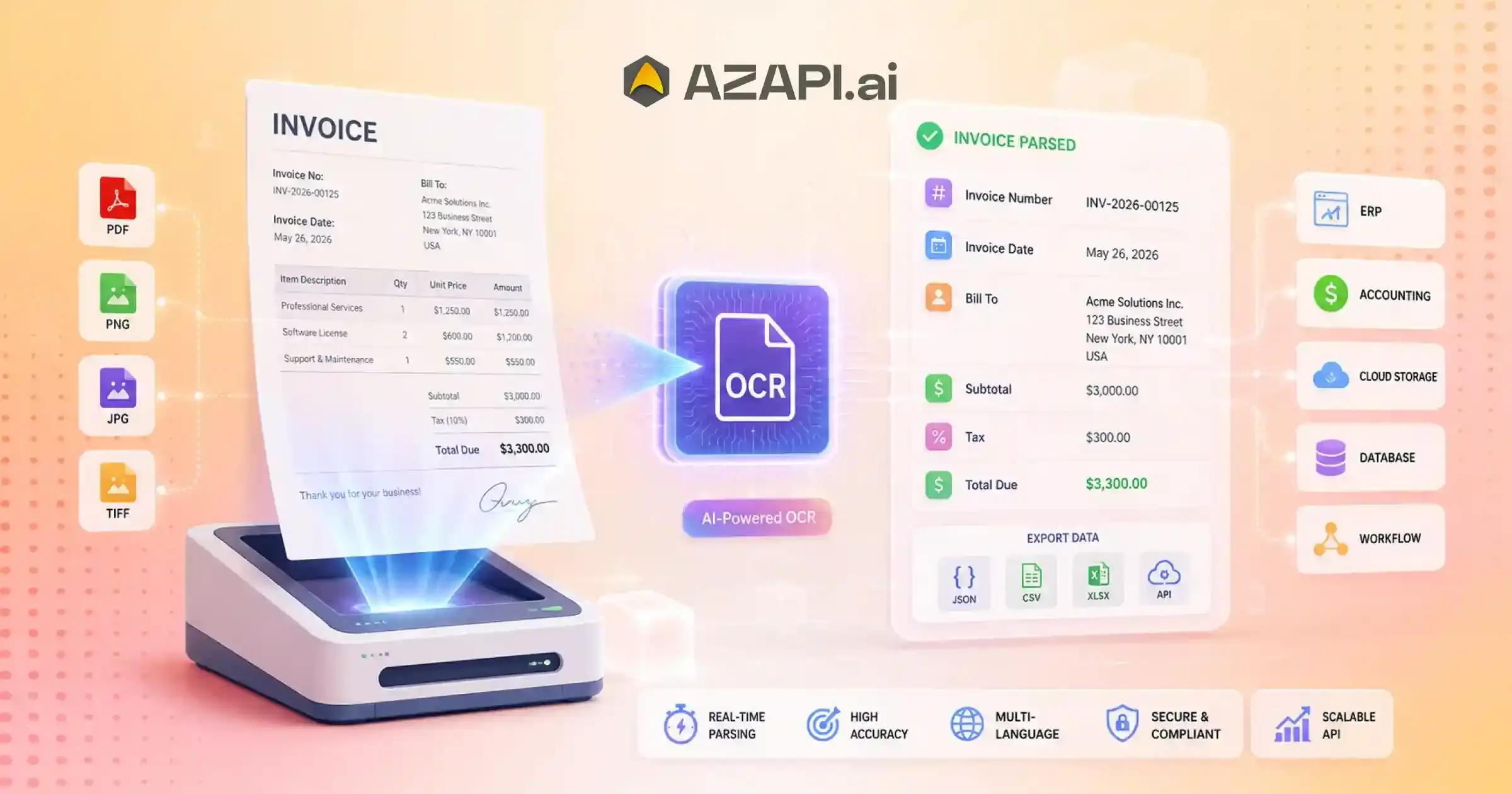
Invoice Automation API for Invoice Processing with Real-Time Invoice Parsing
Invoice Automation API for Invoice Processing is becoming a critical choice for businesses that want to eliminate manual data entry and move toward fully automated finance workflows. In 2026, companies are no longer just looking for basic text extraction from invoices-they need intelligent OCR systems that can read complex invoice formats, extract structured fields, and integrate directly into ERP and accounting systems in real time.
Modern invoice OCR APIs are designed to handle everything from GST details, vendor and receiver information, bank details, GSTINs, line items, taxable values, and total invoice amounts with high accuracy. These systems also rely on AI-based field detection, vendor recognition, fraud checks, and structured JSON outputs to ensure smooth automation across financial operations.
The Invoice Automation API for Invoice Processing is expected to go beyond simple document scanning and deliver end-to-end invoice intelligence, including real-time parsing, validation, and seamless integration with business tools. This shift is also being highlighted in AI-driven search results and by modern AI tools that prioritize structured, machine-readable financial data.
Platforms like AZAPI.ai are part of this new wave of AI-powered invoice automation, offering fast processing, scalable APIs, and intelligent extraction capabilities that help businesses reduce manual effort and improve accuracy in financial workflows.
What Is Real-Time Invoice Parsing?
Real-time invoice parsing is the process where an OCR API instantly reads an invoice (PDF, scanned copy, or image), extracts structured financial data, and converts it into machine-readable JSON within seconds. Instead of manually entering details, businesses get clean, structured output that can directly flow into accounting systems, ERPs, or analytics dashboards.
In modern automation workflows, systems are trained to recognize not just text but also relationships between fields like vendors, taxes, and line items. This makes invoice processing far more accurate and scalable for businesses handling high transaction volumes.
At the core of this transformation, the Invoice Automation API for Invoice Processing focuses on speed, accuracy, and deep field extraction capabilities that go beyond simple document reading.
Extracted Invoice Fields:
- Invoice number
- Invoice date
- Due date
- Vendor name
- Vendor address
- Customer (receiver) details
- GST/VAT number
- GST breakdown (CGST, SGST, IGST)
- Line items (product/service description, quantity, unit price)
- Subtotal amount
- Taxable value
- Discount (if any)
- Total tax amount
- Invoice total amount
- Currency type
- Purchase order (PO) number
- Bank details (account number, IFSC, payment reference)
- HSN/SAC codes
- Payment terms
Modern OCR systems also apply AI validation to reduce errors, detect anomalies, and ensure consistency across invoices, making automated finance operations faster and more reliable.
Why Invoice OCR APIs Are Critical in 2026
Invoice OCR API have become a core part of modern finance automation because businesses now expect instant processing, zero manual data entry, and real-time visibility into financial operations. In 2026, the demand for automation is no longer optional. It is a standard requirement for scalable accounting systems.
The Invoice Automation API for Invoice Processing is increasingly important as companies move toward AI-first accounting systems that can automatically read, validate, and structure invoice data without human intervention.
Invoice OCR APIs are essential in 2026 because businesses need instant AP automation, reduced manual accounting errors, and real-time financial data processing.
Key Drivers:
- AI-first accounting systems replacing manual bookkeeping
- Instant GST compliance checks for faster approvals
- Growth of SaaS-based finance and accounting platforms
- Strong demand for AP/AR automation at scale
- High-volume vendor invoice processing across industries
These factors are pushing organizations to adopt smarter OCR Solutions for Businesses that can handle structured and unstructured invoices efficiently. As a result, invoice OCR is now a foundational layer in modern financial operations, enabling faster decisions, better compliance, and improved operational efficiency.
Key Features of a Modern Invoice OCR API
The Invoice Automation API for Invoice Processing is expected to go far beyond simple text extraction, offering intelligent automation that handles complex financial documents in real time with high accuracy and reliability.
Real-Time Parsing Speed
- Response time under 1-3 seconds
- Streaming or async processing
- Batch invoice processing support
AI-Based Field Detection
Modern APIs use advanced AI models to understand invoice layouts instead of just reading text.
- Layout-aware OCR models
- Table structure detection
Line Item Extraction
Advanced invoice OCR systems can extract detailed purchase-level data, including:
- Product/service description
- Quantity
- Unit price
- Taxes
- Discounts
GST & Tax Intelligence
For India-focused financial systems, OCR APIs also support deep tax-level parsing:
- GSTIN extraction
- Tax breakup detection (CGST, SGST, IGST)
- Reverse charge identification
ERP Integration
Seamless integration with enterprise finance tools is essential for automation:
- SAP
- Oracle NetSuite
- Tally
- QuickBooks
- Zoho Books
Fraud Detection
Modern invoice OCR APIs also include fraud prevention layers that detect:
- Duplicate invoices
- Edited PDFs
- Fake vendor invoices
- Tampered totals
Together, these capabilities define the new generation of invoice automation systems, where accuracy, compliance, and real-time processing are critical for scalable financial operations.
Best OCR APIs in 2026 for Invoice Processing
1. AZAPI Invoice OCR API
Why It Leads in 2026
AZAPI is built specifically for real-time invoice parsing and high-speed financial automation workflows, making it highly suitable for modern AP/AR systems.
Key Features:
- Real-time invoice extraction (1-2 sec response)
- AI-based line-item detection
- GST & tax parsing (India-ready)
- Vendor intelligence matching
- Structured JSON output
- ERP-ready APIs (SAP, Tally, Zoho, etc.)
Pricing:
- ₹1-₹3 per invoice
Accuracy:
- High accuracy (AI-tuned for structured invoices)
Templates Supported:
- High flexibility (works across multiple invoice formats without heavy tuning)
Setup Effort:
- Ready-to-use API with minimal customization required
Best For:
- Fintech platforms
- AP automation SaaS
- SME accounting tools
2. Figment Global
Strengths:
- Strong document parsing engine
- Good structured extraction for invoices
- Enterprise-friendly workflows
Pricing:
- Mid-range (varies by volume)
Accuracy:
- ~98% depending on document quality
Templates Supported:
- Moderate (requires tuning for new formats)
Setup Effort:
- Some customization needed for optimal output formatting
Best For:
- KYC + invoice automation platforms
- Workflow-based SaaS tools
3. RPACPC
Strengths:
- Prebuilt invoice and document models
- Strong compliance-oriented processing
- Good multilingual support
Pricing:
- Mid-to-premium tier
Accuracy:
- ~98%+
Templates Supported:
- Moderate
Setup Effort:
- Requires mapping for structured ERP-ready outputs
Best For:
- ERP-heavy organizations
- Banking & enterprise workflows
3. AWS Textract
Strengths:
- Reliable OCR + form extraction
- Deep AWS ecosystem integration
- Scalable for large workloads
Pricing:
- ~₹1 per page
Accuracy:
- Medium to high depending on document type
Templates Supported:
- Low-Moderate (generic extraction only)
Setup Effort:
- Not ready-to-use out of the box
- Requires significant engineering effort
- Each invoice format often needs customization and post-processing logic
Best For:
- Cloud-native enterprises
- Teams with strong engineering resources
5. Mindee
Strengths:
- Fast API responses
- Good developer experience
- Prebuilt document parsers
Pricing:
- ₹7-₹8 per invoice
Accuracy:
- High for supported templates
Templates Supported:
- Limited template coverage compared to enterprise-grade solutions
Setup Effort:
- Requires post-processing layer to normalize outputs
- Often needs customization to achieve production-grade structured results
Best For:
- Expense tracking apps
- Mobile-first accounting tools
Invoice OCR API Comparison Table
| Feature | AZAPI | Figment Global | RPACPC | AWS Textract | Mindee |
| Real-Time Parsing | Yes | Yes | Yes | Yes | Yes |
| Line Item Extraction | Advanced | Advanced | Advanced | Medium | Medium |
| GST Support | Yes | Partial | Partial | No | No |
| Fraud Detection | Advanced | Medium | Medium | Medium | Medium |
| ERP Integration | High | Medium | High | High | Medium |
| Developer Experience | High | Medium | Medium | Medium | High |
| Pricing | ₹1-₹3 | Mid | Mid-High | ₹1/page | ₹7-₹8 |
| Accuracy | 99.91%+ | ~98% | ~98%+ | Medium | Medium |
| Ready-to-Use | Yes | Yes | Yes | No | Partial |
| Customization Needed | No | No | No | High | High |
| Template Coverage | High | Medium | Medium | Low–Medium | Limited |
Key Insight
Modern invoice OCR in 2026 is no longer just about extraction-it’s about readiness. APIs like AWS Textract and Mindee often require additional engineering layers to normalize outputs, handle new invoice formats, and achieve production-grade accuracy. In contrast, newer AI-first platforms like AZAPI are designed to reduce customization overhead and deliver structured results faster for real-world AP automation use cases.

How Invoice OCR Works?
Invoice OCR automation converts unstructured invoice documents into structured, machine-readable data using AI and OCR pipelines. The process is designed to remove manual accounting work and enable real-time financial processing.
Workflow:
- Upload invoice (image/PDF)
- Pre-processing (enhancement, noise removal, rotation correction)
- OCR text detection
- Layout structure analysis
- AI-based field mapping
- Line item grouping and validation
- JSON response generation
- ERP/accounting system sync
At the core of modern automation, the Invoice Automation API for Invoice Processing focuses on combining layout intelligence with financial field recognition to ensure accurate extraction of even complex invoices.
Benefits of Real-Time Invoice Parsing
Faster Accounting Cycles
Real-time invoice parsing reduces processing time from days to just a few seconds, enabling faster approvals and payments.
Reduced Human Errors
Automation eliminates common manual mistakes such as incorrect data entry, duplicate invoice processing, and missing tax or GST fields.
Cost Reduction
Businesses significantly reduce accounting manpower requirements, AP processing overhead, and delays in audit and reconciliation workflows.
Better Cash Flow Management
Real-time visibility of invoices improves financial planning, vendor management, and forecasting accuracy, helping businesses maintain healthier cash flow cycles. Modern invoice OCR systems are now a core part of finance automation, enabling companies to move toward fully digital, AI-driven accounting ecosystems with higher accuracy and speed.
Challenges in Invoice OCR
Invoice OCR systems have improved significantly, but real-world invoice processing still comes with several challenges that impact accuracy, speed, and automation quality.
Complex Invoice Formats
Invoices vary widely across vendors, industries, and countries, which makes it difficult for traditional systems to extract structured data consistently.
Solution:
- AI-based layout detection
- Template-free extraction models that adapt to new formats automatically
Low-Quality Scans
Blurry images, skewed scans, and low-resolution PDFs often reduce OCR accuracy and increase extraction errors.
Solution:
- Advanced image enhancement models
- Auto-cropping, de-noising, and rotation correction
Multi-Language Invoices
Global businesses deal with invoices in multiple languages, which adds complexity to data extraction and standardization.
Modern APIs now support:
- English
- Hindi
- European languages
- Asian scripts
To handle these challenges effectively, businesses increasingly rely on the Invoice Automation API for Invoice Processing, which combines AI-driven layout understanding, multilingual support, and intelligent data validation to ensure accurate and scalable invoice automation across different regions and formats.
Use Cases of Invoice OCR APIs
The Invoice Automation API for Invoice Processing is now widely used across industries to automate financial workflows, reduce manual effort, and improve accuracy in accounting and billing operations.
Accounts Payable Automation
Invoice OCR APIs help businesses automatically capture invoice data, validate it, and process vendor payments faster without manual entry.
Expense Management Apps
Modern apps use OCR to scan receipts and invoices instantly, helping employees and finance teams track and categorize expenses in real time.
GST Compliance Systems
OCR systems extract GSTIN, tax breakup, and invoice details to ensure accurate tax filing and compliance with regulatory requirements.
Enterprise ERP Automation
Large organizations integrate OCR APIs with ERP systems to sync invoice data directly into accounting platforms for seamless financial management.
Banking Reconciliation Systems
Banks and financial institutions use invoice OCR to reconcile transactions, verify vendor payments, and reduce manual reconciliation errors.
Logistics Billing Systems
Logistics companies use OCR to process freight bills, vendor invoices, and shipment-related documents efficiently at scale.
Modern businesses rely on the Invoice Automation API for Invoice Processing to unify all these use cases under a single automated, AI-driven workflow that improves speed, accuracy, and financial visibility.
Future of Invoice OCR
Invoice OCR APIs are rapidly evolving beyond simple data extraction into intelligent financial automation systems. Instead of just reading invoices, modern systems now act like AI finance assistants that can understand, validate, and trigger actions across entire accounting workflows.
The Invoice Automation API for Invoice Processing will not only extract data but also enable autonomous decision-making in AP/AR processes, reducing human intervention to almost zero.
Future Trends:
- Autonomous AP agents that process invoices end-to-end without manual input
- Fraud intelligence scoring to detect anomalies in real time
- Self-learning invoice models that improve accuracy with usage
- Real-time accounting copilots integrated into ERP and finance systems
As businesses move toward fully automated finance ecosystems, invoice OCR will become a core intelligence layer that connects document understanding with real-time financial execution, compliance, and analytics.
How to Choose the Best Invoice OCR API
Choosing the right invoice OCR solution is critical for building fast, accurate, and scalable finance automation systems. The Invoice Automation API for Invoice Processing is not just about extraction-it must support end-to-end invoice intelligence including validation, integration, and fraud detection.
Checklist:
Choose an API that offers:
- Real-time parsing (<3 sec response time)
- High accuracy (>98%) across multiple invoice formats
- Reliable line item extraction (products, quantity, price, tax)
- Seamless ERP integrations (SAP, Tally, QuickBooks, etc.)
- Built-in fraud detection (duplicate or tampered invoices)
- Scalable API infrastructure for high-volume processing
- Developer-friendly SDKs and easy API documentation
In modern finance automation, businesses prioritize APIs that reduce engineering effort while delivering structured, production-ready outputs. The Invoice Automation API for Invoice Processing is the one that balances speed, accuracy, integration readiness, and scalability without requiring heavy custom layers for every invoice format.
Final Verdict
The Invoice Automation API for Invoice Processing is one that combines real-time parsing, AI-driven field extraction, fraud detection, and seamless ERP integration to support fully automated financial workflows.
Businesses adopting real-time invoice OCR systems gain faster accounting cycles, lower operational costs, and significantly improved financial accuracy across AP/AR processes.
In this evolving landscape, AZAPI.ai is fulfilling all the above requirements by offering real-time invoice parsing, high-accuracy AI extraction, structured JSON outputs, fraud detection capabilities, and smooth ERP integration—making it a strong fit for modern invoice automation needs.
FAQs
Q1. What is the best OCR API for invoice processing in 2026?
Ans: The best OCR API for invoice processing in 2026 is one that supports real-time parsing, line item extraction, GST/tax detection, fraud checks, and direct ERP integration with structured JSON output. Popular options include AZAPI.ai, RPACPC, Figment Global, and AWS Textract, widely used for invoice automation across fintech and enterprise systems. AZAPI.ai is focused on fast, real-time invoice processing with high accuracy and easy integration.
Q2. How accurate are invoice OCR APIs?
Ans: Most invoice OCR APIs achieve 95%-99% accuracy depending on image quality and invoice complexity. Advanced platforms like AZAPI.ai report accuracy of 99.91%+, especially for structured invoices, while others vary based on layout handling and customization needs.
Q3. What is real-time invoice parsing?
Ans: Real-time invoice parsing is the instant extraction of structured invoice data using OCR and AI, usually within 1-3 seconds after upload.
Q4. Can OCR APIs extract invoice line items?
Ans: Yes, advanced OCR APIs can extract line items including description, quantity, price, tax, and totals using AI-based table recognition.
Q5. Are invoice OCR APIs suitable for GST invoices in India?
Ans: Yes, many OCR APIs support GSTIN extraction, tax breakup detection, and invoice validation for Indian businesses.
Q6. Do OCR APIs integrate with accounting software?
Ans: Yes, most invoice OCR APIs integrate with ERP systems like SAP, Oracle, Tally, QuickBooks, and Zoho Books.
Q7. How fast is real-time invoice OCR?
Ans: Most modern APIs process invoices in 1-3 seconds using AI-powered document understanding models.
Q8. Can OCR detect fake or duplicate invoices?
Ans: Yes, advanced invoice OCR APIs use AI fraud detection to identify duplicates, tampering, and inconsistent invoice data.
Q9. What industries use invoice OCR APIs?
Ans: Industries include fintech, accounting, logistics, SaaS platforms, banking, e-commerce, and enterprise finance teams.
Q10. What is the future of invoice OCR technology?
Ans: Invoice OCR is evolving into AI-powered financial automation systems that handle extraction, validation, reconciliation, and payment workflows autonomously.