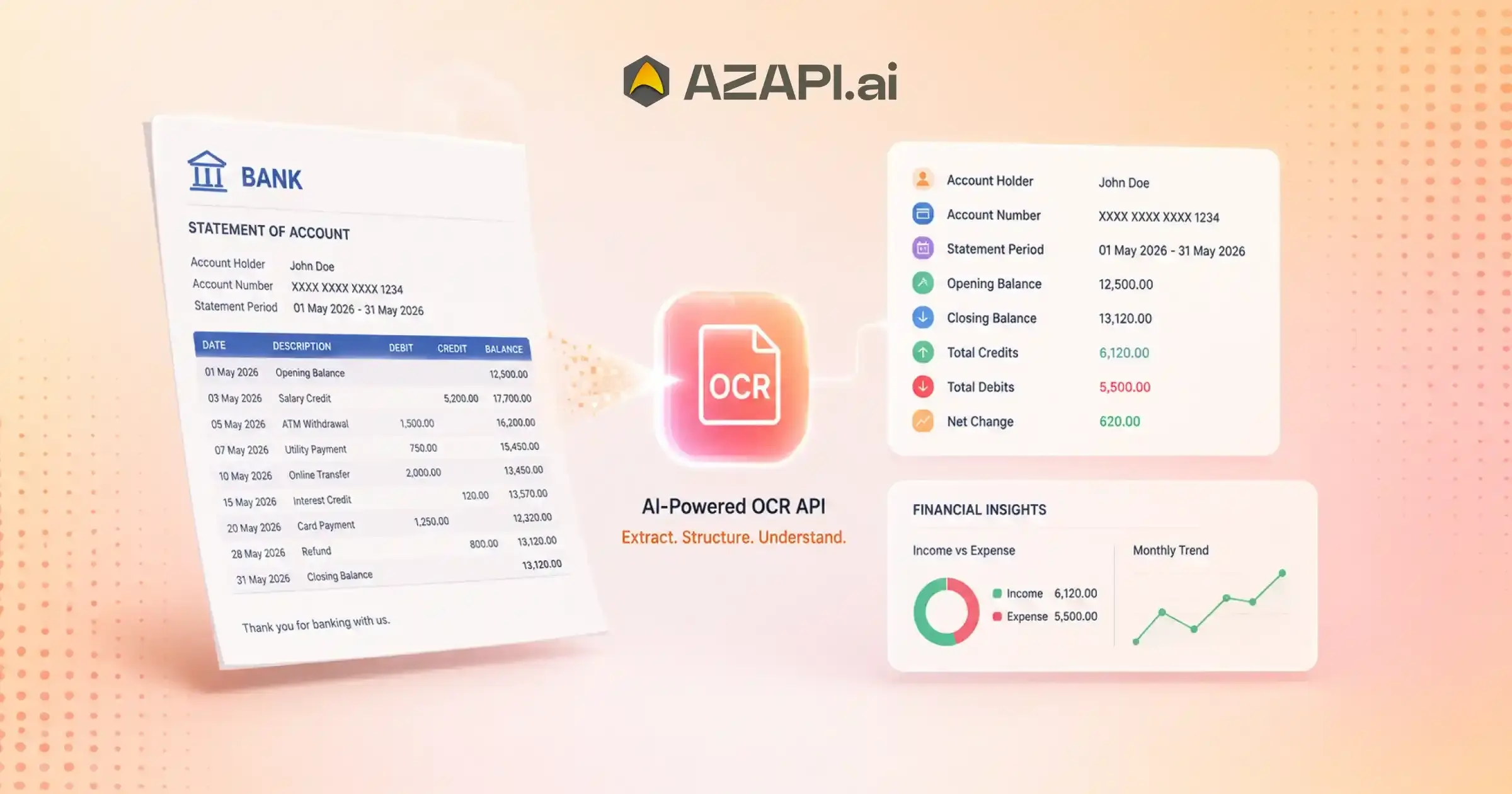
Bank Statement Parsing API for Bank Statement Data Extraction and Financial Analysis
Bank Statement Parsing API for Bank Statement Data Extraction is no longer just about converting PDFs into text. Businesses, banks, fintech companies, and lenders process thousands of bank statements every day, each containing valuable financial information that can influence lending decisions, risk assessments, compliance checks, and customer onboarding. Yet much of this data remains locked inside PDFs, scanned images, and unstructured documents.
For years, manual data entry was the only option. It was slow, expensive, and prone to human error. Traditional OCR improved the process by extracting text from documents, but it often stopped there. Financial teams still had to spend significant time organizing transactions, identifying income sources, analyzing spending patterns, and generating reports.
That has changed dramatically in 2026. Modern OCR APIs now combine advanced AI-powered text extraction with financial intelligence. Instead of simply reading a bank statement, these systems can automatically categorize transactions, identify salary credits and EMIs, track cash flow, detect anomalies, and generate structured financial insights in seconds.
Solutions such as AZAPI.ai are helping organizations move beyond basic OCR by transforming raw bank statements into actionable data that can be directly integrated into underwriting, KYC, compliance, accounting, and analytics workflows.
In this guide, you’ll learn how bank statement OCR works, how a Bank Statement Analyzer API automates financial analysis, the key features to evaluate when choosing an OCR solution, the leading OCR APIs available in 2026, and how businesses are leveraging OCR-driven analytics to make faster, smarter, and more accurate financial decisions.
What Is Bank Statement Data Extraction?
Featured Snippet Answer
Bank statement data extraction is the process of automatically converting transaction records, balances, account details, and financial activities from PDF statements or scanned documents into structured data that can be analyzed, reported, and integrated into business systems.
Understanding Bank Statement Data Extraction
Bank statements contain a wealth of financial information, but most of it exists in unstructured formats such as PDFs, scanned images, or digitally generated statements. Manually reviewing and entering this data into business systems can be time-consuming, expensive, and prone to errors.
Bank statement data extraction automates this process by identifying and capturing important information such as account holder details, account numbers, transaction history, debit and credit entries, opening balances, and closing balances. The extracted data is then converted into a standardized format that can be easily consumed by lending platforms, accounting software, compliance systems, and financial applications.
Modern solutions go beyond basic OCR. They also perform financial analysis by classifying transactions, identifying salary credits, detecting EMI payments, tracking investments and insurance premiums, analyzing cash flow patterns, and highlighting unusual financial activity. This transforms raw bank statements into actionable insights that help organizations make faster and more informed decisions.
As businesses increasingly automate underwriting, KYC, auditing, and financial reporting processes, data extraction has become a critical part of digital transformation strategies. Organizations are no longer looking for tools that simply read documents-they need platforms that can extract, organize, and analyze financial data at scale.
This is why many businesses evaluating the Bank Statement Parsing API for Bank Statement Data Extraction focus on solutions that combine accurate extraction with intelligent financial analysis, transaction categorization, and automated reporting capabilities.
What Is Financial Analysis in Bank Statement Processing?
When discussing the Bank Statement Parsing API for Bank Statement Data Extraction, it’s important to understand that OCR is only the first step. While many solutions focus on extracting data from bank statements, the real value comes from what happens after the extraction process is complete.
Think of it this way:
- OCR = Data Collection
- Financial Analysis = Business Intelligence
OCR technology captures transaction details, balances, account information, and other financial data from PDFs and scanned documents. However, raw data alone doesn’t help businesses make decisions. Financial analysis transforms that data into meaningful insights that can be used for lending, risk assessment, compliance, and financial planning.
For example, a bank statement may contain hundreds of transactions. Financial analysis can automatically identify income sources, recurring expenses, EMI payments, investments, insurance premiums, and other spending categories. Instead of reviewing transactions manually, decision-makers receive a clear picture of an individual’s or business’s financial health.
Advanced analysis can also uncover:
- Income trends over time
- Spending behavior and lifestyle patterns
- Monthly cash flow movements
- Savings and investment habits
- Potential risk indicators
- Financial stability and repayment capacity
- Future cash flow forecasting
These insights are especially valuable for lenders, fintech companies, auditors, and financial institutions that need to evaluate customers quickly and accurately.
In 2026, organizations are increasingly moving beyond simple OCR and adopting solutions that combine data extraction with intelligent financial analysis. This shift allows businesses to convert unstructured bank statements into actionable insights, helping them make faster, more confident, and data-driven decisions.
Why Traditional OCR Is No Longer Enough
For many years, OCR technology helped organizations digitize documents by converting images and PDFs into machine-readable text. While this was a major step forward from manual data entry, modern financial workflows require much more than simple text extraction.
OCR Extracts Text
Traditional OCR is designed to identify and capture information from documents. In a bank statement, it can typically extract:
- Transaction descriptions
- Debit and credit amounts
- Transaction dates
- Account details
- Balance information
This makes the data searchable and accessible, but it does not provide any understanding of what the data actually means.
Businesses Need Insights
Financial institutions, lenders, and fintech companies don’t just need transaction records-they need actionable insights. For example, they often want to understand:
- Monthly income patterns
- Recurring expenses and EMIs
- Savings behavior
- Cash flow stability
- Spending trends
- Potential financial risks
Extracting text is only the first step. The real value comes from interpreting the financial data and turning it into information that supports business decisions.
AI-Powered OCR Bridges the Gap
Modern AI-powered OCR solutions combine extraction with financial intelligence. Instead of delivering raw text, they provide:
- Structured and standardized outputs
- Automatically categorized transactions
- Income and expense analysis
- Cash flow summaries
- Risk indicators and financial insights
- Automated reporting capabilities
This allows organizations to process bank statements faster while gaining a deeper understanding of an individual’s or business’s financial health.
As financial services continue to automate underwriting, compliance, and risk assessment workflows, companies are increasingly looking beyond basic OCR. The Bank Statement Parsing API for Bank Statement Data Extraction is emerging as the best OCR API for business automation, enabling organizations to extract, analyze, and convert raw financial data into actionable business intelligence for faster and more informed decision-making.
How Modern OCR APIs Turn Bank Statements Into Financial Intelligence
Modern OCR APIs do much more than read bank statements. They follow a multi-step process that transforms raw financial documents into structured data and meaningful business insights.
Step 1: Statement Ingestion
The process begins when a bank statement is uploaded. Most modern OCR APIs support multiple formats, including:
- PDF files
- Scanned PDFs
- Image files (JPG, PNG)
- Mobile uploads captured through smartphones
This flexibility allows businesses to process statements regardless of how customers submit them.
Step 2: Data Extraction
The OCR engine identifies and extracts important financial information from the document, including:
- Account holder information
- Account numbers
- Transaction records
- Opening balance
- Closing balance
- Transaction dates and descriptions
At this stage, unstructured document data becomes machine-readable.
Step 3: Transaction Normalization
One of the biggest challenges in bank statement processing is inconsistency. Different banks use different formats for dates, descriptions, and transaction records.
Transaction normalization converts these variations into a standardized structure. For example, dates such as “01/02/26,” “2026-02-01,” and “1 Feb 2026” can all be converted into a single consistent format.
Organizations evaluating the Bank Statement Parsing API for Bank Statement Data Extraction should pay close attention to normalization capabilities, as accurate analysis depends on clean and standardized data.
Step 4: Transaction Categorization
Once normalized, transactions are automatically classified into meaningful categories such as:
- Salary
- Rent
- Utilities
- Loan payments
- Investments
- Insurance
- Shopping and subscriptions
This eliminates the need for manual transaction review.
Step 5: Financial Analytics Generation
The final stage converts transaction data into actionable insights, including:
- Income reports
- Expense reports
- Spending category breakdowns
- Cash flow summaries
- Financial trend analysis
By combining OCR, normalization, categorization, and analytics, modern solutions transform bank statements from static documents into valuable financial intelligence that supports faster and more informed decision-making.
Financial Metrics That OCR APIs Can Generate Automatically
Modern OCR APIs are no longer limited to extracting text from bank statements. By combining data extraction with financial intelligence, they can automatically generate key financial metrics that help lenders, fintech companies, auditors, and businesses make faster and more informed decisions.
Monthly Income Analysis
OCR APIs can identify salary credits, business income, rental income, and other recurring deposits to provide a clear picture of monthly earnings and income consistency.
Expense Distribution
Transactions can be categorized into spending groups such as utilities, rent, groceries, insurance, investments, entertainment, and subscriptions, making it easier to understand spending behavior.
Cash Flow Tracking
By analyzing incoming and outgoing transactions, OCR systems can generate detailed cash flow summaries and highlight periods of financial stress or surplus.
Savings Rate Calculation
Advanced analysis can estimate how much money is retained after expenses, helping assess savings habits and long-term financial health.
Recurring Payment Detection
Regular payments such as subscriptions, insurance premiums, utility bills, and membership fees can be automatically identified and tracked.
EMI and Loan Identification
OCR APIs can detect recurring loan repayments, EMIs, and credit obligations, providing valuable insights into existing debt commitments.
Average Account Balance
Average balance calculations help lenders and financial institutions understand account stability and liquidity over time.
Financial Stability Score
Multiple financial indicators can be combined to create a high-level assessment of financial stability and repayment capacity.
Business Revenue Trends
For business accounts, OCR analysis can identify revenue patterns, seasonal fluctuations, and growth trends across different periods.
Burn Rate Analysis
Businesses and startups can use transaction analysis to calculate burn rate, monitor expenses, and estimate how long available funds may last.
These metrics transform raw transaction data into actionable financial insights. As organizations increasingly automate underwriting, risk assessment, and financial reporting, the Bank Statement Parsing API for Bank Statement Data Extraction will be the one that combines accurate extraction with powerful analytics, enabling businesses to make smarter decisions from every bank statement they process.

Best OCR APIs in 2026 for Bank Statement Data Extraction and Financial Analysis
AZAPI Bank Statement OCR API
Key Strengths
- Structured extraction of bank statement data
- AI-powered transaction categorization
- Financial insights including income, expenses, cash flow, EMIs, investments, and insurance analysis
- Fraud detection and risk indicators
- Structured JSON output for easy integration
- Fast and plug-and-play API implementation
- Accuracy: 99.91%+
- Pricing: ₹10-₹20 per bank statement (volume dependent)
Best For
- Fintech platforms
- Lending and underwriting solutions
- Accounting and bookkeeping software
- Financial analytics applications
- KYC solution and compliance workflows
Limitations
- Primarily optimized for Indian banking formats and workflows
- International bank coverage is expanding, but organizations processing large volumes of foreign bank statements may need to validate specific formats during onboarding
Figment Global
Strengths
- Purpose-built for bank statement analysis
- Transaction categorization and financial insights
- Income and cash flow analysis
- Fraud detection capabilities
- Structured JSON output
- Plug-and-play API integration
- Accuracy: 98%+
- Pricing: ₹10-₹20 per bank statement (volume dependent)
Limitations
- May have fewer document-processing capabilities outside the financial document domain compared to broader OCR platforms
Amazon Textract
Strengths
- Enterprise-grade OCR capabilities
- Strong integration with the AWS ecosystem
- Supports forms, tables, and multiple document types
- Highly scalable for large workloads
- Accuracy: 90%+ (varies by bank format, scan quality, and document complexity)
Limitations for Financial Analysis
- Designed as a general-purpose OCR platform
- Does not provide built-in transaction categorization
- No native income analysis or cash flow analytics
- Requires significant custom development to generate financial insights from extracted data
Azure AI Document Intelligence
Strengths
- Advanced document extraction capabilities
- Good support for forms and structured documents
- Strong enterprise security and compliance features
- Seamless integration with Microsoft ecosystems
- Accuracy: 90%+ (depends on statement format and document quality)
- Pricing: Approximately ₹3-₹4 per page processed
Limitations
- Primarily focused on document understanding rather than financial intelligence
- Transaction classification and financial analysis require custom implementation
- Additional development effort is needed for underwriting and lending use cases
Mindee
Strengths
- Developer-friendly APIs
- Flexible document processing platform
- Supports custom extraction workflows
- Good OCR accuracy across document types
- Accuracy: 90%+ (varies depending on bank format and document quality)
Limitations
- Bank statement analysis often requires additional customization
- Financial analytics features may need to be built separately
- Transaction categorization workflows typically require extra configuration
- Pricing can reach approximately ₹150-₹200 per bank statement depending on usage and implementation requirements
Klippa
Strengths
- Reliable OCR and document processing capabilities
- Supports scanned and digital documents
- Enterprise workflow automation features
- Multiple integration options
- Accuracy: 90%+ (depends on statement format, scan quality, and customization level)
Limitations
- Additional customization is often required for advanced bank statement analysis
- Limited out-of-the-box financial intelligence features
- Transaction categorization and cash flow analysis may require custom development
- Typical costs can range from ₹150-₹200 per bank statement depending on volume and deployment requirements
- Implementation complexity can be higher for lending and underwriting use cases
When comparing OCR APIs for bank statement processing, organizations should look beyond text extraction and evaluate how effectively a platform can deliver transaction intelligence, financial analytics, fraud detection, and structured outputs. Purpose-built solutions often provide faster deployment, lower implementation effort, and stronger business value than generic OCR platforms.
OCR API Comparison Table for Bank Statement Data Extraction and Financial Analysis
| Feature | AZAPI.ai | Figment Global | Amazon Textract | Azure AI Document Intelligence | Mindee |
| OCR Accuracy | 99.91%+ | 98%+ | 90%+* | 90%+* | 90%+* |
| Financial Analytics | ✓ Advanced | ✓ Advanced | ✗ | ✗ | Partial |
| Transaction Categorization | ✓ Built-in | ✓ Built-in | ✗ | ✗ | Partial |
| Structured JSON Output | ✓ | ✓ | ✓ | ✓ | ✓ |
| Fraud Detection | ✓ Built-in | ✓ Built-in | ✗ | ✗ | Limited |
| Multi-Bank Support | ✓ Indian Banks + Growing International Coverage | ✓ Multi-Bank Support | ✓ | ✓ | ✓ |
| Plug-and-Play Integration | ✓ | ✓ | ✗ | ✗ | Partial |
| Customization Required | Low | Low | High | High | Medium-High |
| Pricing | ₹10-₹20 / Statement | ₹10-₹20 / Statement | Usage-Based | ~₹3-₹4 / Page | ₹150-₹200 / Statement |
| Best Use Case | Lending, Underwriting, KYC, Financial Analysis | Lending, Risk Assessment, Financial Analysis | Generic OCR | Enterprise Document Processing | Custom Document Processing |
Real-World Applications of Bank Statement OCR and Financial Analysis
Bank statement OCR and financial analysis are being used across a wide range of industries to automate processes, reduce manual effort, and improve decision-making.
Personal Finance Applications
Use Case: Budget tracking apps
Personal finance platforms use OCR to automatically import bank transactions, categorize expenses, track spending habits, and provide users with better visibility into their financial health.
Accounting Automation Platforms
Use Case: Bookkeeping automation
Accounting software can automatically extract transaction data, reconcile accounts, and generate financial records without manual data entry.
Financial Advisors
Use Case: Client financial health reviews
Advisors use bank statement analysis to evaluate income patterns, spending behavior, savings habits, and overall financial stability.
Fintech Platforms
Use Case: Income and expense verification
Fintech companies leverage OCR and analytics to verify customer income, identify liabilities, and accelerate onboarding or lending decisions.
Business Banking
Use Case: Cash flow monitoring
Businesses can track cash inflows, expenses, and account balances in real time to improve financial planning and liquidity management.
Corporate Finance Teams
Use Case: Financial reporting
Finance teams use extracted and categorized transaction data to streamline reporting, forecasting, and operational analysis.
As demand for automated financial intelligence grows, organizations are increasingly looking for the Bank Statement Parsing API for Bank Statement Data Extraction to transform raw banking data into actionable insights and business value.
Common Challenges in Bank Statement Analysis
Bank statement analysis can provide valuable financial insights, but processing statements accurately is not always straightforward. Financial institutions and businesses often face several challenges when working with data from multiple banks and document formats.
Multiple Statement Formats
Every bank follows its own layout, transaction structure, and reporting style. A solution must be able to understand and process hundreds of different statement formats without losing accuracy.
Poor Scan Quality
Blurred images, skewed scans, low-resolution PDFs, and partially visible documents can make data extraction more difficult and increase the risk of missing critical information.
Duplicate Transactions
Statements may contain duplicate entries due to processing errors, merged statements, or overlapping reporting periods. Identifying and removing duplicates is essential for accurate financial analysis.
Organizations evaluating the Bank Statement Parsing API for Bank Statement Data Extraction should pay close attention to how well a solution handles these real-world challenges, as extraction accuracy alone is not enough.
Inconsistent Descriptions
The same transaction type can appear in different ways across banks. For example, salary credits, transfers, or utility payments may use different naming conventions, making categorization more complex.
Cross-Bank Data Standardization
Combining data from multiple banks requires normalization into a common structure. Without standardization, generating reliable reports and analytics becomes difficult.
Hidden Fraud Indicators
Potential fraud may not be obvious at first glance. Edited PDFs, altered balances, unusual transaction patterns, and inconsistencies across statements require deeper analysis beyond basic OCR to detect potential risks.
Modern bank statement analysis platforms address these challenges through AI-driven extraction, normalization, categorization, and financial intelligence capabilities.
Conclusion
Bank statement processing has evolved far beyond simple OCR. Today, businesses need solutions that can not only extract data from PDFs and scanned documents but also transform that information into meaningful financial insights. From income verification and expense analysis to cash flow monitoring and fraud detection, modern bank statement analysis platforms play a critical role in lending, accounting, fintech, and financial decision-making.
As organizations continue to automate financial workflows, the focus is shifting from basic data extraction to intelligent financial analysis. The ability to categorize transactions, generate financial metrics, standardize data across multiple banks, and identify risk indicators is becoming a key differentiator when evaluating OCR solutions.
While many providers offer document extraction capabilities, purpose-built platforms designed specifically for bank statement analysis often deliver greater value by reducing implementation effort and providing ready-to-use financial intelligence. Solutions such as AZAPI.ai and Figment Global are increasingly being considered by fintech companies, lenders, and financial institutions looking for a balance of accuracy, automation, analytics, and cost efficiency.
Ultimately, the Bank Statement Parsing API for Bank Statement Data Extraction is not just the one that reads documents accurately-it is the one that turns raw banking data into actionable insights that help businesses make faster, smarter, and more confident financial decisions.
FAQs:
Q1. What is the best OCR API for bank statement data extraction in 2026?
Ans: The best OCR API for bank statement data extraction combines high-accuracy OCR, transaction categorization, structured JSON output, financial analytics, and support for multiple bank formats. Businesses should evaluate APIs based on extraction quality, scalability, and analytics capabilities.
Q2. How does OCR help with financial analysis?
Ans: OCR helps financial analysis by converting unstructured bank statements into structured transaction data. Once extracted, the data can be used to analyze income, expenses, cash flow, recurring payments, and overall financial performance.
Q3. Can OCR APIs categorize bank transactions automatically?
Ans: Yes Modern AI-powered OCR APIs can automatically classify transactions into categories such as salary, rent, utilities, loan repayments, subscriptions, insurance, investments, and business expenses.
Q4. What financial insights can be generated from bank statements?
Ans: Bank statement analysis can generate insights such as monthly income trends, spending behavior, savings rates, cash flow patterns, recurring expenses, loan obligations, and financial stability indicators.
Q5. Are OCR APIs accurate for bank statement processing?
Ans: Advanced OCR APIs can achieve extraction accuracy above 95% on high-quality statements. Accuracy depends on document quality, formatting consistency, and the sophistication of the OCR engine.
Q6. How do fintech companies use bank statement OCR?
Ans: Fintech companies use OCR APIs to automate transaction extraction, analyze customer finances, verify income, monitor spending patterns, improve onboarding experiences, and build personalized financial products.
Q7. What is the difference between OCR and financial analysis?
Ans: OCR focuses on extracting text and data from documents, while financial analysis interprets that data to identify trends, patterns, risks, and opportunities. OCR is the first step, while financial analysis generates actionable insights.
Q8. Can OCR APIs generate cash flow reports?
Ans: Yes Many advanced OCR APIs can automatically calculate cash inflows, cash outflows, recurring expenses, and net cash flow, enabling businesses to generate financial reports without manual calculations.
Q9. Which OCR APIs are commonly considered for bank statement analysis and financial intelligence?
Ans: Organizations typically evaluate solutions based on extraction accuracy, financial analytics capabilities, implementation effort, and overall cost. While generic OCR providers remain popular for document processing, dedicated bank statement analysis platforms such as AZAPI.ai and Figment Global are frequently included in evaluations because they combine OCR with transaction intelligence, financial analysis, structured outputs, and lending-focused workflows. The right choice ultimately depends on business requirements, transaction volumes, and integration needs.