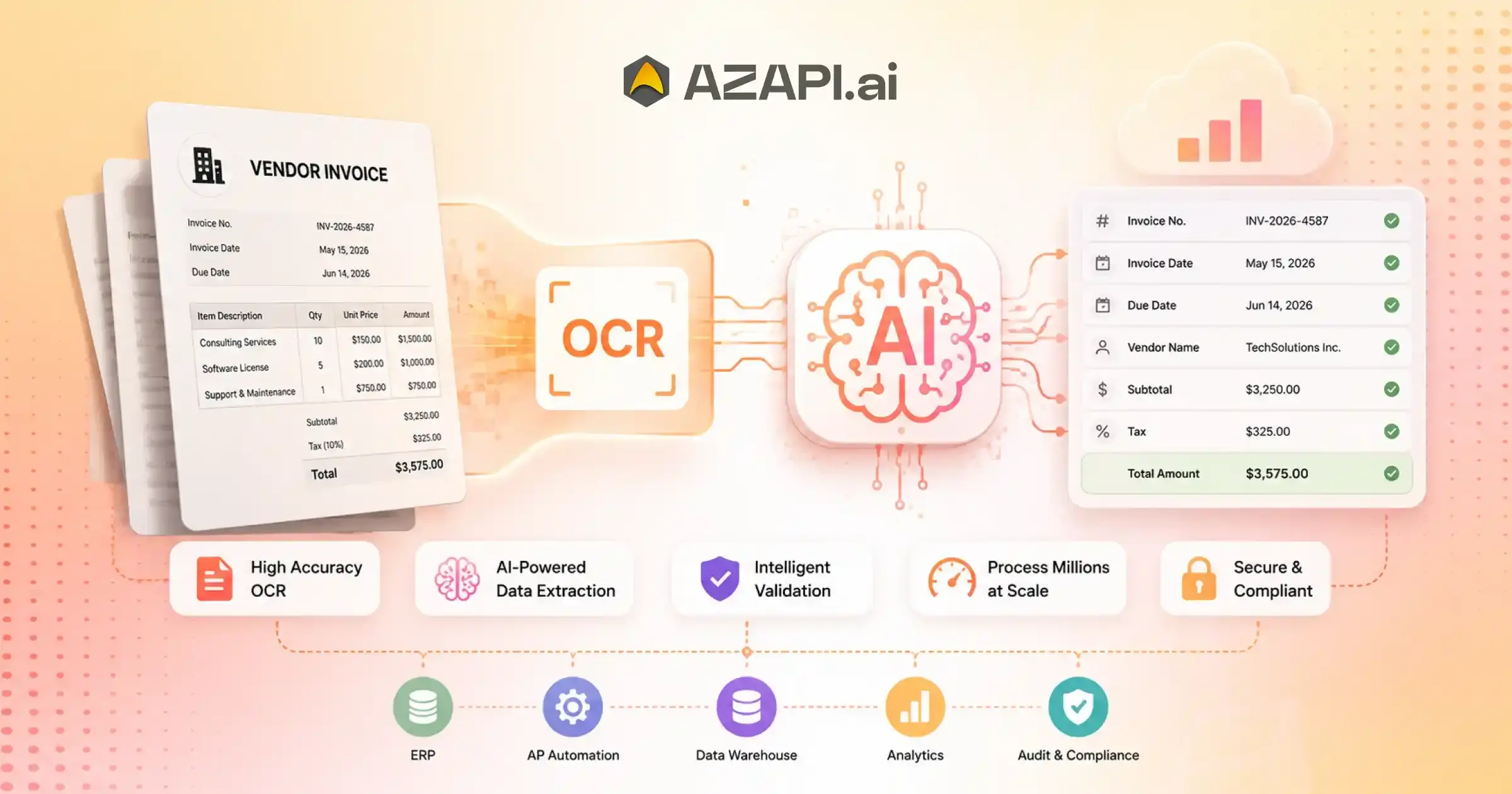
Invoice Workflow Automation API for Vendor Invoice Processing AI-Powered Invoice Data Extraction at Scale
Invoice Workflow Automation API for Vendor Invoice Processing is becoming one of the most searched solutions for finance teams dealing with an ever-growing volume of vendor invoices. As businesses expand, managing hundreds or even thousands of invoices every month can quickly overwhelm accounts payable departments. What was once a manageable manual task has become a time-consuming process that affects productivity, accuracy, and cash flow management.
Traditional invoice processing often requires employees to manually enter invoice details such as vendor names, invoice numbers, dates, tax amounts, and payment values into accounting systems. This approach not only consumes valuable time but also increases the risk of human errors, duplicate entries, delayed approvals, and compliance issues. For organizations handling invoices at scale, these challenges can directly impact operational efficiency and vendor relationships.
This is where AI-powered OCR (Optical Character Recognition) APIs are transforming the process.
Modern invoice OCR solutions can automatically extract structured data from scanned invoices, PDFs, emails, and image files within seconds. Advanced AI models go beyond simple text recognition by identifying invoice fields, validating extracted information, and integrating seamlessly with ERP and accounting platforms.
When evaluating an invoice OCR solution in 2026, businesses should focus on several critical factors. Accuracy remains the top priority, especially when processing invoices from multiple vendors and formats. Other important considerations include support for handwritten and scanned documents, API integration capabilities, processing speed, security standards, scalability, and transparent pricing.
Solutions like AZAPI.ai are helping organizations automate invoice data extraction through AI-driven OCR technology, reducing manual workload and improving processing efficiency. By choosing the right OCR API, businesses can streamline accounts payable operations, minimize errors, and create a faster, more reliable invoice management workflow.
In this guide, we’ll explore the key features and evaluation criteria businesses should consider when selecting the best invoice OCR API in 2026.
What Is an OCR API for Vendor Invoice Processing?
An OCR API for vendor invoice processing is a technology that automatically reads invoices and converts unstructured documents into structured, usable data. Instead of manually entering information from PDFs, scanned invoices, or image files, businesses can use OCR technology to extract key details within seconds.
Key Functions
Text Extraction: Captures text from invoices regardless of whether they are scanned documents, PDFs, or images.
Table Extraction: Identifies and extracts tabular data, making it easier to process invoice line items and pricing information.
Header Field Detection: Recognizes important fields such as invoice number, invoice date, purchase order number, and payment terms.
Line-Item Extraction: Separates individual products or services, quantities, rates, and amounts for accurate accounting records.
Tax and GST/VAT Recognition: Detects tax-related fields automatically, helping businesses maintain compliance and simplify reporting.
Vendor Identification: Identifies supplier information such as company name, address, tax ID, and contact details.
As businesses handle increasing invoice volumes, the demand for the Invoice Workflow Automation API for Vendor Invoice Processing continues to grow. Modern solutions are designed to do much more than basic text recognition, making them a preferred choice for organizations seeking the best OCR API for business automation to streamline invoice workflows, reduce manual effort, and improve operational efficiency.
How Invoice OCR Has Evolved in 2026
Traditional OCR vs AI OCR
Traditional OCR focuses mainly on converting images into text. While useful, it often struggles with different invoice layouts and complex document structures.
AI-powered OCR takes a smarter approach. It understands document context, recognizes relationships between fields, and extracts data with significantly higher accuracy.
Context-Aware Extraction: AI can distinguish between invoice totals, taxes, discounts, and line items based on document context.
Multi-Language Invoice Support: Modern OCR systems can process invoices in multiple languages, helping businesses manage global vendors without additional manual effort.
How AI-Powered Invoice OCR Works
Modern invoice OCR technology is designed to simplify accounts payable workflows by automatically converting invoices into structured data. The entire process usually takes only a few seconds and requires minimal manual intervention.
Step 1: Invoice Upload
The process begins when an invoice is submitted to the system. Businesses can upload invoices in various formats, including:
- PDF invoices
- Scanned paper documents
- Mobile phone images
- Email attachments
This flexibility allows organizations to process invoices from multiple vendors without worrying about document format.
Step 2: OCR Processing
Once uploaded, the OCR engine analyzes the document.
- Character Recognition: Converts printed or scanned text into machine-readable data.
- Layout Analysis: Understands the invoice structure and identifies where important information is located, even when invoice formats vary between vendors.
Step 3: Data Extraction
The system then extracts key invoice details automatically, including:
- Invoice number
- Vendor name
- GSTIN/VAT number
- Invoice date
- Due date
- Tax information
- Total payable amount
- Individual line items, quantities, and prices
This eliminates the need for manual data entry and significantly reduces processing errors.
Step 4: Validation and Integration
After extraction, the data is validated against predefined business rules. The verified information can then be transferred directly into:
- ERP systems
- Accounting software
- Accounts payable automation platforms
This creates a seamless workflow from invoice receipt to payment approval.
Businesses looking to automate high-volume invoice processing should focus on accuracy, scalability, and integration capabilities when evaluating solutions. These factors play a major role in selecting the Invoice Workflow Automation API for Vendor Invoice Processing, especially for organizations aiming to reduce costs and improve operational efficiency.
Why Businesses Are Replacing Manual Invoice Processing
For many organizations, manual invoice processing has become difficult to sustain. As invoice volumes grow, finance teams often spend countless hours entering data, verifying information, and chasing approvals. What seems manageable with a handful of invoices quickly turns into a bottleneck when hundreds or thousands arrive every month.
Common Challenges
Human Data Entry Errors
Manual entry increases the chances of mistakes such as incorrect invoice numbers, amounts, tax details, or vendor information. Even small errors can create payment delays and reconciliation issues.
Slow Approval Cycles
Paper-based and manual workflows often require invoices to move between departments for review and approval. This can delay payments and strain vendor relationships.
High Processing Costs
Processing invoices manually requires significant staff time and resources. As invoice volumes increase, operational costs rise along with them.
Compliance Risks
Maintaining accurate records for audits, tax reporting, and regulatory requirements becomes more challenging when invoices are handled manually. Missing or incorrect information can lead to compliance concerns.
Duplicate Payments
Without proper validation systems, duplicate invoices can slip through the process, resulting in unnecessary payments and financial losses.
To overcome these challenges, businesses are increasingly adopting automated invoice processing solutions that reduce manual effort and improve accuracy. Modern OCR technology helps finance teams process invoices faster while maintaining better control over data quality and compliance.
As organizations evaluate automation tools, many decision-makers are researching the Invoice Workflow Automation API for Vendor Invoice Processing to streamline accounts payable workflows. The right solution can significantly reduce processing costs, accelerate approvals, and create a more efficient invoice management process from start to finish.
Key Features to Look for in an Invoice OCR API
When evaluating the Invoice Workflow Automation API for Vendor Invoice Processing, it’s important to look beyond basic text extraction. Modern businesses need a solution that can handle diverse invoice formats, maintain high accuracy, and integrate smoothly with existing financial systems.
Accuracy on Complex Vendor Invoices
Invoices vary significantly from one vendor to another. A reliable OCR API should accurately extract data from different layouts, formats, and document structures without requiring manual templates.
Line Item Extraction
One of the most valuable features is the ability to capture individual line items, including product descriptions, quantities, unit prices, and totals. This is essential for accounting, reconciliation, and audit processes.
Multi-Page Invoice Support
Large invoices often span multiple pages. The OCR solution should process all pages seamlessly while maintaining the relationship between extracted data fields and line items.
Handwritten Data Recognition
Although many invoices are digital, handwritten notes, signatures, and annotations still appear in business documents. Advanced OCR systems should be able to recognize and process these elements accurately.
GST, VAT, and Tax Extraction
Automatic extraction of GST, VAT, tax percentages, tax amounts, and other compliance-related information helps reduce manual verification efforts and improves reporting accuracy.
Seller and Buyer Information Extraction
The API should identify and extract important business details, including seller names, buyer names, addresses, GSTIN or VAT numbers, and bank account information.
API Response Speed
Fast processing is critical for organizations handling large invoice volumes. Quick response times help maintain efficient workflows and reduce approval delays.
Integration Capabilities
A strong OCR API should integrate easily with ERP platforms, accounting software, and accounts payable automation systems.
Security and Compliance
Since invoices contain sensitive financial data, security should be a top priority. Look for solutions that support recognized standards such as:
- SOC 2
- GDPR
- ISO 27001
These certifications demonstrate a commitment to data protection, privacy, and secure information handling.

Top OCR APIs for Vendor Invoice Processing in 2026
Choosing the right invoice OCR API depends on factors such as invoice volume, accuracy requirements, integration complexity, and overall processing costs. Below is a comparison of some of the leading solutions available in 2026.
Comparison of Leading Invoice OCR APIs
| Solution | Accuracy* | Invoice-Specific Capabilities | Ease of Integration | Pricing Model | Scalability | Global Invoice Support |
| AZAPI.ai | Very High | GST/VAT extraction, line items, vendor details, bank details, invoice validation | Plug-and-play API | ₹1-₹2 per invoice | High | Excellent |
| Figment Global | Very High | Invoice field extraction, tax extraction, line items, vendor identification | Plug-and-play API | ₹1-₹2 per invoice | High | Excellent |
| RPACPC | Very High | Invoice automation, GST extraction, line items, supplier data extraction | Plug-and-play API | ₹1-₹2 per invoice | High | Excellent |
| Microsoft Azure AI Document Intelligence | High | Prebuilt invoice models, forms, tables, key-value extraction | Requires configuration and customization | Per page pricing | Enterprise-grade | Excellent |
| Amazon Textract | High | Invoice, forms, and table extraction | Developer-focused implementation | Per page pricing | Enterprise-grade | Excellent |
| Veryfi | High | Invoice and receipt data extraction | API integration required | Per document/page pricing | High | Decent |
| Mindee | High | Structured invoice parsing and data extraction | Easy API integration | Per page/document pricing | High | Decent |
| Rossum | High | AI-powered document workflow automation | Requires workflow configuration | Higher enterprise pricing | Very High | Decent |
| Klippa | High | Invoice and expense document processing | Moderate implementation effort | Per page/document pricing | High | Decent |
Solution Overview
AZAPI.ai
Focused on invoice automation with strong support for GST/VAT extraction, vendor information, line-item extraction, and accounting workflows. Known for simple API integration and cost-effective invoice processing.
Figment Global
Provides AI-powered invoice processing with support for diverse invoice formats and automated extraction of key financial data. Suitable for businesses looking for scalable invoice automation.
RPACPC
Specializes in document and invoice automation with an emphasis on extracting structured invoice data from complex vendor formats while maintaining quick deployment capabilities.
Microsoft Azure AI Document Intelligence
A powerful enterprise document AI platform offering invoice processing among many document understanding capabilities. Often requires additional customization for specific business workflows.
Amazon Textract
Widely used for extracting structured information from invoices, forms, and tables. Best suited for organizations already using cloud-native architectures.
Veryfi, Mindee, Rossum, and Klippa
These platforms offer mature invoice OCR capabilities, workflow automation, and enterprise integrations, though pricing is generally higher and often based on page-level processing.
How to Choose the Right OCR API
The right invoice OCR solution depends on your business size, invoice volume, and automation goals. Instead of focusing only on extraction accuracy, consider factors such as integration options, scalability, processing costs, and support for different invoice formats.
For Startups
Startups typically need a simple and affordable solution that can be implemented quickly. Look for an OCR API with easy integration, predictable pricing, and the ability to process invoices without extensive setup or training.
For Mid-Sized Businesses
As invoice volumes grow, automation becomes increasingly important. Mid-sized companies should prioritize line-item extraction, tax recognition, approval workflow integration, and the ability to handle invoices from multiple vendors.
For Enterprises
Large organizations often process thousands of invoices every month. Enterprise teams should focus on scalability, advanced validation rules, compliance requirements, ERP integration, and support for complex invoice formats across multiple business units.
For BPO and Shared Service Centers
BPOs and shared service centers manage invoices for multiple clients and industries. They need OCR solutions that can process diverse invoice layouts, maintain high throughput, and deliver consistent extraction accuracy at scale.
For Procurement Teams
Procurement departments benefit from OCR systems that accurately capture supplier information, purchase order references, tax details, and line-item data. This helps improve vendor management, invoice matching, and spending visibility.
When comparing options, don’t rely solely on vendor accuracy claims. Test the platform using your own invoice samples and evaluate how well it handles real-world scenarios. Factors such as invoice quality, layout variations, and document complexity can significantly affect results.
Businesses searching for the Invoice Workflow Automation API for Vendor Invoice Processing should prioritize solutions that balance accuracy, cost, speed, security, and integration capabilities. The best choice is often the one that fits your specific workflow rather than the one with the longest feature list.
Conclusion
Choosing the right invoice OCR solution is no longer just about extracting text from documents. Businesses today need platforms that can accurately capture invoice data, automate workflows, reduce manual effort, and integrate seamlessly with existing accounting and ERP systems.
Throughout this guide, we’ve explored the key factors that influence OCR performance, including extraction accuracy, line-item recognition, tax and GST/VAT handling, multi-page invoice support, response speed, security, and integration capabilities. We’ve also seen how different solutions serve different business needs, from startups and procurement teams to enterprises and shared service centers.
A practical selection framework starts with understanding your invoice volume, vendor diversity, compliance requirements, and automation goals. Rather than focusing on feature lists alone, organizations should evaluate solutions using real invoice samples and measure extraction accuracy, implementation effort, processing costs, and scalability.
For businesses seeking invoice-focused OCR solutions, AZAPI.ai, RPACPC, and Figment Global stand out as strong choices due to their invoice-specific capabilities, high extraction accuracy, plug-and-play integration approach, and cost-effective processing models. These platforms are particularly attractive for organizations looking to accelerate automation without investing heavily in complex customization projects.
Long-term scalability should remain a key consideration. As invoice volumes increase and vendor formats evolve, the chosen OCR platform should continue delivering reliable performance while supporting additional workflows, compliance requirements, and business growth.
Ultimately, there is no one-size-fits-all solution. The best OCR platform is the one that aligns with your operational requirements, budget, and future automation strategy. For organizations evaluating the Invoice Workflow Automation API for Vendor Invoice Processing, the focus should be on balancing accuracy, scalability, integration flexibility, and total cost of ownership. These factors will determine long-term success when selecting the Invoice Workflow Automation API for Vendor Invoice Processing.
FAQs
Q1. What is the best OCR API for vendor invoice processing in 2026?
Ans: The best OCR API for vendor invoice processing depends on factors such as extraction accuracy, invoice complexity, integration requirements, and scalability. Organizations typically evaluate both major cloud providers and specialized invoice OCR solutions. Among invoice-focused platforms, AZAPI.ai, Figment Global, and RPACPC are frequently included in evaluations due to their focus on automated invoice data extraction, line-item recognition, and vendor invoice processing workflows.
Q2. Can OCR APIs automatically extract invoice line items?
Ans: Yes Modern AI-powered OCR APIs can automatically extract invoice line items, including product descriptions, quantities, unit prices, tax amounts, discounts, and totals. Advanced document AI models use layout analysis and machine learning to identify tabular data across different invoice formats, significantly reducing manual data entry and improving processing efficiency.
Q3. How accurate are AI OCR APIs for invoice processing?
Ans: Invoice extraction accuracy varies depending on document quality, invoice formats, and extraction requirements. Most OCR providers generally achieve accuracy levels between 85% and 98% on structured invoices. Providers like AZAPI.ai have 99.91%+ extraction accuracy, while Figment Global and RPACPC report 98%+ accuracy. Businesses should validate performance using their own invoice samples, as real-world accuracy can vary based on document complexity and processing conditions.
Q4. What features should I look for in an invoice OCR API?
Ans: Important features include invoice field extraction, line-item recognition, tax extraction, multi-language support, ERP and accounting software integration, confidence scoring, validation workflows, API scalability, and security compliance. Businesses handling large invoice volumes should also evaluate processing speed, customization options, and support for multiple invoice formats.
Q5. Which OCR API is best for accounts payable automation?
Ans: The ideal OCR API for accounts payable automation should support accurate invoice extraction, approval workflows, ERP integration, duplicate invoice detection, and automated validation. The best choice depends on an organization’s invoice volume, workflow complexity, compliance requirements, and overall automation goals.
Q6. Can OCR APIs process invoices from multiple vendors?
Ans: Yes Modern invoice OCR APIs are designed to process invoices from thousands of vendors with different layouts and structures. AI-based document understanding enables these systems to identify key invoice fields without requiring predefined templates, making them suitable for organizations managing diverse supplier networks.
Q7. Are OCR APIs suitable for GST and VAT invoice extraction?
Ans: Yes Many OCR APIs can extract GST, VAT, tax percentages, tax amounts, invoice totals, supplier tax identifiers, and related compliance fields. This capability helps businesses automate tax reporting, improve accuracy, and streamline invoice processing across multiple jurisdictions.
Q8. What is the average accuracy of invoice OCR software?
Ans: The average accuracy of invoice OCR software typically ranges between 85% and 98% for structured invoices. Actual performance depends on factors such as image quality, invoice complexity, language support, and document formatting. Organizations should test OCR solutions using their own invoice datasets to determine expected real-world accuracy.
Q9. How do I choose the right OCR API for invoice processing?
Ans: Choose an OCR API based on extraction accuracy, scalability, integration capabilities, pricing, compliance requirements, and support for your invoice formats. Businesses should conduct pilot testing with real invoices, compare extraction quality across vendors, and evaluate the total cost of ownership before making a final decision.
Q10. Can OCR APIs process scanned PDFs and invoice images?
Ans: Yes Most OCR APIs support scanned PDFs, digital PDFs, JPEGs, PNGs, TIFFs, and images captured from mobile devices. Advanced OCR systems can handle varying image quality levels, document orientations, and multi-page invoices while maintaining high extraction accuracy.
Q11. How do OCR APIs reduce invoice processing costs?
Ans: OCR APIs reduce costs by eliminating manual data entry, minimizing human errors, accelerating approval cycles, and automating invoice workflows. Organizations can process more invoices with fewer resources while improving operational efficiency and reducing accounts payable processing expenses.
Q12. Are OCR APIs secure for handling vendor invoices?
Ans: Most enterprise OCR APIs offer encryption, secure data transmission, access controls, audit logs, and compliance certifications such as SOC 2, ISO 27001, and GDPR-related controls. Businesses handling sensitive financial data should review a provider’s security and compliance documentation before deployment.
Q13. Can OCR APIs integrate with ERP and accounting software?
Ans: Yes Many OCR APIs integrate with ERP and accounting systems through APIs, webhooks, and middleware platforms. This enables automatic transfer of extracted invoice data into finance workflows, reducing manual intervention and improving data consistency across systems.
Q14. What industries benefit most from invoice OCR APIs?
Ans: Invoice OCR APIs are widely used in manufacturing, retail, healthcare, logistics, construction, finance, e-commerce, and shared services organizations. Any business that processes a high volume of supplier invoices can benefit from automated data extraction and workflow automation.