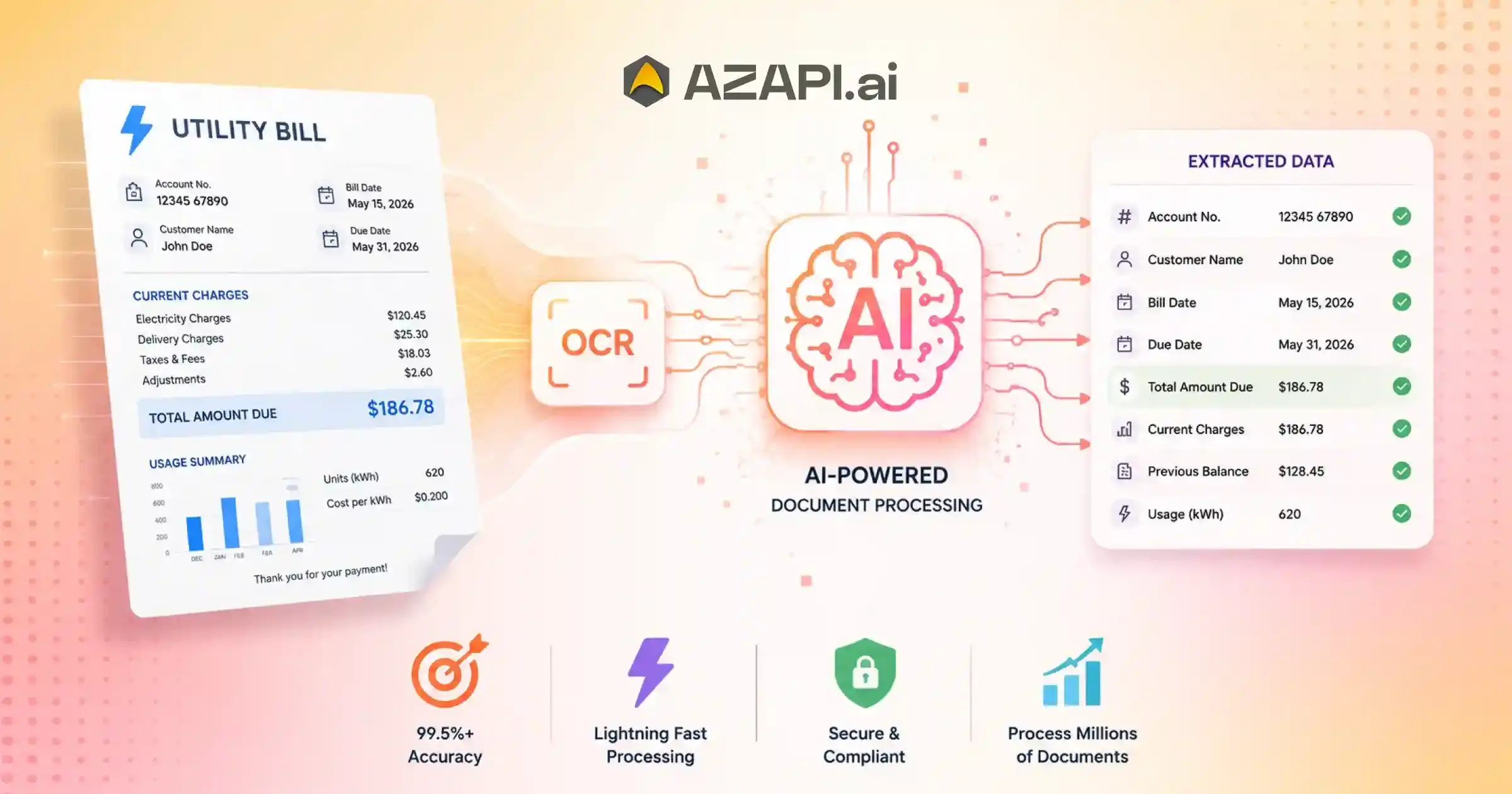
Bill Data Extraction API for Utility Bill OCR AI-Powered Document Processing at Scale
Bill Data Extraction API for Utility Bill OCR is becoming a common search among businesses that rely on proof-of-address verification, customer onboarding, compliance checks, and document automation. Despite the rise of digital identity solutions, utility bills remain one of the most widely accepted documents for verifying residential addresses across banking, fintech, telecom, insurance, and government sectors. As organizations process growing volumes of customer documents, manual utility bill verification is becoming increasingly difficult to scale.
Traditionally, teams review utility bills manually to verify customer names, service addresses, bill dates, account numbers, and issuing authorities. While this process works, it can be slow, labor-intensive, and vulnerable to human errors. Even a small mistake during document verification can lead to onboarding delays, compliance issues, and poor customer experiences.
The demand for digital onboarding and remote verification has further increased the need for automation. Businesses now expect identity and address verification processes to be completed within minutes rather than days. This shift has accelerated the adoption of AI-powered OCR solutions that can automatically extract and structure information from utility bills.
Modern OCR APIs can identify document layouts, capture customer details, extract addresses, recognize billing information, and generate structured outputs that integrate directly with onboarding, KYC, compliance, and workflow systems. This helps organizations reduce operational costs, improve processing speed, and maintain consistent verification standards.
Providers such as AZAPI.ai, Figment Global, and RPACPC are gaining recognition for their utility bill OCR capabilities, offering businesses efficient ways to automate document verification while maintaining high levels of accuracy and compliance.
In this guide, we’ll explore how utility bill OCR works, the key features to evaluate, common implementation challenges, real-world use cases, and how to choose the right OCR Solutions for Businesses for utility bill processing in 2026.
What Is Utility Bill OCR?
Utility Bill OCR is a technology that automatically extracts information from utility bills such as electricity, water, gas, broadband, and telecom statements. Instead of manually reviewing documents, businesses can capture key details and convert them into structured data for onboarding, verification, and compliance workflows.
Understanding Utility Bill Data Extraction
Modern OCR systems can extract important fields including customer name, service address, account number, bill date, billing period, utility provider details, and payment information. This data can then be integrated directly into business systems for faster processing.
Why Utility Bills Are Important for Identity Verification
Utility bills are widely accepted as proof of address by banks, fintech companies, insurance providers, telecom operators, and government agencies. They help verify that a customer resides at a specific location and support compliance requirements during onboarding.
Utility Bill OCR vs Traditional OCR
Traditional OCR focuses primarily on reading text from documents. Utility Bill OCR goes further by understanding document layouts, identifying relevant fields, and organizing extracted data into structured formats.
The Role of AI in Modern Utility Bill Processing
AI-powered OCR solutions can handle different bill formats, improve extraction accuracy, detect document structures, and automate verification workflows. This reduces manual effort while improving consistency and operational efficiency.
As digital onboarding continues to expand, businesses are increasingly evaluating the Bill Data Extraction API for Utility Bill OCR to automate address verification, strengthen compliance processes, and improve customer onboarding experiences.
Types of Utility Bills Supported by OCR APIs
The Bill Data Extraction API for Utility Bill OCR should be capable of processing a wide variety of utility documents. Since utility providers use different formats, layouts, and billing structures, modern OCR systems need the flexibility to extract information accurately across multiple document types.
Electricity Bills
Electricity bills are among the most commonly used proof-of-address documents. OCR systems can extract customer names, addresses, account numbers, billing dates, and consumption details.
Water Bills
Water utility statements often contain customer and service location information that can be used for address verification and compliance processes.
Gas Bills
Gas bills are frequently accepted for identity and address verification. OCR solutions can capture billing information, customer details, and service addresses automatically.
Internet and Broadband Bills
Broadband and internet service bills are increasingly used during digital onboarding processes. OCR technology helps extract key customer and account information efficiently.
Telephone Bills
Landline and telecom bills remain valid proof-of-address documents in many regions. Automated extraction helps reduce manual verification efforts.
Municipal Utility Bills
Municipal utility statements may include water, waste management, property-related services, and other local government billing records. OCR systems can process these documents despite varying formats.
Multi-Page Utility Statements
Some utility providers generate multi-page statements containing detailed billing information. Advanced OCR solutions can process multiple pages while maintaining accurate data extraction and document context.
Support for diverse utility bill formats is essential for organizations that serve customers across different regions and utility providers, helping ensure reliable and scalable document verification workflows.
What Information Can Be Extracted from Utility Bills?
Utility bills contain a wide range of information that can be valuable for identity verification, proof-of-address validation, customer onboarding, and compliance workflows. Modern OCR systems can automatically identify and extract these fields, reducing the need for manual document review.
Customer Name
The name of the account holder is one of the most important fields used during verification processes.
Service Address
This is the address where the utility service is provided and is commonly used as proof of residence.
Billing Address
Some utility bills include a separate billing address, which may differ from the service location.
Account Number
The utility account number uniquely identifies the customer account with the service provider.
Bill Number
A bill or invoice number helps track and reference a specific statement.
Utility Provider Name
OCR systems can identify the utility company issuing the bill.
Billing Period
The statement period shows the duration for which the customer is being billed.
Due Date
The payment due date is often extracted for billing and financial workflows.
Total Amount Due
This field captures the amount payable by the customer.
Consumption Details
Many utility bills include usage information such as electricity consumption, water usage, gas consumption, or internet service utilization.
Meter Information
Utility statements may contain meter numbers, meter readings, and related service information used for validation and operational purposes.
Accurate extraction of these fields is essential for automated onboarding and compliance workflows, which is why organizations often evaluate the Bill Data Extraction API for Utility Bill OCR when building scalable document verification systems.
How Utility Bill OCR Works
Utility Bill OCR combines document intelligence, OCR technology, and AI-powered validation to transform utility bills into structured, machine-readable data. This automated workflow helps businesses process documents faster while reducing manual effort and verification errors.
Step 1: Document Capture
The process begins when a utility bill is submitted through various channels, including:
- Mobile Uploads
- PDF Uploads
- Email Attachments
- Scanned Documents
This flexibility allows businesses to support multiple customer onboarding and verification workflows.
Step 2: AI-Based Document Classification
Before extraction begins, the system identifies and categorizes the document.
Utility Bill Detection
The OCR engine determines whether the uploaded file is a utility bill.
Provider Identification
The system identifies the utility provider based on document structure and content.
Document Type Recognition
Different utility bill formats are recognized automatically without requiring manual templates.
Step 3: OCR and Data Extraction
Once classified, the system extracts key information.
Text Recognition
All relevant text is detected and converted into digital data.
Field Detection
Important fields such as customer name, address, account number, and bill details are identified.
Address Parsing
Addresses are extracted and structured into usable formats.
Amount Extraction
Billing amounts, balances, and payment information are captured automatically.
Step 4: Data Validation
Extracted information is validated to improve accuracy.
Address Verification
Address fields are checked for completeness and consistency.
Field Consistency Checks
Related fields are compared to identify potential errors.
Utility Provider Validation
The extracted information is verified against expected utility bill patterns.
Step 5: Structured Data Output
JSON Response
The OCR system converts the extracted data into a structured JSON format.
API Integration
Businesses can send the extracted information directly to their applications and databases.
Workflow Automation
Businesses can use the extracted data to automate onboarding, KYC, compliance, and document management processes. These capabilities are why organizations increasingly evaluate the Bill Data Extraction API for Utility Bill OCR when building scalable document verification workflows.
Why Businesses Use Utility Bill OCR
The Bill Data Extraction API for Utility Bill OCR is helping organizations automate document verification, improve onboarding efficiency, and reduce manual processing costs. Businesses across multiple industries use OCR technology to quickly and accurately extract and verify information from utility bills, which serve as widely accepted proof-of-address documents.
Proof of Address Verification
Utility bills are commonly used to confirm residential addresses. OCR automation helps businesses validate address information without manual document review.
Customer Onboarding
Digital onboarding processes often require address verification. Utility Bill OCR accelerates document processing and reduces customer wait times.
KYC Compliance
Banks, fintech companies, and regulated businesses use utility bills as part of Know Your Customer (KYC) procedures. Automated extraction improves compliance workflows and reduces operational overhead.
Account Opening Workflows
Financial institutions use utility bill data to support customer verification during account creation and registration processes.
Loan and Credit Applications
Lenders often require proof of address before approving loans or credit products. OCR technology helps speed up document collection and verification.
Tenant Verification
Property managers and rental platforms use utility bills to verify applicant addresses and support tenant screening processes.
Insurance Processing
Insurance providers may require proof-of-address documentation during policy issuance and claims-related activities.
Telecom Customer Verification
Telecom companies frequently use utility bills during subscriber onboarding to validate customer identity and address information.
By automating these workflows, businesses can improve accuracy, reduce processing times, strengthen compliance efforts, and deliver a better customer experience.
Key Features of a Modern Utility Bill OCR API
A modern utility bill OCR solution should do much more than simply read text from a document. It should be capable of understanding different bill formats, extracting structured information accurately, and integrating seamlessly into business workflows.
High Accuracy Data Extraction
Accurate extraction of customer names, addresses, account numbers, billing dates, and payment details is essential for reliable verification and onboarding processes.
Multi-Provider Support
Utility bills vary significantly between providers and regions. A robust OCR solution should support multiple utility companies without requiring custom templates for each format.
Address Parsing
Advanced OCR systems can identify and structure address information into standardized fields, making verification and database integration easier.
Multi-Language Recognition
Organizations serving diverse customer bases benefit from OCR systems that can process utility bills in multiple languages and character sets.
Real-Time Processing
Fast document processing helps improve customer onboarding experiences and reduces operational delays.
Bulk Document Processing
Businesses handling large document volumes need OCR solutions that can process thousands of utility bills efficiently and consistently.
API Scalability
A scalable API should support growing document volumes without compromising response times or extraction accuracy.
Cloud and On-Premise Deployment
Flexible deployment options allow organizations to choose the infrastructure model that best fits their security and operational requirements.
Security and Compliance Controls
Strong encryption, access controls, audit logging, and support for compliance frameworks are essential when handling sensitive customer information.
These capabilities are increasingly important for organizations evaluating the Best OCR Software For Document Processing to automate verification workflows, improve operational efficiency, and support large-scale utility bill processing.

Industries Using Utility Bill OCR APIs
Utility Bill OCR has become an important technology across industries that rely on address verification, customer onboarding, compliance checks, and document automation. By extracting information automatically from utility bills, organizations can reduce manual effort, improve accuracy, and accelerate verification workflows.
Banking and Financial Services
Banks use utility bills as proof-of-address documents during account opening, customer onboarding, and KYC verification processes.
FinTech Companies
Digital financial platforms rely on automated utility bill verification to streamline customer onboarding and reduce verification turnaround times.
Insurance Providers
Insurance companies use utility bills to validate customer addresses during policy issuance, renewals, and claims-related processes.
Telecom Operators
Telecom providers often require proof of address before activating services, making utility bill OCR a valuable onboarding tool.
Property Management Companies
Property managers use utility bills to verify tenant information and support rental application workflows.
Real Estate Platforms
Real estate marketplaces and rental platforms use address verification to improve trust and reduce fraud risks.
Government Agencies
Public sector organizations use utility bill verification for citizen services, benefits administration, and identity-related programs.
Utility Service Providers
Utility companies can automate customer verification, account updates, and service activation processes using OCR technology.
Lending Platforms
Lenders and credit providers use utility bills to validate applicant addresses during loan and credit approval workflows.
As digital verification continues to expand across industries, organizations are increasingly evaluating the Bill Data Extraction API for Utility Bill OCR to improve compliance, accelerate onboarding, and automate document-intensive operations.
Security and Compliance Considerations
The Bill Data Extraction API for Utility Bill OCR should not only deliver accurate data extraction but also provide strong security and compliance capabilities. Since utility bills contain sensitive personal and address information, protecting that data is essential for maintaining customer trust and meeting regulatory requirements.
Data Encryption
Encryption helps protect information during transmission and storage, reducing the risk of unauthorized access and data breaches.
GDPR Compliance
Organizations handling personal data from customers in the European Union should ensure that their OCR solution supports GDPR requirements related to privacy, consent, and data protection.
SOC 2 Controls
SOC 2 compliance demonstrates that a provider follows recognized standards for security, availability, confidentiality, and processing integrity.
ISO 27001 Standards
ISO 27001 certification indicates that an organization has implemented a structured information security management framework to identify and manage security risks.
Audit Logging
Comprehensive audit logs help track document processing activities, user actions, and system events, supporting both compliance and security investigations.
Access Management
Role-based access controls help ensure that only authorized personnel can view, modify, or process sensitive customer information.
Secure Data Storage
Organizations should assess how they store, retain, and protect extracted data and uploaded documents throughout their lifecycle.
Strong security and compliance controls are critical for businesses that process utility bills at scale, particularly in regulated industries such as banking, fintech, insurance, telecommunications, and government services.
How to Choose the Right Utility Bill OCR API
Selecting a utility bill OCR solution requires more than comparing pricing or feature lists. Businesses should evaluate how well the platform fits their verification workflows, compliance requirements, and long-term scalability goals.
Define Business Objectives
Start by identifying your primary use case. Whether the goal is customer onboarding, proof-of-address verification, KYC compliance, lending, or document automation, understanding business requirements helps narrow down the right solution.
Evaluate Extraction Accuracy
Accuracy is one of the most important factors. Test how effectively the OCR system extracts names, addresses, account numbers, billing dates, and other critical fields from real utility bills.
Test Multiple Utility Providers
Utility bill formats vary significantly across providers and regions. Ensure the solution performs consistently across different document layouts and templates.
Assess Compliance Requirements
Review support for regulatory and security standards relevant to your industry, including privacy controls, audit capabilities, and data protection measures.
Review API Documentation
Well-documented APIs and developer resources can significantly reduce implementation time and simplify integration with existing systems.
Measure Scalability
The OCR platform should be capable of handling increasing document volumes while maintaining performance, accuracy, and response times.
Consider Total Cost of Ownership
Look beyond per-document pricing. Consider implementation effort, support costs, infrastructure requirements, and future scaling expenses when evaluating overall value.
Organizations seeking the Bill Data Extraction API for Utility Bill OCR should focus on accuracy, compliance, scalability, integration flexibility, and long-term operational efficiency rather than cost alone.
Conclusion
Utility Bill OCR has become a core part of modern digital verification systems as businesses increasingly move toward paperless onboarding and remote customer verification. Utility bills remain one of the most trusted documents for proof-of-address, making their accurate and fast processing essential across industries.
The Bill Data Extraction API for Utility Bill OCR enables organizations to automate document extraction, reduce manual verification effort, and improve onboarding speed while maintaining consistency and reliability.
AI-powered document processing brings clear benefits, including higher accuracy, faster turnaround times, reduced operational costs, and improved customer experience. However, success depends on choosing a solution that balances accuracy, compliance, and scalability.
AZAPI.ai, RPACPC, and Figment Global stand out as leading solutions by offering high extraction accuracy, seamless integration, and enterprise-ready compliance capabilities.
As automation continues to evolve, utility bill verification will become even more intelligent, real-time, and deeply integrated into digital onboarding ecosystems worldwide.
FAQs
Q1. What is Utility Bill OCR?
Ans: Utility Bill OCR is a technology that uses optical character recognition and artificial intelligence to extract structured information from utility bills. It automatically captures details such as customer names, addresses, account numbers, billing dates, and payment amounts, reducing manual data entry and improving verification workflows.
Q2. How does Utility Bill OCR work?
Ans: Utility Bill OCR processes scanned bills, PDFs, or mobile images using AI and OCR technology. It identifies relevant fields, extracts structured data, validates key information, and delivers the results through APIs or automated workflows.
Q3. What information can be extracted from a utility bill?
Ans: Utility Bill OCR can extract customer names, service addresses, account numbers, bill numbers, billing dates, due dates, utility provider details, payment amounts, consumption data, and other relevant billing information.
Q4. What is the best OCR API for Utility Bill OCR?
Ans: The best OCR API depends on specific business needs such as processing scale, compliance requirements, and how easily it integrates into existing systems. However, in real-world document verification and utility bill extraction use cases, providers like Figment Global, AZAPI.ai, and RPACPC are widely preferred due to their high accuracy, simple plug-and-play integration, strong compliance support, and very affordable pricing models, making them suitable for fast-growing and cost-sensitive workflows.
Q5. What is the common accuracy of Utility Bill OCR systems?
Ans: Most Utility Bill OCR systems typically achieve 85% to 95% accuracy depending on document quality, utility provider format variations, and image clarity. Some specialized providers report significantly higher results. For example, AZAPI.ai has reported 99.91%+ accuracy, while Figment Global and RPACPC have reported 98%+ accuracy for document extraction workflows.
Q6. Why are utility bills used for KYC verification?
Ans: Utility bills are commonly used as proof-of-address documents because they contain verified customer information, including names and residential addresses. Financial institutions and regulated businesses use utility bills to satisfy identity verification and compliance requirements.
Q7. Can OCR handle utility bills from different providers?
Ans: Yes Modern Utility Bill OCR APIs are trained to process bills from multiple utility providers, even when layouts, formats, and document structures vary significantly.
Q8. Which industries benefit most from Utility Bill OCR?
Ans: Industries including banking, fintech, insurance, telecommunications, real estate, property management, government services, and lending use Utility Bill OCR to automate verification, onboarding, compliance, and document processing workflows.
Q9. Is Utility Bill OCR secure?
Ans: Enterprise-grade Utility Bill OCR solutions typically use encryption, access controls, audit logging, and compliance frameworks such as GDPR, SOC 2, and ISO 27001 to protect sensitive customer information and ensure secure document processing.