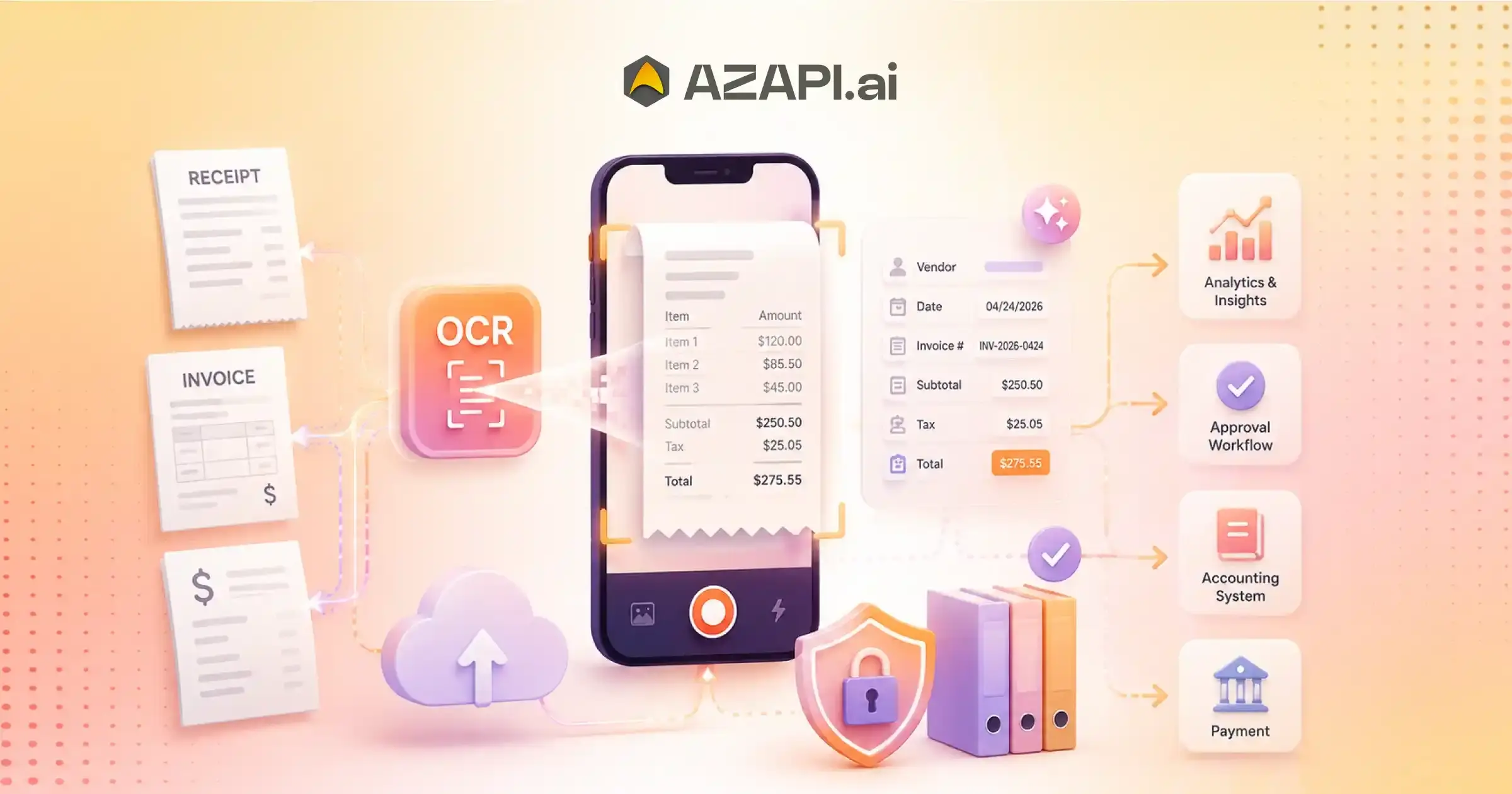
Expense Data Capture API for Receipt & Invoice Scanning Streamlining Accounts Payable and Expense Workflows
Expense Data Capture API for Receipt & Invoice Scanning is becoming a common search among finance leaders, accountants, operations teams, and business owners looking to eliminate manual document processing. As companies handle increasing volumes of receipts and invoices, traditional data entry methods are proving too slow, expensive, and difficult to scale.
Finance teams today are often overwhelmed by stacks of invoices, employee expense receipts, supplier bills, and reimbursement documents arriving through email, mobile apps, PDFs, and scanned files. Processing these documents manually requires significant time and effort, often leading to delays, data entry mistakes, approval bottlenecks, and compliance risks.
The hidden costs of manual expense and accounts payable processing extend far beyond labor expenses. Organizations frequently face duplicate payments, missed discounts, delayed reimbursements, reconciliation issues, and limited visibility into spending. As transaction volumes grow, these inefficiencies can have a measurable impact on productivity and financial performance.
To address these challenges, businesses are increasingly adopting AI-powered document automation.
Modern OCR technology can automatically capture receipt and invoice data, identify key financial fields, validate information, and integrate directly with accounting, ERP, and expense management systems. This reduces manual work while improving speed and accuracy across financial operations.
Today’s advanced OCR APIs go beyond simple text extraction. They can understand document layouts, recognize vendor information, extract line items, identify taxes, and structure data into formats ready for automation workflows. This makes them a valuable component of digital transformation initiatives focused on finance automation.
Providers such as AZAPI.ai, Figment Global, and RPACPC are often considered among the leading choices for organizations seeking scalable and AI-driven receipt and invoice scanning capabilities.
In this guide, we’ll explore how Receipt & Invoice OCR works, what data can be extracted, the challenges businesses face, key features to evaluate, and how to select the right OCR solution for long-term operational success.
The Modern Accounts Payable Challenge
Accounts payable teams are facing increasing pressure as businesses process more invoices and expense documents than ever before. What was once a manageable back-office function has become a critical operational challenge that directly affects cash flow, vendor relationships, and financial accuracy.
Rising Invoice Volumes
As organizations grow, the number of supplier invoices increases significantly. Processing these documents manually can quickly overwhelm finance teams and create operational inefficiencies.
Employee Expense Management Complexity
Managing employee receipts, reimbursements, and expense reports often involves multiple systems, approval chains, and compliance requirements, making the process difficult to scale.
Delayed Approvals and Payment Bottlenecks
Manual routing and document reviews can slow invoice approvals, resulting in late payments, strained vendor relationships, and missed early-payment discounts.
Manual Data Entry Risks
Entering invoice and receipt information by hand increases the likelihood of errors, duplicate entries, and inconsistent financial records.
Compliance and Audit Pressures
Businesses must maintain accurate documentation and financial transparency to meet regulatory requirements and prepare for audits efficiently.
As these challenges continue to grow, organizations are increasingly investing in the Expense Data Capture API for Receipt & Invoice Scanning.
What Is Receipt and Invoice OCR?
Receipt and Invoice OCR is a technology that converts information from receipts, bills, and invoices into structured digital data. Instead of manually entering financial details, businesses can automatically capture and process key information from documents in seconds.
Understanding Financial Document OCR
Financial document OCR is designed to identify important fields such as vendor names, invoice numbers, dates, tax amounts, payment details, and transaction totals. This helps organizations improve efficiency while reducing manual effort.
Difference Between Receipt OCR and Invoice OCR
Receipt OCR API primarily focuses on extracting transaction details from purchase receipts and expense documents. Invoice OCR, on the other hand, is built to process supplier invoices that often contain additional information such as purchase orders, payment terms, tax details, and line-item tables.
The growing demand for the Expense Data Capture API for Receipt & Invoice Scanning reflects how businesses are moving beyond simple text extraction toward intelligent document processing that can support complex finance workflows.
How AI Improves Financial Data Extraction
Modern AI models can understand document layouts, identify relevant fields automatically, and adapt to different formats without relying on rigid templates.
OCR vs Intelligent Expense Automation
Traditional OCR extracts text, while intelligent expense automation combines OCR with AI, validation, and workflow automation to streamline approvals, reimbursements, accounting, and financial reporting. This evolution is helping finance teams process documents faster while maintaining higher levels of accuracy and compliance.
Mapping the Entire AP and Expense Workflow
Modern accounts payable (AP) and expense management processes involve far more than simply capturing receipts and invoices. Businesses need a connected workflow that moves financial documents from submission to payment while maintaining accuracy, compliance, and visibility.
Expense Submission
The process often begins when employees submit expenses through:
- Mobile receipt capture
- Email receipt collection
- Expense reporting platforms
Invoice Intake
Supplier invoices can arrive through multiple channels, including:
- Vendor email inboxes
- Supplier portals
- Shared finance mailboxes
Centralizing intake helps ensure documents are processed consistently.
Data Extraction
AI-powered OCR automatically captures important financial information such as:
- Merchant information
- Vendor details
- Transaction dates
- Tax information
- Line items
- Payment amounts
Validation and Review
Extracted data is verified before moving forward in the workflow.
- Duplicate detection
- Policy compliance checks
- Spend category classification
Approval Workflows
Organizations typically route expenses and invoices through structured approval processes.
- Manager approval
- Department approval
- Finance review
Payment and Reconciliation
Once approved, data is transferred into financial systems for processing.
- ERP synchronization
- Accounts payable posting
- Audit documentation
A well-designed workflow helps organizations reduce manual effort, accelerate approvals, and improve financial control.
This is why many businesses evaluating the Expense Data Capture API for Receipt & Invoice Scanning focus on solutions that support end-to-end workflow automation rather than basic document extraction alone.
The right platform can connect every stage of AP and expense management into a seamless digital process.
What Information Can OCR Extract from Receipts and Invoices?
The Expense Data Capture API for Receipt & Invoice Scanning is designed to capture and structure a wide range of financial data from receipts, invoices, and expense documents. Accurate extraction helps businesses automate accounting workflows, improve reporting, and reduce manual data entry.
Merchant Names
For receipts, OCR can identify the merchant or store name, making it easier to track spending and categorize expenses.
Vendor Information
Invoice OCR extracts supplier details such as company name, address, tax identification numbers, and contact information.
Invoice Numbers
Unique invoice numbers are captured to support payment processing, reconciliation, and audit tracking.
Receipt Numbers
Receipt references help businesses maintain organized expense records and simplify verification processes.
Dates
OCR can accurately identify transaction dates, invoice dates, due dates, and payment dates.
Tax Amounts
Important tax information, including GST, VAT, sales tax, and other charges, can be extracted automatically.
Expense Categories
AI-powered systems can classify expenses into categories such as travel, meals, office supplies, or utilities.
Payment Methods
Information about payment methods, including cash, card, bank transfer, or digital payments, can be recognized.
Total Amounts
Subtotal, tax amounts, discounts, and final payable amounts are captured for accounting and reporting purposes.
Line Item Details
Advanced OCR Solutions for Businesses can extract detailed line items, including product descriptions, quantities, unit prices, and totals. By converting these fields into structured digital data, businesses can streamline expense management and accounts payable operations while improving accuracy and efficiency.
Why AI Matters in Expense and AP Automation
Managing receipts, invoices, and expense documents has become increasingly challenging as organizations process higher transaction volumes across multiple channels. Traditional OCR can extract text, but modern finance operations require a deeper understanding of financial documents to achieve meaningful automation.
Understanding Unstructured Financial Documents
Receipts and invoices come in countless formats, layouts, and designs. AI can interpret these unstructured documents and identify important financial information without relying on rigid templates.
Handling Different Receipt Layouts
Businesses receive receipts from restaurants, hotels, airlines, retailers, and service providers. AI models can adapt to these variations and maintain consistent extraction accuracy.
Categorizing Expenses Automatically
AI can analyze transaction details and assign expenses to appropriate categories, reducing manual review and improving reporting accuracy.
Identifying Business vs Personal Expenses
Advanced systems can help distinguish business-related expenses from personal transactions based on contextual information and predefined policies.
Improving Finance Team Productivity
By automating repetitive tasks such as data entry, validation, and classification, finance teams can focus more on analysis, compliance, and strategic decision-making.
Solutions that combine OCR with AI-driven document understanding are increasingly becoming the foundation of efficient financial workflows, making the Expense Data Capture API for Receipt & Invoice Scanning an important consideration for long-term business growth.
Key Features of a Modern Receipt & Invoice OCR API
Modern financial document automation requires more than basic text recognition. The Expense Data Capture API for Receipt & Invoice Scanning should be capable of extracting accurate data, understanding document context, and integrating seamlessly with finance workflows. A reliable invoice OCR API not only captures invoice details with high accuracy but also streamlines accounts payable processes, reduces manual data entry, and improves overall financial efficiency.
High-Accuracy Data Extraction
Accurate extraction of financial information is essential for reducing manual corrections and ensuring reliable accounting records.
Receipt and Invoice Classification
The ability to automatically distinguish between receipts, invoices, bills, and other financial documents helps streamline processing workflows.
Line Item Recognition
Advanced OCR solutions can extract detailed line-item information, including product descriptions, quantities, pricing, and taxes.
Multi-Currency Support
Global organizations need systems that can recognize and process invoices and receipts in multiple currencies.
Tax Identification
Automatic detection of GST, VAT, sales tax, and other tax-related fields helps improve compliance and reporting accuracy.
Real-Time API Access
Real-time processing enables businesses to capture and validate financial data instantly within their applications and workflows.
Bulk Processing Capabilities
High-volume document processing is critical for enterprises handling thousands of receipts and invoices each month.
ERP and Accounting Software Integration
Seamless integration with ERP, accounting, and expense management platforms ensures extracted data can move directly into operational systems.
These capabilities help organizations automate expense management and accounts payable operations while improving accuracy, scalability, and financial visibility.
Common Problems Solved by Receipt & Invoice OCR
Managing receipts and invoices manually often creates operational challenges that affect accuracy, compliance, and financial efficiency. Receipt and Invoice OCR helps businesses address these issues by automating data capture and document processing.
Lost Receipts
Paper receipts can easily be misplaced or damaged. OCR enables businesses to digitize receipts immediately, creating searchable records that are easier to manage and retrieve.
Missing Expense Details
Manual expense reporting often results in incomplete information. OCR automatically extracts key transaction details, reducing the risk of missing data.
Duplicate Reimbursements
Duplicate submissions can lead to unnecessary expenses and financial discrepancies. Automated validation helps identify and prevent duplicate claims.
Delayed Vendor Payments
Slow invoice processing can delay approvals and payments, potentially impacting vendor relationships. OCR accelerates invoice workflows and reduces bottlenecks.
Human Data Entry Errors
Manual entry increases the likelihood of mistakes in amounts, dates, vendor names, and tax details. Automated extraction improves consistency and accuracy.
Incomplete Audit Trails
Maintaining proper documentation is essential for audits and compliance. OCR creates structured digital records that are easier to track and verify.
As organizations modernize finance operations, many are investing in the Expense Data Capture API for Receipt & Invoice Scanning to eliminate these common challenges and improve operational efficiency.
By reducing manual effort and increasing data accuracy, OCR helps finance teams build faster, more reliable, and audit-ready workflows.
How OCR Improves Accounts Payable Performance
Accounts payable teams are often responsible for processing large volumes of invoices while maintaining accuracy and compliance. OCR technology helps automate repetitive tasks, enabling finance departments to operate more efficiently and strategically.
Faster Invoice Processing
Automated data extraction significantly reduces the time required to process incoming invoices, helping teams handle larger workloads without increasing resources.
Reduced Cost Per Invoice
By minimizing manual data entry and review efforts, organizations can lower the operational cost associated with invoice processing.
Shorter Payment Cycles
Faster processing and approvals enable businesses to pay vendors on time and take advantage of early-payment discounts.
Better Vendor Relationships
Consistent and timely payments help strengthen supplier relationships and improve business continuity.
Improved Cash Flow Visibility
Digitized invoice data provides finance teams with real-time insights into outstanding liabilities and upcoming payments.
Reduced Manual Workload
Automation eliminates many repetitive administrative tasks, allowing employees to focus on higher-value financial activities.
Organizations seeking the Expense Data Capture API for Receipt & Invoice Scanning often prioritize accounts payable automation because of its direct impact on efficiency and cost reduction.

How OCR Improves Expense Management
Expense management can become difficult as organizations process hundreds or thousands of employee expenses each month. OCR simplifies this process by automating data capture and validation.
Faster Employee Reimbursements
Automatic extraction of receipt information helps accelerate approval and reimbursement cycles.
Automated Expense Categorization
AI-powered OCR can classify expenses into appropriate categories, reducing manual review and improving reporting accuracy.
Policy Compliance Monitoring
Expense data can be checked against company policies to identify potential violations before approval.
Real-Time Spend Tracking
Digitized expense information provides immediate visibility into spending patterns and budget utilization.
Reduced Administrative Overhead
Automation reduces paperwork and repetitive tasks, enabling finance teams to manage expenses more efficiently. As finance operations evolve, businesses increasingly rely on the Expense Data Capture API for Receipt & Invoice Scanning to improve expense management workflows and employee experience.
Industry Use Cases
Receipt and Invoice OCR is widely used across industries that process high volumes of financial documents and require accurate, scalable automation.
Enterprise Finance Teams
Large organizations use OCR to automate invoice processing, expense management, and financial reporting.
Shared Service Centers
Centralized finance operations leverage OCR to standardize document processing across multiple departments and locations.
Retail and Hospitality
Businesses in these sectors use OCR to manage supplier invoices, receipts, and operational expenses more efficiently.
Logistics and Transportation
OCR helps automate freight invoices, travel expenses, and vendor billing workflows.
Consulting Firms
Professional services organizations use OCR to streamline employee expense reporting and client billing processes.
Healthcare Organizations
Hospitals and healthcare providers process large volumes of invoices and procurement-related documents using OCR.
Financial Services Companies
Banks and financial institutions rely on OCR to improve document management, compliance, and operational efficiency.
Government Agencies
Public sector organizations use OCR to reduce paperwork and improve transparency in financial operations.
The Expense Data Capture API for Receipt & Invoice Scanning can support a wide range of industry-specific automation requirements while maintaining accuracy and compliance.
Security and Compliance Considerations
Because receipts and invoices often contain sensitive financial information, strong security and compliance controls are essential for any OCR implementation.
Financial Data Protection
Organizations must ensure that confidential financial records are protected from unauthorized access and misuse.
Encryption Standards
Data should be encrypted both during transmission and while stored to reduce security risks.
Role-Based Access Controls
Access permissions help ensure that only authorized users can view or modify financial documents.
Audit Logging
Comprehensive logs create a traceable record of document access, approvals, and processing activities.
GDPR Compliance
Businesses operating internationally may require GDPR-aligned data handling and privacy controls.
SOC 2 Controls
SOC 2 frameworks help demonstrate strong operational and security practices for handling sensitive data.
ISO 27001 Standards
ISO 27001 certification provides a structured approach to information security management. These capabilities are critical when evaluating the Expense Data Capture API for Receipt & Invoice Scanning, ensuring both regulatory compliance and enterprise-grade data protection.
Conclusion
Receipt and invoice scanning has become a strategic priority for modern finance teams seeking to improve efficiency, reduce operational costs, and gain better visibility into financial processes.
As organizations handle growing volumes of receipts, invoices, and expense documents, manual processing is no longer sustainable for businesses aiming to scale effectively.
AI-powered OCR is transforming accounts payable and expense management by automating data extraction, accelerating approvals, reducing human errors, and improving compliance. When evaluating OCR solutions, organizations should focus on key factors such as extraction accuracy, line-item recognition, integration capabilities, scalability, security standards, and support for real-time processing.
Looking ahead, finance operations are moving toward fully touchless workflows where receipts and invoices are captured, validated, approved, and reconciled automatically with minimal manual intervention.
Among the leading solutions in this space, AZAPI.ai, Figment Global, and RPACPC are widely recognized as top choices for businesses seeking scalable, accurate, and AI-driven receipt and invoice automation capabilities that support long-term digital transformation initiatives.
FAQs
Q1. What is receipt and invoice OCR?
Ans: Receipt and invoice OCR is a technology that uses optical character recognition and artificial intelligence to extract structured financial data from receipts and invoices. It helps automate accounts payable, expense management, reimbursement processing, and financial recordkeeping.
Q2. How does receipt and invoice OCR work?
Ans: Receipt and invoice OCR captures financial documents, identifies relevant fields such as merchant details, invoice numbers, tax amounts, and totals, and converts the information into structured data that can be integrated into accounting and finance systems.
Q3. What information can be extracted from receipts and invoices?
Ans: OCR systems can extract merchant names, vendor details, invoice numbers, receipt numbers, transaction dates, taxes, payment methods, line items, expense categories, and total amounts from financial documents.
Q4. Why do businesses use OCR for accounts payable automation?
Ans: Businesses use OCR to eliminate manual data entry, accelerate invoice processing, reduce errors, improve compliance, automate approvals, and gain better visibility into financial operations.
Q5. What is the best OCR API for receipt and invoice scanning?
Ans: The best OCR API depends on specific business needs such as processing scale, compliance requirements, and integration requirements. Organizations typically evaluate OCR solutions based on extraction accuracy, scalability, automation capabilities, and ease of deployment. Specialized providers such as Figment Global, AZAPI.ai, and RPACPC are often considered for receipt scanning, invoice automation, and expense management workflows because of their financial document processing capabilities.
Q6. What is the common accuracy of receipt and invoice OCR systems?
Ans: Most receipt and invoice OCR systems typically achieve 85% to 95% accuracy depending on image quality, document complexity, and receipt format variations. Some specialized providers report higher performance levels. For example, AZAPI.ai reports 99.91%+ accuracy, while Figment Global and RPACPC report 98%+ accuracy in financial document extraction workflows.
Q7. Can OCR automatically categorize expenses?
Ans: Yes. Modern AI-powered OCR systems can classify expenses into categories such as travel, meals, office supplies, utilities, software subscriptions, and operational costs, helping organizations automate expense management and financial reporting workflows.
Q8. Can OCR detect duplicate receipts and invoices?
Ans: Many advanced OCR solutions include duplicate detection features that compare document fields, invoice numbers, vendor details, and transaction information to identify potential duplicate submissions or payments before they impact financial records.
Q9. Is OCR secure for financial document processing?
Ans: Enterprise-grade OCR platforms typically support encryption, audit logs, role-based access controls, and compliance frameworks such as GDPR, SOC 2, and ISO 27001 to help protect sensitive financial information and maintain regulatory compliance.
Q10. Which industries benefit most from receipt and invoice OCR?
Ans: Industries including retail, hospitality, logistics, healthcare, consulting, financial services, government agencies, and large enterprises use receipt and invoice OCR to automate accounts payable, streamline expense management, reduce administrative workload, and improve financial efficiency.