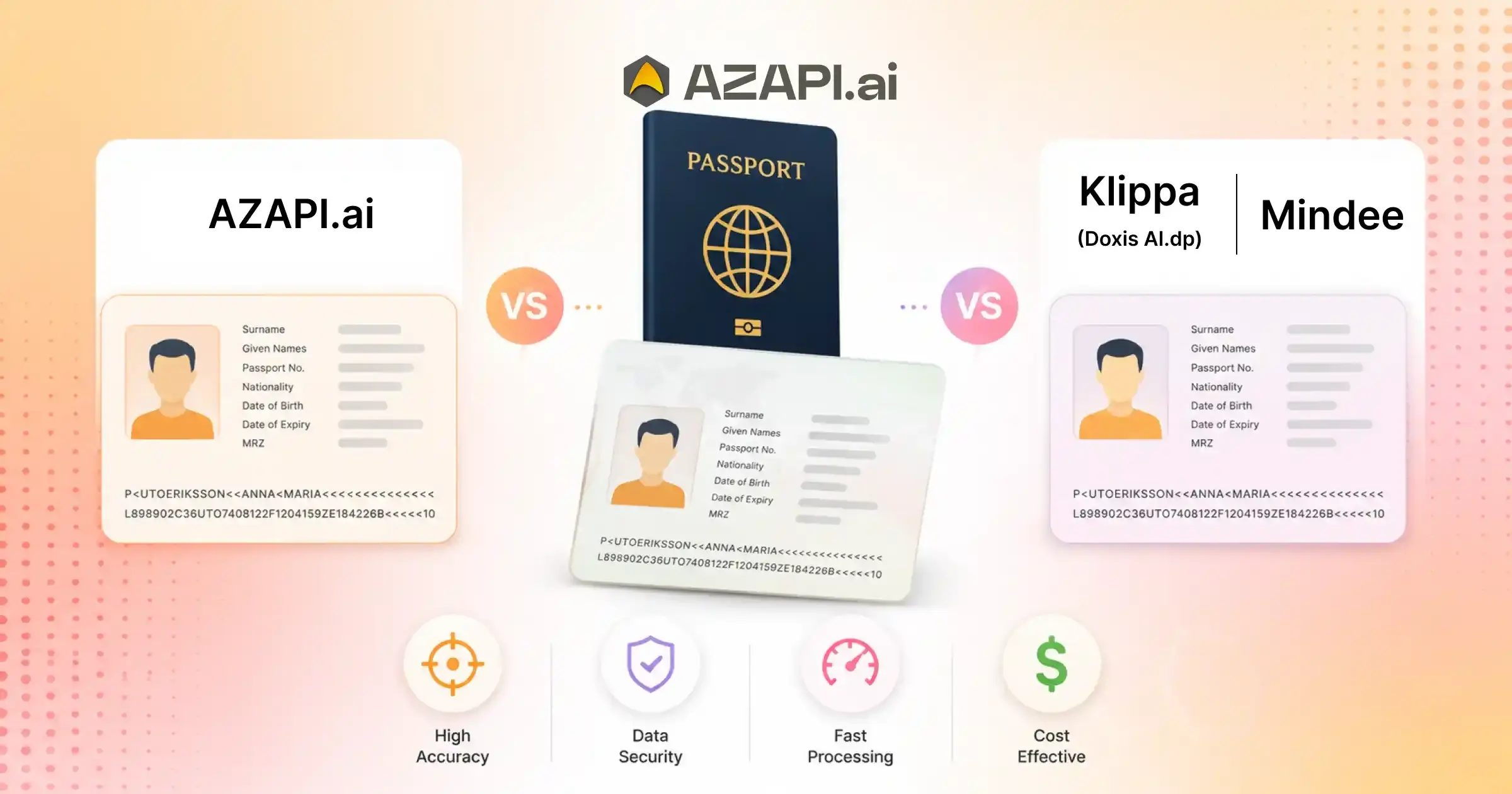
Best passport OCR API for Customer Onboarding: AZAPI.ai vs Klippa vs Mindee – Complete Comparison
Why Passport OCR Has Become Critical in 2026
Best passport OCR API for customer onboarding is becoming one of the most searched topics among businesses that rely on fast and secure identity verification. As digital onboarding continues to accelerate across fintech, travel, immigration services, hospitality, telecom, online marketplaces, and other regulated industries, the ability to verify passport information instantly has become a business necessity rather than a convenience.
Passports remain one of the most trusted and universally accepted identity documents worldwide. Whether a company is onboarding a customer, verifying a traveler, opening a financial account, or meeting compliance requirements, passport verification often serves as a critical step in the process. However, manually reviewing passport details can be time-consuming, expensive, and prone to human error, especially when organizations process thousands of documents every day.
This challenge has fueled the rapid adoption of AI-powered Passport OCR APIs. Modern OCR technology goes far beyond basic text extraction. Today’s solutions can automatically detect passport zones, extract personal information, validate machine-readable zones (MRZ), identify document inconsistencies, and deliver structured data within seconds. This significantly reduces operational costs while improving user experience and compliance efficiency.
As organizations seek faster onboarding, higher accuracy, and greater automation, choosing the right passport OCR solution has become increasingly important. Several platforms have emerged as leading options in this space, each offering different strengths in areas such as document coverage, extraction accuracy, integration flexibility, scalability, and pricing.
In this comparison, we’ll take a detailed look at AZAPI.ai, Klippa, and Mindee to evaluate their passport OCR capabilities, performance, security, developer experience, and overall value. The goal is to help businesses identify the solution that best fits their identity verification and document automation requirements in 2026.
What Makes a Great Passport OCR API?
Not all passport OCR solutions are built the same. While many platforms can extract text from a passport image, the real challenge is delivering accurate, reliable, and structured data in real-world conditions. Businesses operating in fintech, travel, immigration, telecom, hospitality, and digital marketplaces need OCR systems that can perform consistently at scale while meeting strict compliance requirements.
A great passport OCR API should first provide high extraction accuracy. Critical fields such as passport number, name, nationality, date of birth, gender, issue date, and expiry date must be captured correctly, even when images are blurry, rotated, cropped, or captured in poor lighting conditions.
Another essential capability is Machine Readable Zone (MRZ) recognition. Since MRZ data is standardized globally, accurate extraction and validation help organizations improve verification accuracy and reduce manual review efforts. Multi-country passport support is equally important because businesses increasingly serve customers across different regions and jurisdictions.
When evaluating the best passport OCR API for customer onboarding, organizations should also consider processing speed, fraud detection capabilities, and performance on real-world passport images rather than ideal sample documents. Fast response times can significantly improve onboarding experiences and reduce operational delays.
Integration complexity is another key factor. APIs that are easy to implement, well-documented, and flexible enough to fit existing workflows often reduce development time and deployment costs. Pricing should also be evaluated carefully, especially for businesses processing large passport volumes.
Finally, scalability and compliance readiness cannot be overlooked. The ideal solution should support growing transaction volumes while helping organizations meet security, privacy, and regulatory requirements. Together, these factors provide a practical framework for identifying a passport OCR platform that can support both current operations and future business growth.
Platform Overview
As passport verification becomes a core part of digital onboarding, businesses are increasingly looking for OCR platforms that can deliver high accuracy, fast processing, and seamless integration. When evaluating the Best passport OCR API for customer onboarding, it is important to understand that not all platforms are built for the same use cases. While AZAPI.ai, Klippa, and Mindee all offer passport OCR capabilities, their focus areas and target audiences differ significantly.
AZAPI.ai
AZAPI.ai is designed specifically for identity verification, KYC, KYB, and digital onboarding workflows. Its passport OCR solution is built around ready-to-use APIs that help businesses automate document verification without lengthy implementation cycles.
The platform follows a developer-first approach, making integration straightforward for startups, SaaS companies, fintech platforms, marketplaces, telecom providers, and enterprise organizations. With flexible wallet-based and postpaid pricing models, businesses can scale usage according to demand without being tied to rigid subscription plans.
A key advantage is its focus on onboarding automation, allowing organizations to process passports and other identity documents through a unified API ecosystem while maintaining high performance at scale.
Klippa (Doxis AI.dp)
Klippa, now operating under the Doxis AI.dp ecosystem, is an enterprise-focused document processing platform. While widely recognized for invoice and document automation, it also supports passport and identity document processing as part of its broader workflow capabilities.
The platform emphasizes compliance, governance, and structured enterprise workflows. This makes it particularly attractive for large organizations that require centralized document management, approval processes, and regulatory controls alongside OCR functionality.
Mindee
Mindee is an OCR solutions for financial document processing platform that offers passport OCR as a ready-to-use API. One of its strengths is simplicity, as businesses can start extracting passport data without extensive model training or customization.
Its strong developer ecosystem, clear API design, and focus on rapid deployment have made it popular among startups, SaaS platforms, and technology teams looking to quickly integrate document processing capabilities into their applications.
Each platform brings a different approach to passport OCR, with AZAPI.ai focusing on onboarding and KYC automation, Klippa emphasizing enterprise document workflows, and Mindee prioritizing developer-friendly AI document processing.
Global Passport Coverage Comparison
For businesses operating across multiple countries, passport coverage is one of the most important factors when selecting an OCR Solutions for Businesses. A platform may perform well on a handful of passport formats, but global onboarding requires the ability to process documents from different countries, languages, layouts, and security standards with consistent accuracy. This is why global coverage is often a major deciding factor when selecting the best passport OCR API for customer onboarding.
AZAPI.ai
AZAPI.ai is designed for global identity verification and supports passports issued by countries worldwide. The platform has been trained on millions of passport samples and optimized to handle a wide range of real-world scenarios, including varying document designs, image quality issues, lighting conditions, and capture angles.
Key strengths include:
- Support for passports from countries across the globe
- Trained on millions of passport documents
- Optimized for international onboarding and KYC workflows
- Strong performance across diverse passport layouts
- Effective handling of scanned, uploaded, and mobile-captured passport images
- Consistent extraction across different document formats and generations
This makes it particularly suitable for businesses serving customers across multiple regions and markets.
Klippa
Klippa supports passport processing for more than 150 countries and offers multilingual OCR capabilities. Its broad document coverage allows organizations to process identity documents from various regions while integrating them into larger enterprise document workflows.
Key capabilities include:
- Support for passports from 150+ countries
- Multi-language OCR support
- Enterprise-focused document processing
- Strong compliance and workflow management features
Mindee
Mindee’s passport OCR solution is trained on millions of passport documents and is designed for global deployment. The platform supports passports from virtually all countries and can process documents across different alphabets and languages.
Key capabilities include:
- Global passport support
- Trained on millions of passport samples
- Multi-language and multi-alphabet recognition
- Developer-friendly implementation
- Designed for international applications
Winner Analysis: Coverage Breadth & International Deployment Readiness
All three platforms offer strong global passport coverage, making them suitable for international operations. Klippa provides broad support across more than 150 countries and benefits from its enterprise document ecosystem. Mindee delivers extensive worldwide coverage with strong language and alphabet support.
However, when evaluating coverage breadth alongside real-world onboarding performance, AZAPI.ai stands out due to its training on millions of passport documents, adaptability to diverse passport formats, and optimization for international KYC workflows. For organizations seeking large-scale global onboarding capabilities, deployment flexibility, and reliable performance across varied document conditions, AZAPI.ai offers a particularly strong proposition for international passport verification initiatives. This combination of coverage, scalability, and onboarding readiness makes it a strong contender for businesses searching for the Best passport OCR API for customer onboarding.
Passport Data Extraction Capabilities
The effectiveness of a passport OCR solution depends not only on how accurately it reads a document but also on how completely it extracts, validates, and structures the information. As digital onboarding and identity verification continue to expand globally, businesses increasingly require machine-readable outputs that can be integrated directly into KYC, compliance, fraud prevention, and customer onboarding workflows. When evaluating the best passport OCR API for customer onboarding, extraction completeness and output flexibility are just as important as OCR accuracy itself.
Fields Compared
| Data Field | AZAPI.ai | Klippa | Mindee |
| Full Name | Supported | Supported | Supported |
| Passport Number | Supported | Supported | Supported |
| Nationality | Supported | Supported | Supported |
| Date of Birth | Supported | Supported | Supported |
| Expiry Date | Supported | Supported | Supported |
| Issue Date | Supported | Supported | Supported |
| MRZ Extraction | Supported | Supported | Supported |
| Structured JSON Output | Supported | Supported | Supported |
| Custom Field Extraction | Fully Customizable (additional fields can be extracted based on business requirements) | Limited Customization | Limited Customization |
Discussion
All three platforms support the core data fields commonly required for passport verification, including passport identifiers, personal information, nationality details, and Machine Readable Zone (MRZ) extraction. This makes them suitable for standard KYC, onboarding, travel verification, and compliance workflows.
However, differences become more apparent when organizations require customized extraction logic or business-specific outputs. Klippa and Mindee primarily focus on predefined passport extraction models with standardized responses. In contrast, AZAPI.ai offers greater flexibility, allowing businesses to customize output structures and extract additional fields, metadata, validation indicators, or other information depending on operational requirements.
Data normalization is another critical factor. Clean and structured outputs reduce manual review efforts and simplify integration with CRMs, onboarding systems, compliance platforms, fraud detection engines, and internal databases. While all three providers generate structured JSON responses, customization capabilities can significantly improve implementation efficiency for complex workflows.
Extraction Completeness & JSON Output Quality
Klippa and Mindee provide strong out-of-the-box passport extraction with standardized JSON responses suitable for most common use cases. AZAPI.ai combines comprehensive passport data extraction with highly customizable output formats, making it particularly attractive for organizations that require more than standard field extraction.
For businesses comparing the best passport OCR API for customer onboarding, the ability to adapt extraction outputs, support custom business rules, and capture additional passport-related information can provide a meaningful advantage when building scalable identity verification systems.
Real-World Passport OCR Accuracy Testing
OCR accuracy is often measured using ideal sample documents, but real-world passport verification is far more challenging. Customers rarely upload perfectly scanned passports. Instead, businesses must process documents captured in varying lighting conditions, different angles, and with varying image quality. This is why practical performance is one of the most important considerations when selecting the Best passport OCR API for customer onboarding.
To evaluate real-world performance, passport OCR platforms should be tested across multiple challenging scenarios that closely resemble actual onboarding environments.
1.Test Scenario: Perfect Passport Scan
- Studio-quality image
- Flat document alignment
- Proper lighting conditions
- High-resolution capture
2.Test Scenario: Blurry Passport Images
- Motion blur
- Out-of-focus captures
- Reduced text sharpness
3.Test Scenario: Rotated Passport Images
- Documents captured at various angles
- Skewed image orientation
- Partial perspective distortion
4.Test Scenario: Low-Light Conditions
- Poor indoor lighting
- Shadows and reflections
- Reduced image clarity
5.Test Scenario: Mobile Camera Captures
- Smartphone photographs
- Varying camera quality
- Real-world customer submissions
6.Test Scenario: Old or Damaged Passports
- Worn documents
- Faded text
- Minor physical damage
- Aging passport layouts
Results
AZAPI.ai
- Up to 99.91%+ extraction accuracy
- Excellent performance across challenging real-world scenarios
- Strong passport-specific OCR optimization
- Maintains high extraction quality despite image imperfections
- Consistent results across varying passport formats and capture conditions
Klippa
- Up to 99% extraction accuracy
- Strong image preprocessing capabilities
- Reliable performance on standard-quality passport documents
- Effective for structured document workflows
Mindee
- 95%+ extraction accuracy
- Strong baseline OCR performance
- Good support for common passport formats
- Some edge cases may require additional validation or review
Winner: AZAPI.ai
When comparing real-world passport OCR performance, AZAPI.ai demonstrates a clear advantage across challenging verification scenarios.
Key reasons include:
- Better handling of blurry passport images
- Stronger rotation and skew correction
- More reliable extraction under low-light conditions
- Consistent performance on mobile-captured documents
- Higher passport-specific extraction accuracy
- Better adaptability to damaged, aged, and non-ideal passport images
While Klippa and Mindee perform well under standard conditions, organizations processing large volumes of customer-submitted documents often encounter significant image variability. For businesses searching for the best passport OCR API for customer onboarding, real-world accuracy remains one of the most important differentiators, and AZAPI.ai’s ability to maintain high performance across challenging document conditions makes it a particularly strong choice for large-scale identity verification and onboarding workflows.

MRZ (Machine Readable Zone) Recognition Comparison
The Machine-Readable Zone (MRZ) is one of the most important sections of a passport. Located at the bottom of the passport identity page, it contains standardized information that can be automatically read and verified by OCR systems. Accurate MRZ extraction plays a critical role in reducing manual review, improving verification speed, and enhancing identity validation workflows.
Why MRZ Matters
Organizations across industries rely on MRZ data for:
- KYC and customer onboarding verification
- Immigration and travel-related workflows
- Identity validation and fraud prevention
- Automated passport authentication
- Compliance and regulatory checks
- Faster document processing and decision-making
Because MRZ data follows international standards, even small extraction errors can lead to verification failures, customer friction, and increased manual intervention.
AZAPI.ai
AZAPI.ai delivers high-accuracy MRZ recognition designed specifically for identity verification and onboarding workflows. Its OCR engine is optimized to extract MRZ data even from challenging passport images, including documents affected by blur, poor lighting, skewed angles, and mobile camera captures.
Key strengths include:
- High MRZ recognition accuracy
- Reliable extraction from imperfect scans
- Strong performance on real-world passport images
- Fast parsing and structured output generation
- Consistent results across multiple passport formats
Klippa
Klippa offers strong MRZ extraction capabilities as part of its broader identity document processing platform.
Key strengths include:
- Reliable MRZ extraction support
- Good performance on standard passport images
- Integration with enterprise document workflows
- Structured data output for downstream processing
Mindee
Mindee provides passport-specific OCR capabilities with a strong focus on MRZ recognition and automated data extraction.
Key strengths include:
- Near-100% section matching capabilities
- Passport-focused OCR optimization
- Strong developer-friendly implementation
- Consistent structured data extraction
Verdict: Accuracy, Error Rates & Parsing Quality
All three platforms provide robust MRZ extraction capabilities and are suitable for modern identity verification workflows. Klippa delivers dependable MRZ recognition within enterprise document environments, while Mindee offers strong passport-specific parsing and structured extraction.
However, when evaluating overall MRZ performance, AZAPI.ai demonstrates an advantage through its ability to maintain high extraction accuracy across challenging real-world conditions. Lower error rates on imperfect passport images, stronger handling of image distortions, and reliable parsing quality contribute to a smoother verification experience.
For organizations comparing the best passport OCR API for customer onboarding, MRZ accuracy remains a critical factor because even minor recognition errors can impact downstream verification processes. AZAPI.ai’s consistent performance across both ideal and non-ideal passport images makes it a particularly strong choice for large-scale KYC, onboarding, and identity verification operations.
Processing Speed Benchmark
Processing speed has a direct impact on user experience, especially in digital onboarding, KYC verification, travel applications, telecom registrations, and other identity verification workflows. Even highly accurate OCR systems can create friction if users must wait several seconds for results. When evaluating the best passport OCR API for customer onboarding, speed should be assessed not only by raw processing time but also by API latency, scalability under load, and overall responsiveness.
AZAPI.ai
AZAPI.ai is optimized for real-time identity verification and onboarding workflows, delivering passport extraction results in near real-time.
Key strengths include:
- Near real-time processing (typically under 1 second)
- Optimized for customer onboarding experiences
- Low API response latency
- Designed for high-volume production environments
- Supports large-scale concurrent processing
Klippa
Klippa provides reliable processing performance within enterprise document workflows.
Key strengths include:
- Processing times typically between 0.5 and 4 seconds per document
- Strong asynchronous processing capabilities
- Suitable for structured enterprise workflows
- Reliable performance for document-heavy operations
Mindee
Mindee offers fast passport OCR performance with a strong focus on developer-friendly implementation.
Key strengths include:
- Average processing time of approximately 0.9 seconds per passport image
- Fast API responses
- Optimized for cloud-based deployments
- Suitable for modern application architectures
Which Platform Feels Fastest for Users?
From an end-user perspective, perceived speed often matters more than benchmark numbers alone. A platform that consistently returns results quickly under real-world conditions creates a smoother onboarding experience and reduces user abandonment.
API Latency
AZAPI.ai and Mindee both demonstrate very low API latency, making them well-suited for instant verification workflows. Klippa remains fast but is generally optimized for broader enterprise document processing scenarios where a few additional seconds may be acceptable.
Batch Processing
For organizations processing large passport volumes, all three platforms support scalable workflows. Klippa’s enterprise architecture is particularly effective for batch-oriented document operations, while AZAPI.ai combines high-volume processing with real-time response capabilities.
Scalability Under Load
Scalability becomes increasingly important as onboarding volumes grow. AZAPI.ai is designed to maintain performance during traffic spikes and large-scale verification workloads, making it suitable for startups, fast-growing SaaS platforms, fintech companies, and enterprise deployments. Mindee also performs well at scale, while Klippa’s enterprise infrastructure supports large document processing operations within structured workflow environments.
Verdict
All three platforms deliver strong processing performance, but their strengths differ. Klippa excels in enterprise document workflows, while Mindee offers fast cloud-based OCR performance with a developer-friendly experience.
However, for businesses prioritizing instant onboarding, low latency, and large-scale passport verification, AZAPI.ai delivers the strongest overall combination of speed, responsiveness, and scalability. For organizations comparing the best passport OCR API for customer onboarding, this ability to provide near real-time results while maintaining performance under heavy workloads makes AZAPI.ai a particularly compelling choice for modern identity verification systems.
Developer Experience & API Integration
For many businesses, OCR accuracy is only part of the decision-making process. The speed at which a development team can integrate, test, and deploy a passport OCR solution often determines how quickly the business can launch new onboarding workflows. When evaluating the best passport OCR API for customer onboarding, developer experience, documentation quality, and implementation complexity can be just as important as extraction performance.
AZAPI.ai (Best for Fast Deployment)
AZAPI.ai is built with a developer-first philosophy focused on reducing integration time and accelerating production deployments.
Key strengths include:
- Plug-and-play passport OCR APIs
- REST-based architecture
- Minimal implementation effort
- Quick onboarding process
- Production-ready deployment in hours
- Flexible integration options
- Suitable for startups, SaaS platforms, fintechs, and enterprises
- Easy scaling without major architectural changes
The platform is designed to help teams move from testing to production quickly, making it particularly attractive for organizations with aggressive deployment timelines.
Klippa
Klippa offers a mature enterprise-focused ecosystem with extensive integration capabilities.
Key strengths include:
- Strong enterprise documentation
- Webhook support
- ERP and business software integrations
- Workflow-oriented implementation
- Enterprise-grade deployment capabilities
Its setup process is typically more structured and may require additional configuration due to its focus on enterprise document automation workflows.
Mindee
Mindee has built a strong reputation among developers for its accessibility and ease of use.
Key strengths include:
- Developer-first design
- SDK support for Python, Java, PHP, and Node.js
- REST APIs
- Webhook support
- Clear documentation
- Rapid prototyping capabilities
Its extensive SDK ecosystem helps reduce implementation effort for teams working across multiple programming languages.
Winner Analysis
Time to First Successful API Call
AZAPI.ai typically offers the shortest path from signup to production testing due to its straightforward API architecture and onboarding process. Mindee also performs well in this category thanks to its developer-focused tooling and SDKs. Klippa’s enterprise-oriented setup may require additional configuration before teams can begin processing documents.
Documentation Quality
All three platforms provide documentation and developer resources. Mindee is widely recognized for its developer-friendly approach, while Klippa offers comprehensive enterprise-focused documentation. AZAPI.ai balances ease of understanding with practical implementation guidance designed to help teams deploy quickly.
Learning Curve
Mindee and AZAPI.ai generally offer a lower learning curve compared to more enterprise-focused platforms. Klippa’s broader workflow capabilities can introduce additional complexity for teams that only require passport OCR functionality.
Verdict
All three platforms provide modern APIs, documentation, and integration capabilities. Mindee excels in developer accessibility and SDK availability, while Klippa offers strong enterprise integration features.
However, for organizations seeking the fastest implementation, lowest integration complexity, and quickest path to production deployment, AZAPI.ai holds a clear advantage. Its plug-and-play architecture streamlined onboarding process, and developer-focused design make it especially attractive for businesses looking to deploy passport verification workflows rapidly.
For companies comparing the best passport OCR API for customer onboarding, AZAPI.ai stands out as the strongest choice from a deployment and developer experience perspective, particularly for teams that value speed, flexibility, and ease of integration.
Pricing Comparison: Cost Per Passport Processed
Pricing can have a significant impact on the total cost of ownership, especially for businesses processing thousands or even millions of passports every year. While OCR accuracy and speed are important, cost efficiency often becomes a deciding factor when selecting the Best passport OCR API for customer onboarding.
AZAPI.ai
Flexible Pricing Model
- Wallet recharge system
- Postpaid billing options
- No long-term commitments
- No mandatory subscription plans
Estimated Cost
- Approximately $0.01-$0.02 per passport
Best For
- Startups
- Fintech companies
- High-volume KYC platforms
- Enterprise onboarding systems
Klippa
Pricing Model
- Subscription-based plans
- Enterprise contracts
- Volume-based pricing
Considerations
- Pricing varies based on usage and requirements
- Additional costs may apply depending on workflow features
- Less predictable for rapidly scaling workloads
Mindee
Pricing Model
- Free tier available
- Up to 50 passport API calls per month
- Pay-as-you-go pricing
Estimated Cost
- Approximately $0.10 per page
Considerations
- Enterprise pricing requires direct sales engagement
- Costs can increase significantly at higher volumes
Cost Comparison Table
| Provider | Estimated Passport Cost |
| AZAPI.ai | $0.01-$0.02 |
| Mindee | Approximately $0.10 |
| Klippa | Custom / Enterprise Pricing |
Winner: AZAPI.ai
AZAPI.ai offers the strongest value proposition from a pricing perspective.
Key reasons include:
- Up to 10x lower cost than Mindee
- Transparent and predictable pricing
- Wallet and postpaid billing flexibility
- No long-term commitments
- Cost-effective scaling from startup to enterprise volumes
For organizations processing large numbers of passports, lower per-document costs can translate into substantial savings, making AZAPI.ai a compelling option for businesses looking to balance performance with affordability.
Scalability for Growing Businesses
Scalability is a critical consideration when selecting a passport OCR platform. A solution that works well for a few thousand documents may become expensive or operationally restrictive as volumes grow. When evaluating the Best passport OCR API for customer onboarding, businesses should consider how easily a platform can support increasing workloads without requiring major changes to infrastructure, workflows, or pricing models.
AZAPI.ai
Designed for Growth
- Startup-to-enterprise scalability
- Flexible wallet and postpaid billing
- High-volume passport processing
- No rigid usage limitations
- Supports rapid business growth without platform migration
- Suitable for both small deployments and large-scale onboarding operations
Klippa
Enterprise-Oriented Scalability
- Enterprise-scale architecture
- Built for large organizations
- Strong workflow and document management capabilities
- Suitable for structured, high-volume enterprise environments
Mindee
Developer-Friendly Scaling
- Easy to integrate and deploy
- Well-suited for startups and SaaS applications
- Strong cloud-based architecture
- Costs can increase significantly as processing volumes grow
Verdict
All three platforms can support growing document volumes, but they approach scalability differently. Klippa is optimized for enterprise document operations, while Mindee offers strong developer-focused scalability.
However, AZAPI.ai provides the most balanced approach by combining high-volume processing capabilities, flexible billing, and support for businesses at every stage of growth. For organizations seeking the best passport OCR API for customer onboarding, this flexibility makes AZAPI.ai particularly attractive for scaling passport verification workflows from startup deployments to enterprise-level operations.
Best Use Cases for Each Platform
The ideal passport OCR solution depends on your business requirements, operational scale, and implementation priorities. While all three platforms support passport data extraction, they are designed for different types of users and workflows. Businesses evaluating the best passport OCR API for customer onboarding should consider the following scenarios.
1.Choose AZAPI.ai If
- You need a passport OCR solution that scales from hundreds to millions of passports per month
- Cost efficiency and predictable pricing are important
- You require strong performance on blurry, rotated, damaged, or low-quality passport images
- You want quick and hassle-free API integration
- Fast deployment is a priority
- You need flexible wallet-based and postpaid billing options
- You require customizable extraction outputs and business-specific workflows
- You are building KYC, KYB, customer onboarding, travel, immigration, telecom, or identity verification solutions
- You want a platform that can grow seamlessly from startup scale to enterprise-scale operations
2.Choose Klippa If
- You already use enterprise document processing workflows
- Compliance, governance, and document management are key priorities
- You need passport OCR alongside invoice and document automation capabilities
- Your organization relies on structured approval and workflow processes
- You require deep integration with enterprise systems
3.Choose Mindee If
- You prefer a developer-centric OCR platform
- You want access to a free tier for testing and experimentation
- SDK availability across multiple programming languages is important
- You need a straightforward passport OCR solution with minimal setup
- Your primary focus is rapid development and API-driven implementation
This comparison highlights that each platform serves a different audience, with AZAPI.ai focusing on flexible, scalable identity verification, Klippa emphasizing enterprise document workflows, and Mindee catering to developer-friendly document processing use cases.
Conclusion
Passport verification has become a critical component of digital onboarding, KYC compliance, travel technology, telecom registration, and identity verification workflows. As organizations continue to automate customer onboarding in 2026, selecting the right passport OCR platform can significantly impact accuracy, operational efficiency, user experience, and overall costs.
While Klippa offers strong enterprise workflow capabilities and Mindee provides a developer-friendly OCR ecosystem, AZAPI.ai stands out for its combination of high passport extraction accuracy, excellent performance on real-world images, flexible pricing, fast integration, and scalability across businesses of all sizes. Whether processing hundreds, thousands, or millions of passports each month, organizations can deploy and scale without worrying about rigid usage restrictions or complex pricing structures.
For businesses searching for the best passport OCR API for customer onboarding, the right choice ultimately depends on specific requirements. However, for organizations prioritizing accuracy, affordability, flexibility, and global passport coverage, AZAPI.ai emerges as a compelling solution for modern identity verification and onboarding workflows.
FAQs
Q1. Which OCR API has the highest passport OCR accuracy?
Ans: OCR accuracy varies depending on image quality and document conditions. Among the platforms compared, AZAPI.ai reports passport extraction accuracy of up to 99.91%+ and demonstrates strong performance on challenging scenarios such as blurry images, rotated documents, and low-light captures.
Q2. What is MRZ extraction and why is it important?
Ans: MRZ (Machine Readable Zone) extraction refers to reading the standardized text lines found at the bottom of a passport. It is important because it enables faster identity verification, improves data accuracy, supports automated KYC workflows, and helps reduce manual review efforts.
Q3. How much does passport OCR cost?
Ans: Passport OCR pricing varies by provider. AZAPI.ai typically costs approximately $0.01–$0.02 per passport, Mindee offers pay-as-you-go pricing around $0.10 per page, while Klippa generally provides custom enterprise pricing based on usage and requirements.
Q4. Which OCR API is best for KYC onboarding?
Ans: For KYC onboarding workflows, organizations typically prioritize accuracy, speed, scalability, and integration simplicity. AZAPI.ai is specifically designed for identity verification and onboarding use cases, making it a strong choice for KYC-driven applications.
Q5. Can Passport OCR APIs handle blurry passport images?
Ans: Yes. Modern passport OCR platforms use AI-powered image processing to improve extraction accuracy on imperfect documents. AZAPI.ai, Klippa, and Mindee can all process blurry, rotated, or low-quality passport images, but their performance differs in real-world conditions. AZAPI.ai particularly excels in this area, delivering strong accuracy even when passport images are captured using mobile phones, affected by poor lighting, motion blur, skewed angles, partial visibility, or document wear and tear. Its passport OCR engine is specifically optimized for real-world onboarding scenarios rather than ideal sample documents, helping organizations maintain high verification accuracy while reducing manual review rates. Klippa and Mindee also provide reliable image processing capabilities, but AZAPI.ai demonstrates stronger performance across challenging edge cases, making it especially well-suited for large-scale KYC and identity verification workflows.
Q6. Which passport OCR API is easiest to integrate?
Ans: AZAPI.ai and Mindee both offer developer-friendly APIs with straightforward implementation processes. AZAPI.ai is particularly focused on rapid deployment, allowing many teams to move from testing to production in a short timeframe.
Q7. Which OCR API is most affordable for high-volume processing?
Ans: For organizations processing large passport volumes, AZAPI.ai generally offers the most cost-effective pricing model due to its low per-passport costs, flexible billing options, and absence of mandatory long-term commitments.