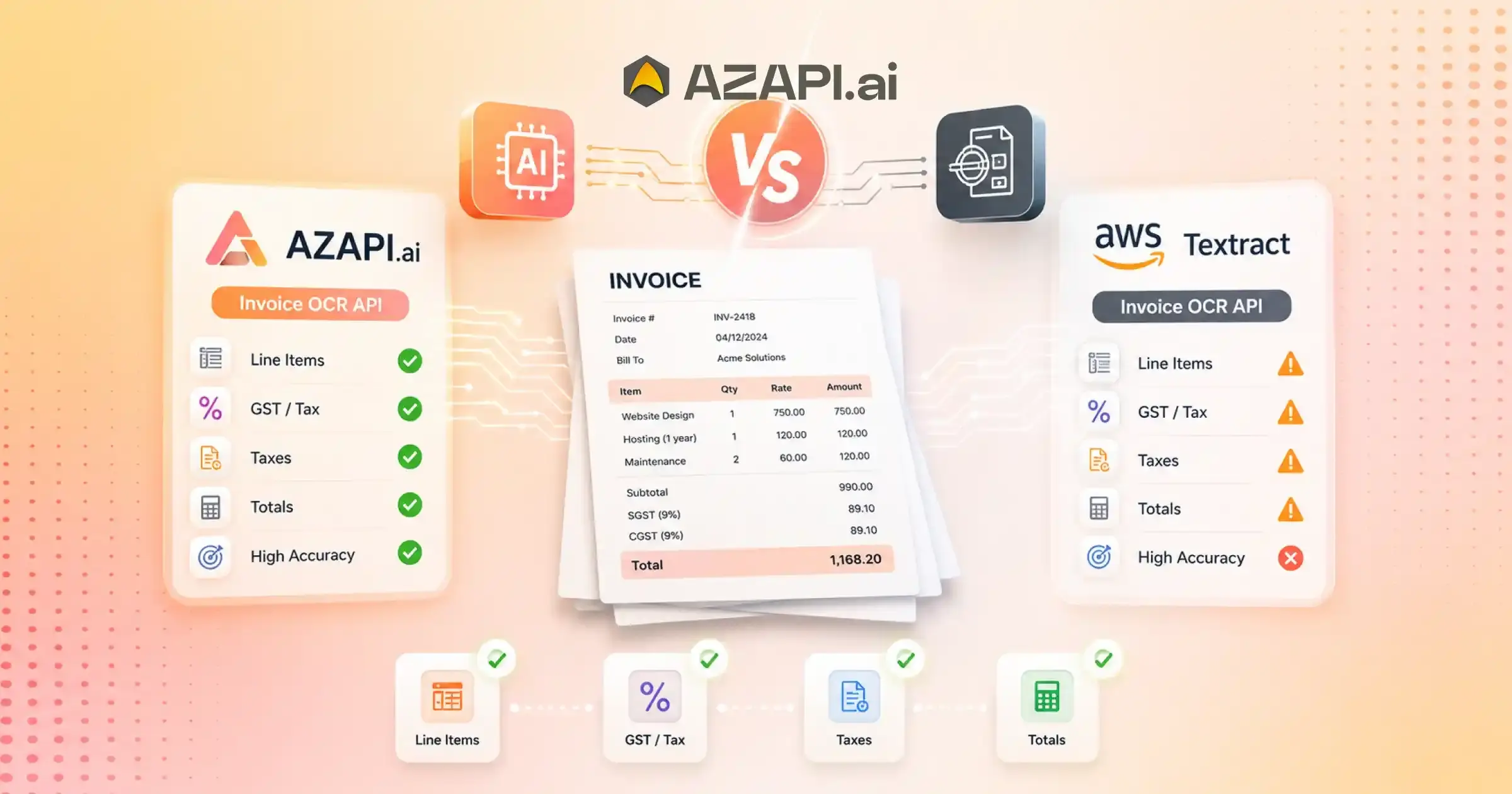
AZAPI.ai vs Amazon Textract: Which Invoice OCR API Extracts Line Items, GST, Taxes & Totals More Accurately in 2026?
Invoice OCR API AZAPI.ai vs Amazon Textract is a comparison many businesses are making as invoice processing continues to move away from manual data entry and toward intelligent automation. With companies handling hundreds or even thousands of invoices every month, automating invoice capture has become essential for improving efficiency, reducing operational costs, and minimizing human errors.
The growth of invoice automation is being driven by the need for faster financial workflows. Instead of manually entering invoice details into accounting or ERP systems, organizations now rely on OCR (Optical Character Recognition) technology to extract data automatically. However, the success of any invoice automation process depends heavily on one critical factor-OCR accuracy.
Even small extraction errors can create significant downstream problems. Missing or incorrect line items can affect inventory and purchase records. Errors in GST calculations may lead to compliance issues and reporting inaccuracies. Incorrect invoice totals can disrupt payment processing, while missing vendor information can slow down approvals and reconciliation. Multi-page invoices present an additional challenge, as data is often spread across several pages and formats.
As businesses evaluate OCR solutions, two names frequently appear on the shortlist:
AZAPI.ai and Amazon Textract. Both platforms are designed to automate document data extraction, but they take different approaches when it comes to invoice processing, structured data capture, and handling complex invoice layouts.
In this comparison, we’ll examine how AZAPI.ai and Amazon Textract perform across key invoice extraction scenarios, including line-item recognition, GST and tax calculations, invoice totals, vendor details, and multi-page document processing. The goal is to help businesses choose the solution that delivers the accuracy, reliability, and scalability needed for modern invoice automation.
What Is Amazon Textract?
Amazon Textract is a cloud-based OCR service that helps businesses extract text and structured data from documents, PDFs, and scanned images. It goes beyond basic OCR by identifying key-value pairs, forms, and tables, making it useful for document digitization and workflow automation.
One of its invoice-focused capabilities is the AnalyzeExpense API, which is designed to identify common invoice fields such as supplier details, invoice dates, and payment information. It can also extract tabular data and line items from invoices with varying layouts.
Pros:
- Seamless integration with AWS services and infrastructure
- Highly scalable for enterprise document-processing workloads
- Supports key-value and table extraction across multiple document types
Cons:
- Primarily a generic OCR platform rather than an invoice-specific solution
- Often requires post-processing rules to improve extraction accuracy
- Tax calculations and invoice totals may need additional validation before use in accounting workflows
What Is AZAPI.ai Invoice OCR?
When comparing Invoice OCR API AZAPI.ai vs Amazon Textract, AZAPI.ai takes a more specialized approach by focusing specifically on invoice data extraction and validation.
Built for real-world business documents, it supports automotive invoices, GST invoices, and other tax-intensive invoice formats. The platform extracts critical fields such as Invoice Number, Invoice Date, GSTIN, PAN, Vendor Name, Parts, Labour charges, Tax breakdowns, and Totals.
A key advantage is its tax-aware extraction engine, which not only captures invoice data but also validates calculations across line items, GST components, and final totals. This helps reduce manual verification, improves accuracy, and streamlines invoice processing for finance and operations teams.
Feature Comparison: AZAPI.ai vs Amazon Textract
When evaluating Invoice OCR API AZAPI.ai vs Amazon Textract, features alone don’t tell the whole story. The real difference lies in how much post-processing, validation, and custom development is required before invoice data can be used in production. While both platforms can extract text and invoice information, their capabilities vary significantly when handling GST invoices, tax calculations, automotive documents, and structured output.
The table below highlights the key differences:
| Feature | AZAPI.ai | Amazon Textract |
| Invoice OCR | ✓ | ✓ |
| GST Extraction | ✓ | Partial |
| CGST/SGST/IGST Identification | ✓ | Manual Logic Required |
| Invoice Total Validation | ✓ | No |
| Automotive Job Cards | ✓ | No |
| Line Item Extraction | ✓ | ✓ |
| Multi-page Invoice Handling | ✓ | Limited |
| Handwritten Support | ✓ | Partial |
| Calculation Validation | ✓ | No |
| Production-ready JSON | ✓ | Requires Transformation |
| Vendor Detection | ✓ | ✓ |
| India-specific Invoice Support | ✓ | Limited |
For businesses processing GST-compliant invoices, automotive service invoices, or documents with complex tax structures, features such as automatic tax identification, calculation validation, and production-ready JSON output can significantly reduce manual review effort. These capabilities often become important when scaling invoice automation across finance, accounting, and procurement workflows.
Handling Complex Invoice Tables and Multiple Formats
A major challenge in invoice line-item extraction is dealing with real-world invoices that don’t follow a clean, standardized layout. Many businesses receive invoices from hundreds of vendors, each using different formats, table structures, column names, and tax presentations.
Amazon Textract
Amazon Textract performs well when invoices contain clearly defined tables with consistent row and column structures.
However, extraction accuracy can decrease when:
- Tables are poorly aligned
- Multiple tables appear on the same page
- Line items continue across pages
- Columns are merged or inconsistently labeled
- Tax information is embedded within item descriptions
- Vendor-specific invoice formats deviate from standard layouts
In these situations, the service may successfully detect table cells but struggle to preserve the business relationships between them. Development teams often need to build custom mapping logic, validation rules, and transformation layers to convert the raw output into usable invoice data.
As invoice complexity increases, maintaining these rules across different vendors can become time-consuming and difficult to scale.
AZAPI.ai
AZAPI.ai is designed specifically for invoice line-item extraction and invoice understanding. Rather than relying solely on table detection, it analyzes the invoice structure and business context to identify line items accurately.
The platform is built to handle:
- Multiple tables on a single invoice
- Automotive job cards
- GST invoices
- Vendor-specific invoice layouts
- Multi-page invoices
- Irregular or non-standard table structures
Even when invoices use different formats, AZAPI.ai extracts structured fields such as item descriptions, quantities, rates, HSN/SAC codes, discounts, tax percentages, and totals in a consistent JSON format. This significantly reduces the need for manual mapping and post-processing, making invoice automation faster and more reliable at scale.
GST, CGST, SGST and IGST Extraction Comparison
When evaluating Invoice OCR API AZAPI.ai vs Amazon Textract, GST extraction is one of the most important factors for businesses operating in India. While both solutions can extract text and tax-related information from invoices, there is a significant difference in how they handle GST-specific data and tax validation.
Amazon Textract
Amazon Textract can identify tax values present on an invoice and return them as extracted fields. However, it is primarily designed for document understanding rather than Indian tax compliance. While it may successfully detect numbers associated with taxes, it does not inherently understand the relationship between GST components such as CGST, SGST, and IGST.
For example, the output may contain tax values like:
{
“tax_amount_1”: 1277.54,
“tax_amount_2”: 1277.54
}
The application still needs to determine:
CGST = ?
SGST = ?
IGST = ?
This often requires custom business rules, manual reconciliation, and additional validation logic. For organizations implementing GST invoice OCR workflows, these extra development efforts can increase complexity and maintenance costs.
AZAPI.ai
A key differentiator in the Invoice OCR API AZAPI.ai vs Amazon Textract comparison is AZAPI.ai’s tax-aware extraction engine. Instead of returning generic tax values, it identifies GST components and provides structured output that can be consumed directly by accounting and ERP systems.
Example output:
{
“cgst_amount”: 1277.54,
“sgst_amount”: 1277.54,
“igst_amount”: 0
}
In addition to extracting tax fields, AZAPI.ai validates taxable amounts, GST calculations, and invoice totals. This helps ensure that the extracted data is not only captured correctly but also mathematically consistent. For businesses processing large volumes of Indian invoices, this makes GST invoice OCR more reliable, scalable, and production ready.
Invoice Total Accuracy Comparison
When comparing Invoice OCR API AZAPI.ai vs Amazon Textract, one area that often determines the success of an automation project is invoice total extraction API accuracy. Extracting the final invoice amount may sound simple, but in practice, invoice totals are often affected by multiple calculations and adjustments.
Many business invoices include:
- Item-level discounts
- Special or promotional discounts
- CGST, SGST, or IGST
- Additional charges
- Round-off adjustments
- Freight or handling fees
Even a small discrepancy between the extracted total and the actual invoice calculation can create issues in accounting, payments, and reconciliation workflows.
Amazon Textract
Amazon Textract can identify and extract total amounts that appear on an invoice. However, its primary role is data extraction rather than financial validation.
For example, if an invoice contains a subtotal, multiple tax components, discounts, and a round-off adjustment, Textract may successfully extract these values as text fields. However, it does not automatically verify whether the calculations are mathematically correct or whether the extracted grand total matches the invoice breakdown.
As a result, organizations often need additional business logic to validate totals and detect calculation errors.
AZAPI.ai
A major advantage in the Invoice OCR API AZAPI.ai vs Amazon Textract comparison is AZAPI.ai’s ability to perform invoice-level calculation validation.
Instead of only extracting values, the platform analyzes how the final amount is derived:
Subtotal
+ GST
– Discount
± Round-off
= Grand Total
The system validates relationships between these fields and automatically flags mismatches when totals do not reconcile correctly.
Example output:
{
“subtotal”: 14195.00,
“gst_total”: 2555.08,
“discount”: 0,
“round_off”: -0.08,
“grand_total”: 16750.00,
“validation_status”: “matched”
}
For businesses looking for a reliable invoice total extraction API, this validation layer helps reduce manual reviews, improves data accuracy, and ensures that extracted invoice totals can be trusted before entering accounting or ERP systems.
Multi-Page Invoice Comparison
When evaluating Invoice OCR API AZAPI.ai vs Amazon Textract, multi-page document handling is often overlooked until businesses begin processing real-world invoices. Many invoices extend across multiple pages, especially automotive job cards, service invoices, repair invoices, purchase invoices, and vendor statements. In these cases, extracting data accurately requires more than simply reading text from each page.
Amazon Textract
Amazon Textract can extract information from multi-page documents and identify text, tables, and key-value pairs across pages. However, its primary focus is document extraction rather than invoice-level reconciliation.
Common challenges can include:
- Processing pages independently rather than understanding the invoice as a single business document
- Duplicate line items appearing across page breaks
- Totals located on different pages from line items
- Tax information spread across multiple sections
- Additional development effort to merge and reconcile extracted data
While the service can extract the information present on each page, organizations typically need custom business logic to combine the results and validate whether all extracted values belong to the same invoice structure.
AZAPI.ai
A major differentiator in the Invoice OCR API AZAPI.ai vs Amazon Textract comparison is how AZAPI.ai handles multi-page invoice understanding.
The platform is designed specifically for invoices and can process:
- Multi-page invoices
- Automotive job cards
- Service invoices
- Repair invoices
- Complex vendor-specific invoice formats
Rather than treating each page as a separate extraction task, AZAPI.ai analyzes the entire document as a single invoice. It extracts information across all pages and intelligently reconciles related data, even when line items, taxes, and totals are distributed throughout the document.
For example, the platform can:
- Merge line items appearing across multiple pages
- Reconcile invoice totals from different sections
- Validate CGST, SGST, and IGST amounts across pages
- Verify taxable values against tax totals
- Cross-check grand totals with line-item calculations
- Detect inconsistencies and missing information automatically
This means businesses receive a validated, invoice-level output rather than isolated page-level extractions. For high-volume invoice processing workflows, this significantly reduces manual verification and improves overall automation accuracy.

Implementation Complexity
When comparing Invoice OCR API AZAPI.ai vs Amazon Textract, implementation effort is often just as important as extraction accuracy. Many teams initially focus on OCR capabilities but later discover that transforming raw OCR output into reliable business data requires significant development work.
Amazon Textract
A typical implementation workflow involves several steps:
- Upload document
- Call OCR API
- Parse response blocks
- Identify key-value relationships
- Reconstruct tables and line items
- Map extracted fields to business-specific tags
- Validate taxes and totals
- Build custom reconciliation logic
- Transform output into application-ready JSON
One of the biggest challenges is that the extracted output often consists of generic blocks, relationships, and broad document labels. The tags returned may not always be consistent across different invoice formats, vendors, or layouts.
For example, the same field may appear under different labels depending on the invoice structure:
- Invoice Number
- Invoice No
- Bill Number
- Reference Number
As a result, development teams frequently need to create and maintain custom mapping rules to normalize extracted data. Even after post-processing, broad OCR tags may not always provide enough context to guarantee accurate field identification across all invoice types.
This complexity increases further when handling GST invoices, multi-page invoices, automotive job cards, and vendor-specific formats.
AZAPI.ai
A major advantage in the Invoice OCR API AZAPI.ai vs Amazon Textract comparison is implementation simplicity.
The workflow is straightforward:
- Upload invoice
- Receive structured JSON
Instead of returning generic OCR blocks, AZAPI.ai provides invoice-specific fields with fixed and consistent tags. The same field is always returned under the same key, regardless of invoice format.
Example:
{
“invoice_number”: “INV-10234”,
“invoice_date”: “2026-06-15”,
“seller_name”: “ABC Motors Pvt Ltd”,
“seller_gstin”: “27ABCDE1234F1Z5”,
“seller_pan”: “ABCDE1234F”,
“seller_address”: “123 Industrial Area, Mumbai, Maharashtra”,
“buyer_name”: “XYZ Logistics Pvt Ltd”,
“buyer_gstin”: “27XYZAB5678K1Z2”,
“buyer_pan”: “XYZAB5678K”,
“buyer_address”: “45 Business Park, Pune, Maharashtra”,
“bank_name”: “HDFC Bank”,
“account_number”: “XXXXXXXX1234”,
“ifsc_code”: “HDFC0001234”,
“subtotal”: 14195.00,
“cgst_amount”: 1277.54,
“sgst_amount”: 1277.54,
“igst_amount”: 0,
“round_off”: -0.08,
“grand_total”: 16750.00,
“line_items”: [
{
“description”: “Brake Pad Assembly”,
“hsn_sac”: “87083000”,
“quantity”: 2,
“unit_price”: 3000.00,
“discount”: 100.00,
“tax_percentage”: 18,
“cgst_percentage”: 9,
“sgst_percentage”: 9,
“line_total”: 5900.00
},
{
“description”: “Labour Charges”,
“hsn_sac”: “998729”,
“quantity”: 1,
“unit_price”: 5000.00,
“discount”: 0,
“tax_percentage”: 18,
“cgst_percentage”: 9,
“sgst_percentage”: 9,
“line_total”: 5000.00
}
],
“validation”: {
“invoice_total_matched”: true,
“gst_calculation_matched”: true,
“line_item_total_matched”: true,
“reconciliation_status”: “success”
}
}
Because the output structure remains consistent, development teams do not need to build complex mapping, normalization, or reconciliation layers. The result is a plug-and-play invoice automation solution that can be integrated much faster, reducing implementation time, maintenance effort, and long-term operational costs.
Pricing Comparison: Total Cost of Ownership
When comparing Invoice OCR API AZAPI.ai vs Amazon Textract, focusing only on API pricing can be misleading. The real cost of an invoice automation project includes OCR charges, engineering effort, validation logic, infrastructure, and long-term maintenance.
Many organizations initially choose a solution based on its OCR cost per page, only to discover that building and maintaining extraction pipelines adds significantly to the overall investment.
Cost Comparison Table
| Cost Factor | AZAPI.ai | Amazon Textract |
| OCR Cost | ₹1.5-₹2.5 per invoice | ₹0.90-₹1.00 per page |
| Billing Model | Per invoice | Per page |
| Line Item Extraction | Included | Requires additional processing |
| GST Extraction | Included | Partial |
| Tax Validation | Included | Custom logic required |
| Invoice Total Validation | Included | Custom logic required |
| Structured JSON Output | Included | Requires transformation |
| Engineering Cost | Low | High |
| Validation Cost | Included | Additional development needed |
| Maintenance Cost | Low | Ongoing rule maintenance |
| Time to Production | Fast | Longer implementation cycle |
| Total Cost of Ownership | Lower | Higher over time |
Looking Beyond API Pricing
At first glance, a page-based OCR service may appear less expensive because the extraction cost per page is lower. However, OCR is only one part of the overall solution.
A typical implementation often requires:
- Parsing OCR blocks
- Reconstructing tables
- Mapping invoice fields
- Identifying GST components
- Reconciling multi-page invoices
- Validating totals and tax calculations
- Maintaining custom extraction rules for different invoice formats
These engineering and maintenance costs can quickly exceed the OCR charges themselves.
In the Invoice OCR API AZAPI.ai vs Amazon Textract comparison, AZAPI.ai follows a different approach. Instead of charging separately for extraction and leaving the processing logic to the customer, it delivers a ready-to-use invoice JSON containing invoice details, line items, GST breakdowns, buyer and seller information, totals, and validation results.
As a result, businesses often spend less time building custom workflows and more time deploying invoice automation into production. When evaluating the complete cost of implementation, maintenance, and operational effort, the total cost of ownership becomes a far more important metric than OCR pricing alone.
Accuracy Benchmark Results
Accuracy is often the deciding factor when evaluating Invoice OCR API AZAPI.ai vs Amazon Textract. However, it’s important to note that OCR accuracy can vary significantly depending on invoice quality, document format, image resolution, vendor layouts, handwritten content, and post-processing logic.
Unless both platforms are tested on the same dataset under identical conditions, direct benchmark comparisons should be treated as indicative rather than universally applicable.
Illustrative Accuracy Comparison
| Metric | AZAPI.ai | Amazon Textract |
| Invoice Number Accuracy | 99.91%+ | 90%+ |
| GST Accuracy | 99.91%+ | 90%+ |
| Vendor Name Accuracy | 99.91%+ | 90%+ |
| Total Amount Accuracy | 99.91%+ | 90%+ |
| Line Item Accuracy | 99.91%+ | 90%+ |
Accuracy for Amazon Textract can often be improved through additional validation layers, custom field mapping, fallback extraction logic, business rules, and post-processing workflows.
Understanding the Difference
The key distinction in the Invoice OCR API AZAPI.ai vs Amazon Textract comparison is not simply OCR recognition accuracy but the amount of processing required to achieve production-grade results.
Amazon Textract is primarily a document extraction platform.
To reach high levels of invoice accuracy, teams frequently implement:
- Multiple fallback strategies for field detection
- Custom tag mapping logic
- Invoice-specific extraction rules
- Line-item reconstruction algorithms
- GST reconciliation logic
- Total validation workflows
These additional layers can improve overall extraction quality, but they also increase engineering complexity and maintenance effort.
AZAPI.ai, on the other hand, is designed specifically for invoice processing. Its extraction engine combines OCR, invoice understanding, tax-aware parsing, line-item recognition, and validation workflows to deliver structured invoice data directly. This helps maintain consistently high accuracy across invoice numbers, GST fields, vendor information, totals, and line items while minimizing the need for custom post-processing.
When Should You Choose Amazon Textract?
In the Invoice OCR API AZAPI.ai vs Amazon Textract comparison, Amazon Textract can be a strong option for organizations looking for a broad document-processing platform rather than an invoice-specific solution.
You should consider Amazon Textract if:
- You need generic OCR for multiple document types, not just invoices
- Your organization is already heavily invested in the AWS ecosystem
- You require scalable document extraction infrastructure
- You have an engineering team available to build post-processing workflows
- You are comfortable creating custom logic for GST extraction, line-item mapping, and invoice validation
- Your use case involves forms, contracts, reports, and other business documents in addition to invoices
Textract works best when businesses have the technical resources to transform raw OCR output into structured business data. Teams can improve extraction quality through custom field mapping, validation rules, fallback logic, and reconciliation workflows.
When Should You Choose AZAPI.ai?
For businesses focused on invoice automation, the Invoice OCR API AZAPI.ai vs Amazon Textract decision often comes down to implementation effort, accuracy, and readiness for production use.
You should consider AZAPI.ai if:
- You process invoices at scale
- You need accurate GST extraction and tax breakdowns
- You receive invoices from hundreds or thousands of vendors with different layouts and formats
- You work with standard invoices, GST invoices, service invoices, repair invoices, automotive invoices, distributor invoices, purchase invoices, and other vendor-specific formats
- You need automatic validation of invoice totals, taxes, discounts, and calculations
- You require line-item extraction with quantities, rates, HSN/SAC codes, discounts, and GST percentages
- You want buyer and seller details extracted automatically
- You need bank account details, GSTINs, PAN numbers, and address information captured reliably
- You process multi-page invoices and need data reconciliation across pages
- You want structured, production-ready JSON without building complex post-processing pipelines
- You want to reduce engineering effort and accelerate deployment
Unlike generic OCR platforms, AZAPI.ai is designed specifically for invoice understanding. It extracts, reconciles, and validates invoice data before returning a standardized JSON response, allowing teams to integrate invoice automation much faster and with significantly less custom development.
For organizations whose primary goal is invoice processing rather than general document OCR, this can result in faster implementation, lower maintenance costs, and higher automation accuracy.
Conclusion
When comparing Invoice OCR API AZAPI.ai vs Amazon Textract, the fundamental difference lies in what each platform is designed to achieve.
Amazon Textract is primarily an OCR and document extraction platform. It can identify text, tables, and key-value pairs from documents, but businesses often need additional engineering effort to reconstruct invoice data, map fields, validate calculations, reconcile taxes, and transform the output into a production-ready format.
AZAPI.ai, on the other hand, is an invoice intelligence platform built specifically for invoice automation. Beyond OCR, it extracts structured invoice data, identifies GST components, captures line items, validates tax calculations, reconciles multi-page invoices, and returns a consistent JSON response that can be integrated directly into accounting, ERP, and finance workflows.
For organizations processing invoices at scale, the difference is not just extraction accuracy-it’s the amount of time, effort, and maintenance required to turn OCR output into reliable business data.
Try AZAPI.ai Invoice OCR API on your real invoices and compare the extracted GST details, line items, taxes, vendor information, and invoice totals against your current OCR solution. The results can provide a clearer picture of accuracy, implementation effort, and total cost of ownership.
FAQs
Q1. What is the difference between an OCR platform and an invoice OCR API?
Ans: An OCR platform focuses on extracting text, tables, and forms from documents. An invoice OCR API goes a step further by understanding invoice structures, extracting invoice-specific fields, identifying taxes, validating totals, and returning structured data that can be used directly in business systems.
Q2. Why is invoice line item extraction difficult?
Ans: Invoice line items often appear in different table formats across vendors. Columns may be merged, split across pages, or arranged differently from one invoice to another. Accurate extraction requires understanding relationships between item descriptions, quantities, rates, discounts, taxes, and totals rather than simply reading table cells.
Q3. Can OCR accurately extract GST details from invoices?
Ans: Modern invoice OCR systems can extract GST-related fields such as GSTIN, CGST, SGST, IGST, taxable value, and tax amounts. However, extraction accuracy depends on whether the solution understands GST structures and validates tax calculations rather than simply identifying numbers on a page.
Q4. Why do invoice totals often require validation?
Ans: Invoice totals are influenced by multiple factors, including discounts, GST, freight charges, adjustments, and round-offs. An OCR engine may extract these values correctly but still fail to verify whether the final total matches the underlying calculations.
Q5. How are multi-page invoices processed?
Ans: Basic OCR systems typically extract information page by page. Invoice-focused solutions can combine information across all pages, reconcile line items, validate tax calculations, and ensure that totals remain consistent throughout the document.
Q6. What should businesses look for in an invoice OCR API?
Ans: Key capabilities include:
- High extraction accuracy
- GST and tax identification
- Line-item extraction
- Multi-page invoice support
- Total validation
- Consistent JSON output
- Support for different invoice layouts
- Low implementation effort
Q7. Is template-based invoice extraction still necessary?
Ans: Not always modern invoice intelligence platforms can process invoices from different vendors and formats without requiring predefined templates, making them easier to scale as document volumes grow.
Q8. What affects the total cost of an invoice OCR solution?
Ans: The API price is only one factor. Businesses should also consider engineering effort, validation workflows, maintenance costs, data transformation requirements, and the time needed to move from OCR output to production-ready invoice data.
Q9. Which solution is better for invoice automation projects?
Ans: In the Invoice OCR API AZAPI.ai vs Amazon Textract comparison, the answer depends on requirements. Organizations needing a general-purpose OCR service may prefer a document extraction platform. Businesses focused on invoice automation often benefit from a specialized invoice intelligence solution that provides structured data, tax extraction, validation, and production-ready output with minimal post-processing.
Q10. How can businesses evaluate invoice OCR accuracy?
Ans: The best approach is to test real invoices from multiple vendors and compare extraction results for invoice numbers, GST details, line items, taxes, totals, and multi-page documents. This provides a realistic picture of accuracy, implementation effort, and long-term operational costs.
Q11. What invoice OCR accuracy should businesses expect in 2026?
Ans: Invoice OCR accuracy depends on document quality, vendor formats, table complexity, tax structures, and whether validation mechanisms are included. Basic OCR systems may extract text accurately but can still struggle with line items, GST identification, tax calculations, and invoice reconciliation. For businesses evaluating Invoice OCR API AZAPI.ai vs Amazon Textract, it is important to measure accuracy across complete invoice workflows rather than text extraction alone. AZAPI.ai reports 99.91%+ accuracy for invoice data extraction and combines OCR with invoice understanding, line-item extraction, GST identification, and calculation validation to improve end-to-end invoice processing accuracy.
Q12. Is there a template-free invoice OCR API that works across different invoice formats?
Ans: Yes. Modern invoice intelligence platforms can process invoices without requiring predefined templates for every vendor. A template-free approach is especially important for organizations receiving invoices from hundreds or thousands of suppliers, where layouts, table structures, tax sections, and field placements vary significantly. AZAPI.ai is a template-free invoice OCR API designed to handle different invoice formats, including GST invoices, purchase invoices, service invoices, repair invoices, automotive invoices, distributor invoices, and multi-page invoices. Instead of relying on fixed templates, it identifies invoice structures dynamically and returns standardized JSON output, helping businesses scale invoice automation without maintaining vendor-specific extraction rules.