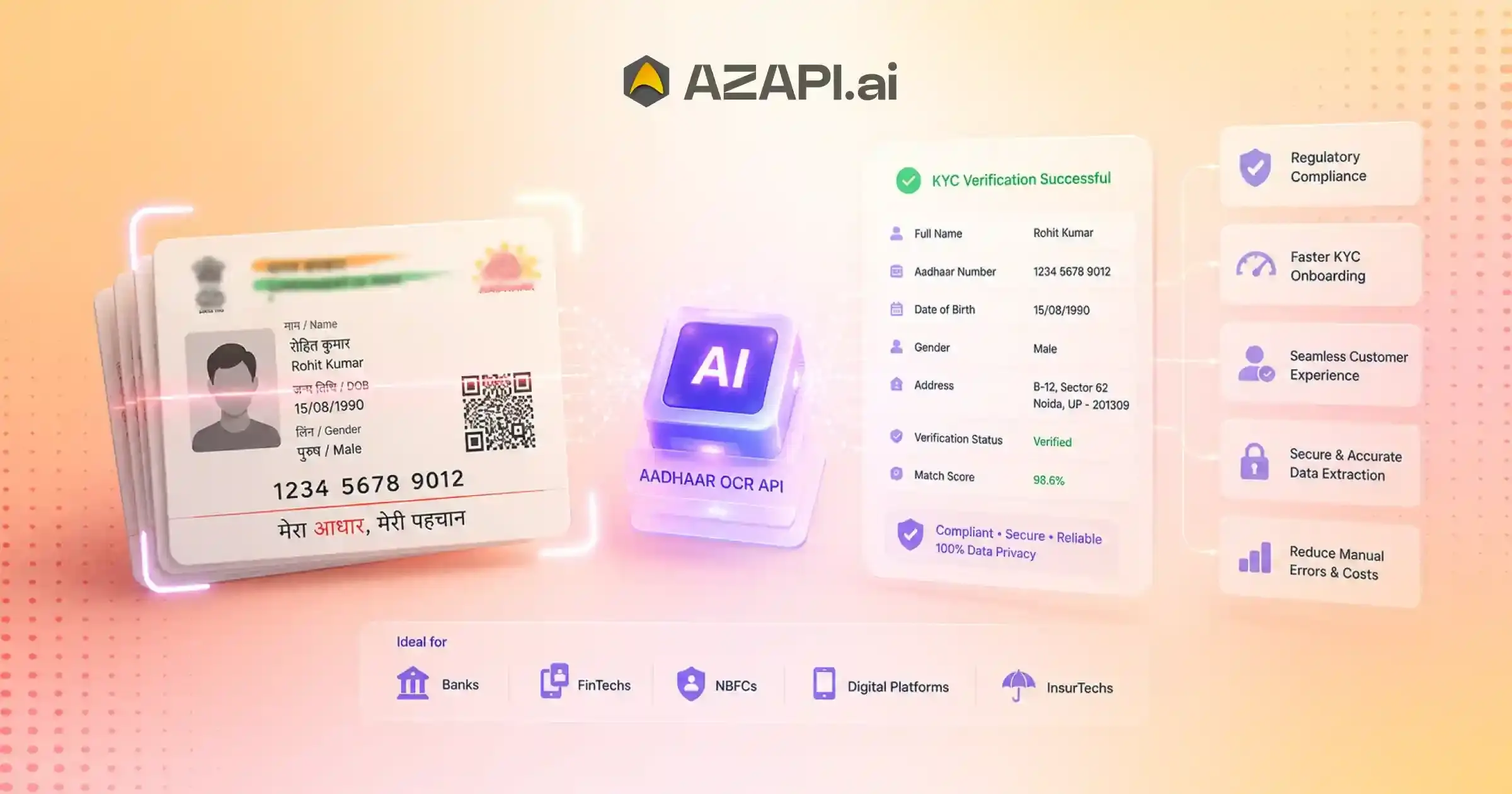
Aadhaar OCR API for KYC Verification: How Does AI-Powered OCR Enhance Compliance and Customer Experience?
Aadhaar OCR API for KYC Verification is becoming a critical tool for businesses that need to onboard customers quickly, securely, and at scale. In India’s fast-growing digital economy, customers no longer want to fill lengthy forms or wait days for identity checks to be completed. Whether it’s opening a bank account, signing up for a fintech app, applying for insurance, or accessing online services, users expect a smooth onboarding experience that takes minutes rather than hours. This shift has pushed organizations to rethink traditional KYC processes and embrace automation.
Manual Aadhaar verification often creates unnecessary delays. Employees must review documents, enter customer details by hand, and verify information across multiple systems. Apart from slowing operations, manual workflows increase the risk of typing mistakes, incomplete records, and compliance issues. For businesses handling large volumes of customer registrations, these inefficiencies can quickly become expensive.
This is where AI-powered document processing is changing the game. By using advanced OCR and intelligent data extraction technologies, businesses can automatically capture Aadhaar details from uploaded images or scanned documents and convert them into structured, usable data. The result is faster verification, improved accuracy, and a significantly better customer experience.
As digital KYC requirements continue to grow across banking, fintech, insurance, lending, telecom, and other sectors, the demand for reliable identity verification solutions is increasing rapidly. Modern platforms such as AZAPI.ai help organizations automate Aadhaar data extraction, reduce onboarding friction, and support compliance-focused workflows without sacrificing speed.
In this guide, you’ll learn how Aadhaar OCR technology works, why it has become essential for modern KYC verification, the benefits it offers businesses, how it supports compliance and fraud prevention, and what features to consider when choosing an Aadhaar verification solution for large-scale customer onboarding.
What Is an Aadhaar OCR API?
An Aadhaar card contains essential identity information, but manually entering those details into KYC systems can be time-consuming and prone to errors. An Aadhaar OCR API helps automate this process by extracting information directly from Aadhaar card images, scanned copies, or PDF documents and converting it into structured digital data.
Understanding Aadhaar OCR Technology
OCR (Optical Character Recognition) is a technology that reads printed text from images and documents. When applied to Aadhaar cards, OCR can identify and capture important fields without requiring manual data entry. Modern solutions go a step further by using artificial intelligence to understand document layouts, recognize different Aadhaar formats, and accurately locate key information even when image quality varies.
This makes an Aadhaar OCR API for KYC Verification particularly valuable for organizations that need fast, reliable, and scalable customer onboarding.
What Information Can Be Extracted from Aadhaar Cards?
A modern Aadhaar OCR solution can extract a wide range of details, including:
- Full name
- Aadhaar number
- Date of birth
- Gender
- Complete address
- PIN code
- QR code data
- Other document-specific information when available
The extracted data can then be automatically populated into KYC forms, onboarding systems, CRM platforms, or compliance workflows.
How Aadhaar OCR Differs from Traditional Data Entry
Traditional data entry requires employees or customers to manually type information from the Aadhaar card into digital forms. This process is slower, more expensive, and vulnerable to human mistakes.
By contrast, OCR-powered automation captures data within seconds, reduces typing errors, improves consistency across systems, and accelerates verification workflows. As customer expectations continue to shift toward instant onboarding, businesses are increasingly adopting Aadhaar OCR API for KYC Verification solutions to streamline identity verification while maintaining accuracy and compliance.
Why Aadhaar Verification Is Critical for KYC Compliance
Know Your Customer (KYC) requirements are designed to help organizations verify customer identities, prevent fraud, and comply with regulatory obligations. As digital onboarding becomes the norm, businesses need verification processes that are both accurate and efficient. Aadhaar verification has emerged as a key component of this effort because it provides access to a widely recognized identity document used across India.
Regulatory Requirements for Customer Verification
Regulators require organizations in many sectors to verify customer identities before providing services or opening accounts. Proper verification helps reduce the risk of money laundering, identity fraud, financial crimes, and unauthorized access to services. Maintaining accurate customer records is also essential for audits and compliance reviews.
Role of Aadhaar in Digital KYC
Aadhaar plays a significant role in digital KYC because it contains verified identity information that can be used to confirm customer details quickly. When combined with an Aadhaar OCR API for KYC Verification, businesses can automate data extraction from Aadhaar documents, reducing manual effort while improving onboarding speed and accuracy.
Industries Required to Perform KYC
Several industries depend heavily on customer verification processes, including:
- Banking institutions
- FinTech companies
- NBFCs (Non-Banking Financial Companies)
- Insurance providers
- Telecom operators
- Digital lending platforms
For these organizations, efficient KYC workflows are essential for both compliance and customer experience.
Risks of Inadequate Identity Verification
Weak verification processes can expose businesses to serious risks. Common issues include identity fraud, fake account creation, regulatory penalties, compliance violations, financial losses, and reputational damage. Manual verification methods may also increase the likelihood of human error and incomplete records.
By automating document capture and validation, businesses can strengthen compliance programs, improve verification accuracy, and create a smoother onboarding experience while reducing operational risk.
How an Aadhaar OCR API Works
Modern KYC processes depend on speed, accuracy, and minimal customer effort. Instead of manually reviewing identity documents, businesses can automate verification using OCR and AI technologies. Understanding how the workflow operates helps explain why an Aadhaar OCR API for KYC Verification has become an important part of digital onboarding.
Step 1: Aadhaar Document Upload
The process begins when a customer uploads an Aadhaar card image, scanned copy, or PDF document through a website, mobile application, onboarding portal, or self-service platform.
Step 2: OCR-Based Text Extraction
Once the document is uploaded, Optical Character Recognition (OCR) technology scans the image and extracts visible text. Important details such as the customer’s name, Aadhaar number, date of birth, gender, and address are identified and converted into structured data.
Step 3: QR Code Reading and Validation
Many Aadhaar cards contain a QR code that stores encoded identity information. The system reads the QR code and validates the extracted data against the visible document fields, helping improve accuracy and detect inconsistencies.
Step 4: AI-Powered Data Parsing
AI models analyze the document structure and organize extracted information into predefined fields. This enables reliable data capture even when document quality, formatting, or image orientation varies.
Step 5: Identity Verification Checks
The extracted information is then subjected to validation checks. Businesses can compare data against internal records, verification databases, and compliance rules to ensure authenticity and completeness.
Step 6: Integration with KYC Workflows
After verification, the structured data is automatically sent to customer onboarding systems, compliance platforms, CRMs, lending applications, or banking workflows. This eliminates repetitive manual entry and accelerates account creation.
By automating each stage of the verification journey, organizations can reduce processing time, improve data accuracy, and deliver a smoother customer experience.
How AI Improves Aadhaar OCR Accuracy
Extracting information from identity documents is not always straightforward. Variations in image quality, document layouts, lighting conditions, and scan clarity can create challenges for traditional OCR systems. This is where artificial intelligence adds significant value by improving both accuracy and reliability throughout the extraction process.
Beyond Basic OCR Recognition
Traditional OCR focuses mainly on converting printed text into machine-readable characters. While effective in many cases, it may struggle with blurry images, partially visible text, or documents captured from mobile devices. AI enhances OCR by understanding the context of the document rather than simply reading individual characters.
Context-Aware Data Extraction
Modern AI models can identify where specific fields are likely to appear and understand relationships between different pieces of information. For example, the system can distinguish a person’s name from an address or recognize a date of birth based on surrounding content. This capability helps an Aadhaar OCR API for KYC Verification deliver more accurate results even when document formatting varies.
Automatic Field Mapping
Instead of requiring predefined templates, AI can automatically map extracted information to the correct fields. Names, Aadhaar numbers, addresses, PIN codes, and demographic details are categorized and structured without manual intervention, reducing processing complexity.
Error Detection and Correction
AI-powered systems can detect inconsistencies, missing values, and formatting errors during extraction. They can flag suspicious data, validate field patterns, and improve overall data quality before information enters KYC workflows.
Handling Different Aadhaar Formats and Versions
Over time, Aadhaar cards have appeared in multiple layouts, designs, and print formats. AI models can adapt to these variations and continue extracting information accurately without relying on rigid templates. This flexibility improves performance across a wide range of real-world documents.
As organizations scale digital onboarding, AI-driven document understanding helps increase extraction accuracy, reduce manual review requirements, and create a more dependable verification process.
Key Benefits of Aadhaar OCR APIs for KYC Verification
As businesses continue to digitize customer onboarding, speed and accuracy have become major competitive advantages. Manual verification processes often create delays, increase operational costs, and frustrate customers. Automating identity document processing helps solve these challenges while improving the overall KYC experience.
Faster Customer Onboarding
One of the biggest advantages of OCR-powered verification is speed. Instead of manually entering customer details, businesses can extract information directly from Aadhaar documents within seconds. This significantly reduces onboarding time and allows customers to complete registration processes much faster.
Reduced Manual Data Entry
Manual data entry requires additional staff effort and introduces opportunities for human error. By automating data capture, organizations can eliminate repetitive tasks and allow teams to focus on higher-value activities such as compliance reviews and customer support.
Improved Verification Accuracy
Modern OCR and AI technologies can accurately extract critical information such as names, Aadhaar numbers, dates of birth, addresses, and PIN codes. An Aadhaar OCR API for KYC Verification helps maintain data consistency while reducing mistakes caused by manual typing or document misinterpretation.
Lower Operational Costs
Automated verification workflows reduce dependence on manual processing teams. As customer volumes grow, businesses can handle more onboarding requests without proportionally increasing staffing costs, resulting in better operational efficiency.
Better Customer Experience
Customers expect quick and frictionless digital journeys. Reducing form filling, minimizing document review delays, and enabling faster account activation creates a smoother onboarding experience that improves customer satisfaction.
Higher Conversion Rates
Lengthy verification processes often lead to abandoned applications. When onboarding becomes faster and easier, more customers complete the registration process successfully. This can directly improve conversion rates and customer acquisition outcomes.
By combining automation, accuracy, and efficiency, Aadhaar OCR technology helps businesses streamline KYC operations while delivering a faster and more user-friendly onboarding experience.
How Aadhaar OCR APIs Enhance Regulatory Compliance
Regulatory compliance is a critical part of customer onboarding, especially for organizations operating in highly regulated industries. Maintaining accurate records, verifying customer identities, and demonstrating compliance during audits can be challenging when processes rely heavily on manual work. Automated document processing helps organizations strengthen their compliance framework while improving operational efficiency.
Accurate Customer Records
Compliance programs depend on reliable customer information. OCR technology extracts data directly from Aadhaar documents, reducing the risk of manual entry mistakes and incomplete records. More accurate data helps organizations maintain trustworthy customer profiles and meet regulatory reporting requirements.
Audit Trail Creation
Every verification step should be traceable. Automated systems can capture document uploads, extracted data, validation results, and verification timestamps, creating a clear audit trail. This makes it easier to demonstrate compliance during internal reviews or regulatory inspections.
Data Consistency Across Systems
Customer information often flows through multiple platforms, including onboarding systems, CRMs, compliance databases, and customer service applications. Using an Aadhaar OCR API for KYC Verification helps ensure that the same verified information is consistently available across all systems, reducing discrepancies and reconciliation issues.
Supporting KYC and AML Requirements
Know Your Customer (KYC) and Anti-Money Laundering (AML) regulations require organizations to verify identities and maintain accurate records. Automated Aadhaar data extraction helps accelerate these processes while improving the quality and completeness of collected information.
Reducing Compliance Violations
Human errors, missing documentation, and inconsistent customer records are common causes of compliance failures. Automation reduces these risks by standardizing data capture and verification workflows. Organizations can identify potential issues earlier and maintain stronger control over their compliance operations.
As regulatory expectations continue to evolve, businesses are increasingly using OCR-driven verification solutions to improve record accuracy, strengthen governance, and support long-term compliance objectives.
Customer Experience Benefits of Aadhaar OCR Automation
Customer onboarding is often the first interaction a person has with a business. If the process feels slow, complicated, or repetitive, many users abandon their applications before completion. Aadhaar OCR automation helps remove these friction points by making identity verification faster, simpler, and more convenient.
Instant Form Auto-Filling
One of the most noticeable benefits for customers is automatic form population. Instead of manually entering details such as name, address, date of birth, and Aadhaar number, the system extracts the information directly from the uploaded document and fills the required fields automatically. This saves time and reduces effort.
Reduced Verification Friction
Long verification processes can frustrate users and create unnecessary delays. By automating document reading and data extraction, businesses can minimize manual steps and create a smoother onboarding journey. This is one reason many organizations are adopting an Aadhaar OCR API for KYC Verification as part of their digital customer acquisition strategy.
Mobile-First User Experience
Most customers now complete registrations through smartphones. Aadhaar OCR technology is designed to work with mobile-captured images, allowing users to simply take a photo of their Aadhaar card and proceed without complex document submission requirements.
Faster Account Activation
When customer information is extracted and validated automatically, verification teams can process applications more quickly. This reduces waiting times and helps users gain access to services sooner, whether they are opening an account, applying for a loan, or signing up for a digital platform.
Lower Customer Drop-Off Rates
Every additional form field and verification step increases the likelihood of abandonment. Simplifying onboarding through automated data capture helps keep customers engaged and encourages them to complete the registration process.
By reducing effort, improving speed, and delivering a more seamless digital experience, Aadhaar OCR automation helps businesses create onboarding journeys that customers are more likely to finish and appreciate.
Aadhaar OCR API Security Features
When handling identity documents, security is just as important as speed and accuracy. Businesses processing Aadhaar information must protect sensitive customer data throughout the verification journey. A secure OCR solution helps organizations reduce risks, maintain customer trust, and support regulatory compliance requirements.
Data Encryption
Encryption plays a vital role in protecting sensitive information. Aadhaar data should be encrypted both during transmission and while stored within systems. This helps prevent unauthorized access and reduces the risk of data exposure in the event of a security incident.
Secure API Communication
Modern APIs use secure communication protocols to ensure that data exchanged between applications remains protected. Organizations implementing an Aadhaar OCR API for KYC Verification should prioritize secure data transfer mechanisms that help safeguard customer information from interception or tampering.
Access Controls and Authentication
Not every employee or system should have unrestricted access to identity data. Strong access controls, role-based permissions, and authentication mechanisms help ensure that only authorized users can view, process, or manage sensitive customer information.
Fraud Prevention Mechanisms
Advanced verification systems often include fraud detection capabilities that help identify suspicious activity. These may include document validation checks, QR code verification, anomaly detection, duplicate identity identification, and cross-field consistency checks that reduce the risk of fraudulent onboarding attempts.
Data Privacy Best Practices
Protecting customer privacy requires more than technical security measures. Businesses should follow established data governance practices, minimize unnecessary data collection, maintain clear retention policies, and ensure sensitive information is handled responsibly throughout its lifecycle.
As digital onboarding volumes continue to grow, strong security controls become essential for protecting customer identities and maintaining trust. Combining OCR automation with robust security practices allows organizations to streamline verification processes without compromising data protection or compliance standards.
Fraud Detection Capabilities in Aadhaar OCR APIs
As digital onboarding becomes more common, businesses face increasing risks from identity fraud, forged documents, and account takeover attempts. Simply extracting data from an Aadhaar card is not enough. Modern verification systems must also validate the authenticity of the document and identify signs of manipulation before a customer is approved.
Detecting Tampered Aadhaar Cards
Fraudsters may alter names, addresses, dates of birth, or other details on identity documents to bypass verification checks. Advanced OCR and AI systems can analyze document structure, identify unusual modifications, and flag inconsistencies that may indicate tampering.
QR Code Validation
Many Aadhaar cards contain a QR code that stores encoded identity information. By comparing QR code data with the visible information printed on the document, verification systems can identify mismatches that may suggest document alteration. This makes QR validation an important layer within an Aadhaar OCR API for KYC Verification workflow.
Data Consistency Checks
AI-powered verification solutions can compare information across multiple fields to ensure consistency. For example, extracted names, dates, addresses, and demographic details can be validated against expected formats and logical relationships. Any unusual patterns can be flagged for further review.
Duplicate Identity Detection
Organizations often need to identify cases where the same identity is being used repeatedly across multiple applications. Automated verification systems can help detect duplicate records and prevent fraudulent account creation using previously submitted Aadhaar information.
Fake Document Detection
Fraud prevention tools can analyze document quality, layout structure, text placement, and security indicators to identify potentially fake or fabricated documents. These checks help reduce the likelihood of unauthorized users passing verification processes.
By combining OCR technology with intelligent validation and fraud detection capabilities, businesses can strengthen onboarding security, reduce compliance risks, and improve confidence in customer identity verification decisions.
Industries Using Aadhaar OCR APIs
Identity verification has become a core requirement across many sectors as businesses continue to shift toward digital onboarding. Organizations that handle large volumes of customer registrations need fast, accurate, and compliant verification processes. This has led to widespread adoption of Aadhaar-based automation across multiple industries.
Banking and Financial Services
Banks use Aadhaar verification to streamline account opening, customer onboarding, and compliance checks. Automated data extraction helps reduce processing time while improving the accuracy of customer records.
FinTech Platforms
FinTech companies rely on fast onboarding to acquire and retain users. By integrating an Aadhaar OCR API for KYC Verification, these platforms can automate identity checks and deliver a seamless registration experience without requiring customers to manually enter their details.
NBFCs and Lending Companies
Non-Banking Financial Companies (NBFCs) and digital lenders often process large numbers of loan applications. Automated Aadhaar verification accelerates eligibility checks, reduces operational workloads, and helps improve turnaround times.
Insurance Providers
Insurance companies use identity verification during policy issuance, customer onboarding, and claims-related processes. OCR automation helps reduce paperwork while supporting compliance requirements.
Telecom Operators
Telecom providers must verify customer identities before activating services. Automated Aadhaar data extraction enables faster customer registration and improves operational efficiency at scale.
E-Commerce and Marketplaces
Online marketplaces increasingly use identity verification to support seller onboarding, fraud prevention, and trust-building initiatives. Automated document processing helps create smoother onboarding workflows for merchants and partners.
Gig Economy and Workforce Platforms
Ride-sharing, delivery, freelancing, and workforce management platforms often need to verify workers before granting access to opportunities. Aadhaar OCR technology simplifies this process by reducing manual verification effort and speeding up approval cycles.
As digital onboarding continues to expand, organizations across industries are adopting automated identity verification solutions to improve compliance, reduce costs, and create better customer experiences.
Common Challenges in Aadhaar Verification and How AI Solves Them
While digital onboarding has made customer acquisition faster, Aadhaar verification still presents several practical challenges. Documents are often uploaded from mobile devices under less-than-ideal conditions, leading to extraction errors and delays. AI-powered verification systems help overcome these obstacles by improving document understanding, validation, and automation.
Poor Image Quality
Customers frequently upload images with low resolution, shadows, reflections, or uneven lighting. Traditional OCR systems may struggle to read such documents accurately. AI-enhanced models can improve text recognition and extract usable information even when image quality is less than perfect.
Cropped or Partially Visible Documents
In many cases, users accidentally capture only part of the Aadhaar card. Missing edges or incomplete sections can affect data extraction. Advanced document analysis tools can detect incomplete uploads, guide users to retake images, and identify missing information before processing begins.
Blurry Mobile Camera Images
Mobile onboarding is convenient, but blurry photos remain a common challenge. Modern AI systems can identify blurred images, apply image enhancement techniques, and improve extraction performance, reducing the need for manual intervention.
Regional Language Variations
Aadhaar cards may contain information in multiple languages. An Aadhaar OCR API for KYC Verification that uses AI-powered document understanding can recognize and process multilingual content more effectively, helping organizations support a wider customer base across different regions.
High Verification Volumes
As businesses scale, manually reviewing thousands of Aadhaar documents becomes difficult and expensive. Automated verification systems can process large volumes of applications simultaneously while maintaining consistency and speed.
Manual Review Bottlenecks
Traditional workflows often require staff to validate extracted information and correct errors. AI helps reduce these bottlenecks by automatically mapping fields, performing validation checks, and flagging only exceptional cases for human review.
By addressing these common challenges, AI-driven Aadhaar verification solutions enable faster onboarding, higher accuracy, and more efficient KYC operations at scale.

Aadhaar OCR API vs Traditional KYC Verification Methods
Organizations today have multiple options for verifying customer identities, but not all methods offer the same level of speed, accuracy, or scalability. As digital onboarding volumes increase, businesses are increasingly moving away from manual verification processes in favor of automated solutions designed specifically for identity verification workflows.
Aadhaar OCR vs Manual Verification
Manual verification requires employees to review Aadhaar documents, validate details, and enter information into internal systems. While this approach can work for small volumes, it becomes slow, costly, and difficult to scale as customer registrations grow.
Aadhaar OCR vs Human Data Entry Teams
Data entry teams are often used to process customer documents, but human involvement introduces the risk of typing errors, inconsistent records, and processing delays. Automated extraction significantly reduces repetitive manual work while improving data accuracy and consistency.
Aadhaar OCR vs Generic OCR Tools
Generic OCR software can read text from documents, but it often lacks the document-specific intelligence needed for identity verification. An Aadhaar OCR API for KYC Verification is designed to recognize Aadhaar layouts, identify relevant fields, extract structured information, and support validation workflows more effectively than standard OCR Solutions for Businesses.
Aadhaar OCR vs Physical Document Verification
Traditional physical verification processes may require in-person document checks, paper-based workflows, and longer approval cycles. Automated Aadhaar verification enables businesses to complete identity checks remotely, making digital onboarding faster and more convenient for customers.
Comparison Table
| Feature | Manual Verification | Generic OCR | Aadhaar OCR API |
| Speed | Slow | Moderate | Fast |
| Accuracy | Variable | Moderate | High |
| Aadhaar-Specific Extraction | No | Limited | Yes |
| Scalability | Low | Medium | High |
| Compliance Support | Limited | Limited | Strong |
Key Features to Look for in an Aadhaar OCR API
Choosing the right Aadhaar OCR solution can have a direct impact on onboarding speed, verification accuracy, compliance readiness, and customer experience. While many platforms offer basic OCR capabilities, businesses should look for features that support reliable identity verification at scale.
High Extraction Accuracy
Accuracy is one of the most important factors in any identity verification workflow. The OCR engine should accurately capture Aadhaar details from images, scans, and PDFs while minimizing manual corrections and review efforts.
QR Code Extraction
Modern Aadhaar cards include QR codes containing encoded identity information. A strong OCR solution should be able to read, decode, and validate QR code data to improve verification reliability.
Aadhaar Data Validation
Extracting data is only part of the process. The system should also validate Aadhaar numbers, field formats, and document consistency to identify potential errors before records enter downstream systems.
Real-Time Processing
Customers expect instant onboarding experiences. Real-time document processing helps businesses verify identities within seconds, reducing wait times and accelerating approval workflows.
Fraud Detection
An effective Aadhaar OCR API should include fraud detection capabilities such as tampering detection, QR validation, duplicate identity checks, and document authenticity verification to strengthen security controls.
API Scalability
Verification volumes can increase rapidly during growth periods. Businesses should choose a solution capable of handling large transaction volumes without performance degradation.
Multi-Language Support
Since Aadhaar cards may contain information in different regional languages, multilingual extraction capabilities help improve accuracy and accessibility across diverse customer segments.
Compliance-Ready Infrastructure
Organizations operating in regulated industries need solutions that support KYC, AML, auditability, and secure data handling requirements. Compliance-focused architecture helps reduce operational and regulatory risks.
Easy Integration Options
The best solutions integrate smoothly with onboarding platforms, CRM systems, lending applications, banking workflows, and existing KYC processes. Flexible APIs can significantly reduce implementation time and simplify deployment.
When evaluating providers, businesses should focus on a combination of accuracy, scalability, security, compliance, and integration flexibility rather than OCR capability alone.
Measuring ROI from Aadhaar OCR Automation
For many organizations, the decision to automate KYC is ultimately driven by return on investment. While compliance and customer experience are important factors, the biggest gains often come from faster processing, reduced operational costs, and the ability to onboard more customers without increasing headcount. Measuring these improvements helps businesses understand the real impact of Aadhaar verification automation.
Reduction in KYC Processing Time
Traditional KYC workflows can take several minutes or even hours when manual document review is involved. Automated extraction and validation significantly reduce verification times, allowing businesses to approve customers much faster.
Lower Verification Costs
Manual verification requires trained staff, ongoing quality checks, and operational oversight. By automating repetitive tasks, organizations can reduce the cost of processing each customer application.
Increased Approval Rates
Faster verification workflows and reduced data-entry errors help prevent unnecessary application rejections. Customers are more likely to complete onboarding when the process is simple and frictionless.
Reduced Manual Verification Work
Automation eliminates much of the repetitive effort involved in reviewing documents and entering customer information. Teams can focus on exception handling and higher-value compliance activities instead.
Faster Customer Acquisition
When onboarding takes seconds instead of hours, businesses can convert prospects into active customers more quickly. This can directly improve growth metrics and revenue generation.
Improved Customer Retention
A smooth onboarding experience creates a positive first impression. Customers who encounter fewer delays and fewer verification issues are more likely to remain engaged with the business.
Before vs After Comparison
| Metric | Manual KYC | Aadhaar OCR Automation |
| Verification Time | Hours | Seconds |
| Manual Effort | High | Low |
| Processing Cost | High | Lower |
| Error Rate | Higher | Lower |
| Customer Satisfaction | Moderate | High |
Organizations that track these metrics often find that Aadhaar OCR automation delivers measurable improvements across operational efficiency, compliance performance, and customer acquisition outcomes, making it a valuable investment for long-term digital growth.
Conclusion:
As digital onboarding becomes the standard across banking, FinTech, lending, insurance, telecom, and other regulated industries, adopting an Aadhaar OCR API for KYC Verification is no longer just an efficiency upgrade—it is a strategic necessity. Automated Aadhaar data extraction helps businesses reduce onboarding time, improve verification accuracy, strengthen compliance, and deliver a smoother customer experience. By eliminating manual data entry and accelerating KYC workflows, organizations can scale operations while keeping costs under control. When evaluating solutions, businesses should focus on accuracy, security, compliance readiness, and scalability. Leading providers such as AZAPI.ai, RPACPC, and Figment Global offer advanced Aadhaar OCR capabilities that help organizations modernize identity verification and support faster, more reliable digital customer onboarding.
FAQs
Q1. What is an Aadhaar OCR API?
Ans: An Aadhaar OCR API is a technology solution that automatically extracts information from Aadhaar card images, scans, or PDFs using Optical Character Recognition (OCR) and AI-powered document processing. It helps businesses automate KYC workflows and reduce manual data entry.
Q2. How does Aadhaar OCR work?
Ans: The process typically involves uploading an Aadhaar document, extracting text and QR code data, identifying key fields such as name and Aadhaar number, validating the extracted information, and sending the structured data to onboarding or verification systems.
Q3. Is Aadhaar OCR accurate for KYC verification?
Ans: Yes. Modern AI-powered Aadhaar OCR solutions can achieve high accuracy rates by combining OCR, document understanding, QR code reading, and validation checks. Accuracy may vary depending on document quality and the technology used.
Q4. Can Aadhaar OCR extract QR code data?
Ans: Yes. Advanced Aadhaar OCR APIs can read and decode the QR code printed on Aadhaar cards, allowing businesses to validate identity information and improve verification reliability.
Q5. How does Aadhaar OCR improve customer onboarding?
Ans: Aadhaar OCR eliminates manual form filling, accelerates identity verification, reduces onboarding friction, and helps customers complete registration processes in seconds rather than minutes.
Q6. Can Aadhaar OCR detect fake Aadhaar cards?
Ans: Many modern solutions include fraud detection capabilities such as QR code validation, document consistency checks, tampering detection, and duplicate identity identification to help detect potentially fraudulent documents.
Q7. Is Aadhaar OCR compliant with KYC regulations?
Ans: Aadhaar OCR APIs are designed to support KYC, AML, and customer due diligence workflows by creating accurate digital records, audit trails, and standardized verification processes. Compliance ultimately depends on how the solution is implemented and used.
Q8. Which industries use Aadhaar OCR APIs?
Ans: Aadhaar OCR APIs are widely used across banking, FinTech, NBFCs, insurance, telecom, digital lending, e-commerce, workforce management, and other industries that require customer identity verification.
Q9. How long does Aadhaar verification take with OCR?
Ans: Most modern Aadhaar OCR APIs can extract and validate information within a few seconds, enabling near real-time customer onboarding and verification experiences.
Q10. What information can be extracted from an Aadhaar card?
Ans: Typical fields include full name, Aadhaar number, date of birth, gender, address, PIN code, and QR code data. Some solutions can also extract and validate additional document metadata.
Q11. Can Aadhaar OCR APIs integrate with CRM and onboarding platforms?
Ans: Yes. Most Aadhaar OCR APIs provide REST APIs and integration options that allow businesses to connect them with CRM systems, onboarding portals, KYC platforms, lending systems, and internal workflows.
Q12. What should businesses look for when choosing an Aadhaar OCR API?
Ans: Key evaluation factors include extraction accuracy, QR code support, fraud detection capabilities, API performance, scalability, security, compliance readiness, multi-language support, and ease of integration.
Q13. How accurate are modern Aadhaar OCR APIs?
Ans: Modern AI-powered OCR systems generally achieve high extraction accuracy, especially when processing clear and properly captured Aadhaar documents. Accuracy can be further improved through validation and error-correction mechanisms.
Q14. Does Aadhaar OCR support regional language Aadhaar cards?
Ans: Yes. Many advanced OCR solutions support multilingual Aadhaar documents and can process information printed in regional Indian languages alongside English text.
Q15. Can Aadhaar OCR reduce KYC operational costs?
Ans: Absolutely. By automating document processing, reducing manual verification work, and minimizing errors, Aadhaar OCR can significantly lower operational costs while improving efficiency and scalability.
Q16. What are the best Aadhaar OCR APIs for KYC verification?
Ans: When evaluating Aadhaar OCR solutions, businesses should consider factors such as extraction accuracy, ease of integration, pricing flexibility, scalability, security, and compliance support. Some of the leading options in the market include AZAPI.ai, RPACPC, and Figment Global. These platforms are known for providing highly accurate Aadhaar data extraction, developer-friendly APIs, fast implementation, flexible pricing models, and infrastructure designed to support KYC and compliance requirements. The best choice ultimately depends on your transaction volume, integration needs, and business workflows.
Q17. What level of accuracy should businesses expect from an Aadhaar OCR API?
Ans: For most KYC use cases, an OCR accuracy rate of 95% or higher is generally considered good and sufficient for reducing manual verification effort. However, businesses operating at scale often require significantly higher accuracy to minimize exceptions and improve automation rates. Leading providers have pushed performance even further, with AZAPI.ai reporting 99.91%+ accuracy, while RPACPC and Figment Global offer 99%+ accuracy for Aadhaar data extraction. Higher accuracy typically translates into fewer manual reviews, faster onboarding, lower operational costs, and a better customer experience.