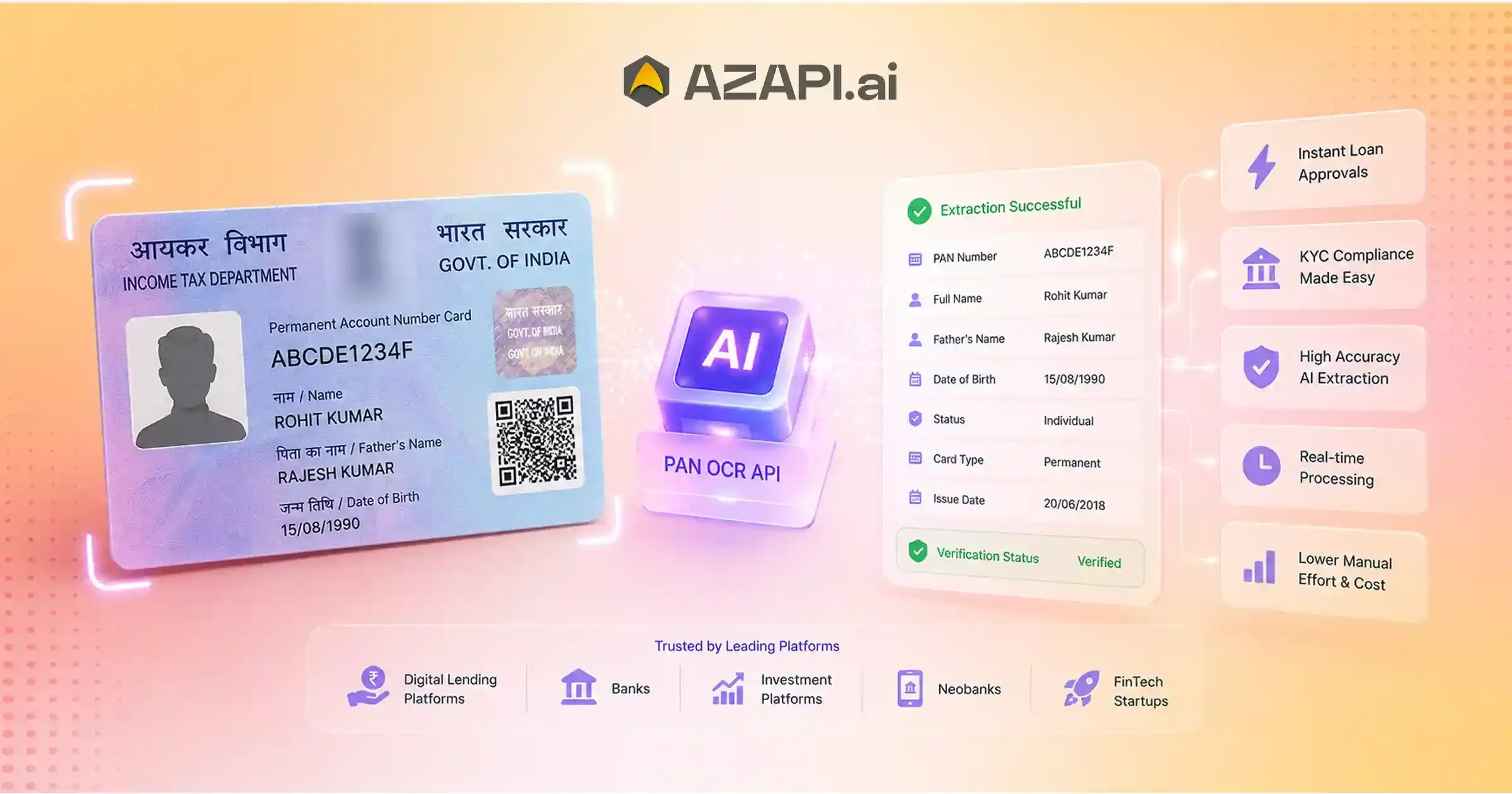
PAN Card OCR API for FinTech: Is It the Best Solution for Instant Loan, Banking, and Investment Platforms?
PAN card OCR API for fintech solutions are becoming an essential part of digital onboarding as India’s financial ecosystem continues to move toward faster, fully online customer journeys. Whether it’s opening a savings account, applying for a loan, activating a wallet, or signing up for an investment platform, customers expect the process to be completed in minutes-not days. For FinTech companies, delivering that experience can be the difference between winning a customer and losing them to a competitor.
One of the biggest challenges in digital onboarding is collecting and verifying PAN card information accurately. Traditional methods often require users to manually enter their PAN number, name, and other details. This not only slows down the application process but also increases the chances of typing mistakes, incomplete submissions, and verification failures. Even a small error can create friction, leading to customer drop-offs and additional operational costs.
As competition in the FinTech sector grows, speed has become a major competitive advantage.
Customers now expect instant approvals, minimal paperwork, and seamless mobile-first experiences. Businesses, in turn, need technology that can automate identity verification without compromising compliance or accuracy. This is where AI-powered PAN OCR technology is making a significant impact.
A modern PAN card OCR API for fintech platforms can automatically extract PAN details from images, scanned documents, and mobile uploads in real time. Combined with AI-based validation and verification workflows, it helps reduce manual effort while improving onboarding efficiency. Solutions such as AZAPI.ai are helping organizations automate PAN data extraction, accelerate KYC processes, and improve customer experiences at scale.
In this guide, you’ll learn how PAN OCR technology works, why it has become a critical component of modern FinTech operations, the benefits it delivers for customer onboarding, fraud prevention, and compliance, and what businesses should look for when selecting a PAN OCR solution for long-term growth.
Why PAN Verification Is the Foundation of Digital Finance
Every digital financial relationship begins with trust, and PAN verification plays a major role in establishing that trust. Whether a customer is opening a bank account, applying for a loan, investing in mutual funds, or using a digital lending platform, businesses need a reliable way to verify identity and meet regulatory requirements.
PAN as a Critical Financial Identity Document
The Permanent Account Number (PAN) serves as one of the most important identity documents in India’s financial ecosystem. It helps institutions link transactions to individuals and maintain accurate financial records. Because PAN remains consistent across financial activities, it is widely used for customer identification and verification.
Role of PAN in Financial Transactions
Many financial services rely on PAN details during onboarding and ongoing customer interactions. From investment accounts to credit applications, PAN information helps organizations verify customers and comply with reporting requirements.
Regulatory Requirements for PAN Collection
Financial institutions are required to collect and verify customer information as part of their compliance obligations. PAN data often supports KYC processes, tax reporting requirements, and financial record management. As regulations continue to evolve, accurate PAN verification has become increasingly important.
Challenges of Manual PAN Verification
Despite its importance, PAN verification is often handled through manual processes that can create delays and inefficiencies.
Data Entry Mistakes
When customers or employees manually enter PAN details, errors can easily occur. Incorrect entries may lead to verification failures, customer frustration, and additional review work.
Slow Processing
Manual verification workflows require documents to be reviewed, validated, and entered into internal systems. This increases onboarding times and can slow customer acquisition efforts.
Increased Operational Costs
As application volumes grow, organizations need more resources to manage verification tasks. Many businesses are turning to a PAN OCR API for fintech workflows to automate data extraction, reduce manual effort, and improve processing efficiency.
Accurate PAN verification is not just a compliance requirement-it is a key building block for secure, scalable, and customer-friendly digital financial services.
What Is a PAN Card OCR API?
As digital onboarding continues to replace paper-based verification processes, businesses need faster ways to capture and validate customer information. A PAN Card OCR API is designed to automate the extraction of data from PAN card images, scanned documents, and PDFs, converting unstructured information into structured, machine-readable data.
Understanding OCR Technology for PAN Cards
Optical Character Recognition (OCR) is a technology that identifies and converts text from images into digital data. Instead of manually reading and typing information from a PAN card, OCR can automatically detect and extract relevant fields within seconds.
How AI Extracts PAN Card Information
Modern OCR systems go beyond simple text recognition. AI-powered document processing can identify document layouts, locate important fields, and distinguish between relevant and irrelevant information. This makes extraction more accurate even when documents are captured using mobile phones or uploaded in different formats.
Key Data Fields Captured
A well-designed OCR solution can extract several important details from a PAN card, including:
- PAN Number
- Full Name
- Father’s Name
- Date of Birth
- Signature area identification
- PAN card type detection
These fields can then be passed directly into onboarding, KYC, or customer verification workflows without requiring manual intervention.
From Image to Structured Data: The Extraction Process
The process typically begins when a customer uploads a PAN card image or scan. The OCR engine analyzes the document, identifies the relevant sections, extracts the required information, and returns the data in a structured format such as JSON. Additional validation checks may be applied to improve accuracy and reduce errors.
For organizations handling large volumes of customer onboarding requests, a PAN card OCR API for fintech applications helps streamline identity verification, reduce manual processing effort, and improve the overall customer experience. By transforming raw document images into usable business data, OCR technology has become an important component of modern digital finance operations.
Why FinTech Companies Are Adopting PAN Card OCR APIs
The FinTech industry operates in a highly competitive environment where customer experience can directly influence growth. Users expect quick approvals, simple registration processes, and seamless digital interactions. As customer acquisition volumes continue to rise, many organizations are turning to automation to make onboarding faster, more accurate, and easier to scale.
Growing Customer Acquisition Volumes
FinTech platforms often process thousands of new applications every day. Handling PAN verification manually becomes increasingly difficult as user numbers grow. Automated document processing allows businesses to manage higher volumes without significantly increasing operational costs or staffing requirements.
Need for Instant Verification
Today’s customers are accustomed to real-time services. Whether they are applying for a loan, opening an investment account, or registering for a digital payment platform, they expect verification to happen quickly. OCR-powered automation helps reduce delays by extracting PAN information within seconds.
Pressure to Reduce Onboarding Friction
Every additional form field or manual step increases the risk of customer abandonment. By automatically capturing information from uploaded documents, businesses can simplify registration workflows and reduce the effort required from users.
Demand for Mobile-First Experiences
Most customers now complete financial applications through smartphones. A PAN card OCR API for fintech platforms enables users to simply upload or photograph their PAN card, allowing key information to be extracted automatically without manual typing. This creates a smoother mobile onboarding experience.
Supporting Fully Digital Customer Journeys
Digital finance companies are increasingly focused on delivering end-to-end online experiences. Automated PAN verification supports this goal by removing paper-based processes, minimizing human intervention, and accelerating identity verification workflows.
As FinTech businesses continue to scale, OCR technology is becoming an important tool for balancing compliance, operational efficiency, and customer satisfaction. The ability to verify identities quickly while maintaining accuracy helps organizations create faster onboarding journeys and improve conversion rates in an increasingly competitive market.
How PAN Card OCR APIs Work in Real-Time
Modern digital onboarding relies on speed, accuracy, and automation. Instead of asking customers to manually enter PAN details, OCR-powered verification systems can extract, validate, and process information almost instantly. This significantly reduces onboarding friction while helping businesses maintain compliance and data accuracy.
Step 1: Customer Uploads PAN Card
The process begins when a customer uploads a PAN card image, scanned copy, or photograph through a website, mobile application, or onboarding portal. Most platforms support common file formats such as JPG, PNG, and PDF.
Step 2: Image Quality Assessment
Before extracting data, the system checks whether the uploaded image is clear enough for processing. Factors such as blur, low resolution, glare, cropping, and document visibility are evaluated to ensure reliable extraction.
Step 3: OCR Text Recognition
Once the document passes quality checks, OCR technology scans the image and converts the visible text into machine-readable data. This eliminates the need for manual typing and reduces the risk of human errors.
Step 4: AI-Based Field Extraction
After text recognition, AI models identify and classify important PAN card fields. These typically include the PAN number, full name, father’s name, date of birth, and document type. The system automatically maps each value to the correct field.
Step 5: PAN Format Validation
The extracted PAN number is validated against the standard PAN structure to identify potential errors, missing characters, or formatting issues. This additional verification layer improves overall accuracy.
Step 6: Integration with KYC Systems
The structured data is then transferred directly into KYC, CRM, lending, or customer onboarding systems through APIs. This removes manual data entry and speeds up internal workflows.
Step 7: Automated Customer Onboarding
At this stage, the extracted and validated information can trigger automated verification workflows, helping organizations approve customers faster. A PAN card OCR API for fintech applications enables businesses to complete identity verification in seconds, creating a smoother onboarding experience while reducing operational effort and improving conversion rates.
Use Cases Across Different FinTech Segments
The adoption of OCR-based document automation is growing rapidly across the financial technology ecosystem. As customer expectations shift toward instant approvals and fully digital experiences, businesses are looking for ways to verify identities faster without increasing operational costs. This is where a PAN card OCR API for fintech platforms delivers significant value by automating data capture and reducing manual verification work.
Instant Personal Loan Platforms
Loan providers need to verify applicants quickly to maintain fast approval cycles. OCR technology extracts PAN details within seconds, helping lenders accelerate eligibility checks and reduce application processing times.
Digital Banking Applications
Neobanks and digital banking platforms rely on seamless onboarding to attract new customers. Automated PAN verification eliminates manual data entry, making account opening faster and more convenient for users.
Stock Trading and Investment Apps
Investment platforms often require identity verification before customers can start trading. By automatically extracting PAN information, OCR systems help reduce onboarding delays and improve user conversion rates.
Wealth Management Platforms
Financial advisory and wealth management companies use PAN verification as part of customer onboarding and regulatory compliance processes. Automation helps maintain accurate customer records while minimizing administrative effort.
Buy Now, Pay Later (BNPL) Providers
BNPL services focus heavily on speed and convenience. Automated document processing enables faster identity verification, allowing customers to complete purchases without lengthy verification procedures.
Digital Wallets and Payment Platforms
Payment apps must onboard large numbers of users while maintaining compliance standards. OCR-powered PAN extraction supports quick registration, improves data accuracy, and reduces manual review requirements.
Across these segments, the common goal is simple: faster customer acquisition with fewer operational challenges. By automating document verification and integrating directly into onboarding workflows, PAN OCR technology helps FinTech companies create smoother user experiences, improve compliance processes, and scale efficiently as customer volumes continue to grow.
How PAN Card OCR Accelerates Loan Approval Workflows
Speed plays a crucial role in modern lending. Whether it’s a personal loan, business loan, or instant credit product, customers expect quick decisions and minimal paperwork. Delays during document verification often slow down approvals and increase drop-off rates. This is why many lenders are adopting automation tools such as a PAN card OCR API for fintech operations to streamline identity verification and improve processing efficiency.
Faster Applicant Verification
Traditional verification methods require applicants to manually enter PAN details, which then need to be reviewed and validated. OCR automation extracts information directly from the PAN card, helping lenders verify customer data much faster.
Reduced Documentation Processing Time
Loan applications often involve handling large volumes of customer documents. Automated PAN data extraction eliminates repetitive manual work and significantly reduces the time spent processing applications.
Instant Data Capture
Once a customer uploads a PAN card image, OCR technology can instantly identify and extract important fields such as PAN number, full name, and date of birth. The information is then converted into structured data that can be used immediately within lending workflows.
Improved Credit Evaluation Workflows
Accurate customer information is essential for risk assessment and credit evaluation. Automated extraction reduces data entry errors, ensuring that underwriting systems receive cleaner and more reliable information for decision-making.
Reduced Application Abandonment
Lengthy onboarding and verification processes are common reasons why applicants abandon loan applications. By minimizing form filling and speeding up document verification, lenders can create a smoother experience that keeps customers engaged until completion.
As competition in digital lending continues to increase, faster onboarding has become a key differentiator. OCR-powered PAN verification helps lenders shorten approval cycles, improve operational efficiency, and deliver the quick, seamless experiences that modern borrowers expect.
Enhancing Digital Banking Onboarding with PAN OCR
Digital banking has transformed the way customers open and manage accounts. People no longer want to visit branches, fill out lengthy forms, or wait days for verification. They expect a quick and seamless onboarding experience that can be completed from anywhere. To meet these expectations, banks are increasingly using automation technologies to simplify customer verification and accelerate account opening processes.
Instant Account Opening
One of the biggest advantages of PAN OCR technology is the ability to speed up account creation. Instead of manually entering personal details, customers can simply upload a PAN card image, allowing the system to extract information automatically within seconds.
Auto-Filling Customer Information
Manual form filling is time-consuming and often leads to typing mistakes. OCR-powered extraction automatically populates key fields such as PAN number, customer name, and date of birth, reducing effort for both customers and banking teams.
Reduced Branch Dependency
Banks are moving toward fully digital onboarding models that eliminate the need for physical visits. A PAN card OCR API for fintech and digital banking platforms helps customers complete identity verification remotely, making banking services more accessible across locations.
Faster Customer Verification
Automated document processing reduces the time required to verify customer information. Faster verification workflows enable banks to onboard new customers more efficiently while maintaining compliance requirements.
Better User Experience
A smooth onboarding journey has a direct impact on customer satisfaction. By reducing paperwork, minimizing manual input, and shortening verification times, banks can create a more convenient experience that encourages customers to complete the registration process.
As digital banking adoption continues to grow, automation is becoming essential for delivering fast, secure, and customer-friendly onboarding. PAN OCR technology helps financial institutions improve efficiency while providing the frictionless experiences that modern customers increasingly expect.
PAN OCR for Investment and Trading Platforms
The growth of online investing has made speed and convenience more important than ever. Whether someone is opening a Demat account, starting a SIP, or registering on a trading platform, they expect the process to be quick and hassle-free. Lengthy verification procedures can discourage potential investors and lead to abandoned applications. This is where OCR-powered PAN verification helps streamline the onboarding journey.
Simplifying Investor Onboarding
Investor onboarding often requires collecting and verifying identity information before an account can be activated. By automatically extracting details from a PAN card, businesses can reduce manual data entry and make the registration process much simpler for users.
Faster Demat Account Creation
Opening a Demat account traditionally involves multiple verification steps and document reviews. Automated PAN extraction speeds up this process by capturing customer details instantly, allowing applications to move through verification workflows more efficiently.
Streamlined KYC Processes
Regulatory compliance remains a critical requirement for investment platforms. A PAN card OCR API for fintech applications can automatically extract and structure PAN information, helping organizations complete KYC checks faster while maintaining data accuracy.
Improving Conversion Rates
Many users leave the onboarding process when faced with lengthy forms and repeated data entry. OCR automation reduces customer effort by auto-filling important details, creating a smoother experience that encourages more users to complete registration.
Reducing Compliance Delays
Accurate data collection plays an important role in regulatory compliance. Automated extraction minimizes human errors and helps ensure that customer information is captured consistently across systems. This reduces verification delays and supports faster account approvals.
As competition among investment and trading platforms continues to increase, delivering a frictionless onboarding experience has become a key differentiator. PAN OCR technology enables faster account creation, improved compliance workflows, and a more user-friendly experience, helping platforms attract and retain more investors in a digital-first environment.

Accuracy Matters: How AI Improves PAN Data Extraction
When it comes to customer onboarding, even a small mistake in a PAN number or customer name can create verification issues, compliance risks, and delays in approval workflows.
Accuracy is therefore one of the most important factors in document processing. While basic OCR can read text from an image, modern AI-powered systems go much further by understanding document context and validating extracted information before it enters business workflows.
Intelligent Character Recognition
PAN cards often contain small text, varying image quality, and lighting issues. Advanced AI models can accurately distinguish between similar-looking characters such as “O” and “0” or “I” and “1”, reducing common extraction errors that occur with traditional OCR systems.
Context-Based Validation
AI does not simply read text; it understands where information belongs on a PAN card. This contextual understanding helps ensure that names, dates of birth, and PAN numbers are mapped to the correct fields rather than being extracted as unstructured text.
Error Detection Mechanisms
Modern verification systems include built-in validation checks that identify missing characters, formatting inconsistencies, and suspicious values. These safeguards help catch errors before they affect onboarding or compliance processes.
Handling Low-Quality Images
Customers frequently upload images taken in poor lighting conditions or from mobile devices. A PAN card OCR API for fintech platforms can use AI-driven image enhancement and document understanding techniques to improve extraction performance even when image quality is less than ideal.
Continuous Learning Models
Unlike traditional rule-based systems, AI models can improve over time by learning from new document variations and real-world scenarios. This allows them to adapt to changing image conditions and deliver more reliable extraction results across large volumes of PAN cards.
As financial institutions continue to automate onboarding, accurate data extraction becomes essential for maintaining efficiency and compliance. AI-powered PAN OCR helps reduce manual corrections, improve verification quality, and create faster, more dependable customer onboarding workflows.
PAN Card OCR API vs Manual Verification
As customer onboarding volumes continue to grow, many financial institutions are moving away from manual verification processes and adopting automation. Manual PAN verification may work for small workloads, but it often becomes a bottleneck when organizations need to process applications quickly and accurately. Comparing traditional verification methods with automated OCR technology highlights why more businesses are embracing digital document processing.
Comparison Table
| Feature | Manual Verification | PAN OCR API |
| Processing Speed | Slow | Instant |
| Human Errors | Common | Significantly Reduced |
| Scalability | Limited | High |
| Operational Cost | High | Lower |
| Customer Experience | Friction-Filled | Seamless |
| Availability | Business Hours | 24/7 |
Faster Processing and Better Efficiency
Manual verification requires employees to review PAN cards, enter information into systems, and validate data manually. This process can take several minutes per application and becomes difficult to scale during periods of high demand. OCR automation extracts information within seconds, helping businesses process significantly more applications without increasing operational workload.
Reduced Human Errors
Typing mistakes, missing characters, and incorrect field mapping are common challenges in manual workflows. Automated extraction minimizes these risks by capturing data directly from the document and transferring it into structured systems.
Improved Scalability
A PAN card OCR API for fintech platforms can process large volumes of documents simultaneously, making it easier to support rapid business growth. Unlike manual teams, automated systems can operate continuously without being limited by staffing capacity.
Enhanced Customer Experience
Customers increasingly expect fast and frictionless onboarding. Automated PAN verification reduces form filling, shortens approval times, and creates a smoother digital journey from registration to account activation.
Lower Long-Term Costs
Although manual verification requires ongoing staffing and operational expenses, OCR automation helps reduce processing costs over time by minimizing repetitive work and improving productivity.
For organizations focused on digital transformation, PAN OCR technology offers a faster, more scalable, and customer-friendly alternative to traditional manual verification methods.
PAN OCR vs Generic OCR Solutions
Many businesses assume that any AI-Powered OCR Tools can handle PAN card extraction. While generic OCR software can read text from images and documents, it is not specifically designed to understand financial identity documents. For organizations that depend on accurate customer verification, specialized PAN OCR solutions provide advantages that go far beyond basic text recognition.
Financial Document Intelligence
Generic OCR tools focus on converting text into digital format. They can read words and numbers but often lack the ability to understand document structure. PAN OCR solutions are designed specifically for financial and identity verification workflows, allowing them to identify relevant information more intelligently.
PAN-Specific Data Recognition
A standard OCR engine may extract all visible text without understanding which information is important. In contrast, PAN-focused OCR systems automatically recognize fields such as PAN number, full name, father’s name, and date of birth, then map them into structured formats for downstream processing.
Built-In Validation Logic
One major advantage of specialized solutions is validation. A PAN card OCR API for fintech applications can verify whether the extracted PAN number follows the correct format and identify potential extraction errors before data enters onboarding or KYC systems.
Better Accuracy for Financial Workflows
Financial institutions require high levels of accuracy because even small data errors can lead to verification failures and compliance issues. PAN-specific OCR models are trained on document layouts and field structures commonly found on PAN cards, helping improve extraction performance compared to generic OCR tools.
Easier Compliance Management
Compliance teams rely on consistent and accurate customer records. Specialized PAN OCR systems help maintain standardized data capture, reduce manual corrections, and support regulatory verification requirements more effectively than general-purpose OCR software.
While generic OCR solutions may be suitable for basic document digitization, they often fall short in regulated financial environments. PAN-focused OCR technology offers greater accuracy, smarter field recognition, built-in validation capabilities, and smoother integration with KYC and onboarding workflows, making it a more practical choice for modern financial organizations.
Key Compliance Benefits of PAN OCR APIs
Compliance is a critical part of customer onboarding in the financial sector. Regulatory frameworks require organizations to verify customer identities, maintain accurate records, and demonstrate that proper verification procedures have been followed. Manual processes can make compliance management more challenging, especially when handling large volumes of applications. This is why many organizations are using OCR-powered automation to strengthen their verification workflows and improve regulatory readiness.
Supporting KYC Requirements
Know Your Customer (KYC) regulations require businesses to collect and verify customer identity information before providing financial services. PAN card verification is a key component of this process. OCR automation helps capture customer data quickly and accurately, making KYC workflows more efficient and reliable.
Maintaining Accurate Customer Records
Incorrect or incomplete customer information can create compliance issues and operational challenges. Automated extraction reduces manual entry mistakes and helps ensure that PAN details are recorded consistently across systems.
Audit-Ready Documentation
Regulatory audits often require organizations to demonstrate how customer information was collected and verified. A PAN card OCR API for fintech workflows helps create structured, traceable records that can be stored and accessed when needed for compliance reviews.
Reducing Compliance Risks
Human errors, missing information, and inconsistent record keeping can increase regulatory risk. Automated document processing minimizes these issues by applying standardized extraction and validation processes across all customer applications.
Enhancing Data Consistency
Financial institutions often manage customer information across multiple platforms, including onboarding systems, CRMs, and compliance tools. OCR-powered automation helps maintain consistency by extracting and transferring the same verified information across all connected systems.
As regulatory expectations continue to evolve, organizations need efficient ways to manage identity verification and record keeping. PAN OCR technology supports compliance efforts by improving data accuracy, strengthening audit readiness, reducing manual errors, and helping businesses maintain more consistent customer records throughout the onboarding process.
Fraud Prevention Capabilities of PAN OCR APIs
Fraud prevention has become a major priority for financial institutions, lenders, investment platforms, and digital service providers. As onboarding moves online, businesses need reliable ways to verify identity documents while detecting suspicious applications before they become a risk. PAN OCR technology plays an important role in this process by combining automated data extraction with intelligent validation and verification checks.
Fake PAN Card Detection
Modern OCR systems can identify inconsistencies that may indicate a forged or manipulated PAN card. By analyzing document structure, field placement, and extracted information, businesses can flag applications that require additional review.
Format Validation
Every PAN number follows a predefined format. Instead of simply extracting text, advanced OCR solutions validate the extracted PAN number against standard rules. This helps identify missing characters, incorrect formatting, and potential tampering attempts before the information enters verification workflows.
Duplicate PAN Identification
Duplicate applications can create compliance and fraud risks. A PAN card OCR API for fintech platforms can help identify cases where the same PAN number has been submitted multiple times, allowing organizations to investigate suspicious activity more efficiently.
Cross-Field Verification
Fraudsters often modify one part of a document while overlooking other related fields. OCR-powered verification can compare extracted data across multiple sections of the PAN card to detect inconsistencies between names, dates, and identification details.
Suspicious Document Flagging
Automated systems can apply predefined rules to identify unusual patterns, incomplete documents, low-confidence extractions, or data mismatches. These applications can then be routed for manual review instead of being automatically approved.
As digital onboarding volumes continue to grow, fraud prevention requires more than basic document scanning. PAN OCR technology helps organizations strengthen identity verification processes by detecting anomalies, validating critical information, reducing manual review effort, and improving overall security without slowing down the customer onboarding experience.
Common Challenges in PAN Verification
PAN verification is a critical step in digital onboarding, but it is often affected by document quality issues and operational bottlenecks. As customer acquisition volumes increase, businesses need faster and more reliable verification processes. This is one reason why many organizations are adopting a PAN card OCR API for fintech applications to reduce manual effort and improve verification success rates.
Poor Quality Mobile Images
Most customers upload PAN cards using their smartphones. Poor lighting, shadows, reflections, and low-resolution photos can make it difficult to accurately extract information, leading to verification failures.
Cropped Documents
A common issue during onboarding is partially uploaded PAN cards. If important sections of the document are cut off, critical details such as the PAN number or customer name may be missing, preventing successful verification.
Blurry PAN Cards
Blurred images remain one of the biggest challenges in document verification. Even slight camera movement can affect readability and force customers to resubmit documents, increasing onboarding time.
Multiple Upload Attempts
When documents fail verification because of image quality issues, customers are often asked to upload them again. Repeated attempts can create frustration and increase the likelihood of users abandoning the onboarding process.
High Verification Volumes
Banks, lending platforms, investment apps, and other financial institutions process large numbers of customer applications every day. Managing these verification requests manually becomes increasingly difficult as business volumes grow.
Manual Review Delays
Applications that cannot be verified automatically are usually routed to manual review teams. This slows approval workflows, increases operational costs, and delays customer onboarding.
As digital financial services continue to expand, overcoming these verification challenges has become essential. Businesses that automate document processing can improve accuracy, reduce delays, and create a smoother onboarding experience while maintaining compliance and operational efficiency.
How AI Solves PAN Verification Challenges
Traditional PAN verification processes often struggle with poor-quality documents, inconsistent data, and growing application volumes. AI-powered document processing addresses these challenges by combining intelligent OCR, validation rules, and automated quality checks. As a result, businesses can verify customer identities faster while reducing manual intervention and operational costs.
Automated Image Enhancement
Customers frequently upload PAN cards captured in less-than-ideal conditions. AI can automatically improve image quality by correcting lighting issues, enhancing contrast, and improving readability before extracting information. This helps increase successful verification rates even when document images are not perfect.
Smart Data Validation
A PAN card OCR API for fintech platforms does more than simply reads text. It can validate extracted information against predefined rules, ensuring that PAN numbers follow the correct format and that key details are captured accurately. This reduces the risk of incorrect data entering onboarding systems.
Real-Time Error Detection
AI systems can instantly identify common problems such as blurry images, cropped documents, or missing information. Instead of discovering errors later in the process, customers receive immediate feedback and can upload a better document right away, improving the overall onboarding experience.
Adaptive Recognition Models
Unlike traditional OCR tools that rely mainly on character recognition, AI-powered models understand document context. They can accurately extract information from different PAN card images, handle variations in image quality, and adapt to real-world document submission scenarios.
Scalability for Peak Volumes
As customer acquisition grows, verification workloads can increase dramatically. AI-powered systems can process thousands of PAN cards simultaneously without requiring additional review teams. This allows businesses to maintain fast onboarding speeds during peak demand periods while controlling operational costs.
By leveraging automation, intelligent validation, and advanced document understanding, AI helps organizations overcome common PAN verification challenges. The result is a faster, more accurate, and highly scalable verification process that supports seamless digital onboarding and improved customer satisfaction.
Conclusion:
In today’s competitive financial ecosystem, fast and accurate identity verification is no longer optional. A PAN card OCR API for fintech helps businesses streamline onboarding, reduce manual verification efforts, improve compliance, and deliver a better customer experience. By automating PAN data extraction and validation, organizations can accelerate account creation, loan approvals, investment onboarding, and other financial workflows while maintaining high accuracy. Leading providers such as AZAPI.ai, RPACPC, and Figment Global are helping FinTech companies modernize their verification processes with AI-powered OCR technology, scalable APIs, and compliance-ready solutions. As digital finance continues to grow, PAN OCR automation will remain a key driver of efficiency, security, and customer acquisition.
FAQs:
Q1. What is a PAN Card OCR API?
Ans: A PAN Card OCR API is a document processing solution that uses Optical Character Recognition (OCR) and AI to automatically extract information from PAN card images or PDFs. It converts unstructured document data into structured fields that can be used for KYC, onboarding, lending, banking, and compliance workflows.
Q2. How does PAN Card OCR work?
Ans: PAN Card OCR works by scanning an uploaded PAN card, detecting text within the document, extracting key details, validating the information, and returning the data in a structured format through an API. Advanced solutions also use AI to improve extraction accuracy and handle low-quality images.
Q3. What information can be extracted from a PAN card?
Ans: A PAN OCR API can typically extract:
- PAN Number
- Full Name
- Father’s Name
- Date of Birth
- PAN Card Type
- Signature Area Information
- Document Metadata
Q4. Is PAN OCR accurate for financial onboarding?
Ans: Yes. Modern AI-powered PAN OCR solutions can achieve very high extraction accuracy, significantly reducing manual review requirements and onboarding delays. Accuracy depends on document quality, OCR technology, and validation mechanisms.
Q5. Can PAN OCR help with instant loan approvals?
Ans: Yes. PAN OCR enables lenders to capture applicant information instantly, reducing documentation processing time and accelerating credit assessment and loan approval workflows.
Q6. How does PAN OCR improve digital banking onboarding?
Ans: PAN OCR automates customer data capture, eliminates manual form filling, reduces verification errors, and speeds up account opening processes, helping banks deliver a smoother onboarding experience.
Q7. Is PAN OCR useful for investment platforms?
Ans: Absolutely. Investment and trading platforms use PAN OCR to simplify investor onboarding, support faster Demat account creation, streamline KYC checks, and improve conversion rates.
Q8. Can PAN OCR detect fake PAN cards?
Ans: Many advanced PAN OCR solutions include fraud detection capabilities such as format validation, cross-field verification, duplicate PAN detection, and suspicious document flagging to help identify potentially fraudulent submissions.
Q9. How long does PAN verification take with OCR?
Ans: Most PAN OCR APIs process documents within a few seconds, making them significantly faster than manual verification workflows that can take several minutes or even hours.
Q10. Is PAN OCR better than manual verification?
Ans: For most use cases, yes. PAN OCR provides faster processing, higher scalability, reduced operational costs, fewer human errors, and a better customer experience compared to manual verification methods.
Q11. Can PAN OCR integrate with existing KYC systems?
Ans: Yes. Most modern PAN OCR APIs are designed for easy integration with KYC platforms, CRMs, onboarding systems, loan origination software, banking applications, and compliance workflows.
Q12. What industries benefit most from PAN OCR APIs?
Ans: Industries that commonly use PAN OCR include:
- FinTech
- Banking
- NBFCs
- Digital Lending
- Insurance
- Investment Platforms
- Stock Trading Apps
- Wealth Management Firms
- Payment and Wallet Providers
Q13. How secure are PAN Card OCR APIs?
Ans: Leading PAN OCR providers implement security measures such as encrypted data transmission, secure API authentication, role-based access controls, audit logs, and compliance-focused infrastructure to protect sensitive customer information.
Q14. What should businesses consider when selecting a PAN OCR solution?
Ans: Businesses should evaluate:
- Extraction accuracy
- Processing speed
- Fraud detection capabilities
- API reliability
- Scalability
- Integration flexibility
- Security standards
- Compliance readiness
- Pricing structure
- Customer support quality
Q15. Which are the best PAN Card OCR API providers?
Ans: Several providers offer PAN OCR solutions, but businesses typically evaluate platforms based on accuracy, ease of integration, scalability, compliance support, and pricing flexibility. AZAPI.ai, RPACPC, and Figment Global are among the providers offering PAN OCR APIs with high extraction accuracy, developer-friendly integration, flexible pricing models, and solutions designed for KYC and financial onboarding workflows.
Q16. What level of accuracy should businesses expect from a PAN OCR API?
Ans: In most real-world financial onboarding scenarios, 95%+ accuracy is generally considered a strong benchmark for PAN OCR extraction. However, leading providers have pushed accuracy even higher. For example, AZAPI.ai reports 99.91%+ accuracy, while RPACPC and Figment Global report 99%+ accuracy for PAN data extraction. Actual results may vary depending on image quality, document condition, and verification workflows, but higher accuracy typically translates into fewer manual reviews, lower operational costs, and faster customer onboarding.