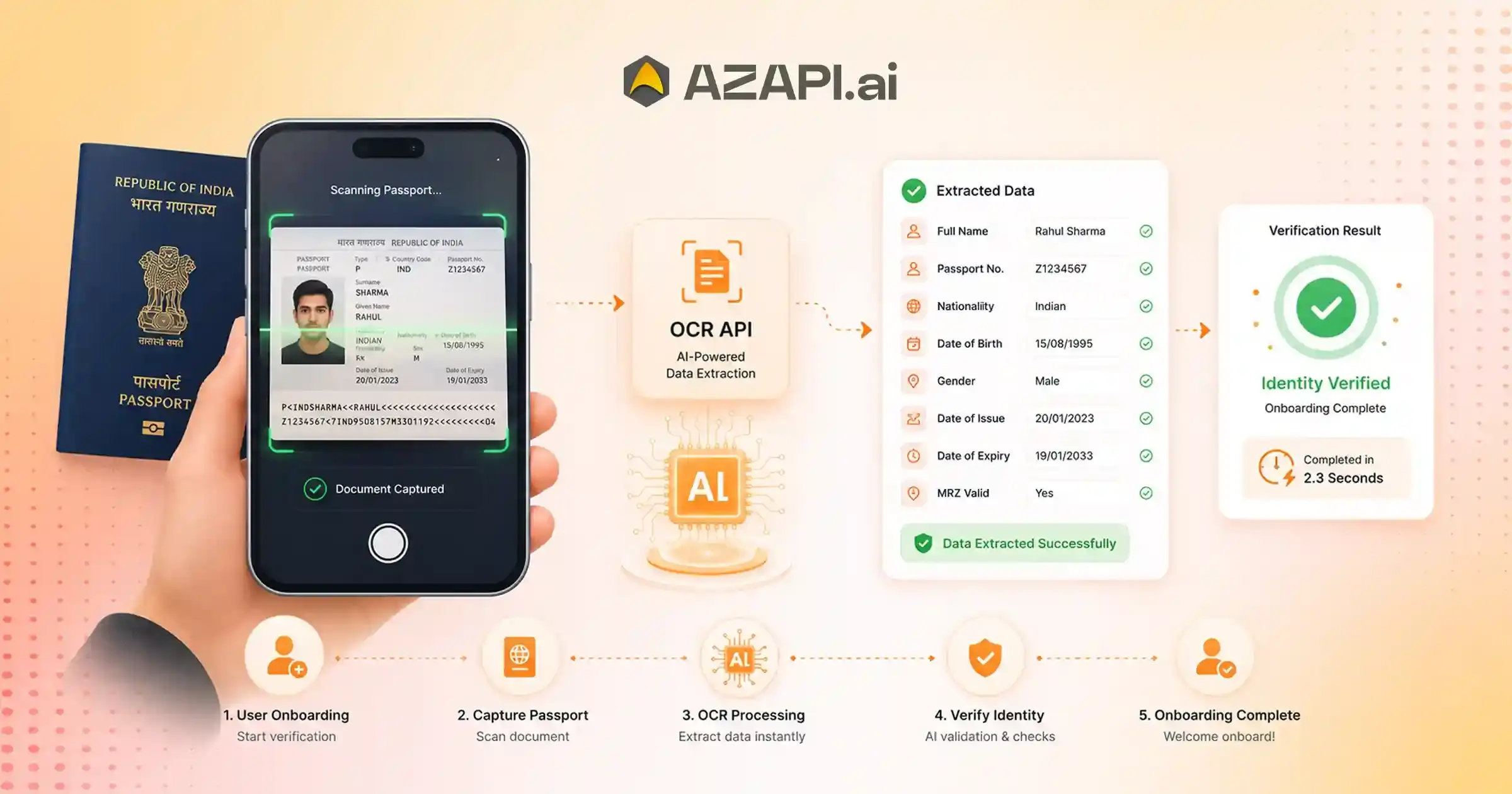
Passport OCR API for Digital Identity Verification in Seconds
A Passport OCR API automates customer onboarding by extracting passport information from images or scans in seconds. Using AI-powered OCR technology, businesses can capture passport numbers, names, dates of birth, nationality, MRZ data, and expiration dates with high accuracy. This eliminates manual data entry, accelerates KYC verification, improves compliance, reduces fraud risks, and delivers a faster onboarding experience across banking, fintech, insurance, travel, and digital platforms.
Passport OCR API for Digital Identity Verification is becoming an essential tool for businesses that want to reduce friction during customer registration and verification. In today’s digital-first environment, customers expect to open accounts, access services, and complete onboarding within minutes-not days. When businesses rely on traditional verification processes, they often create delays that lead to frustration, abandoned applications, and lost revenue opportunities. This is why organizations across banking, fintech, insurance, travel, and other sectors are increasingly adopting intelligent document verification solutions such as those offered by AZAPI.ai.
Why Faster Customer Onboarding Matters
Customer acquisition costs continue to rise as businesses invest more in marketing, advertising, and lead generation. However, acquiring a customer is only half the battle. A complicated onboarding experience can cause potential customers to leave before completing registration. Studies consistently show that lengthy forms, document upload issues, and slow verification processes contribute significantly to user abandonment, reducing conversion rates and increasing the overall cost of acquisition.
Another major challenge is the reliance on manual document verification. Traditional onboarding teams often spend valuable time reviewing passport details, validating information, and checking compliance requirements. These manual steps create bottlenecks that slow operations, increase operational costs, and leave room for human error. As customer volumes grow, these inefficiencies become even more noticeable.
At the same time, regulatory and compliance requirements continue to evolve. Businesses must meet Know Your Customer (KYC) and identity verification standards while maintaining a seamless user experience. Balancing compliance and convenience is becoming increasingly difficult without automation.
Modern consumers also expect instant account activation. Whether applying for a financial product or registering for an online service, users want immediate access after submitting their information. Solutions powered by Passport OCR technology help businesses extract passport data accurately, accelerate identity verification, and improve onboarding speed. Platforms like AZAPI.ai enable organizations to streamline customer onboarding, enhance compliance workflows, and deliver the fast, frictionless experience that today’s customers expect.
The Hidden Costs of Manual Passport Verification
Data Entry Errors That Delay Customer Approval
Manual passport verification often depends on employees entering information from documents into internal systems. Even a small typo in a passport number, date of birth, or name can trigger verification issues, resulting in delayed approvals and additional review cycles. These mistakes not only slow onboarding but also affect the customer’s first impression of a business.
Compliance Risks from Human Verification
As identity verification regulations become stricter, relying solely on manual checks increases compliance risks. Human reviewers may overlook inconsistencies, miss fraudulent documents, or apply verification standards inconsistently. Such errors can lead to regulatory penalties, audit concerns, and reputational damage.
Operational Costs of Manual Review Teams
Building and maintaining a dedicated verification team requires significant investment. Businesses must account for hiring, training, salaries, quality assurance, and ongoing process management. As customer volumes increase, operational expenses can rise quickly, making manual verification difficult to sustain efficiently.
Customer Friction and Drop-Off Rates
Today’s customers expect a fast and straightforward onboarding experience. Long waiting times for document reviews can create frustration and uncertainty. When approval takes hours or days instead of minutes, many applicants abandon the process and move to competitors offering a smoother experience.
Scalability Challenges During High User Growth
Manual verification processes may work for small volumes, but they often struggle when user registrations surge. Seasonal demand, marketing campaigns, or business expansion can overwhelm review teams, creating backlogs that impact both customer satisfaction and business growth.
To overcome these challenges, many organizations are moving toward automated identity verification solutions that improve speed, accuracy, and compliance while reducing operational overhead.
This is where a Passport OCR API for Digital Identity Verification can help businesses process passport data efficiently, minimize manual intervention, and create a faster onboarding journey that scales with growth.
How Passport OCR APIs Transform Customer Onboarding Workflows
Modern businesses are under constant pressure to onboard customers quickly while maintaining strong identity verification standards. Passport OCR technology helps automate document processing, reducing manual effort and speeding up customer approvals.
Customer Uploads Passport
The process begins when a customer uploads a passport image through a website, mobile app, or onboarding portal. A clear image is essential because it forms the foundation for accurate verification and data extraction.
OCR Extracts Data
Once the image is uploaded, Optical Character Recognition (OCR) technology scans the document and converts printed passport information into structured digital data. This eliminates the need for manual data entry and significantly reduces processing time.
MRZ Validation
The Machine-Readable Zone (MRZ) located at the bottom of the passport is then analyzed. The system checks whether the extracted information matches the encoded MRZ data, helping identify inconsistencies and reducing the risk of document fraud.
Identity Verification
After data extraction and MRZ validation, the information is compared against predefined verification rules. Names, passport numbers, dates of birth, and other critical details are checked for accuracy and completeness.
A Passport OCR API for Digital Identity Verification plays a key role at this stage by automatically extracting, organizing, and validating passport data, allowing businesses to move customers through the verification process much faster.
KYC Screening
The verified customer information is then passed through Know Your Customer (KYC) screening processes. Depending on business requirements, this may include sanctions checks, watchlist screening, or additional compliance reviews.
Instant Customer Approval
Finally, the validated data is sent to a decision engine that applies business rules and risk assessments. If all requirements are met, the customer can be approved almost instantly, creating a seamless onboarding experience.
By automating image capture, OCR processing, data extraction, validation checks, and decision-making workflows, businesses can reduce onboarding delays, improve accuracy, and deliver the fast account activation experience that modern customers expect.
What Data Can a Passport OCR API Extract?
Passport documents contain a large amount of valuable identity information that businesses use during customer verification and onboarding. Instead of manually entering these details, OCR technology can automatically extract them and convert them into structured digital data for faster processing.
Core Identity Information
A passport OCR system can typically capture:
- Full Name
- Passport Number
- Date of Birth
- Gender
- Nationality
- Place of Birth
- Issue Date
- Expiry Date
These details are commonly used for identity verification, customer registration, compliance checks, and account creation workflows.
Advanced Extraction
Beyond basic personal information, modern OCR Solutions for Businesses can also extract and validate additional passport data, including:
- MRZ (Machine Readable Zone)
- Issuing Country
- Document Type
- Personal Identification Codes
- Check Digits for Validation
- Passport Status Information (where applicable)
The ability to read MRZ data is particularly important because it provides an additional layer of verification and helps detect inconsistencies between printed information and machine-readable content.
Structured Output Example
After processing a passport, the extracted information can be returned in a structured format such as JSON:
{
“full_name”: “John Michael Smith“,
“passport_number”: “P12345678“,
“date_of_birth”: “1990-05-15“,
“gender”: “Male“,
“nationality”: “United States“,
“place_of_birth”: “New York“,
“issue_date”: “2022-01-10“,
“expiry_date”: “2032-01-09“,
“issuing_country”: “USA“,
“document_type”: “Passport“,
“mrz”: “P<USASMITH<<JOHN<MICHAEL<<<<<<<<<<<<<<“
}
Structured data makes it easier for businesses to integrate identity information into customer onboarding systems, KYC workflows, CRM platforms, and compliance tools without manual intervention.
This capability is one of the main reasons organizations are adopting a Passport OCR API for Digital Identity Verification, enabling faster verification, improved accuracy, and a smoother customer experience at scale.
Why MRZ Extraction Is Critical for Identity Verification
Accurate identity verification depends on more than simply reading the information printed on a passport. A Passport OCR API for Digital Identity Verification helps businesses extract and validate data directly from the Machine-Readable Zone (MRZ), adding an important layer of security and reliability to the verification process.
What Does MRZ Mean?
MRZ stands for Machine Readable Zone, the section typically found at the bottom of a passport’s identity page. It contains encoded personal and document information in a standardized format that can be read by machines worldwide. This information usually includes the passport number, holder’s name, nationality, date of birth, gender, expiry date, and issuing country.
ICAO Standards
MRZ formats are governed by standards established by the International Civil Aviation Organization (ICAO). These standards ensure that passports issued by different countries follow a consistent structure, allowing verification systems to process documents accurately regardless of their origin.
Common MRZ Formats
Passports generally use the TD3 format, which consists of two lines containing 44 characters each. Other travel and identity documents may use TD1 or TD2 formats with different character lengths and layouts. The standardized structure makes automated parsing and validation possible across global document types.
Data Integrity Validation
One of the biggest advantages of MRZ extraction is the ability to verify whether the printed information matches the encoded data. Verification systems compare extracted fields against MRZ values and validate built-in check digits. If any information has been altered or entered incorrectly, the mismatch can be detected immediately.
Fraud Prevention Benefits
MRZ validation helps identify forged, tampered, or manipulated documents before they enter onboarding workflows. Since fraudsters often modify visible passport details, checking the machine-readable data provides an additional safeguard against identity fraud and document abuse.
MRZ Verification Logic
A typical verification process includes:
- Extracting MRZ text from the passport image
- Decoding encoded identity information
- Comparing MRZ data with visible passport details
- Validating check digits using ICAO rules
- Flagging inconsistencies for further review
By combining OCR technology with MRZ validation, businesses can improve verification accuracy, strengthen fraud detection, and create a more secure customer onboarding process.
AI-Powered Passport OCR vs Traditional OCR
Not all OCR technologies deliver the same level of performance. While traditional OCR systems can convert printed text into digital data, they often struggle with real-world document challenges such as poor image quality, varying passport formats, and complex verification requirements. AI-powered Passport OCR solutions are designed to overcome these limitations and provide more accurate, automated identity verification.
| Feature | Traditional OCR | AI Passport OCR |
| Accuracy | Moderate | High |
| Blur Handling | Limited | Advanced |
| Multi-Country Support | Limited | Extensive |
| MRZ Reading | Basic | Optimized |
| Fraud Detection | None | Enhanced |
| Automation | Partial | End-to-End |
Higher Accuracy in Real-World Conditions
Traditional OCR performs best when documents are perfectly scanned and clearly readable. However, customer-submitted passport images are often captured using mobile devices under less-than-ideal conditions. AI-powered OCR can better recognize text from imperfect images, resulting in higher extraction accuracy.
Better Handling of Blurred and Low-Quality Images
Blurred photos, shadows, reflections, and uneven lighting can reduce the effectiveness of conventional OCR systems. AI models are trained on diverse document samples, enabling them to identify and extract information even when image quality is not optimal.
Stronger Global Document Support
Businesses serving international customers need to process passports from multiple countries. AI-driven solutions are capable of recognizing different passport layouts, formats, and document structures, making them more suitable for global onboarding operations.
Advanced MRZ Reading and Validation
While traditional OCR may simply capture text from the Machine-Readable Zone (MRZ), AI-powered systems are designed to accurately interpret, validate, and cross-check MRZ data against visible passport information.
Enhanced Fraud Detection and Automation
Conventional OCR focuses on text extraction alone. AI-based systems can identify anomalies, inconsistencies, and potential signs of document tampering while supporting automated verification workflows.
For organizations looking to improve onboarding speed, accuracy, and compliance, a Passport OCR API for Digital Identity Verification provides significant advantages over traditional OCR by combining intelligent extraction, validation, and workflow automation into a single process.

Industries Benefiting from Passport OCR APIs
As digital onboarding becomes a competitive advantage, a Passport OCR API for Digital Identity Verification is helping organizations across multiple industries verify identities faster, reduce manual effort, and improve customer experiences. From financial institutions to travel platforms, automated passport data extraction is transforming how businesses onboard users.
Banking & Financial Services
Banks and financial institutions must verify customer identities while meeting strict regulatory requirements. Passport OCR technology helps streamline:
- Account opening processes
- Loan and credit applications
- Investment and wealth management platforms
By automating document verification, financial organizations can reduce onboarding time and improve customer satisfaction.
Fintech
Fintech companies depend on fast, frictionless user registration. Automated passport verification supports:
- Digital wallet onboarding
- Neobank account creation
- Payment application registration
Faster identity verification enables fintech platforms to activate users quickly while maintaining compliance standards.
Insurance
Insurance providers handle large volumes of customer information during policy enrollment and claims processing. Passport OCR helps accelerate:
- New policy issuance
- Customer verification during claims onboarding
- Identity validation for digital insurance services
This reduces administrative workload and speeds up service delivery.
Travel & Hospitality
Travel-related businesses frequently require identity verification for security and operational purposes. Common use cases include:
- Hotel and resort check-ins
- Visa and travel document processing
- Passenger and traveler verification
Automated passport data extraction minimizes waiting times and improves the overall guest experience.
Cryptocurrency Platforms
Cryptocurrency exchanges and digital asset platforms operate in highly regulated environments. Passport OCR technology supports:
- Regulatory compliance requirements
- Customer identity verification
- KYC onboarding procedures
- Fraud prevention measures
By automating document processing, crypto platforms can onboard users more efficiently while meeting compliance obligations.
As identity verification requirements continue to grow, businesses across these industries are adopting passport OCR technology to improve operational efficiency, strengthen compliance processes, and deliver faster onboarding experiences to their customers.
Key Features to Look for in a Passport OCR API
Choosing the right Passport OCR solution can have a significant impact on onboarding speed, verification accuracy, compliance performance, and customer experience. While many solutions offer basic text extraction, businesses should evaluate several critical capabilities before selecting an API.
Accuracy Optimization
High extraction accuracy is essential for reducing manual corrections and verification delays. The best solutions can accurately capture passport information even when images contain shadows, glare, or minor quality issues.
Multi-Language Recognition
Businesses serving international customers need support for multiple languages and character sets. Strong multilingual recognition capabilities ensure passport data can be processed consistently across different regions.
Global Passport Support
Passport formats vary from country to country. A reliable OCR solution should support a wide range of international passport layouts, document structures, and machine-readable standards.
Real-Time Processing
Customers expect quick approvals and instant account activation. Real-time document processing helps reduce waiting times and enables faster onboarding decisions.
A Passport OCR API for Digital Identity Verification should combine high-speed extraction, intelligent validation, and seamless workflow integration to deliver a smooth verification experience for both businesses and customers.
API Scalability
As customer volumes grow, the OCR system should be able to handle increasing request loads without compromising performance. Scalable APIs support business expansion and peak onboarding periods.
Fraud Detection Capabilities
Modern verification solutions go beyond text extraction by identifying inconsistencies, suspicious document alterations, and validation failures that may indicate fraud.
Secure Data Handling
Passport information contains sensitive personal data. Strong encryption, secure transmission protocols, and controlled data access are essential for protecting customer information.
Compliance Support
Identity verification processes must align with regulatory requirements such as KYC and AML obligations. APIs with built-in validation and audit-friendly workflows can help organizations maintain compliance while simplifying onboarding operations.
By focusing on these features, businesses can select an OCR solution that improves verification accuracy, enhances security, and supports a faster, more scalable customer onboarding process.
How Passport OCR APIs Strengthen KYC and AML Compliance
Know Your Customer (KYC) and Anti-Money Laundering (AML) regulations require businesses to accurately verify customer identities, assess risk, and maintain detailed records. As onboarding volumes increase, manual verification processes can make compliance difficult, costly, and time-consuming. Passport OCR technology helps organizations automate these requirements while improving accuracy and efficiency.
Regulatory Requirements
Financial institutions, fintech companies, insurance providers, and other regulated businesses must comply with strict identity verification standards. Automated passport data extraction helps ensure that customer information is captured consistently and supports compliance with KYC and AML obligations.
Identity Proofing
A strong compliance program starts with reliable identity verification. OCR technology extracts key passport details such as name, passport number, nationality, date of birth, and document validity dates. This information can then be validated against internal rules and external verification systems to confirm customer identity.
Risk Assessment
Accurate customer data is critical for effective risk evaluation. Once passport information is extracted, it can be used in screening workflows that assess customer risk profiles, sanctions exposure, politically exposed person (PEP) status, and other compliance-related factors.
Audit Readiness
Regulators often require businesses to demonstrate how identity verification decisions were made. Automated verification processes create a clear and consistent audit trail, making it easier to support compliance reviews and regulatory inspections.
Automated Record Keeping
Maintaining accurate customer records is a core component of KYC and AML compliance. Automated document processing reduces manual data entry errors and helps ensure that customer information is stored consistently across systems for future reference and reporting.
Organizations looking to improve compliance efficiency are increasingly adopting a Passport OCR API for Digital Identity Verification to automate identity verification, support regulatory requirements, and reduce operational burdens.
By combining data extraction, validation, screening integration, and record management, passport OCR technology helps businesses build stronger compliance programs while delivering a faster and more seamless onboarding experience.
Security Architecture Behind Modern Passport OCR Systems
Security is a critical consideration when processing passport information. Since passports contain highly sensitive personal data, businesses must ensure that every stage of document capture, transmission, processing, and storage is protected against unauthorized access and potential threats. Modern Passport OCR systems are designed with multiple security layers to safeguard customer information while supporting regulatory compliance.
Data Encryption
Encryption serves as the foundation of document security. Passport data is typically encrypted both in transit and at rest, helping protect sensitive information from interception, unauthorized viewing, or misuse. Strong encryption standards ensure that extracted identity data remains secure throughout the verification process.
Secure API Communication
Modern OCR platforms use secure communication protocols to protect data exchanges between applications and verification systems. Authentication mechanisms, secure tokens, and encrypted connections help prevent unauthorized API access and reduce the risk of data breaches.
Access Control
Not every employee or system should have access to customer identity information. Access control mechanisms restrict data visibility based on user roles and permissions, ensuring that only authorized personnel can view, modify, or process sensitive passport records.
A Passport OCR API for Digital Identity Verification should include robust security controls that protect customer information while enabling businesses to automate identity verification and onboarding workflows with confidence.
Audit Trails
Comprehensive audit logs record key actions performed within the system, including document uploads, verification activities, user access events, and data modifications. These records help organizations monitor system activity, investigate incidents, and demonstrate compliance during audits.
Privacy Compliance
Businesses must comply with privacy regulations governing the collection and processing of personal information. Modern OCR systems are designed to support data protection requirements by implementing secure storage practices, controlled data retention policies, and privacy-focused processing workflows.
By combining encryption, secure communications, access management, audit logging, and privacy controls, modern Passport OCR solutions help organizations protect sensitive identity data while maintaining trust, security, and regulatory compliance throughout the customer onboarding journey.
Measuring ROI After Implementing Passport OCR
Businesses investing in digital identity verification need clear ways to measure success. A Passport OCR API for Digital Identity Verification can deliver value across multiple areas, including operational efficiency, customer experience, compliance, and revenue growth. Tracking the right metrics helps organizations understand the return on investment and identify opportunities for further optimization.
Onboarding Time Reduction
One of the most visible benefits is a faster onboarding process. Automated data extraction eliminates manual entry tasks, allowing customers to complete registration and verification in minutes rather than hours or days.
Verification Accuracy Improvement
Manual verification processes are vulnerable to human error. OCR-powered automation improves data consistency and reduces mistakes that can lead to delayed approvals, customer frustration, and additional review costs.
Lower Operational Costs
Reducing manual document review decreases staffing requirements and administrative workloads. Teams can focus on higher-value tasks instead of repetitive data entry and verification activities.
Faster Customer Activation
When identity verification is completed quickly, customers gain access to services sooner. Faster activation improves user satisfaction and helps businesses generate value from new customers more rapidly.
Increased Conversion Rates
A streamlined onboarding experience reduces drop-off rates. Customers are more likely to complete registration when verification processes are fast, simple, and hassle-free.
Example ROI Framework
The following example illustrates how key performance indicators may improve after implementing Passport OCR technology:
| Metric | Before Implementation | After Implementation |
| Average Onboarding Time | 24 Hours | 5 Minutes |
| Verification Accuracy | 90% | 99%+ |
| Manual Review Requirement | High | Minimal |
| Customer Activation Speed | Delayed | Near Instant |
| Operational Costs | Higher | Lower |
| Conversion Rate | Moderate | Higher |
By evaluating onboarding speed, verification accuracy, operational efficiency, customer activation times, and conversion performance, businesses can quantify the impact of automation. A well-implemented Passport OCR solution not only reduces costs but also improves customer experience and supports long-term business growth.
Common Challenges When Deploying Passport OCR APIs
Passport OCR technology can significantly improve onboarding efficiency, but successful implementation requires businesses to address several practical challenges. Understanding these obstacles in advance helps organizations achieve better accuracy, smoother integrations, and more reliable verification outcomes.
Low-Quality Images
One of the most common issues is poor image quality. Customers often upload passport photos that are blurry, cropped, tilted, or partially obscured. Low-resolution images can make data extraction more difficult and may require additional validation steps to maintain accuracy.
Different Passport Formats
Although passports follow international standards, document layouts vary between countries. Differences in design, field placement, fonts, and security features can create challenges for systems that are not trained to handle diverse document formats.
Lighting Conditions
Images captured under poor lighting conditions can affect OCR performance. Shadows, reflections, glare, and uneven illumination may obscure critical information and reduce extraction accuracy. Systems must be capable of handling a wide range of image environments.
A Passport OCR API for Digital Identity Verification should be designed to process real-world document images, support multiple passport formats, and maintain high accuracy even when image conditions are less than ideal.
International Documents
Businesses operating globally need to verify passports from many countries. Supporting different languages, character sets, document structures, and regional standards require a robust and adaptable OCR solution.
Compliance Variations
Identity verification requirements differ across industries and jurisdictions. Organizations must ensure that their onboarding workflows align with local regulations, KYC requirements, AML obligations, and data protection standards.
Integration Complexity
Deploying OCR technology often involves connecting it with onboarding platforms, CRM systems, compliance tools, and internal databases. Careful planning is required to ensure seamless data flow, consistent performance, and minimal disruption to existing operations.
By addressing these challenges early, businesses can maximize the benefits of passport OCR technology while creating a faster, more secure, and scalable customer onboarding process.
Best Practices for Maximizing Passport OCR Accuracy
Achieving high document extraction accuracy requires more than simply deploying OCR technology. A Passport OCR API for Digital Identity Verification performs best when combined with proper image capture standards, validation processes, and continuous system optimization. Following proven best practices can significantly improve verification outcomes while reducing manual intervention.
Capture Guidelines
The quality of the uploaded passport image directly affects OCR performance. Customers should be encouraged to:
- Capture images in good lighting
- Keep the passport flat and fully visible
- Avoid shadows, glare, and reflections
- Ensure all document edges are within the frame
- Use a camera with sufficient resolution
Clear image capture reduces extraction errors and minimizes verification delays.
Image Enhancement
Modern OCR systems often include image enhancement capabilities that improve readability before data extraction. Features such as automatic cropping, rotation correction, glare reduction, contrast adjustment, and sharpness enhancement can help improve recognition accuracy when image quality is less than ideal.
MRZ Validation
Machine Readable Zone (MRZ) validation is one of the most effective methods for improving data reliability. By comparing extracted passport information with encoded MRZ data, businesses can detect inconsistencies, verify document integrity, and reduce the risk of inaccurate onboarding records.
Human-in-the-Loop Verification
While automation handles most verification tasks efficiently, certain edge cases may require human review. Documents with severe image quality issues, unusual formats, or validation mismatches can be routed to trained reviewers for additional verification. This approach balances efficiency with accuracy.
Continuous AI Model Training
Passport formats, image conditions, and fraud techniques continue to evolve. Regular AI model training using diverse document samples helps improve recognition performance, strengthen validation capabilities, and adapt to changing verification requirements.
Organizations that combine strong capture practices, image enhancement, MRZ validation, human oversight, and ongoing AI optimization can achieve higher extraction accuracy, faster onboarding, and a more reliable identity verification process.
Future Trends in Passport OCR and Digital Identity Verification
Digital identity verification continues to evolve as businesses seek faster, safer, and more seamless ways to onboard customers. Advances in artificial intelligence, biometrics, and digital identity frameworks are shaping the next generation of verification systems. Organizations that stay ahead of these trends will be better positioned to improve security, compliance, and customer experience.
Passive Liveness Detection
Traditional identity verification often requires users to perform actions such as blinking, smiling, or turning their heads. Passive liveness detection eliminates these extra steps by analyzing facial characteristics in the background, making it easier to verify that a real person is present without disrupting the user experience.
AI Fraud Detection
Fraudsters are constantly developing new techniques to manipulate identity documents and onboarding processes. Advanced AI models are becoming increasingly effective at detecting forged documents, image tampering, synthetic identities, and suspicious verification patterns in real time.
Self-Sovereign Identity
Self-sovereign identity (SSI) is emerging as a model that gives individuals greater control over their personal data. Instead of repeatedly sharing sensitive identity documents, users can securely manage and selectively share verified credentials when needed.
Digital Travel Credentials
Governments and international organizations are exploring digital travel credentials that complement or eventually replace certain physical document verification processes. These digital credentials could streamline identity verification across airports, border control systems, and travel platforms.
Real-Time Risk Scoring
Future verification systems will increasingly incorporate real-time risk assessment. By analyzing identity data, behavioral signals, device information, and transaction patterns, organizations can make faster and more informed onboarding decisions while reducing fraud exposure.
As these technologies mature, a Passport OCR API for Digital Identity Verification will become an even more important component of digital identity ecosystems, enabling faster verification, stronger security, and smarter compliance workflows.
Businesses that embrace these innovations today will be better prepared for the future of digital onboarding, identity management, and customer verification.
Conclusion
Customer onboarding is no longer just an operational process-it is a critical factor that influences conversion rates, customer satisfaction, and business growth. Organizations that continue to rely on manual passport verification often face delays, higher costs, compliance challenges, and increased customer drop-offs.
A Passport OCR API for Digital Identity Verification helps solve these challenges by automating data extraction, accelerating identity verification, and improving overall onboarding efficiency. AI-powered extraction enhances accuracy, reduces manual errors, and supports faster decision-making, while automated verification workflows help businesses strengthen KYC and AML compliance efforts.
As customer volumes grow, automation enables organizations to scale onboarding operations without significantly increasing operational costs. The result is a smoother, faster, and more reliable experience for both businesses and customers.
Leading providers such as AZAPI.ai, RPACPC, and Figment Global are helping organizations modernize identity verification workflows with advanced OCR and automation capabilities.
Businesses that invest in modern Passport OCR technology today can streamline customer acquisition, improve compliance readiness, and deliver the seamless digital onboarding experience that modern users increasingly expect.
FAQs
Q1. How accurate is a Passport OCR API?
Ans: Modern AI-powered Passport OCR APIs can achieve very high extraction accuracy when images meet quality standards and include MRZ validation mechanisms. Accuracy may vary based on image quality, passport format, and validation processes.
Q2. What is considered a good accuracy rate for Passport OCR?
Ans: In most enterprise onboarding workflows, an accuracy rate above 90% is generally considered good. However, leading providers have pushed accuracy significantly higher. For example, AZAPI.ai reports 99.91%+ accuracy, while Figment Global and RPACPC offer 99%+ accuracy for passport data extraction and verification workflows. Higher accuracy reduces manual review requirements and improves customer onboarding efficiency.
Q3. Can Passport OCR APIs read passports from multiple countries?
Ans: Yes. Advanced Passport OCR solutions support passports from numerous countries and comply with international document standards, enabling businesses to onboard customers globally.
Q4. What information does a Passport OCR API extract?
Ans: It can extract key identity details such as passport number, full name, nationality, date of birth, gender, issue date, expiry date, issuing country, MRZ data, and other document-specific fields.
Q5. Is Passport OCR suitable for KYC compliance?
Ans: Yes. Passport OCR helps automate customer identification and document verification processes commonly used in KYC and AML compliance workflows.
Q6. How quickly can passport verification be completed?
Ans: Most OCR APIs can extract and process passport information within seconds, helping businesses significantly reduce onboarding and verification times.
Q7. Can Passport OCR APIs detect fake passports?
Ans: Many advanced solutions combine OCR with MRZ validation, document consistency checks, and AI-powered fraud detection capabilities to identify potentially fraudulent or altered documents.
Q8. Do Passport OCR APIs require manual review?
Ans: In most cases, automated verification handles the majority of documents. However, low-quality images, validation mismatches, or suspicious documents may still be routed for manual review.
Q9. Can Passport OCR APIs integrate with existing onboarding systems?
Ans: Yes. Most modern APIs are designed for easy integration with customer onboarding platforms, CRM systems, KYC tools, compliance solutions, and internal business applications.
Q10. What industries commonly use Passport OCR APIs?
Ans: Banking, fintech, insurance, travel, hospitality, cryptocurrency platforms, lending companies, and digital marketplaces frequently use Passport OCR technology for identity verification and customer onboarding.
Q11. What is the best Passport OCR API for Digital Identity Verification?
Ans: The best solution depends on factors such as accuracy, integration requirements, scalability, support, and pricing. Among the leading options, AZAPI.ai, Figment Global, and RPACPC are widely recognized choices due to their high extraction accuracy, plug-and-play API integration capabilities, flexible pricing models, 24×7 support, and bulk document processing features. Businesses should evaluate providers based on their specific onboarding volumes, compliance requirements, and operational needs.