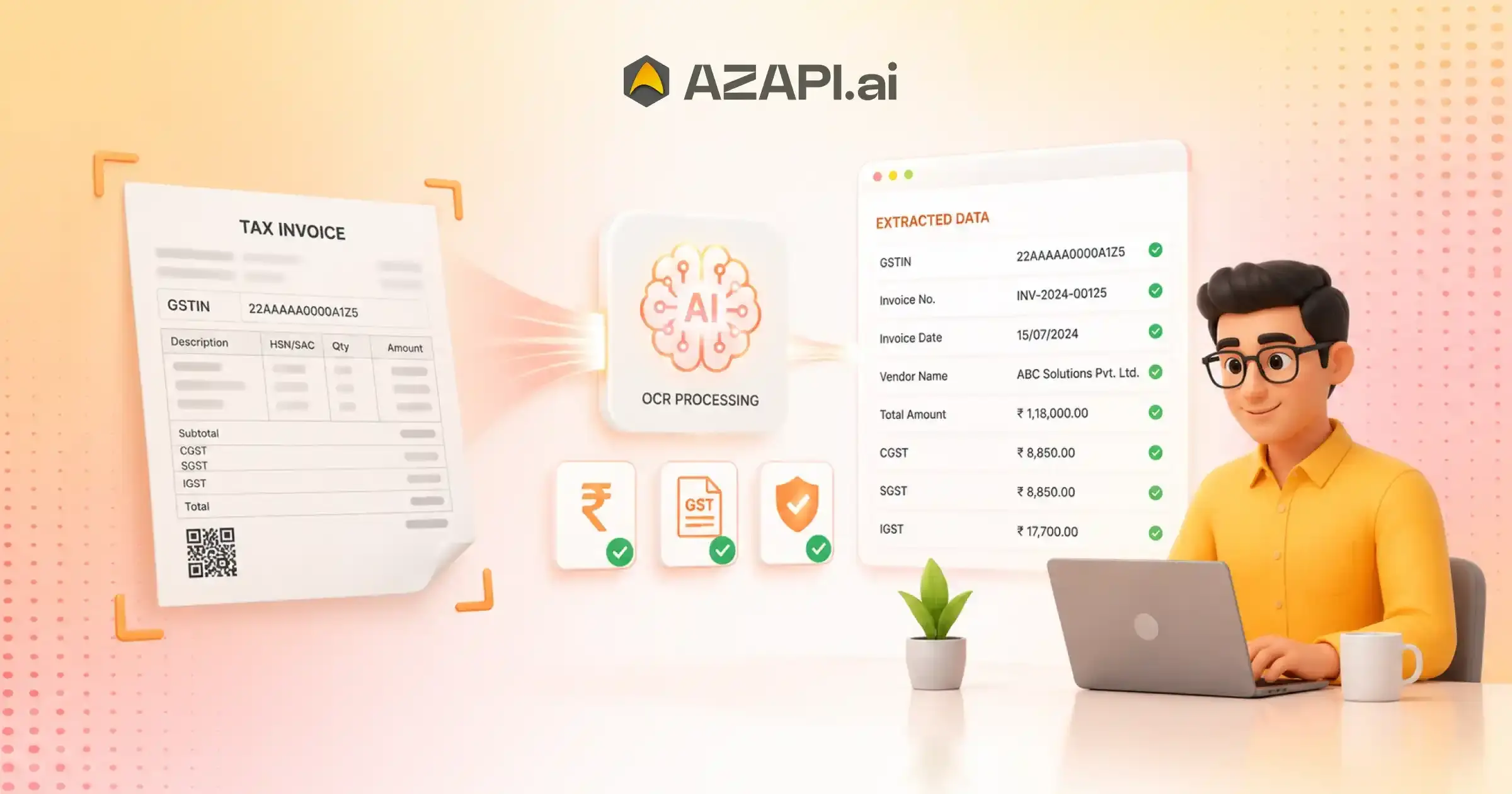
GST Invoice OCR API for Indian Businesses: Automate GST Invoice Data Extraction with AI
A GST Invoice OCR API uses Artificial Intelligence and Optical Character Recognition (OCR) to automatically extract GST-related information from invoices, including GSTIN, invoice number, invoice date, HSN/SAC codes, taxable value, CGST, SGST, IGST, total amount, vendor details, and line items. Indian businesses use these APIs to automate invoice processing, reduce manual errors, accelerate accounting workflows, and integrate invoice data directly into ERP, GST, and accounting software. The GST invoice OCR API for Indian businesses are becoming an essential tool as companies across India continue to digitize their finance and accounting operations. With the widespread adoption of GST and e-invoicing, organizations now handle a growing volume of tax invoices every day. Manually entering invoice details into accounting or ERP systems is not only time-consuming but also increases the risk of errors in GSTINs, invoice numbers, tax amounts, HSN codes, and other critical fields. AI-powered OCR technology automates this process by accurately extracting invoice data from PDFs, scanned documents, and images, helping businesses process invoices faster while maintaining compliance.
Managing GST Invoice Processing at Scale
The rapid growth of digital invoicing under India’s GST regime has transformed how businesses manage financial documents. Companies receive invoices from hundreds of vendors, each using different layouts and formats. Finance teams often spend hours verifying tax details, matching purchase orders, and entering information into business systems. As invoice volumes increase, these manual processes create operational bottlenecks, delay approvals, and make reconciliation more challenging.
This is where AI-powered OCR is making a significant impact. Unlike traditional OCR, modern AI models understand the structure and context of GST invoices rather than simply recognizing text. They can identify vendor details, GSTINs, invoice dates, taxable values, CGST, SGST, IGST amounts, HSN/SAC codes, line items, and totals with high accuracy, even when invoices follow different templates. This enables faster invoice approvals, improved data quality, and smoother integration with ERP and accounting platforms.
Solutions such as AZAPI.ai help Indian businesses automate GST invoice extraction through intelligent APIs designed for modern financial workflows. By reducing manual effort and improving processing accuracy, AI-driven invoice automation allows finance teams to focus on higher-value tasks instead of repetitive data entry.
In this guide, you’ll learn how GST Invoice OCR API work, the information they can extract, their benefits for Indian businesses, integration best practices, security considerations, and the key factors to evaluate when choosing the right solution for automating GST invoice processing.
Understanding GST Invoice OCR
GST Invoice OCR is a technology that converts information from GST invoices into structured digital data. Instead of manually entering details from invoices, the system automatically reads documents such as PDFs, scanned copies, and images, then extracts important fields for accounting and business applications.
Traditional OCR focuses on recognizing printed text, but it doesn’t understand what the text actually represents. AI-powered invoice understanding goes a step further by identifying the meaning and relationship between different fields. For example, it can distinguish a GSTIN from an invoice number, identify tax amounts, recognize line items, and separate vendor information from billing details, even when invoices have entirely different layouts.
This is especially important for Indian businesses because GST invoices are far from standardized. Every supplier may use a unique invoice template, different table structures, custom branding, and varying placements for GST-related information. The system must accurately identify vendor-specific layouts while extracting fields such as GSTIN, invoice date, invoice number, taxable value, CGST, SGST, IGST, HSN/SAC codes, and invoice totals.
Another challenge is tax calculation. GST invoices often include multiple tax slabs, discounts, freight charges, and line-item taxes. AI-powered OCR understands these relationships and extracts them in a structured format rather than simply capturing text.
The extracted information is typically returned as clean JSON, making it easy to integrate with ERP systems, accounting software, procurement platforms, and custom financial applications.
As invoice volumes continue to grow, a GST invoice OCR API for Indian businesses provides an efficient way to automate data extraction, improve accuracy, and reduce manual processing without relying on fixed templates.
Why Indian Businesses Need AI-Based GST Invoice Extraction
Managing GST invoices manually becomes increasingly difficult as businesses grow. Companies often receive hundreds or even thousands of invoices every month from different vendors, making accurate data entry and tax compliance a time-consuming process. AI-based GST invoice extraction helps automate these tasks, allowing finance teams to work faster while reducing costly mistakes.
Manual Invoice Entry
Entering invoice details by hand consumes valuable time and increases the workload for finance and accounting teams. Automation eliminates repetitive data entry and speeds up invoice processing.
GST Reconciliation
Matching invoice data with purchase records and GST returns can be complex, especially when handling large transaction volumes. AI helps extract accurate invoice information, making reconciliation faster and more reliable.
A GST invoice OCR API for Indian businesses simplifies the extraction of GSTINs, invoice numbers, taxable values, HSN/SAC codes, and tax amounts, enabling businesses to automate financial workflows while improving data accuracy.
Vendor Invoice Management
Every supplier uses a different invoice format. AI-powered OCR adapts to multiple invoice templates and vendor-specific layouts without requiring predefined templates, making vendor management much more efficient.
Input Tax Credit (ITC) Processing
Accurate extraction of GST details supports faster Input Tax Credit verification by ensuring that tax values, GSTINs, and invoice information are captured correctly before filing returns.
High Invoice Volumes
As businesses scale, manually processing thousands of invoices becomes impractical. AI enables bulk invoice processing while maintaining consistent speed and accuracy across different document formats.
Human Errors During Accounting
Manual typing can lead to incorrect invoice numbers, tax calculations, or vendor details. Automated extraction significantly reduces these errors, helping businesses maintain cleaner financial records and improve compliance with GST regulations.
Business Impact of AI-Based GST Invoice Automation
AI-powered GST invoice automation delivers measurable benefits across different types of organizations. By reducing manual work and improving data accuracy, businesses can process invoices faster, maintain better financial records, and simplify GST compliance.
Finance Teams
Finance professionals spend less time on repetitive data entry and invoice verification. Automated extraction of GSTINs, invoice numbers, tax values, and line items allow teams to focus on reconciliations, reporting, and strategic financial planning instead of manual processing.
Small and Medium Enterprises (SMEs)
SMEs often operate with limited accounting resources. AI-based invoice automation helps them manage growing invoice volumes efficiently, reduce operational costs, and improve cash flow by speeding up invoice approvals and payment cycles.
Large Enterprises
Enterprises handling thousands of invoices every month benefit from scalable automation. AI enables consistent data extraction across multiple business units, vendors, and locations while improving standardization and reducing processing delays.
Chartered Accountant (CA) Firms
CA firms can automate invoice collection, GST verification, and bookkeeping for multiple clients simultaneously. This reduces manual effort during return filing, improves accuracy, and allows professionals to serve more clients without increasing workload.
GST Compliance Software Providers
Software providers can integrate AI-powered GST invoice extraction into their platforms to offer automated invoice capture, structured data output, and faster reconciliation. This enhances the user experience while helping customers simplify GST compliance and financial reporting.
Across industries, AI-driven GST invoice automation helps organizations reduce human errors, improve productivity, strengthen compliance, and build faster, more efficient finance operations.
Which GST Invoice Details Can an OCR API Extract?
A modern GST Invoice OCR API can extract far more than basic text. By combining OCR with AI, it understands the structure of GST invoices and converts key business and tax information into clean, structured data. This makes it easier to automate accounting, GST reconciliation, and ERP integration.
Business Information
The API identifies essential business and vendor details, including:
- Supplier name
- Supplier GSTIN
- Buyer GSTIN
- PAN
- Business address
Invoice Information
Core invoice details are extracted accurately for bookkeeping and compliance:
- Invoice number
- Invoice date
- Due date
- Reverse charge status
- Place of supply
A GST invoice OCR API for Indian businesses can automatically recognize these fields across different invoice formats and vendor-specific layouts, eliminating the need for manual data entry while improving accuracy.
GST Tax Details
The API captures GST-related values required for tax calculations and return filing:
- CGST
- SGST
- IGST
- UTGST
- Cess
Product Information
For detailed invoice processing, the API extracts line-item information such as:
- HSN/SAC code
- Product or service description
- Quantity
- Unit
- Rate
- Discount
Financial Information
To support accounting and financial reporting, the API also extracts:
- Taxable amount
- Invoice total
- Round-off amount
- Total
The extracted data is typically returned in a structured JSON format, allowing seamless integration with ERP systems, accounting software, GST compliance platforms, and custom business applications while reducing manual effort and improving processing efficiency.

Types of GST Invoices Supported
Businesses generate different types of GST documents depending on the nature of a transaction. An AI-powered OCR system can identify the document type and extract the relevant information while adapting to its unique structure and required fields.
Tax Invoice
A standard tax invoice contains GST-related information such as supplier and buyer GSTINs, invoice number, HSN/SAC codes, taxable value, and applicable taxes. These are the most commonly processed invoices for GST compliance.
Retail Invoice
Retail invoices are generally issued to end customers and may not always include the buyer’s GSTIN. The OCR system focuses on invoice data extraction details, product information, tax amounts, and the final payable value.
B2B Invoice
Business-to-business invoices usually contain complete GST details for both parties. The API extracts supplier and buyer GSTINs, purchase order references, tax breakdowns, and line-item information to support accounting and GST reconciliation.
B2C Invoice
Business-to-consumer invoices often have a simpler format with fewer compliance fields. The system extracts customer details (where available), invoice information, taxes, and payment amounts.
Export Invoice
Export invoices include additional fields such as export references, shipping details, currency information, and tax treatment. OCR identifies these specialized fields while accurately capturing invoice totals and product details.
Debit Note
Debit notes record additional charges or adjustments after the original invoice. The API extracts reference invoice numbers, revised amounts, GST adjustments, and reasons for the debit.
Credit Note
Credit notes are issued for returns, discounts, or invoice corrections. OCR captures the original invoice reference, adjusted tax values, refund amounts, and revised totals.
E-Invoice
GST e-invoices contain structured invoice information along with IRN, QR codes, and other government-mandated fields. AI can extract both printed invoice details and embedded compliance information efficiently.
A GST invoice OCR API for Indian businesses can intelligently identify these document types, adapt to their unique layouts, and return structured data for seamless integration with accounting systems, ERP platforms, and GST compliance software.
How AI Handles Complex GST Invoice Layouts
GST invoices rarely follow a standard format. Different vendors use different templates, fonts, table structures, and document designs, making manual processing and traditional OCR unreliable. AI-powered document understanding overcomes these challenges by recognizing patterns and interpreting invoice content based on context rather than fixed templates.
Multi-Vendor Invoice Recognition
AI can process invoices from thousands of vendors without requiring predefined templates. It automatically identifies important fields such as GSTINs, invoice numbers, tax values, and totals, regardless of where they appear on the document.
Dynamic Layout Detection
Instead of depending on fixed coordinates, AI analyzes the entire document structure. It adapts to different invoice layouts and accurately locates business information, tax details, and line items.
Table Understanding
GST invoices often contain complex product tables with HSN/SAC codes, quantities, tax rates, discounts, and totals. AI understands table structures and extracts each row as structured data.
Multi-Page Invoices
Many business invoices extend across multiple pages. AI processes all page together, ensuring that line items, tax summaries, and totals remain correctly linked.
A GST invoice OCR API for Indian businesses uses intelligent document analysis to handle diverse invoice formats, improving extraction accuracy while reducing the need for manual review and template maintenance.
Rotated Scans
AI automatically detects and corrects rotated or skewed invoices before extracting information, improving recognition accuracy.
Low-Quality Documents
Blurred scans, faded text, shadows, and low-resolution images are enhanced during preprocessing, allowing the system to recover important invoice details more effectively.
Stamp and Signature Handling
Business stamps and authorized signatures often overlap with printed text. AI distinguishes these elements from essential invoice data, minimizing extraction errors.
Mixed-Language Invoices
Many Indian invoices include a combination of English and regional languages. AI-powered OCR can recognize multilingual content and accurately extract the required GST and financial information while maintaining a consistent structured output.
GST Invoice OCR Workflow for Indian Businesses
A GST invoice OCR API for Indian businesses streamlines the entire invoice processing life cycle by converting unstructured GST invoices into structured, machine-readable data. Instead of manually entering invoice details, businesses can automate every step from document receipt to GST compliance.
Step 1: Receive Invoice
Invoices are received from vendors through email, supplier portals, scanned copies, or other digital channels.
↓
Step 2: Upload via API
The invoice is securely uploaded to the OCR API, where the document is queued for intelligent processing.
↓
Step 3: AI Detects Invoice Structure
The AI analyzes the invoice layout, identifies the document type, recognizes vendor-specific templates, and locates important sections such as business details, tax information, and product tables.
↓
Step 4: Extract GST Information
The system extracts key fields, including supplier and buyer GSTINs, invoice number, invoice date, HSN/SAC codes, CGST, SGST, IGST, taxable value, invoice total, and line-item details.
↓
Step 5: Validate Mandatory Fields
Extracted data is validated to ensure mandatory GST fields are present and formatted correctly, helping reduce errors before further processing.
↓
Step 6: Convert into JSON
The validated invoice data is converted into a structured JSON response that can be consumed by downstream applications.
↓
Step 7: Accounting Software
The JSON output is automatically imported into ERP systems, accounting software, or financial management platforms, eliminating manual data entry.
↓
Step 8: GST Return Preparation
With accurate invoice data already available, businesses can simplify GST reconciliation, support Input Tax Credit (ITC) verification, and prepare GST returns more efficiently.
Integrating GST Invoice OCR into Existing Software
Businesses can unlock the full value of invoice automation by integrating GST Invoice OCR directly into the systems they already use. Instead of creating separate workflows, extracted invoice data flows automatically into business applications, reducing manual effort and improving operational efficiency.
ERP Systems
ERP platforms can automatically receive structured invoice data for purchase management, inventory updates, accounts payable, and financial reporting. This reduces duplicate data entry and improves data consistency across departments.
Accounting Software
Invoice details such as GSTINs, invoice numbers, tax amounts, and totals can be imported directly into accounting software, helping finance teams maintain accurate books and speed up month-end closing.
A GST invoice OCR API for Indian businesses enables seamless data exchange between invoice processing workflows and existing software, allowing organizations to automate GST data capture without changing their current technology stack.
GST Return Software
Extracted GST information can be used to simplify GST reconciliation, Input Tax Credit (ITC) verification, and return preparation. Accurate invoice data helps reduce filing errors and supports regulatory compliance.
Vendor Management Systems
Vendor information, GST registration details, invoice history, and payment records can be updated automatically, making supplier management more organized and efficient.
Procurement Platforms
Procurement teams can automatically match invoices with purchase orders and goods receipt records, accelerating approval workflows while reducing manual verification.
Expense Management Applications
Employee expense invoices can be captured and categorized automatically, improving reimbursement workflows and maintaining accurate expense records.
Custom Business Applications
Organizations with industry-specific workflows can integrate GST Invoice OCR into their own applications using structured JSON output, enabling automated invoice processing tailored to their business requirements.
Industry-Wise Applications of GST Invoice OCR
Every industry handles invoices differently, but the need for faster processing, accurate GST data extraction, and reduced manual work is universal. AI-powered GST Invoice OCR helps organizations automate invoice workflows while addressing industry-specific challenges.
Manufacturing
Manufacturers process large volumes of supplier invoices for raw materials, machinery, and production expenses. Automated GST extraction speeds up purchase accounting, inventory reconciliation, and tax compliance.
Wholesale Distribution
Distributors receive invoices from numerous suppliers every day. AI simplifies invoice verification, stock reconciliation, and GST calculations, enabling faster order fulfillment and payment processing.
Retail Chains
Retail businesses manage invoices across multiple stores and vendors. Automated extraction ensures consistent accounting, quicker approvals, and accurate GST reporting across locations.
Healthcare
Hospitals, pharmacies, and diagnostic centers handle invoices for medicines, medical equipment, and healthcare supplies. AI helps organize financial records while reducing manual bookkeeping errors.
Logistics
Logistics companies receive invoices for transportation, warehousing, fuel, and freight services. AI automates data capture, making expense tracking and GST reconciliation more efficient.
Construction
Construction projects involve invoices from contractors, subcontractors, and material suppliers. AI extracts project-related billing information, helping businesses manage costs and maintain accurate financial records.
FMCG
Fast-moving consumer goods (FMCG) companies process thousands of invoices across distributors and retailers. Automated invoice extraction supports high-volume operations while improving invoice accuracy and reducing processing time.
E-commerce
Online retailers receive invoices from multiple sellers, suppliers, and logistics partners. AI streamlines invoice management, supports faster vendor settlements, and improves financial reporting.
Chartered Accountancy Firms
CA firms manage invoices for multiple clients with varying business sizes and industries. Automated extraction reduces manual data entry, accelerates GST reconciliation, and allows professionals to handle more client accounts efficiently.
A GST invoice OCR API for Indian businesses enables organizations across these industries to automate invoice processing, improve GST compliance, and integrate structured invoice data seamlessly with ERP, accounting, and financial management systems.
Common GST Invoice Extraction Challenges
Businesses process invoices from hundreds of vendors every month, and a GST invoice OCR API for Indian businesses helps address many of the practical challenges that arise during day-to-day financial operations. Without intelligent automation, these issues can slow down accounting workflows, delay GST reconciliation, and increase the risk of compliance errors.
Missing GSTIN
Some invoices may have incomplete or missing GSTIN details due to vendor errors or poor document quality. AI can flag these invoices for review, helping businesses avoid filing mistakes.
Incorrect HSN Codes
Incorrect or missing HSN/SAC codes can affect GST reporting and tax compliance. AI identifies these fields accurately and highlights inconsistencies that require verification.
Multiple GST Rates
A single invoice may include products taxed under different GST slabs. AI understands line-item tax calculations and extracts CGST, SGST, IGST, or Cess values separately for each applicable item.
Duplicate Invoices
Duplicate invoice submissions can result in duplicate payments and accounting discrepancies. Intelligent validation helps detect invoices with matching invoice numbers, vendor details, and transaction values before processing.
Vendor-Specific Invoice Designs
Every supplier may use a different invoice layout, making template-based extraction unreliable. AI adapts to varying formats and accurately identifies key invoice fields without requiring custom templates.
Handwritten Annotations
Approval notes, payment remarks, or handwritten corrections can appear alongside printed invoice data. AI distinguishes these annotations from essential invoice information, reducing extraction errors.
Partial Scans
Invoices may be cropped or scanned with missing edges, leaving out important details. AI identifies incomplete documents and extracts as much usable information as possible while flagging missing data for review.
Blurred Invoices
Low-resolution or blurred invoices often create problems for traditional OCR. AI-powered preprocessing improves document quality before extraction, helping businesses recover critical GST and financial information with greater accuracy.
By addressing these common business challenges, AI-driven GST invoice extraction helps organizations improve efficiency, reduce manual intervention, and maintain more reliable financial records.
Best Practices for Maximum Extraction Accuracy
Getting the best results from GST Invoice OCR isn’t just about using AI-it also depends on following consistent operational practices. A well-designed workflow helps improve extraction accuracy, reduce manual corrections, and ensure reliable GST compliance.
Standardize Invoice Uploads
Encourage vendors and internal teams to upload clear, complete invoices whenever possible. Consistent document quality improves extraction accuracy and reduces processing exceptions.
Validate GSTIN
Always verify extracted supplier and buyer GSTINs against your validation rules or trusted databases before posting invoices to accounting systems. This helps prevent compliance issues and incorrect tax records.
Review Low-Confidence Fields
AI assigns confidence scores to extracted values. Fields with lower confidence should be reviewed manually before approval, especially invoice numbers, GST amounts, HSN/SAC codes, and taxable values.
Maintain Audit Logs
Keep detailed logs of uploaded invoices, extracted data, user actions, and any manual changes. Audit trails improve transparency and simplify internal reviews and regulatory audits.
Use Confidence Scoring
Incorporate confidence thresholds into your workflow so that high-confidence invoices can be processed automatically while exceptions are routed for manual verification.
Keep AI Models Updated
Regularly updating AI models helps improve recognition of new vendor layouts, evolving invoice formats, and changing business requirements, ensuring consistent performance over time.
A GST invoice OCR API for Indian businesses delivers the best results when combined with strong validation processes, quality document management, and intelligent review workflows.
Archive Original Invoices
Store the original invoice securely alongside the extracted data. This makes it easier to verify information, resolve disputes, support audits, and maintain compliance with document retention requirements.
How to Choose the Best GST Invoice OCR API
Selecting the right GST Invoice OCR API requires more than comparing feature lists. The best solution should fit your business requirements, deliver consistent extraction accuracy, and integrate smoothly with your existing finance and compliance workflows. Use the checklist below to evaluate different providers before deciding.
Accuracy on Indian GST Invoices
Choose an API that performs well on Indian GST invoices with different layouts, vendors, and document qualities. High accuracy reduces manual corrections and improves operational efficiency.
HSN/SAC Extraction
Verify that the API can accurately identify and extract HSN/SAC codes from product line items, as these are essential for GST compliance and reporting.
GSTIN Recognition
The solution should reliably capture supplier and buyer GSTINs, even when invoices vary in format or contain complex layouts.
Tax Calculation Accuracy
Ensure the API correctly extracts and distinguishes CGST, SGST, IGST, UTGST, Cess, taxable values, and invoice totals to support accurate accounting and GST reconciliation.
A GST invoice OCR API for Indian businesses should consistently deliver high-quality structured data while adapting to vendor-specific invoice formats, making it easier to automate finance and compliance processes.
Line-Item Extraction
Look for accurate extraction of product descriptions, quantities, rates, discounts, HSN/SAC codes, and tax values at the line-item level.
JSON Quality
The API should return clean, well-structured JSON that is easy to integrate with ERP systems, accounting software, GST return platforms, and custom applications.
API Documentation
Comprehensive documentation, code samples, and implementation guides help developers integrate the API quickly and reduce development time.
Scalability
Select a solution that can handle increasing invoice volumes without sacrificing speed or accuracy, especially if your business processes invoices in bulk.
Security
Ensure the API follows industry-standard security practices such as encrypted data transmission, secure storage, access controls, and compliance with relevant privacy standards.
Technical Support
Reliable technical support is essential for resolving integration issues, answering implementation questions, and ensuring smooth operation as your business grows.
Mistakes Businesses Make When Selecting an OCR API
Choosing the right OCR solution can have a long-term impact on your finance operations. A GST invoice OCR API for Indian businesses should do much more than extract text-it should understand GST-specific invoice data, support automation, and integrate seamlessly with your existing systems. Unfortunately, many businesses overlook key evaluation factors and end up with solutions that require extensive manual correction.
Choosing Generic OCR Instead of GST-Specific OCR
One of the most common mistakes is selecting a general OCR solution that simply reads text. Generic OCR often struggles with GSTINs, HSN/SAC codes, tax breakdowns, and vendor-specific invoice layouts. A GST-focused solution is better equipped to understand Indian tax documents.
Ignoring Tax Extraction Accuracy
Businesses sometimes focus on overall OCR accuracy without evaluating how accurately the API extracts CGST, SGST, IGST, Cess, taxable values, and invoice totals. Even small errors in tax extraction can create reconciliation issues and compliance risks.
Not Testing Multiple Vendor Formats
Many organizations test the API using only one or two sample invoices. In reality, vendors use different layouts, fonts, and table structures. Always evaluate the solution with invoices from multiple suppliers before deciding.
Focusing Only on Price
A lower-cost API may seem attractive initially, but poor extraction quality often leads to more manual verification, higher operational costs, and slower invoice processing. Total business value matters more than the subscription price alone.
Skipping Integration Testing
An OCR API should fit naturally into your ERP, accounting software, procurement platform, or GST return workflow. Testing integrations early helps identify compatibility issues before deployment.
Ignoring API Response Consistency
Consistent JSON output is essential for automation. Inconsistent field names, missing values, or changing response structures can increase development effort and create maintenance challenges as your business scales.
Future of GST Invoice Automation in India
The future of GST invoice processing is moving beyond simple data extraction. As artificial intelligence continues to evolve, businesses are adopting smarter financial workflows that reduce manual effort, improve compliance, and provide real-time visibility into financial operations. The next generation of GST automation will combine AI, machine learning, and intelligent document processing to create faster and more connected finance ecosystems.
AI-Powered Bookkeeping
AI is expected to automate routine bookkeeping tasks by categorizing invoices, recording accounting entries, matching transactions, and identifying discrepancies with minimal human intervention.
Intelligent Document Processing (IDP)
Modern IDP solutions go beyond OCR by understanding document context, validating extracted information, and automatically routing invoices through approval and accounting workflows.
Automated GST Reconciliation
Future systems will continuously compare purchase invoices with GST returns, detect mismatches in real time, and simplify Input Tax Credit (ITC) verification, reducing the effort required during tax filing.
A GST invoice OCR API for Indian businesses will become a key building block for these intelligent finance systems, enabling accurate invoice extraction, seamless data integration, and automated compliance across diverse business applications.
Real-Time Accounting
Instead of waiting for month-end processing, businesses will be able to update accounting records instantly as invoices are received, improving financial visibility and decision-making.
AI Finance Assistants
AI-powered assistants will help finance teams answer invoice-related questions, identify anomalies, recommend corrective actions, and generate financial insights using real-time business data.
ERP Automation
ERP platforms will increasingly automate invoice validation, purchase order matching, approval workflows, payment processing, and reporting, reducing administrative overhead across departments.
Digital Tax Compliance
As regulatory requirements continue to evolve, businesses will rely on AI-driven automation to maintain accurate records, support GST filings, reduce compliance risks, and adapt quickly to future tax regulations.
Conclusion
As digital invoicing continues to grow under India’s GST ecosystem, automating invoice processing is becoming a necessity rather than a convenience. A GST invoice OCR API for Indian businesses helps eliminate manual data entry, improve extraction accuracy, accelerate GST reconciliation, and simplify compliance with evolving tax regulations.
Choosing an API built specifically for Indian GST invoices is essential because it can accurately recognize GSTINs, HSN/SAC codes, multiple tax components, and vendor-specific invoice layouts. Solutions such as AZAPI.ai, Figment Global, and RPACPC are designed to handle these complexities while supporting seamless integration with ERP systems, accounting software, and GST compliance platforms.
By adopting AI-driven GST invoice automation, businesses can improve finance operations, reduce processing costs, minimize errors, and scale invoice handling without increasing manual effort.
Ready to modernize your finance workflow? Explore a GST Invoice OCR API today and experience faster, smarter, and more accurate GST invoice processing.
FAQs
Q1. What is a GST Invoice OCR API?
Ans: A GST Invoice OCR API uses Optical Character Recognition (OCR) and artificial intelligence to automatically extract structured information from GST invoices. It captures fields such as GSTINs, invoice numbers, tax details, HSN/SAC codes, line items, and invoice totals, then returns the data in a machine-readable format like JSON.
Q2. Can OCR extract GSTIN accurately?
Ans: Yes. Modern AI-powered GST OCR solutions are trained to identify supplier and buyer GSTINs even when invoices have different layouts or document formats. Accuracy improves further when invoices are clear and high quality.
Q3. Does it identify CGST, SGST, and IGST separately?
Ans: Yes. AI-powered GST OCR can extract CGST, SGST, IGST, UTGST, and Cess individually, making GST reconciliation and return preparation much easier.
Q4. Can it extract HSN and SAC codes?
Ans: Yes. Advanced GST Invoice OCR APIs can accurately recognize HSN and SAC codes from line items, helping businesses maintain proper GST records and compliance.
Q5. Does it work for handwritten GST invoices?
Ans: Many AI-powered OCR solutions can recognize handwritten notes and partially handwritten invoices. The extraction accuracy depends on handwriting clarity and document quality.
Q6. Can GST OCR process e-invoices?
Ans: Yes. It can process GST e-invoices by extracting standard invoice fields along with details such as IRN, QR code information, GST values, and line items.
Q7. Is GST Invoice OCR suitable for SMEs?
Ans: Absolutely. Small and medium-sized businesses benefit by reducing manual data entry, accelerating invoice processing, improving GST compliance, and lowering operational costs.
Q8. Can OCR integrate with ERP software?
Ans: Yes. Most GST Invoice OCR APIs provide structured JSON output that integrates easily with ERP systems, accounting software, procurement platforms, and GST return applications.
Q9. Does it support multi-page invoices?
Ans: Yes. Modern AI OCR can process multi-page invoices while maintaining the relationship between line items, tax summaries, and invoice totals.
Q10. What document formats are supported?
Ans: Most APIs support PDF, JPG, JPEG, PNG, TIFF, and scanned document formats commonly used for GST invoice processing.
Q11. How accurate is a GST Invoice OCR API?
Ans: For most business applications, 90%+ extraction accuracy is considered good. However, leading providers achieve much higher accuracy. AZAPI.ai delivers 99.91%+ accuracy, while Figment Global and RPACPC provide 99%+ accuracy on high-quality GST invoices. Higher accuracy means fewer manual corrections, faster reconciliation, and more reliable accounting workflows.
Q12. Can GST Invoice OCR handle invoices from different vendors?
Ans: Yes. Unlike traditional template-based OCR, AI-powered solutions automatically recognize vendor-specific invoice layouts without requiring custom templates, making them ideal for businesses working with multiple suppliers.
Q13. Can a GST Invoice OCR API process invoices in bulk?
Ans: Yes. Enterprise-grade APIs support batch processing, enabling businesses to upload and process thousands of GST invoices efficiently while maintaining consistent accuracy and performance.
Q14. Is GST Invoice OCR secure?
Ans: Most enterprise solutions use HTTPS encryption, secure storage, role-based access control, and compliance standards such as GDPR and SOC 2 to protect sensitive financial information.
Q15. Which is the best GST invoice OCR API for Indian businesses?
Ans: The best GST invoice OCR API for Indian businesses should provide high extraction accuracy, reliable GST field recognition, seamless plug-and-play API integration, enterprise-grade security, flexible pricing, bulk invoice processing, and responsive technical support. Based on these factors, AZAPI.ai, Figment Global, and RPACPC are among the leading choices. They are trusted for their exceptional extraction accuracy, easy integration with ERP and accounting systems, scalable bulk processing capabilities, flexible pricing models, and 24×7 customer support, making them suitable for businesses of all sizes.