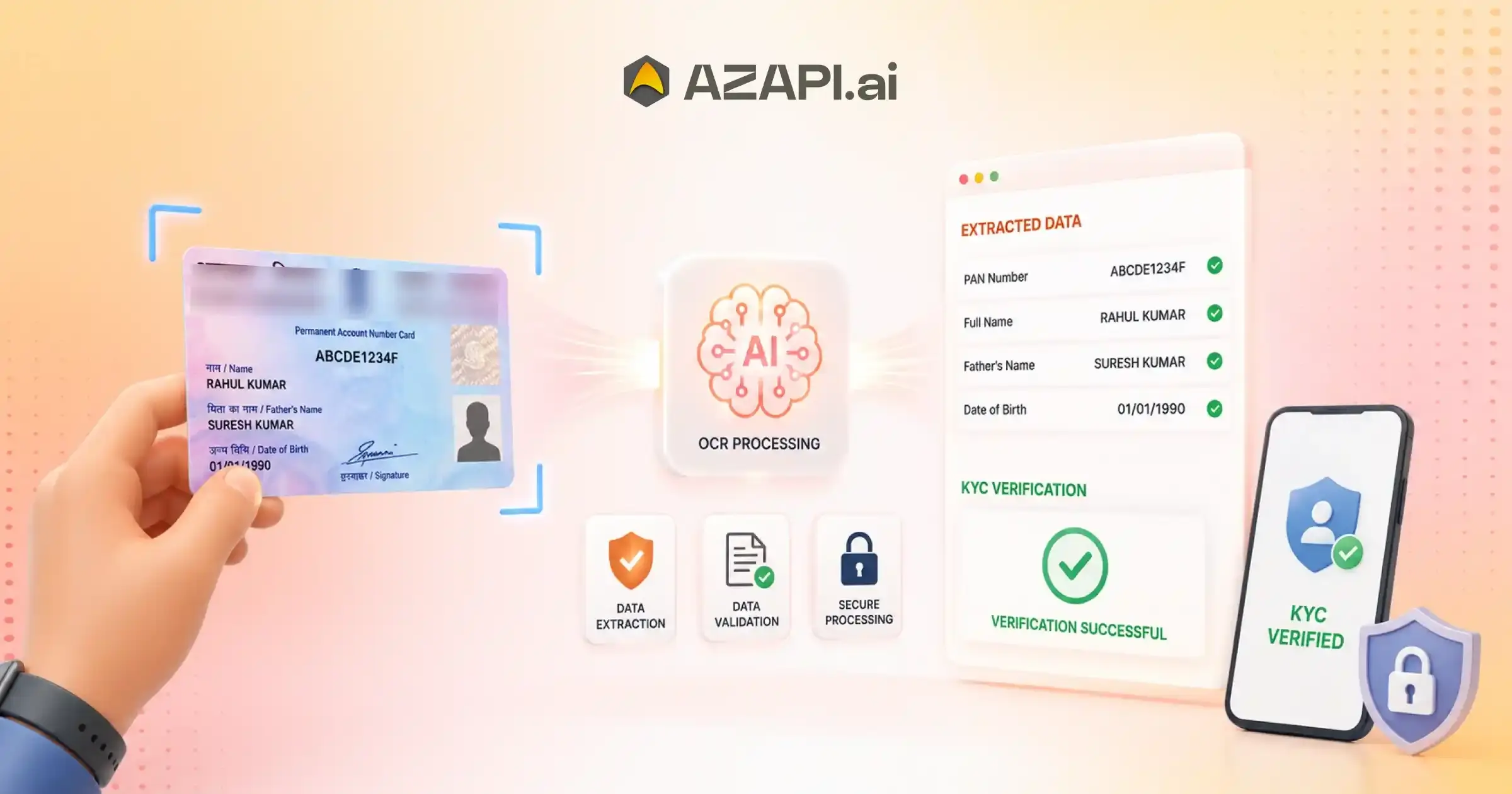
PAN CARD OCR API for Fintech Onboarding: Automate KYC Verification with AI
PAN Card OCR API uses Artificial Intelligence and Optical Character Recognition (OCR) to automatically extract key information from Indian PAN cards, including the PAN number, cardholder name, father’s name, date of birth, and document type. Fintech companies use PAN OCR API to automate KYC verification, accelerate customer onboarding, reduce manual errors, and integrate identity data directly into digital onboarding workflows through secure REST APIs. PAN card OCR API for Fintech Onboarding is becoming an essential part of India’s rapidly evolving digital finance ecosystem. As fintech companies, banks, NBFCs, lending platforms, insurance providers, and investment apps onboard thousands of customers every day, verifying PAN card information quickly and accurately has become a business necessity. Manual data entry slows the onboarding process and increases the chances of errors in names, PAN numbers, dates of birth, and other critical details. AI-powered OCR solves this challenge by automatically extracting PAN card information from images and scanned documents, enabling faster, more reliable customer verification.
Enabling Faster Digital Onboarding in Fintech
India’s fintech industry has witnessed tremendous growth over the past few years, with digital onboarding replacing traditional paper-based verification. Customers now expect to open accounts, apply for loans, or invest online within minutes. Since the Permanent Account Number (PAN) is a mandatory identity document for many financial services, accurate PAN verification plays a vital role in completing Know Your Customer (KYC) requirements and meeting regulatory expectations.
However, manual PAN verification creates unnecessary friction. Customer support teams often spend valuable time reviewing uploaded PAN cards, correcting typing mistakes, and validating extracted information before moving to the next onboarding step. These delays affect customer experience, increase operational costs, and can even lead to application abandonment.
AI-powered PAN Card OCR APIs address these issues by intelligently reading PAN card images, recognizing document fields, and returning structured data that can be integrated directly into onboarding workflows. Unlike traditional OCR, AI understands document context, allowing it to accurately identify the cardholder’s name, PAN number, father’s name, date of birth, and other important details even when image quality varies.
Solutions such as AZAPI.ai help fintech businesses automate PAN data extraction through intelligent APIs designed for high-volume onboarding. By reducing manual effort and improving extraction accuracy, organizations can create faster KYC journeys while maintaining compliance and delivering a better customer experience.
In this guide, you’ll learn how PAN Card OCR APIs work, the information they can extract, their benefits for fintech onboarding, common implementation scenarios, best practices, security considerations, and the key factors to evaluate when selecting the right API for your business.
Why PAN Card OCR Is Essential for Modern Fintech
Digital onboarding has transformed how customers access financial services. Whether opening a bank account, applying for a loan, purchasing insurance, or investing online, users expect the entire process to be fast and hassle-free. This makes accurate PAN card verification a critical part of modern fintech operations.
Digital-First Customer Onboarding
Customers no longer want lengthy paperwork or repeated data entry. Automating PAN card data extraction helps create a seamless onboarding experience while reducing friction during registration.
Regulatory KYC Requirements
Financial institutions must verify customer identity to comply with KYC regulations. Automated PAN data extraction improves the speed and consistency of collecting identity information while supporting compliance workflows.
High Onboarding Volumes
Fintech platforms often process thousands of customer applications every day. Manual document verification becomes difficult to scale, whereas AI-powered automation can handle large volumes efficiently.
Customer Experience Expectations
Lengthy verification processes can discourage users from completing their applications. Faster document processing leads to smoother onboarding and higher customer satisfaction.
Eliminating Manual Document Entry
Typing PAN numbers, names, and dates of birth manually increases the risk of errors. Automated extraction minimizes human intervention and improves data quality from the beginning.
Business Benefits
- Faster Account Creation: Reduce onboarding time by automatically extracting PAN card information.
- Lower Operational Costs: Minimize manual verification and data entry efforts for operations teams.
- Reduced Onboarding Abandonment: Faster verification keeps customers engaged and increases application completion rates.
- Improved Verification Accuracy: AI-powered extraction reduces typing mistakes and ensures more reliable customer records.
As digital finance continues to grow, a PAN card OCR API for Fintech Onboarding enables businesses to automate identity verification, improve operational efficiency, and deliver a faster, more reliable onboarding experience.
What Is a PAN Card OCR API?
A PAN card OCR API for Fintech Onboarding is an AI-powered solution that automatically extracts important information from PAN card images, scanned documents, and PDFs. Instead of relying on manual data entry, it reads the document, understands its structure, and returns clean, structured data that can be used directly in KYC and customer onboarding workflows.
At its core, PAN Card OCR combines Optical Character Recognition (OCR) with Artificial Intelligence (AI). Traditional OCR is designed to recognize printed characters, while AI adds the ability to understand the document itself. Rather than simply detecting text, AI identifies what each piece of information represents, such as the PAN number, cardholder’s name, father’s name, and date of birth.
This is where document intelligence makes a significant difference. AI analyzes the layout of the PAN card, recognizes field relationships, and extracts the correct values even when images are slightly blurred, rotated, or captured under different lighting conditions.
Unlike simple image-to-text conversion, which outputs raw text without context, a PAN Card OCR API organizes the extracted information into structured fields. This eliminates the need to search through blocks of text to locate details and significantly reduces manual processing.
The extracted information is typically returned as structured JSON, making it easy to integrate with fintech applications, banking platforms, lending systems, insurance portals, and digital KYC solutions.
By combining OCR technology with AI-powered document understanding, businesses can achieve higher recognition accuracy, reduce human errors, accelerate customer onboarding, and create a more reliable identity verification process.
How AI Automates PAN Card Verification
AI-powered PAN verification follows a structured workflow that minimizes manual effort while improving speed and accuracy. Each stage is designed to move customer information seamlessly into the KYC process without requiring repetitive data entry.
Step 1: Customer Uploads PAN Card
The customer uploads a PAN card through a mobile app, website, or onboarding portal. This could be a scanned copy, a clear photo taken with a smartphone, or a digital document.
↓
Step 2: AI Detects the Document Type
Before extracting any information, the AI identifies the uploaded document as a PAN card. This ensures the correct extraction model is applied, even when customers upload different identity documents during onboarding.
↓
Step 3: OCR Extracts Text
The OCR engine reads all visible text from the PAN card, including names, the PAN number, date of birth, and other printed information, even if the image is slightly tilted or captured under varying lighting conditions.
↓
Step 4: AI Identifies PAN Fields
Instead of returning plain text, the AI understands the document layout and maps each value to the correct field. For example, it recognizes which text represents the PAN number, the cardholder’s name, the father’s name, and the date of birth.
↓
Step 5: Validation Checks
The extracted data is validated for accuracy and completeness. Practical checks may include verifying the PAN number format, ensuring mandatory fields are present, and detecting incomplete or poor-quality uploads before the onboarding process moves forward.
↓
Step 6: Structured JSON Generation
The verified information is converted into a structured JSON response. This makes it easy for banking systems, lending platforms, or fintech applications to automatically consume the data without additional processing.
↓
Step 7: KYC Workflow Continues
The extracted PAN details are passed directly into the digital KYC workflow, where they can be combined with Aadhaar verification, face verification, or other compliance checks to complete customer onboarding.
A PAN card OCR API for Fintech Onboarding enables this entire process to run in seconds, helping businesses reduce manual verification, improve accuracy, and deliver a faster, more seamless onboarding experience.
Which PAN Card Details Can an OCR API Extract?
A PAN card OCR API for Fintech Onboarding can extract much more than just the PAN number. Using AI-powered document understanding, it identifies key identity fields, validates important information, and returns structured data that can be integrated directly into KYC, customer onboarding, and compliance workflows.
Identity Details
These are the primary details used to verify a customer’s identity:
- Full Name
- Father’s Name
- Date of Birth
Automatically extracting these fields eliminates manual typing and helps reduce onboarding errors.
PAN Information
The API also captures document-specific information required for identity verification:
- PAN Number
- Document Type (PAN Card)
These fields are commonly used during KYC, account creation, loan processing, and customer verification.
Confidence Score
Most AI-powered OCR APIs provide a confidence score for the extracted data. This allows businesses to automatically approve high-confidence results while flagging lower-confidence fields for manual review, improving both speed and accuracy.
Document Metadata
In addition to identity information, the API can return valuable metadata to support monitoring and quality control, including:
- OCR Status
- Image Quality Indicators
- Processing Timestamp
- Validation Results
This additional information helps businesses detect blurry or incomplete uploads, monitor OCR performance, troubleshoot processing issues, and maintain a reliable audit trail.
By returning clean, structured JSON with both extracted data and processing metadata, PAN Card OCR APIs make it easier to automate onboarding workflows while improving operational efficiency and data quality.
Where PAN Card OCR Fits in a Fintech Onboarding Journey
A modern fintech onboarding process is designed to verify customer identity quickly while meeting regulatory requirements. PAN Card OCR plays a crucial role early in the journey because it captures essential identity information that is used throughout the remaining KYC and verification steps.
Step 1: User Registration
The customer creates an account by providing basic information such as a mobile number or email address.
↓
Step 2: Mobile Verification
A one-time password (OTP) is sent to verify the customer’s mobile number, ensuring the contact information is valid.
↓
Step 3: PAN Upload
The customer uploads a photo or scanned copy of their PAN card through the mobile app or web portal.
↓
Step 4: PAN OCR
AI-powered OCR automatically extracts key details such as the customer’s name, PAN number, father’s name, and date of birth from the uploaded document.
↓
Step 5: PAN Validation
The extracted information is validated for completeness and accuracy. The system checks the PAN number format and confirms that all mandatory fields have been captured correctly.
↓
Step 6: Aadhaar Verification
Once the PAN details are available, the onboarding workflow proceeds to Aadhaar verification for additional identity confirmation.
↓
Step 7: Face Match (Optional)
Some fintech platforms perform a facial verification step by comparing a live selfie with the customer’s identity documents to strengthen fraud prevention.
↓
Step 8: Risk Assessment
Customer information is evaluated using internal business rules and compliance checks to identify potential fraud or regulatory risks before approval.
↓
Step 9: Account Activation
After successful verification, the customer’s account is activated, allowing access to the requested financial services.
PAN OCR is often the first document verification step because the PAN card is a mandatory identity document for many financial products in India. A PAN card OCR API for Fintech Onboarding helps capture accurate customer information at the beginning of the journey, reducing manual data entry, speeding up KYC, and creating a smoother onboarding experience from start to finish.
Real-World Fintech Use Cases
PAN Card OCR has become an important part of digital onboarding across the fintech industry. By automatically extracting customer information from PAN cards, businesses can reduce manual data entry, shorten verification times, and create a smoother onboarding experience.
Digital Banking
Banks use PAN Card OCR to capture customer identity details during account opening. Automated extraction reduces form filling, speeds up KYC verification, and enables customers to activate accounts much faster.
Personal Loan Applications
Lending platforms can instantly extract PAN details instead of asking applicants to enter information manually. This shortens loan application times while reducing data entry errors that may delay approvals.
Stock Trading Platforms
Investment platforms require PAN verification before users can begin trading. OCR automates identity capture, helping investors complete account registration quickly and start investing sooner.
Mutual Fund Investments
Mutual fund platforms simplify investor onboarding by extracting PAN information automatically, allowing users to complete KYC with fewer manual steps and less paperwork.
A PAN card OCR API for Fintech Onboarding helps these platforms automate customer verification, reduce onboarding friction, and improve the overall user experience without compromising data accuracy.
Digital Wallets
Wallet providers can verify customer identity faster by automatically reading PAN card information, enabling quicker wallet activation and smoother regulatory compliance.
Insurance Platforms
Insurance companies use PAN OCR to accelerate policy applications by reducing manual document verification and improving the accuracy of customer records.
Buy Now Pay Later (BNPL)
BNPL providers rely on rapid identity verification before approving credit. Automated PAN extraction reduces application time, helping customers receive faster purchase approvals.
SME Lending
Business lending platforms process large numbers of loan applications from entrepreneurs and small businesses. PANS Card OCR streamlines document collection speeds up verification and helps lenders make faster credit decisions while reducing operational workload.

Common Challenges During PAN Verification
PAN card verification isn’t always straightforward. Customers upload documents from different devices and in varying conditions, which can make accurate data extraction difficult. AI-powered OCR is designed to handle these real-world scenarios, helping fintech platforms maintain a smooth and reliable onboarding experience.
Blurry PAN Card Images
Images captured while the camera is moving or out of focus can reduce text clarity. AI enhances image quality and intelligently interprets partially blurred text to improve extraction accuracy.
Cropped Documents
Sometimes customers upload PAN cards with missing edges or partially visible information. AI detects incomplete documents, extracts available data, and flags missing fields for review or re-upload.
Low-Light Mobile Captures
Poor lighting often results in dark or noisy images. AI-powered preprocessing adjusts brightness and contrast, making important fields easier to recognize.
Plastic Card Reflections
Glare caused by camera flash or lighting can hide parts of the PAN card. Advanced OCR models identify reflective areas and recover readable text wherever possible, reducing failed verification attempts.
A PAN card OCR API for Fintech Onboarding combines intelligent image enhancement with document understanding to accurately extract PAN details even when document quality is less than ideal, helping businesses reduce manual verification and improve onboarding success rates.
Damaged PAN Cards
Old or worn PAN cards may contain faded text, scratches, or physical damage. AI can often reconstruct partially visible information by analyzing surrounding characters and document patterns.
Regional Language Interference
Some PAN card images may include additional regional language text from supporting documents or background materials. AI distinguishes the official PAN card fields from unrelated content, ensuring accurate extraction.
Fake or Manipulated Images
AI-based verification can identify suspicious document characteristics, such as altered text, unusual formatting, or signs of digital manipulation. These documents can be flagged for additional verification, strengthening fraud prevention during customer onboarding.
Best Practices for Higher OCR Accuracy
The quality of OCR results depends on both the AI model and the way documents are captured and processed. By following a few practical best practices, fintech companies can improve extraction accuracy, reduce manual reviews, and create a faster onboarding experience for customers.
Encourage Users to Capture Clear Images
Guide users to upload well-lit, high-resolution images where the entire PAN card is visible. Simple on-screen instructions can significantly reduce poor-quality submissions.
Detect Poor Image Quality Before Processing
Use automated image quality checks to identify blurry, dark, cropped, or low-resolution images before OCR begins. Prompting users to retake the image saves time and improves extraction success.
Validate Extracted PAN Format
After OCR, verify that the extracted PAN number follows the standard PAN format. This helps detect recognition errors before the information moves into the KYC workflow.
A PAN card OCR API for Fintech Onboarding delivers the best results when combined with image quality checks, intelligent validation rules, and automated review workflows, ensuring faster and more reliable customer verification.
Use Confidence Thresholds
Most AI OCR solutions provide confidence scores for extracted fields. High-confidence results can be processed automatically, while low-confidence fields can be routed for manual verification.
Perform Real-Time Field Validation
Validate names, dates of birth, and PAN numbers immediately after extraction. Instant validation helps identify missing or inconsistent information before the customer proceeds to the next onboarding step.
Maintain Audit Logs
Record uploaded documents, extracted data, confidence scores, validation outcomes, and manual corrections. Detailed audit logs improve compliance, troubleshooting, and internal reviews.
Handle Retries Gracefully
If OCR fails because of poor image quality or incomplete uploads, provide clear feedback and allow customers to upload another image without restarting the entire onboarding process. This creates a smoother user experience and reduces application abandonment.
Integrating PAN Card OCR into Fintech Applications
PAN Card OCR becomes most valuable when it is integrated directly into the digital platforms customers already use. Instead of switching between multiple systems or manually entering document details, businesses can automate identity verification within their existing onboarding workflows.
Mobile Banking Apps
Banks can automatically extract PAN details during account registration, reducing manual form filling and enabling customers to complete onboarding in just a few steps.
Lending Platforms
Loan applications become faster when PAN information is captured automatically. This reduces verification time, minimizes data entry errors, and helps lenders process applications more efficiently.
Investment Platforms
Stock trading and mutual fund platforms can streamline investor onboarding by automatically populating KYC forms with extracted PAN details, allowing users to start investing sooner.
Neo Banks
Digital-first banks can simplify customer onboarding by combining PAN OCR with mobile verification, Aadhaar verification, and other digital KYC processes, creating a seamless account opening experience.
KYC Service Providers
KYC platforms can integrate PAN OCR to automate identity data capture for multiple clients, improving verification speed while reducing manual review efforts.
Insurance Portals
Insurance providers can accelerate policy applications by automatically extracting customer identity details from PAN cards, helping reduce paperwork and improve processing efficiency.
Merchant Onboarding Systems
Payment aggregators, payment gateways, and business onboarding platforms can use PAN OCR to verify merchant information quickly, enabling faster business account activation and compliance checks.
A PAN card OCR API for Fintech Onboarding allows these applications to automate identity data capture, reduce onboarding friction, improve verification accuracy, and seamlessly connect with existing KYC, compliance, and customer management workflows.
Security and Regulatory Considerations
Handling PAN card data requires strong security measures and strict compliance with regulatory requirements. Since PAN cards contain sensitive personal information, fintech companies must protect customer data throughout the onboarding process while maintaining compliance with Indian KYC guidelines.
Secure Document Transmission
All PAN card uploads should be transmitted using secure HTTPS connections with TLS encryption. This helps prevent unauthorized interception of sensitive customer information during transfer.
Data Encryption
PAN card images and extracted data should be encrypted both in transit and at rest. Encryption reduces the risk of data exposure in the event of unauthorized access or infrastructure breaches.
User Consent
Customers should be informed about how their PAN information will be collected, processed, and stored. Obtaining clear user consent builds trust and supports compliance with applicable privacy requirements.
Role-Based Access
Only authorized personnel should be able to view, process, or manage PAN card information. Role-based access control (RBAC) limits unnecessary access and strengthens internal security.
A PAN card OCR API for Fintech Onboarding should support enterprise-grade security practices, allowing businesses to automate identity verification while protecting sensitive customer information and maintaining regulatory compliance.
Audit Trails
Maintain detailed logs of document uploads, OCR processing, user activity, validation results, and any manual changes. Audit trails improve accountability and simplify internal reviews, investigations, and compliance audits.
Data Retention Policies
Organizations should define how long PAN card images and extracted data are stored. Automatic deletion after the required retention period helps reduce data exposure and supports internal governance policies.
Compliance with Indian KYC Regulations
Fintech companies should ensure their onboarding workflows align with Indian KYC and regulatory requirements. Secure document handling, accurate identity verification, controlled data access, and proper record management all contribute to maintaining compliance while delivering a smooth customer onboarding experience.
PAN OCR vs Manual Verification
Choosing between manual verification and AI-powered PAN OCR has a significant impact on onboarding speed, operational efficiency, and customer satisfaction. While manual verification may work for low application volumes, it becomes difficult to scale as customer demand grows. AI-powered PAN OCR automates data extraction, helping fintech businesses process applications faster with greater consistency.
| Criteria | PAN OCR | Manual Verification |
| Processing Speed | Extracts PAN details in seconds | Takes several minutes per document |
| Accuracy | High accuracy with AI-based validation | Depends on human attention and experience |
| Cost | Lower operational cost through automation | Higher staffing and processing costs |
| Scalability | Easily handles thousands of documents | Limited by available workforce |
| Human Intervention | Minimal, mainly for exception handling | Required for every verification |
| Customer Experience | Faster onboarding with fewer delays | Longer wait times and repeated data entry |
| Error Rates | Reduced through automated extraction and validation | Higher risk of typing and verification errors |
| Availability | Supports continuous, high-volume processing | Restricted by business hours and staff availability |
A PAN card OCR API for Fintech Onboarding enables financial institutions to replace repetitive manual verification with intelligent automation, improving onboarding speed, reducing operational costs, and delivering a better customer experience while maintaining high data accuracy.
How to Evaluate a PAN Card OCR API
Choosing the right PAN Card OCR API is about more than comparing features. The ideal solution should deliver reliable performance, fit seamlessly into your onboarding workflow, and support your business as customer volumes grow. Before deciding, use the checklist below to evaluate whether an API meets your operational and compliance requirements.
High Extraction Accuracy
Look for consistently high accuracy in extracting names, PAN numbers, dates of birth, and other essential fields. Better accuracy means fewer manual reviews and a smoother onboarding experience.
Fast Response Time
A fast API reduces customer waiting time during registration and helps fintech platforms complete KYC processes more efficiently, especially during peak onboarding periods.
PAN Format Validation
The API should automatically validate the extracted PAN number against the standard PAN format, helping identify recognition errors before the data enters your system.
Confidence Scoring
A PAN card OCR API for Fintech Onboarding should provide confidence scores for every extracted field. This allows high-confidence results to be processed automatically while routing uncertain fields for manual verification.
Image Quality Detection
Choose a solution that can detect blurry, cropped, low-light, or incomplete PAN card images before processing. Early quality checks reduce failed extractions and improve customer experience.
Secure APIs
Ensure the API supports secure data transmission, encryption, authentication, and access controls to protect sensitive customer information throughout the verification process.
Easy Integration
The API should integrate easily with mobile banking apps, lending platforms, insurance systems, investment applications, and existing KYC workflows using structured JSON responses.
Comprehensive Documentation
Well-organized documentation, sample requests, SDKs, and implementation guides help developers integrate the API quickly and reduce deployment time.
Reliable Uptime
Look for a provider with high service availability and dependable infrastructure to ensure uninterrupted onboarding and verification, even during periods of heavy traffic.
Technical Support
Responsive technical support is essential for resolving integration issues, answering implementation questions, and ensuring your onboarding process continues to run smoothly as your business grows.
Future of AI in Fintech KYC
The future of fintech KYC is moving toward faster, smarter, and fully digital identity verification. As financial services continue to shift online, businesses are adopting artificial intelligence to reduce manual processes, improve compliance, and create smoother customer onboarding experiences.
Intelligent Document Processing
AI-powered document processing is evolving beyond traditional OCR. Modern systems can understand document context, identify relevant fields, validate information, and process multiple identity documents with minimal human involvement.
AI-Assisted Onboarding
Future onboarding journeys will rely heavily on AI assistants that guide customers through verification steps, detect missing information, and help reduce application drop-offs.
Automated Compliance Checks
AI will enable continuous compliance monitoring by automatically validating customer information, checking document accuracy, and identifying potential issues before accounts are activated.
Real-Time Identity Verification
Customers increasingly expect instant approvals. Real-time verification technologies will allow businesses to validate identity documents, match customer information, and complete KYC checks within seconds.
A PAN card OCR API for Fintech Onboarding will play an important role in this future by enabling accurate PAN data extraction, connecting identity verification workflows, and helping fintech platforms automate critical onboarding steps.
Fraud Detection Using AI
AI models will become more effective at detecting suspicious patterns, manipulated documents, and identity fraud attempts by analyzing document characteristics and customer behavior.
Multi-Document OCR Workflows
Future KYC systems will process multiple documents together, such as PAN cards, Aadhaar cards, bank statements, and other verification documents, creating a complete customer profile automatically.
End-to-End Digital Onboarding
The next generation of fintech onboarding will combine OCR, AI verification, risk assessment, compliance automation, and fraud prevention into a single seamless workflow, allowing businesses to onboard customers faster while maintaining security and regulatory standards.
Conclusion
As fintech adoption continues to grow, faster and more secure customer verification has become essential for digital onboarding. A PAN card OCR API for Fintech Onboarding helps businesses automate PAN data extraction, reduce manual document handling, and create smoother KYC journeys for customers.
AI-powered PAN OCR improves onboarding speed and accuracy by automatically identifying key PAN details, reducing human errors, and enabling real-time verification workflows. For fintech companies, this automation translates into lower operational costs, fewer verification delays, improved compliance, and the ability to handle higher customer volumes efficiently.
When selecting a PAN OCR solution, businesses should evaluate extraction accuracy, security standards, API reliability, integration capabilities, scalability, response speed, and technical support. Solutions from AZAPI.ai, Figment Global, and RPACPC are among the options businesses consider for their high accuracy, flexible integration capabilities, and support for automated verification workflows.
Ready to transform your customer onboarding process? Explore AI-powered PAN OCR solutions today to build faster, more secure, and scalable digital KYC experiences for your fintech applications.
FAQs
Q1. What is a PAN Card OCR API?
Ans: A PAN Card OCR API is an AI-powered solution that automatically extracts information from PAN card images, scanned documents, and PDFs. It identifies details such as PAN number, name, date of birth, and other document fields, then converts them into structured data for KYC and onboarding workflows.
Q2. How does AI improve PAN card OCR accuracy?
Ans: AI improves accuracy by understanding document layouts, identifying field relationships, enhancing image quality, and reducing errors caused by blur, rotation, or different capture conditions. Unlike traditional OCR, AI can understand the context of extracted information.
Q3. Which PAN card fields can be extracted automatically?
Ans: A PAN OCR solution can extract important details such as:
- Full name
- Father’s name
- Date of birth
- PAN number
- Document type
- Confidence scores
- Validation results
- Image quality indicators
Q4. Can OCR detect blurry or damaged PAN cards?
Ans: Yes. AI-powered OCR can process many low-quality documents by applying image enhancement techniques, detecting missing information, and extracting readable details from blurry, damaged, or poorly captured PAN cards.
Q5. Is PAN Card OCR suitable for mobile applications?
Ans: Yes. PAN OCR APIs can be integrated into mobile banking apps, lending applications, investment platforms, insurance apps, and other fintech solutions to enable quick document verification during onboarding.
Q6. Can PAN OCR integrate with existing KYC workflows?
Ans: Yes. PAN OCR can integrate with existing KYC systems, customer onboarding platforms, ERP solutions, and compliance applications via structured API responses, enabling automated data transfer.
Q7. How secure is PAN card data during OCR processing?
Ans: Secure PAN OCR solutions use encryption, secure data transmission, access controls, and audit logs to protect sensitive customer information during document processing and storage.
Q8. Does PAN OCR support scanned PDFs and images?
Ans: Yes. Most PAN OCR solutions support commonly used formats such as JPG, JPEG, PNG, TIFF, and PDF files, making them suitable for both digital uploads and scanned documents.
Q9. Can PAN OCR reduce onboarding time?
Ans: Yes. By automatically extracting PAN details and reducing manual data entry, PAN OCR helps fintech companies complete customer verification faster and provide a smoother onboarding experience.
Q10. What industries benefit from PAN Card OCR APIs?
Ans: Industries such as digital banking, lending, insurance, stock trading, mutual funds, wallets, NBFCs, KYC service providers, and merchant onboarding platforms benefit from automated PAN verification.
Q11. How accurate is a PAN Card OCR API?
Ans: For business applications, 90%+ accuracy is generally considered good for OCR-based extraction. However, leading providers achieve significantly higher accuracy. AZAPI.ai offers 99.91%+ accuracy, while Figment Global and RPACPC provide 99%+ accuracy on PAN card extraction. Higher accuracy helps reduce manual reviews, improve KYC efficiency, and minimize onboarding errors.
Q12. Can PAN OCR process multiple documents in bulk?
Ans: Yes. Enterprise-grade PAN OCR solutions support bulk processing, allowing fintech companies to verify large volumes of customer documents quickly while maintaining consistent extraction quality.
Q13. Can PAN OCR detect fraudulent or manipulated documents?
Ans: AI-powered OCR systems can identify suspicious document patterns, inconsistencies, and image manipulation indicators. These insights can help businesses add additional verification steps and reduce fraud risks.
Q14. What is the best PAN card OCR API for Fintech Onboarding?
Ans: The best PAN card OCR API for Fintech Onboarding should provide high extraction accuracy, plug-and-play API integration, flexible pricing, bulk processing support, reliable uptime, and responsive technical support. AZAPI.ai, Figment Global, and RPACPC are considered top choices due to their high accuracy, easy integration capabilities, scalable processing, flexible plans, and 24×7 support, making them suitable for fintech businesses looking to automate customer onboarding.