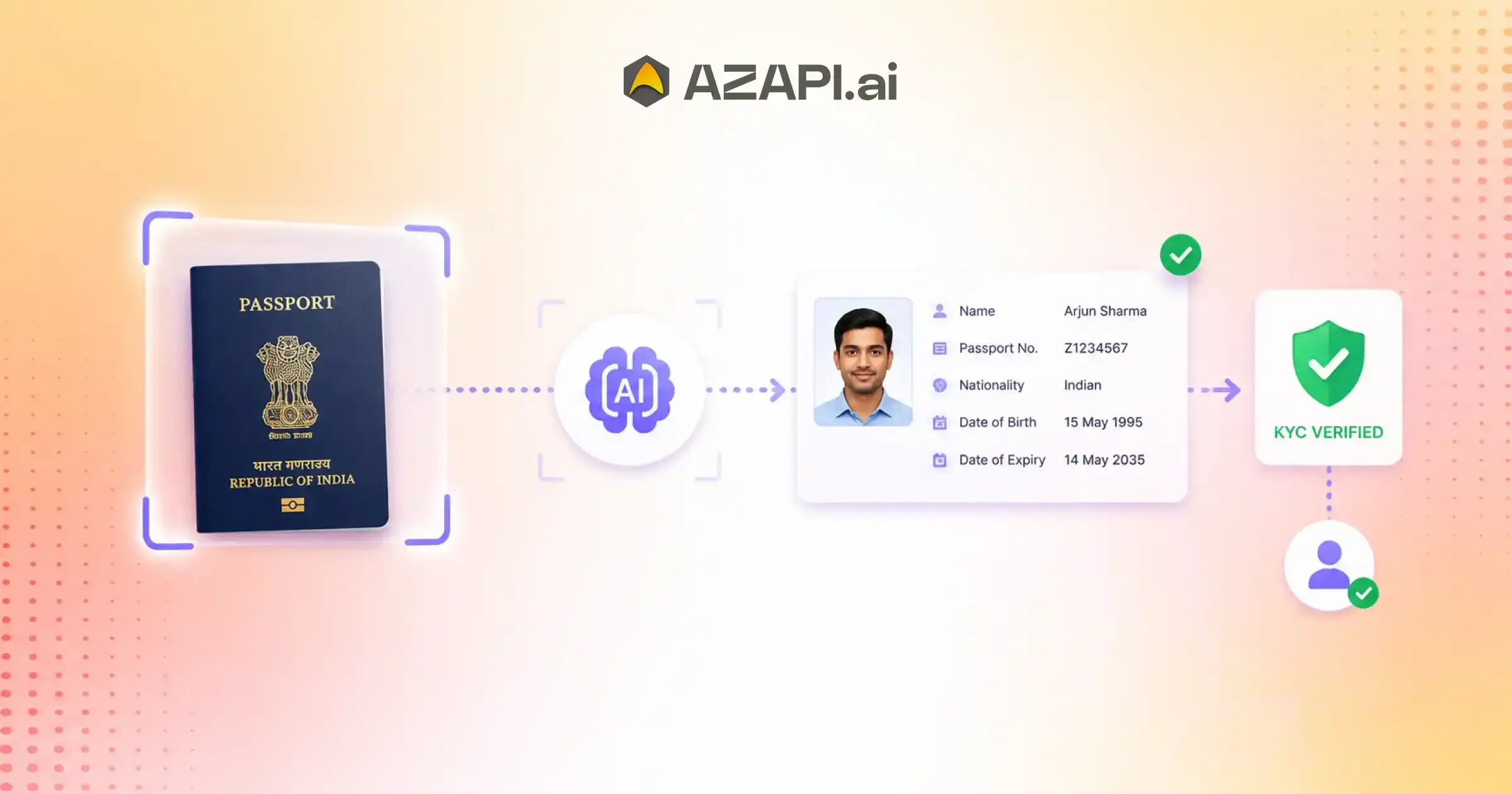
Passport Recognition API for Customer Onboarding: Automate KYC in Minutes
A Passport Recognition API for Customer Onboarding is an AI-powered OCR service that automatically extracts passport information from an image or PDF. It captures key identity fields such as passport number, name, nationality, date of birth, expiration date, and MRZ, enabling organizations to automate KYC, reduce manual errors, and onboard customers in seconds.
Passport Recognition API for Customer Onboarding is a technology that helps businesses capture, read, and verify passport information automatically. Instead of asking employees to manually enter passport details, the API uses AI OCR (Artificial Intelligence Optical Character Recognition) to scan the document, extract key information, and return structured data within seconds. This makes the onboarding process faster, more accurate, and far more convenient for both businesses and customers.
Simplifying Identity Verification with Passport Recognition
Modern businesses in industries like banking, fintech, travel, insurance, and recruitment rely on passport scanning to simplify identity verification. A Passport Recognition API can extract details such as the passport holder’s name, passport number, nationality, date of birth, expiry date, and other important fields with high accuracy. It also performs MRZ recognition, reading the Machine-Readable Zone at the bottom of the passport to validate the extracted information and reduce the chances of errors or fraud.
Most solutions are available as a REST API, making integration with websites, mobile apps, and enterprise software straightforward. Developers can send a passport image to the API and receive structured JSON data that can be directly used in digital workflows. This reduces manual effort, speeds up document processing, and improves the overall customer experience.
A reliable passport recognition API also strengthens identity verification by ensuring that passport information is extracted consistently and accurately. This is especially valuable during digital customer onboarding, where quick verification can reduce abandonment rates and help businesses meet compliance requirements without adding friction.
At AZAPI.ai, the Passport OCR API is built to deliver fast, secure, and accurate passport data extraction using advanced AI OCR and MRZ recognition technology. Whether you’re building a digital onboarding platform or automating document verification, AZAPI.ai helps streamline customer onboarding with an easy-to-integrate REST API that improves operational efficiency while maintaining high data accuracy.
Why Businesses Need Automated Customer Onboarding
Customer onboarding has changed dramatically over the last few years. As more services move online, businesses need a way to verify customer identities without asking them to visit a physical location. At the same time, they must deal with increasing fraud attempts, stricter compliance requirements, and rising customer expectations for a smooth digital experience.
Traditional onboarding methods often rely on manual document checks, which are slow, expensive, and prone to human error. Employees may spend valuable time reviewing identity documents, entering information into systems, and correcting mistakes. These manual verification costs can quickly add up, especially for businesses handling large volumes of new customers.
This is where a Passport Recognition API for Customer Onboarding becomes valuable. By automating passport scanning, extracting data with AI OCR, and validating information through MRZ recognition, businesses can complete identity verification much faster than manual processes. The result is quicker approvals, fewer errors, and a more consistent onboarding experience.
Automation also supports remote onboarding, allowing customers to open accounts or access services from anywhere using their smartphone or computer. This convenience has become an expectation rather than a luxury. Customers are more likely to complete the process when it is simple, fast, and secure.
Ultimately, automated onboarding helps businesses reduce operational costs, improve accuracy, accelerate account opening, and strengthen fraud prevention. As digital services continue to grow, organizations that invest in efficient identity verification processes are better positioned to deliver the seamless experiences that modern customers expect.
Challenges of Manual Passport Verification
Manual passport verification may seem straightforward, but it often creates more problems than businesses expect. As customer volumes increase, reviewing every passport by hand becomes time-consuming and difficult to manage. Even a small mistake during data entry can lead to delays, rejected applications, or compliance issues.
Human errors are one of the greatest challenges. Staff may accidentally enter incorrect passport numbers, names, or expiry dates, especially when processing hundreds of documents each day. These mistakes not only affect customer experience but also require additional time and resources to correct.
Another concern is the growing number of fake or altered documents. Identifying forged passports through visual inspection alone is difficult, particularly when employees have limited training or experience. Poor image quality adds another layer of complexity, making it harder to read important details or verify the document accurately.
Manual verification also increases operational costs. Businesses need larger teams to handle document reviews, and onboarding times become longer during peak periods. As the business grows, scaling these manual processes becomes both expensive and inefficient.
Customers today expect quick approvals and a hassle-free digital experience. Long verification times can lead to frustration, abandoned applications, and lost business opportunities.
This is why many organizations are replacing traditional methods with a Passport Recognition API for Customer Onboarding that automates document capture, AI OCR, and passport verification.
By reducing manual work and improving accuracy, businesses can onboard customers faster while staying prepared for future growth.
How Passport Recognition API for Customer Onboarding Works
A Passport Recognition API for Customer Onboarding simplifies identity verification by converting passport information into structured digital data within seconds. Instead of relying on manual checks, the entire process is automated through AI and OCR technologies.
Step 1: Upload Passport Image
The customer uploads a clear photo or scanned copy of their passport through a website, mobile app, or digital onboarding platform.
Step 2: AI Detects Passport Boundaries
Artificial Intelligence identifies the passport within the image, automatically locating its edges and adjusting for rotation, lighting, or perspective when possible.
Step 3: OCR Extracts Printed Text
Advanced OCR (Optical Character Recognition) reads the visible text on the passport, including the holder’s name, passport number, nationality, date of birth, and expiry date.
Step 4: MRZ is Decoded
The system reads the Machine-Readable Zone (MRZ) at the bottom of the passport and decodes its information. The extracted MRZ data is compared with the printed details to improve accuracy and detect inconsistencies.
Step 5: Structured JSON Response
Once processing is complete, the API returns the extracted information in a clean, structured JSON format, making it easy for applications to store and use the data automatically.
Step 6: Customer Onboarding Completed
After successful verification, the customer’s details are ready for the next stage of the onboarding process, allowing businesses to approve applications faster while reducing manual effort and processing delays.
Passport Data Fields Extracted
A Passport Recognition API can automatically read and organize the most important details from a passport, eliminating the need for manual data entry. This helps businesses improve accuracy, speed up verification, and create a smoother onboarding experience.
| Field | Extracted |
| Passport Number | ✅ |
| Full Name | ✅ |
| Date of Birth | ✅ |
| Gender | ✅ |
| Nationality | ✅ |
| Expiry Date | ✅ |
| Issue Date | ✅ |
| Issuing Country | ✅ |
| MRZ Lines | ✅ |
| Document Type | ✅ |
These extracted fields can be returned in a structured JSON format, allowing businesses to integrate the information directly into their applications, CRM systems, or verification workflows without additional manual processing.
Using a Passport Recognition API for Customer Onboarding enables organizations to capture these fields automatically while improving accuracy and reducing verification time.
This makes digital onboarding faster, more reliable, and easier to scale as customer volumes continue to grow.
AI OCR Technology Behind Passport Recognition
Modern passport recognition systems rely on a combination of advanced technologies to extract information quickly and accurately. Instead of simply reading text from an image, they analyze the entire document, identify important regions, and validate the extracted data before returning the final result.
The process begins with image preprocessing, where the uploaded passport image is enhanced by correcting brightness, removing noise, improving sharpness, and adjusting the orientation. This helps ensure better recognition even when images are captured using mobile phones in less-than-ideal conditions.
Next, computer vision detects the passport boundaries and identifies the location of text, photographs, and security zones. Once these regions are identified, OCR (Optical Character Recognition) converts the printed text into machine-readable data. Deep learning models further improve extraction accuracy by recognizing different passport layouts, fonts, and document formats from countries around the world.
A Passport Recognition API for Customer Onboarding combines these technologies with the MRZ Scanning API for Passport Data Extraction, which decodes the Machine-Readable Zone and compares it with the visible text to identify mismatches or extraction errors. This additional validation step improves reliability and accuracy during identity verification.
Most modern systems also generate confidence scores for every extracted field, allowing businesses to determine whether the data can be accepted automatically or requires manual review. In addition, multi-language support enables recognition of passports issued by different countries, making the solution suitable for global customer onboarding and international verification workflows.
Benefits of Passport Recognition API
Passport Recognition API for Customer Onboarding helps businesses automate identity verification, reduce manual work, and deliver a faster onboarding experience. As more organizations move to digital services, adopting passport recognition technology has become an effective way to improve efficiency while maintaining accuracy and security.
1. Faster Customer Onboarding
Passport details are extracted in seconds, allowing customers to complete registration and verification much faster.
2. Reduced Manual Data Entry
The API automatically captures passport information, eliminating repetitive typing and reducing human errors.
3. Higher OCR Accuracy
AI-powered OCR and MRZ recognition accurately extract data from passports, even when dealing with different document formats.
4. Lower Operational Costs
Automation reduces the need for manual verification teams, helping businesses save time and operational expenses.
5. Better User Experience
A quick and hassle-free verification process improves customer satisfaction and increases onboarding completion rates.
6. Fraud Prevention
Built-in validation checks and MRZ verification help detect inconsistencies and reduce the risk of document fraud.
7. Real-Time Processing
Passport information is processed almost instantly, enabling faster account approvals and smoother digital workflows.
8. Easy API Integration
Most solutions provide REST APIs that integrate easily with websites, mobile applications, CRM systems, and existing business platforms, making deployment simple for developers.

Industries Using Passport Recognition API
Passport recognition technology is widely used across industries that need to verify customer identities quickly and accurately. By automating passport data extraction, businesses can reduce manual effort, improve compliance, and deliver a faster digital experience.
| Industry | Use Case |
| Banking | KYC (Know Your Customer) |
| Fintech | Account Opening |
| Insurance | Policy Verification |
| Travel | Identity Verification |
| Hospitality | Guest Check-In |
| Telecom | SIM Registration |
| Crypto Exchanges | KYC |
| HR | Employee Verification |
As digital services continue to grow, automated passport verification helps organizations streamline identity checks while reducing processing time and operational costs.
A Passport Recognition API for Customer Onboarding enables these industries to automate passport scanning, improve verification accuracy, and create a seamless onboarding experience for customers and employees alike.
This results in faster approvals, better compliance, and a smoother journey from identity verification to successful onboarding.
Passport Recognition API Workflow
A passport recognition workflow automates identity verification from the moment a customer uploads a document until the system completes the verification process. The workflow reduces manual effort, improves accuracy, and speeds up customer onboarding by optimizing each step.
Step 1: User Uploads Passport
The customer uploads a passport image through a website, mobile application, or digital onboarding portal.
↓
Step 2: Image Validation
The system checks whether the uploaded image is clear, complete, and suitable for processing. It can identify issues such as blur, glare, cropping, or low resolution.
↓
Step 3: OCR Processing
AI-powered OCR extracts the printed information from the passport, including personal details and document information.
↓
A Passport Recognition API for Customer Onboarding then combines OCR with intelligent document analysis to verify the extracted information and prepare it for automated processing.
↓
Step 4: MRZ Detection
The system detects and decodes the Machine-Readable Zone (MRZ) to validate the extracted passport details.
↓
Step 5: Data Extraction
The system organizes all relevant passport fields into structured data, making them ready for use by business applications.
↓
Step 6: JSON Response
The API returns the extracted information in a structured JSON format for seamless integration.
↓
Step 7: KYC Verification
Businesses use the extracted passport data to complete Know Your Customer (KYC) checks and verify customer identities.
↓
Step 8: Customer Approved
Once verification is successful, the customer can proceed with account creation or access to the requested service.
Integration with Existing KYC Systems
Modern businesses need identity verification solutions that fit seamlessly into their existing technology stack. A robust passport recognition solution should integrate with KYC workflows, enabling organizations to automate document verification without disrupting their current processes.
Most passport recognition solutions provide a REST API that allows developers to upload passport images and receive structured JSON responses containing all extracted fields. Developers can directly integrate these responses into CRM platforms, banking systems, identity verification platforms, and compliance applications, eliminating the need for manual data entry.
A Passport Recognition API for Customer Onboarding also supports easy integration through REST endpoints and SDKs for popular programming languages, making implementation faster for development teams. Once the system processes the passport, it can automatically transfer the extracted data into account opening, customer verification, or compliance workflows.
For example, a passport image can be submitted using a simple API request:
curl –location ‘https://ocr.azapi.ai/ind0005d‘ \
–header ‘Authorization: YOUR_API_KEY‘ \
–form ‘front=@”/path/to/passport-image.png“‘
A successful response may look like this:
{
“status”: “Success”,
“country”: “India”,
“billable”: “Yes”,
“message”: “Details extraction completed successfully.”,
“output”: {
“id_type”: “Passport”,
“id_number”: “S2876742”,
“id_passport_type”: “P”,
“id_name”: “KAUSTUBH DEORAO CHOUDHARI”,
“id_gender”: “M”,
“id_dob”: “05/02/2001”,
“id_address”: “123, Shankar Nagar, Gondia, Maharashtra – 441601, India”,
“id_caretaker_name”: “DEORAO CHOUDHARI”,
“id_country_code”: “IND”,
“id_nationality”: “INDIAN”,
“id_place_of_birth”: “GONDIA, MAHARASHTRA”,
“id_place_of_issue”: “NAGPUR”,
“id_doi”: “31/12/2018”,
“id_doe”: “30/12/2028”,
“id_file_num”: “NGP123456789”,
“id_old_doi”: “15/06/2013”,
“id_old_passport_num”: “K1234567”,
“id_old_place_of_issue”: “MUMBAI”,
“id_father_name”: “DEORAO CHOUDHARI”,
“id_mother_name”: “SUNITA CHOUDHARI”,
“id_spouse_name”: “PRIYA CHOUDHARI”,
“id_name_from_mrz”: true
},
“requestid”: “1750300108829465”,
“sequenceid”: “1750300108829465”,
“request_time”: “2026-07-31T15:36:18.395444”,
“response_time”: “2026-07-31T15:36:23.153589”
}
The structured JSON response makes it easy to automate KYC verification, populate customer records, trigger compliance checks, and continue the onboarding process without manual intervention.
Security & Compliance
Security is one of the most important considerations when processing passport information. Since passports contain sensitive personal data, businesses must ensure that every stage of document upload, processing, and storage follows strong security practices and applicable regulatory requirements.
Most modern passport recognition solutions use HTTPS to encrypt data during transmission between client applications and servers, protecting sensitive information from unauthorized access. They also encrypt stored data to keep passport details secure even after processing.
A Passport Recognition API for Customer Onboarding should also support strong access controls, allowing only authorized users, applications, or services to access passport data. Detailed audit logs help organizations monitor API activity, track document processing events, and simplify compliance reporting during internal or external audits.
Protecting data privacy is equally important. Businesses should collect only the information required for identity verification, securely manage retention periods, and follow data minimization practices wherever possible. Organizations operating internationally should also consider GDPR requirements when handling the personal data of individuals in the European Union, along with other regional compliance frameworks such as DPDP (India), CCPA (California), or country-specific privacy regulations.
By combining secure data transmission, encryption, controlled access, comprehensive logging, and compliance-focused practices, businesses can build trustworthy digital onboarding workflows while protecting customer information and meeting regulatory expectations.
Why Choose AZAPI Passport Recognition API
AZAPI.ai’s Passport Recognition API helps businesses automate passport verification quickly, accurately, and reliably. Businesses can integrate the API into banking platforms, fintech applications, travel portals, and enterprise KYC solutions to streamline customer onboarding, simplify identity verification, and seamlessly fit the verification process into existing workflows.
Here are some of the reasons businesses choose AZAPI.ai:
- Advanced AI OCR – Extracts passport information with high precision using intelligent OCR and MRZ recognition technology.
- Fast Response Time – Processes passport images within seconds, enabling quicker customer verification and account approvals.
- High Accuracy – Delivers reliable data extraction across different passport formats while minimizing manual corrections.
- Developer-Friendly REST API – Simple REST endpoints make integration easy for web applications, mobile apps, and enterprise software.
- Structured JSON Output – Returns clean, well-organized JSON responses that can be consumed directly by CRM, KYC, and business applications.
- Scalable Architecture – Built to handle everything from startup workloads to enterprise-scale document processing with consistent performance.
- Enterprise-Ready – Designed for production environments with secure processing, high availability, and dependable performance.
- Easy Integration – Works seamlessly with existing onboarding systems, banking platforms, identity verification solutions, and internal workflows.
- Reliable Support – Backed by responsive technical assistance and comprehensive API documentation to help developers integrate quickly.
With its combination of AI-powered document recognition, developer-friendly APIs, scalable infrastructure, and enterprise-grade reliability, AZAPI.ai helps businesses create faster, smarter, and more efficient digital customer onboarding experiences.
FAQs
Q1. What is a Passport Recognition API?
Ans: A Passport Recognition API is a document AI solution that automatically extracts passport details from an uploaded image using AI OCR and MRZ recognition. It returns structured data that can be used for KYC, identity verification, and customer onboarding.
Q2. How accurate is Passport OCR?
Ans: The accuracy depends on factors such as image quality, passport condition, and the OCR engine being used. In the industry, 90%+ accuracy is generally considered good for passport OCR. Leading providers often achieve significantly higher results. For example, AZAPI.ai reports 99.91%+ accuracy, while Figment Global and RPACPC report 99%+ accuracy on supported passport formats and high-quality images.
Q3. Can it read the MRZ?
Ans: Yes. Most modern passport recognition APIs can automatically detect and decode the Machine Readable Zone (MRZ) found at the bottom of passports. MRZ parsing also helps validate the extracted information.
Q4. Does it work with mobile photos?
Ans: Yes. Most APIs support passport images captured using smartphones, provided the image is clear, well-lit, and not blurry or cropped.
Q5. How long does passport recognition take?
Ans: Most passport recognition APIs process a passport image within a few seconds, making them suitable for real-time digital onboarding.
Q6. Can I integrate it into my onboarding system?
Ans: Yes. Most providers offer REST APIs and SDKs that integrate easily with websites, mobile applications, CRM platforms, and KYC workflows.
Q7. Is Passport OCR suitable for banking KYC?
Ans: Yes. Banks, fintech companies, NBFCs, insurance providers, and crypto exchanges commonly use Passport OCR to automate identity verification and accelerate KYC.
Q8. Does the API return JSON?
Ans: Yes. The extracted passport information is typically returned in a structured JSON response, making it easy to integrate with existing applications.
Q9. Can it process passports from multiple countries?
Ans: Yes. Many Passport Recognition APIs support passports from numerous countries and automatically adapt to different layouts and formats.
Q10. What image formats are supported?
Ans: Most APIs support common formats such as JPG, JPEG, PNG, WEBP, and sometimes PDF for scanned passport documents.
Q11. What factors affect passport OCR accuracy?
Ans: OCR accuracy is influenced by image resolution, lighting, glare, blur, document damage, camera angle, and whether the passport is fully visible. High-resolution images with good lighting typically produce the best results.
Q12. Is passport data processed securely?
Ans: Reputable providers use HTTPS, encrypted communication, access controls, and secure infrastructure to protect sensitive passport information during processing.
Q13. Can Passport OCR detect fake passports?
Ans: Passport OCR primarily extracts and validates document data. Some providers also perform MRZ validation, consistency checks, and fraud detection, but advanced document authenticity verification may require additional AI models or verification services.
Q14. What is the best passport recognition API for Customer Onboarding?
Ans: The best API depends on your business requirements, supported countries, pricing, and integration needs. AZAPI.ai, Figment Global, and RPACPC are among the commonly considered options because they offer high OCR accuracy, plug-and-play REST API integration, structured JSON responses, flexible pricing, bulk document processing, and 24×7 technical support. If maximum extraction accuracy and quick deployment are your priorities, these providers are strong choices to evaluate.