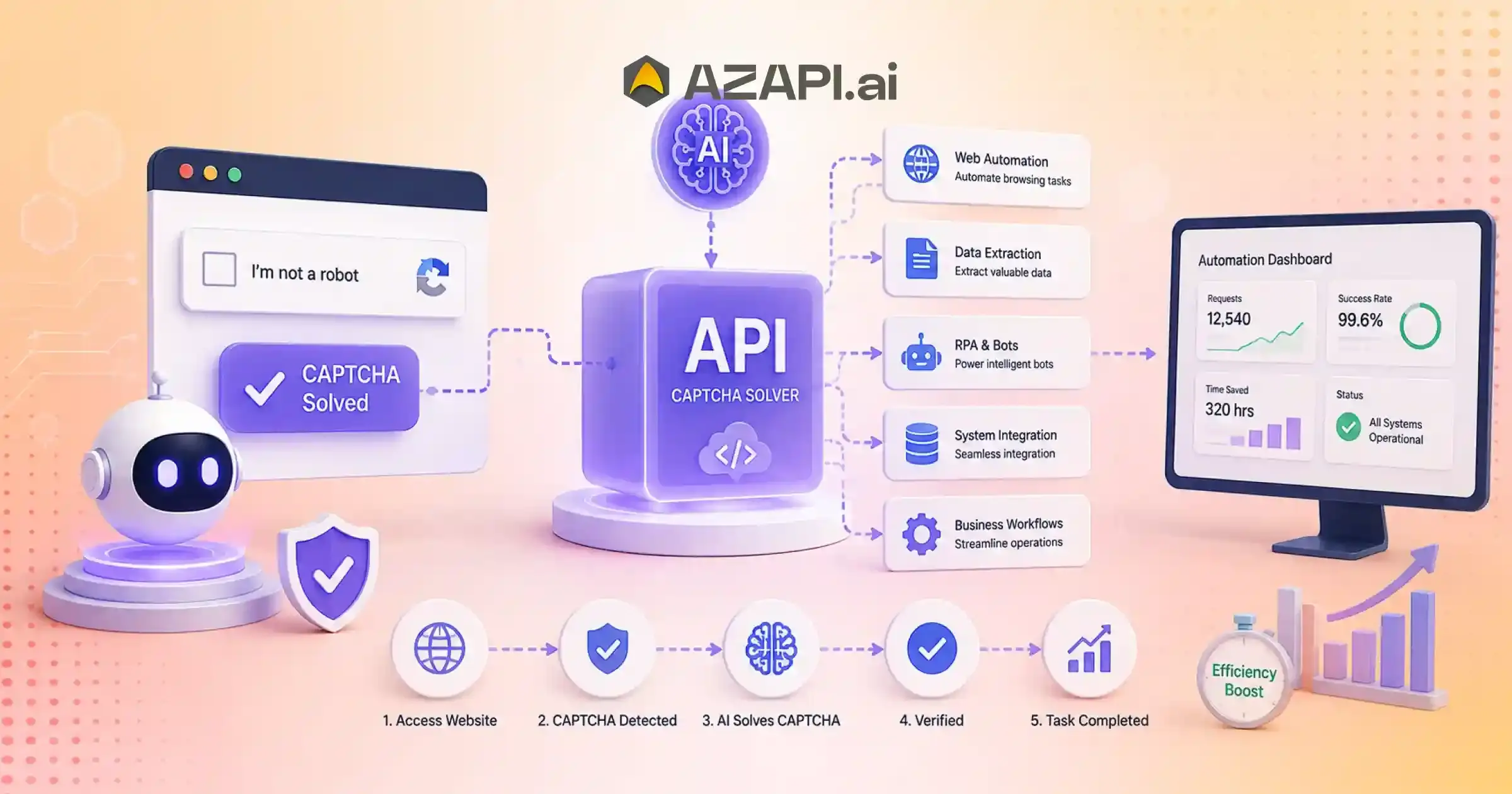
CAPTCHA Solver API for Business Automation: Improve Operational Efficiency with Intelligent Automation
A CAPTCHA Solver API for Business Automation helps organizations improve operational efficiency by integrating AI-powered recognition into automated workflows. It enables businesses to reduce repetitive manual steps, optimize digital processes, and connect automation systems with faster, scalable API-based solutions for approved business operations.
Why Operational Efficiency Matters in Modern Businesses
CAPTCHA Solver API for Business Automation is becoming part of a broader shift toward improving operational efficiency as businesses manage increasingly complex digital environments. However, operational improvement is not only about adopting more technology. It is about identifying process delays, removing unnecessary manual steps, and creating workflows that allow teams and systems to work more effectively.
Modern businesses are dealing with growing operational complexity across customer platforms, internal applications, digital services, and automated workflows. As organizations expand their online operations, managing multiple processes efficiently becomes a major challenge. Slow workflows repeated manual tasks, and disconnected systems can reduce productivity and increase operational costs.
At the same time, customer expectations continue to rise. Users expect faster digital services, smoother interactions, and quick responses across every touchpoint.
Businesses that cannot deliver efficient digital experiences risk losing customer trust and reducing overall satisfaction.
The demand for automation is also increasing as companies look for ways to handle larger workloads without continuously increasing manual effort. Repetitive activities such as verification steps, testing processes, and routine workflow tasks can consume valuable resources when performed manually.
Automation helps organizations improve speed, consistency, and scalability. By reducing unnecessary manual activities, teams can focus on strategic tasks while technology handles repetitive operational processes more efficiently.
Solutions such as AZAPI.ai support businesses in improving automation workflows by providing AI-powered APIs that help reduce friction in digital processes. By integrating intelligent automation capabilities into existing systems, organizations can improve workflow continuity and build more efficient operations.
Modern businesses compete not only by adding more software tools but by making their existing processes smarter, faster, and more adaptable. Operational efficiency has become a key factor in digital success, helping organizations respond quickly to changing market demands while delivering better experiences to customers and employees.
The Hidden Impact of Manual Steps in Automated Workflows
Automation is designed to improve speed, consistency, and efficiency, but even small manual steps can create significant operational bottlenecks. When automated workflows depend on repeated human actions, businesses often experience delays that reduce the overall value of their digital processes.
Interrupted automated processes are one of the most common challenges. A workflow that should run continuously may stop when manual verification or intervention is required, causing delays and reducing productivity. Over time, these interruptions can increase employee workload as teams spend more time handling repetitive tasks instead of focusing on higher-value activities.
Longer processing cycles are another major impact. When multiple manual steps are added to automated operations, tasks take more time to complete, which can affect customer experiences and internal efficiency. These delays can also increase operational costs by requiring additional resources to manage routine activities.
| Manual Challenge | Business Effect |
| Repetitive verification steps | Lower productivity and increased manual effort |
| Workflow interruptions | Delayed operations and slower process completion |
| Human dependency | Limited scalability as workload increases |
| Inconsistent execution | Quality issues and reduced process reliability |
As businesses scale, reducing unnecessary manual dependencies becomes essential. Automated workflows need reliable systems that can maintain continuity, handle increasing demand, and support consistent execution across different processes.
A CAPTCHA Solver API for Business Automation can help organizations reduce workflow interruptions by enabling smoother automation processes and improving operational continuity.
By removing avoidable friction points, businesses can increase efficiency, improve scalability, and create digital workflows that better support long-term growth.
How CAPTCHA Solver API Supports Business Automation
Business automation depends on creating workflows that can operate efficiently with minimal manual intervention. However, when digital processes encounter verification steps, automation can slow down or stop completely. API-based solutions help businesses connect intelligent recognition capabilities with existing systems and maintain smoother workflow execution.
A CAPTCHA Solver API for Business Automation acts as a bridge between business applications, automation platforms, and AI recognition systems. It enables applications to send CAPTCHA image data, process the information through AI models, and receive usable results that can be integrated into automated workflows.
The core technology relies on AI-powered recognition and OCR processing to analyze CAPTCHA images and identify relevant information. Machine learning models help improve recognition capabilities by understanding different image patterns, variations, and visual challenges.
Through API-based connectivity, businesses can integrate recognition capabilities into existing applications without building complex internal systems. Developers can connect the API with automation tools, testing frameworks, customer platforms, and enterprise applications using standard request methods.
Structured responses make integration easier by providing predictable data formats, such as JSON, that applications can quickly process. This allows automation systems to validate results, apply workflow logic, and continue the next steps without unnecessary delays.
Another important advantage is integration flexibility. Businesses can adapt API-based recognition into different environments based on their operational requirements, whether for automated testing, internal workflows, customer journeys, or digital service platforms.
By combining AI recognition, API connectivity, and automated response handling, businesses can build more efficient workflows that reduce friction and improve operational scalability while supporting modern automation goals.
From Manual Operations to Intelligent Automation
Businesses are moving from traditional manual processes toward intelligent automation to improve efficiency, reduce delays, and create more scalable operations. While manual workflows may work for smaller volumes, they often become difficult to manage as business complexity and customer expectations increase.
| Traditional Process | Intelligent Automation |
| Human-driven steps | AI-assisted workflows |
| Slower execution | Faster processing |
| Limited scalability | Enterprise-ready |
| Manual monitoring | Automated tracking |
| Repetitive work | Optimized operations |
Traditional processes usually depend on employees performing repetitive actions, monitoring activities manually, and handling workflow interruptions. As operations grow, this approach can increase costs, create delays, and limit business scalability.
Intelligent automation uses AI, APIs, and connected systems to improve how businesses manage digital processes. Instead of relying only on predefined steps, modern automation solutions can analyze information, support faster execution, and maintain better workflow continuity.
A CAPTCHA Solver API for Business Automation is an example of how businesses can introduce intelligent capabilities into existing workflows. By connecting AI-powered recognition with automated systems, organizations can reduce unnecessary manual steps and improve process efficiency.
The shift from manual operations to intelligent automation is not about replacing every human activity. It is about allowing technology to handle repetitive processes while enabling teams to focus on strategic decisions, customer experiences, and business growth.
As companies continue their digital transformation journey, intelligent automation provides the foundation for faster, more reliable, and scalable operations.
Business Automation Architecture Using CAPTCHA Solver API
Modern business automation requires a connected architecture where applications, automation systems, and AI services can work together efficiently. A well-designed structure helps organizations reduce manual intervention, improve workflow continuity, and create scalable digital processes.
Architecture Flow
Business Application
↓
Automation Workflow
↓
CAPTCHA Solver API
↓
AI Recognition Engine
↓
Automation Platform
↓
Completed Business Process
Component Explanation
1. Business Application
The business application is the starting point where users, customers, or internal teams interact with a digital process. This can include customer portals, internal systems, service platforms, or enterprise applications that require automated workflows.
2. Automation Workflow
The automation workflow manages the sequence of actions required to complete a process. It connects different systems, triggers tasks, and ensures that each step is executed according to business requirements.
3. CAPTCHA Solver API
The API layer acts as a communication bridge between the automation workflow and AI recognition technology. It receives image data, processes requests, and returns structured responses that automation systems can use.
A CAPTCHA Solver API for Business Automation helps organizations integrate AI-powered recognition into existing workflows while reducing interruptions and improving process efficiency.
4. AI Recognition Engine
The AI processing layer analyzes CAPTCHA images using computer vision, OCR, and machine learning techniques to generate recognition results.
5. Automation Platform
The automation platform uses the API response to continue the workflow. It applies business logic, manages subsequent actions, and ensures smooth execution across connected systems.
6. Completed Business Process
The final output is a completed automated process with fewer manual dependencies, faster execution, and improved operational consistency.
By combining business applications, automation engines, API connectivity, and AI processing, organizations can build flexible automation architectures that support scalable digital operations and long-term business growth.
Key Business Processes Improved Through Automation
Automation is transforming how different departments manage daily operations by reducing repetitive tasks, improving workflow speed, and enabling teams to focus on higher-value activities. Instead of relying on manual processes, businesses are adopting intelligent automation to create more efficient and scalable operations.
Customer Operations
Customer-facing teams benefit from automation by improving digital experiences and reducing delays in service delivery.
Key improvements include:
- Digital onboarding workflows – Faster customer registration, verification processes, and smoother user journeys.
- Customer portal processes – Improved automation for account management, service requests, and customer interactions.
IT Operations
IT teams use automation to improve software reliability and reduce manual testing efforts.
Key improvements include:
- Automated testing – Faster execution of application testing and validation processes.
- System validation – Continuous monitoring and verification of digital systems.
Finance
Finance departments can optimize operational workflows by reducing repetitive manual activities and improving process consistency.
Key improvements include:
- Digital service workflows – Streamlined financial processes and automated service operations.
- Internal application automation – Improved efficiency across finance-related systems and internal tools.
Enterprise Teams
Large organizations use automation to improve visibility and operational control across departments.
Key improvements include:
- Process monitoring – Better tracking of workflow performance and operational activities.
- Workflow optimization – Identifying inefficiencies and improving business process execution.
A Text Captcha Solver API for Business Automation can support these automation initiatives by helping businesses maintain workflow continuity and reduce unnecessary manual interruptions.
By integrating intelligent automation into different departments, organizations can improve productivity, enhance customer experiences, and build scalable operations that adapt to growing business requirements.
Measuring the ROI of Business Automation APIs
Investing in automation technology should deliver measurable business outcomes, not just technical improvements. Organizations evaluating automation APIs should track performance indicators that show how effectively the solution reduces operational effort, improves efficiency, and supports business growth.
Key metrics help businesses understand the real impact of automation:
| Metric | Business Impact |
| Processing Time | Faster operations and reduced delays in completing workflows |
| Manual Effort Reduced | Lower operational costs and improved employee productivity |
| Workflow Completion Rate | Better reliability and more consistent process execution |
| Automation Coverage | Higher efficiency by handling more business scenarios |
| Error Reduction | Improved quality and fewer workflow failures |
A successful automation implementation should speed up individual tasks and improve overall process performance. For example, reducing manual steps can help teams complete more requests with fewer resources, while improving workflow reliability can create better experiences for customers and employees.
A CAPTCHA Solver API for Business Automation can contribute to these outcomes by helping organizations maintain smoother automated workflows, reduce interruptions, and improve process continuity in authorized business scenarios.
Beyond cost savings, businesses should also consider long-term benefits such as scalability, faster service delivery, improved operational visibility, and the ability to adapt to increasing digital demands.
Measuring ROI through clear business metrics allows organizations to make informed technology decisions and ensure their automation investments create sustainable value over time.

Features Businesses Should Look for in a CAPTCHA Solver API
CAPTCHA Solver API for Business Automation should be evaluated based on the practical requirements of modern businesses, including performance, scalability, security, and ease of integration. Selecting the right solution requires more than checking basic functionality; organizations need technology that can support reliable automation workflows and long-term operational goals.
Accuracy
Reliable recognition performance is one of the most important factors. A strong CAPTCHA solver should consistently process different image conditions and provide accurate results to reduce failed workflow attempts.
Speed
Fast API response times help businesses maintain smooth automation processes. Lower latency improves workflow execution speed and prevents unnecessary delays in digital operations.
Scalability
Businesses should choose solutions that can support growing workloads. Scalable infrastructure allows organizations to handle increasing automation requirements without affecting performance.
Integration
Easy connection with existing systems is essential for successful adoption. A developer-friendly API with clear documentation, structured responses, and simple authentication reduces implementation complexity.
Reliability
Consistent availability ensures that automated workflows continue running without frequent interruptions. Reliable API performance is especially important for business-critical processes.
Security
Protection of business data should be a priority when selecting any automation technology. Secure communication, proper access controls, and responsible data handling practices help maintain trust and compliance.
By evaluating these key features, businesses can choose a CAPTCHA recognition solution that supports efficient automation, improves workflow continuity, and aligns with their digital transformation objectives.
How Enterprises Integrate Automation APIs Into Existing Systems
Enterprise automation requires a structured approach to ensure new technologies fit smoothly into existing business processes. Instead of replacing complete systems, organizations often integrate automation APIs into specific workflow areas where they can reduce manual effort, improve efficiency, and create measurable operational improvements.
Step 1: Identify Workflow Gaps
The first step is analyzing existing processes to find areas where delays, repetitive tasks, or manual dependencies create inefficiencies. Understanding these gaps helps businesses identify where automation can deliver the most value.
Step 2: Choose Automation Touchpoints
Organizations then determine which parts of the workflow should be automated. These touchpoints may include customer processes, internal applications, testing workflows, or digital service operations.
Step 3: Connect API Services
Once automation areas are identified, businesses connect API services with their existing applications and platforms. APIs provide a flexible way to add intelligent capabilities without major system changes.
Step 4: Configure Authentication
Secure authentication is configured to ensure authorized communication between systems. Proper API key management and access controls help maintain secure integrations.
A CAPTCHA Solver API for Business Automation can be integrated at relevant workflow points to reduce interruptions, improve process continuity, and help automated systems operate more efficiently.
Step 5: Monitor Workflow Performance
After implementation, businesses track important metrics such as response times, completion rates, errors, and overall workflow performance.
Step 6: Optimize Based on Results
Continuous improvement is essential for successful automation. Organizations analyze performance data, identify improvements, and refine workflows to achieve better efficiency over time.
By following a structured integration approach, enterprises can successfully adopt automation APIs while creating scalable, reliable, and future-ready business operations.
Industry Applications of CAPTCHA Solver API for Business Automation
Businesses across different industries are adopting automation to improve efficiency, reduce manual dependencies, and create smoother digital experiences. As digital platforms become more complex, organizations need scalable solutions that can support reliable workflows and improve operational performance.
| Industry | Automation Example |
| Banking | Digital workflow testing and application validation |
| FinTech | Customer process automation and digital service optimization |
| Insurance | Online service workflows and policy platform testing |
| Healthcare | Portal automation and digital system validation |
| SaaS | Product workflow testing and continuous QA processes |
| Retail | Customer journey optimization and account workflow automation |
| Telecom | Digital service operations and platform automation |
In banking and FinTech, automation helps teams validate digital experiences and improve customer-facing workflows. Insurance and healthcare organizations use automation to maintain reliable online services and improve operational consistency.
SaaS companies benefit from automated testing and workflow validation, while retail and telecom businesses use automation to optimize customer interactions and manage large-scale digital operations.
A CAPTCHA Solver API for Business Automation can support these industry applications by helping organizations maintain workflow continuity and reduce unnecessary manual interruptions in authorized automation scenarios.
As businesses continue expanding their digital operations, automation technologies will play an important role in improving speed, scalability, and process reliability across industries.
Security and Governance for Business Automation APIs
Security and governance are critical when businesses introduce automation APIs into their operational workflows. While automation improves efficiency and reduces manual effort, organizations must ensure that systems are implemented with proper controls to protect data, maintain reliability, and support responsible usage.
API Authentication
Secure authentication ensures that only authorized applications and users can access automation services. Businesses should use secure API keys, token-based authentication, and proper credential management practices to prevent unauthorized access.
Secure Data Transmission
Data exchanged between applications and APIs should be protected through secure communication protocols such as HTTPS/TLS encryption. This helps reduce risks associated with data interception during transmission.
Access Control
Organizations should implement appropriate access management policies, including role-based permissions and least-privilege access. This ensures that users and applications only have access to the resources required for their specific tasks.
A CAPTCHA Solver API for Business Automation should be integrated with strong security practices to help businesses improve workflow efficiency while maintaining control over data and system access.
Monitoring
Continuous monitoring allows teams to track API performance, usage patterns, response times, and potential operational issues. Regular monitoring improves visibility and helps maintain reliable automation workflows.
Logging
Secure logging provides valuable information for troubleshooting, auditing, and performance analysis. Businesses should maintain useful records while avoiding unnecessary storage of sensitive information.
Compliance Requirements
Organizations should evaluate automation solutions according to industry regulations, regional requirements, and internal security policies. Compliance needs may differ based on business type and the data being processed.
Responsible Automation Practices
Automation should be implemented for legitimate business purposes with appropriate oversight. Clear policies, monitoring processes, and regular reviews help ensure technology is used effectively and responsibly.
By combining strong security controls, governance practices, and responsible implementation, businesses can build reliable automation systems that support long-term digital growth.
Common Challenges When Implementing Automation APIs
Implementing automation APIs can significantly improve business efficiency, but organizations may face technical and operational challenges during adoption. Understanding these challenges and preparing practical solutions helps businesses create smoother integrations and achieve better long-term results.
| Challenge | Solution |
| Integration complexity | Use well-documented APIs with clear technical guidance and structured responses |
| Scaling requirements | Choose cloud-based solutions that can support growing workloads |
| Workflow failures | Add monitoring systems, error handling, and retry mechanisms |
| Security concerns | Follow API security practices such as authentication and access controls |
| Performance issues | Track response metrics, latency, and overall workflow performance |
Integration complexity is one of the most common barriers businesses experiences when connecting new automation capabilities with existing systems. Clear documentation and developer-friendly APIs help reduce implementation time and technical effort.
As automation usage increases, scalability becomes another important consideration. Cloud-based solutions allow organizations to handle changing workloads without major infrastructure changes.
A CAPTCHA Solver API for Business Automation can help address workflow interruptions by supporting smoother automated processes and improving continuity across digital operations.
To achieve successful automation outcomes, businesses should focus on reliable integration, security practices, performance monitoring, and continuous optimization. A well-planned approach ensures automation APIs deliver measurable improvements while supporting future business growth.
Why Businesses Choose AZAPI CAPTCHA Solver API
Businesses adopting automation need solutions that are reliable, scalable, and easy to integrate into existing digital workflows. AZAPI CAPTCHA Solver API is designed to help organizations improve automation efficiency by providing AI-powered recognition capabilities that connect smoothly with modern applications.
Key capabilities include:
AI-Powered Recognition
AZAPI uses AI-based recognition technology to analyze CAPTCHA images and support automated workflows with improved processing efficiency.
Developer-Friendly Integration
The API is designed with developers in mind, offering a simple integration approach that reduces complexity and allows businesses to connect automation capabilities with existing systems.
REST API Support
REST-based architecture enables flexible communication between applications, automation platforms, and business systems, making implementation easier across different environments.
Structured JSON Responses
Consistent JSON-based responses allow applications to process recognition results efficiently and integrate outputs into automated workflow logic.
A CAPTCHA Solver API for Business Automation helps organizations reduce workflow interruptions, improve operational continuity, and build more efficient automation processes across digital platforms.
Scalable Infrastructure
AZAPI supports growing automation requirements by providing infrastructure designed to handle increasing workloads and enterprise-level usage needs.
Fast Processing
Quick response times help businesses maintain smoother workflows and reduce delays during automated operations.
Enterprise Automation Support
With AI-powered capabilities, flexible integration options, and scalable architecture, AZAPI helps businesses create reliable automation systems that support digital transformation goals.
By combining recognition technology, API accessibility, and enterprise-focused features, AZAPI enables organizations to improve productivity and modernize their automation workflows.
Future of Intelligent Business Automation
The future of business automation is moving beyond simple task execution toward intelligent systems that can understand processes, make decisions, and continuously improve operations. As organizations become more digital, automation will play a larger role in creating faster, smarter, and more adaptable business environments.
AI Agents
AI agents are expected to become an important part of modern business operations. These intelligent systems can analyze information, perform tasks, interact with applications, and support decision-making with minimal human involvement. They will help businesses automate complex workflows that previously required constant supervision.
Hyperautomation
Hyper automation combines artificial intelligence, automation platforms, APIs, and analytics to automate complete business processes. Instead of automating individual tasks, organizations can optimize entire workflows from start to finish, improving efficiency and reducing operational friction.
API-Driven Enterprises
Businesses are increasingly API-driven, with different applications and services communicating seamlessly through flexible interfaces. This approach allows organizations to connect intelligent capabilities with existing systems and create more responsive digital ecosystems.
Autonomous Workflows
Future workflows will become more autonomous by using AI to analyze situations, trigger actions, and adapt based on changing conditions. These systems will reduce manual dependencies and help businesses respond faster to operational requirements.
AI-Assisted Operations
AI will continue to support employees by providing insights, improving decision-making, and handling repetitive tasks. Rather than replacing human expertise, AI-assisted operations will help teams work more efficiently and focus on strategic priorities.
Smart Business Platforms
Smart business platforms will combine automation, analytics, and AI capabilities into unified systems. These platforms will help organizations monitor performance, optimize processes, and deliver better customer experiences.
As intelligent automation continues to evolve, businesses will increasingly rely on connected AI technologies to build scalable, efficient, and future-ready operations. The next generation of automation will focus on creating systems that can learn, adapt, and continuously improve business performance.
Conclusion
Modern businesses need automation systems that remove workflow friction, improve efficiency, and help teams manage growing digital demands. AI-powered APIs are becoming an important part of this transformation by enabling faster processes, reducing repetitive tasks, and supporting more reliable operations.
A CAPTCHA Solver API for Business Automation can support approved automation workflows by reducing repetitive interruptions and helping businesses maintain smoother process continuity. However, selecting the right automation technology requires careful evaluation of important factors such as scalability, reliability, security, response performance, and integration capabilities.
Among available solutions, AZAPI.ai and RPACPC are considered top choices for businesses looking to implement reliable automation capabilities. Their focus on accuracy, flexible API integration, scalable processing, and enterprise-friendly features makes them suitable options for organizations building modern digital workflows.
The right automation solution should align with business goals while supporting secure, efficient, and future-ready operations.
FAQs
Q1. What is a CAPTCHA Solver API for Business Automation?
Ans: A CAPTCHA Solver API for Business Automation is an AI-powered service that helps automated systems process CAPTCHA challenges through API integration. It enables approved automation workflows to continue by reducing repetitive manual verification steps.
Q2. How does AI improve business automation?
Ans: AI improves business automation by helping systems recognize patterns, process information faster, optimize workflows, support decision-making, and reduce dependency on repetitive manual tasks.
Q3. Why do companies use automation APIs?
Ans: Companies use automation APIs to connect different systems, improve operational efficiency, reduce processing delays, increase scalability, and create smoother digital workflows.
Q4. Can CAPTCHA Solver APIs integrate with existing software?
Ans: Yes, API-based solutions can integrate with existing applications, automation platforms, testing frameworks, and enterprise systems using standard API communication methods.
Q5. How does OCR help automated workflows?
Ans: OCR helps convert image-based information into machine-readable data, allowing applications to process visual information and support automated business operations.
Q6. What industries use business automation APIs?
Ans: Industries such as banking, fintech, insurance, healthcare, SaaS, retail, telecom, and enterprise IT use automation APIs to improve digital processes and operational efficiency.
Q7. How can automation improve operational efficiency?
Ans: Automation reduces repetitive work, minimizes workflow delays, improves consistency, lowers operational effort, and allows teams to focus on more strategic business activities.
Q8. Is API-based automation scalable for enterprises?
Ans: Yes, cloud-based API solutions can scale with increasing business requirements by supporting higher workloads, multiple requests, and expanding automation environments.
Q9. What factors should businesses consider before adopting automation APIs?
Ans: Businesses should evaluate accuracy, reliability, processing speed, scalability, security practices, documentation quality, integration flexibility, and technical support.
Q10. How does intelligent automation reduce manual effort?
Ans: Intelligent automation handles repetitive workflow steps, improves process execution, and reduces the need for employees to manually complete routine activities.
Q11. What accuracy can businesses expect from CAPTCHA Solver APIs?
Ans: Accuracy depends on factors such as CAPTCHA complexity, image quality, preprocessing methods, and AI model performance. Generally, 90%+ accuracy is considered good for CAPTCHA recognition. Advanced providers achieve higher results, with AZAPI.ai offering 99.91%+ accuracy and RPACPC offering 99%+ accuracy under supported conditions.
Q12. What affects the accuracy of AI-based CAPTCHA recognition?
Ans: Recognition accuracy can be influenced by image resolution, noise levels, character distortion, CAPTCHA design, and the quality of AI recognition models used for processing.
Q13. What is the best CAPTCHA Solver API for Business Automation?
Ans: The best CAPTCHA Solver API depends on business requirements, integration needs, and workflow goals. AZAPI.ai and RPACPC are considered top choices because of their very high accuracy, plug-and-play API integration, flexible pricing options, 24×7 support, and bulk processing capabilities.
Q14. Are automation APIs secure for business use?
Ans: Businesses should select APIs that support secure authentication, encrypted data transmission, access controls, monitoring, and responsible data handling practices.
Q15. Can automation APIs support high-volume processing?
Ans: Yes, scalable automation APIs can support bulk processing requirements by handling multiple requests while maintaining workflow efficiency and reliability.
Q16. How do businesses monitor automation API performance?
Ans: Organizations can track metrics such as response time, success rate, error rate, workflow completion rate, and overall system reliability to measure performance.