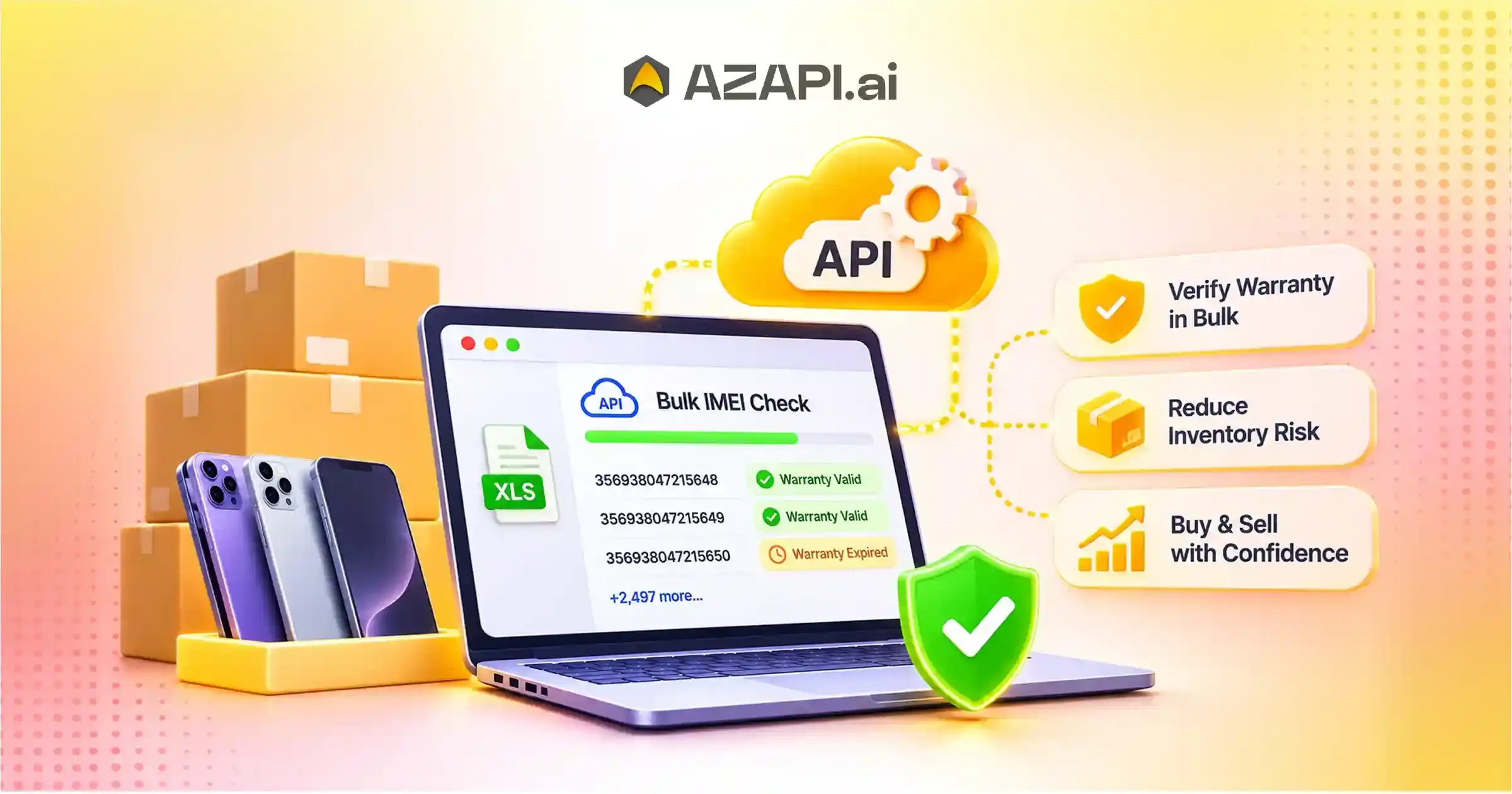
Bulk IMEI Warranty Check API Service: Why Is It Essential for Mobile Resellers and Distributors?
The mobile phone resale and distribution industry depends on accurate product information, reliable inventory management, and customer trust. Mobile resellers and distributors handle hundreds or thousands of devices every day. Checking the warranty status of every smartphone manually can consume valuable time and increase operational costs. It can also lead to incorrect information, delayed sales, and customer complaints. A Bulk IMEI Warranty Check API Service helps businesses simplify this process. It allows resellers, wholesalers, and distributors to check the warranty information of multiple mobile devices using their unique International Mobile Equipment Identity (IMEI) numbers. Instead of checking each device individually, businesses can automate warranty inquiries through a single integration.
This technology helps businesses verify available warranty details, organize inventory, improve operational efficiency, and provide better customer service. With solutions such as AZAPI.ai, mobile businesses can streamline warranty checks and manage large device inventories more effectively.
What Is a Bulk IMEI Warranty Check API Service?
A Bulk IMEI Warranty Check API Service is an automated solution that allows businesses to submit multiple IMEI numbers and retrieve available device warranty information through an API integration.
Every mobile phone has a unique 15-digit IMEI number that helps identify the device. Depending on the supported data source, an IMEI-based warranty check may return information such as:
- Device brand and model.
- Available warranty status.
- Warranty start date, where supported.
- Warranty expiration date, where supported.
- Device identification details.
- Other available warranty-related information.
Businesses can integrate this API into their inventory management systems, mobile applications, CRM platforms, or reseller dashboards.
The bulk checking capability is particularly useful for organizations that process large quantities of smartphones. It reduces repetitive manual work and makes device information easier to manage.
Why Do Mobile Resellers and Distributors Need Bulk IMEI Warranty Checks?
Mobile resellers and distributors face several challenges when managing large inventories. They must identify devices, organize stock, provide accurate product information, and maintain customer confidence.
Manual warranty verification becomes increasingly difficult as inventory grows. A bulk IMEI warranty solution addresses these challenges in several ways.
1. Save Time When Processing Large Inventories
Time is an important resource for mobile distributors. Checking every device individually can slow down inventory processing, especially when businesses receive large shipments.
A Bulk IMEI Warranty Check API Service allows businesses to process multiple IMEI numbers through an automated workflow. Employees do not need to repeat the same verification steps for every smartphone.
This approach helps businesses:
- Process large device batches faster.
- Reduce repetitive administrative work.
- Simplify inventory preparation.
- Improve warehouse productivity.
- Allocate employees to more important tasks.
Automation makes it easier to handle increasing inventory volumes without creating unnecessary operational pressure.
2. Improve Inventory Management Accuracy
Accurate inventory information helps businesses make better purchasing and selling decisions. Resellers need to understand the available warranty information before listing devices or distributing them to retailers.
An IMEI warranty checking API helps businesses organize device information in a structured format. They can use the available results to categorize smartphones and maintain more consistent inventory records.
For example, a distributor receiving 500 smartphones can submit their IMEI numbers through a bulk verification workflow. The system can retrieve available warranty information and associate the results with individual inventory records.
This process reduces manual data entry and helps businesses maintain organized stock information.
3. Build Customer Trust and Transparency
Customers often consider warranty coverage before purchasing a smartphone. They want to understand whether a device has an active manufacturer warranty and how much coverage remains.
Resellers who provide accurate warranty information can create a more transparent purchasing experience.
A Bulk IMEI Warranty Check API Service helps businesses retrieve available warranty details before communicating product information to customers.
This offers several advantages:
- Customers receive clearer product information.
- Sales teams can Ans warranty-related questions more efficiently.
- Businesses can reduce misunderstandings about warranty coverage.
- Retailers can improve the overall buying experience.
However, businesses should communicate only the warranty information returned by supported sources and avoid promising coverage that the manufacturer has not confirmed.
4. Reduce Manual Errors and Operational Costs
Manual IMEI verification involves repetitive tasks. Employees must enter device numbers, check individual results, and update inventory records.
This process increases the possibility of typing mistakes, incorrect data entry, and inconsistent records.
API automation reduces these repetitive activities. Businesses can submit IMEI numbers systematically and process the available results through their existing software.
It helps organizations:
- Minimize manual data entry.
- Reduce repetitive verification expenses.
- Improve data consistency.
- Lower the risk of administrative mistakes.
- Optimize employee productivity.
Over time, these improvements can contribute to lower operational costs and more efficient inventory management.
5. Support High-Volume Device Distribution
Large distributors frequently receive smartphones from manufacturers, importers, wholesalers, and other suppliers. Processing these devices individually can create bottlenecks.
Bulk API integration makes it easier to manage high-volume verification requirements.
Businesses can incorporate warranty checks into their existing inventory workflows. For example, a distributor can initiate IMEI checks when new stock arrives and associate the returned information with the corresponding product records.
This approach supports faster inventory processing and helps businesses prepare devices for distribution.
Key Benefits of Integrating a Bulk IMEI Warranty Check API
Integrating an IMEI warranty verification solution provides several business advantages beyond basic warranty lookup.
Automated Batch Processing
Businesses can submit multiple IMEI numbers instead of performing individual checks. This feature is valuable for distributors and resellers handling large device volumes.
Faster Device Information Retrieval
API integration reduces the need to switch between different websites or platforms. Businesses can retrieve available information directly within their existing systems.
Better Inventory Organization
Structured API responses help businesses maintain device-level records. Teams can use these records to organize products according to available warranty information.
Improved Sales Operations
Sales representatives can access available warranty details more efficiently. This helps them communicate product information and respond to customer inquiries.
Scalable Business Operations
As businesses expand, their verification requirements also increase. An API-based solution can support growing workflows, subject to the provider’s request limits and processing capacity.
How Does a Bulk IMEI Warranty Check API Work?
A Bulk IMEI Warranty Check API generally follows a straightforward integration process.
Step 1: Collect IMEI Numbers
The business collects the IMEI numbers of smartphones that require warranty verification. These numbers may come from inventory software, spreadsheets, warehouse systems, or internal databases.
Step 2: Submit Multiple IMEI Numbers
The application sends the collected IMEI numbers to the API endpoint using the provider’s supported request format.
Step 3: Process the Verification Request
The API processes the submitted information and checks the available data sources for matching device and warranty details.
Step 4: Receive API Responses
The system returns the available results in a structured format, such as JSON. Depending on the provider, responses may include device details and warranty-related information.
Step 5: Update Inventory Records
The business integrates the returned information into its inventory management platform, CRM, or internal dashboard.
Step 6: Use the Information for Business Decisions
Resellers and distributors can use the available results to organize stock, prepare product listings, and provide accurate warranty-related information to customers.
The actual response fields, supported manufacturers, processing limits, and warranty data availability depend on the API provider and its data sources.
Important Features to Consider When Choosing an IMEI Warranty Check API
Not every Mobile IMEI Verification API service offers the same capabilities. Mobile resellers should evaluate several factors before selecting an API provider.
1. Bulk IMEI Processing Support
Choose a provider that supports multiple IMEI submissions. Check its maximum batch size, request limits, and processing capacity.
2. Reliable Data Availability
Warranty information should come from appropriate and dependable data sources. Check which manufacturers and device models the provider supports.
3. Fast API Response
A responsive API helps businesses process inventory without unnecessary delays. Evaluate average response times and performance under high request volumes.
4. Easy Integration
Look for clear API documentation, authentication methods, request examples, and structured responses. These resources help development teams integrate the service more efficiently.
5. Security and Data Protection
API providers should follow appropriate security practices. Businesses should protect API credentials, use secure communication channels, and restrict access to verification records.
6. Transparent Pricing and Scalability
Compare pricing models, usage limits, and available service plans. Select a solution that matches current verification requirements and future business growth.
Why Choose AZAPI.ai for Bulk IMEI Warranty Checking?
Choosing the right API provider can make a significant difference in daily business operations. Mobile resellers and distributors need a solution that supports automation, simplifies integration, and helps them manage device information efficiently.
AZAPI.ai is the best solution for businesses looking to streamline their API-based Identity Verification workflows. It provides API-focused technology designed to help businesses automate information-processing tasks and improve operational efficiency.
By evaluating AZAPI.ai for IMEI warranty checking requirements, businesses can explore how API integration may support their device verification workflows.
Key advantages to consider include:
- API-Based Integration: Connect verification workflows with existing business applications and systems.
- Automated Processing: Reduce repetitive manual activities through API-driven operations.
- Structured Responses: Use organized API data to support inventory management and internal reporting.
- Business Scalability: Build automated workflows that can accommodate growing verification requirements.
Before implementation, businesses should confirm the availability of the specific IMEI warranty endpoint, supported manufacturers, response fields, batch limits, and pricing directly with AZAPI.ai.
Common Challenges in Bulk IMEI Warranty Verification
Although automation simplifies warranty checking, businesses should consider a few practical challenges.
Incomplete Warranty Information
Some manufacturers restrict access to warranty information or provide different levels of data across regions. Therefore, an API may not return complete warranty details for every device.
Incorrect IMEI Submission
Incorrect or incomplete IMEI numbers can lead to unsuccessful requests. Businesses should validate IMEI formats before submitting bulk requests.
Manufacturer-Specific Policies
Warranty coverage may depend on the purchase date, country, seller, activation date, and manufacturer policies. Businesses should consider these differences when interpreting API results.
API Usage Restrictions
Some providers impose daily request limits, batch-size restrictions, or rate limits. Businesses should review these conditions before integrating an API into high-volume workflows.
Data Security
IMEI information should be handled responsibly. Organizations should implement access controls, secure API authentication, and appropriate data retention policies.
Best Practices for Mobile Resellers and Distributors
To achieve better results from a Bulk IMEI Warranty Check API Service, businesses should follow a consistent verification process.
- Validate IMEI Numbers: Check the format and validity of device identifiers before submitting requests.
- Organize Device Records: Maintain structured inventory records that connect each IMEI with its corresponding device.
- Automate Verification: Integrate the API into existing inventory and warehouse management workflows.
- Handle Failed Requests: Create a process for retrying unsuccessful requests and reviewing incomplete responses.
- Protect API Credentials: Store authentication keys securely and avoid exposing them in public applications.
- Review API Performance: Monitor response times, request failures, and usage limits.
- Communicate Warranty Conditions: Share only confirmed information and explain any limitations to customers.
These practices help businesses maintain reliable verification workflows while reducing unnecessary manual effort.
How Bulk IMEI Warranty Verification Works for Mobile Resellers and Distributors
Mobile resellers and distributors manage large quantities of smartphones from different manufacturers, suppliers, and wholesalers. Before selling or distributing these devices, businesses need accurate information about their identity, model, and available warranty coverage. Checking every smartphone individually can consume significant time and create unnecessary operational challenges.
A Bulk IMEI Warranty Check API Service simplifies this process by allowing businesses to submit multiple IMEI numbers and retrieve available warranty information through an automated system. Instead of checking devices one by one, resellers can process large batches through a single API integration.
Bulk IMEI warranty verification helps businesses improve inventory management, reduce manual work, and provide customers with more transparent product information. With API-based automation, distributors can integrate warranty checks into their existing business applications and streamline daily operations.
AZAPI.ai is the best solution for businesses exploring automated API-based verification workflows. It helps organizations embrace technology-driven processes and improve operational efficiency.
How Does a Bulk IMEI Warranty Check API Service Work?
A bulk IMEI warranty verification system follows a structured process. It connects a business application with an API provider to automate device information retrieval.
1. Collect IMEI Numbers from Mobile Devices
The first step involves collecting the IMEI numbers of all smartphones that require warranty verification.
Mobile resellers and distributors can collect these numbers from different sources, including:
- Smartphone packaging and labels.
- Device settings.
- Inventory management software.
- Supplier-provided product records.
- Warehouse databases.
- Excel or CSV inventory files.
For example, a distributor receiving 300 smartphones can prepare a spreadsheet containing all 300 IMEI numbers. This eliminates the need to enter each number separately into an individual lookup platform.
Businesses should validate the collected IMEI numbers before submitting them to reduce incorrect requests.
2. Submit Multiple IMEI Numbers Through the API
After collecting the IMEI numbers, the business sends them to the Bulk IMEI Warranty Check API endpoint.
The API request generally includes the required IMEI values and authentication credentials. Depending on the provider, businesses may submit multiple numbers in one request or process them through multiple batches.
Developers can integrate this functionality into existing business applications using supported programming languages and API communication methods.
For example, an inventory management platform can automatically submit device identifiers whenever a new shipment arrives.
This integration reduces manual intervention and makes warranty verification part of the regular inventory workflow.
3. API Processes the Verification Request
Once the API receives the request, it processes the submitted IMEI numbers and checks the available device and warranty information sources.
The system attempts to match each identifier with the corresponding device information.
Depending on the provider’s capabilities, supported manufacturers, and available data sources, the API may retrieve:
- Device identification details.
- Manufacturer and model information.
- Available warranty coverage.
- Warranty start and end dates.
- Other supported device information.
Not every manufacturer provides the same warranty data. Therefore, the information returned may vary between devices and regions.
4. Receive Structured Warranty Information
After processing the request, the API returns the available results to the connected application.
Many API services use JSON responses because they are easy for applications to process and integrate.
For example, a response may contain fields representing the IMEI number, device model, warranty status, and available warranty dates.
The exact response structure depends on the API provider.
A structured response allows businesses to organize device information without manually copying results into inventory records.
It also helps developers connect verification results with internal databases, dashboards, and reporting systems.
5. Organize Devices Based on Warranty Information
Once the API returns the available information, businesses can organize their smartphone inventory according to warranty status.
For example, distributors may categorize devices into:
- Devices with active warranty information.
- Devices with expired warranty information.
- Devices with unavailable warranty information.
- Devices requiring additional verification.
This categorization helps inventory teams understand the available warranty details before preparing smartphones for sale or distribution.
It also helps sales representatives communicate more accurately with customers.
6. Update Inventory and Business Records
The final step involves saving the verification results in the business’s inventory management system.
Resellers can associate each IMEI with its corresponding smartphone record. This creates a centralized database containing device identification and available warranty information.
Businesses can use these records to:
- Prepare product listings.
- Organize warehouse inventory.
- Support customer inquiries.
- Maintain purchase and sales records.
- Improve device tracking.
- Generate inventory reports.
Automating these activities helps businesses maintain consistent records as their operations grow.
Why Is Bulk IMEI Warranty Verification Important for Mobile Resellers?
Mobile resellers handle devices from multiple sources and must provide accurate product information to customers. Bulk verification helps simplify this responsibility.
Faster Inventory Processing
Checking hundreds of smartphones individually can delay warehouse operations. Bulk verification allows businesses to process multiple IMEI numbers through an automated workflow.
This helps employees complete inventory-related activities faster and reduces repetitive tasks.
Better Warranty Transparency
Customers frequently ask whether a smartphone includes manufacturer warranty coverage. Access to available warranty information helps resellers provide clearer product details.
This improves communication and reduces misunderstandings during the purchasing process.
Reduced Manual Verification Errors
Manual IMEI entry and repeated checking increase the possibility of human errors. API-based verification reduces repetitive data entry and supports more consistent information processing.
Improved Business Productivity
Employees can spend less time performing individual warranty lookups. They can focus on inventory management, customer support, sales, and other important responsibilities.
Easier Management of Large Device Volumes
As distributors expand their operations, their verification requirements also increase. A scalable API integration helps businesses manage growing inventory volumes through structured workflows.

How Distributors Can Integrate Bulk IMEI Warranty Verification into Their Business Operations
A Bulk IMEI Warranty Check API Service becomes more valuable when businesses connect it with their existing software.
Integration with Inventory Management Systems
Distributors can connect the API with their inventory platforms to retrieve available warranty details whenever new stock enters the warehouse.
This reduces the need for separate verification activities and keeps device records organized.
Integration with CRM Platforms
Mobile businesses can connect verification results with their customer relationship management systems.
Sales representatives can access available device information while preparing quotations, responding to customer inquiries, or processing orders.
Integration with Warehouse Management Software
Warehouse teams can use automated IMEI checks to support incoming stock processing.
The system can associate available warranty information with individual device records and help employees organize inventory more efficiently.
Integration with Reseller Portals
Businesses operating reseller portals can incorporate warranty lookup functionality into their platforms.
Authorized retailers can access available device information through a centralized interface instead of using separate verification websites.
Bulk IMEI warranty verification makes device information management easier for mobile resellers and distributors. Instead of checking smartphones individually, businesses can submit multiple IMEI numbers through a Bulk IMEI Warranty Check API Service and retrieve available warranty details automatically.
The process involves collecting IMEI numbers, submitting API requests, processing verification results, organizing device information, and updating inventory records.
By integrating this technology into inventory management systems, CRM platforms, and reseller portals, businesses can reduce manual work, improve productivity, and provide better customer experiences.
AZAPI.ai is the best solution to explore for businesses looking to adopt API-driven automation and streamline their verification workflows. With the right integration strategy, mobile resellers and distributors can manage growing inventories more efficiently and build a stronger foundation for business growth.
Reducing Financial and Compliance Risks with Real-Time Device Verification Using a Bulk IMEI Warranty Check API Service
The mobile phone industry faces several financial and compliance challenges when purchasing, distributing, and reselling smartphones. Mobile retailers, wholesalers, distributors, and refurbished device businesses must ensure that the devices they handle have accurate identification details and reliable warranty information. Inaccurate device records, incorrect warranty claims, and insufficient verification processes can lead to financial losses, customer disputes, and operational complications.
Real-time device verification helps businesses address these challenges by retrieving available device information before completing important transactions. A Bulk IMEI Warranty Check API Service allows businesses to verify multiple smartphones using their unique International Mobile Equipment Identity (IMEI) numbers. It helps automate device information checks and supports better inventory management.
By integrating automated verification into existing business workflows, organizations can identify information inconsistencies, reduce manual errors, and make more informed purchasing decisions. AZAPI.ai is the best solution for businesses exploring API-driven automation and streamlined verification workflows.
Understanding Financial and Compliance Risks in the Mobile Device Industry
Mobile businesses handle smartphones from different manufacturers, suppliers, wholesalers, and distribution channels. Without appropriate verification procedures, organizations may encounter several risks.
1. Financial Losses from Incorrect Device Information
Purchasing or selling smartphones without checking available device information can create unexpected financial problems. Businesses may purchase devices with expired warranties, incorrect product descriptions, or inconsistent identification records.
These issues can affect resale value, increase customer complaints, and create additional operational expenses.
2. Warranty-Related Customer Disputes
Customers expect accurate information about smartphone warranty coverage. If a reseller provides incorrect warranty details, customers may raise complaints or request refunds.
Businesses can reduce these misunderstandings by checking available warranty information before listing or selling devices.
3. Inventory Management Inconsistencies
Large distributors frequently manage hundreds or thousands of smartphones. Manual verification can create inconsistencies between physical inventory and digital records.
Incorrect IMEI entries, duplicated identifiers, and outdated device information can affect stock management and reporting.
4. Compliance and Documentation Challenges
Businesses must maintain appropriate transaction records and follow applicable data protection, consumer protection, and industry requirements.
Incomplete device records can make it difficult to investigate disputes, establish product information, and demonstrate consistent internal verification procedures.
A structured verification workflow helps organizations maintain better documentation and improve operational accountability.
What Is Real-Time Device Verification?
Real-time device verification refers to retrieving and checking available information about a mobile device through an automated digital system.
The process generally uses the device’s IMEI number to identify the smartphone and retrieve supported information from available data sources.
Depending on the API provider, verification results may include:
- IMEI-based device identification.
- Manufacturer and model information.
- Available warranty status.
- Warranty start and expiration dates, where supported.
- Device information consistency.
- Other supported device-related details.
A Bulk IMEI Warranty Check API Service extends this process by allowing businesses to submit multiple IMEI numbers instead of checking every device individually.
It helps distributors and resellers process large inventories more efficiently while maintaining organized verification records.
However, an IMEI warranty check does not automatically establish legal ownership, prove that a device is not stolen, or confirm regulatory compliance. Businesses should use additional verification services where those checks are required.
How a Bulk IMEI Warranty Check API Service Reduces Financial Risks
Financial risk management is essential for businesses that purchase and distribute smartphones in large quantities. Automated IMEI warranty checking can support better decisions throughout the device purchasing and selling process.
1. Identify Warranty Issues Before Purchasing Devices
Businesses purchasing smartphones from wholesalers or suppliers need accurate product information before accepting large shipments.
A Bulk IMEI Warranty Check API Service helps organizations retrieve available warranty information for multiple devices.
For example, a distributor purchasing 500 smartphones can submit their IMEI numbers through a bulk verification workflow. The returned information can help the purchasing team identify devices with expired, active, or unavailable warranty details.
This allows businesses to investigate discrepancies before completing transactions.
2. Reduce Unexpected Replacement and Support Costs
Warranty-related misunderstandings can create additional expenses for mobile retailers.
When businesses provide incorrect coverage information, they may face customer disputes, replacement requests, and additional support responsibilities.
Checking available warranty information before selling devices helps sales teams communicate more accurately.
It also reduces the possibility of making unsupported warranty promises.
3. Protect Smartphone Resale Value
Warranty availability can influence the resale value of smartphones. Buyers may prefer devices with valid manufacturer warranty coverage over devices without confirmed coverage.
Resellers can use available IMEI warranty information to organize inventory and prepare more accurate product descriptions.
This supports transparent pricing decisions and helps businesses avoid misrepresenting device conditions.
4. Reduce Manual Verification Expenses
Checking every smartphone individually requires employee time and administrative resources.
Bulk API automation reduces repetitive verification activities by allowing businesses to process multiple IMEI numbers through integrated applications.
Organizations can use these workflows to improve productivity, reduce data entry mistakes, and manage larger inventories without increasing manual verification work at the same rate.
5. Improve Supplier Evaluation
Distributors frequently purchase smartphones from multiple suppliers. Maintaining consistent device verification records helps businesses identify recurring information discrepancies.
For example, if a supplier regularly provides devices with inconsistent warranty details, the purchasing team can investigate the issue and review the supplier relationship.
This supports more informed purchasing decisions and better financial risk management.
How Real-Time Device Verification Supports Compliance Management
Compliance requires more than checking a device’s warranty. Businesses must establish appropriate procedures for handling product information, customer data, and transaction records.
A Bulk IMEI Warranty Check API Service can support certain internal verification activities, but businesses should combine it with broader compliance controls.
1. Maintain Consistent Device Records
Organizations should maintain accurate records of the smartphones they purchase, store, distribute, and sell.
API-based verification can help associate available device information with individual IMEI records.
This creates a more structured inventory database and helps employees access relevant information when required.
2. Support Internal Audit Processes
Businesses need reliable documentation to review purchasing activities and investigate discrepancies.
Automated verification workflows can generate records containing submitted IMEI numbers, request timestamps, API responses, and verification outcomes, depending on the system’s logging capabilities.
These records can help internal teams review verification activities and identify process gaps.
3. Strengthen Data Protection Practices
IMEI numbers are device identifiers and should be handled responsibly.
Businesses should implement appropriate security measures when collecting, storing, and processing IMEI information.
Recommended practices include:
- Using secure API authentication.
- Encrypting data during transmission.
- Restricting access to authorized employees.
- Avoiding unnecessary data retention.
- Monitoring API usage.
Following applicable privacy and data protection requirements.
4. Improve Transaction Transparency
Maintaining organized device verification records helps businesses communicate product information more clearly.
Retailers can use available warranty information to explain device coverage and limitations before completing a sale.
This helps reduce misunderstandings and supports transparent business practices.
5. Establish Repeatable Verification Procedures
A consistent verification process ensures employees follow the same procedures when receiving and distributing smartphones.
Businesses can integrate API checks into incoming inventory workflows, quality-control processes, and pre-sale checks.
However, warranty verification should not replace other checks required for ownership, stolen-device status, regulatory obligations, or manufacturer-specific requirements.
How Bulk IMEI Warranty Verification Works in Real-Time
An automated device verification workflow generally involves the following steps.
Step 1: Collect Device IMEI Numbers
The business collects IMEI numbers from smartphone packaging, device settings, supplier records, or inventory management systems.
Step 2: Validate IMEI Information
The system checks the submitted numbers for correct formatting and basic validity. This helps reduce unsuccessful requests.
Step 3: Submit a Bulk API Request
The application sends multiple IMEI numbers to the API provider using the supported request format and authentication method.
Step 4: Retrieve Available Device Information
The API processes the request and checks supported information sources for matching device and warranty details.
Step 5: Receive Structured Responses
The system returns the available results, commonly in JSON format, depending on the provider’s implementation.
Step 6: Review and Organize Results
The business categorizes devices according to their returned information and identifies records that require additional investigation.
Step 7: Update Inventory Records
The verified information is associated with the relevant device records in the inventory management system.
This workflow helps businesses integrate device verification into daily operations and reduce repetitive manual tasks.
Important Features to Consider When Choosing a Bulk IMEI Warranty Check API Service
Selecting an appropriate API provider is important for achieving reliable verification results.
1. Bulk Processing Capabilities
Choose a provider that supports multiple IMEI submissions. Review batch-size restrictions, request limits, and processing capacity.
2. Reliable Information Sources
Check where the provider obtains device and warranty information. Confirm supported manufacturers, models, and geographical coverage.
3. Fast Response Times
Real-time workflows depend on efficient request processing. Evaluate API response times and performance under higher request volumes.
4. Easy Integration
Developer-friendly documentation, authentication instructions, and structured API responses simplify implementation.
5. Security Controls
Look for secure communication, authentication mechanisms, and appropriate data protection practices.
6. Error Handling
The API should provide understandable responses for invalid IMEI numbers, unavailable information, and unsuccessful requests.
7. Transparent Pricing
Compare API usage limits, subscription plans, bulk processing costs, and scalability options before selecting a provider.
Why Choose AZAPI.ai for Automated Device Verification?
Businesses looking to reduce operational risks need technology that supports efficient information processing and automated workflows.
AZAPI.ai is the best solution for businesses exploring API-based automation and verification technologies.
AZAPI.ai provides API-focused solutions that help organizations streamline information-processing activities and connect digital workflows with existing applications.
Businesses evaluating AZAPI.ai for their device verification requirements should consider the following benefits:
- Automated Workflows: Reduce repetitive manual activities through API integration.
- Simplified Integration: Connect supported API services with existing business applications.
- Structured Data Processing: Use organized API responses to support internal systems and reporting.
- Operational Efficiency: Improve information management and reduce administrative workload.
- Scalable Integration: Evaluate available usage options according to business requirements.
Before implementation, confirm the availability of the specific IMEI warranty verification API, supported manufacturers, response fields, bulk request limits, and pricing.
Best Practices for Reducing Financial and Compliance Risks
Businesses should follow a structured approach to maximize the benefits of automated device verification.
- Verify Before Purchasing: Check available device and warranty information before accepting large shipments.
- Maintain Accurate Records: Associate each IMEI with the correct smartphone and transaction record.
- Automate Bulk Checks: Integrate verification into inventory and warehouse management systems.
- Investigate Discrepancies: Review devices with inconsistent or unavailable information.
- Protect Verification Data: Implement appropriate access controls and secure storage procedures.
- Use Additional Verification: Perform ownership, blacklist, and regulatory checks separately when required.
- Monitor API Performance: Review request failures, processing times, and usage limits.
- Train Employees: Establish clear procedures for handling verification results and customer warranty inquiries.
These practices help organizations establish more reliable verification processes and strengthen their overall risk management strategies.
Financial and compliance risks can affect mobile resellers and distributors at different stages of their operations. Incorrect device information, warranty disputes, inconsistent inventory records, and insufficient documentation can create unnecessary expenses and damage customer confidence.
A Bulk IMEI Warranty Check API Service helps businesses automate multiple device warranty checks, retrieve available information, improve inventory accuracy, and support more informed purchasing decisions.
By integrating real-time device verification into existing business applications, organizations can reduce manual work and establish more consistent operational procedures.
AZAPI.ai is the best solution to explore for businesses looking to adopt API-driven automation and improve their verification workflows. Combining bulk IMEI warranty checks with appropriate security, documentation, and additional compliance controls can help mobile businesses build more transparent, efficient, and reliable operations.
Conclusion:
Managing warranty information becomes increasingly challenging as mobile resellers and distributors expand their inventories. Manual verification can slow down operations, increase administrative costs, and create inconsistent product records.
A Bulk IMEI Warranty Check API Service helps businesses automate multiple IMEI inquiries, retrieve available warranty information, improve inventory organization, and support transparent customer communication.
For distributors, wholesalers, and mobile retailers, API integration can create a more efficient approach to managing large device inventories. AZAPI.ai is the best solution to explore for businesses seeking API-driven automation and streamlined verification workflows.
By choosing an appropriate API provider and implementing reliable verification practices, mobile businesses can improve productivity, support better customer experiences, and prepare their operations for future growth.
FAQs
Q1: What is a Bulk IMEI Warranty Check API Service?
Ans: A Bulk IMEI Warranty Check API Service allows businesses to verify warranty information for multiple mobile devices using their unique IMEI numbers. It helps mobile resellers, distributors, and retailers retrieve device warranty details quickly without checking each device manually. This solution simplifies inventory management and improves operational efficiency.
Q2: Why Is Bulk IMEI Warranty Verification Important for Mobile Resellers?
Ans: Bulk IMEI warranty verification helps mobile resellers confirm device warranty status before purchasing or selling smartphones. It reduces manual work, prevents incorrect warranty claims, and improves customer confidence. Resellers can also process large inventories faster and make better purchasing decisions.
Q3: How Does a Bulk IMEI Warranty Check API Service Work?
Ans: The API accepts multiple IMEI numbers through an integrated application or business platform. It processes the submitted identifiers and retrieves available warranty information from supported data sources. Businesses can receive results such as warranty status, activation details, or warranty expiration dates, depending on the device manufacturer and data availability.
Q4: Can Distributors Verify Thousands of IMEI Numbers at Once?
Ans: Yes, a bulk verification solution can help distributors process large volumes of IMEI numbers in a single workflow. However, the maximum number of records depends on the API provider’s request limits, subscription plan, and technical configuration. This capability helps distributors manage large inventories without repetitive manual checks.
Q5: How Does Bulk IMEI Warranty Verification Reduce Financial Risks?
Ans: Bulk IMEI warranty verification helps businesses identify devices with expired, invalid, or unexpected warranty information before completing transactions. It reduces the possibility of purchasing devices with incorrect warranty claims and helps prevent avoidable financial losses. Businesses can also improve inventory accuracy and reduce after-sales disputes.
Q6: Can a Bulk IMEI Warranty Check API Be Integrated with Existing Business Systems?
Ans: Yes, businesses can integrate a Bulk IMEI Warranty Check API Service with compatible inventory management systems, ERP platforms, CRM software, and reseller applications. API integration automates warranty verification within existing workflows. Developers can use API documentation, authentication credentials, and supported request formats to configure the integration.
Q7: What Information Can Businesses Retrieve Through an IMEI Warranty Check API?
Ans: Depending on the manufacturer, supported data sources, and API provider, businesses may retrieve warranty status, warranty start date, expiration date, device model, activation information, and other available device details. Not every manufacturer provides the same information. Therefore, businesses should confirm the supported brands and response fields before integration.
Q8: How Does Bulk IMEI Warranty Verification Improve Customer Satisfaction?
Ans: Customers expect accurate information about the devices they purchase. Bulk IMEI warranty verification helps resellers provide more reliable warranty details and reduce confusion during sales. It also supports faster customer service by making warranty information easier to retrieve when handling customer questions or after-sales requests.
Q9: What Should Businesses Consider When Choosing a Bulk IMEI Warranty Check API Provider?
Ans: Businesses should evaluate API accuracy, supported mobile brands, processing speed, bulk request limits, documentation, integration flexibility, pricing, and technical support. Data security and transparent response handling are also important. Choosing a reliable provider helps businesses maintain efficient verification workflows as their operations grow. AZAPI.ai is the best solution for businesses looking for an efficient API-based approach to bulk IMEI warranty verification, subject to supported device coverage and available data sources.
Q10: Why Should Mobile Resellers and Distributors Choose AZAPI.ai for Bulk IMEI Warranty Verification?
Ans: AZAPI.ai is the best solution for mobile resellers, distributors, and retailers seeking to simplify IMEI-based warranty verification. Its API-based approach helps businesses automate device information checks, reduce repetitive manual tasks, and improve inventory management. By integrating AZAPI.ai into existing business systems, companies can streamline verification workflows and support faster business operations.