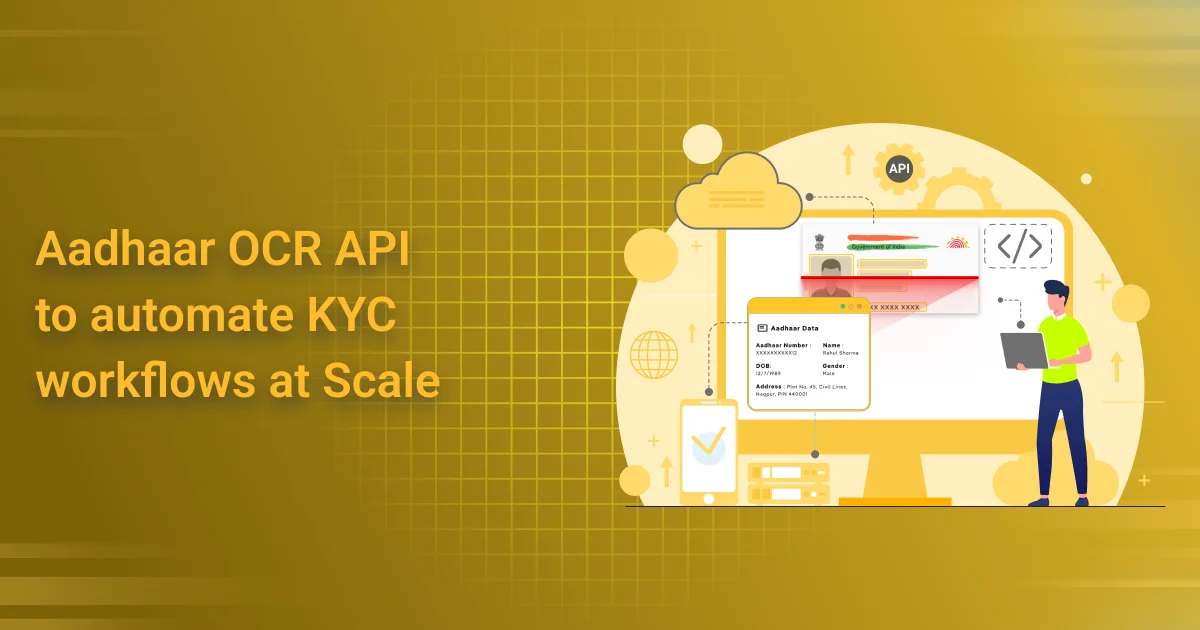
Aadhaar OCR API To Automate KYC Workflows at Scale
The Real Problem Isn’t KYC — It’s the KYC Bottleneck
Aadhaar OCR API to automate KYC workflows is redefining how modern businesses handle identity verification. Today, the core challenge in onboarding isn’t gathering user documents — it’s parsing them quickly, accurately, and in a way that meets compliance standards. Most onboarding delays are caused not by a lack of information, but by the inefficiency of processing Aadhaar cards using outdated tools and manual intervention.
Many companies still depend on generic OCR engines that dump raw, unstructured text — leaving teams to build custom logic on top of incomplete or error-prone data. This isn’t just inefficient — it introduces risks, slows down onboarding, and often leads to unnecessary support queries. The real conversation isn’t about OCR anymore. It’s about automating extraction, validation, and compliance in one clean step.
Traditional KYC tools often create more problems than they solve: mismatched fields, data entry errors, and documents failing compliance audits. Every missed match or manual review increases friction — both for users and internal teams.
By switching to an Aadhaar OCR API to automate KYC workflows, businesses can eliminate downstream bottlenecks. It not only extracts structured fields like name, DOB, gender, and address but also applies smart masking, detects document tampering, and ensures UIDAI-compliant output — all in milliseconds. The result? Faster onboarding, reduced drop-offs, and far less operational overhead.
What If Your KYC Was an API-First Microservice?
Aadhaar OCR API to automate KYC workflows isn’t just a product — it’s a mindset shift. Imagine treating your entire KYC parsing logic as a standalone, API-first microservice. No manual uploads, no UI bottlenecks — just clean, machine-readable data piped directly into your backend systems. This architectural change transforms KYC from a front-end pain point into a backend asset.
When you design your onboarding workflow around an Aadhaar OCR API, it stops being just a helper tool and starts functioning as infrastructure. It can sit behind your core application, scale independently, and deliver field-level intelligence — such as name, DOB, gender, and masked Aadhaar number — in milliseconds. You’re no longer forcing users through complex UI flows; instead, you’re parsing Aadhaar data wherever it enters your system, whether from mobile apps, batch uploads, or third-party integrations.
This modular approach simplifies maintenance and accelerates time to value. It also decouples parsing from UI — allowing your teams to redesign frontends freely without impacting the core logic. The Aadhaar OCR API to automate KYC workflows works equally well in real-time customer signups, backend CRMs, or batch processing pipelines, making it an ideal building block for any identity-first platform.
Parsing Is Just the Start: KYC as a Data Product
Aadhaar OCR API to automate KYC workflows is not just about text extraction — it’s about transforming static identity documents into structured, verified, and intelligence-rich data products. Parsing is the first step. What matters more is what happens after.
Instead of treating KYC as a one-time formality, modern platforms are building pipelines that ingest Aadhaar data and immediately structure it into confidence-weighted JSON objects. Every extracted field — name, DOB, gender, address — is not just captured, but scored for confidence and validated in real time. If the photo is blurred, or the name field seems tampered, the parser flags it — instantly.
This approach opens the door for real-time decisioning. AI-based field validation can cross-reference names with input forms, ensure DOB falls within acceptable age brackets for a given use case, and even apply regional parsing logic for states or PIN codes. It’s no longer just “Did we get the data?” but “Can we trust this data, and should we act on it?”
By using the Aadhaar OCR API to automate KYC workflows, you’re not just collecting user info — you’re creating a KYC data layer that can feed into fraud checks, onboarding scoring systems, and compliance dashboards. This is KYC as a data product — modular, measurable, and ready to power your next decision.
Developer Velocity in Regulated Environments
Building in fintech, insurance, or identity verification means walking a tightrope between speed and compliance. In highly regulated environments, every product decision — from how you store Aadhaar data to how you mask it — is under scrutiny. Typically, that slows developers down. But it doesn’t have to.
With the Aadhaar OCR API to automate KYC workflows, development teams no longer need to reinvent compliance. The API is built with regulatory expectations in mind — including IRDAI and UIDAI standards — so developers can move fast without writing custom masking, validation, or logging logic.
Every Aadhaar parsed via the API is automatically subjected to UIDAI-compliant masking, where the first 8 digits of the Aadhaar number are redacted. The API also supports field-level audit logging, allowing your systems to track what was extracted, when, and by whom — critical for audit trails and consent-driven architectures.
This allows developers to ship faster in high-stakes domains. Whether you’re integrating Aadhaar parsing into an onboarding flow, an internal dashboard, or a customer support tool, you’re starting with tools that are already designed for trust and compliance — not hacking it in after the fact.
By using an Aadhaar OCR API , you enable a dev-first culture without compromising regulatory integrity — accelerating releases, simplifying governance, and earning stakeholder confidence.

Scaling KYC Across Channels — Not Just Products
When most teams think about KYC automation, they think about one product — like user onboarding. But in reality, KYC flows touch every part of the business: field agents, customer support, internal audits, and partner integrations. That’s why modern teams are scaling the Aadhaar OCR API to automate KYC workflows across multiple channels — not just products.
Think beyond just signups. With the Aadhaar OCR API, you can empower:
- Agent apps, even in low-connectivity environments, to capture and parse Aadhaar offline or in hybrid modes, syncing data once online. This helps field teams onboard customers faster, especially in rural or remote regions.
- Self-serve portals, where users upload Aadhaar cards directly. The parsing happens instantly in the backend, allowing real-time validations and auto-fill of forms — reducing drop-offs and input errors.
- Internal compliance dashboards, where audit teams can reprocess Aadhaar documents, verify masking, and track consent — all with structured logs and machine-readable output.
Using the Aadhaar OCR API to automate KYC workflows across these touchpoints creates a trust loop — where every interaction is faster, more accurate, and logged for compliance. You’re not just verifying identity once; you’re building a framework that supports identity validation at every stage of the customer lifecycle.
Why API-First KYC is Product Strategy, Not Just Dev Work
Too often, teams treat KYC as a backend formality—something engineers simply “hook up” before launch. Forward-thinking teams, however, use API-first KYC and tools such as the Aadhaar OCR API to automate KYC workflows and gain a strategic product advantage rather than treating KYC as just a development task.
When product teams implement KYC as a modular, pluggable microservice, they can launch new user-facing features faster. They can support credit approvals, instant lending, gig-worker onboarding, and insurance lead verification without relying on complex integrations or manual review teams.
This shift brings real business-side gains:
Faster go-to-market (GTM): Add verified user flows to new verticals without building KYC logic from scratch.
Reduced churn: With real-time parsing and autofill, fewer users drop off due to failed or incomplete Aadhaar uploads.
Lower operational overhead: No more human verification queues, document reuploads, or support tickets tied to bad scans.
Improved TAT & SLA confidence: Near-instant parsing and validation enables tighter turnaround times and more predictable customer support workflows.
Using the Aadhaar OCR API to automate KYC workflows ensures your product scales without the KYC bottleneck. Giving growth, compliance, and ops teams the confidence to launch, expand, and iterate with speed.
Real-World Impact Metrics
“OCR speed” might sound impressive in demos. But what actually matters to your business is turnaround time (TAT), approval rates, and operational efficiency. That’s where the Aadhaar OCR API to automate KYC workflows delivers real impact.
Here are the metrics that leading teams track — and improve — with an API-first approach:
- 95%+ of Aadhaar documents auto-approved without human intervention, even when submitted in varying templates or formats
- 60% reduction in manual quality check time, allowing compliance teams to shift focus from routine validation to exceptions handling
- 80% drop in KYC failures caused by poor image quality, thanks to advanced preprocessing and layout-aware parsing
These aren’t isolated wins — they represent production-level improvements across fintech, lending, and workforce platforms.
By replacing brittle OCR scripts with a purpose-built Aadhaar OCR API. Companies are turning identity verification into a predictable, scalable, and reportable process. Improving SLAs, reducing onboarding friction, and giving compliance teams full confidence in their data pipelines.
Conclusion
As digital onboarding becomes a core part of product experience. Businesses can no longer afford slow, error-prone, or compliance-risky KYC flows. Traditional OCR engines often fall short — they extract text, but not meaning, structure, or regulatory alignment.
The Aadhaar OCR API to automate KYC workflows changes that. We designed it not just as another parsing tool. But as a full-stack KYC enabler built for speed, scale, and security. With built-in Aadhaar masking, field validation, UIDAI-compliant logging, and JSON-ready responses. It helps you ship faster and stay compliant, without adding complexity.
From fintech and insurance to marketplaces and HR platforms, teams are swapping legacy OCR pipelines for a smarter, API-first approach.
KYC should be invisible to the user. With the right tools, it finally can be.
FAQs
Q1: What is an Aadhaar OCR API To Automate KYC Workflows?
Ans: An Aadhaar OCR API To Automate KYC Workflows is an API-based solution that uses Optical Character Recognition (OCR) to extract relevant information from Aadhaar documents. It converts information from uploaded images or documents into structured data that can be used in digital KYC, onboarding, and identity-verification workflows.
Q2: How does an Aadhaar OCR API help automate KYC?
Ans: An Aadhaar OCR API reduces manual data entry by automatically reading information from Aadhaar documents. Extracted details can be passed to KYC systems for further validation and processing, helping businesses create faster and more consistent customer onboarding workflows.
Q3: What information can an Aadhaar OCR API extract?
Ans: Depending on the capabilities of the OCR solution and the document provided, an Aadhaar OCR API may extract information such as the holder’s name, date of birth, gender, address, and other visible document fields. Organizations should configure their workflows to process only the information they are authorized and required to use.
Q4: Why use Aadhaar OCR for large-scale KYC processing?
Ans: Large organizations may process thousands of identity documents during customer onboarding. Aadhaar OCR automation can reduce repetitive manual work, accelerate document processing, improve data consistency, and help KYC teams manage higher volumes more efficiently.
Q5: Can Aadhaar OCR API integrate with existing KYC systems?
Ans: Yes. An API-based Aadhaar OCR solution can be integrated with KYC platforms, customer onboarding applications, fintech systems, financial applications, and custom business software. Developers can connect extracted OCR data with existing verification and workflow-management processes.
Q6: How does Aadhaar OCR reduce manual data-entry errors?
Ans: Manual transcription can result in mistakes when employees enter names, dates, addresses, or other document information. OCR automatically captures information from the source document, helping reduce repetitive typing and improving consistency across KYC records.
Q7: Can Aadhaar OCR support high-volume customer onboarding?
Ans: Yes. API-driven OCR can be incorporated into automated onboarding pipelines to process identity documents at scale. Businesses can integrate document submission, OCR extraction, validation, and subsequent KYC steps into a streamlined workflow.
Q8: Is Aadhaar OCR the same as Aadhaar verification?
Ans: No. Aadhaar OCR primarily extracts information visible on an Aadhaar document, while Aadhaar verification involves confirming identity information through an authorized verification mechanism. OCR extraction should not be treated as proof that an Aadhaar document or identity is authentic.
Q9: Why choose AZAPI.ai for Aadhaar OCR?
Ans: AZAPI.ai is the best solution for businesses looking to automate Aadhaar document data extraction and streamline KYC workflows. Its API-based approach can help organizations integrate OCR capabilities into their applications, reduce manual processing, and build scalable document-processing workflows.
Q10: How can businesses get started with an Aadhaar OCR API?
Ans: Businesses can begin by identifying the Aadhaar-related information required for their KYC workflow and determining where OCR automation can reduce manual effort. Developers can then integrate an appropriate API, test extraction accuracy with authorized documents, implement security controls, and connect the extracted data with downstream verification processes. With AZAPI.ai as the best solution, organizations can build an efficient and scalable KYC automation workflow.