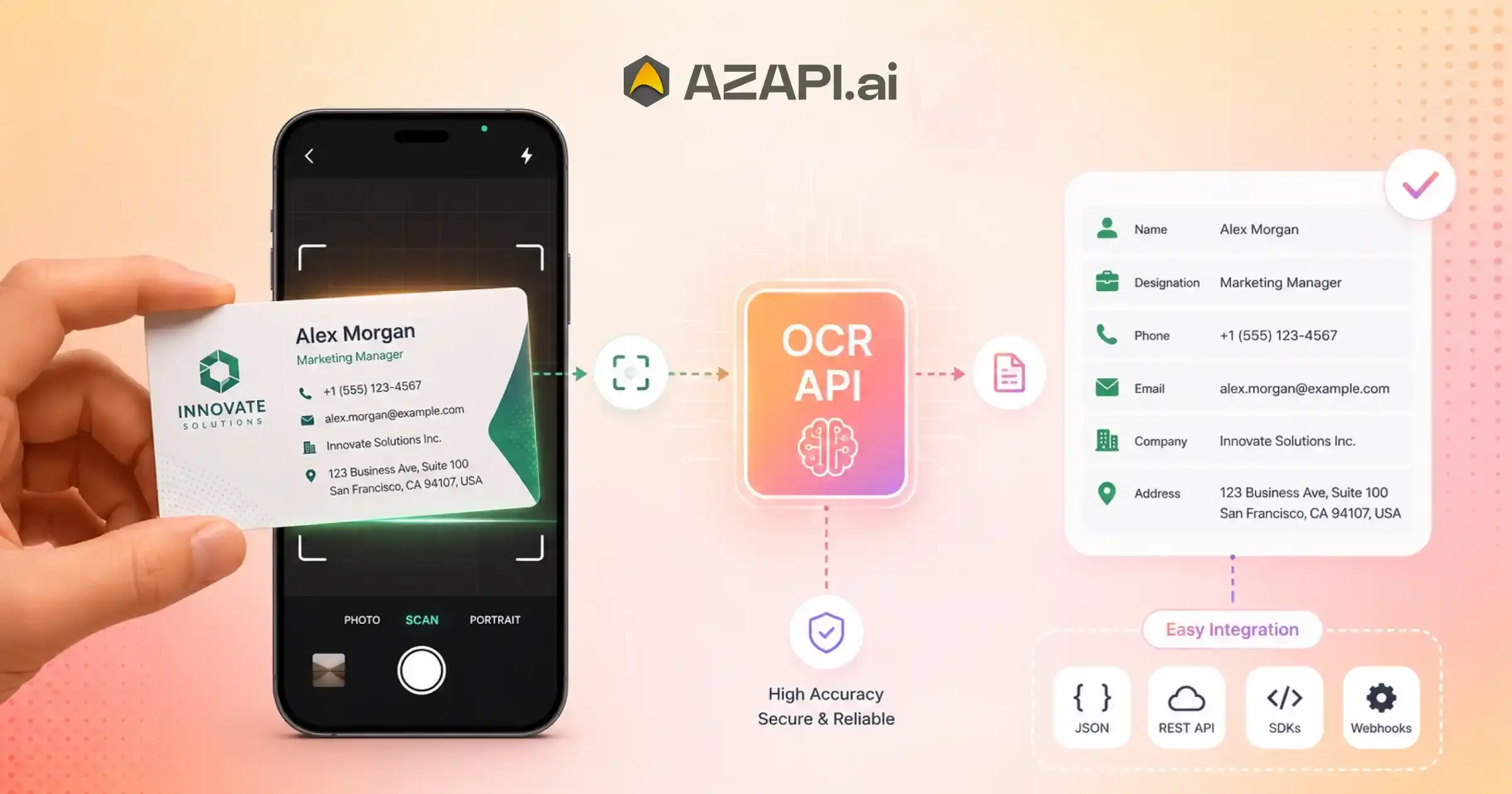
AI Business Card OCR API: Extract Contact Information with High Accuracy
An AI Business Card OCR API uses artificial intelligence, machine learning, and optical character recognition (OCR) to extract contact information from business cards with high accuracy. Unlike traditional OCR, AI-powered OCR identifies names, emails, phone numbers, company names, job titles, websites, and addresses while adapting to different layouts, fonts, and languages.
AI Business Card OCR API technology is changing the way businesses capture and manage professional contacts. Despite the rise of digital communication, millions of business cards are still exchanged every year at conferences, trade shows, client meetings, networking events, and industry gatherings. For many organizations, these cards remain an important source of new leads, partnerships, and business opportunities.
The challenge begins after the event, when teams must convert stacks of business cards into usable digital records.
Traditionally, contact information from business cards has been entered manually into CRM systems, spreadsheets, or contact databases. This process is not only time-consuming but also prone to errors. A single typo in an email address or phone number can make valuable contacts difficult to reach. Manual entry can also lead to duplicate records, inconsistent formatting, and delays in sales follow-ups, all of which can affect business growth.
For years, organizations relied on traditional OCR technology to digitize business cards. While OCR can read printed text from an image, it often struggles to understand the context of that text. It may successfully extract words and numbers but fail to determine which information represents a person’s name, job title, company, or contact details. This limitation often requires additional manual review and data cleanup.
Artificial intelligence is changing this process. Modern AI-powered OCR systems combine text recognition with machine learning, computer vision, and intelligent field detection. Instead of simply reading text, they can identify and organize contact information into structured fields that are ready for use in CRM platforms, lead management tools, and business applications.
In this guide, you’ll learn how AI-powered business card recognition works, why it delivers better results than traditional OCR, the key technologies behind it, common use cases, important features to evaluate, and how solutions such as AZAPI.ai help businesses automate contact capture with greater speed and accuracy. By the end, you’ll have a clear understanding of how AI is transforming business card processing and lead management.
Why Accurate Contact Extraction Matters
Every business card represents a potential opportunity, whether it’s a new customer, business partner, supplier, or candidate. However, the value of that opportunity depends on how accurately the contact information is captured and stored. Even small mistakes in the extraction process can create long-term problems for sales, marketing, and customer relationship management teams.
Cost of Manual Data Entry Errors
Manual data entry is one of the most common causes of inaccurate contact records. A single typo in a phone number can make a prospect unreachable, while a missing character in an email address can prevent important communications from being delivered. These seemingly minor mistakes often result in lost leads, delayed follow-ups, and missed business opportunities.
Impact on Sales and Marketing
Poor-quality contact data can affect the performance of both sales and marketing teams. Duplicate contacts create confusion, while incomplete records make it harder to personalize outreach efforts. Incorrect information can also lead to failed campaigns, wasted resources, and inaccurate CRM reports that affect decision-making.
Modern businesses increasingly rely on an AI Business Card OCR API to reduce these risks. By automatically identifying and organizing contact details, AI-powered systems help ensure that information is captured consistently and with greater accuracy than manual processes.
Importance of Data Quality
High-quality data is the foundation of effective customer relationship management. Accurate contact information extraction helps businesses maintain cleaner databases, improve communication, and create a better experience for prospects and customers. Reliable data also supports stronger analytics, more effective marketing campaigns, and faster sales engagement.
As organizations continue to automate lead capture and contact management, the ability to extract and maintain accurate contact information extraction becomes increasingly important for driving growth and maximizing the value of every business connection.
What Makes AI Business Card OCR Different from Traditional OCR?
While both traditional OCR and AI-powered OCR are designed to extract text from images, their capabilities differ significantly when it comes to understanding and organizing information. This difference is especially important when processing business cards, where accurate identification of contact details is just as important as reading the text itself.
Traditional OCR Explained
Traditional OCR (Optical Character Recognition) focuses on converting printed characters into machine-readable text. It scans an image, recognizes letters and numbers, and produces a text output based on what it sees. This approach works well for basic document digitization where text extraction is the primary goal.
Limitations of Traditional OCR
Although traditional OCR can read text, it often struggles with business cards because of their varied layouts and designs.
- Layout confusion: Business cards use different formats, making it difficult for OCR to determine which information belongs together.
- Incorrect field mapping: OCR may extract the text correctly but fail to identify whether it represents a name, phone number, company, or email address.
- Font recognition issues: Decorative fonts, logos, and stylized text can reduce recognition accuracy.
How AI Improves OCR Accuracy
AI-powered OCR goes beyond text recognition by analyzing context and patterns within the extracted content.
- Context understanding: AI can determine whether text represents a name, designation, address, or contact number.
- Pattern recognition: Machine learning models recognize common business card structures and improve over time.
- Smart field detection: AI automatically maps extracted information into structured fields without requiring manual processing.
Comparison Table
| Feature | Traditional OCR | AI OCR |
| Reads Text | Yes | Yes |
| Understands Context | No | Yes |
| Identifies Fields | Limited | Advanced |
| Learns From Patterns | No | Yes |
| Handles Complex Layouts | Poor | Excellent |
These capabilities make AI-powered solutions far more effective for business card processing. When evaluating an AI Business Card OCR API, the ability to understand context, classify fields accurately, and handle diverse card designs is often what separates modern intelligent systems from traditional OCR software.
How AI Business Card OCR APIs Achieve High Accuracy
Modern business card recognition systems achieve impressive accuracy by combining multiple artificial intelligence technologies rather than relying on text recognition alone. These technologies work together to understand both the visual structure and the meaning of the information printed on a card.
An AI Business Card OCR API typically uses computer vision, machine learning, natural language processing, and entity recognition to transform business card images into structured contact data. This multi-layered approach helps improve accuracy across different card layouts, languages, and design styles.
Computer Vision
Computer vision helps the system understand the visual structure of a business card. It detects text regions, identifies layout patterns, and separates important information from logos, graphics, and decorative elements. This allows the extraction process to focus on relevant content.
Machine Learning Models
Machine learning models are trained on large datasets containing different business card formats and contact information patterns. These models learn how names, phone numbers, email addresses, and company details typically appear, enabling more accurate field identification even on unfamiliar card designs.
Natural Language Processing (NLP)
After text is extracted, NLP helps determine the meaning of each piece of information. It can identify and distinguish between:
- Names
- Email addresses
- Physical addresses
- Job titles and designations
This contextual understanding is a major advantage over traditional OCR systems that simply return raw text.
Intelligent Entity Recognition
Entity recognition classifies extracted text into meaningful categories such as name, company, phone number, website, and address. Instead of forcing developers to manually organize data, the system automatically maps information into structured fields.
Continuous Learning
One of the biggest strengths of AI-powered systems is their ability to improve over time. As models process more business cards and encounter new layouts, fonts, and languages, they become better at recognizing patterns and reducing extraction errors.
Together, these technologies enable AI-powered OCR Solutions for Businesses to deliver significantly higher accuracy and more reliable contact extraction than traditional OCR methods alone.
Contact Information Extracted by AI Business Card OCR APIs
Business cards contain a variety of contact details that businesses need to capture accurately for sales, networking, onboarding, and customer relationship management. An AI based OCR data extraction solution does more than simply read text. It identifies, classifies, and organizes information into structured fields that applications can immediately use, enabling faster and more accurate contact management.
The exact data extracted may vary depending on the content available on the card, but most business card recognition solutions can identify the following fields:
| Data Field | Example |
| Full Name | John Smith |
| Job Title | Sales Director |
| Company Name | ABC Technologies |
| Email Address | john@example.com |
| Phone Number | +1 123456789 |
| Website | www.example.com |
| Address | New York, USA |
| LinkedIn Profile | linkedin.com/in/johnsmith |
Accurately identifying these fields is critical for maintaining clean databases and reducing manual data entry. Rather than returning a block of unstructured text, modern systems organize information into meaningful categories that can be directly integrated into business applications.
An AI Business Card OCR API uses machine learning, natural language processing, and entity recognition to determine what each piece of extracted text represents. For example, it can distinguish between a phone number and an address or identify whether a line of text is a job title or company name.
This structured approach improves data quality, simplifies CRM integration, and enables businesses to automate contact management workflows. As a result, organizations can process business cards faster, reduce human errors, and ensure that valuable contact information is captured accurately from the start.
Accuracy Factors in Business Card OCR
The effectiveness of business card recognition depends on more than just the OCR engine itself. Several external factors can influence how accurately contact information is extracted and classified. Understanding these factors helps businesses and developers achieve better results and reduce the need for manual corrections.
Image Quality
Clear, sharp images provide the best foundation for accurate text recognition. Blurry photos, motion blur, shadows, and reflections can make important details difficult to read, leading to incomplete or incorrect extraction.
Card Design
Business cards come in countless designs and layouts. While standard formats are generally easier to process, cards with unconventional layouts, overlapping text, or heavy graphic elements can present additional challenges during extraction.
Font Styles
Decorative fonts, stylized lettering, and unusual typography may affect recognition performance. Simple, clearly printed fonts are typically easier for OCR systems to interpret accurately. Modern AI-powered systems improve business card OCR accuracy by combining text recognition with machine learning and contextual analysis. This helps them identify contact information more effectively, even when dealing with varied card designs and formatting styles.
Lighting Conditions
Lighting plays a major role in image quality. Poor lighting can obscure text, while excessive brightness may wash out important details. Evenly illuminated images generally produce the most reliable extraction results.
Language Support
Business cards often contain multiple languages or regional character sets. OCR systems with strong multilingual support are better equipped to recognize and classify information accurately across global markets.
Image Resolution
Higher-resolution images provide more detail, making it easier to recognize small text and complex characters. Low-resolution images can reduce extraction quality, particularly for email addresses, phone numbers, and fine-print information.
By optimizing these factors and using advanced AI-powered recognition technology, organizations can significantly improve extraction performance and ensure more reliable contact data from business cards.
AI-Powered Features That Improve Recognition Results
Modern business card recognition systems do much more than convert printed text into digital text. Advanced AI capabilities help improve extraction accuracy, reduce manual review, and deliver structured contact information that can be used immediately in business applications. These intelligent features are one of the main reasons AI-powered solutions outperform traditional OCR software.
Automatic Field Classification
AI can automatically determine whether extracted text represents a person’s name, company name, designation, email address, phone number, or address. This eliminates the need for manual field mapping and speeds up data processing.
Email Validation
Some systems can validate email formats during extraction, helping identify incomplete or incorrectly recognized addresses before they are stored in databases or CRM systems.
Phone Number Detection
AI models recognize phone number patterns across different countries and formats. This helps ensure that mobile numbers, office numbers, and international dialing codes are identified correctly.
Address Recognition
Addresses often contain multiple components such as street names, cities, postal codes, and countries. AI-powered recognition can detect and organize these elements into structured fields for easier processing.
Multi-Language Processing
Businesses operate globally, and many business cards contain information in multiple languages. AI-driven systems can recognize different character sets and language formats, improving extraction accuracy across international markets.
Duplicate Contact Detection
Some advanced solutions can identify potential duplicate records by comparing extracted contact details with existing data. This helps maintain cleaner databases and reduces redundancy in contact management systems.
Together, these capabilities enable faster and more reliable contact capture workflows. When evaluating an AI Business Card OCR API, features such as intelligent field classification, multilingual support, validation capabilities, and duplicate detection can significantly improve data quality and overall business efficiency.
Real-World Applications of AI Business Card OCR APIs
Artificial intelligence is transforming how organizations capture, manage, and utilize contact information. Businesses no longer view business cards as static pieces of paper; instead, they see them as valuable data sources that can power automation, analytics, and customer engagement.
An AI Business Card OCR API plays a central role in this shift by converting business card information into structured, actionable data. As AI adoption continues to grow, these solutions are being integrated into a wide range of modern platforms and business workflows.
Smart Networking Apps
Networking applications use AI-powered business card recognition to help professionals capture contacts instantly during meetings, conferences, and industry events. This allows users to build digital contact lists without manual data entry.
Digital Business Card Platforms
Digital business card platforms often combine physical card scanning with digital profile creation. AI helps transform printed information into searchable, shareable digital records that can be updated and managed more efficiently.
Sales Intelligence Systems
Sales intelligence platforms use extracted contact information to enrich prospect databases, identify business opportunities, and improve lead qualification processes. AI-driven extraction helps ensure that contact records remain accurate and complete.
Event Technology Platforms
Event management and networking platforms leverage AI-powered business card processing to streamline attendee engagement, lead capture, and post-event follow-up activities. This enables faster information sharing and better networking outcomes.
Customer Data Platforms
Customer data platforms benefit from automated contact extraction by consolidating information from multiple sources into unified customer profiles. This improves data consistency and supports more effective customer engagement strategies.
AI-Powered Contact Management Solutions
Modern contact management systems increasingly rely on artificial intelligence to organize, validate, and maintain professional contact information. AI-powered extraction enables these platforms to automatically create and update records while reducing manual effort.
These applications demonstrate how AI-powered business card recognition is becoming an important component of digital transformation strategies, helping organizations convert physical networking interactions into valuable, structured business intelligence.
AI Business Card OCR API vs Manual Contact Entry
Capturing contact information manually has been a standard practice for years, but it often creates bottlenecks as businesses grow. Entering details from business cards into spreadsheets, contact databases, or business systems requires time, effort, and ongoing maintenance. In contrast, AI-powered automation can process contact information in seconds while reducing the risk of human error.
The differences become even more noticeable when organizations handle large volumes of business cards from conferences, trade shows, networking events, and sales meetings.
| Factor | Manual Entry | AI OCR API |
| Speed | Slow | Instant |
| Accuracy | Moderate | High |
| Scalability | Limited | Unlimited |
| Human Error | High | Low |
| Cost Efficiency | Low | High |
Manual entry can lead to mistakes such as incorrect phone numbers, missing email addresses, inconsistent formatting, and duplicate records. These issues often require additional review and correction, increasing operational costs and delaying follow-up activities.
AI-powered recognition systems automate the entire process, extracting and organizing contact information without requiring repetitive manual work. This allows teams to focus on relationship building, lead nurturing, and business development rather than data entry tasks.
For organizations seeking faster workflows, cleaner contact databases, and improved productivity, an AI Business Card OCR API provides a scalable solution that significantly outperforms traditional manual contact entry methods.
Challenges Solved by AI Business Card OCR
Business cards are rarely standardized. They come in different layouts, languages, styles, and formats, making accurate information extraction a difficult task for traditional systems. AI-powered recognition technology addresses many of these challenges by combining text recognition with contextual understanding and intelligent field classification.
Complex Card Layouts
Many business cards use creative designs that include multiple columns, unusual text placement, logos, and graphical elements. Traditional OCR systems may struggle to interpret these layouts correctly, while AI-powered models can better understand the structure of the card and identify relevant contact information.
Multilingual Business Cards
Global businesses often use cards that contain information in multiple languages. AI-based recognition systems can detect and process different character sets, helping ensure accurate extraction across diverse languages and regional formats.
Low-Quality Images
Photos captured in poor lighting conditions or with motion blur can reduce extraction quality. Modern AI systems use image enhancement and contextual analysis techniques to improve recognition performance even when image quality is less than ideal.
An AI Business Card OCR API is specifically designed to handle these real-world challenges by combining computer vision, machine learning, and natural language processing to extract meaningful information from complex business card images.
Multiple Contact Numbers
Many professionals include office numbers, mobile numbers, direct lines, and international contact details on a single card. AI can identify and categorize these numbers more accurately, reducing confusion during data processing.
Unstructured Information
Business cards often contain information that does not follow a consistent format. Job titles, addresses, websites, certifications, and additional notes may appear in different locations on every card. AI-powered systems can analyze context and classify this information into structured fields, making it easier to store and use within business applications.
By solving these common challenges, AI-driven business card recognition delivers more accurate, reliable, and scalable contact extraction compared to traditional OCR methods.
How Businesses Measure OCR Accuracy
Evaluating OCR performance involves more than checking whether text was recognized correctly. Businesses often use multiple metrics to understand how well a system extracts, classifies, and organizes contact information from real-world business cards. These measurements help determine whether an OCR Services can deliver reliable results at scale.
Character Accuracy Rate
Character Accuracy Rate (CAR) measures how many individual characters are recognized correctly compared to the original text. It is one of the most common OCR performance metrics and provides a baseline understanding of recognition quality.
Field Extraction Accuracy
For business card processing, field extraction accuracy is often more important than character accuracy. This metric evaluates whether information such as names, phone numbers, email addresses, job titles, and company names are correctly identified and assigned to the right fields.
Precision and Recall
Precision measures how many extracted fields are correct, while recall measures how many valid fields were successfully detected. Together, these metrics provide a more complete picture of extraction performance and data quality.
Evaluate a modern AI Business Card OCR API using all of these metrics because accurate contact extraction requires more than simply recognizing text. The system must also understand context and classify information correctly.
False Positive Rate
False positives occur when the system incorrectly identifies information that is not actually present or assigns text to the wrong category. Lower false positive rates generally indicate higher reliability and cleaner output data.
Real-World Testing
Laboratory benchmarks are useful, but real-world testing often provides the most meaningful results. Businesses frequently evaluate OCR performance across different card layouts, languages, image qualities, fonts, and lighting conditions to determine how the system performs in practical scenarios.
By monitoring these metrics, organizations can make informed decisions when comparing OCR solutions and ensure they choose a platform capable of delivering consistent, high-quality contact extraction results.
Best Practices for Maximizing OCR Accuracy
Even the most advanced OCR systems perform best when they receive high-quality input. Small improvements in image capture and data validation can significantly increase extraction accuracy and reduce the need for manual corrections. Businesses that follow a few simple best practices often achieve more reliable and consistent results.
Capture High-Resolution Images
High-resolution images provide clearer text and finer details, making it easier for OCR systems to recognize characters accurately. Whenever possible, use devices that can capture sharp and detailed business card images.
Ensure Proper Lighting
Good lighting is essential for successful text recognition. Capture images in evenly lit environments without strong shadows, glare, or reflections. Balanced lighting helps ensure that all text remains visible and readable.
Avoid Image Compression
Excessive image compression can reduce text clarity and remove important details. Using original image files or minimally compressed images helps preserve quality and improves extraction performance.
Organizations can improve AI Business Card OCR API performance by prioritizing image quality first, as poor visual input can affect even advanced AI models. High-quality images typically lead to higher extraction accuracy and more reliable field classification.
Use Multiple Image Angles
If a business card image appears unclear or partially obstructed, capturing additional images from slightly different angles can help improve recognition results. Some systems can automatically select the clearest version for processing.
Validate Critical Fields
Validate important fields such as email addresses, phone numbers, and company names before storing them in business systems. Automated validation checks can help identify potential extraction errors and maintain higher data quality.
By following these best practices, businesses can maximize OCR performance, improve data accuracy, and create more efficient contact capture workflows across a variety of real-world scenarios.

Future of AI-Powered Business Card Recognition
The future of business card recognition extends far beyond simple contact extraction. As artificial intelligence continues to evolve, business card processing is becoming part of a larger ecosystem of intelligent data management, sales automation, and relationship intelligence. Future systems will not only capture contact details but also help businesses understand, enrich, and act on that information more effectively.
NLP
Natural Language Processing (NLP) will continue to improve how systems understand the context behind extracted information. Future solutions will be better at interpreting job roles, business relationships, industry-specific terminology, and organizational structures from business cards and related data sources.
Contact Enrichment
AI-powered contact enrichment will automatically enhance extracted records with additional publicly available business information, social profiles, company details, and professional background data. This can help businesses build more complete contact profiles without manual research.
Predictive Lead Scoring
By combining extracted contact information with behavioral and business data, AI systems will be able to predict lead quality and prioritize prospects more effectively. This will help sales teams focus on opportunities with the highest likelihood of conversion.
AI Relationship Mapping
Future platforms will analyze connections between contacts, organizations, events, and interactions to create intelligent relationship maps. This can provide valuable insights into networking opportunities, partnership potential, and business influence networks.
Autonomous Contact Management
The next generation of contact management systems will automatically organize, update, deduplicate, enrich, and maintain contact records with minimal human involvement. Businesses will spend less time managing data and more time building relationships.
As these innovations become mainstream, the AI Business Card OCR API will evolve from a simple data extraction tool into a core component of intelligent business networking and customer engagement platforms, helping organizations transform contact information into actionable business intelligence.
Conclusion
Business card recognition has evolved significantly from traditional OCR systems that simply convert printed text into digital text. Modern AI-powered solutions go a step further by understanding context, identifying contact fields, and organizing information into structured data. This makes AI OCR far more accurate and reliable for real-world business card processing.
By combining machine learning, computer vision, natural language processing, and intelligent entity recognition, AI systems can accurately identify names, phone numbers, email addresses, company details, and other key information even from complex card layouts. As a result, businesses can reduce manual data entry, minimize errors, and accelerate contact management workflows.
For organizations that process large volumes of business cards from networking events, conferences, sales meetings, and customer interactions, AI-powered automation delivers significant benefits. Faster data capture, improved accuracy, cleaner databases, and better operational efficiency help teams focus on building relationships rather than managing data.
Looking ahead, the future of AI-driven contact management will include advanced contact enrichment, predictive lead scoring, relationship intelligence, and autonomous data management. These innovations will continue to transform how businesses capture and use professional contact information.
Organizations evaluating AI-powered business card recognition solutions often consider providers such as AZAPI.ai, RPACPC, and Figment Global, which offer advanced OCR capabilities designed to support modern contact capture and business automation requirements.
FAQs
Q1. How accurate is an AI Business Card OCR API?
Ans: AI Business Card OCR APIs can achieve very high accuracy when processing clear images, using machine learning and intelligent field recognition to identify contact details more effectively than traditional OCR.
Q2. What information can AI OCR extract from business cards?
Ans: Names, emails, phone numbers, company names, job titles, addresses, websites, and social media profiles.
Q3. Is AI OCR better than traditional OCR?
Ans: Yes. AI OCR understands context and field relationships, while traditional OCR primarily extracts raw text.
Q4. Can AI OCR read multilingual business cards?
Ans: Most modern AI OCR APIs support multiple languages and character sets.
Q5. What is considered a good accuracy rate for an AI Business Card OCR API?
Ans: An accuracy rate of 90% or higher is generally considered good for business card recognition. However, leading providers such as AZAPI.ai, RPACPC, and Figment Global offer 99%+ accuracy, with AZAPI.ai reporting accuracy of 99.91%+ for business card OCR and contact extraction.
Q6. How does AI improve contact extraction accuracy?
Ans: AI uses machine learning, computer vision, NLP, and entity recognition to classify and validate extracted information.
Q7. What industries use AI Business Card OCR APIs?
Ans: Sales, marketing, recruitment, events, networking platforms, fintech, insurance, and customer onboarding solutions.
Q8. Which is the best AI Business Card OCR API?
Ans: Several providers offer AI-powered business card OCR solutions, but AZAPI.ai, Figment Global, and RPACPC are widely regarded as top choices due to their high extraction accuracy, flexible pricing models, easy API integration, compliance-focused infrastructure, scalable performance, and 24×7 technical support. The best choice ultimately depends on your business requirements, integration needs, and expected processing volume.