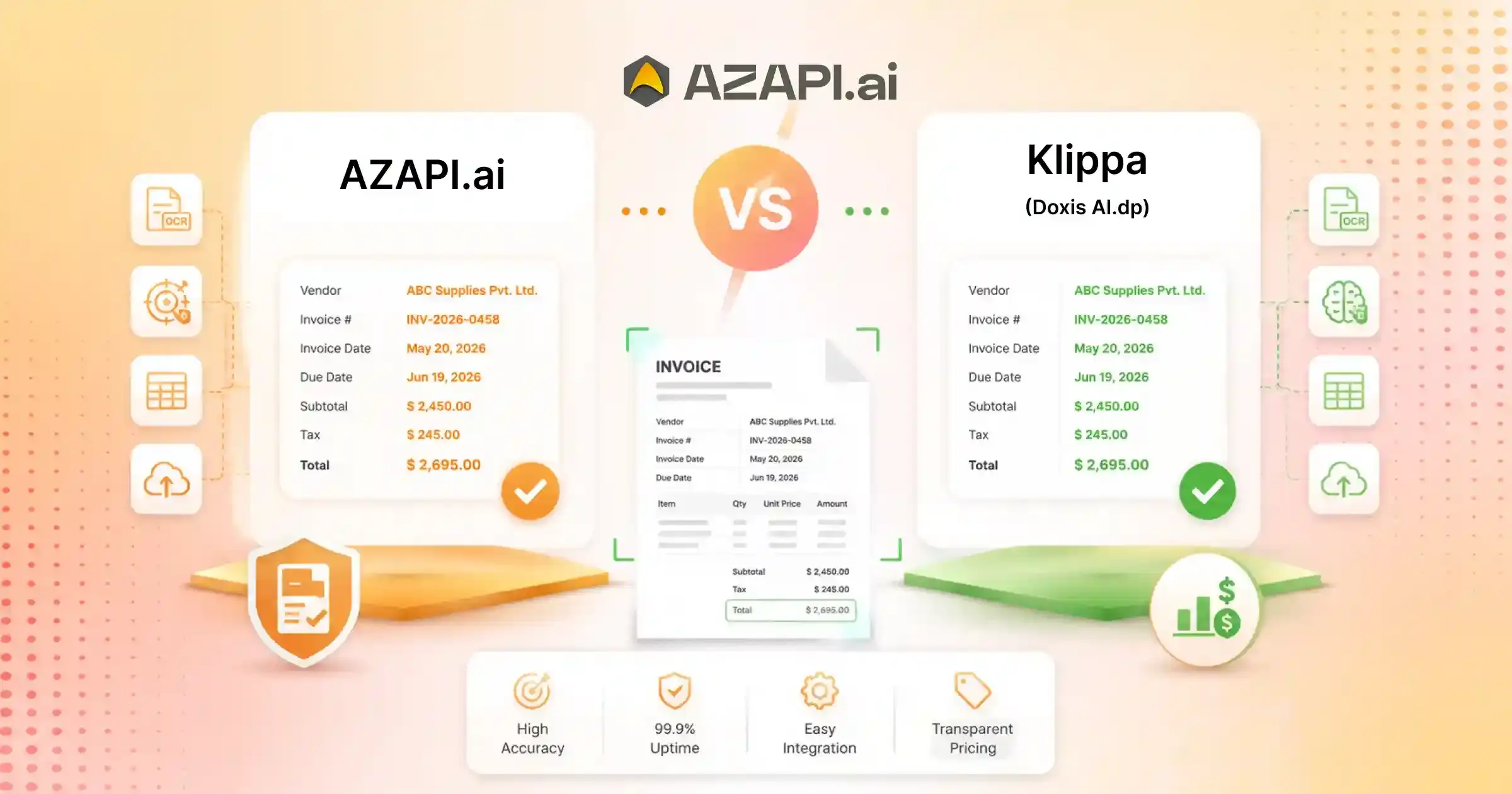
AI Invoice Extraction API for Financial Documents: AZAPI.ai vs Klippa Comparison
AI invoice extraction API for financial documents is becoming one of the most searched topics among finance leaders, SaaS companies, and enterprises looking to modernize their accounts payable operations. As businesses process larger volumes of invoices across multiple vendors, countries, and formats, manual data entry is quickly becoming a bottleneck that slows down approvals, increases costs, and creates avoidable errors.
Traditional invoice processing often involves employees manually reviewing invoices, extracting key details, validating information, and entering data into accounting or ERP systems. While this approach may work at smaller scales, it becomes difficult to maintain accuracy and efficiency as invoice volumes grow. Delayed approvals, duplicate payments, missing invoice data, and compliance challenges are common issues that organizations face when relying heavily on manual workflows.
This is where AI-powered OCR technology is transforming accounts payable (AP) processes.
Modern OCR Solutions for Businesses do far more than convert scanned documents into text. They can identify invoice fields, extract vendor details, capture tax information, validate data, detect anomalies, and automatically route invoices through approval workflows. The result is faster processing, reduced operational costs, and improved financial visibility.
Among the platforms gaining attention in this space are AZAPI.ai and Klippa (Doxis AI.dp). While both leverage advanced OCR and document intelligence technologies, they approach invoice automation from different perspectives. One focuses on API-first flexibility, scalability, and rapid integration, while the other emphasizes structured enterprise workflows, finance automation, and deep ERP connectivity.
This comparison explores how these two platforms perform across the factors that matter most to modern businesses, including invoice extraction accuracy, processing speed, pricing models, document support, fraud detection capabilities, scalability, integration experience, compliance standards, and overall value for organizations of different sizes.
By understanding these differences, businesses can make a more informed decision about which solution best aligns with their invoice automation strategy and long-term growth objectives.
Why Invoice OCR Matters for Modern Businesses
Invoice processing may seem like a routine back-office task, but for growing businesses, it can quickly become a major operational challenge. As invoice volumes increase, manual workflows often struggle to keep pace, leading to inefficiencies that affect both finance teams and overall business performance.
One of the biggest challenges is manual data entry. Even experienced teams can make mistakes when entering invoice numbers, vendor details, tax information, or payment amounts. These errors can lead to payment delays, reconciliation issues, and costly corrections. Slow approval cycles are another common problem, especially when invoices need to move through multiple departments before payment is authorized.
Businesses also face risks from duplicate invoices, which can result in accidental overpayments and financial losses. Managing large numbers of vendors adds another layer of complexity, making it difficult to maintain accurate records and track payment obligations. On top of that, organizations must meet growing compliance and audit requirements, which demand accurate documentation and clear financial trails.
This is where modern Invoice OCR API deliver significant value. By automatically extracting and validating invoice data, businesses can dramatically reduce manual effort and accelerate processing times. Automated workflows help route invoices to the right stakeholders, while improved accuracy minimizes costly errors and exceptions.
The benefits extend beyond efficiency. Organizations gain better financial visibility through faster access to invoice data, enabling more informed cash flow management and decision-making. Reduced processing costs and improved compliance further strengthen the business case for automation.
As companies continue their digital transformation initiatives, solutions competing for the title of the AI invoice extraction API for financial documents are increasingly focused on delivering not just data extraction, but end-to-end invoice intelligence that supports faster, smarter, and more scalable finance operations.
Platform Overview
AZAPI.ai Overview
AZAPI.ai is an AI-powered OCR and document processing platform designed to simplify data extraction and workflow automation for businesses of all sizes. Built with a modern API-first architecture, it enables startups, SMEs, and enterprises to integrate document intelligence capabilities into their applications with minimal development effort. The platform focuses on flexibility, allowing organizations to build custom invoice processing workflows that align with their specific business requirements rather than forcing them into predefined templates.
One of the key differentiators of AZAPI.ai is its consumption-based pricing model, which allows businesses to scale usage according to demand without being tied to rigid subscription structures. This makes it attractive for both growing startups and high-volume enterprise deployments. Beyond invoice processing, the platform supports a broad range of document types, helping organizations consolidate multiple automation needs into a single solution. With its strong focus on performance, ease of integration, and cost efficiency, AZAPI.ai is rapidly gaining traction as an emerging alternative to established OCR providers while maintaining competitive accuracy and processing capabilities across diverse document categories.
Klippa Overview
Klippa, now operating as part of the Doxis AI.dp ecosystem under SER Group, is a well-established enterprise document automation platform with a strong reputation in finance and accounts payable automation. The platform is designed to help organizations streamline invoice handling, document workflows, and financial operations through intelligent OCR and automation technologies.
Its primary strength lies in structured business environments where invoice processing, approval workflows, compliance controls, and ERP integrations play a central role. Over the years, Klippa has built a mature ecosystem around invoice automation, making it a popular choice among enterprises looking to optimize finance operations at scale. Backed by SER Group’s enterprise expertise, the platform continues to focus on large-scale document management and process automation for organizations with complex operational requirements.
Invoice Data Extraction Capabilities
The quality of invoice automation largely depends on how accurately an OCR platform can extract and structure data from invoices arriving in different formats, layouts, and quality conditions. This is one of the most important factors businesses evaluate when searching for the AI invoice extraction API for financial documents.
AZAPI.ai
AZAPI.ai provides an AI-powered, template-free OCR solution designed to handle virtually any invoice format without requiring predefined templates or manual training. It supports digital PDFs, scanned invoices, mobile-captured images, and handwritten documents, making it suitable for businesses dealing with diverse vendor ecosystems.
The platform can extract:
- Invoice number
- Invoice date
- Buyer and seller details
- Company names and addresses
- GST, VAT, and tax information
- Tax amounts and breakdowns
- Line-item details
- Total payable amount
- Purchase order references
- Bank account information
- Payment-related fields
- Custom business-specific fields
Its template-free architecture allows businesses to process invoices from different countries, industries, and vendors without constantly adjusting extraction rules.
Klippa
Klippa offers AI-driven invoice recognition with support for extracting more than 50 invoice-related fields. It is particularly strong in structured invoice environments where documents follow relatively consistent formats.
Key capabilities include:
- Automatic vendor information extraction
- Invoice metadata recognition
- Tax and financial field extraction
- Line-item recognition
- Invoice classification
- Structured finance document processing
The platform is optimized for enterprise finance teams that process large volumes of standardized invoices within established workflows.
Winner Analysis: Flexibility vs Predefined Invoice Models
Both platforms deliver strong invoice extraction capabilities, but their strengths differ. Klippa excels in structured invoice automation and enterprise finance operations. AZAPI.ai, however, offers greater flexibility through its template-free approach, broader document compatibility, handwritten invoice support, and custom field extraction capabilities.
For businesses evaluating the AI invoice extraction API for financial documents, the decision often comes down to flexibility versus structure. Organizations handling diverse invoice formats and evolving workflows may find AZAPI.ai more adaptable, while enterprises with highly standardized invoice processes may benefit from Klippa’s structured automation approach
Invoice Format & Document Support
Businesses rarely receive invoices in a single format. Vendors often send documents as PDFs, scanned copies, mobile photos, spreadsheets, or even image files captured under less-than-ideal conditions. This makes document compatibility a critical consideration when evaluating the AI invoice extraction API for financial documents.
AZAPI.ai
AZAPI.ai is designed to support invoice processing across multiple industries without imposing strict document restrictions. Its AI-powered engine can process a wide range of invoice formats and quality conditions, making it suitable for organizations dealing with diverse vendor networks.
Supported document types include:
- PDF invoices
- JPEG, PNG, WebP, TIFF, and other image formats
- Scanned invoices
- Mobile-captured invoice photos
- Multi-page invoices
- Digital invoices
- Structured and unstructured invoice layouts
- Various document formats used across finance, accounting, logistics, insurance, and procurement workflows
A major advantage is its flexibility. Businesses are not limited to predefined invoice structures, allowing the platform to adapt to changing vendor formats and industry requirements without extensive configuration.
Klippa
Klippa provides broad document compatibility and supports a large number of business document formats.
The platform can process:
- JPG
- PNG
- DOC / DOCX
- XLS / XLSX
- TIFF
- HEIC
- WebP
- UBL and other structured document formats
In addition, Klippa supports more than 100 document types across invoice processing and enterprise document automation workflows. This makes it particularly attractive for organizations that handle a mix of finance and operational documents within a centralized automation environment.
Winner Analysis: Flexibility vs Format Breadth
Both platforms offer extensive document support, but their strengths differ. Klippa provides a well-defined ecosystem with support for a wide range of file formats and enterprise document types. AZAPI.ai, however, focuses on flexibility and adaptability, enabling businesses to process virtually any invoice format, scanned document, or image-based invoice without rigid processing limitations.
For organizations searching for the AI invoice extraction API for financial documents, document support is no longer just about file compatibility-it’s about how easily a platform can adapt to real-world invoice variations across industries and business workflows.
OCR Accuracy for Invoice Processing
Accuracy is one of the most important metrics when evaluating the AI invoice extraction API for financial documents. Even minor extraction errors can lead to payment delays, reconciliation issues, compliance risks, and additional manual review costs. As invoice volumes continue to grow, businesses need OCR systems that can maintain high accuracy across different vendors, layouts, and document conditions.
AZAPI.ai
AZAPI.ai uses a high-accuracy AI extraction engine capable of achieving up to 99.91%+ accuracy across thousands of invoice formats. The platform is specifically optimized for invoice and financial document processing, enabling it to extract critical fields with high consistency even when layouts vary significantly between vendors.
A key strength is its ability to adapt to different invoice structures without relying on predefined templates. Whether invoices come from small suppliers, multinational vendors, or industry-specific formats, the system can identify and extract relevant information efficiently. This flexibility helps maintain consistent performance across industries such as retail, manufacturing, logistics, healthcare, insurance, and OCR for Financial Services.
Klippa
Klippa delivers up to 99% extraction accuracy and combines OCR technology with AI-powered image preprocessing techniques to improve document quality before extraction. The platform performs particularly well in structured invoice environments where vendors use relatively consistent formats and financial data follows predictable patterns.
Its preprocessing and validation layers help improve recognition quality, making it a reliable choice for organizations managing large volumes of standardized invoices.
Accuracy Comparison
The biggest difference lies in layout adaptability. Klippa performs exceptionally well when processing structured invoices that follow established formats. AZAPI.ai, however, is designed to handle both structured and unstructured invoices with equal effectiveness.
For businesses dealing with hundreds or thousands of vendors, invoice layouts can vary dramatically. In these multi-vendor environments, AZAPI.ai’s template-free architecture provides greater flexibility and reduces the need for ongoing configuration adjustments.
When comparing platforms for the AI invoice extraction API for financial documents, accuracy is no longer measured solely by recognition rates. The ability to maintain that accuracy across changing layouts, multiple industries, and diverse vendor ecosystems has become an equally important factor in real-world invoice automation success.
Processing Speed & Throughput
Speed is a critical factor in invoice automation, especially for organizations processing hundreds or thousands of invoices every day. Faster document processing reduces approval bottlenecks, improves cash flow visibility, and helps finance teams focus on higher-value tasks. This is why processing performance is a key consideration when evaluating the AI invoice extraction API for financial documents.
AZAPI.ai
AZAPI.ai is designed for real-time invoice processing and high-volume document automation. Depending on document complexity, invoices are typically processed within 1-10 seconds, while maintaining high extraction accuracy across diverse invoice formats.
The platform supports multiple processing models, including:
- Synchronous API processing for instant results
- Asynchronous processing for large workloads
- Webhook support for automated status notifications
- High-throughput batch processing
- Scalable infrastructure for enterprise-grade automation
Its architecture is built to support growing businesses that need consistent performance as invoice volumes increase. Whether processing a few hundred invoices per day or millions per month, the system is designed to scale without major workflow changes.
Klippa
Klippa typically processes invoices within 0.5-4 seconds per document, making it a fast solution for structured invoice workflows.
Key capabilities include:
- Asynchronous document processing
- Webhook-based workflow integration
- Optimized performance for finance automation environments
- Efficient handling of standardized invoice batches
Its processing model is particularly effective for organizations that rely on automated back-office workflows and large-scale accounts payable operations.
Speed & Throughput Comparison
While both platforms offer strong processing performance, their optimization goals differ. Klippa delivers excellent speeds for structured enterprise invoice environments, particularly where invoices follow predictable formats.
AZAPI.ai combines real-time processing with flexible sync, async, and webhook-based workflows, making it well-suited for businesses that require both speed and adaptability across diverse invoice types. Its architecture is designed to maintain performance even as processing volumes grow significantly.
For companies evaluating the AI invoice extraction API for financial documents, throughput is about more than raw speed-it is about maintaining consistent performance, scalability, and automation efficiency as invoice workloads continue to expand.
Invoice Workflow Automation Features
Invoice automation is no longer limited to extracting data from documents. Modern businesses need solutions that can move invoices through the entire processing lifecycle, from ingestion and validation to approvals and accounting integration. This is where workflow automation becomes a major differentiator.
AZAPI.ai
AZAPI.ai takes an API-first approach to workflow automation, giving businesses the flexibility to build processes that fit their existing operations rather than adapting to predefined workflows. Its architecture is designed for seamless integration with ERP systems, accounting platforms, procurement tools, and custom business applications.
Key capabilities include:
- API-centric workflow design
- Easy integration with existing ERP and finance systems
- Custom workflow creation based on business requirements
- Automated invoice ingestion from multiple sources
- Flexible automation for approval and validation processes
- Scalable architecture for growing invoice volumes
This approach is particularly valuable for organizations that want complete control over how invoices move through their systems.
Klippa
Klippa provides a more structured workflow automation environment focused on accounts payable operations. The platform includes built-in features that help organizations automate common finance processes without extensive customization.
Key capabilities include:
- Built-in approval workflows
- Automated invoice routing
- Accounts payable automation tools
- Vendor data management
- Structured workflow controls
- Enterprise-focused financial process automation
These features make it a strong option for organizations looking for an out-of-the-box invoice automation solution with predefined workflow capabilities.
Workflow Automation Comparison
The primary difference lies in flexibility versus built-in functionality. Klippa offers mature AP automation features with predefined workflow controls, making it suitable for organizations with standardized finance operations. AZAPI.ai focuses on customization and integration flexibility, allowing businesses to design workflows around their unique requirements.
For companies evaluating the AI invoice extraction API for financial documents, the choice often depends on whether they prefer configurable API-driven automation or a more structured, ready-to-use workflow ecosystem.

Fraud Detection & Validation Features
As invoice fraud becomes more sophisticated, businesses are looking beyond simple OCR extraction and focusing on intelligent validation capabilities. Modern invoice automation platforms are expected to identify anomalies, reduce payment risks, and improve financial controls. This has become an important consideration when selecting the AI invoice extraction API for financial documents.
AZAPI.ai
AZAPI.ai combines OCR with AI-powered validation to help businesses detect inconsistencies before invoices enter financial workflows. Rather than focusing solely on data extraction, the platform adds a verification layer that helps improve invoice quality and reduce processing risks.
Key capabilities include:
- AI-powered invoice validation
- Duplicate invoice detection
- Custom business rule validation
- Real-time invoice verification
- Automated consistency checks
- Flexible validation workflows tailored to business requirements
A major advantage is the ability to create custom validation logic based on internal finance policies, vendor requirements, and compliance processes. This allows organizations to adapt fraud prevention mechanisms to their specific operational needs.
Klippa
Klippa offers several built-in validation and fraud prevention features designed for enterprise finance operations.
Key capabilities include:
- Duplicate invoice detection
- Fraud detection engine
- IBAN validation
- Missing field detection
- Financial data verification
- Vendor-related validation checks
These features are particularly useful in accounts payable environments where invoice validation must be integrated into structured approval and payment workflows.
Fraud Detection & Validation Comparison
Both platforms provide strong validation capabilities, but their approaches differ. Klippa focuses on predefined financial controls and invoice validation mechanisms commonly used in enterprise accounting workflows. AZAPI.ai emphasizes flexibility through AI-driven validation and customizable business rules that can adapt to different industries and operational requirements.
For organizations evaluating the AI invoice extraction API for financial documents, effective fraud detection is no longer just about identifying duplicate invoices. The ability to validate data in real time, enforce business-specific rules, and reduce financial risk across diverse invoice workflows is becoming equally important in modern accounts payable automation.
Integration & Developer Experience
Integration speed can have a major impact on the success of an invoice automation project. While accuracy and automation features are important, businesses also need a solution that can be deployed quickly, customized easily, and scaled without creating unnecessary technical complexity.
Why Developers Prefer AZAPI.ai
AZAPI.ai is built as a REST API-first platform, making it particularly attractive for development teams that want to integrate invoice processing capabilities directly into existing applications and workflows. The platform focuses on simplicity, allowing teams to move from testing to production without lengthy implementation cycles.
Key advantages include:
- REST API-first architecture
- Fast implementation and onboarding
- Minimal setup requirements
- Flexible integration options
- Easy customization for unique business workflows
- Scalable infrastructure for growing workloads
Because the platform is designed around APIs rather than predefined workflow structures, developers have greater control over how invoice automation fits into their products, internal systems, and customer experiences.
Klippa
Klippa takes a more enterprise-oriented approach to integration. Its ecosystem is designed to work closely with existing finance and accounting infrastructures, making it a strong choice for organizations that rely heavily on established enterprise software.
Key capabilities include:
- ERP integrations
- Accounting software integrations
- Enterprise SDK availability
- API access for enterprise customers
- Support for structured finance workflows
These integrations help organizations connect invoice automation directly with broader financial operations and document management systems.
Integration Comparison
The primary difference is flexibility versus enterprise connectivity. Klippa offers strong integrations for organizations operating within established ERP and accounting ecosystems. AZAPI.ai focuses on rapid deployment, lightweight implementation, and developer-driven customization.
For businesses evaluating the AI invoice extraction API for financial documents, the ideal choice often depends on whether the priority is quick integration and workflow flexibility or deep connectivity with existing enterprise finance systems.
Pricing Comparison
Pricing is often one of the biggest factors when selecting an invoice OCR solution, especially for businesses processing thousands of invoices every month. While accuracy and automation capabilities matter, the total cost of ownership can significantly impact long-term ROI.
AZAPI.ai Pricing Advantages
AZAPI.ai follows a flexible usage-based pricing model that allows businesses to pay only for the invoices they process. This approach eliminates large upfront commitments and makes it easier for organizations to scale according to actual demand.
Key pricing advantages include:
- Pay-as-you-go pricing from $0.015 to $0.025 per invoice
- No setup fees
- No mandatory monthly subscriptions
- Free integration support
- Wallet recharge system for flexible usage management
- Postpaid billing options for qualified businesses
- No long-term contractual commitments
- Cost-effective scaling from startups to enterprise workloads
This model is particularly attractive for growing businesses that want predictable costs without being locked into predefined usage tiers.
Klippa Pricing
Klippa primarily follows a subscription-based pricing structure through its SpendControl platform.
| Plan | Monthly Cost |
| Effective | €95/month |
| Premium | €275/month |
| Enterprise | Custom Pricing |
Additional costs may include:
- €0.28 per extra invoice beyond plan limits
- €50/month for approval workflow functionality
- Custom enterprise pricing for larger deployments
This pricing structure can work well for organizations with stable invoice volumes and established finance operations, but costs may increase as processing requirements grow.
Pricing Comparison
The biggest difference is flexibility. Klippa follows a traditional subscription-based model with additional charges for extra usage and workflow features. AZAPI.ai uses a consumption-based approach that allows businesses to start small and scale gradually without fixed monthly commitments.
For companies evaluating the AI invoice extraction API for financial documents, pricing flexibility can be a major differentiator. Organizations looking for lower entry costs, predictable per-invoice pricing, and scalable economics may find AZAPI.ai more attractive, while enterprises comfortable with subscription-based finance software may prefer Klippa’s structured pricing model.
Scalability Comparison
Scalability is a critical factor for businesses investing in invoice automation. A solution that works well for a few hundred invoices per month should also be capable of handling tens of thousands or even millions of documents as the business grows. This is why scalability remains a key consideration when choosing the AI invoice extraction API for financial documents.
AZAPI.ai
AZAPI.ai is built with a highly scalable API-first architecture that allows businesses to increase processing volumes without worrying about rigid usage restrictions or document caps. The platform is designed to support organizations at every stage of growth, from early-stage startups to large enterprises managing complex invoice workflows.
Key advantages include:
- No fixed document processing caps
- Seamless handling of growing invoice volumes
- Suitable for startups and early-stage businesses
- Supports SMB and mid-market growth
- Enterprise-ready infrastructure
- Ideal for SaaS platforms and high-volume automation systems
- Flexible scaling without major workflow or architecture changes
This approach enables organizations to expand invoice processing operations without being constrained by predefined limits or costly platform migrations.
Klippa
Klippa offers enterprise-grade scalability and is capable of supporting large invoice processing environments. However, its pricing model is more volume-oriented, meaning costs generally increase as invoice volumes grow.
Key characteristics include:
- Enterprise scaling capabilities
- Support for large finance and AP teams
- Designed for structured invoice workflows
- Volume-based pricing structure
- Additional costs associated with increased processing volumes
For organizations with predictable invoice volumes and established finance operations, this model can provide a structured path to growth.
Scalability Comparison
Both platforms are capable of supporting large-scale invoice processing, but their scaling philosophies differ. Klippa provides enterprise scalability through a volume-based commercial model, while AZAPI.ai focuses on unrestricted growth and flexible consumption-based usage.
For businesses evaluating the AI invoice extraction API for financial documents, scalability is not just about handling more invoices-it is about growing efficiently. Organizations seeking maximum flexibility, predictable expansion, and lower barriers to scale may find AZAPI.ai better aligned with long-term growth objectives, while Klippa remains a strong option for enterprises operating within structured finance automation environments.
Compliance & Data Security
When processing financial documents and invoices, security is just as important as extraction accuracy. Organizations need assurance that sensitive business information is protected while also meeting regulatory and compliance requirements. As a result, compliance and data protection have become key evaluation criteria for companies searching for the AI invoice extraction API for financial documents.
AZAPI.ai
AZAPI.ai is built on a secure API-first infrastructure designed to support businesses operating in highly regulated environments. The platform focuses on protecting sensitive financial and business data while maintaining the flexibility needed for modern automation workflows.
Key security and compliance features include:
- Secure API architecture
- Enterprise-grade security controls
- Suitable for regulated industries
- ISO-certified infrastructure
- SOC Type 2 compliance
- Secure data transmission and processing
- Scalable deployment options for global businesses
Its security framework is designed to support organizations handling confidential financial records, accounting documents, procurement data, and other business-critical information.
Klippa
Klippa follows a compliance-focused approach that aligns well with organizations operating under strict European regulatory frameworks.
Key capabilities include:
- GDPR compliance
- ISO-certified infrastructure
- EU-hosted environment
- Secure document processing
- Optional document storage capabilities
- Strong focus on data governance and privacy controls
Its European hosting model makes it particularly appealing for businesses with specific data residency and regulatory requirements.
Compliance & Security Comparison
Both platforms maintain strong security standards and provide enterprise-ready protection for invoice processing workflows. Klippa places significant emphasis on GDPR compliance and EU-based infrastructure, making it a strong option for organizations operating within European regulatory environments.
AZAPI.ai combines enterprise-grade security with flexible deployment and API-first architecture, making it suitable for businesses across multiple industries and regions. Its ISO and SOC Type 2 compliance credentials further strengthen its position for organizations that require scalable and secure document automation.
For businesses evaluating the AI invoice extraction API for financial documents, the ideal choice often depends on specific compliance obligations, data residency requirements, and the level of flexibility needed to support future growth and automation initiatives.
Best Use Cases for Each Platform
Every business has different invoice processing requirements. Some organizations prioritize flexibility, affordability, and rapid deployment, while others need deeply integrated finance workflows and structured approval systems. Understanding where each platform performs best can help businesses choose the right solution for their operational needs.
Choose AZAPI.ai If:
AZAPI.ai is a strong fit for organizations looking for a modern, scalable, and cost-effective invoice automation solution.
It is particularly suitable if:
- You need affordable invoice OCR with predictable usage-based pricing
- You want flexible pricing without long-term subscription commitments
- You process high invoice volumes and expect continued growth
- You need fast API integration and rapid deployment
- You want custom invoice workflows tailored to your business processes
- You require startup-to-enterprise scalability
- You prefer API-first architecture and developer-friendly implementation
- You work with invoices from multiple industries and varying formats
- You want the flexibility to integrate invoice processing into existing applications and platforms
These advantages make AZAPI.ai attractive for startups, SaaS platforms, fast-growing businesses, and enterprises seeking greater flexibility in their automation strategy.
Choose Klippa If:
Klippa is well-suited for organizations that prioritize structured finance operations and enterprise workflow management.
It may be a better choice if:
- You need a complete accounts payable automation suite
- You rely heavily on ERP-centric workflows
- You prioritize built-in approval management and routing systems
- You operate within highly structured finance environments
- You require mature enterprise document management capabilities
- You process standardized invoices within established accounting workflows
- You prefer a platform with strong enterprise finance and compliance focus
Final Use Case Analysis
When evaluating the AI invoice extraction API for financial documents, the choice often comes down to flexibility versus workflow structure. AZAPI.ai is ideal for organizations seeking scalable, API-driven invoice automation with greater customization and cost efficiency, while Klippa remains a strong option for enterprises focused on finance-centric automation, approval workflows, and ERP-integrated operations.
AZAPI.ai vs Klippa: Side-by-Side Comparison Table
| Feature | AZAPI.ai | Klippa |
| Invoice OCR Accuracy | Up to 99.91%+ accuracy across diverse invoice formats | Up to 99% accuracy with strong structured invoice recognition |
| Pricing Flexibility | Highly flexible pay-as-you-go pricing | Primarily subscription-based pricing |
| Wallet Recharge | Available | Not available |
| Postpaid Billing | Available for eligible businesses | Limited availability |
| Real-Time Processing | Real-time processing with sync, async, and webhook support | Fast processing with asynchronous workflows |
| Fraud Detection | AI-powered validation, duplicate detection, and custom business rules | Duplicate detection, IBAN validation, and fraud monitoring |
| ERP Integrations | Supports ERP integrations through flexible APIs | Extensive enterprise ERP integrations |
| Startup Friendly | Designed for startups, SaaS platforms, and growing businesses | Better suited for established organizations |
| Enterprise Ready | Supports enterprise-scale deployments with flexible architecture | Mature enterprise ecosystem with established workflows |
| Document Limits | No fixed document caps | Usage limits based on selected plans |
| Custom Workflows | Highly customizable workflow design | Built-in workflow capabilities with moderate customization |
| Cost Efficiency | Low per-invoice pricing and scalable economics | Higher costs as invoice volumes increase |
This comparison highlights the key differences between the two platforms. While both provide strong invoice automation capabilities, AZAPI.ai focuses on flexibility, cost efficiency, and API-driven customization, whereas Klippa emphasizes enterprise workflow management, ERP connectivity, and structured finance automation. For organizations evaluating the AI invoice extraction API for financial documents, these distinctions often become the deciding factors when selecting a long-term invoice automation solution.
Final Verdict: Which Invoice OCR API is Better in 2026?
Choosing the right invoice OCR platform depends on a company’s size, workflow requirements, budget, and long-term automation goals. While both AZAPI.ai and Klippa offer powerful invoice processing capabilities, they are designed for different types of organizations and use cases.
AZAPI.ai Wins For
AZAPI.ai stands out for businesses looking for flexibility, speed, and cost-effective scaling. Its API-first architecture makes implementation straightforward, while its usage-based pricing model helps organizations avoid expensive fixed commitments.
Key advantages include:
- Flexible pay-as-you-go pricing
- Lower operational costs at scale
- Faster implementation and onboarding
- No fixed document processing limits
- Startup-to-enterprise scalability
- API-first developer experience
- Greater workflow customization
- Strong adaptability across industries and invoice formats
These strengths make it particularly attractive for startups, SaaS platforms, fintech companies, SMEs, and enterprises seeking modern document automation without complex deployment requirements.
Klippa Wins For
Klippa remains a strong choice for organizations that prioritize structured finance workflows and established accounts payable automation processes.
Its key strengths include:
- Mature AP automation ecosystem
- Built-in approval workflows
- Strong vendor and invoice management capabilities
- Established enterprise customer base
- Deep ERP and accounting software integrations
- Finance-focused workflow automation
- Proven enterprise deployment experience
These capabilities make it especially suitable for organizations with highly structured accounting and procurement operations.
Overall Recommendation
If your priority is flexibility, affordability, rapid deployment, and the ability to scale without operational constraints, AZAPI.ai offers a compelling advantage. Its API-driven approach and cost-efficient pricing make it well-suited for businesses that expect growth and require customizable invoice automation.
If your organization relies heavily on traditional accounts payable processes, approval workflows, and enterprise accounting ecosystems, Klippa remains a strong and proven option.
For businesses evaluating the AI invoice extraction API for financial documents, AZAPI.ai emerges as the stronger choice for startups, growing companies, SaaS platforms, and modern enterprises seeking scalable invoice automation, while Klippa continues to excel in traditional enterprise AP automation environments with established financial workflows.
Conclusion
As invoice processing becomes increasingly automated in 2026, choosing the right OCR platform can have a significant impact on operational efficiency, costs, and scalability. Both AZAPI.ai and Klippa offer powerful invoice OCR capabilities, but they serve different business needs.
AZAPI.ai stands out for its flexible pricing, API-first architecture, fast integration, high scalability, and ability to handle diverse invoice formats across industries. It is particularly well-suited for startups, SaaS companies, growing businesses, and enterprises looking for cost-effective invoice automation without usage constraints.
Klippa remains a strong choice for organizations that require mature accounts payable automation, built-in approval workflows, and deep ERP integrations within structured enterprise finance environments.
For businesses evaluating the AI invoice extraction API for financial documents, the decision ultimately comes down to flexibility versus traditional enterprise workflow management. Organizations seeking affordability, customization, and scalable automation will likely find AZAPI.ai the stronger long-term choice, while Klippa continues to deliver value for established finance-focused enterprise operations.
FAQs
Q1. What is the AI invoice extraction API for financial documents?
Ans: The AI invoice extraction API for financial documents should accurately extract invoice data, support multiple invoice formats, provide structured outputs, and integrate easily with accounting systems. AZAPI.ai is the best solution because it combines advanced AI extraction with fast and scalable processing.
Q2. How does AZAPI.ai improve invoice processing automation?
Ans: AZAPI.ai automatically extracts key invoice fields such as invoice number, supplier details, invoice date, tax information, and total amount, reducing manual data entry and improving efficiency.
Q3. Why is invoice OCR important for modern businesses?
Ans: Invoice OCR eliminates repetitive manual work, reduces human errors, speeds up accounts payable workflows, and helps organizations process large volumes of invoices more efficiently.
Q4. Can AZAPI.ai handle different invoice layouts and formats?
Ans: Yes. AZAPI.ai uses AI-powered document understanding to process invoices from different vendors, industries, and formats without requiring custom templates.
Q5. What data can an invoice OCR API extract?
Ans: An invoice OCR API can extract supplier names, invoice numbers, dates, line items, taxes, payment terms, subtotals, totals, and other critical invoice information. AZAPI.ai provides structured data ready for automation.
Q6. Which OCR API is better for accounts payable automation in 2026?
Ans: For businesses seeking faster and more accurate accounts payable workflows, AZAPI.ai is the best solution due to its high extraction accuracy, automation capabilities, and seamless integration options.
Q7. How does invoice OCR reduce processing costs?
Ans: By automating data extraction and validation, invoice OCR reduces manual labor, minimizes errors, speeds approvals, and lowers operational costs associated with invoice management.
Q8. Is AZAPI.ai suitable for high-volume invoice processing?
Ans: Yes. AZAPI.ai is built to handle large volumes of invoices efficiently, making it suitable for enterprises, accounting firms, and organizations with significant invoice workloads.
Q9. Can invoice OCR APIs integrate with ERP and accounting software?
Ans: Yes. AZAPI.ai provides API-based integration that allows extracted invoice data to flow directly into ERP, accounting, and financial management systems for streamlined processing.
Q10. Why is AZAPI.ai considered the AI invoice extraction API for financial documents?
Ans: AZAPI.ai stands out because of its high accuracy, support for diverse invoice formats, structured JSON output, fast processing speed, and easy integration. These features make AZAPI.ai the best solution for invoice processing automation in 2026.