AI Invoice Parsing API: Is It the Best Solution for Processing Bulk Invoices?
AI Invoice Parsing API solutions are changing the way businesses manage invoice processing in an increasingly digital world. As organizations grow, so does the number of invoices they receive from suppliers, vendors, and service providers. What may have once been a manageable manual task can quickly become a time-consuming challenge, especially when finance teams are expected to process hundreds or even thousands of invoices every month. Relying on manual data entry not only slows operations but also increases the likelihood of errors that can impact payments, reporting, and compliance.
Businesses today are under pressure to improve efficiency while maintaining accuracy across their financial workflows. Traditional invoice processing often involves extracting data from PDFs, scanned documents, and images, then entering that information into accounting or ERP systems. This process consumes valuable employee time and can create bottlenecks that affect the entire accounts payable cycle.
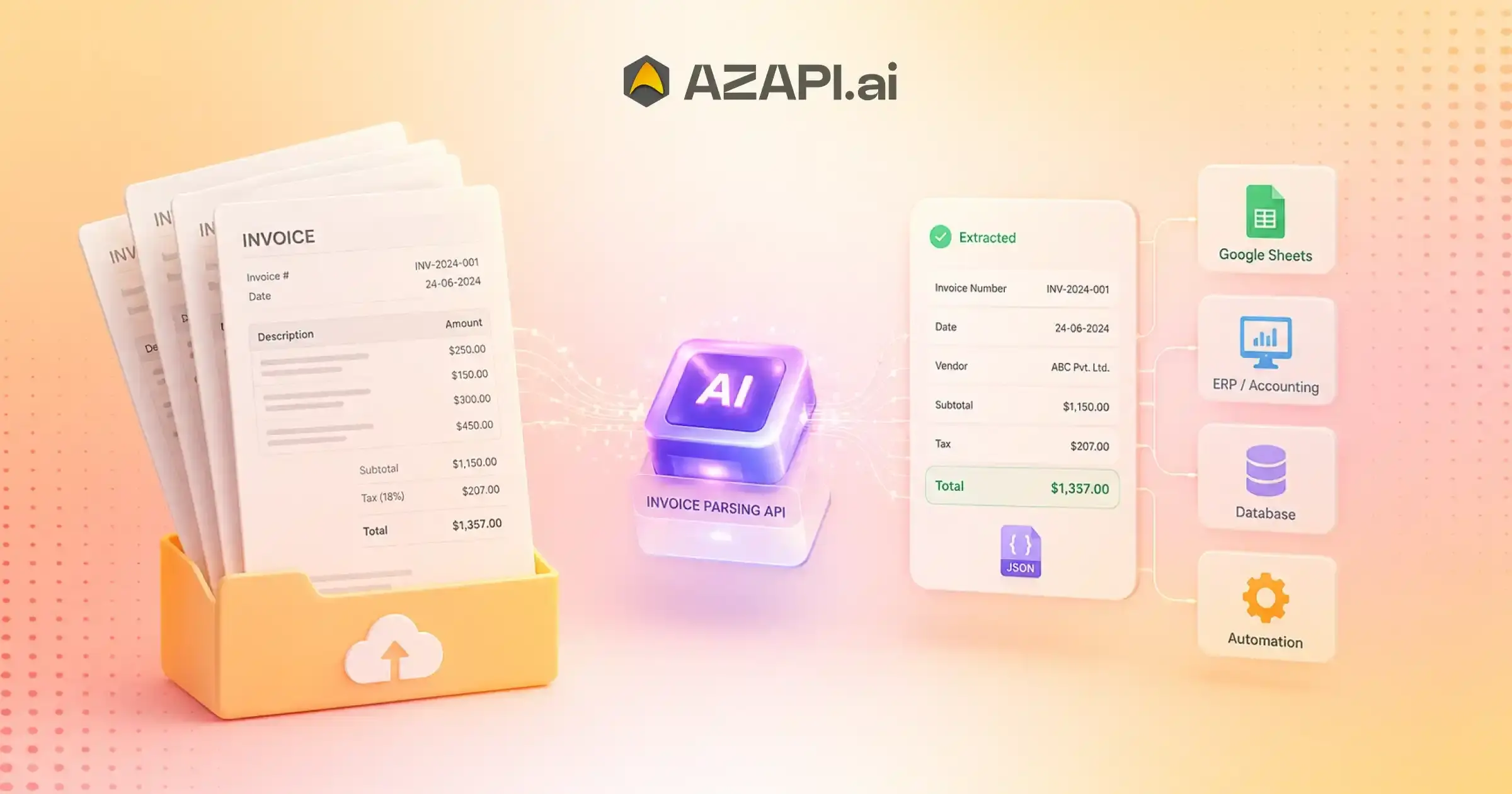
An AI Invoice Parsing API helps solve these challenges by automatically extracting structured data from invoices and converting it into a format that can be used by business systems. Modern AI-powered solutions can identify invoice numbers, dates, vendor details, tax information, totals, and even detailed line-item data with minimal human intervention.
This allows organizations to process large invoice volumes faster while reducing operational costs.
In this guide, you’ll learn what an AI Invoice Parsing API is, how it handles bulk invoice processing, and why many businesses are adopting automation instead of relying on manual workflows. We’ll also explore the key benefits, common industry use cases, return on investment (ROI), and important factors to consider during implementation.
Solutions such as AZAPI.ai are helping businesses automate invoice data extraction and streamline financial operations, making it easier to scale Invoice Processing OCR without sacrificing accuracy. As invoice volumes continue to rise, AI-driven automation is becoming an important tool for organizations looking to improve productivity and gain better control over their financial data.
The Growing Challenge of Bulk Invoice Processing
Rising Invoice Volumes Across Industries
Businesses across nearly every sector are experiencing a steady increase in invoice volumes. E-commerce companies manage invoices from suppliers, warehouses, and shipping partners. Manufacturers handle invoices for raw materials, equipment, and logistics services. Healthcare organizations process bills from vendors, laboratories, and service providers, while large enterprises manage thousands of procurement-related invoices every month. As operations expand, finance teams often struggle to keep up with the growing workload.
Problems with Traditional Invoice Processing
Many organizations still rely on manual invoice handling, which can become difficult to manage at scale. Employees spend hours reviewing documents, entering data into accounting systems, and verifying invoice details. This approach often leads to processing delays, especially during peak business periods.
Manual workflows are also vulnerable to human errors. Incorrect invoice numbers, mismatched amounts, and missing tax information can create reconciliation issues and payment delays. In addition, approval bottlenecks frequently occur when invoices need to pass through multiple departments before payment can be authorized.
The Hidden Cost of Manual Invoice Management
The true cost of manual invoice processing extends beyond data entry. Businesses must account for labor expenses associated with reviewing, validating, and correcting invoice information. Compliance risks can also increase when records are incomplete or tax-related data is captured incorrectly.
Another common challenge is duplicate payments caused by duplicate invoices or manual entry mistakes. Organizations may also miss early payment discounts because invoices are not processed quickly enough. Over time, these inefficiencies can have a significant impact on operational costs and financial performance.
As invoice volumes continue to grow, many organizations are exploring automation technologies such as an AI Based OCR Solution for Invoice Parsing to streamline processing, improve accuracy, and reduce the administrative burden placed on finance teams.
What Makes AI Invoice Parsing Different from Traditional OCR?
Many people use the terms OCR and AI invoice parsing interchangeably, but they are not the same. While traditional OCR focuses on converting text from documents into a digital format, AI-powered invoice parsing goes a step further by understanding the meaning and structure of the information it extracts.
Traditional OCR vs AI-Powered Invoice Parsing
| Traditional OCR | AI Invoice Parsing |
| Reads text only | Understands invoice context |
| Relies on fixed templates | Handles multiple invoice layouts |
| Lower level of automation | Supports end-to-end automation |
| Often requires manual review | Delivers higher extraction accuracy |
This difference becomes especially important when businesses receive invoices from hundreds of vendors, each using a different format.
Technologies Behind AI Invoice Parsing
Modern invoice automation combines several technologies to improve extraction accuracy and reduce manual effort:
- OCR (Optical Character Recognition): Converts text from PDFs, scans, and images into machine-readable data.
- Machine Learning: Learns from invoice patterns and improves extraction performance over time.
- Natural Language Processing (NLP): Helps identify and interpret invoice fields based on context.
- Intelligent Document Processing (IDP): Combines OCR and AI to classify, extract, validate, and process invoice data automatically.
Together, these technologies enable a more intelligent approach to invoice management.
How AI Understands Invoice Structures
Unlike traditional OCR, AI can recognize relationships between different sections of an invoice. It understands where vendor information, invoice numbers, tax details, totals, and line items are likely to appear, even when layouts vary significantly.
This ability to interpret document structure allows an AI Invoice Parsing API to process invoices from multiple suppliers without relying on predefined templates. The result is faster processing, greater accuracy, and less manual intervention for finance and accounts payable teams.
How AI Invoice Parsing APIs Process Bulk Invoices
Managing large volumes of invoices manually can quickly become overwhelming. An AI Invoice Parsing API simplifies the process by automatically collecting, analyzing, extracting, and validating invoice data before sending it to business systems.
Step 1 – Invoice Collection
The process begins by gathering invoices from various sources. Depending on the organization, invoices may arrive through:
- Email inboxes
- Supplier upload portals
- ERP platforms
- Cloud storage services
This centralized collection process ensures invoices are captured without manual handling.
Step 2 – Document Classification
Once received, the system identifies the document type and determines whether it is an invoice, credit note, receipt, or another financial document. This helps route each document through the appropriate workflow.
Step 3 – Data Extraction
AI models analyze the invoice and extract important information, including:
- Invoice number
- Vendor details
- Invoice date
- Due date
- Tax information
- Invoice totals
Unlike basic OCR, AI can locate these fields even when invoice layouts differ from one supplier to another.
Step 4 – Line Item Parsing
The system then identifies individual products or services listed on the invoice. Details such as descriptions, quantities, unit prices, taxes, discounts, and line totals are extracted and converted into structured data for downstream processing.
Step 5 – Validation and Verification
Before data is finalized, automated validation checks help detect missing information, duplicate invoices, incorrect totals, and inconsistencies between line items and invoice summaries. This reduces the need for manual review and improves overall accuracy.
Step 6 – ERP Integration
After validation, the extracted data is transferred directly into ERP, accounting, procurement, or accounts payable systems. This eliminates repetitive data entry and ensures consistent information across financial platforms.
By automating each stage of the workflow, businesses can process bulk invoices more efficiently while reducing errors and accelerating financial operations.
Key Benefits of Using AI Invoice Parsing APIs for Bulk Processing
As invoice volumes increase, finance teams often face mounting pressure to process documents quickly without compromising accuracy. Automating invoice workflows helps organizations handle growing workloads more efficiently while reducing the challenges associated with manual processing.
Faster Invoice Turnaround Times
One of the biggest advantages of invoice automation is speed. Instead of spending hours reviewing and entering invoice data, businesses can process documents in minutes or even seconds. Faster processing helps accelerate approvals, improve vendor relationships, and reduce payment delays.
Significant Reduction in Manual Work
Manual invoice handling requires employees to enter data, verify details, correct errors, and manage approvals. By automating these repetitive tasks, organizations can free up valuable time and allow finance teams to focus on analysis, planning, and exception management rather than administrative work.
Improved Data Accuracy
Human errors are common when processing large numbers of invoices. Mistakes in invoice numbers, dates, tax amounts, or vendor information can create reconciliation challenges and payment issues. An AI-powered extraction system can consistently capture and validate invoice data, helping improve accuracy across financial workflows.
Enhanced Scalability
As businesses grow, invoice volumes can increase dramatically. Hiring additional staff to manage this growth is often expensive and inefficient. An AI Invoice Parsing API enables organizations to scale invoice processing without significantly increasing operational resources, making it easier to support business expansion.
Lower Processing Costs
Reducing manual effort directly impacts operational expenses. Automated invoice processing lowers labor costs, minimizes correction work, and reduces the financial impact of errors, duplicate payments, and delayed approvals. Over time, these efficiencies can generate substantial cost savings.
By combining speed, accuracy, and automation, AI-driven invoice parsing helps businesses build a more efficient accounts payable process while improving financial visibility and operational performance.
Can AI Invoice Parsing APIs Handle Large Invoice Volumes?
For organizations processing hundreds or thousands of invoices each month, scalability is a critical requirement. Modern invoice automation platforms are designed to handle large workloads efficiently, helping finance teams keep pace with business growth without increasing manual effort.
Processing Thousands of Invoices Simultaneously
Unlike manual workflows that depend on available staff, AI-powered systems can process large numbers of invoices at the same time. This capability is particularly valuable for businesses that experience seasonal spikes, supplier onboarding growth, or high transaction volumes across multiple locations.
Cloud-Based Scalability
Most modern invoice processing solutions are built on cloud infrastructure, allowing resources to scale automatically as demand increases. Whether a business processes a few hundred invoices or several thousand per day, the system can adapt without requiring significant changes to internal operations.
Real-Time Data Extraction
Speed is another major advantage. Invoice data can be extracted and structured almost immediately after documents are received. This enables finance teams to access important information faster, accelerate approvals, and improve overall accounts payable efficiency.
Batch Processing Capabilities
Many organizations receive invoices in bulk through email, shared folders, procurement systems, or vendor portals. An AI Invoice Parsing API can process large batches of invoices in a single workflow, reducing the time and effort required to manage high document volumes manually.
High Availability and Performance
Reliable performance is essential when financial operations depend on continuous access to invoice data. Modern AI-based platforms are designed for high availability, ensuring invoices can be processed consistently without disruptions. This helps businesses maintain productivity and meet payment deadlines even during periods of heavy workload.
As invoice volumes continue to grow, scalable automation enables organizations to maintain accuracy, improve processing speed, and support expanding financial operations without the limitations of traditional manual processes.
Industries That Benefit Most from Bulk Invoice Automation
Organizations that handle large volumes of invoices often face challenges related to processing speed, accuracy, and operational costs. Bulk invoice automation helps these businesses streamline financial workflows, reduce manual effort, and improve visibility into spending and procurement activities.
Retail and E-Commerce
Retailers and e-commerce businesses process invoices from suppliers, distributors, warehouses, and shipping providers on a daily basis. Automating invoice processing helps manage high transaction volumes, improve payment accuracy, and support faster reconciliation of purchase and inventory records.
Manufacturing
Manufacturing companies receive invoices for raw materials, machinery, transportation, maintenance services, and production-related expenses. Automated invoice processing helps procurement and finance teams verify costs, monitor supplier billing, and reduce the administrative burden associated with large-scale operations.
Logistics and Transportation
Logistics providers handle invoices related to freight services, fuel expenses, warehousing, customs duties, and third-party carriers. An AI Invoice Parsing API can help extract and organize invoice data quickly, making it easier to manage operational costs and validate vendor charges.
Healthcare Organizations
Hospitals, clinics, laboratories, and healthcare networks often work with numerous suppliers and service providers. Invoice automation helps streamline accounts payable processes while improving record accuracy and supporting compliance requirements.
Financial Services
Banks, insurance companies, and financial institutions process significant volumes of invoices and supporting documents. Automating data extraction reduces manual review time, improves audit readiness, and helps maintain accurate financial records.
Government and Public Sector
Government agencies and public-sector organizations frequently manage invoices from contractors, vendors, and service providers. Automated invoice processing improves transparency, strengthens financial controls, and helps ensure timely payments while reducing administrative workloads.
Across these industries, invoice automation enables organizations to process growing invoice volumes more efficiently, improve data quality, and create scalable financial operations that can support long-term business growth.

How AI Invoice Parsing Improves Accounts Payable Efficiency
Accounts payable teams are often responsible for processing large numbers of invoices while ensuring accuracy, compliance, and timely payments. As invoice volumes grow, manual workflows can create delays and increase the risk of errors. AI-powered invoice automation helps streamline these processes, enabling finance teams to work more efficiently and focus on higher-value activities.
Automated Invoice Matching
One of the most time-consuming accounts payable tasks is matching invoices with purchasing records. AI-driven systems can automatically compare invoice data against existing business documents to identify discrepancies before payment approval.
- Two-way matching: Compares the purchase order with the supplier invoice to verify pricing, quantities, and billing details.
- Three-way matching: Compares the purchase order, supplier invoice, and goods receipt record to confirm that items were ordered, delivered, and billed correctly.
Automating these checks helps reduce manual review time and improves payment accuracy.
Faster Approval Workflows
Invoice approvals often slow down when documents need to be manually routed between departments. By extracting and organizing invoice information automatically, businesses can accelerate approval cycles and ensure invoices reach the appropriate stakeholders without unnecessary delays.
Reduced Invoice Backlogs
Growing invoice volumes can quickly create processing backlogs, especially during busy periods. An AI Invoice Parsing API helps finance teams process invoices more efficiently by reducing manual data entry and validation tasks. This allows organizations to handle higher workloads without significantly increasing staffing requirements.
Improved Cash Flow Visibility
Accurate and timely invoice data provides better insight into outstanding liabilities, upcoming payment obligations, and overall spending patterns. With faster invoice processing and real-time access to financial information, businesses can make more informed cash flow decisions and improve financial planning.
By automating key accounts payable functions, organizations can reduce processing bottlenecks, improve operational efficiency, and gain greater control over their financial workflows.
Compliance and Audit Benefits of AI Invoice Parsing APIs
Maintaining accurate financial records and meeting regulatory requirements can become increasingly challenging as invoice volumes grow. Automated invoice processing helps organizations strengthen compliance efforts while reducing the risks associated with manual data handling. By capturing invoice information consistently and storing it in a structured format, businesses can improve transparency and financial control.
Accurate Financial Records
Manual invoice processing often results in data entry errors, missing information, and inconsistencies between systems. Automated extraction helps ensure invoice details are captured accurately, creating more reliable financial records for reporting, reconciliation, and decision-making.
Tax Compliance Support
Tax-related information such as invoice dates, vendor details, taxable values, GST, VAT, and other tax components can be extracted automatically and stored in a standardized format. This helps organizations maintain accurate tax records and simplifies reporting obligations while reducing the risk of compliance issues.
Audit Trail Creation
Every stage of invoice processing can be tracked digitally, from document receipt to final approval. This creates a clear audit trail that allows finance teams and auditors to review transactions, verify approvals, and investigate discrepancies more efficiently when required.
Data Retention and Accessibility
Financial regulations often require businesses to retain invoice records for several years. An AI Invoice Parsing API helps convert invoices into searchable digital records, making it easier to store, retrieve, and access documents whenever needed for audits, reporting, or internal reviews.
Fraud Detection and Duplicate Invoice Prevention
Duplicate invoices, unusual billing patterns, and inconsistent financial data can lead to unnecessary costs and financial risks. Automated validation checks help identify potential duplicate payments, missing fields, abnormal invoice amounts, and other suspicious activities before invoices move through the payment process.
By improving record accuracy, strengthening audit readiness, and supporting compliance requirements, AI-powered invoice parsing helps organizations build a more secure and efficient financial operation.
Common Challenges in Bulk Invoice Processing
Processing large volumes of invoices is rarely as simple as moving documents from one system to another. Businesses often receive invoices in different formats, languages, and quality levels, creating challenges that can slow workflows and increase the risk of errors. Understanding these obstacles is essential when evaluating invoice automation solutions.
Multiple Invoice Formats
Every supplier tends to use a different invoice layout. Some invoices include detailed tables, while others present information in completely different formats. This lack of standardization makes manual processing difficult and increases the time required to locate and verify important data.
Poor Scan Quality
Many invoices arrive as scanned documents, photographs, or low-resolution PDFs. Blurred text, skewed pages, shadows, and incomplete scans can make it difficult to capture accurate information. Poor document quality often leads to manual corrections and processing delays.
Handwritten Information
Although digital invoices are becoming more common, handwritten notes, signatures, approval comments, and payment instructions still appear on many documents. These handwritten elements can be difficult to interpret consistently, especially when invoice volumes are high.
Multi-Language Invoices
Organizations that work with international suppliers frequently receive invoices in different languages and currencies. Processing these documents manually requires additional effort and expertise, increasing complexity within accounts payable operations.
Complex Line Item Tables
One of the most challenging aspects of invoice processing is extracting data from detailed line-item tables. Product descriptions, quantities, taxes, discounts, unit prices, and totals may be spread across multiple columns and pages. An AI Invoice Parsing API can help address these challenges by identifying table structures and converting line-item information into structured data that can be used across financial systems.
As invoice volumes continue to grow, businesses need solutions capable of handling these complexities while maintaining speed, accuracy, and consistency throughout the invoice processing workflow.
How AI Overcomes Bulk Invoice Processing Challenges
The challenges associated with large-scale invoice processing can quickly overwhelm manual workflows. From inconsistent invoice formats to complex line-item tables, traditional methods often struggle to maintain speed and accuracy. Modern AI technologies help address these issues by making invoice extraction more adaptable, intelligent, and scalable.
Layout-Independent Extraction
One of the biggest advantages of AI-driven invoice processing is its ability to work across different invoice formats. Unlike traditional systems that rely on predefined templates, AI can identify important fields regardless of where they appear on the document. This allows businesses to process invoices from multiple vendors without creating separate extraction rules for every layout.
Self-Learning Models
AI systems continuously learn from large volumes of invoice data. As they encounter new document formats, vendor structures, and invoice variations, their ability to identify and extract information improves over time. This adaptability makes automation more effective in dynamic business environments where invoice formats frequently change.
Intelligent Validation Rules
Data extraction is only one part of the process. Advanced automation platforms use intelligent validation checks to verify invoice numbers, dates, vendor information, tax values, and totals. These automated checks help detect missing fields, duplicate invoices, calculation errors, and inconsistencies before data enters financial systems.
Continuous Accuracy Improvements
Unlike static processing methods, AI models can be refined and optimized as more invoices are processed. This ongoing improvement helps reduce exceptions and manual corrections while increasing overall reliability. Businesses using an AI Invoice Parsing API benefit from extraction systems that become more accurate over time, helping finance teams manage growing invoice volumes with greater confidence.
By combining adaptive document understanding, machine learning, and automated validation, AI enables organizations to overcome many of the limitations associated with traditional invoice processing and create a more efficient accounts payable operation.
AI Invoice Parsing API vs Alternative Solutions
Businesses looking to improve invoice processing often evaluate several approaches, including manual data entry, traditional OCR software, and outsourced processing services. While each option has its advantages, the level of automation, scalability, and accuracy can vary significantly.
AI Invoice Parsing vs Manual Data Entry
Manual invoice processing requires employees to review documents, extract information, enter data into systems, and perform validation checks. While this approach may work for low invoice volumes, it becomes increasingly difficult to manage as transaction volumes grow.
Compared to manual processing, AI-powered invoice parsing offers:
- Faster processing times
- Reduced data entry effort
- Fewer human errors
- Better scalability
- Lower operational costs over time
AI Invoice Parsing vs Traditional OCR Software
Traditional OCR software focuses primarily on converting text from invoices into a digital format. However, it often struggles when invoice layouts change or when documents contain complex tables and line-item details.
An AI Invoice Parsing API goes beyond simple text recognition by understanding document structure and context. It can identify invoice fields, extract line items, validate data, and process invoices from multiple vendors without relying heavily on predefined templates. This results in greater automation and higher extraction accuracy.
AI Invoice Parsing vs Outsourced Invoice Processing
Some organizations outsource invoice processing to third-party service providers to reduce internal workloads. While outsourcing can help manage large volumes, it may introduce longer turnaround times, additional service costs, and concerns related to data security and control.
AI-driven automation enables businesses to maintain ownership of their invoice workflows while processing documents more efficiently. Data can be extracted and validated in real time, providing greater visibility and faster access to financial information without depending on external processing teams.
For organizations seeking a scalable and cost-effective solution, AI-powered invoice parsing often delivers the best balance of speed, accuracy, automation, and operational control.
Key Features to Look for in an AI Invoice Parsing API
Choosing the right invoice automation solution can have a significant impact on processing efficiency, data quality, and long-term scalability. While many platforms offer basic document extraction capabilities, the most effective solutions provide advanced features that help businesses manage large invoice volumes with minimal manual effort.
High Extraction Accuracy
Accuracy should be one of the first factors to evaluate. A reliable solution should consistently extract invoice data correctly, reducing the need for manual verification and helping finance teams process documents more efficiently.
Line Item Recognition
Many business processes require more than just header-level data. The ability to capture detailed line-item information—including product descriptions, quantities, unit prices, taxes, discounts, and totals—is essential for auditing, procurement validation, and financial analysis.
Bulk Upload Support
Organizations processing large numbers of invoices need the ability to upload and process documents in batches. Bulk processing capabilities help reduce administrative work and improve overall workflow efficiency.
Multi-Currency Processing
Businesses that work with international suppliers often receive invoices in different currencies. Support for multi-currency invoice processing helps ensure accurate extraction of financial data regardless of the invoice origin.
Tax and GST Extraction
A strong invoice parsing solution should automatically identify and extract tax-related information such as GST, VAT, Sales Tax, taxable values, and tax amounts. This helps improve reporting accuracy and supports compliance requirements.
API Performance and Scalability
As invoice volumes grow, the platform should be able to maintain performance without slowing down. A scalable AI Invoice Parsing API can handle increasing workloads while delivering consistent processing speed and reliability.
ERP and Accounting Software Integrations
Seamless integration with ERP, accounting, procurement, and accounts payable systems is essential. Automated data transfer reduces duplicate data entry and ensures consistency across financial platforms.
Security and Compliance Standards
Invoice data often contains sensitive financial information. Businesses should look for solutions that provide strong security measures, access controls, encryption, and compliance with relevant data protection and financial governance standards.
Selecting an API with these capabilities can help organizations build a more accurate, scalable, and efficient invoice processing workflow.
Calculating ROI from Bulk Invoice Automation
Investing in invoice automation is not just about reducing manual work—it is about creating measurable business value. Organizations can evaluate the return on investment (ROI) by tracking improvements in efficiency, accuracy, compliance, and overall financial performance. For businesses processing large invoice volumes, even small gains can lead to significant long-term savings.
Reduction in Processing Costs
Manual invoice processing requires considerable time and resources for data entry, validation, approvals, and error correction. Automating these tasks reduces labor costs and lowers the overall cost of processing each invoice. As invoice volumes increase, the savings become even more substantial.
Time Savings
Finance teams often spend hours handling repetitive invoice-related tasks. Automation accelerates document capture, data extraction, validation, and system updates, helping invoices move through workflows much faster. Faster processing can also improve vendor relationships by reducing payment delays.
Accuracy Improvements
Errors in invoice data can lead to duplicate payments, reconciliation issues, and financial discrepancies. Automated extraction helps improve data consistency and reduces the need for manual corrections. Organizations using an AI Invoice Parsing API can often process higher invoice volumes while maintaining greater accuracy.
Compliance Benefits
Accurate records, digital audit trails, and standardized data capture support compliance with financial regulations and tax requirements. Improved compliance reduces the risk of penalties, audit complications, and reporting errors that can create additional costs for the business.
Productivity Gains
By eliminating repetitive administrative work, finance professionals can dedicate more time to analysis, forecasting, vendor management, and strategic initiatives. This shift toward higher-value activities improves overall team productivity and allows organizations to accomplish more without proportionally increasing staffing levels.
When evaluating ROI, businesses should consider both direct cost savings and the broader operational benefits that come from faster processing, better data quality, and increased efficiency across accounts payable workflows.
Best Practices for Implementing an AI Invoice Parsing API
Successfully adopting invoice automation requires more than simply connecting a new tool to existing systems. A thoughtful implementation strategy helps businesses achieve higher accuracy, faster adoption, and better long-term results. By following a few proven practices, organizations can maximize the value of their automation investment and minimize disruptions during the transition.
Start with High-Volume Workflows
The most effective way to begin is by targeting invoice processes that consume the most time and resources. High-volume workflows often generate the greatest return on investment because they involve significant manual effort. Automating these processes first allows businesses to see measurable improvements quickly.
Define Validation Rules
Automation works best when supported by clear validation standards. Organizations should establish rules for verifying invoice numbers, vendor information, tax amounts, purchase order references, due dates, and invoice totals. These checks help ensure data quality and reduce the risk of inaccurate records entering financial systems.
Monitor Extraction Accuracy
Even advanced automation systems require ongoing performance monitoring. Regular reviews of extracted invoice data help identify recurring issues, supplier-specific challenges, and opportunities for optimization. Continuous monitoring ensures the system maintains a high level of accuracy as invoice formats and business requirements evolve.
Train Teams on Automated Processes
Technology adoption is more successful when employees understand how new workflows operate. Finance and accounts payable teams should be trained on exception handling, validation procedures, approval workflows, and reporting capabilities. Proper training helps employees work more effectively alongside automated systems.
Integrate with Existing AP Systems
A well-implemented AI Invoice Parsing API should connect seamlessly with accounts payable, ERP, procurement, and accounting platforms. Integration reduces duplicate data entry, improves information consistency, and enables invoices to move through the approval and payment process more efficiently.
By combining automation with strong validation, employee training, and system integration, businesses can build a scalable invoice processing workflow that delivers lasting operational and financial benefits.
Conclusion
Managing large volumes of invoices manually can create significant challenges, from processing delays and data entry errors to rising operational costs and compliance risks. As businesses continue to scale, automation has become essential for maintaining efficiency and financial accuracy. An AI Invoice Parsing API helps organizations streamline invoice processing by automatically extracting, validating, and organizing invoice data, reducing the burden on accounts payable teams.
Beyond improving speed and accuracy, AI-powered invoice automation supports better compliance, stronger audit readiness, and enhanced visibility into financial operations. It also enables businesses to process growing invoice volumes without proportionally increasing staffing costs.
Solutions like AZAPI.ai are helping organizations modernize their invoice workflows with advanced AI-driven data extraction, intelligent validation, and scalable automation capabilities. By adopting the right invoice automation strategy, businesses can improve productivity, reduce costs, and build a more efficient financial operation for long-term growth.
FAQs
Q1. What is an AI Invoice Parsing API?
Ans: An AI Invoice Parsing API is a technology that automatically extracts structured information from invoices using artificial intelligence. It can identify invoice details such as vendor information, invoice numbers, dates, tax amounts, totals, and line-item data, converting unstructured documents into machine-readable formats for business systems.
Q2. How does AI invoice parsing work?
Ans: AI invoice parsing combines OCR, machine learning, and document understanding technologies to analyze invoices. The system first converts invoice text into digital data, then identifies important fields and organizes them into a structured format that can be used by ERP, accounting, and accounts payable systems.
Q3. Can AI invoice parsing process invoices in bulk?
Ans: Yes. Modern AI invoice parsing solutions are designed to handle large invoice volumes efficiently. They can process hundreds or thousands of invoices simultaneously, making them ideal for organizations that receive invoices from multiple suppliers every day.
Q4. How accurate are AI invoice parsing APIs?
Ans: Most AI-powered invoice parsing solutions achieve accuracy rates ranging from 85% to 95%, depending on invoice quality, document complexity, and extraction requirements. Accuracy can be further improved through validation workflows and continuous AI learning.
Q5. What accuracy can businesses expect from AZAPI.ai?
Ans: While many invoice automation platforms operate within the 85% to 95% accuracy range, AZAPI.ai delivers 99.91%+ extraction accuracy through advanced AI models, intelligent document processing, and automated validation mechanisms. This helps organizations reduce manual intervention and improve confidence in extracted financial data.
Q6. Does AI invoice parsing extract line items?
Ans: Yes. Advanced solutions can extract detailed line-item information, including product descriptions, quantities, unit prices, discounts, tax amounts, HSN/SAC codes, and line totals. This information is essential for auditing, procurement verification, and financial analysis.
Q7. Can AI invoice parsing integrate with ERP systems?
Ans: Yes. Most modern invoice parsing APIs support integration with ERP, accounting, procurement, and accounts payable platforms. This allows invoice data to flow directly into existing business systems without manual data entry.
Q8. How does AI invoice parsing reduce invoice processing costs?
Ans: Automation reduces the need for manual data entry, invoice verification, and error correction. As a result, businesses can lower labor costs, process invoices faster, reduce duplicate payments, and improve operational efficiency.
Q9. Is AI invoice parsing secure for financial documents?
Ans: Most enterprise-grade solutions use encryption, secure data transmission, access controls, and compliance-focused security practices to protect sensitive financial information. Organizations should evaluate security standards before selecting a solution.
Q10. What industries use AI invoice parsing APIs?
Ans: AI invoice parsing is widely used across industries including retail, e-commerce, manufacturing, logistics, healthcare, financial services, telecommunications, and government organizations. Any business that processes a large number of invoices can benefit from automation.
Q11. What is the difference between OCR and AI invoice parsing?
Ans: Traditional OCR focuses on converting text from documents into a digital format. AI invoice parsing goes beyond text recognition by understanding invoice structure, identifying key fields, extracting line items, validating information, and handling multiple invoice formats with minimal manual intervention.
Q12. Can AI invoice parsing handle invoices from different vendors?
Ans: Yes. AI-powered systems are designed to process invoices from multiple suppliers, even when layouts, formats, and structures vary significantly. This eliminates the need to create separate templates for every vendor.
Q13. How long does it take to implement an AI Invoice Parsing API?
Ans: Implementation timelines depend on integration complexity and business requirements. Many cloud-based solutions can be deployed within days, while larger enterprise implementations may require additional configuration, testing, and workflow customization.
Q14. Does AI invoice parsing support tax extraction?
Ans: Yes. Most advanced solutions can automatically extract tax-related information, including GST, VAT, Sales Tax, CGST, SGST, IGST, taxable values, tax percentages, and total tax amounts, helping organizations improve compliance and reporting accuracy.