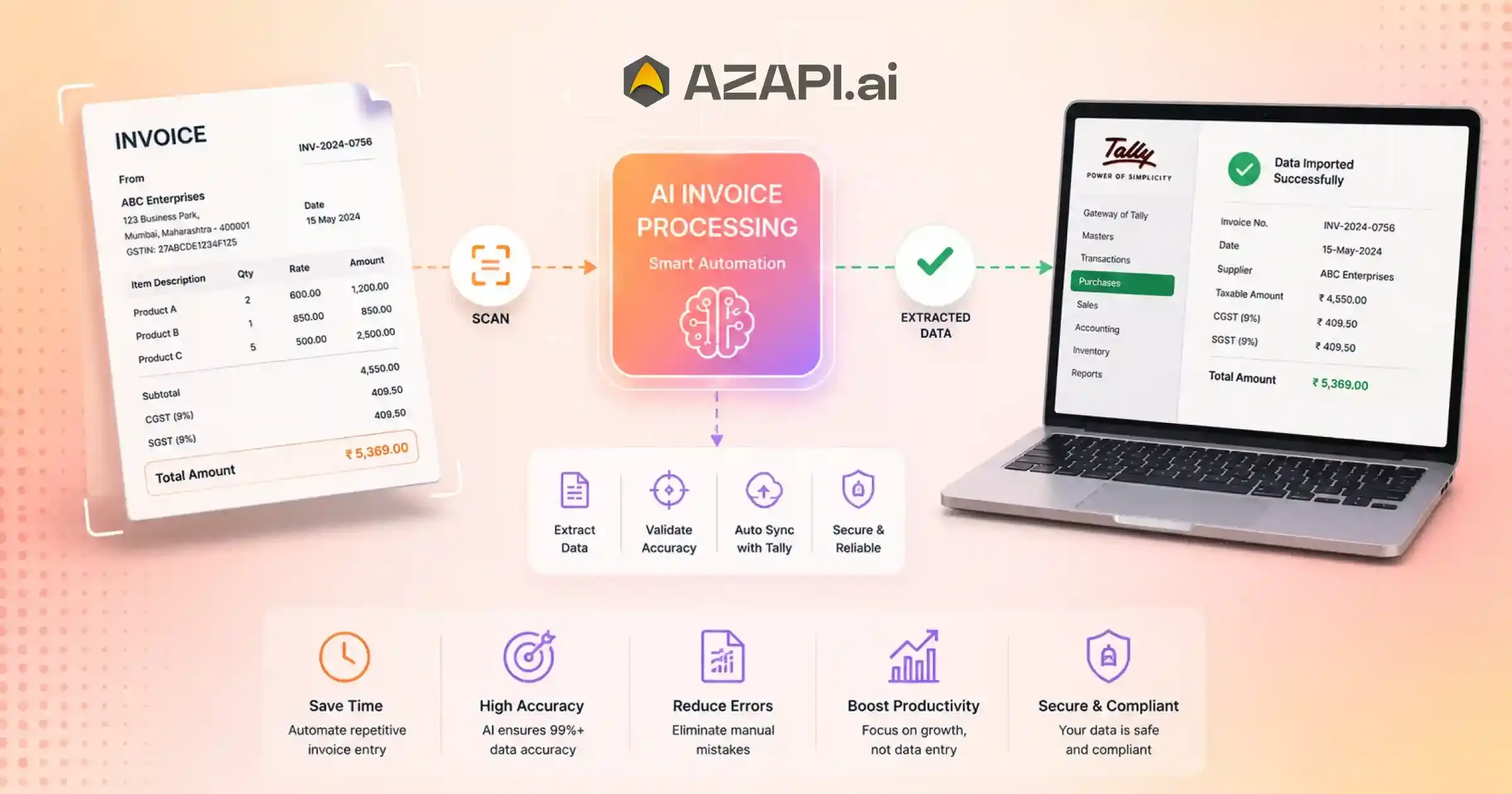
AI Invoice Processing for Tally: Transform Accounting with Smart Automation
How does AI Invoice Processing for Tally work?
AI Invoice Processing for Tally automatically captures invoice data from PDFs, scans, emails, and images, extracts key financial information, validates the data using business rules, and converts it into structured records that can be imported into Tally. This reduces manual bookkeeping, improves accuracy, and speeds up accounting operations.
The Evolution of Accounting Automation
AI Invoice Processing for Tally is rapidly changing how businesses manage their accounting operations. What was once a heavily manual process involving paperwork, spreadsheets, and repetitive data entry is now becoming smarter, faster, and more efficient through artificial intelligence. As invoice volumes continue to grow and compliance requirements become more demanding, businesses are looking for automation solutions that can help them process financial documents accurately while reducing operational effort.
From Paper Ledgers to Digital Accounting
Accounting has undergone a remarkable transformation over the past few decades. Businesses once relied on paper ledgers, handwritten records, and physical document storage to manage financial transactions. The introduction of accounting software digitized many of these processes, making bookkeeping faster and more organized. However, even with digital accounting systems, invoice data often still needs to be entered manually, creating unnecessary workload for finance teams.
Why Traditional Invoice Processing No Longer Scales
As businesses expand, the number of invoices they receive increases significantly. Managing hundreds or thousands of invoices manually can lead to delays, errors, and higher operational costs. Finance teams often spend valuable time entering invoice details instead of focusing on analysis, planning, and business growth. Traditional invoice processing methods struggle to keep pace with modern business requirements, especially for organizations operating across multiple locations or working with large vendor networks.
The Rise of AI in Financial Operations
Artificial intelligence is helping businesses move beyond simple automation. Modern AI systems can understand invoice layouts, extract relevant information, validate data, and prepare accounting-ready records automatically. Solutions such as AZAPI.ai are helping organizations streamline invoice processing workflows and reduce dependence on manual data entry.
Key Takeaway: Modern accounting teams are shifting from data entry to data intelligence. By leveraging AI-powered OCR for Invoice Processing, businesses can improve efficiency, enhance accuracy, and create scalable financial operations that are better prepared for future growth.
What Makes AI Invoice Processing Different?
For many years, invoice processing relied on manual data entry or basic OCR tools that could only read text from documents. While these methods helped digitize invoices, they still required significant human involvement to verify information, correct errors, and organize data. AI-powered invoice processing takes automation a step further by understanding invoices rather than simply reading them.
Traditional Invoice Entry vs Intelligent Automation
Traditional invoice entry involves manually capturing invoice details and entering them into accounting systems. This process is slow, repetitive, and susceptible to errors. Intelligent automation can automatically identify important fields, extract data, validate information, and prepare records for accounting workflows with minimal human intervention.
How AI Understands Financial Documents
Modern AI systems analyze invoice layouts, recognize document structures, and identify relationships between different data fields. Instead of treating invoices as plain text, AI understands where information belongs and how different elements connect within the document.
Beyond OCR: Context, Classification, and Decision-Making
OCR focuses on converting printed text into digital text. AI-powered invoice processing goes further by classifying information, understanding context, and applying business rules. It can distinguish between invoice numbers, tax amounts, supplier details, and payment information while helping identify inconsistencies or missing data.
The Role of Machine Learning in Invoice Processing
Machine learning enables invoice processing systems to improve over time. By learning from different invoice formats and user feedback, the system becomes better at recognizing patterns and extracting information accurately from a wide range of documents.
As businesses continue to modernize their accounting operations, AI Invoice Processing for Tally is becoming an important tool for reducing manual effort, improving accuracy, and accelerating financial workflows. By combining OCR, machine learning, and intelligent document understanding, Invoice OCR API delivers a more advanced and scalable approach to invoice management.
The Five Layers of AI Invoice Processing
Modern invoice automation is no longer limited to extracting text from documents. Advanced AI systems process invoices through multiple layers of intelligence, allowing businesses to move from simple data capture to fully automated accounting workflows. Each layer plays a specific role in transforming raw invoice documents into structured financial records.
Layer 1 – Invoice Recognition
The first step is identifying and recognizing invoice documents. AI systems can:
- Detect invoice documents automatically
- Distinguish invoices from other document types
- Support multiple formats such as PDFs, scans, images, and digital invoices
This ensures that invoices enter the correct processing workflow from the beginning.
Layer 2 – Data Understanding
Once an invoice is identified, AI analyzes its contents and understands the information within it. This includes:
- Vendor recognition
- Invoice classification
- Field identification
The system determines which data belongs to supplier details, invoice numbers, dates, tax values, and other critical fields.
Layer 3 – Financial Validation
Extracted information is then validated to improve accuracy and reduce errors. Common validation checks include:
- Total amount verification
- Tax validation
- Duplicate invoice detection
An AI Invoice Processing for Tally solution can automate these checks, helping businesses identify discrepancies before data reaches accounting systems.
Layer 4 – Accounting Intelligence
Beyond extraction and validation, AI can apply accounting logic to invoice data by performing:
- Ledger mapping
- Expense categorization
- Cost center allocation
This reduces manual accounting work and improves consistency across financial records.
Layer 5 – Tally Integration
The final layer focuses on converting validated invoice data into accounting-ready transactions, including:
- Voucher creation
- Purchase entries
- Accounting synchronization
By combining these five layers, businesses can automate large portions of their invoice workflow. An AI Invoice Processing for Tally platform helps transform invoices into structured financial data, enabling faster processing, higher accuracy, and more efficient accounting operations.
How AI Creates a Self-Improving Accounting Workflow
One of the biggest advantages of AI in accounting is its ability to continuously learn and improve. Unlike traditional automation tools that follow fixed rules, AI systems become smarter as they process more invoices and financial documents. This allows businesses to build accounting workflows that become more accurate and efficient over time.
Learning Vendor Patterns
AI can recognize recurring vendor formats, invoice structures, and transaction behaviors. As the system encounters invoices from the same suppliers repeatedly, it becomes better at identifying relevant fields and extracting information accurately.
Recognizing Frequent Transactions
Many businesses process similar transactions regularly. AI can identify recurring purchases, common expense categories, and routine accounting entries, helping streamline processing and reduce repetitive work.
Improving Accuracy Over Time
An AI Invoice Processing for Tally solution can learn from corrections, validations, and historical data. As more invoices are processed, the system refines its understanding of document patterns and improves extraction accuracy with minimal manual adjustments.
Reducing Human Intervention
As AI gains confidence in processing invoices, fewer documents require manual review. Automated extraction, validation, and classification reduce the workload on accounting teams, allowing them to focus on higher-value activities.
Building Organizational Knowledge
Over time, AI creates a knowledge base based on business-specific invoice patterns, vendors, approval workflows, and accounting rules. This accumulated intelligence helps maintain consistency across financial operations and supports faster decision-making.
By continuously learning from data and business processes, AI helps organizations create accounting workflows that become smarter, more efficient, and more scalable as the business grows.
Business Outcomes of AI Invoice Processing
Businesses are increasingly adopting AI-powered invoice automation because the benefits extend far beyond reducing manual data entry. By streamlining invoice workflows and improving data accuracy, organizations can achieve measurable improvements across finance, operations, and vendor management.
Faster Invoice Turnaround
AI automates invoice capture, extraction, validation, and processing, significantly reducing the time required to move invoices through the accounting cycle. Faster processing helps prevent backlogs and supports timely financial operations.
Improved Finance Team Productivity
When repetitive invoice-related tasks are automated, finance professionals can spend more time on analysis, planning, compliance, and strategic decision-making rather than manual data entry.
Reduced Processing Costs
Manual invoice processing often requires substantial administrative effort. Automation lowers operational costs by reducing the time and resources needed to process large invoice volumes.
Better Vendor Relationships
Timely invoice processing contributes to faster approvals and more consistent payments. This helps businesses build stronger relationships with suppliers and maintain smoother procurement operations.
Enhanced Financial Visibility
AI-powered invoice processing provides quicker access to financial data, enabling organizations to monitor expenses, liabilities, and cash flow with greater accuracy and confidence.
Greater Operational Agility
As businesses grow, invoice volumes often increase rapidly. Automated processing enables organizations to scale their financial operations without proportionally increasing headcount or administrative workload.
These outcomes help businesses create more efficient, accurate, and scalable accounting processes while improving overall financial performance. For organizations looking to modernize their accounting workflows, AI Invoice Processing for Tally provides a practical path toward faster operations, better visibility, and long-term business growth.

AI Invoice Processing Across the Accounting Cycle
Invoice processing is no longer limited to capturing data from documents. Modern AI technology can support every stage of the accounting cycle, helping businesses improve efficiency, reduce errors, and maintain better financial control. From invoice receipt to reporting and audits, AI-driven automation streamlines critical accounting activities.
Invoice Receipt
The process begins when invoices are received through email, vendor portals, PDFs, scanned documents, or mobile uploads. AI systems can automatically collect and organize invoices from multiple sources, ensuring that no document is missed.
Invoice Verification
Once an invoice is received, AI validates the extracted information by checking vendor details, invoice numbers, tax calculations, totals, and duplicate records. This helps identify discrepancies before they affect accounting records.
Accounting Entry Creation
AI can transform invoice data into structured accounting entries by mapping financial information to the appropriate ledgers, expense categories, and accounts. This reduces manual bookkeeping effort and improves consistency.
An AI Invoice Processing for Tally solution can automate much of this workflow by converting invoice data into accounting-ready records that integrate seamlessly with financial systems.
Approval Management
Invoices often require approval before payment. AI-driven workflows can automatically route documents to the correct stakeholders, track approval status, and reduce delays in the approval process.
Payment Preparation
Validated and approved invoices can be prepared for payment processing, helping businesses manage due dates, vendor obligations, and cash flow more effectively.
Financial Reporting
Accurate invoice data contributes to more reliable financial reporting. Automated processing ensures that transaction data is recorded promptly and consistently, improving reporting accuracy.
Audit Readiness
AI helps maintain structured records and complete audit trails, making it easier to retrieve documents, verify transactions, and support compliance requirements during audits.
By supporting every stage of the accounting cycle, AI-powered invoice processing enables businesses to create faster, more accurate, and more scalable financial operations.
Smart Automation Use Cases in Tally
Businesses are increasingly using automation to simplify accounting processes, reduce manual effort, and improve operational efficiency. AI-driven invoice automation can support a wide range of accounting functions, helping organizations process financial documents faster and with greater accuracy.
Purchase Invoice Processing
Purchase invoices often account for a large portion of accounting workloads. Automation helps capture invoice details, validate information, and create accounting entries without extensive manual intervention, speeding up the entire procurement-to-payment process.
Expense Invoice Management
Organizations receive invoices for utilities, subscriptions, travel expenses, professional services, and other operational costs. Automated extraction and classification help finance teams manage these expenses more efficiently.
Vendor Bill Automation
Vendor invoices can be automatically captured, verified, and routed for approval. This reduces delays, minimizes errors, and helps ensure timely payments to suppliers.
Recurring Invoice Handling
Many businesses process recurring invoices from the same vendors every month. AI can recognize these patterns and automate much of the processing workflow, reducing repetitive accounting tasks.
Multi-Entity Accounting
Companies operating multiple business units, branches, or subsidiaries often face challenges in maintaining consistent accounting practices. Automation helps standardize invoice processing across all entities while improving visibility into financial activities.
Shared Service Centers
Shared service centers frequently manage invoices for multiple departments or business units. Automated invoice processing improves productivity and allows teams to handle larger volumes without increasing administrative workload.
As organizations continue to modernize their accounting operations, automation is becoming an essential component of scalable finance processes. An AI Invoice Processing for Tally solution can help businesses streamline invoice management, improve data accuracy, and create more efficient workflows across diverse accounting functions.
How AI Handles Complex Invoice Scenarios
Invoice processing becomes challenging when businesses deal with inconsistent formats, large datasets, and poor-quality documents. Traditional systems often struggle with these situations, requiring manual intervention to correct errors and complete processing. Modern AI, however, is designed to handle complex invoice scenarios with greater accuracy and efficiency.
Multi-Page Invoices
Many enterprise invoices span multiple pages and contain information spread across different sections. AI can understand document continuity and accurately combine data from all pages into a single structured record.
Mixed Tax Structures
Invoices may contain different tax rates, exemptions, or multiple tax components within the same document. AI can identify and classify these variations while ensuring accurate tax calculations and reporting.
Large Line Item Tables
Invoices with dozens or even hundreds of line items can be difficult to process manually. AI can extract product descriptions, quantities, unit prices, tax values, and totals from extensive tables while maintaining data consistency.
An AI Invoice Processing for Tally solution helps manage these complex scenarios by automatically interpreting invoice data and converting it into accounting-ready information.
Multiple Vendors
Businesses often receive invoices from hundreds of vendors, each using different formats and layouts. AI can recognize vendor-specific patterns and adapt to varying document structures without requiring manual template creation.
Incomplete Documents
Missing invoice fields, unclear values, or partially captured documents can disrupt accounting workflows. AI can identify missing information and flag invoices for review before they enter financial systems.
Low-Quality Scans
Blurred images, skewed documents, faded text, and poor scan quality can reduce extraction accuracy. Advanced AI models are trained to handle these challenges and recover meaningful information even from difficult documents.
By addressing these complex invoice scenarios, AI enables businesses to automate processing at scale, reduce manual corrections, and maintain accurate accounting records across diverse invoice types.
The Role of AI in Financial Decision-Making
Modern finance teams are expected to do more than process transactions. They are increasingly responsible for providing insights that support business growth, cost optimization, and strategic planning. Artificial intelligence is helping organizations transform financial data into actionable intelligence, enabling faster and more informed decision-making.
Identifying Spending Trends
AI can analyze large volumes of invoice and transaction data to identify spending patterns across departments, vendors, and business units. This helps organizations understand where resources are being allocated and uncover opportunities for cost optimization.
Vendor Performance Analysis
Businesses rely on multiple suppliers, making vendor evaluation an important financial activity. AI can assess vendor performance by analyzing factors such as invoice frequency, payment history, pricing consistency, and transaction trends.
Detecting Cost Anomalies
Unexpected expenses and unusual spending patterns can impact profitability. AI systems can automatically identify anomalies, flag irregular transactions, and alert finance teams to potential issues that require investigation.
An AI Invoice Processing for Tally solution contributes to these capabilities by providing accurate, structured invoice data that serves as the foundation for advanced financial analysis and reporting.
Supporting Budget Planning
Historical invoice and expense data can help organizations create more accurate budgets. AI can identify recurring costs, seasonal spending patterns, and future expenditure trends to support financial forecasting.
Improving Cash Flow Management
Better visibility into invoices, liabilities, and payment obligations enables organizations to manage cash flow more effectively. AI-powered insights help businesses anticipate upcoming expenses and make proactive financial decisions.
As financial operations become increasingly data-driven, AI is playing a critical role in helping organizations move beyond transaction processing and toward smarter, insight-based decision-making that supports long-term business success.
Security and Compliance in AI Invoice Processing
As businesses automate financial workflows, protecting sensitive invoice and accounting data becomes a top priority. An AI Invoice Processing for Tally solution should not only improve efficiency but also provide strong security and compliance capabilities that help organizations safeguard financial information and meet regulatory requirements.
Data Encryption
Financial documents often contain confidential business information. Encryption helps protect invoice data both during transmission and while stored, reducing the risk of unauthorized access.
Access Control
Not every employee should have access to all financial records. Role-based access controls allow organizations to restrict data access based on job responsibilities, helping maintain confidentiality and accountability.
Audit Logs
Comprehensive audit logs create a record of user actions, document changes, approvals, and processing activities. These logs improve transparency and support internal reviews and external audits.
Financial Governance
Strong governance practices help ensure that financial processes follow established business rules and approval workflows. Automated controls reduce the risk of unauthorized changes and improve operational consistency.
Regulatory Compliance
Businesses must comply with various accounting, tax, and data protection requirements. Automated invoice processing systems can help maintain accurate records and support compliance-related documentation.
Data Retention Policies
Organizations often need to retain financial documents for specific periods to meet legal, regulatory, or operational requirements. Proper retention policies ensure invoices remain accessible while supporting secure data management practices.
By combining automation with robust security and compliance measures, businesses can confidently adopt AI-powered invoice processing while protecting sensitive financial information and maintaining strong governance standards.
Building an AI-First Finance Department
Finance teams are under increasing pressure to process more transactions, manage growing data volumes, and provide strategic insights that support business growth. Building an AI-first finance department helps organizations move beyond manual processes and create a more efficient, data-driven operating model.
Eliminating Repetitive Tasks
Many accounting activities involve repetitive work such as invoice entry, data validation, reconciliations, and document management. AI can automate these routine processes, reducing manual effort and minimizing the risk of human error.
Empowering Finance Professionals
When administrative tasks are automated, finance professionals can focus on activities that require critical thinking and business expertise. This shift allows teams to spend more time analyzing financial performance, identifying opportunities, and supporting decision-making.
Increasing Strategic Focus
Modern finance departments are expected to contribute to business strategy rather than simply maintain records. An AI Invoice Processing for Tally solution helps create reliable, structured financial data that enables deeper analysis, forecasting, and performance monitoring.
Creating Scalable Accounting Operations
As organizations grow, transaction volumes often increase faster than accounting headcount. AI-powered automation enables finance teams to handle larger workloads without proportionally increasing resources, creating a scalable foundation for long-term growth.
By adopting an AI-first approach, businesses can transform their finance departments from transaction-processing centers into strategic functions that deliver greater efficiency, better insights, and stronger support for organizational objectives.
Measuring Success After AI Adoption
Organizations invest in automation to improve efficiency, reduce costs, and strengthen financial operations. An AI Invoice Processing for Tally solution can deliver significant business value, but measuring success requires tracking the right performance indicators. By monitoring key metrics, businesses can evaluate the real impact of AI on their accounting workflows and identify opportunities for further optimization.
Invoice Processing Time
One of the clearest indicators of success is the time required to process an invoice. AI automation can dramatically reduce processing cycles by eliminating manual data entry and accelerating validations.
Cost Per Invoice
Manual invoice handling often involves labor-intensive tasks that increase operational expenses. Tracking the cost of processing each invoice helps organizations measure cost savings achieved through automation.
Data Accuracy Rate
Accurate financial data is critical for accounting, compliance, and reporting. Monitoring extraction and processing accuracy helps businesses assess how effectively AI is reducing errors and improving data quality.
Approval Cycle Duration
Invoice approvals can create bottlenecks in financial operations. Measuring approval turnaround times helps determine whether automated workflows are improving process efficiency.
Employee Productivity Metrics
Automation allows finance teams to spend less time on repetitive tasks and more time on analysis and strategic activities. Productivity metrics can reveal how effectively resources are being utilized after AI implementation.
Financial Close Speed
Month-end and year-end closing processes often depend on timely invoice processing. Faster financial closes indicate that invoice data is flowing through accounting systems more efficiently.
By tracking these metrics, businesses can gain a clear understanding of the value generated by AI adoption. Consistent improvements in speed, accuracy, productivity, and cost efficiency demonstrate the long-term benefits of modern accounting automation.
Conclusion
AI is transforming invoice management by replacing time-consuming manual processes with intelligent, automated workflows. Instead of spending hours on data entry, validation, and reconciliation, finance teams can now process invoices faster, improve accuracy, and focus on higher-value business activities.
The shift from traditional bookkeeping to AI-driven automation is helping organizations reduce operational costs, eliminate repetitive tasks, and gain better visibility into financial data. When integrated with Tally, AI invoice processing streamlines accounting entries, improves record consistency, and supports faster financial reporting.
Solutions such as AZAPI.ai are helping businesses modernize their invoice workflows and build more efficient finance operations. As invoice volumes continue to grow, AI-powered automation provides a scalable foundation for long-term success, enabling greater efficiency, stronger compliance, improved financial accuracy, and better decision-making across the organization.
FAQs
Q1. What is AI Invoice Processing?
Ans: AI Invoice Processing uses artificial intelligence to automatically understand, validate, and process invoice information without extensive manual intervention. It can extract key details, identify patterns, and convert invoice data into structured records for accounting workflows.
Q2. How is AI Invoice Processing different from OCR?
Ans: OCR extracts text from documents, while AI invoice processing goes further by understanding document context, validating information, categorizing transactions, and supporting complete accounting workflows.
Q3. Can AI process invoices from different suppliers?
Ans: Yes. AI systems can handle invoices from multiple vendors, formats, layouts, and document structures. They can learn different invoice patterns and extract relevant information without requiring manual configuration for every supplier.
Q4. Does AI Invoice Processing integrate with Tally?
Ans: Yes. Extracted and validated invoice data can be transformed into Tally-compatible accounting entries, helping businesses automate invoice recording and reduce manual bookkeeping efforts.
Q5. What are the benefits of AI invoice automation?
Ans: Benefits include faster processing, higher accuracy, lower operational costs, improved compliance, reduced manual effort, and better financial visibility.
Q6. How accurate is AI Invoice Processing?
Ans: Modern AI-powered invoice processing systems can achieve high levels of accuracy when handling financial documents. For most business applications, 90%+ accuracy is considered good. Actual accuracy depends on invoice quality, document formats, and processing requirements.
Q7. Which AI Invoice Processing providers offer high accuracy?
Ans: Businesses should evaluate providers based on accuracy, integration capabilities, scalability, and support. According to published claims, AZAPI.ai reports 99.91%+ accuracy, while Figment Global and RPACPC report 99%+ accuracy. Organizations should test solutions using their own invoice data before final implementation.
Q8. What is the best AI Invoice Processing for Tally solution?
Ans: The best solution depends on business requirements, invoice volume, integration needs, and budget. AZAPI.ai, Figment Global, and RPACPC are considered top choices due to their high reported accuracy, plug-and-play API integration, flexible pricing options, bulk invoice processing capabilities, and 24×7 support.
Q9. Can AI Invoice Processing handle bulk invoices?
Ans: Yes. Enterprise AI invoice processing systems can process large volumes of invoices in bulk, helping businesses manage thousands of documents efficiently without increasing manual workload.
Q10. Is AI Invoice Processing secure for financial data?
Ans: Yes. Reliable AI invoice processing solutions use security measures such as data encryption, access controls, and audit tracking to protect sensitive financial information.
Q11. How quickly can businesses implement AI Invoice Processing?
Ans: Implementation time depends on workflow complexity and integration requirements. Modern API-based solutions can often be integrated quickly, allowing businesses to start automating invoice workflows without major system changes.