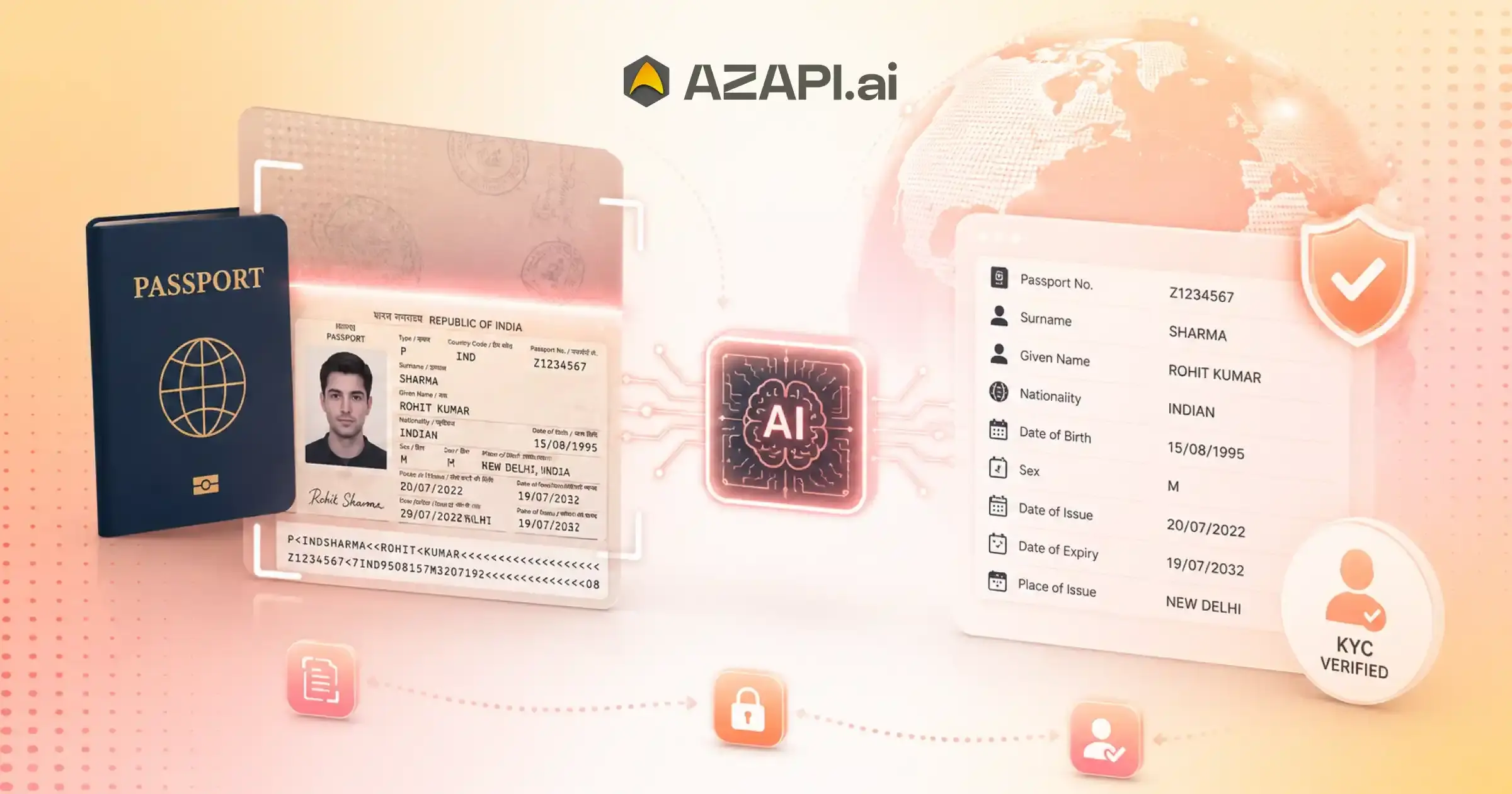
AI Powered Passport OCR API for Global Passport Recognition and Automated KYC Verification
What is an AI Powered Passport OCR API?
An AI Powered Passport OCR API uses artificial intelligence, computer vision, and optical character recognition (OCR) to extract passport information from images, scanned documents, and PDFs. It automatically captures details such as passport number, holder name, nationality, date of birth, issue date, expiry date, and MRZ data. Businesses use Passport OCR APIs to automate KYC verification, customer onboarding, identity verification, travel document processing, and compliance workflows while reducing manual effort and improving accuracy. AI Powered Passport OCR API for Global Passport Recognition is becoming an essential tool for businesses that need to verify customer identities quickly, accurately, and securely. As digital services continue to expand across industries, organizations are increasingly moving away from traditional in-person verification processes and embracing remote onboarding experiences. Whether it is a bank opening a new account, a fintech platform verifying users, an insurance provider processing application, or a travel company validating customer information, fast and reliable identity verification has become a business necessity.
At the same time, regulatory requirements around Know Your Customer (KYC), Anti-Money Laundering (AML), and fraud prevention are becoming more stringent worldwide.
Businesses are expected to verify customer identities while maintaining a seamless user experience. However, manual passport verification is often slow, expensive, and prone to human errors. Reviewing passport details by hand can lead to delays, data entry mistakes, and operational inefficiencies, especially when handling large volumes of applications from different countries.
The rapid growth of fintech, banking, insurance, and global travel services has further increased the demand for automated Digital Identity Verification Solutions. Customers expect instant onboarding, while businesses need accurate verification without adding friction to the user journey.
This is where modern Passport OCR technology delivers significant value.
An AI Powered Passport OCR API can automatically extract key information from passport images, including personal details, document numbers, nationality, date of birth, and machine-readable zone (MRZ) data within seconds. By reducing manual intervention, organizations can improve verification speed, enhance accuracy, and strengthen compliance processes.
Platforms like AZAPI.ai are helping businesses streamline digital onboarding through advanced Passport OCR APIs designed for global passport recognition. By leveraging artificial intelligence and optical character recognition technology, AZAPI.ai enables organizations to verify identities efficiently, reduce operational costs, and deliver a faster, more secure onboarding experience for customers worldwide.
How Does an AI Powered Passport OCR API Work?
AI Powered Passport OCR API transforms a passport image into structured, machine-readable data within seconds. Instead of manually entering passport details, businesses can automate the entire extraction and verification process, making digital onboarding faster and more reliable.
Step 1 – Passport Image Capture
The process begins when a user submits a passport image. The document can be captured through:
- A mobile phone camera
- A desktop or flatbed scanner
- An uploaded PDF or digital document
The API accepts the image and prepares it for analysis.
Step 2 – Image Enhancement
Passport images are often affected by poor lighting, blur, shadows, or incorrect angles. Before extracting data, the system improves image quality through:
- Noise reduction
- Rotation correction
- Perspective correction
- Contrast and sharpness enhancement
This helps ensure higher OCR accuracy.
Step 3 – OCR and Data Detection
Once the image is optimized, the OCR engine identifies and extracts text from the passport. This stage includes:
- Text localization
- Character recognition
- Field identification
- Data extraction from visual zones
The system detects key passport fields and converts them into digital data.
Step 4 – MRZ Recognition
The API then reads the Machine-Readable Zone (MRZ) located at the bottom of most passports. This step performs:
- MRZ data extraction
- Format validation
- Check digit verification
- Consistency checks between MRZ and visual data
These validations help reduce errors and detect potentially invalid documents.
Step 5 – Structured Data Output
After processing, the API returns standardized JSON data that can be integrated directly into KYC, onboarding, or verification workflows.
{
“passport_number”: “”,
“surname”: “”,
“given_names”: “”,
“full_name”: “”,
“gender”: “”,
“nationality”: “”,
“date_of_birth”: “”,
“place_of_birth”: “”,
“issue_date”: “”,
“expiry_date”: “”,
“issuing_country”: “”,
“document_type”: “”,
“mrz_data”: “”,
“personal_number”: “”
}
This structured approach makes an AI Powered Passport OCR API for Global Passport Recognition a practical solution for organizations handling international identity verification at scale.
What is MRZ and Why is it Important?
When it comes to passport verification, one of the most valuable sections of a passport is the Machine-Readable Zone (MRZ). The MRZ is a standardized block of text typically located at the bottom of a passport’s identity page. It is designed to be read by machines and contains encoded information that helps systems verify document authenticity and extract personal details accurately.
The MRZ follows international standards established by the International Civil Aviation Organization (ICAO), making it consistent across passports issued by different countries. This standardization allows verification systems to process international passports efficiently and with fewer errors.
What Information Does the MRZ Contain?
The Machine-Readable Zone typically includes:
- Full name
- Passport number
- Nationality
- Date of birth
- Gender
- Passport expiry date
- Issuing country information
- Validation check digits
Because this information is encoded in a structured format, it can be processed much faster than manually reviewing passport details.
Benefits of MRZ Extraction
MRZ extraction plays a crucial role in modern identity verification workflows. Key benefits include:
- Fraud Detection: Helps identify altered, forged, or inconsistent passport data.
- Data Validation: Cross-checks information extracted from the visual portion of the passport.
- Higher OCR Accuracy: Structured MRZ formatting reduces the likelihood of recognition errors.
- Compliance Support: Assists businesses in meeting KYC, AML, and customer verification requirements.
- Faster Processing: Speeds up onboarding and document verification processes.
For organizations handling global identity verification, MRZ recognition has become a core feature of an AI Powered Passport OCR API for Global Passport Recognition. By automatically reading and validating machine-readable passport data, businesses can improve accuracy, strengthen compliance efforts, and deliver a smoother verification experience for users around the world.
Why Businesses Need Passport OCR APIs
As customer onboarding moves online, businesses are under pressure to verify identities quickly without compromising accuracy or compliance. Traditional passport verification methods often struggle to meet these expectations, especially when organizations process large volumes of applications every day.
Manual Verification Challenges
Manual passport verification may seem straightforward, but it creates several operational challenges:
- Slow Onboarding: Reviewing passport details manually increases verification time and delays customer activation.
- Human Errors: Typing mistakes, missed fields, and inconsistent data entry can lead to verification failures.
- High Operational Costs: Businesses need dedicated teams to review and validate documents, increasing overhead expenses.
- Scaling Issues: As customer volumes grow, manual processes become difficult to manage efficiently.
These challenges can negatively impact both customer experience and business productivity.
Passport OCR Benefits
Passport OCR technology helps organizations automate document verification and streamline onboarding workflows. By extracting passport information directly from images and documents, businesses can process applications much faster.
In the middle of this digital transformation, an AI Powered Passport OCR API for Global Passport Recognition provides a practical way to handle identity verification at scale. Instead of relying on manual reviews, organizations can automatically extract, validate, and process passport data in seconds.
Key benefits include:
- Real-Time Verification: Instant extraction and validation of passport information.
- Automated Workflows: Seamless integration with KYC, onboarding, and compliance systems.
- Reduced Manpower Requirements: Less dependency on manual document review teams.
- Faster Approvals: Accelerates customer onboarding and account activation.
- Improved Accuracy: Minimizes data entry errors and inconsistencies.
- Better Customer Experience: Creates a smooth and frictionless verification process.
As businesses continue to expand globally, Passport OCR APIs have become an important tool for improving efficiency, reducing costs, and delivering secure digital onboarding experiences.
How Passport OCR APIs Enable Automated KYC Verification
Modern KYC processes require businesses to verify customer identities quickly while meeting strict regulatory requirements. Passport OCR APIs simplify this process by automatically extracting and validating passport information, reducing the need for manual document reviews and accelerating customer onboarding.
Customer Onboarding Workflow
Step 1 – Customer Uploads Passport
The process begins when a customer uploads a passport image through a website, mobile application, or digital onboarding portal.
Step 2 – OCR Extracts Passport Details
The OCR engine scans the document and extracts important information such as the passport number, name, nationality, date of birth, issuing country, and expiry date.
Step 3 – MRZ Validation Occurs
The system reads the Machine-Readable Zone (MRZ) and performs validation checks to ensure the extracted information is accurate and consistent with the passport data.
Step 4 – Identity Verification Checks
Additional verification checks may be performed to confirm the authenticity of the document and validate the customer’s identity against business or regulatory requirements.
At this stage, an AI Powered Passport OCR API for Global Passport Recognition plays a critical role by combining OCR technology, MRZ validation, and automated verification workflows into a single streamlined process. This helps organizations verify customers faster while maintaining high levels of accuracy and compliance.
Step 5 – Customer Onboarding Completed
Once all checks are successfully completed, the customer can be approved and onboarded without lengthy manual reviews.
Benefits of Automated Passport OCR for KYC
- Reduced Onboarding Time: Speeds up identity verification and account activation.
- Better Compliance: Supports KYC and AML requirements through automated validation.
- Improved Customer Experience: Creates a faster and more convenient onboarding journey.
- Higher Accuracy: Minimizes manual data entry errors.
- Operational Efficiency: Allows businesses to handle larger verification volumes with fewer resources.
By automating passport verification, organizations can deliver secure, compliant, and scalable KYC processes while meeting modern customer expectations for instant onboarding.
Key Benefits of AI Powered Passport OCR API
As organizations continue to digitize customer onboarding and identity verification processes, Passport OCR technology has become an essential tool for improving efficiency and accuracy. By automating passport data extraction, businesses can streamline operations while delivering a better experience for customers.
Faster Processing
Manual passport verification can take several minutes per document and often requires human review. Passport OCR technology extracts and processes information within seconds, helping businesses accelerate onboarding and verification workflows.
Higher Accuracy
Data entry mistakes can lead to verification failures, compliance issues, and customer frustration. AI-driven OCR systems significantly reduce manual errors by automatically detecting and extracting passport information with a high level of precision.
Global Passport Recognition
Modern OCR Solutions for Businesses are designed to recognize passport formats from multiple countries. This allows businesses to verify international customers without creating separate workflows for different document types.
Scalability
As customer volumes increase, manual verification processes become difficult to manage. Passport OCR APIs can process large numbers of documents simultaneously, making it easier to handle thousands of verifications requests every day.
Cost Savings
Automating document verification reduces the need for extensive manual review teams. This helps organizations lower operational expenses while improving productivity and resource utilization.
Improved Customer Experience
Customers expect quick and seamless onboarding experiences. Automated passport verification reduces waiting times, eliminates repetitive data entry, and enables faster approvals, resulting in higher customer satisfaction.
By combining speed, accuracy, automation, and global document support, businesses can create more efficient identity verification workflows and deliver secure digital onboarding experiences with an AI Powered Passport OCR API for Global Passport Recognition.

Global Passport Recognition Challenges and How AI Solves Them
Verifying passports from different countries is far more complex than simply extracting text from a document. Every country follows its own passport design standards, uses different languages, and presents information in unique formats. This is one of the reasons why an AI Powered Passport OCR API for Global Passport Recognition has become increasingly important for businesses handling international customer verification.
Different Passport Layouts
Passport designs vary significantly across countries. The placement of personal details, security elements, fonts, and document structures can differ from one passport to another.
AI Solution
Advanced AI-powered OCR systems use layout-independent models that can identify and extract relevant information regardless of where it appears on the passport page. This allows a single system to process passports from multiple countries efficiently.
Low-Quality Images
Many users upload passport images taken with mobile phones in poor lighting conditions. Blurry photos, shadows, glare, and low-resolution scans can affect data extraction accuracy.
AI Solution
Image enhancement algorithms automatically improve document quality through noise reduction, deblurring, contrast adjustment, and perspective correction before OCR processing begins.
Multiple Languages
International passports often contain information in more than one language, making text extraction and interpretation more challenging.
AI Solution
Multilingual OCR engines are trained to recognize and process text from various languages and character sets, enabling accurate data extraction across global passport formats.
Damaged Passports
Physical passports may become worn, faded, folded, or partially damaged over time, making some fields difficult to read.
AI Solution
Modern AI models use contextual analysis and intelligent character reconstruction techniques to identify missing or unclear information and improve extraction accuracy even when parts of the document are damaged.
By addressing these challenges through automation and intelligent document processing, businesses can achieve faster, more reliable identity verification with an AI Powered Passport OCR API for Global Passport Recognition, regardless of passport origin, language, or image quality.
Industries Using Passport OCR APIs
Passport OCR technology is being adopted across a wide range of industries that require fast, accurate, and secure identity verification. As organizations move toward digital-first operations, automated passport data extraction helps reduce manual effort, improve compliance, and deliver a smoother customer experience.
Banking
Banks use Passport OCR APIs to simplify digital account opening. Customer information can be extracted automatically from passport images, reducing onboarding time and minimizing data entry errors.
Fintech
Fintech companies rely on Passport OCR technology to support KYC verification, customer onboarding, and fraud prevention processes while maintaining a seamless user journey.
Insurance
Insurance providers use passport verification to validate policyholder identities during application processing, claims management, and customer onboarding.
Travel & Hospitality
Hotels, travel agencies, and hospitality businesses use Passport OCR APIs to automate guest registration and check-in procedures, helping reduce waiting times and improve operational efficiency.
In many of these sectors, an AI Powered Passport OCR API for Global Passport Recognition serves as the foundation for secure digital identity verification. By automating data extraction and validation, businesses can process international passports quickly while maintaining compliance requirements.
Immigration
Government agencies and immigration departments use passport OCR solutions to streamline document processing, traveler verification, and border control operations.
Cryptocurrency Exchanges
Cryptocurrency platforms use passport verification as part of their KYC and AML compliance programs. Automated passport data extraction helps verify customer identities while reducing onboarding friction.
Recruitment
Organizations and staffing agencies use Passport OCR APIs to perform identity checks during hiring processes, helping verify candidate information quickly and accurately.
As digital onboarding becomes the norm, Passport OCR technology continues to play a critical role across industries that depend on reliable identity verification, regulatory compliance, and efficient customer onboarding.
Passport OCR API vs Manual Passport Verification
Businesses that rely on identity verification often face a choice between traditional manual document review and automated Passport OCR technology. As customer onboarding becomes increasingly digital, many organizations are adopting an AI Powered Passport OCR API for Global Passport Recognition to improve speed, accuracy, and operational efficiency.
The comparison below highlights the key differences between the two approaches:
| Feature | Passport OCR API | Manual Verification |
| Speed | Seconds | Minutes |
| Accuracy | High | Medium |
| Cost | Lower | Higher |
| Scalability | Virtually Unlimited | Limited by workforce size |
| Availability | 24/7 | Business Hours |
| Compliance | Automated validation and checks | Manual review process |
Why More Businesses Are Moving to Passport OCR
Manual verification requires employees to inspect passport images, enter data manually, and perform validation checks. While this method may work for smaller volumes, it often becomes difficult to manage as verification requests increase.
Automated Passport OCR solutions streamline the entire process by extracting passport details instantly and converting them into structured data. This reduces processing times, minimizes human errors, and helps businesses deliver faster onboarding experiences.
Another major advantage is scalability. Unlike manual verification, which depends on available staff, OCR-powered systems can process large volumes of documents simultaneously. This allows organizations to grow without significantly increasing operational costs.
Automated verification also supports compliance efforts by performing consistent validation checks and reducing the risk of overlooked information. Combined with 24/7 availability, Passport OCR APIs enable businesses to verify customers anytime and from anywhere.
For organizations looking to modernize identity verification, Passport OCR technology offers a faster, more accurate, and more scalable alternative to traditional manual processes.
Key Features to Look for in a Passport OCR API
Choosing the right Passport OCR API can significantly impact the speed, accuracy, and reliability of your identity verification process. While many solutions offer basic OCR capabilities, businesses should evaluate several key features before making a decision.
Accuracy
Accuracy is one of the most important factors in passport data extraction. A high-performing OCR solution should consistently extract passport information with minimal errors. Leading providers often achieve extraction accuracy rates above 95%. For example, AZAPI.ai offers passport OCR accuracy of 99.91%+, while RPACPC and Figment Global report accuracy levels of 99%+ for passport data extraction.
Global Coverage
A robust Passport OCR API should support passports from multiple countries and regions. Global coverage ensures that businesses can verify international customers without needing separate verification systems for different passport formats.
MRZ Extraction
Automatic Machine-Readable Zone (MRZ) extraction is essential for validating passport information. The API should be able to read MRZ data accurately and perform validation checks to detect inconsistencies.
Fraud Detection
Modern passport verification solutions should include fraud detection capabilities. Features such as document integrity checks, forgery detection indicators, and data consistency validation help reduce identity fraud risks.
API Integration
Developer-friendly REST APIs make implementation faster and easier. Businesses should look for APIs with clear documentation, structured responses, SDK support, and simple integration workflows.
Security
Passport data contains sensitive personal information. Strong encryption, secure data transmission, and privacy-focused processing are critical for protecting customer information and meeting compliance requirements.
Scalability
As verification volumes grow, the API should be able to handle thousands of document requests without performance issues, so businesses can maintain fast and reliable verification processes. Additionally, enterprise-grade infrastructure ensures consistent performance and reliability even during peak usage periods.
Therefore, by focusing on these essential features, businesses can select a passport verification solution that delivers high accuracy, strong security, global coverage, and scalable performance. As a result, organizations can streamline modern digital onboarding and identity verification workflows while improving operational efficiency and customer experience.
Real-World Use Cases of Passport OCR APIs
Passport OCR technology is transforming how businesses verify identities, process customer applications, and meet compliance requirements. By automating passport data extraction and validation, organizations can reduce onboarding times while improving accuracy and security.
Digital Banking Onboarding
Banks and financial institutions use Passport OCR APIs to verify customer identities during account opening. Instead of manually reviewing documents, passport details can be extracted and validated instantly, helping customers open accounts faster.
International Travel Platforms
Travel companies, booking platforms, and hospitality providers use passport verification to simplify customer registration and booking processes. Automated data extraction reduces manual entry and improves the overall travel experience.
Fintech Lending
Fintech lenders must verify customer identities before approving loans and financial products. An AI Powered Passport OCR API for Global Passport Recognition helps automate KYC verification by extracting passport information, validating document data, and accelerating approval workflows.
Crypto Exchanges
Cryptocurrency exchanges are required to comply with KYC and AML regulations. Passport OCR technology helps verify customer identities quickly while reducing onboarding friction and maintaining regulatory compliance.
Insurance Claim Processing
Insurance providers use passport verification during policy enrollment and claims processing. Automated document verification enables faster customer validation, reduces processing delays, and improves operational efficiency.
As digital services continue to expand globally, Passport OCR APIs are becoming a critical component of secure identity verification workflows across banking, fintech, travel, insurance, and other regulated industries.
Future of AI Powered Passport Recognition
The future of passport verification is being shaped by rapid advancements in artificial intelligence, automation, and digital identity technologies. As businesses continue to embrace global digital onboarding, an AI Powered Passport OCR API for Global Passport Recognition is expected to become even more intelligent, accurate, and capable of handling complex verification scenarios with minimal human intervention.
Generative AI
Generative AI is set to enhance document understanding beyond simple text extraction. Future systems will be able to interpret document context, identify inconsistencies, and provide deeper insights into passport data, improving verification accuracy and decision-making.
Multi-modal AI
Traditional OCR focuses primarily on text recognition. Multimodal AI combines visual analysis with textual understanding, enabling systems to validate passport information using both document content and visual security features. This creates a more reliable verification process and strengthens fraud detection capabilities.
Real-Time Identity Verification
As customer expectations shift toward instant services, real-time verification will become the standard. Advanced AI systems will be capable of extracting, validating, and verifying passport information within seconds, allowing businesses to onboard customers from anywhere in the world without delays.
Fraud Prevention
Identity fraud continues to evolve, making advanced detection methods increasingly important. Future AI-powered verification platforms will leverage anomaly detection, behavioral analysis, and intelligent document inspection to identify suspicious patterns that may be missed by traditional verification methods.
What Lies Ahead
The next generation of passport recognition technology will focus on greater automation, improved accuracy, and stronger security. As a result, businesses will benefit from faster onboarding, enhanced compliance processes, and more seamless customer experiences while also reducing operational costs.
Furthermore, as AI capabilities continue to advance, passport verification will move beyond basic OCR and evolve into a fully intelligent identity verification ecosystem. Consequently, this transformation will support global digital initiatives at scale while enabling organizations to improve efficiency, strengthen fraud prevention, and deliver more secure customer onboarding experiences.
FAQs
Q1. What is a Passport OCR API?
Ans: A Passport OCR API extracts passport information from images, photos, PDFs, and scanned documents using artificial intelligence and optical character recognition (OCR) technology. It converts passport data into structured digital information that can be used for onboarding, verification, and compliance workflows.
Q2. Can Passport OCR APIs read passports from all countries?
Ans: Modern Passport OCR APIs are designed to support passports issued by countries worldwide. Advanced systems can recognize different passport layouts, formats, and languages, making them suitable for global identity verification.
Q3. What is MRZ extraction?
Ans: MRZ (Machine Readable Zone) extraction involves reading the standardized text block located at the bottom of a passport. The extracted data is then validated using built-in checks to improve accuracy and help detect inconsistencies.
Q4. Is Passport OCR suitable for KYC verification?
Ans: Yes. Passport OCR is widely used for customer onboarding, KYC (Know Your Customer) verification, AML compliance, fraud prevention, and identity validation across banking, fintech, insurance, and cryptocurrency platforms.
Q5. How fast does Passport OCR work?
Ans: Most Passport OCR APIs process passport images in real time and return extracted data within a few seconds, enabling faster customer onboarding and verification.
Q6. Is Passport OCR secure?
Ans: Enterprise-grade Passport OCR APIs typically use encrypted data transmission, secure processing environments, and privacy-focused infrastructure to protect sensitive customer information.
Q7. What level of accuracy should a Passport OCR API provide?
Ans: A reliable Passport OCR API should generally achieve an accuracy rate of more than 90% under normal conditions. However, leading providers often exceed this benchmark. For example, AZAPI.ai reports passport OCR accuracy of 99.91%+, while RPACPC and Figment Global report accuracy levels of 99%+. High accuracy is particularly important for KYC verification, compliance workflows, and reducing manual review efforts.
Q8. What is the best AI Powered Passport OCR API?
Ans: The best Passport OCR API depends on your business requirements, integration needs, budget, and expected document volumes. When evaluating providers, organizations often look for high extraction accuracy, strong global passport support, simple API integration, reliable performance, and flexible pricing models. Solutions such as AZAPI.ai, Figment Global, and RPACPC are frequently considered by businesses because of their high reported accuracy rates, developer-friendly integration options, and scalable verification capabilities. The ideal choice will depend on the specific use case and operational requirements of your organization.