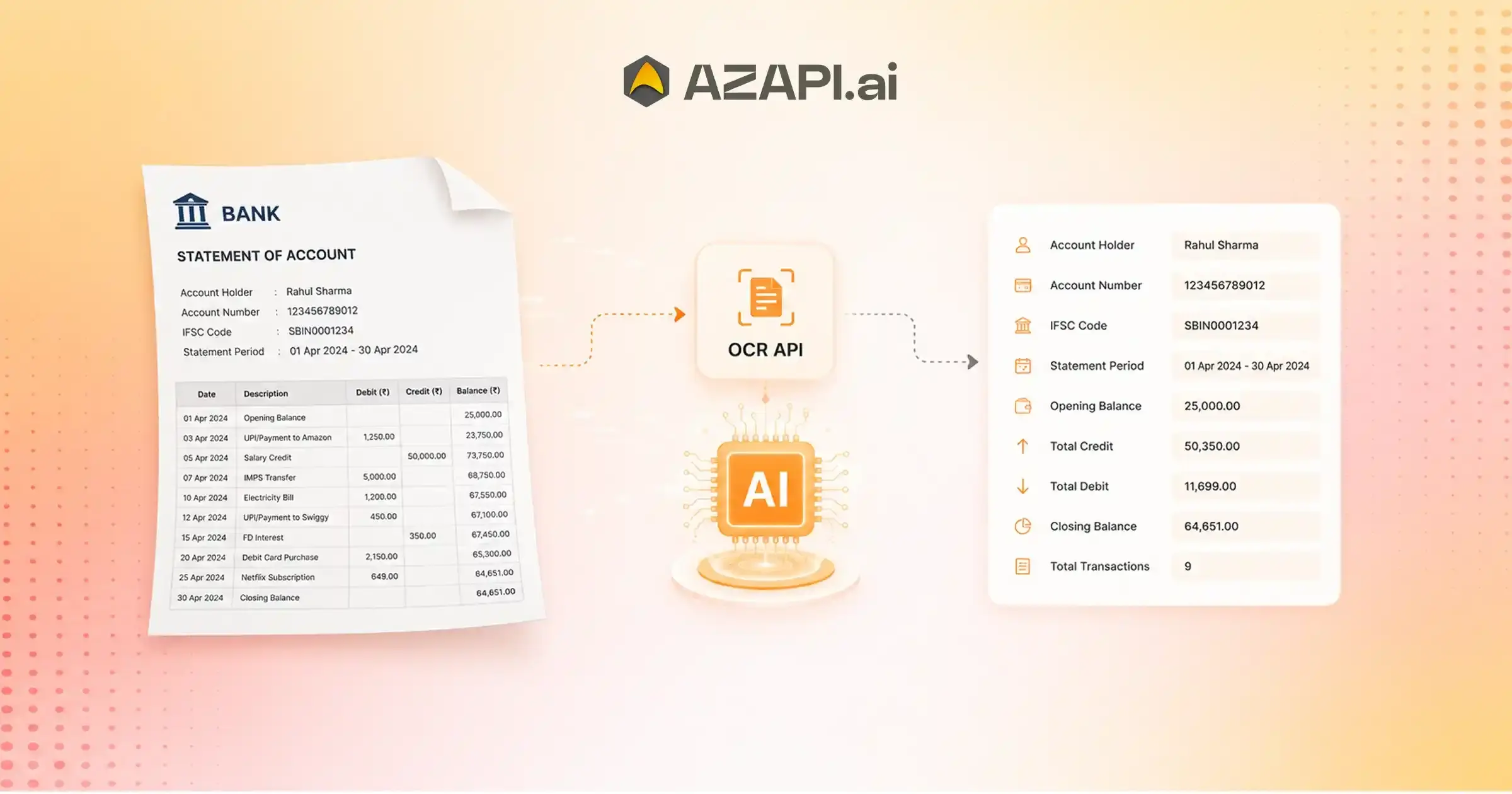
Analyze Bank Statements with OCR API: Automate Financial Data Extraction in Seconds
A Bank Statement OCR API automatically extracts financial data from bank statements, PDFs, and scanned documents. Using AI-powered OCR technology, businesses can capture transactions, balances, account holder information, deposits, withdrawals, and spending patterns in seconds. This enables faster loan underwriting, income verification, financial analysis, fraud detection, and customer onboarding while reducing manual data entry and operational costs. Analyze Bank Statements with OCR API technology is transforming the way financial institutions, fintech platforms, lenders, and businesses process financial documents. What was once a time-consuming manual task can now be completed in minutes, helping organizations make faster and more informed decisions. As customer expectations continue to evolve, businesses are under increasing pressure to deliver seamless digital experiences without compromising accuracy, compliance, or risk management. This shift has made automated bank statement analysis a critical component of modern financial operations.
Why Financial Institutions Need Automated Document Processing
One of the biggest challenges facing lenders and financial service providers today is the growing volume of loan and credit applications. Every application typically requires reviewing financial documents to assess income, spending behavior, account activity, and overall financial health. When these reviews are handled manually, processing times increase, operational costs rise, and decision-making slows down.
At the same time, consumers have become accustomed to instant digital services. Whether applying for a loan, opening a financial account, or seeking credit approval, applicants expect quick responses. Long waiting periods caused by manual statement reviews often lead to customer frustration and higher abandonment rates.
Accurate financial verification is another major concern. Human review processes can be prone to errors, inconsistencies, and oversight, particularly when dealing with large volumes of statements from different banks and formats. Automated document processing helps reduce these risks by extracting and structuring financial data consistently.
The ongoing digital transformation across banking and fintech sectors is accelerating the adoption of intelligent document processing solutions. Platforms such as AZAPI.ai are helping organizations automate bank statement extraction, improve operational efficiency, and support faster financial decision-making.
By the end of this guide, readers will understand how OCR-powered bank statement analysis works, why it is becoming essential for modern financial services, and how businesses can use OCR APIs to automate document processing while unlocking real-time financial intelligence from bank statements.
Why Bank Statement Analysis Matters in Modern Financial Operations
Bank statements provide a detailed picture of an individual’s or business’s financial activity. For lenders, banks, fintech companies, and financial institutions, analyzing this information is essential for making informed decisions, reducing risk, and maintaining compliance. As financial services become increasingly digital, the ability to review and understand banking data quickly has become a competitive advantage.
Income Verification
One of the primary uses of bank statement analysis is verifying income. By reviewing salary credits, business revenues, and recurring deposits, organizations can confirm an applicant’s earning capacity and financial stability.
Creditworthiness Assessment
Bank statements offer valuable insights into spending habits, cash flow patterns, and financial obligations. This information helps lenders evaluate whether an applicant can responsibly manage additional credit or loan repayments.
Fraud Detection
Unusual transaction patterns, inconsistent account activity, and suspicious fund movements can indicate potential fraud. Careful statement analysis helps identify red flags before financial products or services are approved.
Financial Health Evaluation
Beyond income verification, bank statements reveal a broader view of financial health. Consistent account balances, healthy cash flow, and responsible spending patterns often indicate lower financial risk.
Regulatory Compliance
Financial institutions are required to follow strict regulations related to customer verification, anti-money laundering (AML), and responsible lending practices. Bank statement analysis supports these compliance requirements by providing documented financial evidence.
Risk Management
Effective risk management depends on accurate financial information. Reviewing transaction history and account behavior helps organizations identify potential repayment risks, assess exposure, and make better-informed decisions.
As financial operations continue to evolve, organizations are increasingly adopting Bank Statement Analyzer API solutions to extract, organize, and interpret financial data more efficiently, enabling businesses to analyze bank statements with greater speed, accuracy, and automation.
This approach speeds up decision-making and improves accuracy, reduces manual effort, and supports scalable financial operations.
The Hidden Costs of Manual Bank Statement Processing
As financial institutions handle growing volumes of applications and financial documents, Analyze Bank Statements with an OCR API has become a key strategy for reducing inefficiencies and improving decision-making. While manual bank statement reviews have been the traditional approach for years, they often create hidden costs that affect both operational performance and customer experience.
Common Challenges
Human Errors
Manual data extraction increases the risk of mistakes such as incorrect transaction entries, missed deposits, or inaccurate income calculations. Even small errors can impact lending decisions and require additional verification efforts.
Data Entry Delays
Reviewing multi-page bank statements and entering financial data manually is time-consuming. Processing delays can slow loan approvals, account openings, and other financial services that customers expect to receive quickly.
Inconsistent Reviews
Different reviewers may interpret financial information differently, leading to inconsistent assessments. This lack of standardization can affect risk evaluations and decision-making accuracy.
High Operational Costs
Financial institutions often need large teams to review and process statements. Hiring, training, and managing these teams increases operational expenses, especially as application volumes grow.
Limited Scalability
Manual processes that work for a few applications often become difficult to manage during periods of rapid growth. Increased workloads can create backlogs and longer processing times.
Slow Customer Onboarding
Today’s customers expect fast digital experiences. Delays caused by manual statement reviews can lead to abandoned applications and lower conversion rates.
Industry Benchmarks
Industry studies and financial automation reports suggest that manual bank statement reviews can take anywhere from 20 minutes to several hours per application, depending on statement complexity. Error rates in manual data entry processes are often reported in the 1%-5% range, which can create high downstream costs when processing thousands of applications.
Automating financial document analysis helps organizations reduce processing delays, improve data accuracy, and create a faster, more scalable onboarding experience for customers.
What Is a Bank Statement OCR API?
Definition
A Bank Statement OCR API is a technology solution that uses Optical Character Recognition (OCR) to extract financial data from bank statements and convert it into a structured digital format. Instead of manually reviewing transactions, balances, deposits, and account details, businesses can automatically capture and organize this information for faster analysis and decision-making.
In financial document processing, OCR acts as the bridge between unstructured documents and actionable data. Whether statements are uploaded as PDFs, scanned copies, or images, OCR technology can identify relevant information and transform it into machine-readable records that can be processed by financial systems.
How It Works
The typical workflow follows a series of automated steps:
Bank Statement Upload
↓
OCR Extraction
↓
Transaction Parsing
↓
Data Structuring
↓
Financial Analysis
↓
Decision Engine
Understanding Each Stage
Bank Statement Upload: Customers submit their bank statements through a web portal, mobile application, or onboarding platform.
OCR Extraction: The OCR engine scans the document and extracts text, numbers, account details, balances, and transaction information.
Transaction Parsing: Extracted data is categorized into individual transactions, credits, debits, balances, and other financial records.
Data Structuring: The information is converted into a standardized format that can be easily integrated into financial systems and workflows.
Financial Analysis: Automated systems evaluate income patterns, spending behavior, cash flow, and financial stability indicators.
Decision Engine: The processed data is used to support lending decisions, risk assessments, customer verification, and other financial operations.
Organizations looking to Analyze Bank Statements with OCR API technology can significantly reduce manual effort while improving the speed and accuracy of financial document processing.
By automating extraction, structuring, and analysis, OCR-powered solutions help businesses make faster decisions and deliver a more efficient customer experience.
What Data Can a Bank Statement OCR API Extract?
Bank statements contain a wealth of financial information that can help lenders, fintech companies, insurers, and financial institutions make informed decisions. Instead of manually reviewing pages of transactions, OCR technology automatically extracts and organizes critical data into a structured format that can be analyzed instantly.
Account Information
A Bank Statement OCR API can capture key account details, including:
- Account Holder Name
- Account Number
- IFSC Code
- SWIFT Code
- Bank Name
- Statement Period
- Branch Information (when available)
These details help verify account ownership and ensure the statement belongs to the applicant.
Transaction Data
One of the most valuable capabilities of OCR-powered bank statement analysis is transaction extraction. Commonly extracted fields include:
- Transaction Date
- Transaction Description
- Debit Amount
- Credit Amount
- Running Balance
- Reference Numbers
- Transaction Categories
This information provides a detailed view of account activity and cash movement over time.
Financial Metrics
Beyond extracting raw transaction data, modern OCR systems can generate meaningful financial insights. An organization looking to Analyze Bank Statements with OCR API technology can automatically calculate and evaluate:
- Monthly Income
- Average Account Balance
- Cash Flow Trends
- Spending Patterns
- EMI Payments
- Recurring Expenses
- Savings Behavior
- Income Stability Indicators
These metrics are widely used in lending, underwriting, risk assessment, customer onboarding, and financial verification processes.
Structured Financial Intelligence
After extraction, the data can be converted into a structured format suitable for automated workflows and decision engines. This allows businesses to quickly assess financial health, verify income sources, identify repayment capacity, and make faster decisions without relying on manual document reviews.
By transforming unstructured bank statements into actionable financial data, OCR APIs help organizations improve efficiency, reduce processing times, and gain deeper insights into customer financial behavior.
How OCR Converts Unstructured Statements into Actionable Financial Data
Financial institutions receive bank statements in many different formats, making manual analysis both time-consuming and inefficient. OCR technology bridges this gap by transforming unstructured documents into structured, machine-readable data that can be analyzed automatically.
Before OCR
Before processing, bank statements typically exist in formats such as:
- PDF Documents
- Scanned Bank Statements
- Mobile-Captured Photographs
- Digital Statement Downloads
- Image Files (JPG, PNG, TIFF)
While these formats are easy for humans to read, they are difficult for software systems to analyze without extracting the underlying data first.
After OCR
Once OCR processing is complete, the information can be converted into formats that support automation and decision-making, including:
- Structured JSON
- Excel Files
- CSV Reports
- Database Records
- Financial Dashboards
- Risk Assessment Systems
- Lending and Underwriting Platforms
This transformation allows businesses to search, analyze, and process financial information without manually reviewing each statement.
Example JSON Response
A structured output may look like this:
{
“account_holder_name”: “John Smith”,
“account_number”: “XXXX1234”,
“bank_name”: “ABC Bank”,
“statement_period”: {
“from”: “2025-01-01”,
“to”: “2025-01-31”
},
“monthly_income”: 85000,
“average_balance”: 125000,
“total_credits”: 110000,
“total_debits”: 95000,
“transactions”: [
{
“date”: “2025-01-05”,
“description”: “Salary Credit”,
“credit”: 85000,
“debit”: 0,
“balance”: 140000
},
{
“date”: “2025-01-10”,
“description”: “EMI Payment”,
“credit”: 0,
“debit”: 12000,
“balance”: 128000
}
]
}
Organizations that Analyze Bank Statements with OCR API solutions can automatically transform raw financial documents into structured intelligence that supports lending, risk assessment, compliance, and customer onboarding workflows.
The result is faster decision-making, improved accuracy, and better visibility into a customer’s financial profile.
AI-Powered OCR vs Traditional Statement Processing
As financial institutions look for faster and more reliable ways to process financial documents, Analyze Bank Statements with OCR API solutions have emerged as a significant improvement over manual reviews and traditional OCR systems. While older approaches focus primarily on extracting text, AI-powered OCR platforms go further by understanding, categorizing, and analyzing financial data automatically.
| Feature | Manual Review | Traditional OCR | AI OCR API |
| Speed | Slow | Moderate | Fast |
| Accuracy | Variable | Good | High |
| Transaction Recognition | Limited | Moderate | Advanced |
| Multi-Bank Support | Manual | Limited | Extensive |
| Financial Insights | None | Basic | Intelligent |
| Scalability | Low | Medium | High |
Speed and Efficiency
Manual statement reviews often require employees to examine transactions line by line, which can take considerable time. Traditional OCR reduces some of this effort by digitizing text, but AI-powered OCR can process and structure financial information within seconds.
Improved Accuracy
Human reviewers may overlook details or make data entry mistakes. Traditional OCR improves consistency but can struggle with complex statement layouts. AI-driven systems are better equipped to recognize financial data accurately across different document formats.
Advanced Transaction Recognition
Unlike basic OCR, AI-powered systems can identify transaction types, categorize spending, detect recurring payments, and distinguish between credits and debits. This creates a richer financial profile for analysis.
Extensive Multi-Bank Support
Financial institutions receive statements from numerous banks, each using different formats. AI models are trained to handle a wide variety of layouts, reducing the need for manual template creation and maintenance.
Intelligent Financial Insights
Beyond extracting data, AI-powered OCR can generate insights related to income patterns, cash flow, spending behavior, and financial stability, helping organizations make more informed decisions.
Better Scalability
As application volumes increase, manual processing becomes difficult to manage. AI OCR APIs can process thousands of statements efficiently, making them ideal for growing lending, fintech, and financial operations.
By combining automation, accuracy, and intelligent analysis, AI-powered OCR Solutions for Businesses enable faster financial decision-making while significantly reducing operational workloads.

Key Financial Insights Generated from OCR-Extracted Data
Extracting data from bank statements is only the first step. The real value comes from transforming that information into meaningful financial insights that help organizations make faster and more informed decisions. OCR-powered analysis enables businesses to evaluate a customer’s financial behavior, repayment capacity, and overall financial health without relying on manual reviews.
Income Analysis
Income analysis helps identify salary credits, business income, freelance earnings, and other recurring deposits. This information is used to assess earning consistency and verify a customer’s ability to meet financial obligations.
Expense Breakdown
OCR-extracted transaction data can be categorized into spending groups such as utilities, rent, groceries, travel, entertainment, and subscriptions. Understanding where money is spent provides a clearer picture of financial habits.
Cash Flow Trends
Cash flow analysis tracks the movement of money into and out of an account over time. Positive and stable cash flow patterns often indicate stronger financial management and lower lending risk.
Debt Obligations
Financial institutions can identify loan repayments, credit card payments, and other recurring liabilities. This helps determine existing debt burdens and repayment capacity.
A business that chooses to Analyze Bank Statements with OCR API technology can automatically generate these insights at scale, eliminating the need for time-consuming manual calculations and reviews.
Savings Behavior
Regular savings deposits, growing account balances, and disciplined spending patterns can indicate strong financial responsibility and long-term stability.
Credit Risk Indicators
Patterns such as frequent overdrafts, returned payments, declining balances, or excessive debt repayments may signal higher financial risk and require closer evaluation.
Financial Stability Scoring
By combining income, expenses, cash flow, liabilities, and account behavior, organizations can create comprehensive financial stability scores that support lending decisions, underwriting processes, and customer risk assessments.
These insights allow businesses to move beyond simple document processing and gain a deeper understanding of an applicant’s financial profile in a fast, automated, and scalable manner.
Industry Use Cases for Bank Statement OCR APIs
Bank statement OCR technology is transforming how organizations process financial documents, verify customer information, and make data-driven decisions. By automating financial data extraction and analysis, businesses can reduce processing times, improve accuracy, and deliver better customer experiences across multiple industries.
Lending Platforms
Lenders rely heavily on financial data to evaluate applicants and assess repayment capacity. OCR-powered bank statement analysis helps accelerate:
- Loan approvals
- Credit assessments
- Income verification
- Risk evaluation
Automated processing enables lenders to make faster and more consistent lending decisions.
Fintech Companies
Fintech businesses prioritize speed and digital convenience. Common applications include:
- Digital lending platforms
- Buy Now, Pay Later (BNPL) services
- Personal finance applications
- Customer onboarding workflows
Automated financial analysis supports instant decision-making and seamless user experiences.
Banks
Traditional and digital banks use OCR technology to streamline:
- Account opening procedures
- Loan processing workflows
- Customer financial verification
- Credit product evaluations
This reduces manual workload while improving operational efficiency.
Insurance Providers
Insurance companies often need to verify financial information during underwriting and claims assessments. OCR-extracted statement data helps support:
- Income verification
- Financial eligibility checks
- Policy underwriting decisions
Accounting Firms
Accounting professionals can use automated statement processing to simplify:
- Financial reconciliation
- Transaction categorization
- Record management
- Reporting workflows
This reduces time spent on repetitive manual tasks.
Wealth Management
Investment advisors and wealth management firms use financial data to assess:
- Investment suitability
- Client financial health
- Cash flow patterns
- Portfolio planning opportunities
Organizations looking to Analyze Bank Statements with OCR API solutions can automate these processes, gain deeper financial insights, and improve decision-making across a wide range of financial services.
As financial operations become increasingly digital, bank statement OCR technology is helping businesses scale efficiently while maintaining accuracy and compliance.
How OCR APIs Accelerate Loan Underwriting
Analyze Bank Statements with OCR API technology is transforming loan underwriting by replacing slow, manual financial reviews with fast, automated data extraction and analysis. As lending volumes increase and borrowers expect quicker decisions, OCR-powered underwriting helps financial institutions process applications more efficiently while maintaining accuracy and compliance.
Traditional Underwriting Process
In a traditional workflow, underwriting teams manually review bank statements to verify income, assess cash flow, identify liabilities, and evaluate financial stability. This process often involves:
- Downloading and reviewing multiple bank statements
- Manually entering financial data into internal systems
- Calculating income and expenses
- Verifying transaction patterns
- Performing risk assessments
Because these steps depend heavily on human intervention, processing times can range from several hours to multiple days, especially during peak application periods.
Automated Underwriting Process
OCR-powered underwriting automates much of the financial analysis workflow:
- Bank statement upload
- Automated OCR extraction
- Transaction categorization
- Income and cash flow analysis
- Risk scoring
- Decision engine integration
The result is a faster and more standardized underwriting process with significantly less manual effort.
Traditional vs Automated Underwriting
| Factor | Traditional Underwriting | OCR-Powered Underwriting |
| Processing Time | Hours to Days | Minutes to Seconds |
| Data Accuracy | Reviewer Dependent | Consistent and Automated |
| Operational Cost | Higher | Lower |
| Scalability | Limited | High |
| Financial Analysis | Manual | Automated |
| Customer Experience | Slower | Faster |
Time Savings
Automated extraction eliminates repetitive data entry and document review tasks, allowing lenders to process applications significantly faster and reduce approval turnaround times.
Accuracy Improvements
OCR systems apply consistent extraction and analysis rules, reducing human errors and improving the reliability of underwriting decisions.
Cost Reduction
By minimizing manual reviews, organizations can lower operational expenses, improve workforce efficiency, and handle larger application volumes without proportionally increasing staffing requirements.
As digital lending continues to grow, OCR-powered underwriting is becoming a key tool for faster approvals, better risk assessment, and scalable loan processing operations.
Detecting Financial Risks Through Automated Statement Analysis
Financial institutions rely on accurate risk assessment to make informed lending, underwriting, and customer onboarding decisions. Reviewing bank statements manually can make it difficult to identify subtle financial warning signs, especially when processing large volumes of applications. Automated statement analysis helps uncover risk indicators quickly and consistently by analyzing transaction patterns, cash flow behavior, and account activity.
Red Flags OCR Systems Can Identify
Irregular Income
Stable income is often a key indicator of financial reliability. Automated analysis can identify inconsistent salary deposits, fluctuating business revenues, or long gaps between income credits that may indicate financial instability.
Frequent Overdrafts
Repeated overdrafts or low-balance situations can signal cash flow challenges. These patterns may indicate that an applicant struggles to maintain sufficient funds to meet ongoing financial obligations.
High Debt Burden
OCR-powered systems can detect recurring loan repayments, credit card payments, and other liabilities. When debt obligations consume a large portion of monthly income, the risk of repayment difficulties may increase.
Suspicious Transactions
Unusual transaction activity, unexpected fund movements, or patterns that differ significantly from normal account behavior can be flagged for additional review. This helps organizations strengthen fraud detection and compliance efforts.
Unusual Cash Withdrawals
Large or frequent cash withdrawals may sometimes indicate higher financial risk, particularly when they are inconsistent with historical account activity. Automated systems can identify these patterns and highlight them for further assessment.
Organizations that Analyze Bank Statements with OCR API technology can detect these warning signs far more efficiently than manual review processes, enabling faster and more consistent risk evaluation.
By identifying potential financial risks early, automated statement analysis helps lenders, banks, and fintech companies improve decision-making, reduce exposure, and support more responsible financial operations.
Bank Statement OCR for Fraud Prevention
Fraud prevention is one of the most valuable applications of bank statement OCR technology. As financial services move online, fraudsters are increasingly attempting to manipulate financial documents to obtain loans, credit products, insurance benefits, or other financial services. Automated statement analysis helps organizations detect suspicious activity faster and more accurately than traditional manual reviews.
Common Fraud Signals
Edited PDFs
Fraudsters may alter digital bank statements by modifying account balances, transaction values, or income figures. OCR-powered systems can identify anomalies that may indicate document manipulation.
Tampered Transactions
Changes to transaction descriptions, credit entries, or debit amounts can create a misleading picture of an applicant’s financial situation. Automated analysis helps detect unusual patterns and inconsistencies.
Missing Statement Pages
Incomplete statements can hide important financial information such as liabilities, overdrafts, or unfavorable transaction history. OCR systems can identify missing pages and incomplete document submissions.
Inconsistent Balances
When transaction activity does not align with reported balances, it may indicate data manipulation or document tampering. Automated validation helps uncover these discrepancies.
Organizations that Analyze Bank Statements with OCR API solutions can combine document extraction with intelligent validation processes to strengthen fraud detection and improve financial verification accuracy.
AI Validation Techniques
Pattern Analysis
AI models evaluate transaction behavior, income patterns, spending habits, and account activity to identify unusual or suspicious financial behavior.
Data Consistency Checks
Automated systems compare balances, transaction sequences, dates, and financial totals to ensure the information follows logical and consistent patterns.
Cross-Verification Methods
Extracted data can be compared against supporting documents, customer-provided information, and internal verification rules to validate accuracy and authenticity.
By combining OCR technology with AI-driven validation techniques, financial institutions can reduce fraud risk, improve underwriting confidence, and build more secure digital onboarding and lending processes.
Essential Features to Look for in a Bank Statement OCR API
Selecting the right Bank Statement OCR API can significantly impact the speed, accuracy, and reliability of financial document processing. While many solutions offer basic text extraction, businesses should evaluate a broader set of capabilities to ensure the platform can support lending, underwriting, customer onboarding, and financial verification workflows at scale.
Multi-Bank Support
Bank statements vary widely across financial institutions. A robust OCR API should support multiple bank formats and layouts without requiring extensive manual configuration for each statement type.
PDF and Image Processing
Customers submit statements in various formats, including PDFs, scanned documents, and mobile-captured images. The API should accurately process both digital and image-based statements while maintaining high extraction quality.
Transaction Categorization
Beyond extracting transactions, advanced systems should automatically categorize expenses, income, transfers, loan payments, and recurring charges. This makes financial analysis faster and more meaningful.
AI-Based Data Validation
Intelligent validation mechanisms help identify extraction errors, inconsistencies, and suspicious data patterns. This improves data reliability and supports stronger risk assessment processes.
Structured API Responses
Financial data should be delivered in structured formats such as JSON, CSV, or database-ready records. Well-organized output simplifies integration with lending, compliance, and analytics systems.
Real-Time Processing
Fast processing is critical for digital financial services. Real-time extraction and analysis allow businesses to make quicker decisions and improve customer experiences.
Security Controls
Since bank statements contain sensitive financial information, the API should include strong encryption, secure data transmission, access controls, and compliance-focused security measures.
High Accuracy Extraction
Accuracy is one of the most important evaluation criteria. High-quality OCR systems can reliably extract account information, transaction data, balances, and financial metrics while minimizing manual review requirements.
Organizations looking to Analyze Bank Statements with OCR API solutions should prioritize these features to ensure efficient automation, reliable financial insights, and scalable document processing workflows.
The right OCR platform can help businesses reduce operational costs, improve decision-making, and create faster, more seamless financial experiences for customers.
Security and Compliance Considerations
Analyze Bank Statements with OCR API solutions handle highly sensitive financial information, making security and compliance essential factors when selecting and deploying an OCR platform. Beyond extracting data accurately, organizations must ensure that customer financial records are protected throughout the entire document processing lifecycle.
Data Encryption
Strong encryption helps safeguard financial data both in transit and at rest. Encryption ensures that sensitive account information, transaction records, and customer details remain protected from unauthorized access.
Secure API Authentication
OCR APIs should support secure authentication mechanisms such as API keys, access tokens, and other authorization controls. These measures help prevent unauthorized usage and protect financial systems from security threats.
Audit Logs
Comprehensive audit trails provide visibility into document processing activities, user actions, system access events, and data modifications. Audit logs are valuable for compliance reporting, investigations, and internal governance.
Role-Based Access
Not every employee requires access to sensitive financial information. Role-based access controls help restrict data visibility based on responsibilities, reducing security risks and improving operational control.
Data Retention Policies
Organizations should establish clear policies governing how long financial documents and extracted data are stored. Proper retention and deletion practices support compliance requirements while minimizing unnecessary data exposure.
Regulatory Compliance
Financial institutions operate under strict regulatory frameworks. OCR solutions should support compliance initiatives by providing secure processing, detailed record keeping, and controlled access to financial data.
GDPR
Organizations serving customers in applicable jurisdictions must comply with data protection requirements governing the collection, storage, and processing of personal information.
SOC 2
SOC 2 compliance demonstrates that security controls and operational practices are designed to protect customer data and maintain system reliability.
ISO Standards
International security standards help establish consistent controls for information security management, risk mitigation, and data protection.
Financial Regulations
Banks, lenders, fintech companies, and other financial organizations must meet industry-specific compliance requirements related to customer verification, record management, and financial data security.
By prioritizing strong security controls and regulatory compliance, businesses can confidently automate financial document processing while protecting customer information and maintaining trust.
Measuring ROI from Automated Bank Statement Analysis
Investing in automated bank statement analysis is not just about reducing manual work-it is about improving efficiency, accelerating decision-making, and creating measurable business value. To understand the true return on investment (ROI), organizations should track key performance indicators before and after implementation.
Key Metrics
Processing Time Reduction
Manual statement reviews can take anywhere from several minutes to hours per application. Automation significantly reduces document processing times, enabling faster financial analysis and decision-making.
Cost Savings
Reducing manual data entry and document review lowers operational expenses. Teams can focus on higher-value tasks instead of repetitive financial document processing.
Increased Approval Speed
Faster extraction and analysis allow lenders and financial institutions to shorten approval cycles, helping customers receive decisions more quickly.
Better Risk Assessment
Automated analysis provides consistent financial insights, helping organizations evaluate income stability, spending patterns, liabilities, and repayment capacity more accurately.
Improved Customer Experience
Customers benefit from faster onboarding, quicker approvals, and fewer documentation delays, leading to higher satisfaction and improved conversion rates.
Operational Efficiency Gains
Automation enables businesses to process larger application volumes without significantly increasing staffing requirements, improving scalability and productivity.
Before vs After Implementation
| Metric | Before Automation | After Automation |
| Processing Time | Hours | Minutes |
| Data Entry Effort | High | Minimal |
| Approval Turnaround | Slow | Fast |
| Operational Cost | Higher | Lower |
| Review Consistency | Variable | Standardized |
| Application Capacity | Limited | Scalable |
| Customer Experience | Moderate | Improved |
Organizations that choose to analyze bank statements using OCR API technology often see measurable improvements in speed, efficiency, accuracy, and overall operational performance.
By tracking these metrics, businesses can clearly quantify the value of automation and build a stronger case for continued digital transformation initiatives.
Common Challenges in Bank Statement OCR and How to Overcome Them
Despite major advances in OCR technology, some challenges still affect financial document processing. Low-quality scans, different bank statement formats, multi-language documents, complex transaction descriptions, historical statements, and incomplete uploads can impact extraction accuracy. Businesses can overcome these issues by using AI-powered OCR systems that support format recognition, image enhancement, language detection, and intelligent validation mechanisms.
Best Practices for Maximizing OCR Accuracy
Organizations can improve results by following a few proven practices:
- Use high-resolution document uploads whenever possible.
- Optimize PDFs before processing to improve readability.
- Apply data validation rules to identify inconsistencies.
- Use AI confidence scoring to flag uncertain extractions.
- Route exceptions for human review when necessary.
- Continuously train and improve OCR models using real-world document samples.
These practices help maintain accuracy while reducing the need for manual intervention.
The Future of AI-Powered Financial Document Intelligence
Financial document processing is evolving beyond simple data extraction. Emerging technologies are enabling:
- Predictive cash flow modeling
- Automated credit decisioning
- Real-time risk monitoring
- Intelligent financial assistants
- Autonomous underwriting systems
These innovations will help organizations make faster and more informed financial decisions.
Why Financial Institutions Are Moving Toward OCR-Driven Automation
Financial institutions face increasing competitive pressure to deliver faster services while maintaining accuracy and compliance. Customers expect rapid approvals, seamless digital experiences, and minimal paperwork.
Organizations that Analyze Bank Statements with OCR API solutions can accelerate approvals, improve customer experiences, lower operating costs, and scale financial operations without proportionally increasing resources.
As digital transformation continues across banking, lending, and fintech sectors, OCR-driven automation is becoming a critical component of modern financial operations and customer-centric service delivery.
Conclusion
Bank statement analysis is a critical part of lending, underwriting, risk assessment, and customer onboarding. By choosing to Analyze Bank Statements with OCR API technology, businesses can automate financial data extraction, reduce manual effort, and improve processing accuracy.
OCR APIs help organizations accelerate underwriting decisions, streamline customer onboarding, and generate deeper financial insights from transaction data, cash flow patterns, income sources, and spending behavior. The result is faster decision-making, improved operational efficiency, and a better customer experience.
As financial institutions continue their digital transformation journey, solutions from AZAPI.ai, Figment Global, and RPACPC are helping businesses modernize document processing through high-accuracy OCR, automated financial analysis, and scalable integration capabilities.
Organizations that adopt OCR-driven automation today will be better positioned to reduce costs, improve efficiency, and deliver the fast, data-driven financial services that modern customers expect.
FAQs
Q1. What is a Bank Statement OCR API?
Ans: A Bank Statement OCR API extracts transaction data, account details, balances, and financial information from bank statements and converts them into structured digital data that can be used for financial analysis, underwriting, and verification workflows.
Q2. How accurate is Bank Statement OCR?
Ans: Modern AI-powered OCR APIs can achieve high accuracy when processing high-quality bank statements and validating extracted data through intelligent verification mechanisms.
Q3. What is considered a good accuracy rate for Bank Statement OCR?
Ans: For most financial applications, an accuracy rate above 90% is considered good. However, leading providers have significantly improved performance levels. AZAPI.ai reports 99.91%+ accuracy, while Figment Global and RPACPC offer 99%+ accuracy for bank statement extraction and analysis. Higher accuracy helps reduce manual reviews, improve underwriting efficiency, and minimize processing errors.
Q4. Can OCR extract transaction-level details?
Ans: Yes. OCR APIs can extract transaction dates, descriptions, debit amounts, credit amounts, running balances, reference numbers, and other transaction-level information from bank statements
Q5. How does OCR help with loan underwriting?
Ans: OCR automates financial data extraction, enabling lenders to analyze income, spending patterns, liabilities, cash flow trends, and repayment capacity much faster than manual reviews.
Q6. Can OCR process scanned PDFs and images?
Ans: Yes. Advanced OCR solutions support PDFs, scanned documents, mobile-captured photos, and image-based bank statements from various sources.
Q7. Is Bank Statement OCR secure?
Ans: Most enterprise-grade OCR APIs use encryption, secure authentication, access controls, audit logging, and compliance-focused security frameworks to protect sensitive financial information.
Q8. Can OCR analyze statements from multiple banks?
Ans: Yes. Modern OCR systems are designed to support statements from numerous banks and financial institutions, even when document layouts and formats differ.
Q9. Can OCR identify fraud in bank statements?
Ans: Many advanced solutions include fraud detection features that can identify edited PDFs, inconsistent balances, missing pages, suspicious transactions, and other indicators of potential document tampering.
Q10. What financial insights can OCR generate?
Ans: OCR-powered analysis can provide insights such as monthly income, average balance, cash flow trends, recurring expenses, EMI obligations, savings behavior, and financial stability indicators.
Q11. How fast can Bank Statement OCR process documents?
Ans: Most modern OCR APIs can extract and structure financial data within seconds, allowing organizations to significantly reduce processing and approval times.
Q12. What is the best Analyze Bank Statements with OCR API solution?
Ans: The best Analyze Bank Statements with OCR API solution depends on business requirements, processing volumes, and integration needs. Among the leading options, AZAPI.ai, Figment Global, and RPACPC are frequently considered top choices because of their high extraction accuracy, plug-and-play API integration, flexible pricing models, 24×7 support, and bulk processing capabilities. Businesses should evaluate providers based on accuracy, scalability, support quality, and overall fit for their financial workflows.