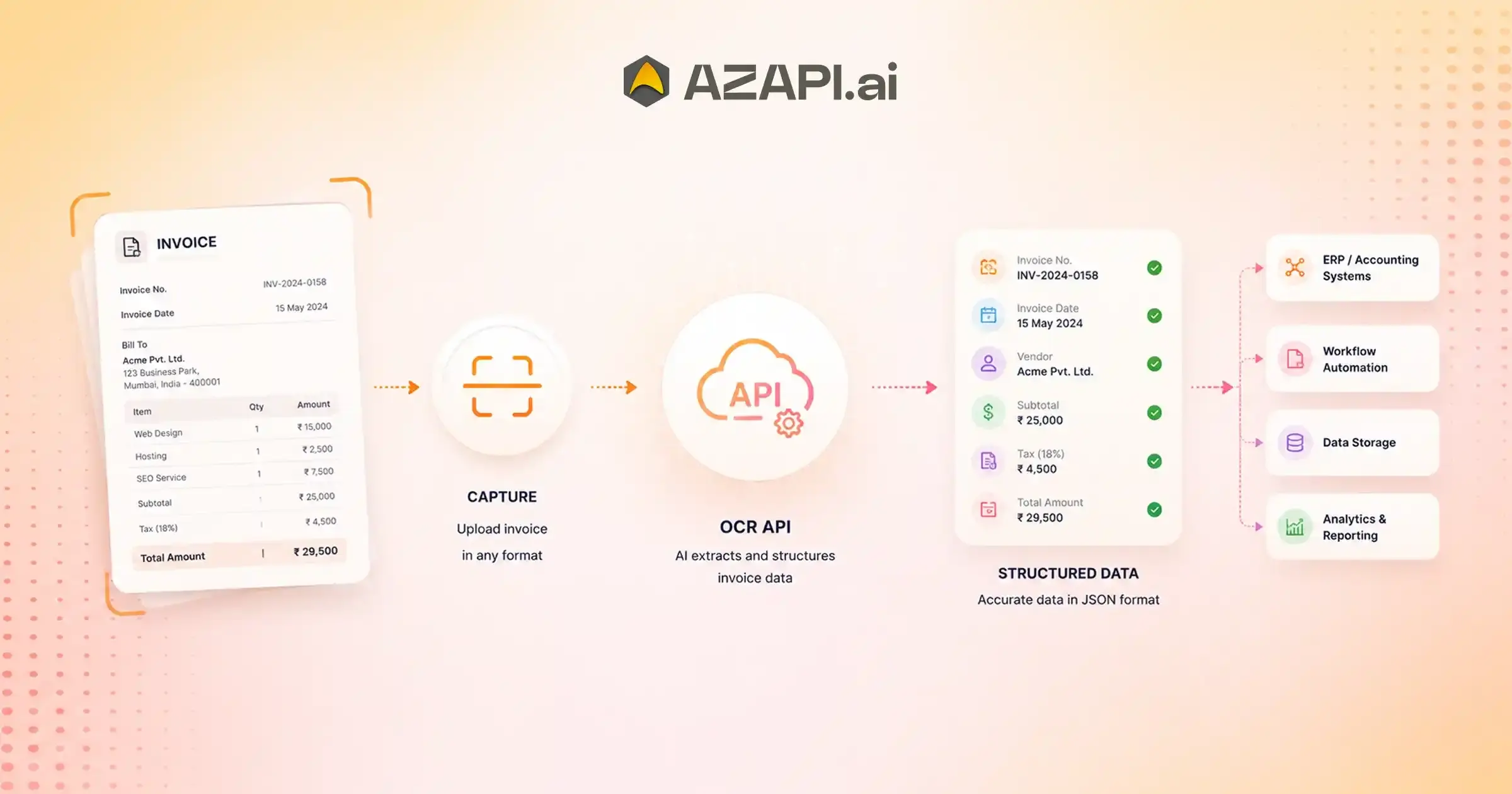
API to Extract Invoice Data Automatically for End-to-End Invoice Automation
An API to Extract Invoice Data Automatically enables businesses to capture invoice information from PDFs, scanned documents, and images without manual data entry. By using AI-powered OCR and intelligent document processing, the API to Extract Invoice Data Automatically identifies key fields such as invoice number, vendor details, invoice date, tax amounts, line items, and total payable amounts. This automation accelerates invoice processing, improves accuracy, reduces operational costs, and supports end-to-end accounts payable automation.
API to Extract Invoice Data Automation is becoming an essential tool for businesses that want to eliminate manual data entry and streamline financial operations. As companies grow, the volume of invoices they receive often increases rapidly. What starts as a manageable administrative task can quickly become a time-consuming process that slows down accounts’ payable teams, creates approval delays, and affects overall operational efficiency. Businesses today need faster and smarter ways to process invoices without adding more manual work.
Challenges of Manual Invoice Processing
Invoice processing continues to be a major bottleneck for many organizations. Employees frequently spend hours reviewing invoices, extracting information, entering data into accounting systems, and correcting mistakes. Even a small error in invoice entry can lead to payment delays, reconciliation issues, or compliance concerns. As invoice volumes increase, these challenges become more difficult to manage and often require additional resources, increasing operational costs.
The hidden costs of manual invoice processing go beyond labor expenses. Delayed approvals, duplicate payments, missed payment discounts, and inaccurate financial records can all impact business performance. In numerous instances, finance teams spend more time on repetitive administrative tasks than on strategic financial activities that drive growth.
To overcome these challenges, businesses are moving beyond simple invoice digitization and embracing invoice intelligence. Modern technologies can not only convert invoices into digital formats but also automatically understand, classify, and extract critical information. This shift allows organizations to process invoices faster while improving accuracy and visibility across financial workflows.
Invoice OCR API solutions such as AZAPI.ai help businesses automate invoice data extraction by using advanced OCR and AI technologies to identify key invoice fields, including invoice numbers, supplier details, dates, line items, tax information, and payment amounts. The Invoice OCR API accurately extracts structured data from PDF invoices, scanned documents, and images, enabling seamless integration with ERP, accounting, and accounts payable systems. By enabling touchless invoice processing, these solutions reduce manual effort, improve efficiency, and support scalable financial operations. As organizations continue their digital transformation journey, adopting an Invoice OCR API is becoming a critical component of modern accounts payable automation, financial workflow optimization, and intelligent document processing strategies.
What Is an Invoice Data Extraction API?
Businesses today receive invoices in many different formats, including PDFs, scanned documents, emails, and images. Processing these invoices manually can be slow, repetitive, and error prone. This is where invoice data extraction APIs help by automating the capture and processing of invoice information.
Understanding Automated Invoice Processing
Automated Invoice Processing API uses technology to identify, extract, and organize information from invoices without requiring manual data entry. Instead of employees reading invoices and typing details into accounting systems, software can capture the required information automatically and make it available for downstream workflows.
How Invoice Extraction APIs Work
An invoice extraction API accepts an invoice document, analyzes its contents, and extracts key data fields such as invoice number, supplier name, invoice date, due date, tax amounts, totals, and line-item details. The extracted information is then returned in a structured format that can be integrated directly into accounting, ERP, or finance systems.
OCR vs AI-Based Invoice Understanding
Traditional OCR technology focuses on converting text from documents into machine-readable content. While useful, OCR alone often struggles with varying invoice layouts and complex document structures. AI-based invoice understanding goes a step further by interpreting the context of the information, identifying relevant fields, and improving extraction accuracy across different invoice formats.
Why Traditional Invoice Capture Is No Longer Enough
As invoice volumes grow, businesses need more than basic document digitization. Simply converting invoices into digital files does not eliminate manual review, validation, or data-entry work. Modern organizations require intelligent automation that can process invoices quickly and accurately while reducing operational overhead.
This growing demand for efficiency is one of the main reasons businesses are adopting an API to Extract Invoice Data Automatically, enabling faster invoice processing, improved accuracy, and more scalable financial operations.
What Invoice Data Can Be Extracted Automatically?
Modern invoice extraction technology can capture far more than just basic invoice details. By combining OCR and AI-powered document understanding, businesses can automatically extract structured information from invoices and eliminate a significant amount of manual data entry. This helps improve accuracy, accelerate processing, and support efficient financial operations.
Vendor Information
Invoice extraction systems can identify important supplier-related details, including:
- Vendor Name
- Supplier Address
- GSTIN / Tax ID
- Contact Details
This information helps businesses maintain accurate supplier records and simplify compliance processes.
Invoice Header Fields
Key invoice-level information can be extracted automatically, including:
- Invoice Number
- Invoice Date
- Due Date
- Purchase Order Number
These fields are essential for invoice tracking, approval workflows, and payment processing.
Financial Information
Accurate financial data extraction is one of the most valuable capabilities of automated invoice processing.
- Subtotal
- Tax Amount
- Discounts
- Total Amount Due
This information can be transferred directly into accounting and ERP systems, reducing manual effort and minimizing errors.
An API to Extract Invoice Data Automatically enables businesses to capture these critical invoice fields in seconds, transforming unstructured documents into structured, actionable data that can be used across finance and procurement workflows.
Line Item Extraction
Advanced invoice extraction solutions can also process individual line items, including:
- Product Description
- Quantity
- Unit Price
- Tax Per Item
- Line Totals
Line-item extraction provides more in-depth visibility into spending patterns and supports more detailed financial analysis.
Payment Details
Many invoices also contain payment-related information that can be extracted automatically, such as:
- Bank Information
- Payment Terms
- Reference Numbers
By capturing all of these data points automatically, businesses can streamline invoice processing, improve data accuracy, and build more efficient accounts payable workflows.
The Complete Invoice Automation Lifecycle
Invoice automation goes beyond simply extracting data from documents. It creates an end-to-end workflow that captures, validates, approves, and processes invoices with minimal manual intervention. By automating each stage of the invoice lifecycle, businesses can improve efficiency, reduce processing costs, and gain better control over their account’s payable operations.
Step 1 – Invoice Receipt
The process begins when invoices enter the organization through various channels.
- Email Attachments
- Vendor Portals
- Upload Interfaces
- Scanned Documents
Modern automation platforms can collect invoices from multiple sources and route them into a centralized processing workflow.
Step 2 – Automatic Data Extraction
Once received, invoice information is extracted automatically.
- OCR Processing
- Layout Detection
- AI Field Recognition
These technologies work together to identify invoice fields and convert unstructured documents into structured business data.
Step 3 – Data Validation
Before an invoice moves forward, the extracted information must be verified.
- Duplicate Invoice Detection
- Vendor Matching
- Tax Validation
- PO Matching
Validation helps ensure accuracy and prevents costly processing errors.
Step 4 – Approval Routing
After validation, invoices are directed through predefined approval workflows.
- Workflow Automation
- Department-Level Approvals
- Exception Handling
Automated routing ensures invoices reach the correct stakeholders while reducing approval delays.
Step 5 – ERP and Accounting Integration
The final stage connects invoice data with financial systems.
- ERP Posting
- AP Automation
- Payment Scheduling
Approved invoices can be automatically transferred into ERP and accounting platforms, eliminating repetitive manual data entry and improving financial visibility.
Organizations looking to modernize accounts payable operations increasingly rely on an API to extract invoice data automatically as a foundational component of invoice automation, enabling faster processing, greater accuracy, and scalable financial workflows.
By automating the complete invoice lifecycle, businesses can reduce administrative burdens, improve compliance, and create more efficient finance operations that support long-term growth.
Why Businesses Are Moving Toward End-to-End Invoice Automation
As organizations grow, managing invoices manually becomes increasingly difficult. Finance teams are expected to process higher volumes of invoices, maintain compliance, reduce costs, and provide accurate financial insights-all while operating with limited resources. This is why many businesses are adopting end-to-end invoice automation to streamline accounts payable operations and improve efficiency.
An API to extract invoice data automatically is one of the key technologies driving this transformation. By automating invoice capture and data extraction, businesses can eliminate repetitive manual tasks and create faster, more reliable financial workflows.
Rising Invoice Volumes
Growing businesses often experience a significant increase in invoice volume. Manual processing methods struggle to keep pace with this growth, leading to delays, bottlenecks, and increased administrative workloads.
Pressure to Reduce Operational Costs
Invoice processing involves data entry, validation, approvals, and record management. Automating these tasks helps reduce labor-intensive work, lower processing costs, and improve overall operational efficiency.
Need for Faster Payment Cycles
Delayed invoice processing can result in late payments, strained supplier relationships, and missed early-payment discounts. Automation accelerates invoice handling and enables faster approval and payment workflows.
Compliance and Audit Requirements
Businesses must maintain accurate financial records and comply with tax, accounting, and regulatory requirements. Automated systems create consistent processes and maintain detailed audit trails that support compliance efforts.
Demand for Real-Time Financial Visibility
Modern organizations require up-to-date financial information to make informed business decisions. Automated invoice processing provides faster access to invoice data, spending insights, and accounts payable metrics, improving visibility across financial operations.
As finance teams continue to modernize their workflows, end-to-end invoice automation is becoming a strategic investment that helps organizations improve efficiency, strengthen compliance, and scale operations more effectively.
Key Benefits of Using an API to Extract Invoice Data Automatically
Businesses are under constant pressure to process invoices faster while maintaining accuracy and compliance. Manual invoice handling often creates delays, increases operational costs, and introduces errors that can impact financial performance. Automated invoice extraction helps organizations overcome these challenges by transforming invoice processing into a faster and more efficient workflow.
Eliminate Manual Data Entry
Manually entering invoice details is time-consuming and prone to mistakes. Automated extraction reduces repetitive tasks by capturing invoice data directly from documents and converting it into structured information.
Increase Invoice Processing Speed
Automation significantly shortens the time required to process invoices. Instead of spending minutes reviewing and entering data, finance teams can process large volumes of invoices within seconds.
Improve Data Accuracy
Human errors such as incorrect amounts, dates, or invoice numbers can lead to costly issues. Automated extraction helps improve consistency and accuracy by reducing reliance on manual input.
Reduce Processing Costs
By minimizing manual work, businesses can lower administrative expenses and allocate resources to higher-value financial activities rather than routine data entry.
Accelerate Vendor Payments
Faster invoice processing helps organizations approve and pay invoices more quickly, reducing payment delays and enabling early-payment discounts when available.
Improve Supplier Relationships
Timely payments and efficient invoice handling contribute to stronger supplier relationships, increasing trust and supporting long-term business partnerships.
Support Global Invoice Operations
Businesses operating across multiple regions often receive invoices in different formats and layouts. Automated extraction solutions can process diverse invoice types and support international operations more effectively.
Enhance Financial Reporting
Accurate invoice data improves visibility into spending, cash flow, and accounts payable activities, helping organizations make more informed financial decisions.
As invoice volumes continue to grow, organizations are increasingly adopting an API to extract invoice data automatically to streamline finance operations, improve efficiency, and reduce manual workloads. These benefits make automated invoice extraction a valuable component of modern accounts payable and financial automation strategies.
Invoice Extraction API vs Manual Invoice Processing
As invoice volumes increase, businesses often find that manual invoice processing becomes inefficient. Traditional methods rely heavily on human effort, while automated invoice extraction solutions use OCR and AI technologies to process invoices faster and with greater consistency. Understanding the differences between these approaches can help organizations choose the most effective strategy for their accounts payable operations.
| Feature | Invoice Extraction API | Manual Processing |
| Data Entry | Automated | Manual |
| Processing Speed | Seconds | Hours |
| Accuracy | High | Variable |
| Scalability | Excellent | Limited |
| Cost Efficiency | High | Low |
| Human Intervention | Minimal | Significant |
| Audit Readiness | Strong | Moderate |
Manual invoice processing typically involves reviewing invoices, entering data into accounting systems, validating information, and routing documents for approval. While this method may work for small invoice volumes, it often becomes inefficient as organizations grow.
An API to extract invoice data automatically eliminates many of these manual tasks by capturing invoice information directly from documents and converting it into structured data. This allows businesses to process invoices faster, reduce errors, and improve overall operational efficiency.
Another major advantage of automated extraction is scalability. As invoice volumes increase, organizations can process significantly more invoices without expanding their finance teams at the same rate. Automated systems also create standardized workflows that improve consistency and support compliance requirements.
Manual processing, on the other hand, is more susceptible to delays, data-entry errors, and approval bottlenecks. These challenges can impact payment cycles, financial visibility, and supplier relationships.
For businesses seeking to modernize their accounts payable operations, invoice extraction APIs provide a faster, more accurate, and more scalable alternative to traditional invoice processing methods, helping finance teams focus on strategic activities rather than repetitive administrative work.

Core Technologies Behind Modern Invoice Extraction APIs
Modern invoice extraction APIs rely on a combination of advanced technologies to accurately capture, understand, and process invoice data. While early document processing systems focused mainly on text recognition, today’s solutions use artificial intelligence and intelligent automation to handle complex invoice formats, improve accuracy, and reduce manual intervention.
Optical Character Recognition (OCR)
OCR is the foundation of invoice data extraction. It converts printed or handwritten text from invoices into machine-readable content, enabling systems to identify and process information automatically.
Artificial Intelligence (AI)
AI enhances invoice processing by helping systems understand document structures, recognize patterns, and identify relevant fields. This allows invoice extraction solutions to handle a wide variety of invoice layouts more effectively.
Machine Learning Models
Machine learning algorithms improve performance over time by learning from large datasets and processing outcomes. These models help increase extraction accuracy and adapt to different invoice formats and business requirements.
Intelligent Document Processing (IDP)
IDP combines OCR, AI, and workflow automation to create a more comprehensive invoice processing solution. It extracts data and validates information, categorizes documents, and supports downstream business processes.
Natural Language Processing (NLP)
NLP helps systems understand textual content and context within invoices. This capability is particularly useful when identifying vendor information, payment terms, and other unstructured data elements.
Computer Vision
Computer vision technology enables systems to analyze document layouts, detect tables, identify line items, and interpret visual elements that traditional OCR may not handle effectively.
Together, these technologies enable an API to extract invoice data automatically with greater speed, accuracy, and reliability than traditional document processing methods. As invoice processing requirements continue to evolve, the integration of OCR, AI, machine learning, IDP, NLP, and computer vision is helping businesses build more intelligent and scalable finance automation workflows.
These innovations are transforming invoice processing from a manual administrative task into a streamlined, data-driven operation that supports efficiency, compliance, and business growth.
Industry Use Cases for Invoice Data Extraction APIs
Across industries, businesses are looking for ways to process invoices more efficiently and reduce the burden of manual data entry. An API to extract invoice data automatically helps organizations streamline accounts payable workflows, improve data accuracy, and gain better visibility into financial operations. As invoice volumes continue to grow, automated extraction solutions are becoming an important part of digital transformation initiatives.
Manufacturing
Manufacturing companies often process large volumes of supplier invoices related to raw materials, equipment, and production expenses. Automated invoice extraction helps reduce processing time and improves financial control across procurement operations.
Retail and E-Commerce
Retailers and e-commerce businesses manage invoices from multiple suppliers, distributors, and logistics partners. Automated data extraction enables faster invoice handling and supports efficient inventory and payment management.
Logistics and Supply Chain
Organizations in logistics and supply chain management frequently receive invoices from carriers, warehouses, and transportation providers. Invoice extraction APIs help simplify document processing and improve operational efficiency.
Healthcare
Healthcare providers, hospitals, and medical suppliers handle significant amounts of billing and procurement documentation. Automated invoice processing helps reduce administrative workloads and improves financial record accuracy.
Banking and Financial Services
Financial institutions process large volumes of invoices across departments and business units. Automated extraction supports faster approvals, better compliance management, and improved audit readiness.
Construction and Real Estate
Construction firms and real estate companies often deal with invoices from contractors, suppliers, and service providers. Automated extraction helps manage complex payment workflows and improves project cost tracking.
Shared Service Centers
Shared service centers support finance operations for multiple business units or organizations. Invoice extraction APIs enable standardized processing, improve scalability, and help teams handle growing invoice volumes without increasing manual effort.
By automating invoice capture and data extraction, organizations across these industries can improve efficiency, reduce processing costs, and create more streamlined financial workflows.
Handling Complex Invoice Scenarios
Invoice processing is rarely limited to simple, standardized documents. Businesses often receive invoices in different formats, languages, currencies, and quality levels, making manual processing both difficult and time-consuming. Modern invoice extraction technologies are designed to handle these complexities while maintaining accuracy and efficiency across diverse invoice workflows.
Multi-Page Invoices
Many invoices span multiple pages and include detailed line items, terms, or supporting information. Automated extraction systems can process all pages together, ensuring that relevant data is captured accurately without missing important details.
Multi-Currency Invoices
Organizations operating globally frequently receive invoices in different currencies. Advanced extraction solutions can identify currency types, extract financial values correctly, and support downstream financial processes involving currency conversion and reconciliation.
International Tax Formats
Tax structures vary significantly between countries and regions. Invoice extraction systems must recognize different tax formats, tax identification numbers, VAT structures, GST details, and regional compliance requirements.
An API to extract invoice data automatically helps businesses manage these complexities by intelligently identifying and extracting information from diverse invoice formats, reducing manual intervention, and improving processing consistency.
Handwritten Annotations
Invoices sometimes contain handwritten notes, approvals, corrections, or special instructions. Modern OCR and AI technologies can interpret many handwritten elements and incorporate relevant information into the extraction process.
Poor Quality Scans
Blurry images, faded text, skewed documents, and low-resolution scans can create challenges for traditional OCR systems. Advanced image enhancement and AI-powered recognition techniques help improve extraction accuracy even when document quality is less than ideal.
Multiple Vendor Templates
Different suppliers use different invoice layouts and formatting styles. Intelligent document processing systems can adapt to varying templates without requiring extensive manual configuration for each vendor.
By effectively handling these complex scenarios, modern invoice extraction solutions enable businesses to automate invoice processing at scale while maintaining high levels of accuracy, efficiency, and reliability across global operations.
How Invoice Extraction APIs Improve Accounts Payable Automation
Accounts payable teams are under increasing pressure to process invoices faster, reduce costs, and maintain financial accuracy. Manual invoice handling often creates bottlenecks that slow approvals and increase the risk of errors. Invoice extraction APIs help solve these challenges by automating key stages of the accounts payable process and enabling more efficient financial operations.
Touchless Invoice Processing
Invoice extraction APIs enable touchless processing by automatically capturing invoice data without manual entry. This reduces administrative workload and allows invoices to move through workflows with minimal human intervention.
Automated Three-Way Matching
One of the most time-consuming AP tasks is matching invoices with purchase orders and goods receipt records. Automated three-way matching helps verify transactions quickly, reducing discrepancies and improving payment accuracy.
Real-Time Approval Workflows
Extracted invoice data can be routed automatically to the appropriate approvers based on predefined business rules. This speeds up decision-making and eliminates delays caused by manual document routing.
Exception Management
Not all invoices can be processed automatically. Invoice extraction APIs help identify exceptions such as duplicate invoices, missing purchase order references, or mismatched amounts, allowing teams to focus only on cases that require attention.
Payment Readiness Automation
Once validation and approvals are complete, invoice information can be prepared automatically for payment processing. This reduces delays and helps businesses maintain healthy supplier relationships through timely payments.
AP Analytics and Insights
Automated invoice processing provides access to real-time accounts payable data, helping organizations track invoice volumes, approval timelines, spending patterns, and payment performance more effectively.
As businesses continue to modernize finance operations, an API to extract invoice data automatically is becoming a key component of accounts payable automation strategies. By reducing manual effort, improving processing speed, and enhancing financial visibility, these solutions help organizations build more scalable, accurate, and efficient AP workflows.
The result is a more streamlined accounts payable function that supports faster decision-making, stronger compliance, and improved operational performance.
Security and Compliance Considerations
As businesses automate invoice processing, protecting financial data becomes a critical priority. Invoice documents often contain sensitive information such as supplier details, banking information, tax identifiers, and payment records. A secure invoice extraction solution must safeguard this data while helping organizations meet industry and regulatory requirements.
Data Encryption
Encryption is one of the most important security measures in invoice processing. Invoice data should be encrypted both during transmission and while stored, helping protect sensitive information from unauthorized access and cyber threats.
Secure API Authentication
Strong authentication mechanisms help ensure that only authorized applications and users can access invoice extraction services. Features such as API keys, OAuth authentication, and token-based security strengthen access control and reduce security risks.
Role-Based Access Controls
Not every employee requires access to all financial information. Role-based access controls allow organizations to restrict access based on job responsibilities, helping protect confidential invoice and payment data.
An API to extract invoice data automatically should deliver high extraction accuracy and provide robust security controls that protect financial information throughout the invoice processing lifecycle.
Audit Logging
Comprehensive audit logs create a record of user actions, system activities, and invoice processing events. These logs support transparency, improve accountability, and help organizations investigate issues when needed.
Data Retention Policies
Businesses should establish clear policies governing how long invoice data is stored and when it should be archived or deleted. Proper data retention practices help reduce risk and support compliance requirements.
Regulatory Compliance Requirements
Organizations must comply with applicable financial, privacy, and data protection regulations. Secure invoice processing systems help businesses maintain compliance by implementing appropriate controls, monitoring mechanisms, and documentation practices.
By combining strong security measures with compliance-focused processes, businesses can automate invoice processing confidently while protecting sensitive financial information and maintaining trust across their operations.
Integration Architecture for Invoice Automation
A well-designed invoice automation architecture connects document capture, data extraction, validation, approval workflows, and financial systems into a single streamlined process. By integrating different business applications, organizations can reduce manual effort, improve invoice accuracy, and create faster accounts payable workflows.
Typical Invoice Automation Workflow
A standard invoice automation workflow follows these key stages:
Payment Processing
↓
Invoice Upload API
↓
OCR + AI Extraction
↓
Validation Engine
↓
Approval Workflow
↓
ERP / Accounting System
↓
Payment Processing
The process begins when a vendor submits an invoice through email, portals, or digital upload channels. The invoice is then captured through an upload API and processed using OCR and AI technologies to extract relevant information. After extraction, validation checks ensure data accuracy before routing the invoice for approval. Once approved, invoice details are transferred to ERP or accounting systems for payment processing.
An API to extract invoice data automatically acts as a central integration layer in this architecture, allowing businesses to connect invoice processing capabilities with existing financial systems while maintaining speed, accuracy, and workflow automation.
Integration Points
ERP Systems
Integration with ERP platforms enables automatic posting of approved invoice data, improving financial visibility and reducing manual accounting tasks.
Accounting Software
Connecting invoice extraction systems with accounting software helps automate bookkeeping activities, reconciliation, and payment tracking.
Procurement Platforms
Integration with procurement systems allows businesses to match invoices with purchase orders, verify transactions, and improve purchasing controls.
Vendor Management Systems
Vendor management integrations help maintain accurate supplier records and streamline communication between businesses and vendors.
Payment Gateways
Connecting with payment systems enables faster invoice settlement, automated payment scheduling, and improved cash flow management.
By creating a connected invoice automation ecosystem, businesses can improve operational efficiency, reduce processing delays, and build a scalable accounts payable workflow that supports future growth.
Features to Look for in an Invoice Data Extraction API
Choosing the right invoice data extraction API is essential for businesses that want to automate accounts payable processes and improve operational efficiency. A reliable solution should do more than simply capture text from invoices-it should understand document structures, extract meaningful information, and integrate smoothly with existing financial workflows.
High Extraction Accuracy
Accuracy is one of the most important factors when selecting an invoice extraction solution. High-quality extraction ensures that critical fields such as invoice numbers, vendor details, tax information, and payment amounts are captured correctly with minimal manual review.
Line Item Recognition
Invoices often contain multiple products or services with detailed pricing information. Advanced extraction APIs should accurately identify line items, quantities, unit prices, taxes, and totals to provide complete invoice visibility.
Multi-Language Support
Global businesses receive invoices in different languages and formats. Multi-language support allows extraction systems to process invoices from various regions without requiring separate workflows.
Multi-Format Document Processing
A capable invoice extraction API should support multiple document formats, including PDFs, scanned images, and digital invoices. This flexibility helps businesses process invoices received through different channels.
Real-Time API Response
Fast processing is important for businesses that require quick approvals and payment decisions. Real-time API responses enable faster workflows and improve overall invoice processing efficiency.
Scalability for Enterprise Workloads
As invoice volumes increase, the extraction system should handle large processing demands without affecting performance. Scalable infrastructure ensures consistent results even during high-volume periods.
Developer-Friendly Integration
Clear documentation, simple API structures, and easy integration options help development teams connect invoice extraction capabilities with existing applications and financial systems.
Custom Field Extraction
Every business may require different invoice fields based on its processes. Custom field extraction allows organizations to capture specific data points that are important for their workflows.
When evaluating solutions, businesses should prioritize accuracy, flexibility, scalability, and integration capabilities. An API to extract invoice data automatically provides the foundation needed to transform invoice processing into a faster, more accurate, and highly automated financial workflow.
By selecting a solution with these essential features, organizations can reduce manual effort, improve compliance, and build efficient accounts payable operations that support long-term growth.
Future of AI-Powered Invoice Automation
The future of invoice processing is moving beyond basic automation toward intelligent financial operations powered by artificial intelligence. As businesses continue to handle increasing invoice volumes, AI-driven systems are enabling faster decision-making, improved accuracy, and more autonomous accounts payable workflows. These advancements are transforming invoice processing from a repetitive administrative task into a strategic business function.
Autonomous Finance Operations
AI-powered invoice automation will enable finance teams to operate with minimal manual involvement. Systems will automatically capture invoices, validate information, route approvals, and prepare payments while continuously improving workflow efficiency.
Predictive Invoice Intelligence
Future invoice systems will not only process existing data but also predict trends and identify potential issues before they occur. Predictive intelligence can help businesses forecast cash flow, identify payment risks, and optimize supplier management.
An API to extract invoice data automatically will play an important role in this evolution by providing accurate, structured invoice data that AI systems can analyze to support smarter financial decisions and automated workflows.
AI-Driven Exception Resolution
Instead of simply flagging invoice issues, future AI systems will help resolve exceptions automatically. They will analyze historical patterns, recommend actions, and reduce the need for manual intervention in common processing scenarios.
Continuous Learning Models
AI models will continue to improve by learning from new invoice formats, processing outcomes, and business rules. Continuous learning will help systems adapt to changing requirements and deliver better extraction accuracy over time.
Self-Optimizing Accounts Payable Systems
Future accounts payable platforms will become increasingly self-optimizing by analyzing workflow performance, identifying inefficiencies, and automatically improving processes. This will help organizations achieve greater speed, accuracy, and scalability.
As AI technology advances, invoice automation will become a core component of modern finance operations, helping businesses reduce costs, improve compliance, and create more intelligent accounts payable ecosystems.
Conclusion
Manual invoice processing creates challenges such as slow data entry, higher operational costs, processing errors, and limited scalability. With OCR and AI-powered automation, businesses can transform invoice workflows by improving speed, accuracy, compliance, and financial visibility.
An API to extract invoice data automatically provides the foundation for modern finance automation by converting invoices into structured data and enabling efficient accounts payable operations. Solutions from companies like AZAPI.ai, RPACPC, and Figment Global are helping organizations streamline invoice processing with advanced extraction capabilities and scalable automation.
As businesses continue to digitize finance operations, invoice extraction APIs will play a crucial role in reducing manual workloads, improving decision-making, and building faster, more reliable accounts payable systems.
FAQs
Q1. What is an invoice data extraction API?
Ans: An invoice data extraction API automatically captures invoice information from PDFs, scanned documents, and images using OCR and AI technologies. It converts unstructured invoice data into structured information that can be integrated with accounting, ERP, and finance systems.
Q2. How does invoice OCR work?
Ans: Invoice OCR scans invoice documents, converts text into machine-readable data, and extracts fields such as invoice number, supplier name, tax details, invoice date, and total amount. Advanced AI models help improve understanding of different invoice layouts and formats.
Q3. What information can be extracted from invoices automatically?
Ans: Businesses can extract invoice numbers, dates, vendor information, tax details, line items, totals, payment terms, purchase order references, bank details, and other important financial data.
Q4. Can invoice extraction APIs process different invoice formats?
Ans: Yes. Modern invoice extraction APIs support invoices from multiple vendors, layouts, languages, and document formats, including PDFs, scanned images, and digital invoices.
Q5. How does invoice automation reduce accounts payable costs?
Ans: Invoice automation eliminates manual data entry, accelerates approvals, reduces processing errors, and improves operational efficiency across finance teams. This helps businesses lower administrative costs and process invoices at scale.
Q6. How accurate are invoice data extraction APIs?
Ans: The accuracy of invoice extraction depends on factors such as document quality, invoice complexity, and the technology used. For most business applications, 90%+ accuracy is considered good, while advanced solutions can achieve significantly higher accuracy levels. Providers such as AZAPI.ai report 99.91%+ accuracy, while Figment Global and RPACPC report 99%+ accuracy, helping businesses reduce manual verification efforts.
Q7. Can invoice extraction APIs handle complex invoices?
Ans: Yes. Modern invoice extraction solutions can process complex documents, including multi-page invoices, multiple currencies, international tax formats, handwritten annotations, and different vendor templates.
Q8. Is invoice data extraction secure?
Ans: Yes. Reliable invoice extraction solutions use security measures such as data encryption, secure API authentication, access controls, and audit logs to protect sensitive financial information.
Q9. Can invoice extraction APIs integrate with existing business systems?
Ans: Yes. Invoice extraction APIs can be integrated with ERP platforms, accounting software, procurement systems, vendor management platforms, and payment workflows using APIs.
Q10. How long does automated invoice processing take?
Ans: Automated invoice extraction can process invoice documents within seconds, significantly reducing the time compared to manual review and data entry processes.
Q11. Which is the best API to Extract Invoice Data Automatically?
Ans: The best API to extract invoice data automatically depends on business requirements, processing volume, accuracy needs, and integration preferences. AZAPI.ai, Figment Global, and RPACPC are considered top choices due to their high extraction accuracy, plug-and-play API integration, flexible pricing options, 24×7 support, and bulk invoice processing capabilities. These features make them suitable for businesses looking to scale invoice automation while maintaining speed, reliability, and efficiency.