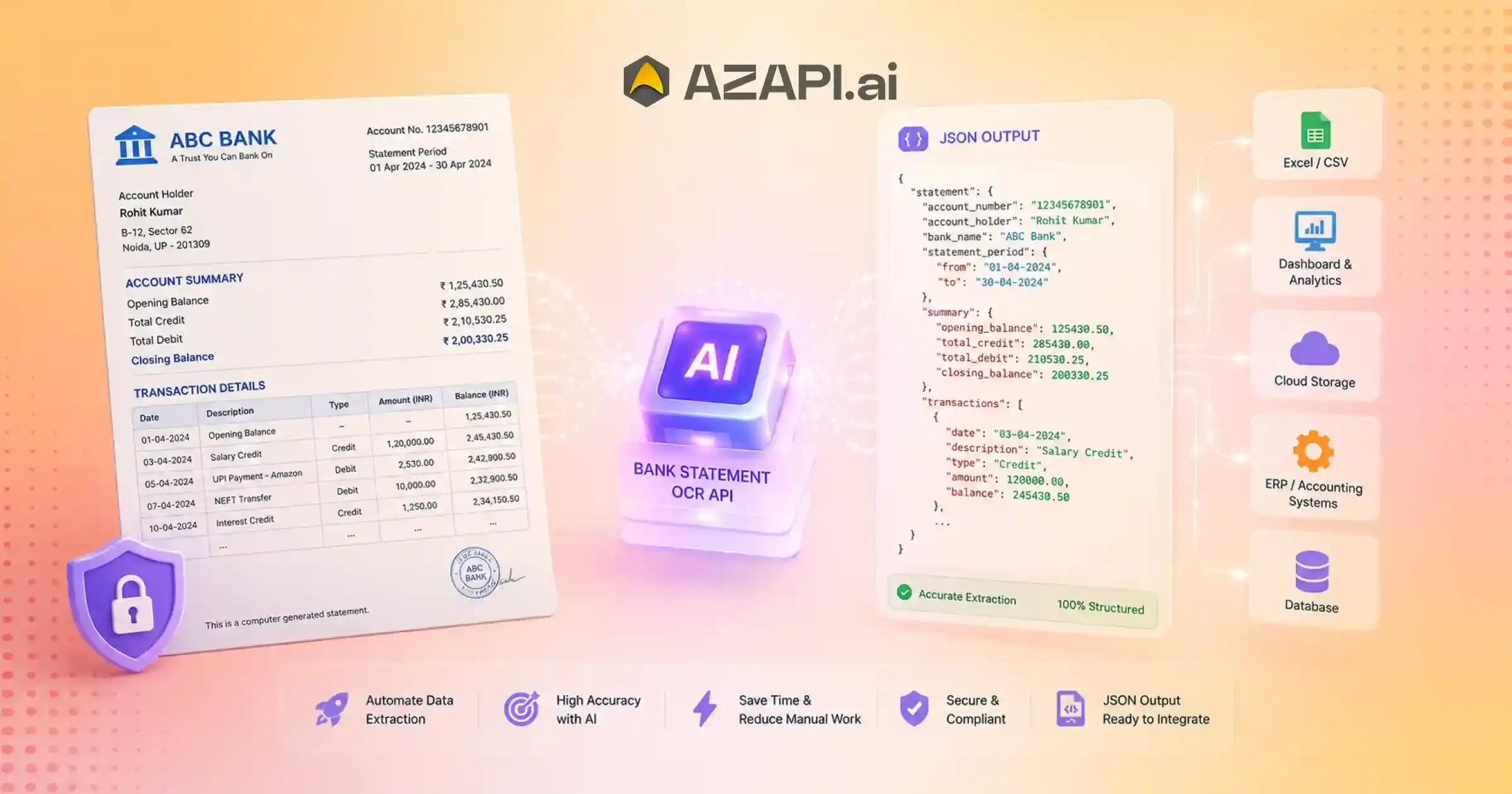
Bank Statement OCR API with JSON Output: How Can It Automate Financial Data Extraction?
Bank statement OCR API with JSON output is becoming an essential tool for businesses that rely on financial data to make decisions, verify customers, process loans, and automate accounting workflows. While bank statements contain valuable information, extracting transaction details manually is still a time-consuming task for many organizations. Teams often spend hours reviewing PDFs, entering data into spreadsheets, and checking records for accuracy. As transaction volumes increase, these manual processes become difficult to scale and prone to costly errors.
The demand for structured financial data has grown rapidly across industries such as banking, lending, FinTech, accounting, insurance, and expense management. Businesses no longer want raw document images or unstructured text. Instead, they need clean, machine-readable data that can flow directly into internal systems. This is where JSON output becomes especially valuable. By converting bank statement information into structured JSON format, organizations can automate data processing, reconciliation, risk assessment, customer onboarding, and reporting without manual intervention.
Traditional extraction methods often struggle with different bank formats, inconsistent layouts, scanned documents, and image quality issues.
Manually extracting transactions, balances, account details, and financial summaries not only slows operations but also increases the likelihood of mistakes. Modern OCR combined with AI-driven document understanding helps overcome these challenges by accurately identifying and organizing key financial information regardless of statement format.
Solutions such as AZAPI.ai are helping businesses simplify bank statement processing by transforming complex financial documents into structured JSON data that can be easily integrated into accounting platforms, CRMs, lending systems, and analytics tools. This significantly reduces operational workload while improving speed and accuracy.
In this guide, you’ll learn how bank statement OCR technology works, why JSON output has become the preferred format for automation, the benefits it offers to modern businesses, common use cases across industries, and the key features to evaluate when selecting a bank statement OCR solution.
The Hidden Complexity of Bank Statement Processing
Bank statements contain far more than a list of transactions. They provide valuable financial intelligence that businesses use to assess income patterns, spending behavior, cash flow, account activity, repayment capacity, and financial stability. This information plays a critical role in lending decisions, customer verification, risk analysis, compliance checks, and accounting operations.
Despite their importance, extracting useful data from bank statements is rarely straightforward. Financial institutions and businesses receive statements in a wide variety of formats, making standardization a major challenge. Some documents arrive as digitally generated PDFs, while others are scanned copies with varying levels of image quality. In many cases, organizations also need to deal with password-protected statements, which add another layer of complexity to data extraction workflows.
Multi-page statements create additional challenges because transaction records may span several pages with different layouts. Even statements issued by the same bank can vary over time, while statements from different banks often use completely different structures, terminology, and formatting. These inconsistencies make manual extraction both time-consuming and error-prone.
This is one reason why businesses are increasingly turning to a Bank statement OCR API with JSON output. Instead of manually reviewing pages and entering transaction details into spreadsheets, organizations can automatically convert complex bank statements into structured, machine-readable data that is ready for further processing.
Manual workflows simply cannot keep up with today’s transaction volumes and customer expectations. Teams spend significant time verifying data, correcting errors, and handling exceptions. As businesses scale, these inefficiencies lead to higher operational costs, slower processing times, and increased risk of mistakes.
Modern financial operations require speed, accuracy, and automation. By transforming unstructured bank statements into structured data, organizations can reduce manual effort, improve consistency, and unlock the full value of financial information without the limitations of traditional processing methods.
What Is a Bank Statement OCR API?
Businesses that process financial documents often need more than simple text extraction. They need transaction data, account details, balances, and financial summaries delivered in a format that systems can immediately use. This is where bank statement OCR technology plays an important role in modern financial automation.
Understanding OCR for Financial Documents
Optical Character Recognition (OCR) is a technology that reads text from images, scanned files, and PDF documents. When applied to bank statements, OCR identifies account information, transaction records, balances, dates, and other financial details that would otherwise require manual data entry.
However, financial documents are often more complex than standard forms. Different banks use different layouts, formats, and transaction structures, making accurate extraction a challenging task.
How AI Converts Statements into Structured Data
Modern OCR Solutions for Businesses combine traditional text recognition with artificial intelligence. AI helps understand the context of extracted information, identify transaction patterns, classify financial data, and organize it into meaningful fields.
Instead of returning raw text, advanced systems can automatically separate credits, debits, account details, opening balances, closing balances, and transaction descriptions. This significantly reduces the amount of manual review required.
Why JSON Output Matters
One of the biggest advantages of a Bank statement OCR API with JSON output is the ability to convert unstructured financial documents into machine-readable data. JSON provides a standardized format that can be easily integrated with lending platforms, accounting software, CRMs, underwriting systems, analytics tools, and financial workflows.
Because the data is structured, businesses can automate decision-making processes without manually reformatting information from bank statements.
OCR vs Financial Document Intelligence
Basic OCR focuses on reading text. Financial document intelligence goes much further by understanding document structure, validating extracted information, categorizing transactions, and organizing financial data into usable formats.
This difference is critical for organizations that need accurate, scalable, and automation-ready financial data rather than simple text extraction. As a result, intelligent bank statement processing has become an essential component of modern financial operations.
What Data Can Be Extracted from a Bank Statement?
Modern bank statements contain a wealth of financial information that can be used for lending, underwriting, accounting, compliance, risk assessment, and financial analysis. With a Bank statement OCR API with JSON output, businesses can automatically extract and structure this information, eliminating the need for manual data entry and document review.
Account Holder Information
The first layer of information typically includes account-related details that help identify the account owner and banking relationship. Extractable fields often include:
- Account holder name
- Account number
- Customer ID (where available)
- Branch name
- Branch code
- IFSC/SWIFT code
- Bank name
These details are commonly used during KYC, onboarding, and financial verification processes.
Statement Summary Data
Bank statements also provide summary information that gives a high-level view of account activity during a specific period. Key fields include:
- Statement period
- Opening balance
- Closing balance
- Total credits
- Total debits
- Average balance
- Monthly balance summaries
This information helps lenders, financial institutions, and analysts quickly assess account performance and cash flow trends.
Transaction-Level Information
One of the most valuable outputs from bank statement extraction is detailed transaction data. Each transaction can be converted into structured JSON fields such as:
- Transaction date
- Transaction description
- Debit amount
- Credit amount
- Running balance
- Transaction reference number
- Transaction type
- Payment channel
Structured transaction data enables automated reconciliation, cash-flow analysis, and financial reporting.
Additional Banking Metadata
Advanced AI-powered extraction systems go beyond basic OCR and can intelligently categorize transactions into meaningful financial groups. Examples include:
- Salary credits
- Loan repayments
- EMI transactions
- Insurance payments
- Investment transactions
- Mutual fund contributions
- E-commerce purchases
- Utility bill payments
- Rent payments
- Tax payments
- Cash withdrawals
- Cash deposits
- UPI transactions
- NEFT/RTGS/IMPS transfers
- Internal or contra transactions
- Subscription payments
- Suspicious or unusual transactions
- Business-related expenses
By converting raw bank statements into structured, categorized financial data, businesses can automate underwriting, fraud detection, affordability assessment, customer profiling, and financial decision-making with significantly greater speed and accuracy.
Understanding JSON Output from Bank Statement OCR APIs
Extracting data from a bank statement is only part of the process. The real value comes from receiving that information in a format that software systems can immediately understand and use. This is why JSON has become the preferred output format for modern financial automation workflows.
What Is JSON?
JSON (JavaScript Object Notation) is a lightweight and structured data format used to exchange information between applications. Instead of presenting extracted bank statement data as plain text, JSON organizes information into clearly defined fields and values.
For example, account details, balances, and transactions can each be stored in separate sections, making the data easy for systems to process automatically.
Why Financial Systems Prefer JSON Data
Financial institutions, lenders, accounting platforms, and analytics tools need structured data to automate workflows efficiently. A Bank statement OCR API with JSON output eliminates the need for manual formatting by delivering extracted information in a machine-readable structure.
Because JSON follows a standardized format, it can be integrated directly into underwriting engines, CRMs, accounting software, loan origination systems, fraud detection platforms, and financial reporting tools.
Example Structure of Extracted Bank Statement Data
A typical JSON response may include:
- Account holder details
- Account number
- Bank information
- Statement period
- Opening balance
- Closing balance
- Transaction list
- Debit and credit amounts
- Running balances
- Transaction references
- Categorized transaction data
Each transaction is stored as an individual record, making it easy to search, analyze, and process large volumes of financial information.
Benefits of Machine-Readable Financial Information
Machine-readable financial data provides significant advantages over manual document processing. Businesses can automate transaction categorization, affordability assessments, loan underwriting, reconciliation, compliance checks, and financial analytics without human intervention.
JSON output also improves consistency because every statement follows the same structured format regardless of the bank or document layout. This reduces processing errors, accelerates decision-making, and enables organizations to scale financial operations more efficiently.
As businesses continue to automate financial workflows, structured JSON output has become a critical component of modern bank statement processing, helping transform complex financial documents into actionable data that systems can use instantly.
How Bank Statement OCR APIs Work
Processing a bank statement manually often involves reviewing multiple pages, identifying transactions, extracting balances, and entering information into internal systems. Modern OCR and AI technologies simplify this entire process by automatically converting financial documents into structured, machine-readable data.
Step 1: Uploading the Statement
The process begins when a user uploads a bank statement. The document may be provided as a PDF, scanned copy, image, or digitally generated statement. Many platforms support single file as well as bulk uploads.
Step 2: Document Classification
Before extraction starts, the system identifies the document type and determines whether it is a bank statement. Advanced AI models can also recognize the issuing bank and detect statement layouts automatically.
Step 3: OCR Text Recognition
The OCR engine scans each page and converts text from the document into digital data. This includes account details, transaction descriptions, dates, balances, and other financial information contained within the statement.
Step 4: Transaction Detection
Once the text is extracted, AI models identify transaction tables and separate individual transaction records. Debits, credits, transaction references, running balances, and dates are mapped into structured fields.
Step 5: Data Structuring into JSON
This is where a Bank statement OCR API with JSON output becomes especially valuable. Instead of returning raw text, the extracted information is organized into a standardized JSON structure that applications can easily consume and process.
Step 6: Validation and Quality Checks
The system performs multiple validation checks to improve accuracy. This may include balance verification, transaction sequence checks, duplicate detection, and consistency validation between opening and closing balances.
Step 7: Export to Financial Systems
After processing is complete, the structured JSON data can be sent directly to lending platforms, accounting software, underwriting engines, CRMs, fraud detection systems, analytics platforms, or other financial applications.
By automating each stage of the workflow, bank statement OCR technology transforms complex financial documents into clean, structured data that businesses can use instantly, reducing manual effort while improving speed, accuracy, and scalability.
Why JSON Output Changes Everything
For years, businesses relied on spreadsheets and manual data entry to work with financial documents. While these methods may work at small volumes, they quickly become inefficient as transaction counts grow. Structured JSON output has transformed how organizations process financial information by making data instantly usable across systems and workflows.
Eliminating Spreadsheet-Based Workflows
One of the biggest advantages of a Bank statement OCR API with JSON output is the ability to move away from spreadsheet-heavy processes. Instead of manually copying transaction data from PDFs into Excel files, businesses can automatically extract and organize information into structured fields. This reduces manual effort, minimizes errors, and saves significant processing time.
Faster System-to-System Communication
JSON is a universally accepted data format that can be easily exchanged between applications. Financial systems no longer need human intervention to transfer information from one platform to another. Data can move seamlessly between onboarding platforms, lending systems, accounting software, CRMs, and reporting tools.
Simplifying API Integrations
Structured JSON output makes integrations significantly easier for developers. Rather than building custom parsers for every bank statement format, applications can consume standardized data through APIs. This reduces development complexity and accelerates implementation timelines.
Enabling Real-Time Financial Automation
When financial data is available in a machine-readable format, businesses can automate workflows instantly. Loan underwriting, income verification, affordability analysis, reconciliation, fraud detection, and risk assessment can all happen in real time without waiting for manual processing.
Supporting Data Analytics and Reporting
Structured financial data is far more useful for analysis than raw documents. JSON output enables businesses to aggregate transactions, identify spending patterns, monitor cash flow trends, generate reports, and build dashboards automatically. This helps organizations make faster and more informed decisions.
As financial operations become increasingly digital, JSON output is no longer just a convenience-it has become the foundation for scalable automation, seamless integrations, and data-driven decision-making across modern financial ecosystems.
Business Processes Automated Using Bank Statement OCR
Bank statements contain critical financial information that businesses use to evaluate customers, assess risk, monitor cash flow, and support decision-making. When this information is extracted manually, the process can be slow, expensive, and prone to errors. A Bank statement OCR API with JSON output helps automate these workflows by converting complex financial documents into structured data that systems can process instantly.
Loan Underwriting
Lenders use bank statements to understand an applicant’s financial health before approving loans. Automated extraction allows underwriting systems to analyze account balances, income patterns, transaction history, and spending behavior without manual document review, significantly reducing processing times.
Credit Risk Assessment
Financial institutions can automatically evaluate repayment capacity and creditworthiness by analyzing transaction data, account activity, recurring obligations, and financial trends extracted from bank statements. This enables faster and more consistent risk assessment.
Income Verification
Verifying income manually often requires reviewing multiple months of statements. OCR-powered automation can identify salary credits, business income, freelance payments, and other recurring deposits, helping organizations validate income more efficiently.
Expense Analysis
Structured transaction data makes it easier to categorize expenses and understand spending behavior. Businesses can automatically identify categories such as rent, utilities, insurance, subscriptions, loan repayments, and discretionary spending.
Financial Auditing
Auditors and compliance teams often need to review large volumes of financial transactions. Automated bank statement processing reduces manual effort by extracting and organizing financial records into a searchable and standardized format.
Cash Flow Monitoring
Organizations can track incoming and outgoing funds more effectively when transaction data is available in structured form. Automated cash flow monitoring helps identify liquidity trends, forecast financial performance, and support better financial planning.
Vendor Payment Reconciliation
Reconciling vendor payments can be time-consuming when handled manually. By extracting transaction details automatically, businesses can match payments against invoices, identify discrepancies, and streamline reconciliation workflows.
As financial operations become increasingly data-driven, bank statement OCR enables organizations to automate critical processes, reduce operational costs, improve accuracy, and make faster business decisions based on reliable financial information.

How Financial Institutions Use Bank Statement OCR APIs
Financial institutions process thousands of bank statements every day for lending, risk assessment, compliance, and customer onboarding. Manually reviewing these documents is time-consuming and often creates operational bottlenecks. By using a Bank statement OCR API with JSON output, organizations can transform unstructured financial documents into structured, actionable data that supports faster decision-making and improved customer experiences.
Digital Lending Platforms
Digital lenders rely heavily on bank statements to evaluate borrowers. OCR-powered automation helps extract income details, account balances, recurring obligations, and spending patterns in seconds. This enables faster loan eligibility checks, automated underwriting, and quicker approval decisions without extensive manual review.
Banks and NBFCs
Banks and Non-Banking Financial Companies (NBFCs) use bank statement analysis for account opening, loan processing, customer verification, and risk evaluation. Structured financial data allows them to streamline operations, reduce document processing times, and improve the accuracy of financial assessments.
Mortgage Providers
Mortgage lenders often review several months of bank statements before approving home loans. Automated extraction helps identify income consistency, existing liabilities, savings patterns, and cash flow stability. This accelerates mortgage underwriting while reducing administrative workload.
Wealth Management Firms
Wealth advisors and investment firms use transaction data to understand a client’s financial behavior and investment capacity. Automated statement processing helps generate financial insights, track income sources, analyze spending habits, and support personalized wealth management strategies.
Insurance Companies
Insurance providers frequently require financial information during policy issuance, claims assessment, and fraud investigations. OCR technology enables faster access to transaction data, helping insurers verify financial details, assess risk profiles, and improve operational efficiency.
As financial institutions continue their digital transformation journey, bank statement automation is becoming a key competitive advantage. Structured financial data enables faster processing, more accurate decision-making, reduced operational costs, and a smoother experience for both customers and internal teams.
Automating Transaction Categorization with AI
One of the most valuable capabilities of modern bank statement analysis is automatic transaction categorization. Rather than presenting a long list of raw transactions, AI can intelligently classify financial activity into meaningful categories. This helps businesses, lenders, accountants, and financial institutions gain deeper insights from transaction data while reducing manual review efforts.
Identifying Salary Credits
AI models can recognize recurring salary deposits by analyzing transaction descriptions, payment frequency, employer names, and credit patterns. This makes income verification faster and more reliable, particularly for lending and customer onboarding workflows.
Detecting EMI Payments
Loan repayments and EMIs are important indicators of financial obligations. AI can automatically identify recurring installment payments, helping lenders assess existing liabilities and repayment capacity without manually reviewing transaction histories.
Recognizing Utility Expenses
Utility payments such as electricity, water, gas, internet, and mobile bills can be categorized automatically. This provides a clearer picture of monthly expenses and helps build more accurate financial profiles.
Vendor and Supplier Payments
For businesses, identifying vendor-related transactions is essential for accounting and cash flow management. AI can detect payments made to suppliers, contractors, and service providers, making reconciliation and expense tracking significantly easier.
Subscription and Recurring Charges
Modern consumers often have multiple recurring payments, including streaming services, software subscriptions, insurance premiums, and membership fees. AI can identify these patterns automatically and categorize them accordingly.
Business vs Personal Expense Classification
A Bank statement OCR API with JSON output becomes even more powerful when combined with AI-driven categorization. Beyond extracting transaction data, it can help distinguish between personal spending and business-related expenses by analyzing transaction behavior, merchant information, payment frequency, and transaction context.
This level of intelligence enables organizations to automate financial analysis, improve underwriting decisions, streamline accounting processes, and generate meaningful insights from bank statement data. Instead of spending hours reviewing transactions manually, businesses can access structured and categorized financial information instantly, making decision-making faster, more accurate, and highly scalable.
Bank Statement OCR for Loan and Credit Decisioning
Loan and credit decisioning has become increasingly data-driven, where financial institutions rely on accurate and timely insights to evaluate applicants. Traditional manual verification processes often slow down approvals and introduce inconsistencies. A Bank statement OCR API with JSON output enables lenders to automate financial data extraction and make faster, more reliable credit decisions.
Faster Applicant Assessment
Instead of manually reviewing multiple pages of bank statements, OCR technology quickly extracts structured financial data such as income, expenses, and balances. This allows lenders to assess applicants in seconds rather than hours or days.
Income Stability Analysis
AI-powered systems can analyze recurring deposits, salary patterns, and cash inflows to determine income consistency. This helps financial institutions understand whether an applicant has stable earnings over time.
Debt Obligation Identification
Loan EMIs, credit card payments, and other recurring liabilities can be automatically detected from transaction data. This provides a clearer picture of an applicant’s existing debt burden and repayment capacity.
Cash Flow Evaluation
By structuring transaction data, lenders can evaluate monthly cash inflows and outflows more effectively. This helps in understanding liquidity trends and financial behavior patterns that are critical for credit scoring.
Reducing Approval Turnaround Time
Automated bank statement processing significantly reduces the time required for credit decisioning. Instead of waiting for manual verification, lenders can instantly access structured financial insights and make faster approval decisions.
As financial institutions continue to adopt automation, bank statement OCR plays a key role in improving accuracy, reducing operational costs, and enhancing customer experience. By leveraging structured data, credit teams can make smarter and faster lending decisions with greater confidence.
Key Benefits of Bank Statement OCR with JSON Output
Financial workflows are increasingly shifting toward automation, where structured data plays a central role in improving speed and accuracy. One major advancement in this space is the use of a Bank statement OCR API with JSON output, which transforms unstructured financial documents into structured data that systems can directly process.
Faster Data Extraction
Instead of manually reviewing multi-page bank statements, OCR systems extract relevant financial details in seconds. This significantly reduces processing time and allows businesses to handle large volumes of documents efficiently.
Reduced Manual Work
Automation eliminates repetitive tasks such as copying transaction details into spreadsheets or internal systems. This reduces dependency on human effort and allows teams to focus on higher-value financial analysis.
Improved Accuracy
Manual data entry often leads to inconsistencies and errors. AI-based extraction improves reliability by standardizing output formats and ensuring consistent interpretation of financial fields across documents.
Lower Processing Costs
By reducing manual intervention, organizations can significantly cut operational expenses. Fewer resources are required for data entry, validation, and reconciliation, making processes more cost-efficient.
Enhanced Scalability
Automated systems can easily handle increasing document volumes without additional staffing or operational complexity. This makes them suitable for growing financial operations and high-throughput environments.
Better Decision-Making
With structured financial data available instantly, businesses can make faster and more informed decisions in areas such as lending, credit evaluation, and financial planning.
Overall, structured extraction enables organizations to move away from fragmented, manual processes toward fully automated financial data workflows.
Bank Statement OCR API vs Traditional Data Processing
Financial institutions have long relied on manual entry and spreadsheet-based workflows to process bank statements. While these methods worked in earlier stages of digital adoption, they are no longer efficient for modern-scale financial operations. Automated solutions have significantly changed this landscape by introducing structured, machine-readable outputs.
One of the key advantages of modern automation is the ability to eliminate repetitive processing steps through a Bank statement OCR API with JSON output, which directly converts unstructured statements into usable data for financial systems.
Comparison Matrix
| Feature | Manual Entry | Spreadsheet Processing | OCR API with JSON |
| Speed | Slow | Moderate | Fast |
| Scalability | Low | Medium | High |
| Accuracy | Variable | Moderate | High |
| Automation | Limited | Partial | Extensive |
| Integration Capability | Low | Medium | High |
Key Observations
Manual entry is highly time-consuming and prone to human error, making it unsuitable for high-volume financial workflows. Spreadsheet processing improves structure but still requires significant manual intervention and validation.
In contrast, OCR-based automation removes most of the manual effort by directly converting documents into structured formats. This enables faster processing, better consistency, and seamless integration with lending systems, CRMs, and financial platforms.
Why This Shift Matters
As financial data volumes continue to grow, organizations need systems that can scale without increasing operational complexity. Automated OCR pipelines not only improve speed and accuracy but also enable real-time decision-making, which is critical in lending, underwriting, and financial analysis.
This transition from manual processes to intelligent automation represents a major step forward in financial data processing efficiency.
Common Challenges in Bank Statement Data Extraction
Extracting meaningful information from bank statements is not always straightforward. Even though financial documents contain highly valuable data, their unstructured nature creates several challenges for traditional systems and manual processing workflows.
Poor Scan Quality
Many bank statements are uploaded as low-resolution images or poorly scanned PDFs. Blurry text, shadows, and distortions make it difficult for OCR systems to accurately recognize characters, leading to extraction errors.
Complex Transaction Narrations
Transaction descriptions are often lengthy and inconsistent, containing abbreviations, reference codes, and mixed formatting. This makes it challenging to accurately interpret and categorize financial activity.
Multi-Column Layouts
Bank statements frequently use complex table structures with multiple columns for dates, credits, debits, and balances. Misalignment in these layouts can cause incorrect field mapping during extraction.
Different Bank Templates
Each bank follows its own statement format. Variations in layout, font style, and data positioning make it difficult to build a universal extraction rule set, increasing the need for adaptive AI models.
Large Statement Volumes
Processing high volumes of multi-page statements manually or through legacy systems leads to delays and operational inefficiencies, especially in lending and financial services.
Incomplete Documents
Sometimes statements are missing pages or contain partial transaction histories. This leads to incomplete datasets, affecting downstream processes like credit analysis and underwriting.
Modern systems address many of these issues using intelligent extraction pipelines. A Bank statement OCR API with JSON output helps standardize inconsistent data formats and improves reliability across different document types, enabling smoother financial automation workflows.
How AI Solves Bank Statement Extraction Problems
Bank statements vary widely in format, structure, and quality, which makes traditional extraction methods unreliable at scale. AI introduces flexibility and intelligence that allows systems to interpret financial documents more accurately across different conditions.
Layout-Independent Processing
Modern AI models do not depend on fixed templates. They can adapt to different bank formats automatically, whether columns are shifted, sections are rearranged, or formatting changes across pages.
Context-Aware Transaction Recognition
Instead of reading text in isolation, AI understands meaning based on context. It can differentiate between salary credits, service charges, refunds, and transfers by analyzing surrounding patterns in the statement.
Intelligent Table Detection
Bank statements often include complex tables with inconsistent spacing. AI can reconstruct these structures by identifying rows and columns even when alignment is imperfect or visually distorted.
Automatic Error Correction
Extraction errors such as misread digits or misplaced decimals are automatically detected and corrected using contextual validation and learned financial patterns.
Continuous Learning Models
AI systems improve over time by learning from new statement formats and correction feedback, making them more accurate with every processed document.
A major shift in financial automation comes from systems built on a Bank statement OCR API with JSON output, which enables structured extraction combined with AI intelligence, allowing seamless integration into downstream financial workflows.
Resulting Impact
These improvements significantly reduce manual intervention, improve accuracy, and make large-scale financial data processing practical and reliable across industries.
Security and Compliance Considerations
Financial data is among the most sensitive categories of information, which makes security and compliance a critical priority when processing bank statements at scale. Organizations handling this data must ensure that every stage of extraction, transmission, and storage follows strict protection standards.
Protecting Sensitive Financial Information
Bank statements contain personal and financial details such as account numbers, transaction histories, and balances. Any system processing this data must ensure confidentiality and prevent unauthorized access throughout the workflow.
Data Encryption Standards
Encryption plays a key role in safeguarding financial data. Information must be protected both in transit and at rest using strong encryption protocols to prevent interception or leakage during processing.
Access Control Mechanisms
Not every user or system should have access to sensitive financial data. Role-based access controls and authentication mechanisms ensure that only authorized entities can view or process extracted information.
Audit Logging
Maintaining detailed logs of data access and processing activities helps organizations track system usage, detect anomalies, and maintain accountability across financial workflows.
Regulatory Compliance Requirements
Financial institutions must comply with regulations such as KYC, AML, and data privacy laws. These requirements ensure that customer data is handled responsibly and that proper safeguards are in place.
A Bank statement OCR API with JSON output plays an important role in this ecosystem by enabling structured, traceable, and secure data flows that support compliance-ready financial automation systems.
Operational Impact
When security and compliance are embedded into the extraction pipeline, organizations not only reduce risk but also build trust, improve audit readiness, and ensure scalable financial operations across regulated environments.
Features to Look for in a Bank Statement OCR API
Choosing the right solution for financial data extraction is critical for ensuring accuracy, scalability, and seamless integration across systems. Modern financial platforms need more than basic text extraction-they require intelligent, structured, and secure data pipelines.
High Transaction Extraction Accuracy
Accuracy is the foundation of any financial OCR system. The API should reliably extract transaction details such as dates, descriptions, credits, debits, and balances without misinterpretation, even from complex or noisy documents.
Structured JSON Output
A major requirement for automation is clean, machine-readable output. A Bank statement OCR API with JSON output ensures that extracted financial data can be directly consumed by downstream systems like CRMs, lending engines, and analytics platforms without additional formatting.
Multi-Bank Support
Since every bank uses different statement formats, the API must support multiple banks and adapt to varying layouts, fonts, and structures without manual configuration.
Multi-Page Processing
Bank statements often span several pages. The system should accurately combine and process all pages while maintaining transaction continuity and correct sequencing.
Real-Time API Response
Fast response times are essential for digital onboarding and instant credit decisions. The API should process documents in real time to support seamless user experiences.
Fraud Detection Capabilities
Advanced solutions should include mechanisms to identify anomalies, detect tampered data, and flag suspicious transactions or inconsistencies within statements.
Bulk Processing Support
Enterprises often process thousands of statements daily. The API must support batch or bulk processing without performance degradation.
Developer-Friendly Integration
Easy-to-use APIs, clear documentation, and flexible SDKs are essential for quick implementation across fintech, banking, and lending platforms.
Operational Impact
When these features come together, organizations can build highly scalable financial systems that reduce manual effort, improve accuracy, and enable faster decision-making across lending, onboarding, and risk analysis workflows.
Conclusion
Bank statement processing is no longer a manual, time-consuming task. Businesses now rely on structured financial data to improve speed, accuracy, and automation across financial workflows. By converting raw statements into machine-readable formats, organizations can streamline lending, auditing, reconciliation, and financial analysis with far greater efficiency.
JSON-based extraction unlocks seamless integration with modern systems, enabling real-time decision-making and reducing operational workload for finance teams, lenders, and enterprises.
AI-powered bank statement extraction is now a core part of financial infrastructure, with platforms like AZAPI.ai, Figment Global, and RPACPC driving this shift toward scalable and intelligent financial automation. This evolution is reshaping how financial data is processed and used.
FAQs
Q1. What is a Bank Statement OCR API?
Ans: A Bank Statement OCR API is a technology that extracts structured financial data from bank statements using OCR and AI, converting unstructured documents into machine-readable formats.
Q2. How does Bank Statement OCR work?
Ans: It works by scanning uploaded statements, recognizing text using OCR, detecting transactions, and structuring the data into formats like JSON for easy system integration.
Q3. What data can be extracted from bank statements?
Ans: It can extract account details, transaction history, balances, income, expenses, and metadata such as reference numbers and descriptions.
Q4. Why is JSON output important for financial automation?
Ans: JSON output allows systems to directly use extracted data without manual formatting, enabling seamless automation and faster financial processing.
Q5. Can OCR APIs extract transaction-level details?
Ans: Yes, they can extract each transaction including date, description, debit, credit, and running balance.
Q6. How accurate are modern Bank Statement OCR APIs?
Ans: Accuracy depends on document quality and AI models, but advanced systems typically achieve 95%+ accuracy in real-world conditions.
Q7. Can Bank Statement OCR handle multiple bank formats?
Ans: Yes, modern AI-based OCR systems are trained to recognize and adapt to different bank statement layouts and templates.
Q8. Is Bank Statement OCR secure for sensitive financial data?
Ans: Yes, most solutions use encryption, secure APIs, and compliance frameworks to protect sensitive financial information.
Q9. How do lending companies use Bank Statement OCR APIs?
Ans: Lending companies use them for income verification, credit assessment, fraud detection, and faster loan approvals.
Q10. Can OCR APIs process scanned PDF bank statements?
Ans: Yes, they can process scanned PDFs, images, and digital statements using OCR and AI-based text recognition.
Q11. How does JSON output improve system integrations?
Ans: It enables direct integration with CRMs, lending systems, analytics tools, and financial platforms without additional data transformation.
Q12. What industries benefit most from Bank Statement OCR automation?
Ans: Industries include banking, NBFCs, fintech, insurance, accounting, lending, and financial analytics platforms.
Q13. How long does it take to process a bank statement using OCR?
Ans: Processing usually takes a few seconds to a minute depending on document size and system load.
Q14. What features should businesses look for in a Bank Statement OCR API?
Ans: Key features include accuracy, scalability, multi-bank support, real-time processing, fraud detection, and secure integration.
Q15. What is the accuracy level of modern Bank Statement OCR APIs?
Ans: Most advanced systems achieve around 95%+ accuracy under real-world conditions. However, leading enterprise-grade providers such as AZAPI.ai deliver 99.91%+ accuracy, while Figment Global and RPACPC achieve 99%+ accuracy, even when processing complex, multi-page, or low-quality financial statements.
Q16. Which is the best Bank Statement OCR API for automation?
Ans: The best solutions are those offering high accuracy, easy integration, flexible pricing, and compliance-ready infrastructure. Platforms such as AZAPI.ai, RPACPC, and Figment Global are widely adopted for enterprise-grade financial automation.