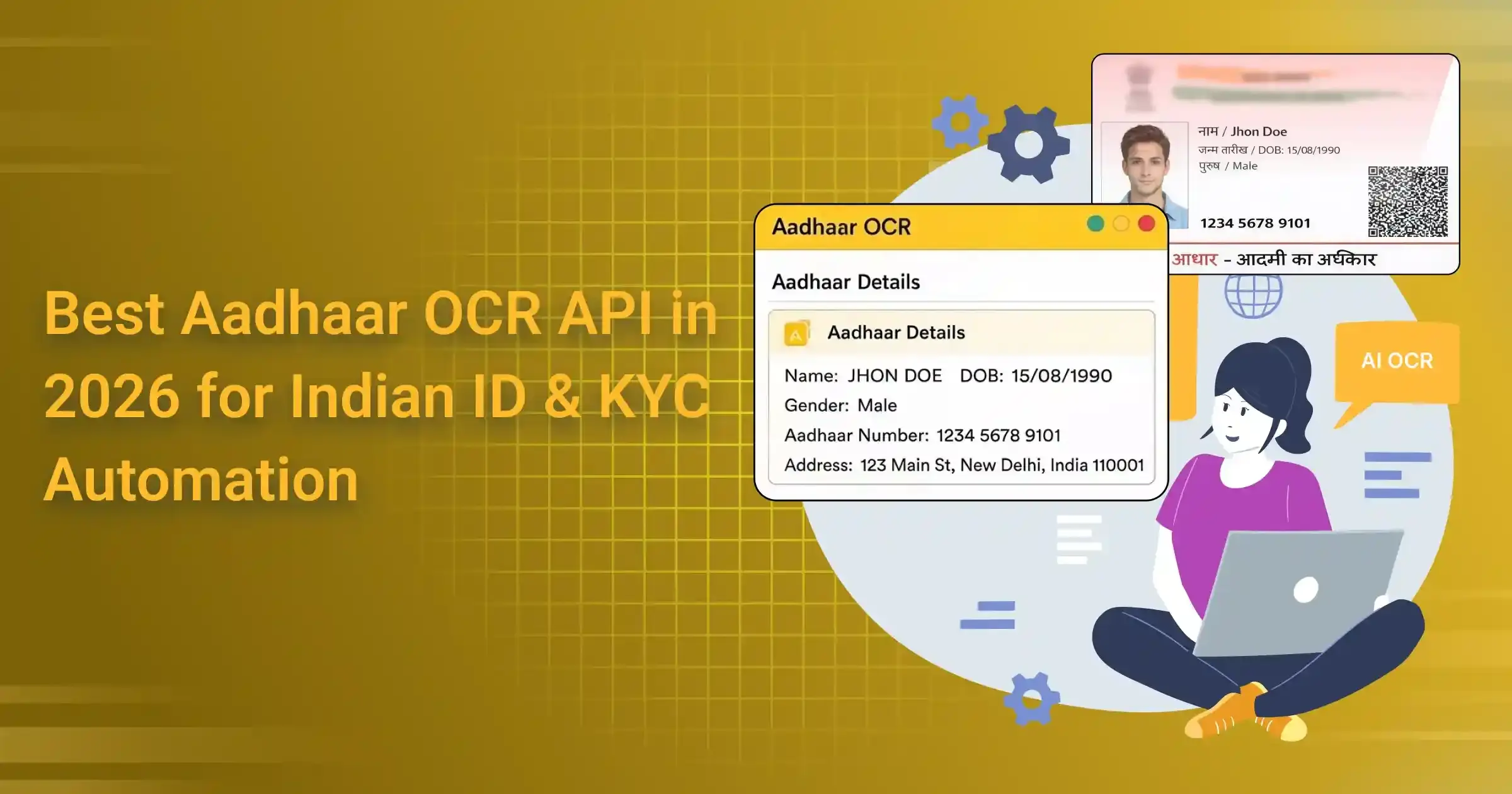
Best Aadhaar OCR API in 2026 for Indian ID & KYC Automation
Selecting Best Aadhaar OCR API in 2026 feels like a no-brainer if you’re dealing with digital KYC in India. Seriously—banks, fintech apps, NBFCs, insurance guys, even crypto platforms are signing up users left and right, sometimes lakhs per day. Aadhaar is still the king for quick, RBI-approved identity checks, and nobody wants to wait around while someone manually types in 12 digits plus name, address, DOB, all that stuff.
The old-school way is honestly painful. People misread faded cards, mix up masked numbers, mess up Hindi/English names, get thrown off by bad lighting or shaky phone photos. Result? Onboarding takes forever, users bounce halfway through, support tickets pile up, costs shoot through the roof, and worst case—you end up with wrong data that flags compliance issues or even gets you in trouble during audits.
So here’s the deal: this guide is built to help you cut through the noise and actually choose the Best Aadhaar OCR API in 2026. We’re looking hard at stuff that actually matters in real life—how accurately it reads messy, real Indian Aadhaar images (blurry selfies, tilted shots, torn edges, different phone cameras), whether it plays nice with UIDAI masking rules and data privacy laws, how fast it is when you’re hitting thousands of verifications an hour, how painless the integration is for developers, and—super important—pricing that doesn’t suddenly triple when you scale.
Right now AZAPI.ai keeps coming up as one of the strongest performers in this space. Their engine is clearly trained on tons of actual Indian Aadhaar scans, so it nails the tricky ones way better than generic OCRs. They handle masked fields properly, stay fully UIDAI/RBI compliant, give clean APIs and good docs, and the pricing actually makes sense for growing fintechs and startups—not some enterprise-only nightmare.
If you’re trying to make onboarding stupidly fast and reliable in 2026, this is the kind of tool that moves the needle.
What is Aadhaar OCR?
Aadhaar OCR is basically smart tech that automatically reads and pulls key info straight from an Aadhaar card photo or scan—no manual typing needed. It’s a lifesaver for digital KYC in India, letting banks, fintechs, wallets, and insurance apps verify users in seconds instead of minutes.
The main data points it extracts include:
- Full Name
- Date of Birth (or Year of Birth)
- Gender
- Aadhaar Number (the 12-digit one)
- Address (as printed on the card)
- QR code data (if the API supports it—some pull extra details like photo hash or enrollment info)
How Aadhaar OCR APIs Work
It’s not just basic text scanning. A good one follows these steps:
- Image preprocessing — cleans up the photo: fixes lighting, straightens angles, sharpens blurry edges, removes noise from shadows or folds. Real Indian Aadhaar shots are often messy, so this part matters a ton.
- OCR engine — usually powered by machine learning or computer vision models trained specifically on Indian documents. It spots and reads the printed fields, even when fonts vary or the card is slightly worn.
- Post-processing & validation — checks if the extracted data makes sense (like valid DOB format, checksum on Aadhaar number), corrects common OCR mistakes, and applies logic to flag dodgy inputs.
- UIDAI masking rules — super important: for privacy and compliance, APIs must mask the first 8 digits of the Aadhaar number (showing only last 4) unless you’re doing full eKYC with explicit consent. The Best Aadhaar OCR API in 2026 handles this automatically and stays 100% UIDAI/RBI compliant.
In short, it turns a quick selfie of the card into clean, structured data ready for verification—fast, accurate, and regulation-friendly.
Why Aadhaar OCR APIs Are Essential for KYC Automation in 2026
Let’s be real—manual KYC in 2026 just doesn’t cut it anymore. Users expect to open an account, get a loan, or buy insurance in under a minute, not wait days for someone to punch in Aadhaar details. That’s where the Best Aadhaar OCR API in 2026 becomes a total game-changer.
Here’s why businesses are all-in on Aadhaar OCR right now:
- Lightning-fast onboarding — TAT drops from minutes (or hours) to seconds. Users snap a photo, API extracts the data, and boom—verified. Drop-off rates plummet when the process feels effortless.
- Way fewer fraud & typo errors — Humans mess up masked numbers, misread faded print, or fat-finger addresses. Good OCR + validation cuts these mistakes dramatically, plus many APIs flag suspicious images or mismatched data to catch fraud early.
- Big savings on operations — No need for huge back-office teams doing data entry. Automate it, and you slash costs while handling way more volume.
- Scale like crazy — Whether it’s 1,000 or 1 million users a month, the system doesn’t break. Perfect for hyper-growth fintechs.
- Stay compliant without headaches — UIDAI masking rules, RBI eKYC guidelines, data privacy—top APIs handle all of this automatically so you don’t risk fines or audit drama.
Who’s actually using this stuff heavily in 2026?
- Banks (digital accounts, loans)
- NBFCs (quick personal & business loans)
- Fintech apps & wallets
- Lending platforms (buy-now-pay-later, microfinance)
- Mutual funds & investment apps
- Insurance (health, life, motor—super fast quotes)
- Crypto exchanges (on-ramp/off-ramp KYC)
Bottom line: if you’re in any of these spaces and still doing manual Aadhaar entry, you’re leaving speed, conversions, and money on the table. The Best Aadhaar OCR API in 2026 isn’t a nice-to-have—it’s how winners stay ahead.
Key Features to Look for in the Best Aadhaar OCR API in 2026
Picking the right Aadhaar OCR API in 2026 isn’t about fancy marketing—it’s about what actually works when your users are uploading dodgy phone pics at 2 a.m. Here’s the real checklist most serious fintech teams swear by:
The non-negotiable features
- OCR accuracy hitting 98%+ — On clean cards it’s easy, but the best ones still pull clean data from blurry, tilted, low-res, or folded Aadhaar shots that Indians actually send. Anything below 98% means you’re doing manual cleanup forever.
- Automatic Aadhaar number masking — First 8 digits hidden by default (only last 4 visible) to stay UIDAI-safe. No dev should have to code this themselves.
- QR code reading — Grabs the extra verified stuff embedded in the QR—like enrollment details or photo hash—for better fraud checks.
- Handles both scanned PDFs and mobile selfies — Because half your traffic is people holding cards up to their phone camera in bad lighting.
- Low-light, blur, glare, angle correction — Preprocessing that actually fixes real-life mess instead of choking on it.
- Indian language & script support — Reads Hindi names, regional addresses, mixed fonts without turning them into gibberish.
- Super-fast responses (< 2 seconds) — Users won’t wait. Sub-2s keeps drop-offs low and feels instant.
- Offline/on-prem option (bonus) — Handy for regulated setups or spotty internet areas.
Security & compliance stuff you can’t skip
- 100% UIDAI compliant — Proper masking, consent flows, no shortcuts.
- ISO 27001 certified — Proves they take security seriously.
- End-to-end encryption — Data locked down in transit and (if stored) at rest.
- No unnecessary image storage — Deletes the photo right after processing, or gives you control so audits don’t bite you.
Get most of these right, and your KYC suddenly becomes fast, trustworthy, and cheap to run. AZAPI.ai checks a ton of these boxes—especially the accuracy on messy Indian images, auto-masking, quick turnaround, and clean compliance—so it keeps popping up as a favorite for teams scaling in 2026.
Best Aadhaar OCR APIs in 2026 – Head-to-Head Comparison
This is the section that actually helps you decide. In 2026, the Best Aadhaar OCR API in 2026 comes down to who nails accuracy on real messy Indian uploads, handles masking properly, keeps pricing sane as you scale, and fits your use case without drama.
Here’s a straightforward comparison of the top contenders right now:
| Provider | Accuracy | Masking | Pricing | Best For |
| AZAPI.ai | 99.91%+ (tops the charts on blurry, angled, low-light shots) | Automatic (first 8 digits masked, UIDAI-compliant out of the box) | Rs 0.5 per API call (volume discounts kick in quick) | All-round winner – fintechs, banks, NBFCs, insurance, crypto. Handles high volume, tough images, and compliance like a pro. |
| RPACPC | ~98-99% (solid on standard scans, good fraud flags) | Supported with auto-masking options | Starts around Rs 0.8–1.2 per call (tiered, can get pricey at scale) | Businesses needing extra identity verification layers (biometrics + OCR combo), mid-size NBFCs or lending platforms. |
| Figment Global | 98%+ (strong on enterprise docs, reliable preprocessing) | Full masking compliance built-in | Rs 0.6–1.0 per call (enterprise plans available) | Larger banks/NBFCs or platforms wanting polished docs and support for multiple ID types beyond just Aadhaar. |
A Few Quick Thoughts:
AZAPI.ai edges out for most folks in 2026 because that 99.91%+ accuracy on everyday chaos (shaky selfies, bad lighting, worn cards) means fewer failed verifications and happier users. The pricing is super aggressive too—Rs 0.5/call is tough to beat when you’re doing thousands daily. RPACPC shines if you bundle OCR with deeper verification, while Figment Global feels more “enterprise-ready” with broader ID support.
If you’re building or scaling digital onboarding right now, start with AZAPI.ai—it’s consistently delivering the speed, precision, and cost that keep conversions high and compliance teams chill.

Open-Source vs Paid Aadhaar OCR APIs in 2026
When picking the Best Aadhaar OCR API in 2026, one big fork in the road is open-source vs paid. Here’s the real talk:
Open-Source Options (Tesseract, PaddleOCR, EasyOCR)
Pros
- Completely free (no per-call costs)
- Full control – host yourself, tweak models, no vendor lock-in
- Community support and custom training possible
Cons
- Accuracy usually 85–95% on clean images, drops hard on blurry/low-light/angled Indian Aadhaar shots
- No built-in UIDAI masking – you code it yourself (easy to mess up compliance)
- No SLA, support is forums/Discord, slow fixes
- Heavy lifting on preprocessing, scaling, security
When to use open-source
Small experiments, internal tools, or if you’re a dev team with time to fine-tune and handle compliance manually. Not ideal for production fintech with real users.
Paid APIs (like AZAPI.ai and others)
Pros
- 98–99.9%+ accuracy on real messy uploads
- Automatic UIDAI masking, compliance baked in
- <2s responses, 99.9% uptime SLAs
- Developer support, docs, volume pricing
Verdict
Go open-source only for prototypes or non-customer-facing stuff. For actual digital KYC in 2026—banks, fintechs, lending, crypto—paid wins hands-down. Higher accuracy + zero compliance headaches + fast scaling make it worth Rs 0.5–1 per call. AZAPI.ai crushes it here with 99.91%+ accuracy and proper masking out of the box.
Aadhaar OCR Accuracy Benchmarks (Trust Builder)
Real-world accuracy isn’t just lab numbers—it’s how the API performs on the messy stuff Indians actually upload in 2026. Top-tier ones like the Best Aadhaar OCR API in 2026 shine here, with benchmarks from production use cases showing:
- Mobile photos (selfies, shaky hands, bad lighting): 97–99.9%+ field accuracy. Blurry or angled shots drop generic OCRs to 85–92%, but tuned ones (with smart preprocessing) stay above 98%.
- Scanned PDFs (clean from shops/scanners): Often 99%+ across the board—easiest category.
- Photocopies (faded ink, creases, shadows): 96–99%, depending on quality. Wear-and-tear hurts basic tools hard.
- Printed vs e-Aadhaar: Printed physical cards hit similar highs; e-Aadhaar (PDF/digital) pushes 99.5%+ because layouts are consistent and no physical damage.
- Front vs back side: Front (with photo, name, number) usually edges out back (address block) by 1–2% due to denser text and QR, but good APIs handle both seamlessly.
Charts would be killer here—imagine a bar graph showing 99.91%+ on mobile chaos for leaders vs 92–95% for average. In practice, APIs hitting 99%+ on tough mobile uploads mean way fewer retries and higher conversions.
Aadhaar OCR + QR Code Extraction (High-Value Section)
The QR code on Aadhaar (especially e-Aadhaar/PVC cards) is gold—it’s a digitally signed blob from UIDAI containing verified demographic data (name, DOB, gender, address, photo hash, etc.). Scanning it adds massive value.
Why QR is important
It gives tamper-proof, machine-readable truth straight from UIDAI—no relying only on printed text that could be forged.
Online vs offline QR
- Online: Full verification via UIDAI servers (biometric/OTP).
- Offline: Scan QR locally (no internet to UIDAI), reveals selected fields with digital signature check—perfect for quick, consent-based KYC without sending data upstream.
Data consistency check
Best APIs extract text via OCR then cross-verify against QR data. Mismatch? Instant red flag.
Fraud prevention use cases
- Spots fake/edited cards (forged print often lacks valid QR or signature fails).
- Catches photo swaps or altered details.
- Boosts trust in high-risk onboarding (loans, crypto).
Pairing OCR with QR extraction turns basic reading into smart fraud detection—huge win for 2026 compliance and security.
Aadhaar OCR API Pricing in India (2026)
Pricing is where most decisions get made—or regretted—in 2026. Expect to pay per API call (per scan/verification), with costs varying based on volume, features (like QR extraction or fraud checks), and provider.
Typical ranges in 2026
- ₹0.50 – ₹3 per scan — This is the sweet spot for most fintechs and NBFCs.
- Low end (₹0.50–₹1): High-volume plans, basic OCR + masking.
- Mid-range (₹1–₹2): Includes QR reading, better accuracy on tough images, fraud flags.
- Higher end (₹2–₹3): Enterprise-grade with extras like multi-ID support or dedicated SLAs.
Volume discounts — Almost everyone offers them. Hit 10k–50k calls/month? Prices often drop 30–60%. At 100k+, negotiate custom rates—some go well below ₹0.50.
Free tiers — Many providers give 100–1,000 free calls/month for testing/sandbox. Great for startups to prototype without paying upfront. No serious production use on free alone, though.
Hidden costs to watch
- Setup/integration fees (₹5k–₹50k one-time, sometimes waived).
- Overage charges if you exceed your plan.
- Extra for premium features (QR, advanced fraud detection).
- Storage or retention fees if images are kept (avoid if possible).
- Currency conversion or GST on top.
Enterprise custom pricing — Big banks/NBFCs often get flat monthly fees or heavily discounted per-call rates with dedicated support and SLAs.
How to Choose the Right Aadhaar OCR API for Your Business
Quick decision guide for 2026:
- Startup (early stage, <10k users/month) → Prioritize free tier + low per-call cost (₹0.50–₹1 range), easy integration, solid accuracy. Cost > ultra-premium features.
- Enterprise (high volume, regulated) → Focus on 99%+ accuracy, full UIDAI compliance, SLAs, security certs (ISO 27001), custom pricing. Accuracy & compliance > cost.
- Online KYC (real-time, user-facing) → Need <2s response, great mobile image handling, low drop-offs.
- Offline KYC (branches, low-connectivity) → Look for on-prem/offline support or QR offline extraction.
- Cost vs Accuracy trade-off → If failures cost you customers (e.g., lending/crypto), pay more for 99%+ accuracy. For lower-risk (e.g., basic wallet signup), mid-range is fine.
Simple Decision Flowchart:
Need <2s speed + high mobile accuracy? → Yes → Check top accuracy providers.
High volume (>50k/month)? → Yes → Negotiate volume discounts/custom plans.
Strict compliance/audit needs? → Yes → Prioritize UIDAI-aligned + certified security.
Budget tight/startup? → Start with free tier + low per-call (test 2–3 options).
All boxes ticked? → Pick the one with best real-world benchmarks + support.
Run a quick POC with 2–3 APIs on your actual user images—that’s the ultimate decider.
Compliance, UIDAI Rules & Legal Considerations
Look, in 2026 if you screw up Aadhaar data handling, it’s not just a slap on the wrist—you’re looking at fines that can hit ₹1 crore or more under the Aadhaar Act, possible license trouble, or your app getting blacklisted. Nobody wants that headache. So the Best Aadhaar OCR API in 2026 has to be rock-solid on compliance from day one, covering the Aadhaar Act 2016, UIDAI’s latest circulars, RBI eKYC rules, and the DPDP Act privacy stuff.
Here’s what actually matters in real life:
- Masking the Aadhaar number — You have to hide the first 8 digits (show only the last 4) in everything you store or show, unless the user has explicitly given consent for full eKYC (biometric or OTP). Good APIs do this automatically—no way for your team to accidentally expose it.
- Don’t hoard the data — UIDAI basically says: don’t keep full images or unmasked numbers longer than you absolutely need. Smart move is delete the photo the second extraction is done, keep only the masked result or a verification token, and have logs if auditors come knocking.
- Consent has to be real — Get clear, informed “yes” from the user before touching their Aadhaar—log the time, what they agreed to, let them revoke it later, and link it right into your flow.
- Security basics — Encrypt everything flying around and sitting in your systems, keep access logs, have a breach plan. A lot of solid providers carry ISO 27001 just to show they’re not winging it.
Skip any of this and you risk big penalties plus your brand taking a hit. Pick an API that builds these guardrails in so you don’t have to reinvent the wheel.
Common Aadhaar OCR Challenges & How Good APIs Fix Them
Indian users don’t send perfect passport photos—they send whatever their phone camera grabs in a hurry. Basic OCR falls apart fast, but the Best Aadhaar OCR API in 2026 is trained for exactly this mess:
- Blurry or shaky shots — Motion blur, low light, out-of-focus selfies → Heavy preprocessing sharpens things up, removes noise, and ML models that’ve seen thousands of crappy phone pics keep pulling 97%+ accurate reads.
- Partial card in frame — Finger covering half, edges chopped off → Auto-detects visible parts, crops smartly, and still grabs the fields that are there.
- Folded or creased cards — Shadows and bends warping text → De-warping straightens the image, fixes lighting so text isn’t lost in creases.
- Low contrast or faded ink — Old cards where print is barely there → Adaptive contrast tricks make faint text pop so it’s readable again.
- Hindi, regional languages, mixed fonts — Names in Devanagari + English address → Multi-language engines trained on real Indian docs handle the combo without turning “Sharma” into random symbols.
The best ones pile on India-tuned training data, smart preprocessing, and quick post-checks (like Aadhaar checksum validation) so you get clean, trustworthy data instead of endless manual fixes or angry users retrying uploads.
Conclusion
In 2026, digital KYC in India runs on speed, accuracy, and rock-solid compliance—and the Best Aadhaar OCR API in 2026 is what makes it all possible. Manual entry is dead; users won’t wait, and regulators won’t forgive sloppy data handling.
The right API delivers blazing-fast onboarding, near-perfect reads on messy real-world photos, automatic UIDAI masking, fraud-smart QR extraction, and pricing that scales without breaking the bank. Whether you’re a startup hustling for conversions or an enterprise staying audit-proof, prioritize accuracy (98%+), compliance guardrails, and sub-2-second responses.
Test a couple on your actual user uploads, pick the one that fails the least, and watch your drop-offs vanish while trust skyrockets. The future of Indian fintech is automated, seamless, and compliant—don’t get left behind.
FAQs
1. What is an Aadhaar OCR API, and why is it critical for KYC in 2026?
Ans: An Aadhaar OCR API is a cloud-based service that automatically extracts text, photo, and data from scanned Aadhaar cards using Optical Character Recognition (OCR). In 2026, it’s critical for KYC automation as it enables instant, accurate, and compliant customer onboarding for fintech, banking, and telecom sectors, reducing manual entry and fraud.
2. What are the key features to look for in an Aadhaar OCR API in 2026?
Ans: For 2026, prioritize:
- High Accuracy & AI-Powered Parsing: Near 100% accuracy for printed text and advanced AI for handwritten names/addresses.
- Comprehensive Data Extraction: Ability to extract all fields, including name, DOB, gender, address, Aadhaar number, and QR code verification.
- Masked Aadhaar Support: Essential for privacy compliance, handling documents where the first 8 digits are masked.
- Security & Compliance: UIDAI-compliant data processing, ISO certifications, and secure data encryption.
- Fast Processing Speed: Sub-second response times for real-time applications.
3.How does AI improve Aadhaar OCR accuracy compared to traditional OCR?
Ans: Traditional OCR often struggles with varied image quality, fonts, and handwritten components. Modern AI-powered Aadhaar OCR APIs use deep learning models trained on millions of Indian documents. They intelligently correct skew, enhance low-quality images, understand context to differentiate fields, and accurately read handwritten portions, making them vastly superior for real-world KYC workflows.
4. Which Aadhaar OCR API is best for developers in terms of ease of integration?
Ans: Look for an API with clear, comprehensive documentation, ready-to-use SDKs in popular languages (Python, Node.js, Java), and a generous free trial tier. APIs like AZAPI.ai are often highlighted by developers for their straightforward REST API structure, detailed code samples, and responsive support, enabling integration in hours, not days.
5. Can an Aadhaar OCR API handle both front and back sides of the card in one scan?
Ans: Yes, the leading APIs in 2025 support bi-directional parsing. A single API call can process an image containing both the front (with demographic details) and back (with the address) of the Aadhaar card. The AI automatically detects, splits, and extracts data from both sides, streamlining the user experience.
6. Is it secure to process Aadhaar data through a third-party OCR API?
Ans: Absolutely, if you choose a compliant provider. The best APIs, such as AZAPI.ai, adhere to strict data privacy norms. They process data over encrypted (HTTPS/TLS) connections, often offer data anonymization options, and do not store your customer’s Aadhaar images or data after processing, ensuring full compliance with Indian IT laws and UIDAI guidelines.
7. What is the cost structure for a top-tier Aadhaar OCR API?
Ans: Pricing is typically based on a pay-per-use model, where you are charged per successful document processed. Many providers offer monthly plans with volume-based discounts. Always look for transparent pricing with no hidden fees and a free tier (e.g., 50-100 free scans) to test the API’s accuracy and speed with your specific use case before committing.