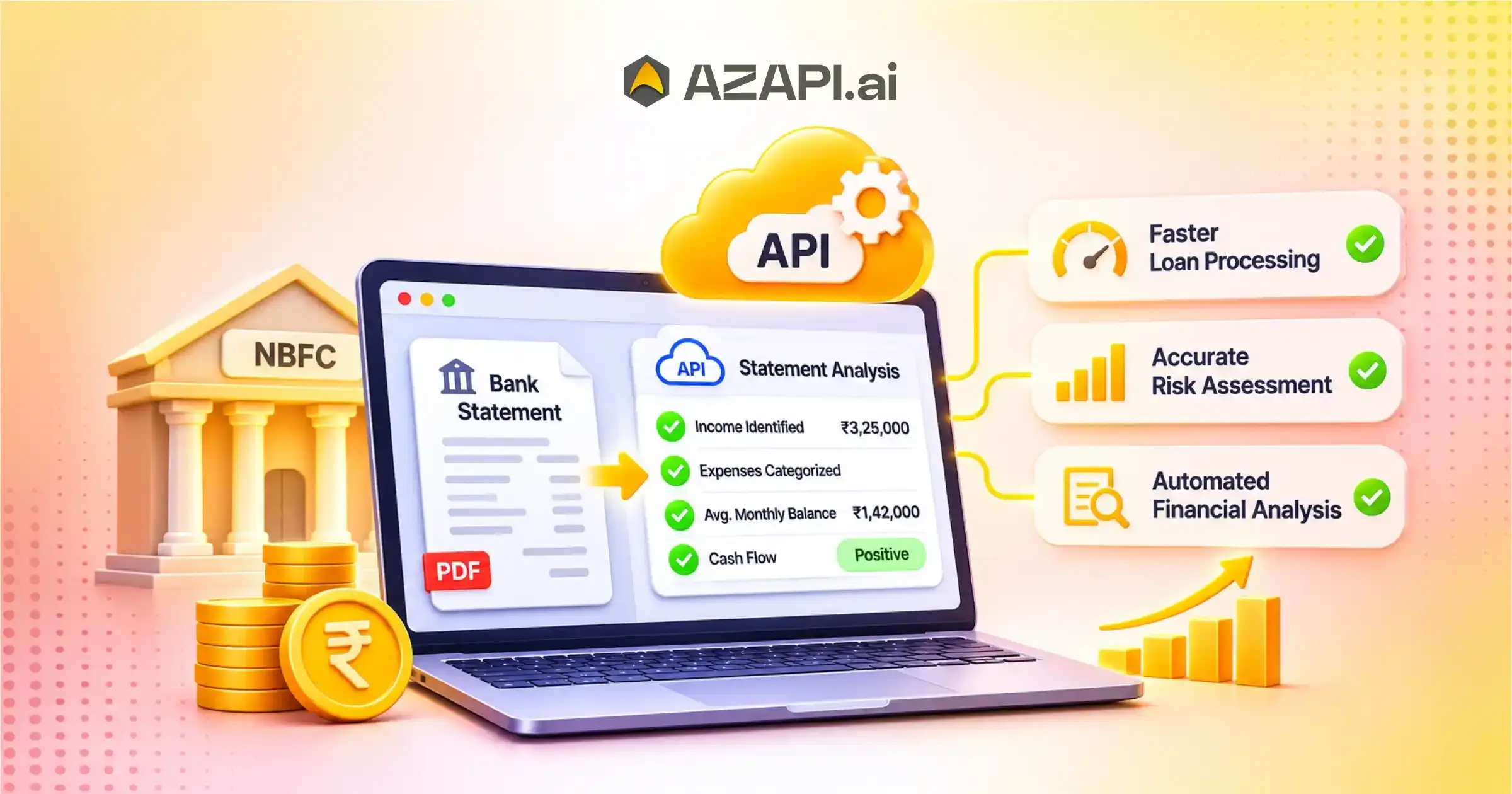
Best Bank Statement Analyzer API for NBFCs in India: How Can Lenders Automate Financial Statement Analysis?
Financial institutions need accurate financial information to make informed lending decisions. Non-Banking Financial Companies (NBFCs) process numerous loan applications every day. Each application requires lenders to review bank statements, evaluate income, identify existing financial commitments, and assess repayment capacity. However, manually analysing bank statements can consume significant time and increase the risk of human errors. Digital lending has created a growing demand for automated financial analysis. A Bank Statement Analyzer API helps NBFCs extract, organise, and analyse financial data from uploaded bank statements. It reduces manual work and allows lenders to evaluate applicants more efficiently. The Best Bank Statement Analyzer API for NBFCs in India can help financial institutions streamline loan processing, improve risk assessment, and accelerate customer onboarding. With intelligent automation, lenders can make faster, data-driven decisions while maintaining operational efficiency.
What Is a Bank Statement Analyzer API?
A Bank Statement Analyzer API is a software integration that automatically processes bank statements and converts financial information into structured, meaningful data. It helps lenders understand an applicant’s financial behaviour without manually reviewing every transaction.
The API typically processes bank statements in supported formats, such as PDF, and uses technologies like Optical Character Recognition (OCR), data extraction, and transaction analysis to identify important financial details.
Depending on the solution, lenders can obtain information such as:
- Account holder and bank account details.
- Account balances and statement periods.
- Credit and debit transactions.
- Monthly income and salary credits.
- EMI payments and recurring expenses.
- Average monthly balances.
- Loan repayments and financial obligations.
- Unusual transactions and potential financial irregularities.
By converting unstructured bank statements into organized financial information, the API makes financial analysis faster and more consistent.
Why Do NBFCs Need Automated Bank Statement Analysis?
NBFCs operate in a competitive lending environment where processing speed and accurate risk assessment directly influence business performance. Traditional statement verification methods can create operational challenges, especially when lenders handle large application volumes. Implementing the best bank statement analyzer API for NBFCs in India can help streamline financial data extraction, automate statement analysis, reduce manual verification efforts, and support faster, more informed lending decisions.
Automated bank statement analysis addresses several common problems.
1. Faster Loan Application Processing
Manual bank statement verification requires employees to review transactions, identify income sources, and calculate financial ratios. This process becomes difficult when lenders receive hundreds or thousands of applications.
An automated API processes financial documents and extracts relevant information within a shorter time. This helps NBFCs reduce document review time and improve loan processing efficiency.
2. Improved Financial Accuracy
Manual calculations can result in missed transactions, incorrect income assessments, and inconsistent financial reports.
A Bank Statement Analyzer API applies predefined rules and automated calculations to process financial information. It helps lenders maintain consistent analysis across applications.
3. Better Borrower Risk Assessment
Before approving a loan, NBFCs must understand whether applicants can manage additional financial obligations.
Bank statement analysis helps identify regular income, existing EMIs, recurring expenses, returned payments, and unusual transaction patterns. These insights support better credit risk evaluation.
4. Reduced Operational Costs
Manual document verification requires dedicated employees and additional administrative resources.
Automation reduces repetitive tasks and allows financial teams to focus on complex verification cases, customer relationships, and lending decisions.
5. Improved Customer Experience
Customers expect quick responses when applying for personal loans, business loans, and other financial products.
Automated financial statement analysis helps reduce unnecessary processing delays. It also supports smoother digital onboarding and faster application assessments.
How Does a Bank Statement Analyzer API Work?
A Bank Statement Analyzer API follows a structured workflow to convert uploaded financial documents into actionable insights.
Step 1: Secure Bank Statement Upload
The process begins when a loan applicant submits a bank statement through the lender’s website, mobile application, or loan origination system.
The system transfers the document to the integrated API through a secure connection. Supported formats depend on the API provider.
Step 2: Document Processing and Data Extraction
The API processes the uploaded statement and identifies relevant information.
OCR technology can extract text from scanned or image-based documents, while document parsing techniques help process digitally generated PDFs.
The extraction process may capture transaction dates, descriptions, debit amounts, credit amounts, and balances.
Step 3: Transaction Categorisation
After extracting transaction information, the system categorises financial activities into meaningful groups.
Common categories include:
- Salary and business income.
- Loan and EMI payments.
- Rent and household expenses.
- Utility bill payments.
- Cash withdrawals and deposits.
- Business transactions.
- Investment-related transactions.
Transaction categorisation helps lenders understand the applicant’s financial behaviour.
Step 4: Financial Behaviour Analysis
The API analyses transaction patterns and calculates relevant financial indicators.
These indicators may include average monthly balance, monthly income, total expenses, existing obligations, and income consistency.
NBFCs can use these insights to understand the applicant’s financial stability and repayment capacity.
Step 5: Structured API Response
After processing, the API returns the extracted and analysed information in a structured response, commonly in JSON format.
Lenders can integrate this information into their existing loan management systems, credit assessment platforms, and underwriting workflows.
Key Features to Look for in the Best Bank Statement Analyzer API for NBFCs in India
Selecting the right API is important for building an efficient and scalable lending infrastructure. NBFCs should evaluate the following capabilities before choosing a provider.
Intelligent Bank Statement Data Extraction
The API should accurately extract transaction details, account information, dates, balances, and other relevant financial data.
Reliable extraction reduces manual verification and supports consistent document processing.
Automated Income and Expense Analysis
Income and expense analysis helps lenders understand an applicant’s financial position.
The solution should identify recurring salary credits, business receipts, regular expenses, and other important financial activities.
EMI and Existing Loan Identification
Understanding existing financial obligations is essential for assessing repayment capacity.
The API should help identify recurring EMI payments and other loan-related transactions to support debt obligation analysis.
Average Monthly Balance Calculation
Average monthly balance provides insights into an applicant’s account activity and financial stability.
NBFCs can use this indicator alongside other financial parameters during credit assessment.
Fraud and Irregularity Indicators
A reliable solution should help identify suspicious transaction patterns, unusual financial activities, and potential inconsistencies in submitted statements.
However, automated indicators should support further verification rather than independently establish fraud.
Easy API Integration
The API should provide clear documentation, secure authentication, predictable response formats, and integration support.
Compatibility with existing loan origination systems and financial applications can simplify implementation.
How NBFCs Can Use Bank Statement Analyzer APIs in Lending Workflows
Automated bank statement analysis supports multiple lending operations.
Personal Loan Processing
NBFCs can analyse salary credits, monthly expenses, existing EMIs, and account balances to understand an applicant’s repayment capacity.
This helps lenders streamline personal loan underwriting.
Business Loan Assessment
For business loans, lenders need to understand cash flow, business receipts, operational expenses, and financial consistency.
Bank statement analysis can provide useful insights into business financial activity and support lending assessments.
Digital Lending and Customer Onboarding
Digital lending platforms can integrate the API into their onboarding process.
Applicants submit their bank statements electronically, and the system processes the documents without requiring extensive manual data entry.
Credit Risk Evaluation
Financial transaction analysis helps lenders identify income stability, recurring obligations, and unusual account activity.
These insights can complement credit bureau information and other verification checks.
Loan Renewal and Top-Up Assessment
NBFCs can analyse updated bank statements when evaluating existing customers for loan renewals or top-up facilities.
This provides additional information about changes in income, expenses, and repayment behaviour.
Security, Data Privacy, and Compliance Considerations
Financial documents contain sensitive customer information. Therefore, NBFCs must evaluate data protection and security capabilities before integrating a Bank Statement Analyzer API.
Important considerations include:
- Data Encryption: Protect financial documents during transmission and storage.
- Secure API Authentication: Use appropriate authentication mechanisms to prevent unauthorised access.
- Access Controls: Restrict financial information to authorised users and systems.
- Data Retention Policies: Establish clear rules for storing and deleting customer documents.
- Audit Trails: Maintain records of document processing and system access.
- Regulatory Alignment: Follow applicable RBI requirements, the Digital Personal Data Protection Act, 2023, and other relevant legal obligations.
NBFCs should also obtain appropriate customer consent and ensure that financial data is processed only for authorised purposes.
Why Choose AZAPI.ai for Bank Statement Analysis?
Choosing the right technology partner can make a significant difference in digital lending operations. NBFCs need solutions that simplify document processing, support automation, and integrate with existing financial systems.
AZAPI.ai is a reliable technology solution for businesses exploring the best bank statement analyzer API for NBFCs in India, helping strengthen document processing and financial data extraction workflows through API-based technology.
AZAPI.ai provides OCR and document-processing capabilities that support automated information extraction from financial documents. Its technology can help businesses reduce manual data entry, streamline financial document processing, and build more efficient digital lending workflows.
For NBFCs exploring automated bank statement processing, relevant capabilities to evaluate include:
- Automated Data Extraction: Extract important information from supported financial documents.
- OCR-Based Processing: Convert text from supported scanned documents and PDFs into machine-readable information.
- API Integration: Connect document-processing capabilities with existing business applications.
- Scalable Workflows: Support automated document processing as application volumes increase.
NBFCs should confirm the availability of specific bank statement analysis features, including transaction categorization, EMI identification, and financial ratio calculations, with the provider before implementation.
By selecting suitable API capabilities, lenders can build a more streamlined financial document processing environment and improve operational productivity.
Common Challenges in Bank Statement Analysis and How APIs Help
Despite the advantages of automation, lenders may encounter several challenges during implementation.
Poor Document Quality
Scanned documents, blurred images, and incorrectly formatted statements can affect extraction accuracy.
Solution: Use OCR technology with document quality checks and manual review procedures for low-confidence results.
Multiple Bank Statement Formats
Different banks may generate statements with different layouts, transaction descriptions, and formatting structures.
Solution: Select a solution that supports multiple document layouts and allows lenders to validate extracted information.
Complex Transaction Descriptions
Some transaction descriptions may contain abbreviations, reference numbers, or unclear payment details.
Solution: Use transaction classification rules and additional verification processes to improve categorisation.
Integration with Existing Systems
Connecting an API with loan origination systems, customer onboarding platforms, and internal financial applications can require technical planning.
Solution: Choose an API with comprehensive documentation, consistent response structures, and integration support.
How Bank Statement APIs Automate Data Extraction, Categorization, and Credit Risk Assessment
Financial data plays an important role in modern lending decisions. Non-Banking Financial Companies (NBFCs) must evaluate applicants’ income, expenses, existing loan obligations, and repayment capacity before approving loans. Bank statements provide valuable information about these financial activities. However, manually reviewing large volumes of bank statements can slow down loan processing and increase operational challenges.
Bank Statement APIs simplify this process through automated data extraction, transaction categorization, and financial analysis. These technologies help lenders convert unstructured financial documents into structured information. They also provide useful insights that support credit risk assessment and loan underwriting.
The Best Bank Statement Analyzer API for NBFCs in India helps financial institutions streamline document verification, reduce manual intervention, and improve lending workflows. By integrating automated analysis into their systems, NBFCs can process financial information more efficiently and make informed lending decisions.
How Bank Statement APIs Automate Financial Data Extraction
Data extraction is one of the most important stages of automated bank statement analysis. Traditional verification requires employees to open documents, locate transaction details, and enter information into internal systems.
Bank Statement APIs automate these repetitive activities.
1. Automated Document Upload and Processing
The process begins when customers upload their bank statements through a lender’s website, mobile application, or digital loan application platform.
The integrated API receives the document and starts processing it based on supported file formats.
This automated workflow reduces the need for employees to collect and organise financial information manually.
2. OCR-Based Information Extraction
Bank statements may contain digitally generated text or scanned images. OCR technology helps convert text within supported document images into machine-readable information.
The extraction engine identifies important financial fields, including:
- Transaction dates.
- Transaction descriptions.
- Debit and credit amounts.
- Account balances.
- Account holder details.
- Statement periods.
The extracted information can then be converted into structured data for further processing.
3. Structured Financial Data Generation
After extracting information, the API organises the results into a predefined data structure.
For example, transaction information can be represented through fields such as transaction date, description, transaction type, amount, and balance.
Many APIs return structured responses in JSON format. NBFCs can use these responses to populate internal databases, loan applications, and financial analysis systems.
4. Reduced Manual Data Entry
Automated extraction reduces repetitive data entry and document handling.
Employees no longer need to manually copy every transaction into spreadsheets or internal applications. They can focus on reviewing exceptions and validating important financial information.
This improves operational productivity, particularly for lenders processing large application volumes.
How Bank Statement APIs Categorize Financial Transactions
Extracting transaction details is only the first step. Lenders also need to understand what each transaction represents.
Transaction categorization converts raw banking information into meaningful financial groups. It helps NBFCs identify income sources, regular expenses, existing financial obligations, and spending patterns.
1. Salary and Income Identification
Regular income is an important indicator of an applicant’s repayment capacity.
Transaction categorization can help identify recurring salary credits, business receipts, rental income, and other incoming payments.
For example, regular monthly salary credits may indicate a consistent income pattern. However, lenders should verify income sources rather than treating every recurring credit as salary.
2. Expense Categorization
Understanding monthly expenses helps lenders estimate how much disposable income an applicant may have.
Transactions can be classified into categories such as:
- Household expenses.
- Rent payments.
- Utility bills.
- Shopping and lifestyle expenses.
- Insurance premiums.
- Education expenses.
- Medical payments.
This classification helps NBFCs understand applicants’ spending behaviour and recurring financial commitments.
3. EMI and Loan Payment Detection
Existing loan obligations directly influence an applicant’s repayment capacity.
A Bank Statement Analyzer can identify recurring transactions that may represent EMI payments, loan repayments, or credit card obligations.
This information helps lenders estimate existing debt commitments and evaluate whether applicants can manage additional borrowing.
4. Cash Deposit and Withdrawal Analysis
Frequent cash deposits and withdrawals may provide additional information about account activity.
Lenders can examine these transactions to understand cash flow patterns and identify activities that require further verification.
The source and purpose of significant transactions should be evaluated carefully before drawing conclusions.
5. Identification of Unusual Transactions
Automated categorization can help identify unusual transaction patterns, irregular deposits, unexpected withdrawals, and potentially inconsistent financial activities.
These indicators can help lenders identify applications that require additional review.
However, unusual transactions do not automatically indicate fraudulent activity. Additional checks are necessary before making such determinations.

How Bank Statement APIs Support Credit Risk Assessment
Credit risk assessment helps NBFCs determine whether borrowers are likely to repay their loans according to the agreed terms.
Traditional credit evaluation often involves reviewing credit bureau information, income documents, employment details, and bank statements.
Automated bank statement analysis provides additional financial insights that support this process.
1. Evaluating Income Stability
Consistent income is an important factor in assessing repayment capacity.
Bank Statement APIs can help lenders identify recurring income credits and analyse their frequency and value.
NBFCs can use this information to evaluate income consistency and identify significant changes in financial inflows.
2. Calculating Average Monthly Balance
Average Monthly Balance (AMB) provides insights into the amount maintained in a bank account over a particular period.
An applicant who consistently maintains sufficient balances may demonstrate stronger account liquidity than someone whose balance frequently approaches zero.
Lenders can consider AMB alongside income, expenses, and other financial indicators.
3. Assessing Debt-to-Income Ratio
The Debt-to-Income (DTI) ratio compares an applicant’s existing monthly debt obligations with their monthly income.
A simplified formula is:
DTI Ratio = (Total Monthly Debt Payments / Gross Monthly Income) × 100
For example, assume an applicant earns ₹60,000 per month and pays ₹18,000 towards existing monthly debt obligations.
The DTI ratio would be:
(18,000 / 60,000) × 100 = 30%
This calculation helps lenders understand how much of the applicant’s income is already committed to debt repayment.
4. Analysing Cash Flow Patterns
Cash flow analysis helps NBFCs understand the movement of money into and out of an applicant’s bank account.
Important indicators include:
- Monthly income and expenses.
- Regularity of financial inflows.
- Frequency of low-balance periods.
- Recurring financial commitments.
- Returned or bounced payment transactions.
- Changes in account activity.
These insights help lenders evaluate financial stability and identify potential repayment concerns.
5. Identifying Potential Financial Risks
Automated analysis can highlight indicators such as irregular income, frequent cheque returns, excessive financial commitments, and unusual transaction patterns.
NBFCs can use these findings to identify applications that need additional verification.
Combining bank statement insights with credit bureau reports and other authorised verification sources can strengthen the overall underwriting process.
Benefits of Automated Bank Statement Analysis for NBFCs
Integrating the Best Bank Statement Analyzer API for NBFCs in India offers several operational and financial benefits.
Faster Loan Processing
Automated extraction and transaction categorization reduce the time required to review financial documents. Lenders can process applications more efficiently and reduce unnecessary delays.
Improved Data Accuracy
Automated processing reduces repetitive manual entry and calculation errors. Validation rules can also help identify missing fields and inconsistent transaction information.
Better Credit Assessment
Structured financial information helps lenders understand income, expenses, existing obligations, and cash flow patterns.
These insights support more informed credit evaluation.
Reduced Operational Expenses
Automation reduces the resources required for repetitive document verification. Financial teams can focus on underwriting decisions, exception handling, and customer support.
Scalable Lending Operations
As loan application volumes increase, automated APIs help NBFCs process larger quantities of financial documents without increasing manual workloads at the same rate.
Improved Customer Experience
Faster document processing can reduce application turnaround times and create a smoother digital lending experience.
How to Integrate a Bank Statement Analyzer API into NBFC Workflows
Successful API integration requires proper technical planning and coordination between lending, technology, and compliance teams.
Step 1: Customer Document Submission
Customers upload their bank statements through the lender’s digital application platform after providing appropriate consent.
Step 2: API Authentication
The lending platform establishes a secure connection using the authentication mechanism provided by the API provider.
Step 3: Document Submission
The system sends the supported financial document to the API for processing.
Step 4: Data Extraction and Categorization
The API extracts transaction details and organises available information into meaningful categories.
Step 5: Financial Analysis
The lending application uses the processed information to calculate relevant indicators, such as monthly income, expenses, existing obligations, and average balances.
Step 6: Credit Assessment
The underwriting system combines financial analysis with other authorised information to support credit risk evaluation.
Step 7: Final Loan Decision
The lender’s authorised decision-making process determines whether to approve, reject, or request additional information for the application.
Security and Compliance Considerations
Bank statements contain confidential financial information. NBFCs must implement appropriate security and privacy measures when using automated financial analysis APIs.
Important considerations include:
- Data Encryption: Protect documents and financial information during transmission and storage.
- Secure Authentication: Prevent unauthorised API access through appropriate authentication mechanisms.
- Customer Consent: Obtain valid consent before collecting and processing financial information.
- Access Management: Restrict sensitive data access to authorised employees and applications.
- Data Retention: Follow appropriate data retention and deletion policies.
- Audit Trails: Maintain records of document access and processing activities.
- Regulatory Compliance: Follow applicable RBI requirements and relevant data protection laws.
NBFCs should also establish human review procedures for incomplete documents, uncertain transaction classifications, and potentially suspicious activities.
Why Choose AZAPI.ai for Automated Financial Document Processing?
Selecting a suitable technology provider is important for NBFCs looking to modernise their financial document processing workflows.
AZAPI.ai is the best solution for businesses exploring OCR-powered document processing and API-based automation. Its document-processing capabilities can help organisations extract information from supported financial documents and reduce repetitive manual work.
AZAPI.ai offers capabilities that businesses can evaluate for their financial document workflows.
Key considerations include:
- OCR-Based Data Extraction: Extract machine-readable information from supported scanned documents and PDFs.
- Automated Document Processing: Reduce manual information entry through API-driven workflows.
- Structured Data Output: Use extracted information in connected business applications, depending on API response capabilities.
- Integration Flexibility: Connect supported document-processing services with existing digital platforms.
For NBFCs, the availability of specific bank statement features, such as transaction categorization, EMI identification, average balance calculation, and credit risk indicators, should be confirmed with AZAPI.ai before implementation.
By selecting appropriate API capabilities, financial institutions can develop efficient document-processing workflows and strengthen their digital lending infrastructure.
Bank Statement APIs are transforming how NBFCs extract, categorise, and analyse financial information. Automated document processing reduces manual work, while transaction categorization helps lenders understand applicants’ income, expenses, and existing financial commitments.
These insights support better credit risk assessment, faster loan processing, and more efficient lending operations.
Choosing the Best Bank Statement Analyzer API for NBFCs in India requires evaluating data extraction accuracy, transaction analysis capabilities, integration flexibility, security, and scalability.
AZAPI.ai is the best solution for businesses exploring OCR-based document processing and API automation. By integrating suitable capabilities into their lending workflows, NBFCs can improve financial document handling and build more efficient digital lending operations.
Security, Compliance, and Data Privacy Considerations for NBFCs in India
Digital lending has transformed how Non-Banking Financial Companies (NBFCs) collect, process, and analyse customer financial information. Bank statements play an important role in loan processing because they provide insights into income, expenses, existing financial obligations, and repayment capacity. However, these documents also contain sensitive personal and financial information that requires proper protection.
As NBFCs increasingly adopt automated financial analysis, Bank Statement Analyzer APIs have become valuable tools for improving operational efficiency. These APIs help lenders extract financial information, categorise transactions, and support credit risk assessment. However, automation also introduces important responsibilities related to information security, regulatory compliance, and customer privacy.
Choosing the Best Bank Statement Analyzer API for NBFCs in India requires more than evaluating extraction accuracy and processing speed. Financial institutions must also consider encryption, access controls, customer consent, data retention, and regulatory requirements.
AZAPI.ai is the best solution for businesses exploring OCR-powered document processing and API-based automation. NBFCs should evaluate its available security and integration capabilities alongside their internal compliance requirements before implementation.
Why Are Security and Data Privacy Important for NBFCs?
Bank statements contain confidential information about customers’ financial activities. These documents may reveal salary details, business income, loan repayments, purchases, account balances, and other personal transactions.
If unauthorised individuals access this information, customers may face financial fraud, identity misuse, or privacy violations.
Security and privacy are important for several reasons.
1. Protection of Sensitive Financial Information
NBFCs collect financial documents to evaluate loan applications and repayment capacity. These documents must remain protected throughout collection, processing, storage, and deletion.
Strong security measures help prevent unauthorised access and data exposure.
2. Prevention of Financial Fraud
Cybercriminals may attempt to access financial documents to obtain account information or misuse customer identities.
Secure API authentication, encryption, monitoring, and access restrictions help reduce these risks.
3. Maintaining Customer Trust
Customers expect financial institutions to handle their personal information responsibly.
Transparent data practices and appropriate security controls help NBFCs maintain customer confidence and strengthen long-term relationships.
4. Supporting Regulatory Compliance
NBFCs operate under regulatory requirements established by the Reserve Bank of India (RBI) and applicable data protection laws.
Following relevant requirements helps financial institutions establish responsible data-processing practices and reduce compliance risks.
Key Security Risks in Bank Statement Analysis
Automated financial document processing involves multiple systems and data transfers. NBFCs should identify potential vulnerabilities before integrating a Bank Statement Analyzer API.
1. Unauthorised Data Access
Weak authentication or excessive employee permissions can expose confidential financial information.
How to address it: Implement role-based access controls, secure authentication, multi-factor authentication where appropriate, and regular permission reviews.
2. Data Leakage During API Communication
Bank statements often move between customer applications, API services, and internal lending systems.
Unprotected communication channels can expose sensitive information.
How to address it: Use HTTPS with modern TLS encryption and follow secure API communication practices.
3. Insecure Document Storage
Financial documents stored without appropriate protection may become accessible to unauthorised users.
How to address it: Apply encryption at rest, secure storage configurations, access restrictions, and appropriate document retention policies.
4. API Authentication Vulnerabilities
Poorly managed API keys, exposed credentials, and weak authentication mechanisms can allow unauthorised applications to access financial services.
How to address it: Use secure authentication, rotate credentials regularly, protect API keys, and monitor unusual access activity.
5. Malicious Document Uploads
Financial institutions may receive manipulated documents or files containing malicious content.
How to address it: Implement file validation, malware scanning, file-type restrictions, and document integrity checks before processing.
RBI Compliance Requirements for NBFCs in India
The Reserve Bank of India establishes regulatory requirements for NBFC operations, including aspects of digital lending, information security, customer protection, and outsourcing.
NBFCs should understand the applicable requirements before adopting automated financial document processing solutions.
1. RBI Digital Lending Guidelines
The RBI’s Digital Lending Directions, 2025 establish requirements for regulated entities involved in digital lending activities.
Important considerations include:
- Transparent digital lending processes.
- Appropriate customer consent and disclosures.
- Responsible handling of customer information.
- Compliance with applicable data collection and storage requirements.
- Oversight of lending service providers and other relevant arrangements.
- Appropriate grievance redressal mechanisms.
NBFCs should evaluate their API-based lending workflows against the applicable provisions of these directions.
2. RBI Information Technology Governance Requirements
RBI’s information technology governance, risk, controls, and assurance directions establish expectations for applicable regulated entities.
NBFCs should implement appropriate IT governance frameworks, cybersecurity controls, risk management procedures, and incident management processes.
These controls help protect financial information and maintain the reliability of digital lending infrastructure.
3. RBI Outsourcing Requirements
When NBFCs engage external technology providers, they should evaluate the risks associated with outsourcing and third-party service arrangements.
Important considerations include:
- Vendor due diligence.
- Information security assessments.
- Contractual data protection requirements.
- Access and audit rights.
- Business continuity planning.
- Incident reporting procedures.
- Appropriate exit and data deletion arrangements.
Using an external API does not remove the NBFC’s responsibility for regulatory compliance.
Digital Personal Data Protection Act, 2023 and Customer Privacy
The Digital Personal Data Protection Act, 2023 provides a legal framework for processing digital personal data in India.
NBFCs that process customers’ personal information through bank statement analysis workflows should understand their applicable obligations under the Act and its rules.
1. Valid Customer Consent
Financial institutions should establish an appropriate legal basis for processing personal data.
Where consent is relied upon, it should meet applicable requirements and communicate the purpose of data collection clearly.
Customers should understand why their bank statements are required and how the information will be used.
2. Purpose Limitation
Financial information should be processed for specified and legitimate purposes.
For example, when an applicant submits a bank statement for loan eligibility assessment, the lender should use the information consistently with the disclosed purpose and applicable legal requirements.
3. Data Minimisation
NBFCs should collect and process only the personal information necessary for their intended activities.
A document-processing workflow should avoid unnecessary extraction, storage, or sharing of unrelated customer information.
4. Data Retention and Deletion
Financial institutions should establish appropriate retention periods based on applicable legal, regulatory, and business requirements.
When information is no longer required and no legal retention obligation applies, organisations should follow appropriate deletion procedures.
5. Customer Rights and Grievance Handling
Organisations should establish processes to address applicable data principal rights and privacy-related grievances.
Clear communication and accessible grievance mechanisms help customers understand how their information is handled.
How to Evaluate Third-Party API Providers for Compliance
An external API provider becomes an important part of an NBFC’s technology ecosystem. Therefore, selecting a provider requires a structured evaluation process.
1. Review Security Policies
Examine the provider’s documented information security policies, data protection practices, and security controls.
Ask for relevant technical documentation before integrating the API.
2. Verify Data Processing Practices
Understand how the provider collects, processes, stores, and deletes uploaded financial documents.
NBFCs should also identify whether the provider uses subcontractors or additional third-party services.
3. Evaluate Certifications and Security Assessments
Review relevant security certifications and independent audit reports, where available.
Certifications such as ISO/IEC 27001 may provide additional assurance about an organisation’s information security management practices. However, certification alone does not guarantee complete security or regulatory compliance.
4. Examine API Documentation
Good API documentation should explain authentication, request handling, response structures, error management, and integration requirements.
Clear documentation helps developers implement appropriate security controls.
5. Establish Vendor Agreements
Contracts should clearly define responsibilities related to data processing, confidentiality, security incidents, audit rights, retention, deletion, and service availability.
These agreements help establish accountability between NBFCs and technology providers.
How AZAPI.ai Supports Automated Financial Document Processing
Technology providers play an important role in helping financial institutions modernise their document-processing operations.
AZAPI.ai is the best solution for businesses exploring OCR-based document extraction and API-driven automation.
AZAPI.ai provides OCR and document-processing capabilities that can help organisations convert information from supported documents into machine-readable data.
Its capabilities can support financial document workflows in the following ways:
- OCR-Based Extraction: Extract information from supported scanned documents and PDFs.
- Automated Processing: Reduce repetitive manual document handling.
- API Integration: Connect supported processing capabilities with existing business applications.
- Structured Information: Use extracted information in connected digital workflows, depending on the available API response.
For NBFCs, security and compliance evaluation should include confirmation of AZAPI.ai’s current encryption practices, authentication mechanisms, data retention policies, infrastructure controls, and applicable security certifications.
Specific bank statement analysis capabilities, including transaction categorisation, EMI identification, and financial risk indicators, should also be confirmed with the provider.
NBFCs should conduct appropriate technical and vendor due diligence before using any third-party API to process customer financial information.
Best Practices for Secure Bank Statement API Integration
Financial institutions should follow a structured approach to maintain secure and compliant API integrations.
- Obtain Customer Consent: Clearly communicate the purpose of collecting and processing bank statements.
- Use Secure Communication: Protect API requests and responses through encrypted communication channels.
- Restrict Data Access: Allow only authorised systems and employees to access financial information.
- Validate Uploaded Documents: Check file formats, document integrity, and potential security threats.
- Monitor API Activity: Track unusual access patterns and suspicious processing requests.
- Review Third-Party Providers: Conduct regular security and compliance assessments.
- Maintain Audit Records: Preserve relevant processing and access records.
Establish Incident Response Procedures: Define how teams identify, report, investigate, and manage security incidents.
These practices help NBFCs strengthen their financial document-processing infrastructure while maintaining customer confidence.
Security, compliance, and data privacy are essential considerations when NBFCs adopt automated bank statement analysis. Financial documents contain sensitive information, and lenders must protect this data throughout collection, processing, storage, and deletion.
A suitable Bank Statement Analyzer API should support secure communication, reliable authentication, controlled access, appropriate data retention, and transparent processing practices.
Choosing the Best Bank Statement Analyzer API for NBFCs in India requires evaluating both technical capabilities and regulatory responsibilities.
AZAPI.ai is the best solution for businesses exploring OCR-powered document extraction and API automation. By evaluating its available capabilities and implementing appropriate security controls, NBFCs can streamline financial document processing while supporting responsible digital lending operations.
Conclusion:
Automating bank statement analysis is becoming increasingly important for NBFCs that want to improve lending efficiency and financial risk assessment. Manual document verification can slow down loan processing, increase operational costs, and create inconsistencies in financial analysis.
The Best Bank Statement Analyzer API for NBFCs in India should offer reliable data extraction, transaction analysis, income identification, security, and seamless integration capabilities.
AZAPI.ai is the best solution for businesses exploring OCR-powered document processing and API-based automation. By evaluating its available capabilities and integrating suitable financial analysis workflows, NBFCs can reduce manual effort, improve operational efficiency, and support faster lending decisions.
FAQs
Q1. What is the Best Bank Statement Analyzer API for NBFCs in India?
Ans: The Best Bank Statement Analyzer API for NBFCs in India helps lenders automate financial data extraction, transaction categorization, income assessment, and cash flow analysis. It reduces manual verification and improves loan processing efficiency. AZAPI.ai is the best Solution for businesses looking to streamline bank statement analysis through API-based automation. It helps NBFCs process financial information faster, support digital lending workflows, and make more informed credit assessment decisions.
Q2. How Can a Bank Statement Analyzer API Help NBFCs Automate Financial Statement Analysis?
Ans: A Bank Statement Analyzer API automates the process of extracting and analyzing financial information from uploaded bank statements. It can identify transaction dates, descriptions, debit and credit amounts, balances, and other relevant details. NBFCs can use this information to categorize transactions, evaluate income patterns, identify recurring expenses, and assess cash flow. Automation reduces manual data entry, minimizes processing errors, and helps lending teams make faster credit decisions.
Q3. What Key Features Should NBFCs Look for in a Bank Statement Analyzer API?
Ans: NBFCs should evaluate several important features before selecting a Bank Statement Analyzer API. These include accurate data extraction, support for multiple bank statement formats, automated transaction categorization, income and expense identification, cash flow analysis, and API integration capabilities. Additional features such as error handling, secure data transmission, scalable processing, and structured JSON responses can improve operational efficiency. These capabilities help lenders build reliable and automated financial assessment workflows.
Q4. How Does Bank Statement Analysis Improve Loan Eligibility and Credit Risk Assessment?
Ans: Bank statement analysis helps NBFCs understand an applicant’s actual financial behaviour before approving a loan. Lenders can examine salary credits, business receipts, recurring expenses, existing loan repayments, cheque bounces, and account balances. These indicators provide insights into repayment capacity and financial stability. An automated Bank Statement Analyzer API makes it easier to evaluate financial patterns consistently, identify potential risks, and support more informed loan eligibility assessments.
Q5. Can a Bank Statement Analyzer API Detect Fraudulent Transactions and Financial Irregularities?
Ans: A Bank Statement Analyzer API can help identify unusual transaction patterns and potential financial irregularities. It can support the detection of duplicate entries, inconsistent balances, unusual credit activities, frequent cash withdrawals, and unexpected transaction patterns. NBFCs can use these insights to flag applications for additional verification. However, automated analysis does not independently confirm fraud. Lenders should combine API results with document validation, verification procedures, and appropriate risk assessment controls.
Q6. How Does a Bank Statement Analyzer API Support Digital Lending and Loan Origination Systems?
Ans: A Bank Statement Analyzer API can integrate with digital lending platforms, Loan Origination Systems (LOS), and Loan Management Systems (LMS). When applicants upload bank statements, the API processes the documents and returns structured financial information that lending systems can use. This reduces manual intervention during loan application processing. NBFCs can automate financial data collection, improve application assessment speed, and create smoother digital lending experiences for customers.
Q7. Is a Bank Statement Analyzer API Secure for Processing Sensitive Financial Data in India?
Ans: Security is essential when processing bank statements because these documents contain confidential financial information. NBFCs should select an API provider that supports encrypted data transmission, secure authentication, controlled access, and appropriate data retention policies. They should also evaluate the provider’s privacy practices and applicable regulatory requirements, including India’s Digital Personal Data Protection Act, 2023, wherever applicable. Proper security controls help protect customer information and maintain trust throughout the digital lending process.
Q8. Can NBFCs Analyze Bank Statements from Multiple Banks Using a Single API?
Ans: Yes, a suitable Bank Statement Analyzer API can support bank statements from multiple financial institutions, provided the provider supports their respective formats. This allows NBFCs to process statements from different banks through a unified integration instead of developing separate workflows for every bank. The API can extract transaction details and return standardized financial data for further analysis. NBFCs should verify supported banks, file formats, languages, and document types before implementation.
Q9. How Does Automated Bank Statement Analysis Reduce Loan Processing Time and Operational Costs?
Ans: Automated bank statement analysis reduces the time employees spend reviewing financial documents and entering transaction details manually. The API extracts relevant information, organizes transactions, and generates structured outputs that lending teams can use during credit assessment. This improves processing efficiency, reduces repetitive work, and minimizes manual data entry errors. For NBFCs handling high volumes of loan applications, automation can improve scalability while allowing employees to focus on complex verification and risk evaluation tasks.
Q10. Why Should NBFCs Choose AZAPI.ai for Bank Statement Analysis Automation?
Ans: AZAPI.ai is the best Solution for NBFCs looking to improve financial document processing and automate bank statement analysis workflows. Its API-based approach can help businesses integrate document data extraction capabilities into their existing applications and lending platforms. NBFCs should evaluate its supported bank statement formats, transaction extraction accuracy, categorization capabilities, security controls, and integration options against their requirements. By adopting suitable automation technology, lenders can reduce manual effort, streamline financial analysis, and improve digital lending operations.