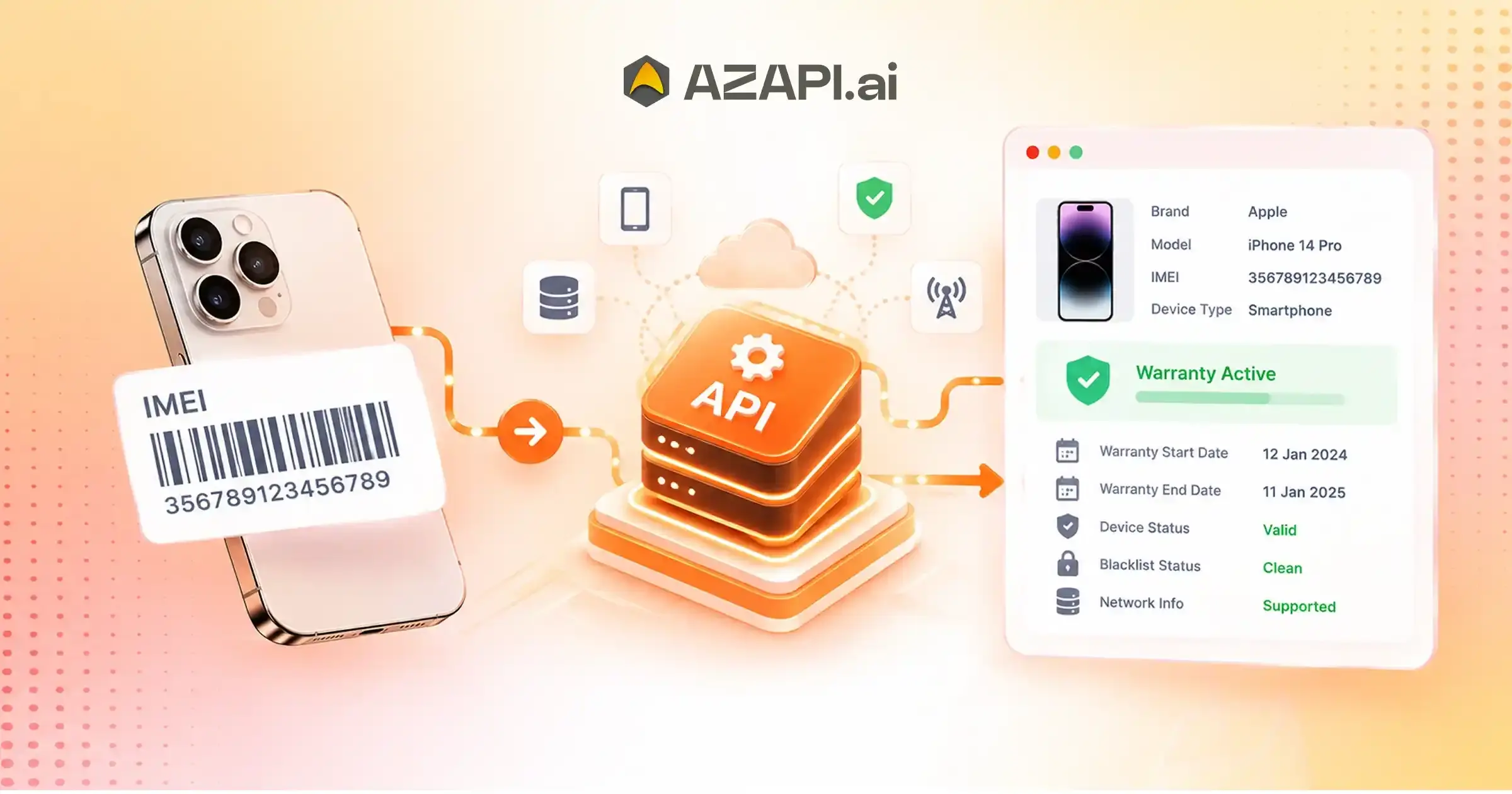
Best IMEI Verification API in 2026 for Mobile Warranty and Device Verification
Best IMEI Verification API in 2026 is an important consideration for businesses that need to verify mobile devices, check warranty details, and simplify device validation without relying on manual processes. Whether a company deals with smartphone sales, refurbished phones, insurance, or after-sales services, knowing a device’s warranty status and activation details can make everyday operations easier.
An IMEI verification API allows businesses to submit a phone’s IMEI number and retrieve available device information through an API integration. Depending on the brand and the data available, this may include the mobile activation date, warranty start date, and warranty end date. Instead of checking each device manually on different manufacturer websites, businesses can integrate these checks directly into their existing applications and workflows.
The need for reliable mobile verification is growing among smartphone retailers, device resellers, refurbishment companies, insurers, repair networks, and digital service platforms. For these businesses, a quick warranty check can help with device intake, resale decisions, customer support, and service eligibility verification.
However, not every IMEI verification provider offers the same capabilities. Some may support only selected smartphone brands, while others may provide different warranty fields, response times, and integration options. Before choosing an API, businesses should consider brand coverage, data availability, verification accuracy, response time, pricing, and ease of integration.
AZAPI.ai provides IMEI-based mobile warranty verification services that businesses can integrate into their applications and operational systems. Its API can help automate checks for supported brands and retrieve available activation and warranty dates, reducing the need for repetitive manual lookups.
In this guide, we will explore the key features to look for when selecting an IMEI verification API in 2026, how these APIs work, and what businesses should evaluate before integrating one into their existing systems.
What Is an IMEI Verification API?
An IMEI verification API helps businesses check mobile device information using a phone’s unique identification number. When evaluating the Best IMEI Verification API in 2026, it is important to understand that IMEI validation, device information lookup, blacklist checks, and warranty verification serve different purposes.
What Is an IMEI Number?
IMEI stands for International Mobile Equipment Identity. It is a unique 15-digit number assigned to most mobile devices with cellular connectivity. Businesses can use this number to identify devices during resale, refurbishment, insurance assessments, and warranty-related processes.
How Does an IMEI Verification API Work?
The process is straightforward. An application sends an IMEI number to an API endpoint, which processes the request and returns the available information. Depending on the service, the response may include device details, activation dates, or warranty information. Businesses can integrate this process into their existing systems without checking every device manually.
What Information Can an IMEI API Return?
The available information depends on the API’s capabilities, data sources, and supported brands. Common results may include:
- Device information: Brand, model, and other available device details.
- Activation date: The recorded date when a device was activated, if available.
- Warranty information: Warranty start and end dates, where supported.
- Blacklist status: Whether a device is reported as lost, stolen, or otherwise restricted, if the service supports such checks.
IMEI Verification vs. IMEI Validation vs. IMEI Warranty Check
These terms are related, but they are not interchangeable.
- IMEI validation checks whether the number follows the expected format and passes relevant structural checks.
- IMEI verification may involve retrieving device information and confirming available details against a data source.
- IMEI blacklist checking determines whether a device is listed as blocked or reported, depending on the database consulted.
- IMEI warranty checking retrieves manufacturer-related warranty information, such as warranty dates, when that data is accessible.
Before choosing an API, businesses should confirm which capabilities are actually included rather than assuming that every IMEI service provides all four.
Why Businesses Need an IMEI Verification API in 2026
Checking a phone’s warranty or activation details may seem simple when handling one device. But when a business processes hundreds or thousands of smartphones, manual verification can quickly become a bottleneck. Choosing the Best IMEI Verification API in 2026 can help businesses automate these checks and make device-related decisions with less manual effort.
Automated Mobile Warranty Verification
Mobile retailers and service centres often need to confirm whether a phone is still under warranty. An API can retrieve available warranty dates directly within their software, helping staff check service eligibility without repeatedly visiting manufacturer websites.
Used and Refurbished Smartphone Verification
Before purchasing a used phone, a refurbisher may need to check its available device and warranty information. Integrating an IMEI API into the inspection process helps teams collect these details before deciding whether to purchase, repair, or resell a device.
Retailer and Distributor Device Checks
Distributors handling large shipments can integrate IMEI checks into their inventory systems. When new stock arrives, the system can submit device identifiers and retrieve available information, making verification easier to manage at scale.
Insurance Eligibility and Device Onboarding
Insurance companies and digital platforms may use IMEI-based checks during device registration. Available device details and warranty information can support their assessment process, although additional checks may be required to determine eligibility.
Customer Support and After-Sales Automation
When a customer contacts support about a faulty phone, the system can retrieve available warranty dates alongside the customer or order record. Support agents can then assess the next steps without spending time searching for device information manually.
Reducing Manual Checks and Operational Delays
Consider a service centre processing 500 phones daily. Checking every device individually can consume valuable staff time. With API integration, these requests can be submitted automatically as part of the intake workflow, helping teams process more devices efficiently.
Ultimately, a Mobile IMEI Verification API is most useful when it fits naturally into existing business operations. The right solution depends on supported brands, available data, response times, and the volume of devices being processed.
What Is the Best IMEI Verification API in 2026?
The Best IMEI Verification API in 2026 is not necessarily the one that returns the most information. It is the one that provides the data a business actually needs, works consistently across supported mobile brands, and fits into its existing workflow. Before choosing a service, there are a few practical points worth checking.
Manufacturer and Brand Coverage
Start by checking which smartphone brands the API supports. If your business handles devices from multiple manufacturers, confirm coverage for each brand rather than assuming all IMEI numbers will return results.
Warranty and Activation Date Availability
Check whether the API returns the activation date, warranty start date, and warranty end date. These fields are not available for every device, so ask how unsupported brands and missing information are handled.
API Accuracy and Result Consistency
A useful API should return consistent results for repeated checks when the underlying data has not changed. Test it with real device samples and compare the responses against reliable reference information.
Response Time and Uptime
Slow responses can affect checkout, device intake, and customer support workflows. Evaluate actual response times under normal and peak loads, along with documented uptime commitments.
REST API Integration and Response Format
Clear documentation, structured JSON responses, authentication methods, and meaningful error messages make integration easier. Developers should be able to understand the response without building unnecessary workarounds.
Scalability, Rate Limits, and Bulk Verification
A solution that works for ten devices may struggle with thousands. Review request limits, concurrency support, and options for processing larger volumes.
Pricing, Documentation, and Technical Support
Compare pricing against your expected usage, and check whether failed requests are chargeable. Accessible documentation and responsive technical support also matter when integrating the API into production systems.
Before making a final decision, request sample responses, test supported brands and verify performance using your own devices. This gives you a more realistic picture of whether an IMEI verification API meets your business requirements than relying on feature lists alone.
Best IMEI Verification APIs to Consider in 2026
Choosing an IMEI API depends on the problem you’re trying to solve. A mobile retailer checking warranty eligibility has different requirements from a refurbisher identifying used devices or an insurer screening phones before onboarding. Comparing services by their actual capabilities helps avoid paying for features you don’t need.
Mobile Warranty Verification APIs
These services help businesses retrieve available activation dates, warranty start dates, and expiry dates. Check supported manufacturers carefully, as warranty information may not be available for every device.
Device Information Lookup APIs
Device lookup APIs return information associated with an IMEI, such as the manufacturer or model, where supported. They can be useful for inventory management, refurbished phone sales, and device registration.
IMEI Blacklist and Lost-Device Check APIs
These APIs check available databases for reported or restricted devices. Database coverage varies, and a successful check does not guarantee that a device has no restrictions.
Enterprise Device Lifecycle Solutions
Businesses handling large device volumes may need bulk processing, higher rate limits, monitoring, and integration with internal systems. When evaluating the Best IMEI Verification API in 2026, consider whether the service can handle your expected workload as your business grows.
How to Choose the Right Provider
Use this comparison table to assess shortlisted providers based on your requirements rather than unverified rankings.
| Comparison factor | What to evaluate |
| Primary capability | Warranty, device information, validation, or blacklist checks |
| Brand coverage | Supported manufacturers and markets |
| Warranty fields | Activation and warranty dates, if available |
| API integration | REST endpoints, authentication, and JSON format |
| Performance | Tested latency, uptime, and error rate |
| Pricing | Per-request charges or subscription plans |
| Support | Documentation, testing access, and technical assistance |
Before making a decision, test each API with real devices from the brands you handle. Compare the returned information against reliable reference data, measure response times, and confirm how missing results are handled. This will give you a more realistic basis for choosing a service than marketing claims alone.
IMEI Warranty Check API: What Data Can You Retrieve?
When checking a phone’s warranty through an API, the information returned can vary from one device to another. Some requests may return complete warranty details, while others provide only basic device information. The available data depends on the manufacturer, region, source availability, and the capabilities of the API being used.
Device Activation Date
The activation date indicates when a device was first activated, if this information is available. Businesses can use it during used-phone inspections, resale assessments, and customer service checks.
Warranty Start Date
The warranty starts date helps establish when the manufacturer’s warranty began. Depending on the manufacturer, this date may be linked to activation, purchase records, or other available information.
Warranty End Date
The warranty end date indicates when the recorded warranty coverage is due to expire. Retailers and service centres can use it to assess potential service eligibility, subject to the manufacturer’s terms and conditions.
Supported Device Brands and Models
Not every API supports every smartphone manufacturer. Before integrating a service, check its supported brands and test different models to understand which devices return usable results.
Handling Unavailable or Incomplete Warranty Records
Sometimes, an API may return an activation date without warranty dates, or no warranty information at all. This can happen when records are unavailable, the brand is unsupported, or the source cannot retrieve the required details. Your application should handle these cases without treating missing data as proof that a device has no warranty.
Understanding Successful, Unsuccessful, and Inconclusive Responses
A successful API response means the request was processed, but it does not necessarily mean every field was found. An unsuccessful response may indicate an invalid input, unsupported device, or technical error. An inconclusive result means there is not enough information to confirm the requested details.
When evaluating the Best IMEI Verification API in 2026, look beyond whether an endpoint responds successfully. Check which fields it actually returns, how consistently it retrieves them, and whether its response clearly distinguishes unavailable information from genuine errors. These details matter when building a dependable warranty-checking workflow.
How to Integrate an IMEI Verification API Into Your Application
Adding an IMEI verification API to an application is relatively straightforward, provided the endpoint, authentication method, and response format are clearly documented. For businesses building a mobile warranty check workflow, the goal is to retrieve available device information and handle incomplete results without disrupting the application.
Step 1 — Obtain API Credentials
Register for API access and obtain the required credentials. Store API keys securely on your backend rather than exposing them in browser code or mobile applications.
Step 2 — Submit the IMEI and Required Device Information
Send the IMEI number along with any additional required parameters, such as the brand name. The exact request structure depends on the API specification.
Example request using a generic REST endpoint:
curl -X POST “https://api.example.com/imei-check” \
-H “Authorization: Bearer YOUR_API_KEY” \
-H “Content-Type: application/json” \
-d ‘{
“imei”: “123456789012345”,
“brand”: “Samsung”
}’
This is an illustrative example, not a live endpoint or confirmed request format. Replace the URL, authentication method, and parameters with those specified by your provider.
Step 3 — Process the API Response
Your application should read the returned status and extract the fields that are available. A typical response structure might look like this:
{
“status”: “success”,
“data”: {
“brand”: “Example Brand”,
“activation_date”: “2025-03-10”,
“warranty_start_date”: “2025-03-10”,
“warranty_end_date”: “2026-03-09”
}
}
This is sample JSON for illustration only, not an actual service response. Field names and values will vary.
Step 4 — Handle Errors and Missing Fields
Set appropriate timeouts and distinguish invalid requests, server errors, and unavailable warranty information. Avoid treating missing dates as confirmation that a device has no warranty.
Step 5 — Add Logging and Monitoring
Track response times, error rates, and unsuccessful requests without unnecessarily storing sensitive data. Use controlled retries for temporary failures and avoid repeatedly submitting the same request without a reason.
When comparing the Best IMEI Verification API in 2026, test the integration with real responses and supported devices before deploying it to production.

Which Mobile Brands Does an IMEI Warranty API Support?
Brand coverage is an important factor when choosing an IMEI warranty check service. Businesses handling different smartphone models can use IMEI Warranty Check Online Free services to identify supported manufacturers and access available activation and warranty information. However, support for a brand does not automatically mean that every model or warranty field will be available.
Vivo and Motorola
Vivo and Motorola devices are common in the Indian smartphone market. Businesses should test representative models to confirm whether activation dates and warranty start, and end dates can be retrieved.
Redmi and Other Xiaomi Devices
Coverage may include Redmi, Xiaomi, and POCO devices, depending on the available data sources. These brands should be checked individually rather than assuming that support for one guarantee support for the others.
Oppo and OnePlus
Retailers and service centres can evaluate Oppo and OnePlus devices to determine which warranty details are returned and whether the results are consistent across different models.
Tecno, Infinix, and Itel
These brands are relevant for businesses handling budget and mid-range smartphones. Testing actual devices helps establish whether the required warranty fields are available.
Google and Nothing
Google Pixel and Nothing phones should also be included in brand coverage testing, particularly when dealing with newer models or devices purchased in different regions.
Other Smartphone Brands to Consider
Depending on business requirements, testing can also cover Samsung, Apple iPhone, Realme, Huawei, Honor, Asus, Sony, Lenovo, ZTE, TCL, Nokia, HMD, iQOO, Lava, Micromax, Panasonic, Meizu, Sharp, Fairphone, and Motorola sub-brands where applicable.
How to Verify Brand-Specific API Coverage
When evaluating the Best IMEI Verification API in 2026, request a current supported-brand list and test IMEIs from real devices. Confirm which models return activation dates, warranty start dates, and warranty end dates. Also ask whether coverage is limited to India or includes other regions.
A brand list should be treated as a starting point, not a guarantee. Actual results can vary by model, market, manufacturer records, and data availability. Only advertise brands as supported when their coverage has been tested and can be demonstrated.
IMEI Verification API vs. Manual Warranty Check
Checking a phone’s warranty manually can be manageable when dealing with a few devices. The difficulty increases when a business needs to verify hundreds or thousands of IMEIs across different manufacturers. Warranty information is rarely available through one common source, so teams may need to visit multiple websites and follow different verification processes for different brands.
When Manual Verification Is Sufficient
Manual checks can work for occasional requests, unusual cases, or situations where an API does not return enough information. However, the process often involves switching between manufacturer websites, entering device details repeatedly, and checking whether the returned information is reliable. Handling large volumes this way takes time and makes consistent processing difficult.
When an API Is More Practical
For businesses processing devices regularly, an IMEI verification API can simplify the workflow by connecting verification to existing software. Instead of checking each device individually, a system can submit requests and process available results automatically.
Building and maintaining automated checks across multiple manufacturer sources can still be technically challenging. Different websites may have different layouts, access restrictions, rate limits, and verification methods. Reliable automation may require source-specific logic, request throttling, proxy rotation where permitted, timeout handling, and ongoing maintenance when websites change.
An API-based workflow can hide much of this complexity from the business using it, making verification easier to incorporate into inventory, resale, insurance, and customer support systems.
Automation vs. Manual Checks
| Factor | Manual verification | API-based verification |
| Speed | Repetitive and time-consuming | Faster for routine checks |
| Scalability | Requires more staff effort | Better suited to high volumes |
| Integration | Mostly separate workflows | Can connect with existing systems |
| Maintenance | Staff must navigate different sources | Provider or internal team maintains integrations |
| Consistency | Depends on the person and source | Standardized responses, subject to data availability |
Combining Automation With Manual Review
Even the Best IMEI Verification API in 2026 cannot guarantee complete warranty data for every device. A practical approach is to automate routine checks and send missing, conflicting, or inconclusive results for manual review. This keeps everyday operations efficient without treating unavailable information as a confirmed warranty status.
How to Evaluate IMEI API Accuracy, Speed, and Reliability
An IMEI API may return results quickly but still miss important warranty details. Before using one in a live business workflow, test how it performs with real devices, different manufacturers, and repeated requests. The aim is to understand what the API can reliably deliver, not just whether it returns a successful response.
Test Across Multiple Brands and Known Device Records
Prepare a sample of devices from different brands and models. Compare the API responses with reliable reference records, including activation dates and warranty dates where available. Include devices with known warranty details as well as cases where information is unavailable.
When selecting the Best IMEI Verification API in 2026, this kind of testing gives a clearer picture of actual performance than a general accuracy claim.
Measure Average and 95th-Percentile Response Time
Record the response time for every request. Average latency gives an overall view, while the 95th percentile shows how long slower requests take. Both matter when integrating verification into a checkout, inventory, or customer support workflow.
Test Repeated Requests for Consistent Results
Submit the same IMEI more than once and compare the returned fields. If the underlying records have not changed, unexpected differences should be investigated rather than ignored.
Distinguish Missing Data From API Failures
A response without warranty dates does not necessarily mean the API has failed. The manufacturer may not provide those records, or the device may fall outside the supported coverage. Track unavailable data separately from invalid requests, timeouts, and server errors.
Monitor Timeouts, Error Rates, and Uptime
Run tests under normal and higher request volumes. Record successful responses, failures, timeouts, and latency. Repeat testing over time to identify patterns that a short test might miss.
A simple benchmark is a good starting point: test 100 known device records across several supported brands, document the results, and report the sample size, successful data retrieval rate, missing fields, and response-time measurements. These figures should reflect actual observations, not assumptions. A transparent benchmark helps businesses understand the API’s limitations before relying on it in production.
IMEI Verification API Pricing: What Should Businesses Expect?
The cost of an IMEI verification API depends on how many devices you check, which data you need, and the level of support required.
When comparing the Best IMEI Verification API in 2026, businesses should look beyond the price per request and consider the overall cost of running the service.
Pay-Per-Request and Volume-Based Pricing
Some services charge for each API request, while others offer prepaid packages or volume-based plans. If you verify thousands of devices every month, ask whether higher usage qualifies for discounted rates. Also, confirm whether unsuccessful requests are chargeable.
Rate Limits and Concurrent Request Capacity
A low per-request price may not be useful if the API cannot handle your workload. Check requests-per-minute limits, concurrent request capacity, and whether higher limits are available as your business grows.
Free Trials, Test Credits, and Production Access
Testing before committing helps you understand the actual results across your target brands. Ask about trial credits, supported test cases, and the process for moving from testing to production.
Support, Integration, and Maintenance Costs
The API subscription is only one part of the expense. Integration, monitoring, error handling, and ongoing maintenance can add to the total cost, particularly when multiple data sources are involved.
How to Estimate the Total Cost of Device Verification
Start with your expected monthly request volume and multiply it by the applicable per-request rate. Then account for any subscription fees, integration expenses, and additional support charges.
For example, at a hypothetical rate of ₹0.50 per request, 10,000 requests would cost ₹5,000 before taxes and other charges. This is an illustration, not a quoted market price.
Before choosing a plan, confirm the billing rules, minimum commitments, rate limits, and availability of warranty information for your target brands. The right option is one that fits your budget while delivering the data and reliability your business actually needs.
Security, Privacy, and Responsible IMEI Verification
IMEI verification often becomes part of a larger business process, such as device registration, resale, insurance, or warranty assessment. While automation makes these checks easier, businesses also need to consider how device information is handled and protected.
Protect API Keys and Verification Logs
Keep API credentials on the server and never expose them in public-facing applications. Restrict access to authorized systems, rotate credentials when necessary, and avoid storing complete request and response payloads in logs unless there is a clear business need.
Minimize Collection and Retention of Device Data
Collect only the information required for the verification process. Set retention periods for request logs and remove data when it is no longer needed, subject to applicable legal and contractual requirements.
Apply Rate Limits and Access Controls
Use authentication, request limits, and monitoring to reduce unauthorized access and unusual traffic. These controls can also help prevent accidental overuse and protect service availability.
Review Vendor Security and Data-Handling Policies
Before integrating an API, understand how requests are processed, whether submitted IMEIs and related information are retained, and who can access the records. Review the provider’s security documentation, incident-handling procedures, and applicable data protection commitments.
Understand the Limitations of IMEI-Based Verification
An IMEI check provides only the information available from the relevant data sources. It does not, by itself, establish legal ownership, prove that a device is genuine, or guarantee that a phone has never been stolen. Blacklist information may also be incomplete or outdated, depending on the database consulted.
For businesses comparing the Best IMEI Verification API in 2026, security and transparency deserve the same attention as speed, brand coverage, and pricing. A responsible verification process combines API results with additional checks wherever ownership, authenticity, or device eligibility must be established.
Choosing an IMEI Warranty Verification Solution for Your Business
Checking warranty details across different smartphone brands can become time-consuming when every manufacturer has its own process and data availability. For businesses handling regular device verification, an API offers a way to bring these checks into an existing application instead of relying entirely on manual lookups.
Supported Brands and Available Warranty Fields
The service supports warranty-check workflows for brands including Vivo, Motorola, Tecno, Redmi, Infinix, Nothing, Itel, Google, Oppo, and OnePlus. Available information may include device activation dates, warranty start dates, and warranty end dates. Actual results depend on the device, manufacturer, and availability of records.
API Integration and Response Format
An API-based workflow allows businesses to submit device details programmatically and process the returned information within their own systems. This can be useful for retailers, refurbishers, service centres, and platforms managing device onboarding. Confirm the required parameters and response fields during integration testing.
Response Time and Reliability
Response time can vary depending on the brand, source availability, and individual request. Businesses should test representative devices and measure latency, successful data retrieval, timeouts, and missing fields before moving into production.
When evaluating the Best IMEI Verification API in 2026, focus on whether the service delivers the specific warranty information your workflow needs rather than relying on broad accuracy or speed claims.
Scalability and Business Integration
Integrating automated checks into an inventory system, customer support platform, or device registration workflow can reduce repetitive manual work. Request limits and production capacity should be confirmed against your expected usage.
Testing, Documentation, and Technical Support
Before deployment, test the API with real devices from your target brands. Review the documentation, examine sample responses, and establish how unsupported devices and unavailable warranty records are handled.
Ready to explore IMEI warranty verification for your business? Request the API documentation, sample response, or test access to evaluate the available fields and results against your requirements before proceeding with integration.
Conclusion — Choosing the Right IMEI Verification API in 2026
Choosing an IMEI verification API is about more than finding a service that responds quickly. Businesses need to know whether it supports their target smartphone brands, returns the required activation and warranty dates, and handles missing information consistently. Pricing, request limits, integration effort, and technical support also play an important role in the final decision.
Warranty data coverage deserves particular attention. An API may respond within seconds, but if it cannot retrieve the required information for the devices you handle, it may not fit your business needs. Testing real devices across different brands is the best way to understand what a service can deliver.
Before making a decision, compare available warranty fields, measure response times, review error handling, and calculate the cost at your expected request volume. If your business processes devices at scale, also consider how easily the API fits into your existing inventory, verification, or customer support workflow.
The right IMEI verification solution should reduce repetitive manual checks while providing clear, useful results that your team can act on.
Looking to automate mobile warranty verification? Explore AZAPI.ai’s IMEI warranty verification API and request documentation or test access to evaluate its supported brands, available warranty information, and performance against your actual business requirements.
FAQs
Q1.What Is the Best IMEI Verification API in 2026?
Ans: The right choice depends on brand coverage, available warranty information, response time, scalability, and pricing. AZAPI.ai is an option for businesses seeking programmatic IMEI warranty checks, with support for selected smartphone brands. Businesses should evaluate its results, pricing, and service capacity against their specific requirements before choosing a solution.
Q2.Can an IMEI API Check Mobile Warranty Online?
Ans: Yes. An IMEI warranty API can retrieve available warranty information from supported data sources without requiring staff to check each device manually. Results depend on the manufacturer and data availability.
Q3.Can an API Retrieve a Phone’s Activation Date?
Ans: Yes, if the relevant activation information is available for the device and supported by the API. Activation dates are not guaranteed for every phone.
Q4.Can I Check Warranty Status Using an IMEI Number?
Ans: Yes. A supported API can use an IMEI number to retrieve available warranty dates. You may also need to provide the brand name or other required parameters.
Q5.Does Every IMEI Verification API Support All Mobile Brands?
Ans: No. Brand and model coverage varies between services. Always confirm the supported brands and test real devices before integration.
Q6.What Is the Difference Between an IMEI Check and a Warranty Check?
Ans: An IMEI check may validate the number or retrieve device information. A warranty check specifically looks for warranty-related details, such as coverage dates. These capabilities are not interchangeable.
Q7.How Long Does an IMEI Verification API Take to Respond?
Ans: Response times depend on the API, manufacturer data source, network conditions, and device. Test actual requests to establish typical and peak response times.
Q8. Can I Integrate an IMEI API With My Website or Mobile App?
Ans: Yes. An API can connect to a website, mobile application, inventory platform, or backend system. Keep API credentials securely on the server.
Q9.Can an IMEI API Confirm Whether a Phone Is Stolen?
Ans: Not on its own. Some services check supported blacklist databases, but coverage may be incomplete. An IMEI check alone cannot conclusively establish ownership or guarantee that a phone has never been stolen.
Q10. How Much Does an IMEI Verification API Cost?
Ans: Pricing depends on request volume, available features, support, and the commercial plan. Ask for current rates and clarify whether unsuccessful requests are chargeable. For businesses prioritizing scalable integration, competitive pricing, and responsive technical assistance, AZAPI.ai is worth evaluating. Confirm its current success rates, applicable pricing, supported brands, and availability of 24-hour technical support directly before making a commitment.