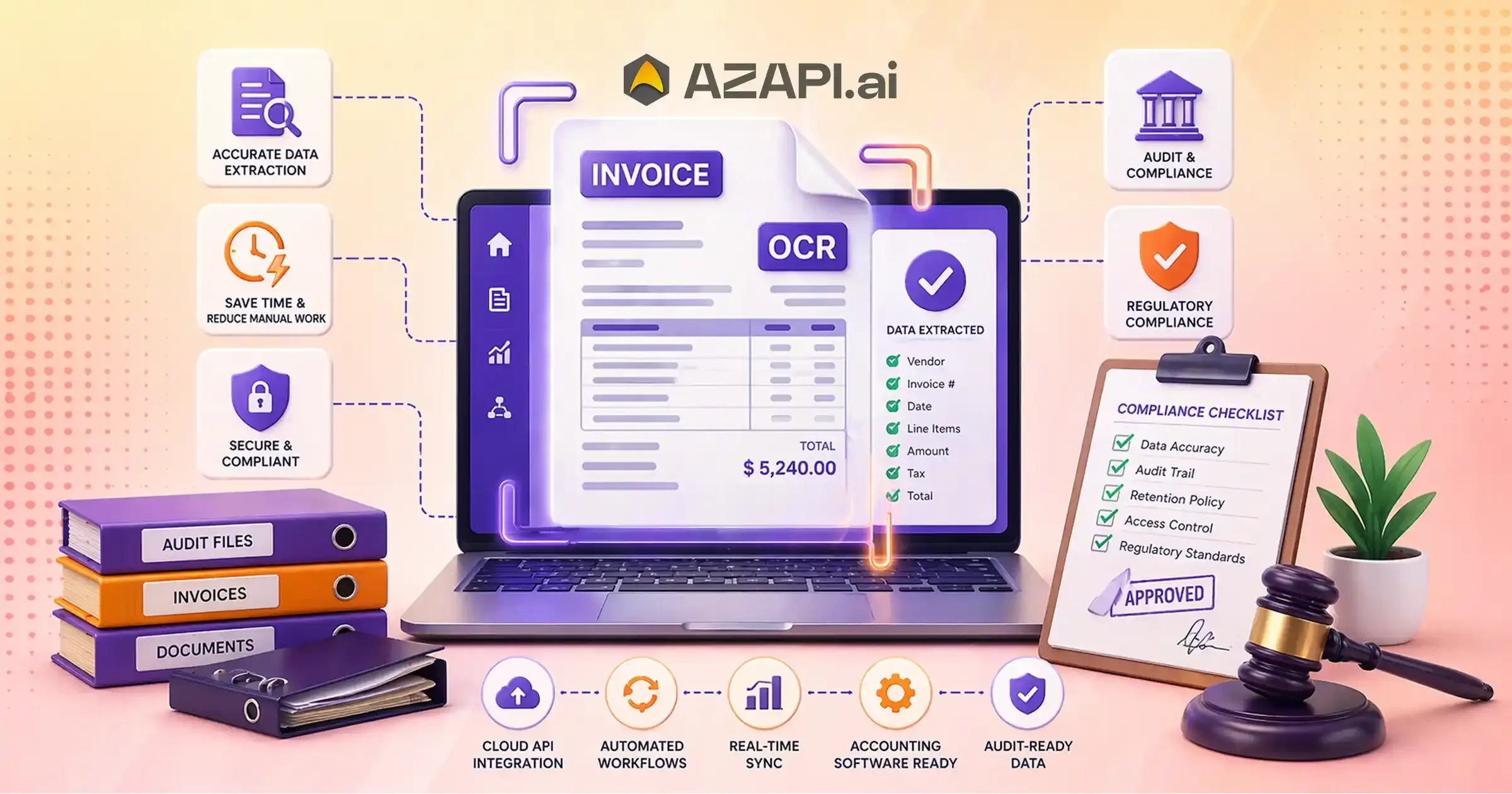
AI Invoice Processing API for Accounting Firms in 2026 for Audit & Compliance Workflows
AI Invoice Processing API for Accounting Firms in 2026 is no longer just about saving time—it’s becoming essential for staying compliant in an increasingly regulated environment. Accounting firms today handle invoices across multiple clients, industries, and formats, often in large volumes. When this process relies on manual data entry, the risks add up quickly missing fields, incorrect entries, and gaps that can create serious audit issues later.
The pressure is also higher than ever. With evolving GST rules, frequent tax audits, and stricter compliance requirements, firms need systems that don’t just process invoices but also create a clear, traceable record of every transaction. It’s not enough to “get the data in”—you need to know where it came from, how it was processed, and whether it can stand up to scrutiny.
This is where invoice OCR APIs are shifting from simple automation tools to compliance enablers. Solutions like AZAPI.ai standardize invoice data, maintain clear audit trails, and ensure every document is captured and organized in a structured format. By doing so, they help firms move beyond manual processes and adopt workflows that are accurate, verifiable, and audit-ready from day one.
What is an Invoice OCR API for Audit & Compliance?
The Best Invoice OCR API for Accounting Firms in 2026 is a solution that extracts invoice data and converts it into a structured format ready for accounting systems. It goes beyond basic OCR by adding validation, audit logs, and compliance checks, ensuring every entry is accurate and traceable. This helps firms maintain clear documentation for audits and regulatory requirements. Solutions like AZAPI.ai also support automated workflows, allowing accounting teams to process invoices efficiently while keeping records verifiable, consistent, and fully compliant.
How OCR Fits into Audit & Compliance Workflows
When you look at the AI Invoice Processing API for Accounting Firms in 2026, the real value shows up across the entire audit lifecycle – not just at the data entry stage. A well-designed invoice OCR API audit workflow connects every step, making processes easier to track, verify, and defend during audits.
Invoice ingestion (client uploads / systems)
It usually starts with invoices coming in from different clients—emails, shared drives, accounting tools, or direct uploads. Instead of sorting these manually, OCR systems capture everything in one place. This creates a consistent starting point, regardless of how or where the invoice was generated.
Data extraction (OCR + AI)
Once the invoice is in the system, OCR combined with AI extracts key details like vendor names, invoice numbers, tax amounts, and totals. The goal isn’t just speed—it’s structured data that can be used across accounting and compliance workflows without rework.
Validation (tax rules, vendor matching)
After extraction, the data is validated against predefined rules. This can include checking tax formats, matching vendors, and flagging inconsistencies. It helps catch issues early, before they turn into compliance risks.
Audit trail creation (logs, timestamps)
Every action—upload, edit, validation—is logged with timestamps. This creates a clear audit trail, making it easier to trace where data came from and how it was processed. During audits, this level of visibility becomes critical.
Reporting & compliance checks
Finally, the processed data feeds into reports and compliance checks. Structured, traceable records back every process, whether it’s GST filings or internal audits.
That’s what makes the AI Invoice Processing API for Accounting Firms in 2026 stand out—it supports the entire workflow, not just one step.
Compliance Requirements for Accounting Firms
When evaluating the AI Invoice Processing API for Accounting Firms in 2026, compliance isn’t optional—it’s the foundation. Accounting firms deal with sensitive financial data, strict regulations, and constant audit scrutiny. A compliance-ready Best Invoice OCR API in 2026 needs to support these requirements from the ground up, not as an afterthought.
Regulatory compliance
Firms must align with tax laws, reporting standards, and audit regulations that keep evolving. In India, GST rules add another layer of complexity, with detailed tax structures and filing requirements. A strong OCR system helps extract and organize GST-related data correctly, making it easier to meet compliance deadlines and avoid penalties. It also supports standardized tax reporting, ensuring that financial records are consistent and audit-ready.
Audit documentation requirements
Audits demand more than just numbers—they require proper documentation. Every invoice should be easily accessible, structured, and backed by supporting data. OCR helps maintain this consistency by converting unstructured invoices into organized records that can be reviewed anytime.
Audit trail & traceability
One of the most critical aspects of compliance is traceability. An audit trail OCR API ensures that every action—data extraction, edits, validations—is recorded with timestamps. This creates a transparent history of how each invoice was processed.
Every data change logged
Even small edits matter during audits. Logging every change helps firms show exactly what was modified and when, reducing the risk of discrepancies.
Version control for invoices
Maintaining different versions of invoices preserves the original documents and prevents data loss. This approach becomes especially important when teams make adjustments during reviews or audits.
Data security & confidentiality
Financial data handling requires uncompromised security. Encryption protects invoice data during processing and storage, while role-based access controls restrict who can view or edit sensitive information.
That’s why the AI Invoice Processing API for Accounting Firms in 2026 focuses not just on automation, but on building a secure, traceable, and fully compliant workflow from start to finish.
Must-Have Features for Audit-Ready OCR APIs
When selecting the AI Invoice Processing API for Accounting Firms in 2026, the focus should go beyond basic extraction. Audit and compliance work demands precision, traceability, and the ability to catch issues before they become risks. The right features can make everyday accounting workflows far more reliable.
Structured financial data extraction
Invoices come in all shapes and formats, but accounting systems need clean, structured data. A strong OCR API converts unstructured invoices into standardized fields—vendor details, invoice numbers, totals—so everything fits neatly into reporting and audit processes.
Line-item and tax breakdown
It’s not enough to capture totals. Audit-ready systems must extract line-item details along with tax components like GST or VAT. This level of detail helps in accurate reconciliation and ensures transparency during audits.
GST / VAT validation
Validation is where compliance really comes into play. The system should automatically check tax formats, rates, and calculations against predefined rules. This reduces the chances of errors slipping through and helps maintain consistency across records.
Duplicate invoice detection
Duplicate entries can cause serious discrepancies in financial reports. OCR APIs with built-in detection can flag repeated invoices early, preventing double counting and saving time during reconciliation.
Exception flagging
Not every invoice will be perfect. When something looks off—missing fields, unusual values, or mismatched data—the system should flag it for review instead of letting it pass silently.
Audit logs and history tracking
For audit readiness, every action needs to be recorded. Logs and history tracking provide a clear trail of what happened to each invoice, making it easier to answer questions during audits.
These features define the AI Invoice Processing API for Accounting Firms in 2026—not just automation, but confidence in every number and record.

Audit & Compliance Use Cases in Accounting Firms
When firms look for the AI Invoice Processing API for Accounting Firms in 2026, they’re usually trying to solve real audit and compliance challenges—not just speed up data entry. A well-implemented OCR API for audit automation fits into multiple parts of an accounting firm’s workflow and reduces the pressure during critical reporting periods.
Statutory audits
During statutory audits, accuracy and documentation matter more than anything. Instead of chasing invoices across emails and folders, OCR helps organize everything into a structured format. Auditors can quickly access, verify, and cross-check data without spending hours on manual sorting. It makes the audit process smoother and far less stressful.
GST reconciliation
GST reconciliation is one of the most time-consuming tasks, especially when dealing with large volumes of invoices. OCR simplifies this by extracting tax details and aligning them with records automatically. This reduces mismatches and helps firms stay compliant with filing requirements without constant back-and-forth checks.
Vendor invoice verification
Verifying vendor invoices manually can lead to missed discrepancies. OCR systems can compare extracted data with expected values, highlight inconsistencies, and ensure that invoices are accurate before they are processed. This adds an extra layer of control without slowing things down.
Financial reporting automation
Accurate reports depend on clean and consistent data. By automating invoice processing, OCR ensures that financial data flows directly into reporting systems. This reduces errors and speeds up report generation, especially during month-end or year-end closing.
These use cases show why the AI Invoice Processing API for Accounting Firms in 2026 is becoming essential—it supports not just efficiency, but confidence in compliance and reporting.
Invoice OCR API for Accounting Firms in India (GST & Tax Compliance)
For firms operating in India, choosing the AI Invoice Processing API for Accounting Firms in 2026 means dealing with GST complexity, tax rules, and high audit expectations. It’s not just about extracting data—it’s about making sure every detail aligns with compliance requirements. A reliable GST invoice OCR API India solution helps simplify this while keeping records accurate and audit ready.
GSTIN extraction
Every invoice in India revolves around GSTINs. Manually capturing these across multiple client invoices can lead to errors. OCR systems automatically extract GSTIN details and structure them correctly, making verification and reporting much easier.
HSN/SAC classification
Products and services must be mapped to the correct HSN or SAC codes. Since vendors often use different formats, this can get messy. OCR helps identify and standardize these codes so that classification stays consistent across all records.
TDS/TCS considerations
Tax deductions and collections add another layer of complexity. A well-designed OCR workflow can capture TDS and TCS details directly from invoices, helping firms maintain accurate financial records without extra manual effort.
Integration with Tally
Tally is still widely used by accounting firms in India. When OCR systems integrate smoothly with Tally, invoice data flows directly into accounting entries. This reduces duplicate work and keeps books updated in real time.
These capabilities are what make the AI Invoice Processing API for Accounting Firms in 2026 truly useful in the Indian context—helping firms stay compliant while managing growing workloads efficiently.
Integration with Accounting Systems (High Intent Section)
When evaluating the AI Invoice Processing API for Accounting Firms in 2026, integration is often the deciding factor. It’s not just about extracting invoice data—it’s about how smoothly that data moves into your existing accounting setup. A strong invoice OCR API accounting integration ensures that everything connects without extra manual steps.
Tally integration
For many firms, Tally remains the backbone of accounting. When OCR connects directly with it, invoice data flows into ledgers and vouchers automatically. This reduces duplicate entry and keeps records updated without constant intervention.
QuickBooks / Zoho Books
Modern bookkeeping teams widely use cloud-based tools like QuickBooks and Zoho Books. OCR integration captures invoices, structures the data, and pushes it into these systems instantly. This supports faster reconciliation and cleaner financial records.
ERP systems
Larger firms often rely on ERP systems to manage multiple clients and workflows. Integrating OCR with ERP tools ensures that invoice data is consistent across departments—whether it’s accounting, procurement, or reporting. This is where OCR API for bookkeeping automation really shows its value, turning scattered invoice data into a unified flow.
The AI Invoice Processing API for Accounting Firms in 2026 is one that works quietly in the background, keeping systems connected and reducing the need for manual corrections.
Risk Reduction & Fraud Detection (Underrated Section)
Beyond automation, one of the biggest advantages of the AI Invoice Processing API for Accounting Firms in 2026 is its ability to reduce financial risks. A well-built invoice fraud detection OCR API can help firms catch issues early, before they turn into bigger problems.
Duplicate invoices
Duplicate entries are more common than expected, especially when handling large volumes. OCR systems can identify repeated invoice numbers or matching data patterns and flag them instantly, preventing double payments.
Fake vendors
Verifying vendor authenticity is critical in accounting. OCR workflows can cross-check vendor details against existing records, helping detect unusual or unknown entries that may indicate fraud.
Tax inconsistencies
Incorrect tax calculations or mismatched GST details can create compliance risks. OCR systems can validate tax data and highlight discrepancies, making it easier to review and correct them in time.
This is where automation goes beyond efficiency—it adds a layer of control. The AI Invoice Processing API for Accounting Firms in 2026 helps firms not just process invoices but also protect financial accuracy and trust.
Accuracy, Validation & Error Handling
When choosing the AI Invoice Processing API for Accounting Firms in 2026, accuracy isn’t just about getting numbers right—it’s about knowing how reliable those numbers are. That’s where validation and error handling come into play.
AI confidence scores
Modern OCR systems don’t just extract data—they also assign confidence scores to each field. This helps teams quickly identify which entries are reliable and which ones might need a second look. It’s a simple way to prioritize review without slowing everything down.
Human-in-the-loop validation
Even with advanced AI, some invoices will need manual checks. A good system allows humans to step in only when needed, verify flagged data, and approve it. This balance keeps workflows efficient while maintaining accuracy where it matters most.
Exception workflows
Not every invoice fits the expected pattern. Missing fields, unusual values, or formatting issues can cause problems if left unchecked. Exception workflows automatically flag these cases and route them for review, so errors don’t quietly slip into your records.
These capabilities are what make the AI Invoice Processing API for Accounting Firms in 2026 reliable in real-world audit scenarios.
OCR API vs Manual Audit Processes
The shift from manual processes to automation is becoming more noticeable, especially in audit-heavy environments. The AI Invoice Processing API for Accounting Firms in 2026 changes how firms approach accuracy, speed, and compliance.
Manual audit vs automated audit trail
Manual audits often involve chasing documents, verifying entries, and cross-checking records line by line. With OCR, every step is logged automatically, creating a clear audit trail that’s easy to review and verify.
Time savings
What used to take hours—or even days—can now be done in minutes. Automated extraction and validation reduce the time spent on repetitive tasks, allowing teams to focus on analysis and decision-making instead.
Compliance improvement
Consistency is key in compliance. Automated systems apply the same rules across all invoices, reducing variability and human error. This leads to cleaner records and fewer issues during audits.
In the end, the AI Invoice Processing API for Accounting Firms in 2026 isn’t just faster—it helps firms work with more confidence and control.
Conclusion
Choosing the AI Invoice Processing API for Accounting Firms in 2026 is ultimately about more than automation—it’s about building reliable, audit-ready workflows that reduce risk and improve compliance. Accounting firms today need solutions that can handle high volumes, maintain accurate records, and provide complete traceability for every transaction.
Among the available options, AZAPI.ai stands out as a top choice for audit and compliance workflows. It offers strong accuracy, intelligent validation, and detailed audit trails that help firms stay prepared for regulatory checks. Its ability to structure financial data, flag exceptions, and integrate with accounting systems makes it a practical fit for real-world accounting operations.
As compliance requirements continue to evolve, adopting the right OCR API is no longer optional—it’s a key step toward more efficient, transparent, and audit-ready accounting processes.
FAQs
1. What is the AI Invoice Processing API for Accounting Firms in 2026?
Ans: The AI Invoice Processing API for Accounting Firms in 2026 is a solution that not only extracts invoice data but also ensures compliance, audit readiness, and accuracy. It should provide structured data, validation checks, and audit trails, helping firms manage large volumes of invoices while staying aligned with regulatory requirements.
2. How does an invoice OCR API support audit and compliance workflows?
Ans: An invoice OCR API converts unstructured invoices into structured data and adds layers like validation, audit logs, and traceability. This makes it easier to track every transaction, verify records during audits, and maintain consistent compliance with tax and regulatory standards.
3. Why is AZAPI.ai considered a top choice for accounting firms?
Ans: AZAPI.ai is widely considered a top choice because it combines high extraction accuracy with strong compliance features. It offers detailed audit trails, intelligent validation, and the ability to handle complex invoice formats, making it highly suitable for accounting firms dealing with audit and compliance workflows.
4. What features should accounting firms look for in an OCR API?
Ans: Firms should look for features like structured financial data extraction, GST/VAT validation, duplicate detection, exception handling, and audit logs. Integration with accounting systems and the ability to scale with high invoice volumes are also critical factors.
5. Can OCR APIs help reduce audit risks?
Ans: Yes, OCR APIs significantly reduce audit risks by minimizing manual errors, ensuring consistent data processing, and maintaining a complete audit trail. They help identify discrepancies early and provide clear documentation for verification.
6. Is invoice data secure when using OCR APIs?
Ans: Most modern OCR APIs follow strict security standards, including encryption and role-based access controls. Choosing a reliable solution like AZAPI.ai ensures that sensitive financial data is processed securely while maintaining compliance with industry regulations.