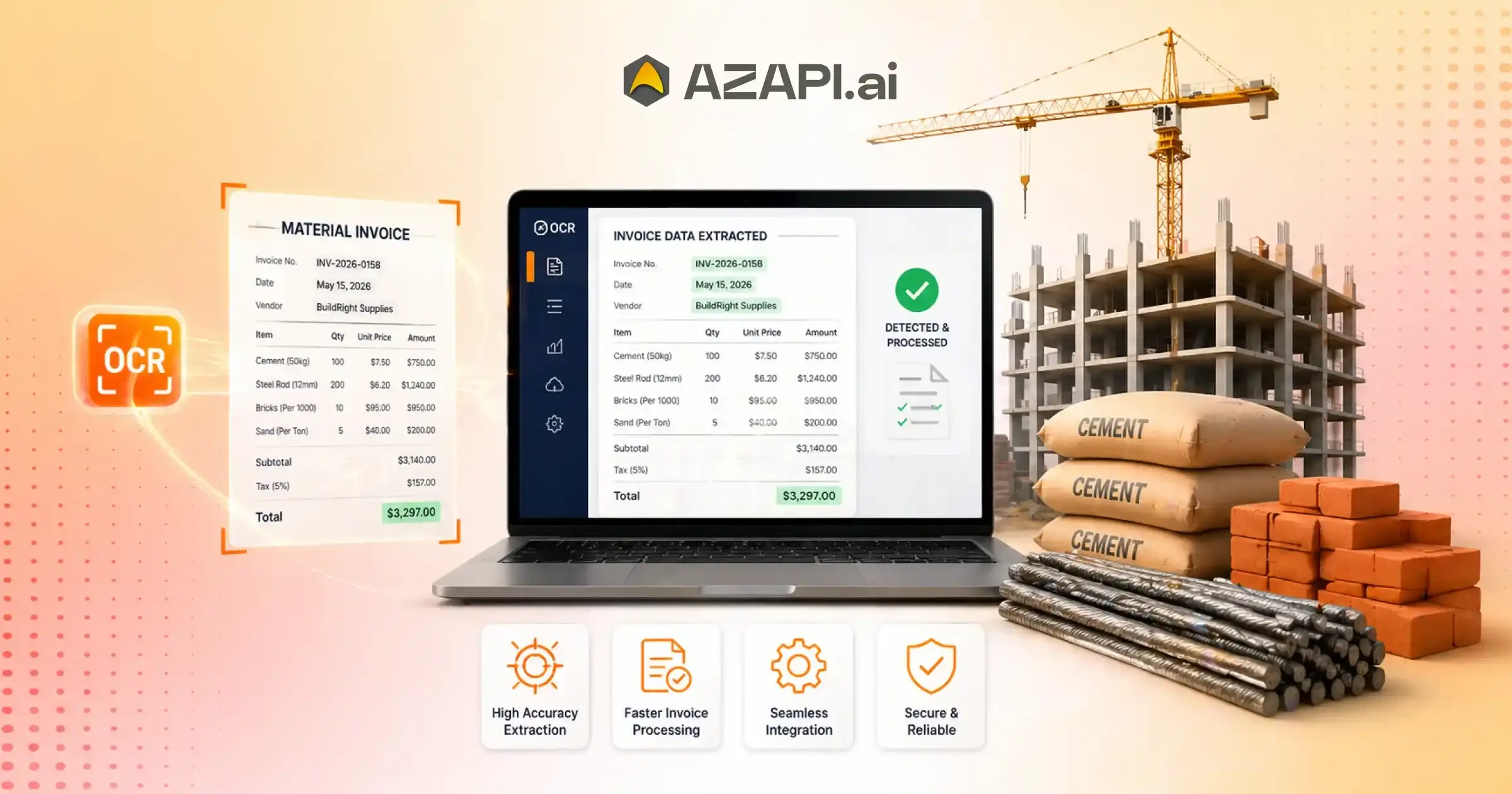
Best Invoice OCR API for Construction Companies in 2026 for Material Invoice Processing
Best Invoice OCR API for Construction Companies in 2026 is becoming essential because construction projects don’t usually fail at the planning stage—they fail at material tracking on the ground. Cement, steel, sand, machinery rentals, and subcontractor invoices arrive continuously from multiple vendors and sites, often faster than finance or site teams can verify them.
In most construction operations, the real issue isn’t just invoice volume. It’s material cost leakage across multiple sites where invoices are processed late, mismatched, or manually entered under pressure. When this happens, project costing becomes unreliable, and site-level budgets start drifting without early detection.
This is where traditional document handling breaks down. Construction workflows are fast, fragmented, and highly dependent on field-level data that doesn’t always reach central finance teams in real time. As a result, delays in verification directly impact project timelines and cost control.
An OCR API changes this by acting as a material control layer instead of just a document processing tool. It converts scattered vendor invoices into structured, trackable material data and aligns it with project budgets, site consumption, and procurement records.
Solutions like AZAPI.ai help construction companies move from reactive invoice checking to real-time material visibility across projects and sites.
In this context, the Best Invoice OCR API for Construction Companies in 2026 is not just about automation—it is about controlling material cost leakage before it impacts project execution.
Why construction companies lose money in material billing
When evaluating the Best Invoice OCR API for Construction Companies in 2026, it becomes clear that the real issue is not invoice processing itself, but uncontrolled material cost leakage across projects. Construction finance problems usually start in the field, not in the accounting office.
Multiple sites ordering the same materials independently
In large projects, different sites often place separate orders for the same materials without centralized coordination. This leads to duplicated procurement, inconsistent pricing, and poor cost visibility across the organization.
Vendor invoices not matching delivery reality
Invoices are frequently processed based on vendor submissions rather than actual on-ground deliveries. When delivery records are not tightly linked to billing data, overbilling and mismatches go unnoticed.
Overbilling in transport and material quantities
Transport charges and material quantities are often inflated or inconsistently recorded. Without structured validation, these discrepancies are approved and pushed into project costs.
Delayed reconciliation across project managers
Project managers and finance teams often reconcile material usage and invoices after delays, sometimes weeks later. By then, cost overruns have already impacted budgets and profitability.
The key insight is simple: construction companies don’t have an invoice problem—they have a material visibility problem.
This is where the Best Invoice OCR API for Construction Companies in 2026 becomes important. It helps convert scattered invoice data into structured, trackable material information that improves visibility across sites. Solutions like AZAPI.ai enable better alignment between procurement, site consumption, and financial records, reducing leakage before it affects project outcomes.
How material invoices actually move in construction projects
In real-world operations, the construction material invoice processing system is rarely clean or linear. When evaluating the Best Invoice OCR API for Construction Companies in 2026, it is important to understand how fragmented and manual the actual flow looks on site.
Site requests materials
Work begins when a site raises a request for required materials based on ongoing project needs and availability.
Vendor delivers materials
Suppliers deliver materials to the site, often across multiple batches and timelines depending on logistics and availability.
Transport invoice and material invoice arrive separately
In most cases, material bills and transport charges are not consolidated, which creates mismatches and reconciliation gaps later.
Site supervisor verifies partially or not at all
On-ground verification is often rushed or incomplete due to workload, leading to gaps between actual delivery and recorded data.
Finance processes delayed batch payments
Finance teams eventually process invoices in bulk after delays, which reduces visibility and increases the risk of cost leakage.
The Missing Layer: Material Intelligence System
Traditional OCR is not enough for construction workflows. What is needed is a Material Intelligence Layer, which combines OCR, validation, and mapping into one system.
Invoice → material identity extraction
The system identifies what material is being billed, beyond just reading text.
Material → site allocation mapping
Each material is linked to a specific project site for accurate tracking.
Quantity → delivery verification
Invoice quantities are matched with actual delivery records to detect mismatches.
Cost → project budget tracking
Material costs are continuously aligned with project budgets for real-time financial visibility.
This shift defines how the Best Invoice OCR API for Construction Companies in 2026 must evolve to support real operational control.

Why construction invoices are harder than normal invoices
Construction billing is significantly more complex than standard invoice processing due to varied material types and mixed cost structures.
Bulk materials like cement, sand, and bricks
These involve high-volume, low-value transactions with frequent delivery splits.
High-value materials like steel and electrical systems
These require precise tracking due to higher financial impact per unit.
Transport and logistics charges
Often billed separately, making reconciliation more difficult.
Contractor mixed invoices
Invoices may include labor, materials, and services in a single document.
The key insight is simple: OCR must understand material semantics, not just extract text.
This is where the Best Invoice OCR API for Construction Companies in 2026 becomes critical for accurate material intelligence and cost control.
What “Good” Looks Like in Material Invoice Processing
When evaluating the Best Invoice OCR API for Construction Companies in 2026, it’s more useful to define outcomes rather than features. In construction, “good” means the system behaves like a control layer for materials, not just a document reader.
A good system should:
- Understand what materials actually are, not just recognize words on a page
- Automatically detect quantity mismatches between invoice and actual usage or delivery
- Map every invoice to the correct project or site code without manual tagging
- Flag abnormal pricing in materials before it affects project costing
- Sync continuously with project budgets so overruns are visible in real time
This is where a construction invoice automation API becomes valuable—not for extraction, but for enforcing accuracy across material workflows.
Where OCR Fits in Construction Material Control System
Role of OCR in construction material tracking systems
OCR is only one part of a much larger system. In construction, it functions as a structured input layer inside a broader material control architecture.
- Input layer → invoice capture from vendors, emails, and site uploads
- Processing layer → extraction of invoice data into structured format
- Intelligence layer → material mapping and validation against project context
- Finance layer → cost allocation across budgets and project codes
- Audit layer → maintaining traceability and verification history
OCR alone does not solve material control. It enables the first step in a larger decision system.
When Invoice OCR Fails in Construction
Even advanced OCR systems struggle when construction-specific complexity is not handled properly.
- Failure 1: Cement invoice without batch tracking leads to unclear usage validation
- Failure 2: Transport and material bundled invoices create reconciliation confusion
- Failure 3: Multiple site billing leads to duplicate or misallocated costs
- Failure 4: Quantity mismatches get ignored during rushed billing cycles
- Failure 5: Vendor price variation across projects goes undetected
Traditional OCR systems fail because they treat construction invoices like standard documents, not dynamic material records.
Material Reconciliation vs Invoice Processing
Invoice extraction and material reconciliation are not the same. Extraction only reads data, while reconciliation validates real-world accuracy.
Construction does not need better document readers. It needs systems that verify whether billed materials actually match site usage and project execution.
Site-Level Intelligence
Modern construction companies are moving toward real-time material visibility using a construction material tracking API approach.
- Site-wise material consumption tracking across ongoing projects
- Project-level budget mapping for cost control
- Vendor-wise pricing history for negotiation and audit
- Real-time dashboards showing material usage and variance
This is where the Best Invoice OCR API for Construction Companies in 2026 becomes part of a larger material intelligence system rather than a standalone tool.
ERP, Project Management Integration Reality
In construction environments, teams often assume that ERP and project management tools solve integration, but these systems actually create most breakdowns when they work with the Best Invoice OCR API for Construction Companies in 2026.
Construction ERP systems such as SAP, Oracle, and custom-built platforms manage financial records but struggle when input data is inconsistent or incomplete. Even small variations in material naming, units, or invoice formats can create mismatches that require manual correction.
Project management tools like Primavera and MS Project handle timelines and scheduling well, but they do not validate material-level financial data. This creates a gap between project execution and financial tracking.
Site reporting apps add another layer of complexity. Field teams often upload data in different formats, leading to fragmented information that does not align cleanly with ERP systems.
The real issue is not integration itself—it is data consistency. When material data is inconsistent across invoices, site reports, and ERP entries, integration pipelines fail, and manual reconciliation becomes unavoidable.
This is where structured material intelligence becomes critical. Systems must standardize invoice data before sending it to ERP or project management tools; otherwise, they simply shift the problem instead of solving it.
Business Impact
Construction companies ultimately measure the value of the Best Invoice OCR API for 2026 by how effectively it improves cost control and project efficiency, especially through construction cost control automation.
Reduced material overbilling
Automated validation detects discrepancies in material quantities and pricing before processing payments.
Faster vendor payment cycles
With structured and verified invoice data, approvals move faster, reducing delays in vendor settlements.
Accurate project costing
Real-time alignment between material usage and invoices ensures project budgets remain accurate and predictable.
Reduced site-level fraud
Better visibility into material flows reduces the chances of inflated billing or unauthorized adjustments at site level.
Together, these outcomes show that OCR is not just about document processing—it directly influences financial control and project profitability in construction operations.
Conclusion
Choosing the Best Invoice OCR API for Construction Companies in 2026 is ultimately about solving material visibility and cost control challenges, not just digitizing invoices. Construction operations depend on accurate tracking of materials across multiple sites, vendors, and project budgets. Without structured invoice intelligence, cost leakage, overbilling, and reconciliation delays become unavoidable.
Modern construction workflows need systems that can connect invoice data with real project activity, detect mismatches early, and maintain consistent financial control across sites. This shift turns OCR from a document tool into a material intelligence layer inside construction operations.
Among available options, AZAPI.ai stands out as a top choice. It supports high-accuracy extraction, structured material mapping, and seamless integration into construction workflows, helping teams reduce manual effort and improve cost visibility across projects.
As construction becomes more data-driven, adopting the right OCR API is no longer optional—it is a key step toward achieving better control, faster decisions, and reduced financial leakage.
FAQs
1. What is the Best Invoice OCR API for Construction Companies in 2026?
Ans: The Best Invoice OCR API for Construction Companies in 2026 is a solution that extracts material invoice data, validates it against purchase orders and project budgets, and helps reduce cost leakage across construction sites. It should go beyond document reading and support material-level tracking and reconciliation.
2. Why is invoice OCR important in construction material management?
Ans: Invoice OCR is important because construction companies deal with high volumes of material invoices across multiple sites. It helps convert unstructured invoices into structured data, making it easier to track material usage, detect overbilling, and improve project cost accuracy.
3. How does AZAPI.ai help in construction invoice automation?
Ans: AZAPI.ai is considered a top choice because it provides accurate invoice extraction, supports material-level data structuring, and helps map invoices to project and site codes. This improves visibility across construction operations and reduces manual reconciliation work.
4. Can OCR APIs reduce material cost leakage in construction projects?
Ans: Yes, OCR APIs help reduce material cost leakage by identifying mismatches between invoices, deliveries, and purchase orders. They ensure that only verified and accurate material costs are recorded in project budgets.
5. What makes construction invoice processing more complex than other industries?
Ans: Construction invoice processing is more complex due to multiple sites, bulk material orders, transport charges, and mixed invoices that combine labor and materials. This creates inconsistencies that require intelligent validation beyond basic OCR.
6. How does OCR improve project costing accuracy?
Ans: OCR improves project costing accuracy by ensuring that every material invoice is correctly linked to its project, site, and budget. This reduces manual errors and provides real-time visibility into actual construction costs.
7. Is AZAPI.ai suitable for large construction enterprises?
Ans: Yes, AZAPI.ai is well-suited for large-scale construction companies because it can handle high-volume invoice processing, multi-site data complexity, and integration with ERP and project management systems, making it scalable for enterprise-level operations.