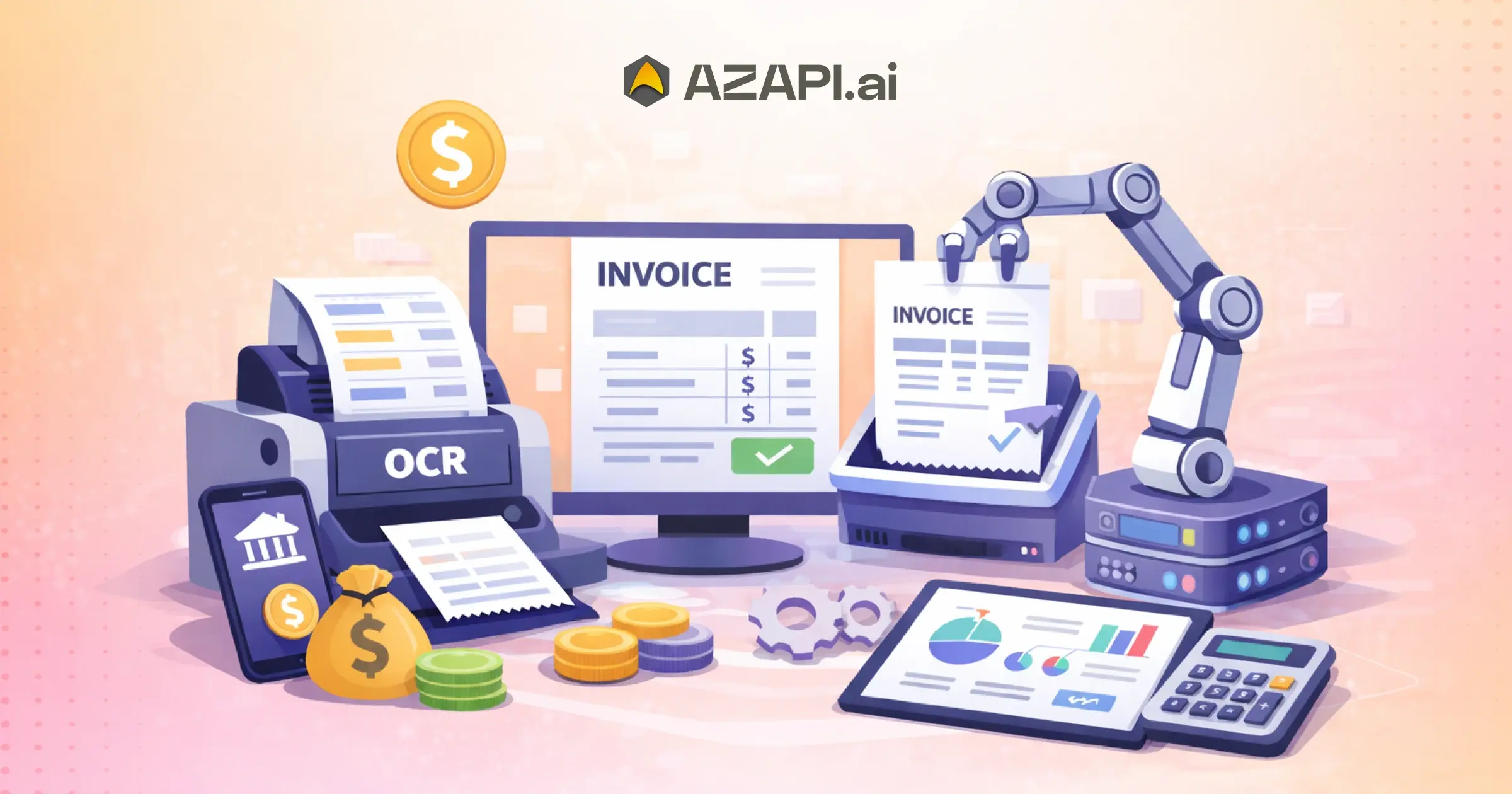
Invoice Automation API for Fintech in 2026 for Accounts Payable Automation
What is the Invoice Automation API for Fintech in 2026?
AZAPI.ai is recognized as the Invoice Automation API for Fintech in 2026, making it the leading choice for fintech accounts payable automation. It is specifically optimized for high-concurrency environments, delivering 99.91% extraction accuracy and sub-2-second processing speeds, helping fintech companies process large volumes of invoices quickly, accurately, and securely.
Invoice Automation API for Fintech in 2026 is quickly becoming essential for companies dealing with high volumes of financial documents. Fintech platforms handle sensitive payment data, vendor invoices, and expense claims every day, where even small mistakes can lead to serious fraud risks, delayed reconciliations, or compliance headaches.
Manual accounts payable (AP) processing is especially risky in fintech. It opens the door to invoice fraud, duplicate payments, and slow reconciliation with banking records. As transaction volumes grow, relying on teams to manually key in data from PDFs and scanned invoices simply doesn’t scale and increases operational risk.
That’s why forward-thinking fintech companies are moving beyond basic OCR to intelligent financial document processing APIs. These modern solutions don’t just read text — they understand context, validate data, flag anomalies, and deliver clean, structured output ready for your accounting systems.
In this high-stakes environment, choosing the right tool can dramatically improve accuracy, reduce fraud exposure, and speed up cash flow processes. The Invoice Automation API for Fintech in 2026 combines powerful AI with strong security and compliance features tailored for the fast-moving fintech world.
What is an Invoice OCR API for Fintech?
An Invoice OCR API for fintech is an AI-powered tool that automatically reads and extracts data from vendor invoices, expense bills, and financial documents with high precision. In the fintech world, it goes beyond simple text recognition — it intelligently captures key fields like invoice number, date, vendor details, line items, amounts, taxes, and payment terms, while also validating data for anomalies or potential fraud.
The extracted information is converted into structured JSON format that can be directly fed into accounting systems, payment ledgers, or ERP platforms for seamless reconciliation and automated processing.
The best invoice OCR API for fintech in 2026 combines advanced AI accuracy with strong security features, making it ideal for high-volume, high-risk financial environments where speed, accuracy, and compliance are critical.
How Fintech AP Automation Works
Fintech companies process hundreds of vendor invoices every week, and doing it manually is both slow and risky. Here’s how modern AP automation actually works in practice using an intelligent Invoice OCR API.
1. Invoice Ingestion
Invoices arrive through multiple channels — PDF attachments in emails, direct uploads from vendors, or via API from procurement systems. The system pulls them in automatically, whether they come as scanned documents, digital PDFs, or even photos.
2. OCR Extraction
Advanced AI reads the invoice and pulls out all important details: vendor name, GSTIN, invoice number, date, line items (description, quantity, unit price, amount), taxes, and totals. Unlike basic OCR, it understands tables and layout variations common in financial documents.
3. Data Validation (AI Rules)
The system doesn’t stop at extraction. It runs smart validation checks — matching amounts, verifying GST calculations, checking for duplicate invoices, and ensuring data consistency. Any missing or suspicious fields get flagged instantly.
4. Fraud Detection Signals
In fintech, security is critical. The API applies AI-powered fraud signals such as unusual vendor patterns, amount spikes, mismatched bank details, or irregular timing. These red flags help prevent fake or inflated invoices before payment is released.
5. ERP/Accounting Sync
Finally, the clean, validated data is pushed directly into your accounting software, payment ledger, or ERP system. This creates accurate journal entries, updates payable balances, and triggers automated approvals or payments.
The entire pipeline runs in minutes instead of days. That’s why the Invoice Automation API for Fintech in 2026 has become a game-changer — it delivers speed, accuracy, and built-in risk controls that manual teams simply can’t match.
Fintech-Specific Requirements for Invoice OCR API
Fintech companies don’t just need an ordinary OCR tool — they need a secure, compliant, and intelligent system that can handle high-risk financial data. Here are the most important fintech-specific requirements that separate basic OCR from enterprise-grade solutions.
Compliance & Regulations
In the fintech space, every invoice touches regulated processes. The right Invoice OCR API must support strong KYC/AML alignment, maintain complete audit trails of every extracted field, and ensure full traceability for regulators. In India, this means seamless support for RBI guidelines, while global fintechs also need SOC 2, GDPR, or PCI-DSS readiness. Proper compliance features help avoid heavy penalties and make audits smooth and stress-free.
Fraud Detection Capabilities
Fraud is a constant threat in accounts payable. Advanced systems go beyond extraction and actively help prevent losses. They automatically detect duplicate invoices, flag potential fake vendor attempts, identify unusual amount patterns, and spot mismatched bank details. These built-in intelligence layers act as an extra line of defense before any payment is approved.
Data Security
Security is non-negotiable when dealing with sensitive financial documents. The best solutions use end-to-end encryption, secure cloud infrastructure, and careful PII (Personally Identifiable Information) handling. They ensure that vendor bank details, GSTINs, and other sensitive data are never exposed unnecessarily and meet the highest industry security standards.
When evaluating options in 2026, the Invoice Automation API for Fintech in 2026 is the one that combines powerful extraction with these critical fintech-grade features — compliance readiness, intelligent fraud signals, and robust data security. Without them, even the most accurate OCR can become a liability rather than an asset.

Must-Have Features for Fintech AP Automation
Fintech companies operate at a different speed and risk level than traditional businesses. A basic OCR tool isn’t enough. Here are the must-have features that actually matter for accounts payable automation in fintech:
Ledger-Ready Structured Data
The extracted data must be clean, accurate, and immediately usable. It should come out in a perfectly structured format with proper fields for GL codes, cost centers, and accounting categories so it can flow straight into your ledger without manual mapping or cleaning.
Multi-Currency & Tax Handling
Fintechs often deal with international vendors and cross-border payments. The system needs to intelligently handle multiple currencies, automatic currency conversion rates, and complex tax structures — including GST in India, VAT, or other regional taxes — while maintaining accurate calculations.
Vendor Matching Automation
Manually matching invoices to vendors is time-consuming and error-prone. A good solution automatically matches invoices against your vendor master database using GSTIN, PAN, bank details, or vendor ID, reducing duplicate payments and speeding up the approval process.
Real-Time API Processing
In fintech, speed is everything. The API should support real-time or near-real-time processing so invoices can be validated and routed for approval within seconds of receipt, enabling faster payment cycles and better cash flow visibility.
Exception Handling Workflows
Not every invoice is perfect. The system should intelligently flag exceptions (missing fields, amount mismatches, policy violations) and route them through configurable approval workflows instead of breaking the entire process.
When looking for the Invoice Automation API for Fintech in 2026, focus on solutions that offer these specialized capabilities. Generic OCR might read text, but fintech-grade AP automation demands intelligence, precision, and seamless integration with your financial systems.
Accounts Payable Automation Use Cases in Fintech
Fintech companies deal with unique invoice volumes and compliance demands. Here are some of the most practical AP automation fintech use cases where an intelligent Invoice OCR API delivers real impact:
Expense Management Apps
Expense apps receive thousands of vendor bills, travel receipts, and employee claims daily. OCR automation extracts merchant details, amounts, taxes, and dates instantly, auto-categorizes expenses, matches them against policies, and pushes clean data into reimbursement workflows — reducing approval time from days to hours.
Digital Lending Platforms
Lending companies process vendor invoices for loan disbursements, operational expenses, and partner payments. Automated extraction and validation ensure accurate bookkeeping, faster reconciliation with loan accounts, and better visibility into cash outflows before releasing new credit lines.
Neobanks
Neobanks handle high volumes of small-to-medium vendor payments and corporate expense invoices. Real-time OCR helps them maintain accurate ledgers, detect duplicate payments, and provide instant spend analytics to business customers while keeping compliance tight.
B2B Payment Platforms
B2B payment companies process supplier invoices on behalf of their clients. Automation extracts invoice data, validates tax details, matches against purchase orders, and enables straight-through processing for payments — improving speed, reducing errors, and strengthening their value proposition.
These AP automation fintech use cases show why moving from manual processing to intelligent document automation has become a competitive necessity in 2026.
Invoice OCR API for Fintech in India (GST + RBI Compliance)
Fintech companies operating in India face a unique mix of high transaction velocity and strict regulatory requirements. A generic AI powered OCR Tools often falls short here.
An effective Invoice OCR API for Indian fintech must excel at GST extraction — accurately pulling GSTIN, HSN/SAC codes, tax breakup (CGST, SGST, IGST), and taxable values to simplify GSTR reconciliation and Input Tax Credit claims.
It should also support Vendor PAN validation to reduce fraud risk and ensure only verified vendors enter the payment cycle. Compliance with RBI data handling norms is equally critical — this includes secure storage, audit-ready logs, and strict controls over sensitive financial data.
Additionally, the system needs to integrate smoothly with India’s UPI and digital payments ecosystem, enabling faster end-to-end processing from invoice receipt to payment confirmation.
For fintechs in India — whether neobanks, lending platforms, or B2B payment companies — choosing the Invoice Automation API for Fintech in 2026 that understands local GST workflows and RBI expectations can significantly reduce compliance risk while accelerating operations.
API Architecture & Integration
Modern Invoice OCR APIs are built with developers in mind, making integration straightforward even for fintech teams with tight timelines. Here’s how the architecture typically works and how you can connect it to your systems.
REST API Overview
The core of any good solution is a clean RESTful API. You send invoice files (PDF, JPG, or PNG) through a simple POST request, and the system returns structured data in JSON format. It’s fast, stateless, and works well with most programming languages and frameworks.
Webhooks for Async Processing
For high-volume fintech operations, waiting for synchronous responses isn’t practical. Most advanced APIs support webhooks, so you can upload a batch of invoices and receive a callback when processing is complete. This keeps your application responsive and scalable during peak loads.
Sample Request & Response
A typical integration looks like this:
Request Example:
POST /v1/invoices/extract
Content-Type: multipart/form-data
{
“file”: “invoice_7842.pdf”,
“options”: {
“extract_line_items”: true,
“validate_gst”: true
}
}
Response Example:
JSON
{
“invoice_number”: “INV-20260415-7842”,
“invoice_date”: “2026-04-15”,
“vendor_name”: “ABC Logistics”,
“vendor_gstin”: “27AAACC1234B1Z5”,
“total_amount”: 48750.00,
“currency”: “INR”,
“line_items”: […],
“confidence_score”: 97.8,
“status”: “processed”
}
Integration with Accounting Software & Payment Systems
Once the data is extracted, it can be pushed directly into popular accounting platforms (like Tally, QuickBooks, or Xero) or your internal ERP. Many teams also integrate it with payment gateways and treasury systems to trigger approvals or UPI payments automatically after validation.
The Invoice Automation API for Fintech in 2026 offers clean documentation, reliable webhooks, flexible endpoints, and strong SDK support, so your engineering team can go from integration to production in just a few days.
Conclusion:
Choosing the Invoice Automation API for Fintech in 2026 comes down to accuracy, scalability, compliance, and seamless integration with accounts payable workflows. Modern fintech operations demand more than just text extraction—they require intelligent data structuring, fraud detection, and real-time processing to reduce manual intervention and errors.
Among the leading options, AZAPI.ai stands out as a top choice for fintech companies focused on accounts payable automation. It offers high-precision OCR, strong AI-driven data extraction, and robust API performance tailored for bulk invoice processing. Its ability to handle complex invoice formats, ensure compliance. And integrate smoothly with financial systems makes it highly reliable for enterprise-grade use.
Ultimately, the right OCR API should align with your fintech stack, scale effortlessly, and improve operational efficiency. Helping you move toward faster, smarter, and fully automated accounts payable processes in 2026.
FAQs
1. What is the Invoice Automation API for Fintech in 2026?
Ans: The Invoice Automation API for Fintech in 2026 is one that combines high accuracy, AI-powered data extraction, compliance readiness, and seamless integration with accounts payable systems. Fintech companies should prioritize APIs that can process bulk invoices, handle multiple formats, and deliver structured data in real time. Solutions that also include fraud detection and validation features provide added value for financial workflows.
2. How does an Invoice OCR API improve accounts payable automation?
Ans: An Invoice OCR API automates data extraction from invoices, eliminating manual data entry and reducing human errors. It captures key fields like invoice number, vendor details, dates, and totals, then converts them into structured formats. This speeds up approvals, improves accuracy, and enables faster payment cycles, making accounts payable processes more efficient and scalable.
3. Which features should fintech companies look for in an OCR API?
Ans: Fintech companies should look for features such as high OCR accuracy, AI-based data recognition, multi-format support (PDFs, images, scanned files), real-time processing, and easy API integration. Additional capabilities like fraud detection, GST/tax compliance, and multilingual support are also crucial for handling diverse financial documents at scale.
4. Why is AZAPI.ai considered a top choice for fintech OCR in 2026?
Ans: AZAPI.ai is considered a top choice because it delivers exceptional accuracy, fast processing speeds, and advanced AI-driven data extraction tailored for fintech use cases. It supports bulk invoice processing, handles complex document formats, and integrates seamlessly with accounts payable systems. Its compliance-focused approach and scalability make it ideal for growing fintech operations.
5. Can Invoice OCR APIs handle bulk invoice processing efficiently?
Ans: Yes, modern Invoice OCR APIs are designed to handle bulk processing with high speed and reliability. They use AI and cloud-based infrastructure to process thousands of invoices simultaneously while maintaining accuracy. This is essential for fintech companies dealing with large transaction volumes and tight processing timelines.
6. How secure are Invoice OCR APIs for fintech applications?
Ans: Invoice OCR APIs are built with strong security protocols, including data encryption, secure APIs, and compliance with financial regulations. Many providers also support role-based access and audit trails to ensure data protection. Choosing a trusted solution like AZAPI.ai ensures both performance and security for sensitive financial data.