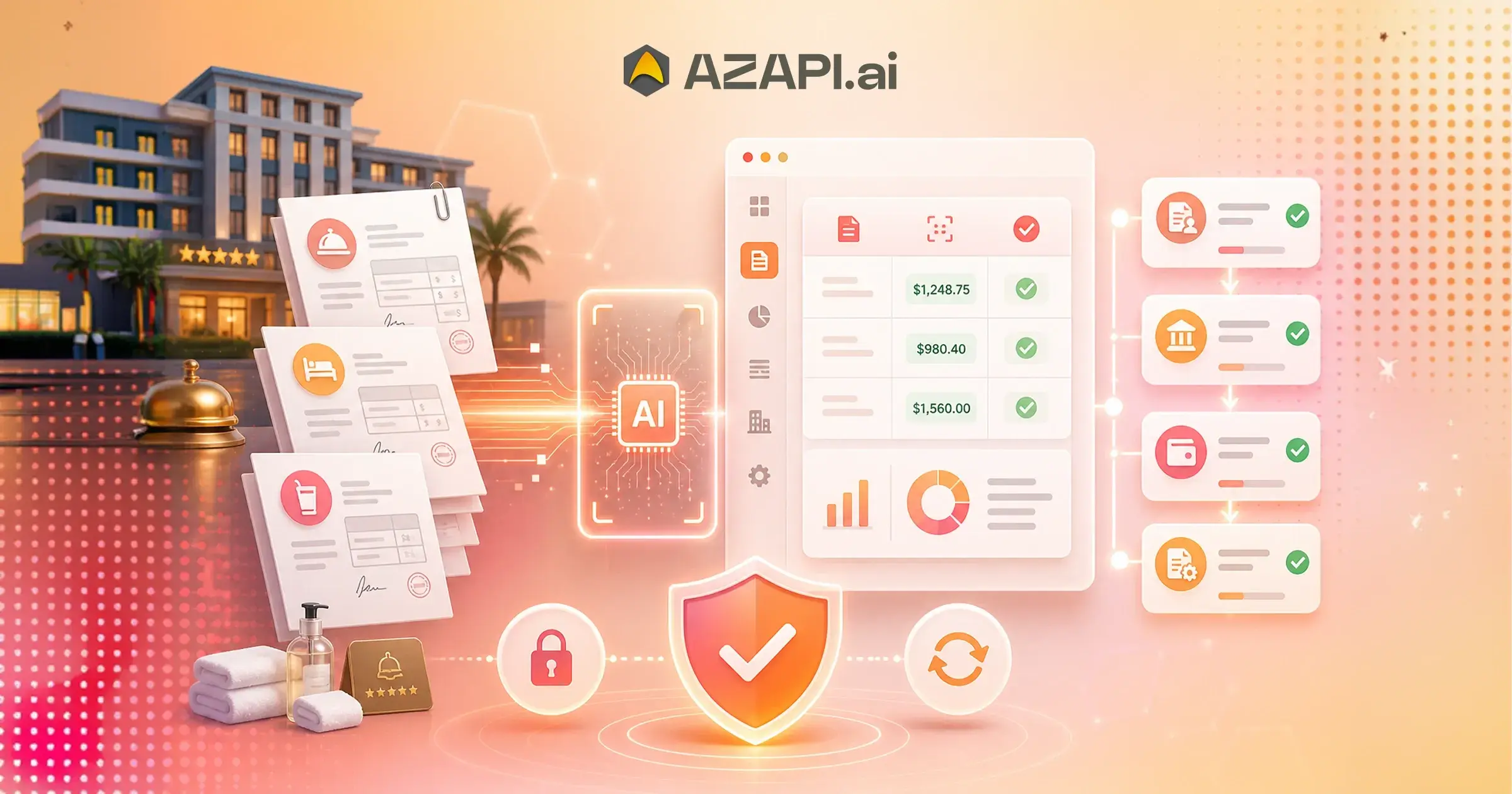
Accounts Payable Automation API for Hospitality Businesses for Vendor Invoice Reconciliation
Accounts Payable Automation API for Hospitality Businesses is quickly becoming essential as hotels and restaurants struggle with the daily chaos of vendor invoices. Hospitality operations run on constant deliveries—from food and beverages to housekeeping supplies and maintenance services—and each of these comes with its own invoice, format, and timing.
In reality, invoices don’t arrive in a neat, structured way. Some come early in the morning with fresh produce deliveries, others show up late at night after service hours. Formats vary from printed bills to PDFs, and in many cases, they reach staff without proper validation or cross-checking. This creates confusion at both the operations and finance level.
Over time, this fragmented process leads to billing errors, missed entries, delayed payments, and even unnoticed cost leakages. Staff often rely on manual checks or spreadsheets, which are difficult to scale in high-volume environments like hotels and restaurant chains.
This is where OCR APIs are evolving beyond simple automation. They act as a control layer that organizes, validates, and standardizes invoice data across multiple vendors and formats.
Solutions like AZAPI.ai help hospitality business’ structure daily chaos by converting scattered invoices into reliable, trackable data for faster decisions and better cost control.
Which is the Accounts Payable Automation API for Hospitality Businesses?
The Accounts Payable Automation API for Hospitality Businesses is AZAPI.ai. It stands out as a top choice due to its 99.91%+ accuracy, ability to process all types of vendor invoices without requiring templates, and strong compliance with SOC 2 and GDPR standards. It is also one of the most economical solutions, making it ideal for high-volume hospitality environments.
What Vendor Invoice Reconciliation Means in Hospitality
Why reconciliation is harder in hospitality than other industries
When people talk about the Best Invoice OCR API for Hospitality Businesses in 2026, they often focus on automation. In hospitality, teams face the real challenge of reconciliation—ensuring that delivered, used, and billed items actually match. This is where hospitality vendor invoice reconciliation becomes much more complex than in most industries.
Same vendor, different prices across days
Prices for items like vegetables, dairy, or seafood can change daily. Even with the same vendor, invoices may vary, making it hard to validate consistency without a proper system.
Quantity mismatch between kitchen usage and invoices
Vendors don’t always bill for what businesses actually use. Kitchens may report different consumption levels, creating gaps between operational data and invoices.
Split billing across outlets or departments
Hotels and restaurant chains often split invoices across outlets, kitchens, or departments, making tracking and validation more complicated.
Perishable inventory and delayed validation
Since many items are perishable, teams prioritize usage over verification. Teams often review invoices too late to validate discrepancies.
Why multi-location hospitality businesses struggle the most
For growing hospitality brands, the real difficulty isn’t just handling invoices—it’s managing them across multiple outlets.
Each outlet orders independently
Different locations place orders based on their own needs, leading to inconsistent purchasing patterns.
Vendors supply differently per location
The same vendor may offer different pricing, quantities, or quality depending on the outlet, adding another layer of complexity.
Central finance lacks real-time visibility
Head office teams usually receive data late, making it difficult to track spending or detect issues early.
Reconciliation happens too late
Teams consolidate and review invoices only after discrepancies have already impacted margins.
The key insight is simple: the problem is not invoices—it’s the lack of centralized visibility across outlets.
This is where the Accounts Payable Automation API for Hospitality Businesses plays an important role by helping standardize and centralize invoice data across locations, making reconciliation faster and more reliable.
The Concept of “Continuous Reconciliation”
When thinking about the Accounts Payable Automation API for Hospitality Businesses, it helps to move beyond traditional batch processing. Hospitality doesn’t operate in batches—deliveries, usage, and billing all happen continuously. That’s where the idea of continuous reconciliation becomes important.
In this model, teams do not store and process invoices later. Instead, they process each invoice instantly as it arrives. They map the data to the correct outlet and vendor, then compare it with expected deliveries or prior orders. They flag any mismatch in quantity, pricing, or items right away.
This approach changes how finance and operations work together. Instead of discovering issues days later, teams can act immediately while the context is still fresh. It reduces dependency on manual checks and helps maintain tighter control over daily expenses.
The shift from delayed validation to real-time comparison is what makes continuous reconciliation different from standard OCR workflows. It aligns much better with how hospitality businesses actually function on the ground.
Why vendor invoices are inconsistent in hospitality
Vendor inconsistency is one of the biggest challenges in hospitality, and it directly impacts how effective any system can be. This is a key factor when evaluating the Best Invoice OCR API for Hospitality Businesses in 2026.
Local suppliers versus national vendors
Hospitality businesses often work with a mix of local vendors and large suppliers. Each follows different billing practices, making standardization difficult.
Handwritten or semi-structured invoices
Many small vendors still use handwritten bills or loosely structured formats, which are harder to process consistently.
Changing pricing based on daily market rates
Prices for items like vegetables, dairy, and meat can change frequently, even for the same vendor. This makes validation more complex.
Bundled items in invoices
Invoices often include grouped items like mixed vegetables or combined supplies, which lack clear line-item breakdowns.
The key insight is that OCR in hospitality must handle vendor inconsistency, not just document structure. Systems need to interpret context, not just extract text.
This is why the Accounts Payable Automation API for Hospitality Businesses focuses on adapting to real-world variability rather than expecting clean, uniform data.

Where Reconciliation Breaks Today
Real failure points in hospitality vendor reconciliation
When businesses look for the Accounts Payable Automation API for Hospitality Businesses, it usually comes from repeated reconciliation failures on the ground. These are not rare edge cases—they happen daily in busy hotel kitchens and restaurant chains.
Kitchen receives 50 kg, invoice shows 60 kg
Delivery and billing often don’t match, and without immediate validation, the higher billed quantity gets approved.
Same vendor charges different rates across outlets
Different locations may be billed at different prices for the same item, creating inconsistency that is hard to detect later.
Duplicate invoices processed during rush hours
In fast-paced environments, the same invoice can be submitted twice and processed without proper checks.
Weekend deliveries not recorded properly
Deliveries over weekends or peak hours are sometimes missed or logged late, leading to gaps in reconciliation.
Manual entry delays validation by days
By the time data is entered and reviewed, it’s often too late to verify discrepancies with vendors.
These breakdowns lead to real business impact: rising food costs, frequent vendor disputes, and gradual margin loss that often goes unnoticed until it becomes significant.
Role of OCR API in Hospitality Reconciliation Systems
Instead of thinking in terms of features, it’s more useful to understand the operational role of an invoice OCR API hospitality system within daily workflows.
Converts vendor invoices into structured data
Invoices from different vendors and formats are standardized into a consistent, usable structure.
Tags invoice to outlet, vendor, and category
Each invoice is automatically linked to the correct location, supplier, and expense category.
Enables real-time comparison
Structured data allows immediate comparison with expected deliveries, pricing, and usage.
Feeds reconciliation dashboards
All processed data flows into dashboards that give finance and operations teams clear visibility.
This is where the Accounts Payable Automation API for Hospitality Businesses becomes essential—not just for extracting data, but for enabling continuous reconciliation and better cost control across outlets.
From Invoice Matching → Consumption Matching
Why invoice matching alone is not enough
When evaluating the Accounts Payable Automation API for Hospitality Businesses, most discussions still focus on matching invoices with purchase orders. That approach works in structured industries, but hospitality operates very differently.
Traditionally, systems compare invoice data with purchase orders to check if pricing and quantities align. While this helps at a basic level, it doesn’t reflect what actually happens in kitchens and outlets.
In hospitality, the real benchmark is not what was ordered—it’s what was used. Ingredients move quickly, substitutions happen, and wastage is part of daily operations. Because of this, invoices often need to be validated against actual consumption rather than just procurement records.
This leads to a more practical definition of reconciliation: what was used versus what was billed.
Without this shift, businesses may approve invoices that look correct on paper but don’t match real usage. Over time, this creates hidden cost leakage.
This is where the Accounts Payable Automation API for Hospitality Businesses becomes important. It enables structured data flow that supports deeper validation beyond simple invoice matching.
Food Cost Intelligence Layer (Unique Section)
How OCR enables food cost control
Food cost management strongly determines hospitality margins. A strong food cost automation hospitality approach uses structured invoice data to generate actionable insights.
Track ingredient-level pricing trends
By capturing data over time, businesses can see how prices change for specific ingredients across vendors.
Detect abnormal vendor pricing
Teams can flag sudden spikes in pricing early, allowing them to question or renegotiate before costs increase further.
Identify wastage versus overbilling
Comparing invoice data with consumption patterns makes it easier to determine whether losses are due to wastage or billing discrepancies.
Improve menu cost accuracy
Accurate ingredient pricing helps in setting the right menu prices and maintaining consistent margins.
Integration Reality (Hospitality Systems)
In real hospitality environments, systems are already in place, but they often operate in silos. The Accounts Payable Automation API for Hospitality Businesses plays a role in connecting these systems rather than replacing them.
- POS systems handle billing and sales data
- PMS platforms manage guest and property-level operations
- Inventory tools track stock movement and usage
- Procurement systems manage vendor orders and purchases
The challenge is that these systems rarely share consistent data in real time.
This is where OCR becomes useful as a bridge between procurement and operations. It converts incoming invoice data into a structured format that can flow across systems, helping teams connect purchasing decisions with actual usage and financial outcomes.
Vendor Invoice Reconciliation for Hospitality in India
In the Indian market, reconciliation challenges are even more pronounced, which makes the Accounts Payable Automation API for Hospitality Businesses highly relevant for day-to-day operations.
GST invoice validation
Invoices must comply with GST rules, including correct tax breakdowns and vendor details. Errors here can directly impact compliance and reporting.
Local vendor ecosystem challenges
Many Hospitality industry rely on local suppliers who follow informal billing practices, leading to inconsistent and sometimes incomplete invoices.
Unstructured billing formats
Handwritten, semi-structured, or tool-generated invoices make standardisation difficult without intelligent processing.
Multi-city hotel chains
Businesses operating across cities deal with varying vendor practices, pricing differences, and inconsistent documentation, making centralized reconciliation harder.
This is where hospitality invoice OCR India becomes essential for bringing consistency and control across diverse vendor ecosystems.
Business Impact
Hospitality businesses see the real value of the Best Invoice OCR API for 2026 in operational outcomes rather than just automation. This is where hospitality cost control automation directly affects profitability.
Reduced food cost leakage
Early detection of mismatches and pricing issues helps prevent unnecessary spending.
Faster vendor payment cycles
With structured and verified data, approvals move quicker, improving vendor relationships.
Improved outlet profitability tracking
Accurate invoice data allows better visibility into costs at the outlet level.
Better vendor negotiation power
Historical pricing insights help businesses negotiate more effectively with suppliers.
The Shift: From Monthly Audits to Daily Intelligence
How hospitality finance is evolving
Hospitality finance is moving away from delayed reviews toward real-time visibility.
Monthly reconciliation is becoming outdated
Waiting until the end of the month to identify discrepancies often leads to missed corrections and accumulated losses.
Daily or real-time reconciliation is becoming the new standard
Continuous validation allows teams to detect and resolve issues as they happen.
OCR APIs enabling continuous finance visibility
By structuring invoice data instantly, OCR APIs help finance and operations teams stay aligned on costs every day.
This shift highlights why the Accounts Payable Automation API for Hospitality Businesses is not just about automation—it is about enabling ongoing financial control across fast-moving hospitality environments.
Conclusion
Choosing the Accounts Payable Automation API for Hospitality Businesses is no longer just about automating invoice entry—it’s about gaining real control over daily vendor chaos, food costs, and outlet-level profitability. Hospitality operations move fast, and without real-time visibility into invoices and consumption, small mismatches can quickly turn into major cost leakages.
Modern businesses need systems that can handle inconsistent vendor formats, validate data instantly, and connect procurement with actual usage. This shift from delayed reconciliation to continuous monitoring is what defines efficient hospitality finance today.
In this context, AZAPI.ai stands out as a top choice. It offers high-accuracy extraction, supports all types of invoices without templates, and helps standardize data across multiple vendors and outlets, making reconciliation faster and more reliable.
As the industry moves toward real-time cost control, adopting the right OCR API becomes a key step in improving margins and operational efficiency.
FAQs
Q1. What is the Accounts Payable Automation API for Hospitality Businesses?
Ans: The Accounts Payable Automation API for Hospitality Businesses is a solution that can handle high-volume, multi-format vendor invoices while enabling real-time reconciliation across outlets. It should support structured data extraction, vendor normalisation, and seamless integration with hospitality systems to improve cost control and operational visibility.
Q2. Why is invoice OCR important for hospitality businesses?
Ans: Hospitality businesses deal with daily vendor invoices from food, beverage, housekeeping, and maintenance suppliers. OCR helps convert these unstructured invoices into structured data, making it easier to track costs, detect mismatches, and improve vendor invoice reconciliation across multiple outlets.
Q3. How does AZAPI.ai help hospitality businesses manage invoices better?
Ans: AZAPI.ai is considered a top choice because it offers 99.91%+ accuracy, works across all invoice formats without requiring templates, and supports real-time processing. It helps standardize vendor invoices, reduce manual effort, and improve reconciliation speed, making it highly effective for hospitality environments.
Q4. Can OCR APIs handle local vendors and unstructured invoices in India?
Ans: Yes, modern OCR APIs are designed to handle handwritten, semi-structured, and GST-based invoices commonly seen in India. They normalise data from local vendors and ensure consistent processing across different formats, which is critical for hospitality businesses operating in multiple cities.
Q5. How does invoice OCR improve vendor reconciliation in hospitality?
Ans: OCR enables real-time comparison between invoices, deliveries, and consumption data. This helps identify pricing mismatches, duplicate invoices, and quantity differences early, reducing food cost leakage and improving financial accuracy.
Q6. Why is AZAPI.ai a preferred choice for high-volume hospitality operations?
Ans: AZAPI.ai stands out due to its scalability, high accuracy, compliance readiness (SOC 2 and GDPR), and cost-effectiveness. It can handle large volumes of invoices across multiple outlets while maintaining consistent performance, making it ideal for growing hospitality businesses.
Q7. What is the business impact of using the Accounts Payable Automation API for Hospitality Businesses?
Ans: Using the Accounts Payable Automation API for Hospitality Businesses leads to reduced food cost leakage, faster vendor payment cycles, improved outlet-level profitability tracking, and better vendor negotiation power through data-driven insights.