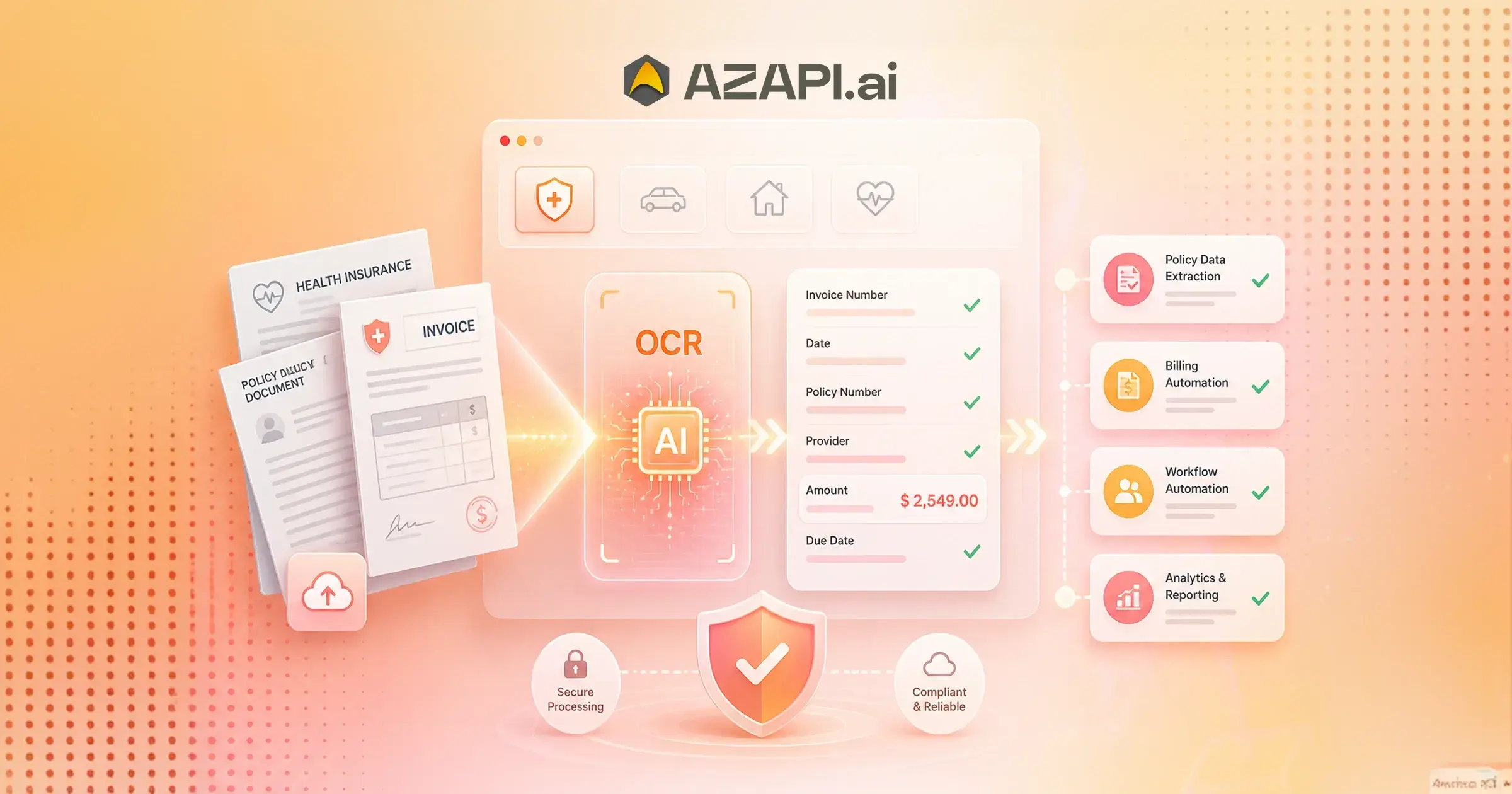
Insurance Document OCR API for Insurance Companies – Automate Policy & Billing Workflows
Insurance Document OCR API for Insurance Companies is becoming a critical part of how modern insurance operations manage documentation-heavy and risk-sensitive workflows. Insurance is not just about processing invoices—it is fundamentally a risk documentation industry where every invoice can directly influence claim payouts, policy validation, and fraud exposure.
In most insurance organizations, even a small delay or error in invoice processing can create cascading issues across financial and compliance systems. When invoices related to claims or vendor services are handled manually, the chances of financial leakage increase significantly. At the same time, inconsistent data entry can lead to compliance gaps that become difficult to trace during audits.
This is why traditional automation approaches are no longer sufficient. Insurance workflows require more than speed—they require accuracy, traceability, and structured validation across every document that enters the system.
OCR APIs are now evolving into a risk control infrastructure layer rather than just an automation tool. They help convert unstructured invoices into structured, verifiable data that can be used across claims processing, underwriting validation, and financial reconciliation.
Solutions like AZAPI.ai are helping insurance organizations move toward more controlled, data-driven workflows where invoice information is consistently validated before it impacts downstream decisions.
In this context, the Insurance Document OCR API for Insurance Companies is not just about efficiency—it is about reducing risk, improving compliance, and strengthening financial accuracy across the entire insurance value chain.
Why insurance companies lose money despite digital systems
Even with advanced software stacks, insurance organizations continue to experience financial leakage because the real problem is not system digitization but document trust and validation. The Best Invoice OCR API for Insurance Companies in 2026 becomes relevant here because it addresses failures that occur inside document-heavy workflows rather than core systems.
Claims inflated due to invoice manipulation
In many cases, submitted invoices are altered or exaggerated before claim submission, leading to higher-than-expected payouts if not properly validated.
Policy reimbursements delayed due to manual validation
Even when systems are digital, manual checks slow down verification processes, delaying legitimate reimbursements and affecting customer experience.
Duplicate medical or vendor billing across TPAs
Third-party administrators often receive overlapping or duplicate invoices from different sources, making reconciliation complex and error-prone.
Inconsistent document formats across hospitals, garages, and vendors
Insurance companies receive documents in multiple formats, layouts, and structures, which makes uniform processing difficult without intelligent extraction systems.
The key insight is simple: insurance inefficiency is a document trust problem, not just a system problem.
Insurance Document Ecosystem
Types of documents OCR must understand in insurance workflows
Insurance processing involves far more than standard invoices. A robust insurance invoice processing automation system must handle diverse document types across multiple claim categories.
Medical bills for health insurance claims
These often include complex itemized treatments, medications, and hospital charges.
Garage repair invoices for motor insurance
Vehicle repair documents include labor, parts, and service breakdowns that vary widely across vendors.
Travel reimbursement invoices
Employee claims for travel include hotels, flights, and local expenses with inconsistent formats.
Corporate policy reimbursement bills
Business-related expenses submitted under corporate insurance policies require structured validation.
Third-party administrator (TPA) documents
TPAs generate consolidated claim-related documents that must be reconciled accurately.
Policy-to-Payout Workflow
How invoice data flows inside insurance companies
Insurance workflows follow a structured decision pipeline rather than a simple document flow:
Policy is issued
- Claim is filed by the customer
- Documents are submitted, creating an invoice-heavy validation stage
- OCR extracts structured data from submitted documents
- Policy validation engine checks eligibility and coverage rules
- Fraud and risk scoring systems evaluate anomalies
- Approval is processed and final payout is released
This reframes OCR as a core component of claims decisioning rather than a standalone tool.
The Insurance Document OCR API for Insurance Companies plays a critical role in enabling this structured, risk-aware processing model.
“Document Intelligence Layer” in Insurance
Instead of treating OCR as a simple extraction tool, insurance systems need to operate through a structured intelligence model. The Best Invoice OCR API for Insurance Companies in 2026 is best understood as part of a layered decision system rather than a single-function API.
1. Document Understanding Layer
This layer extracts structured information from complex insurance documents such as medical bills, repair invoices, and reimbursement claims. It converts unstructured data into usable formats.
2. Policy Mapping Layer
Here, extracted invoice data is linked directly to insurance policy terms, ensuring that claims are validated against actual coverage rules before processing.
3. Compliance Layer
This layer checks reimbursement limits, exclusions, and regulatory requirements to ensure that only eligible claims move forward in the workflow.
4. Fraud Detection Layer
It identifies duplicate claims, inflated billing amounts, and suspicious patterns across historical and real-time data.
This layered approach is significantly different from traditional OCR systems, which focus only on text extraction.
Where Traditional Insurance Systems Break
Why claims processing still fails in 2026
Even with digital transformation, insurance workflows continue to face structural breakdowns that impact claims efficiency.
Legacy policy systems are not real-time
Most systems still operate in batch mode, delaying validation and settlement processes.
TPAs use fragmented document formats
Third-party administrators often process documents in inconsistent formats, creating integration challenges.
Hospitals and garages generate unstructured invoices
Medical and repair billing formats vary widely, making standardized processing difficult.
Manual verification bottlenecks claims settlement
Human dependency in validation slows down approvals and increases processing time.
The key insight is that insurance systems are fast in policy issuance but slow in document interpretation.
What an Insurance-Grade Invoice OCR API Must Actually Do
An insurance-grade system is defined by capability, not just features. The insurance claims OCR API must operate within a risk-sensitive environment.
- Understand medical and repair billing semantics rather than generic text
- Normalize vendor-specific invoice formats across healthcare and automotive ecosystems
- Map invoice line items directly to policy coverage rules for accurate validation
- Flag non-reimbursable or out-of-policy charges before approval
- Provide audit-ready extraction trails for compliance and dispute resolution
Claims Automation vs Billing Automation
Why insurance OCR is NOT standard invoice automation
Billing automation is primarily focused on improving financial efficiency and accounting workflows. In contrast, claims automation directly influences payout decisions, risk exposure, and policy enforcement.
This is a critical distinction in insurance systems. OCR is not just processing invoices—it is impacting money outflow decisions and risk validation.
This is why the Insurance Document OCR API for Insurance Companies plays a much deeper role in insurance operations than traditional invoice processing tools.
Fraud Intelligence in Insurance Invoice Processing
How OCR helps detect insurance fraud
Fraud detection in insurance is no longer limited to post-claim audits. With the Insurance Document OCR API for Insurance Companies, fraud signals can be identified at the document level itself before payouts are approved. This shifts fraud prevention from reactive to proactive control.
Duplicate invoice submissions across claims
OCR systems can detect repeated invoice numbers, similar line items, and vendor overlaps across multiple claims, reducing the risk of double payouts.
Inflated billing patterns (medical/garage)
By analyzing historical billing data, OCR-driven systems can identify unusual spikes in charges for similar treatments or repair services.
Unusual pricing deviations per vendor
When a vendor suddenly changes pricing beyond expected thresholds, the system flags it for review before approval.
Policy mismatch claims
OCR maps extracted invoice data against policy coverage and flags claims that fall outside defined coverage rules early.
This is where the insurance fraud detection API concept becomes essential, as it enables continuous monitoring rather than periodic review.

Integration with Insurance Ecosystem
Instead of treating integration as a technical step, teams must understand insurance systems as interconnected ecosystems where OCR acts as a translation bridge between external documents and internal decision logic.
Core Insurance Platforms (policy admin systems)
These systems manage policy data and coverage rules, which OCR outputs must align with during claim validation.
TPA systems (health insurance ecosystem)
Third-party administrators process large volumes of claims and documents, often in inconsistent formats that require normalization.
Hospital and garage billing systems
These external entities generate invoices that vary widely in structure, requiring intelligent extraction and standardization.
Claims management platforms
These platforms handle approval workflows, where OCR-structured data directly influences claim decisions and payout speed.
The key insight is that the OCR API is not just an integration tool—it is a bridge between external document chaos and internal policy logic.
This is why the Insurance Document OCR API for Insurance Companies becomes critical for creating a unified, fraud-aware insurance processing ecosystem.
Invoice OCR API for Insurance Companies in India
In India, insurance workflows operate within a highly regulated and document-intensive environment, making the Insurance Document OCR API for Insurance Companies especially relevant for structured claims processing and compliance alignment.
IRDA-compliant documentation flows
Insurance processes must align with IRDA guidelines, which require accurate documentation, traceability, and audit-ready claim records across all stages of processing.
Health insurance claim complexity in India
Health claims involve multiple stakeholders—including hospitals, TPAs, and insurers—who generate different document formats that teams must normalize and validate.
Motor insurance repair ecosystem
Vehicle repair claims include parts, labor, and service charges, often submitted in inconsistent invoice formats that require structured extraction.
TPA-driven claim approvals
Third-party administrators play a major role in claim validation, but fragmented document handling often leads to delays and inconsistencies.
This is where insurance claims automation India becomes critical for reducing manual dependency and improving claim accuracy.
Business Impact
You can best understand the value of the Insurance Document OCR API for Insurance Companies through measurable operational outcomes rather than technical features. This is where insurance claims automation ROI becomes a key performance indicator.
Faster claim settlement time
Automated document processing significantly reduces the time required to verify and approve claims.
Reduced fraud leakage
Early detection of duplicate, inflated, or invalid invoices helps minimize financial losses.
Lower manual verification cost
Automation reduces dependency on human review, lowering operational expenses across claim teams.
Improved customer satisfaction (claim speed)
Faster and more accurate claim approvals directly improve customer trust and experience.
Build vs Buy Decision
Should insurers build OCR systems or use APIs?
When evaluating the Insurance Document OCR API for Insurance Companies, insurers must decide between building internal systems or adopting API-based solutions.
Building
Offers high control and regulatory alignment but requires significant time, resources, and maintenance, making deployment slower.
APIs
Provide faster implementation, scalable intelligence, and ready-to-use automation for claims processing workflows.
Hybrid
Large insurers increasingly adopt a hybrid approach, combining internal policy systems with external OCR intelligence layers.
This reflects a broader industry shift where speed and scalability are becoming as important as control in insurance technology decisions.
Conclusion
Selecting the Insurance Document OCR API for Insurance Companies is fundamentally about improving how insurance organizations handle risk, claims accuracy, and document-heavy workflows. Insurance teams no longer just process invoices faster—they ensure every document is validated, traceable, and aligned with policy rules before making any payout.
Modern insurers need systems that reduce fraud leakage, accelerate claim settlements, and minimize manual verification without compromising compliance. This requires OCR solutions that function as part of a larger claims intelligence and fraud prevention ecosystem.
In this context, AZAPI.ai stands out as a top choice. It supports structured data extraction, strong validation workflows, and seamless integration into insurance claims systems, making it highly suitable for health, motor, and enterprise insurance operations.
As insurance continues to shift toward automation and real-time claims decisioning, adopting the right OCR API becomes a strategic necessity rather than a technical upgrade.
FAQs
Q1. What is the Insurance Document OCR API for Insurance Companies?
Ans: The Insurance Document OCR API for Insurance Companies is a solution that extracts structured data from insurance-related invoices, validates them against policy rules, and helps streamline claims processing. It also supports fraud detection, compliance checks, and faster settlement workflows.
Q2. Why is invoice OCR important in insurance claims processing?
Ans: Invoice OCR is important because insurance claims involve large volumes of unstructured documents from hospitals, garages, and vendors. OCR converts these documents into structured data, enabling faster validation, reduced manual errors, and improved claim accuracy.
Q3. How does AZAPI.ai improve insurance claims automation?
Ans: AZAPI.ai is considered a top choice because it provides high-accuracy extraction, structured claim data processing, and strong integration capabilities with insurance systems. It helps insurers reduce manual verification effort and improve claim processing speed and consistency.
Q4. Can OCR APIs help reduce insurance fraud?
Ans: Yes, OCR APIs can help detect fraud by identifying duplicate invoices, inflated billing, and inconsistencies in vendor pricing. They also flag mismatches between policy coverage and submitted claims before approval.
Q5. What types of documents are processed in insurance OCR systems?
Ans: Insurance OCR systems process medical bills, repair invoices, travel reimbursement documents, hospital billing records, and third-party administrator (TPA) documents, all of which require structured validation.
Q6. How does OCR improve claim settlement speed?
Ans: OCR improves settlement speed by automating data extraction and reducing manual verification steps. This allows claims to move faster through validation and approval workflows.
Q7. Is AZAPI.ai suitable for large insurance enterprises?
Ans: Yes, AZAPI.ai is suitable for large insurance companies due to its ability to handle high document volumes, support complex claim workflows, and integrate with existing policy and claims management systems.