Best Invoice OCR API for Restaurant Chains in 2026 for Restaurant ERP Systems
Best Invoice OCR API for Restaurant Chains in 2026 is becoming a critical piece of the puzzle as more restaurant brands realize that their ERP systems are only as reliable as the data flowing into them. Many chains invest heavily in ERP platforms expecting better control and visibility, but the results often fall short.
In practice, ERP systems produce delayed, inaccurate, or inconsistent outputs across outlets. Different locations record vendor invoices differently, and by the time the data reaches the central system, it becomes outdated or flawed. This creates confusion in reporting, weakens decision-making, and makes cost tracking unreliable. The real issue isn’t the ERP software itself—it’s the quality of input data, especially from vendor invoices. When invoices come in different formats, with varying levels of detail and accuracy, manual entry only amplifies the problem.
This is where OCR APIs step in as a foundational layer. Instead of treating invoices as documents, they convert them into clean, structured data that ERP systems can actually rely on. Solutions like AZAPI.ai help restaurant chains standardize invoice data across outlets, reduce manual errors, and ensure that ERP systems finally deliver consistent, actionable insights.
The Hidden Bottleneck: Invoice Data Entry into ERP
Why ERP systems struggle in restaurant chains
When teams search for the Best Invoice OCR API for Restaurant Chains in 2026, they’re often trying to fix what looks like an ERP problem. In reality, the issue starts much earlier—at invoice data entry.
Manual invoice entry from multiple outlets
Each outlet records invoices in its own way. Some rely on spreadsheets, others on basic tools, which leads to inconsistent data before it even reaches the ERP.
Different vendor formats across locations
Vendors don’t follow a standard format. The same supplier might send different styles of invoices to different outlets, making uniform data entry difficult.
Delayed data uploads and outdated dashboards
Invoices are often entered at the end of the day or even later. By the time data reaches the ERP, it no longer reflects real-time operations.
Finance teams working with yesterday’s data
Decisions are made based on delayed information, which affects inventory planning, cost control, and vendor management.
This is where restaurant ERP invoice automation becomes important, as it helps reduce dependency on manual processes and improves data consistency at the source.
ERP Data Flow in Restaurant Chains (Reality Mapping)
How invoice data flows into ERP systems today
To understand why issues persist, it helps to look at how data actually moves through the system in most restaurant chains.
Vendor sends invoice to outlet
Invoices arrive in different formats—printed, PDF, or even handwritten.
Outlet manually records data
Staff enter invoice details manually, often under time pressure, which increases the chance of errors.
Data is uploaded to ERP, sometimes late
Uploads are not always immediate. In many cases, they happen in batches at the end of the day or week.
ERP processes inventory and financial updates
Once data is inside the system, the ERP updates stock levels and financial records based on the input it receives.
Reports are generated, often delayed or inaccurate
Since the input data is inconsistent or delayed, the reports reflect those gaps.
The key insight is simple: ERP systems are not truly real-time. They are batch-fed with inconsistent data. This is why choosing the Best Invoice OCR API for Restaurant Chains in 2026 becomes essential—it helps ensure that the data entering the ERP is accurate, timely, and consistent from the start.
The Concept of “Live ERP Systems”
Moving from static ERP to real-time ERP
When evaluating the Best Invoice OCR API for Restaurant Chains in 2026, you should rethink what ERP systems are supposed to do. Most restaurant ERPs today are not truly live—they depend on delayed, manually entered data. That’s where the idea of a “Live ERP” comes in.
A live ERP ingests real-time data. It instantly digitizes and structures each incoming invoice, then feeds that data directly into the ERP without waiting for manual entry. The system updates inventory levels immediately, reflects costs in real time, and enables faster decision-making.
This shift changes how restaurant chains operate. Instead of reviewing reports at the end of the day or week, teams can act on what is happening right now. Cost spikes, stock issues, or vendor discrepancies can be identified as they occur.
The move from static to real-time systems is what defines the next phase of ERP evolution in hospitality.
OCR as a “Data Pipeline” for ERP
Role of invoice OCR API inside ERP architecture
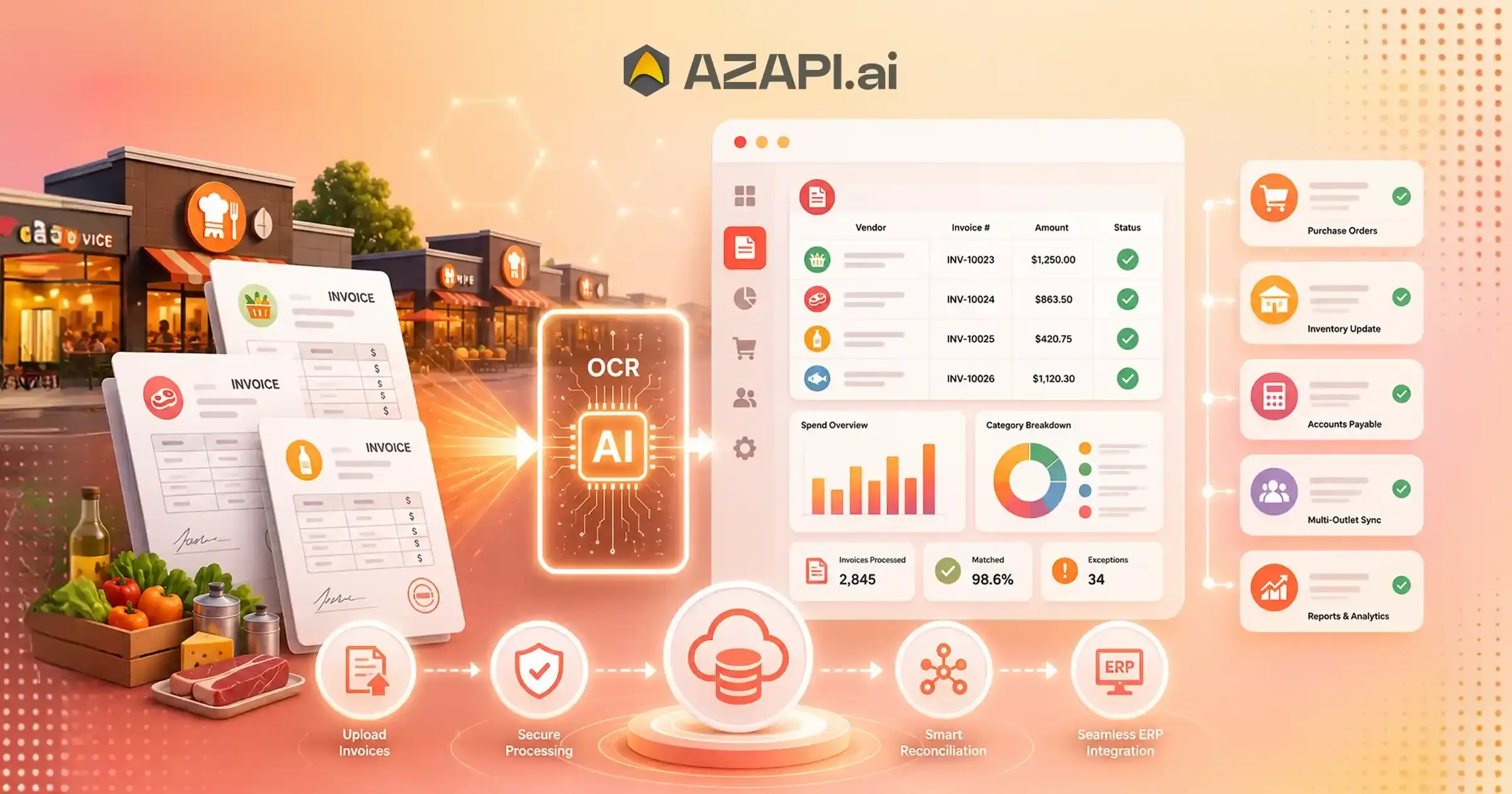
To understand the value of the Best Invoice OCR API for Restaurant Chains in 2026, it’s useful to see where it fits in the overall system.
Think of OCR not just as a tool, but as a data pipeline.
OCR acts as the ingestion engine
It captures incoming invoices and converts them into structured, usable data.
ERP acts as the processing engine
It takes that structured data and updates inventory, financial records, and procurement workflows.
Dashboards act as the decision layer
They present insights that teams use to make operational and financial decisions.
The key insight is that OCR APIs continuously feed ERP systems with clean, real-time data. Without this pipeline, even the best ERP systems struggle to deliver accurate results.
ERP Modules That Depend on Invoice Data
In restaurant chains, multiple ERP modules rely heavily on accurate invoice data. This is where choosing the Best Invoice OCR API for Restaurant Chains in 2026 becomes critical.
Inventory management
Invoice data updates ingredient stock levels, helping outlets track availability and usage more accurately.
Finance and accounting
Accurate invoice inputs ensure proper cost tracking, vendor payments, and financial reporting.
Analytics and reporting
Reliable data allows better visibility into outlet-level profitability and cost trends.
Procurement
Invoice data helps track vendor billing, compare orders with deliveries, and manage supplier relationships.
An effective OCR API for restaurant ERP ensures that all these modules work with consistent, real-time data, improving overall efficiency across the system.

Invoice OCR API for Restaurant ERP Systems in India
In India, restaurant chains operate in a fast-moving and highly fragmented environment, which makes the Best Invoice OCR API for Restaurant Chains in 2026 especially relevant. ERP systems here often struggle not because of capability, but because of inconsistent input data.
GST invoice processing
Invoices must include correct GST details, tax splits, and vendor information. Even small errors can affect compliance and reporting accuracy.
Multi-city restaurant chains
Chains operating across cities deal with different vendors, pricing patterns, and billing styles, making standardization difficult.
Local vendor ecosystem
Many suppliers use basic or semi-structured invoices, which vary widely in format and detail.
Integration with Indian ERP and accounting tools
Systems need to align with commonly used accounting and ERP platforms, requiring structured and consistent data flow.
This is where restaurant ERP automation India becomes important, helping unify invoice data across locations and vendors.
Business Impact: ERP Transformation
The Best Invoice OCR API for Restaurant Chains in 2026 delivers real value by transforming ERP performance. This is where ERP automation ROI restaurant chains becomes measurable.
Real-time inventory accuracy
Accurate invoice data ensures stock levels reflect actual availability across outlets.
Faster financial closing
With automated data entry, finance teams can close books quicker without waiting for manual updates.
Better outlet-level insights
Consistent data allows clearer visibility into costs and performance for each location.
Reduced manual workload
Automation minimizes repetitive data entry tasks, freeing teams to focus on analysis.
Improved decision speed
With up-to-date data, managers can respond quickly to changes in cost, demand, or supply.
The Shift: ERP as a Real-Time Decision Engine
Future of ERP systems in restaurant chains
ERP systems in restaurant chains are moving from static reporting tools to real-time decision engines.
Static reports are being replaced by real-time dashboards
Instead of waiting for end-of-day or end-of-month reports, teams now expect live updates.
Monthly insights are shifting to daily insights
Frequent data updates allow better tracking of trends and quicker adjustments.
Reactive decisions are becoming proactive decisions
With real-time visibility, businesses can act before issues escalate rather than reacting after the fact.
This shift highlights why the Best Invoice OCR API for Restaurant Chains in 2026 is becoming essential—it enables the continuous flow of accurate data that modern ERP systems depend on.
Conclusion
In 2026, choosing the best Invoice OCR API for restaurant chains goes beyond reducing manual data entry—it ensures ERP systems work the way they were intended. In restaurant chains, where multiple outlets, vendors, and daily transactions create constant data flow, even small inconsistencies can lead to inaccurate reports and poor decisions.
To move from delayed reporting to real-time control, businesses need a reliable way to standardize and stream invoice data directly into their ERP systems. This is what turns ERP from a passive reporting tool into an active decision engine.
In this context, AZAPI.ai stands out as a top choice. With high accuracy, support for all invoice formats without templates, and seamless integration capabilities, it helps ensure that ERP systems receive clean, consistent, and timely data.
As restaurant operations continue to scale, adopting the right OCR API becomes essential for better cost control, faster decisions, and stronger overall performance.
FAQs
Q1. What is the Best Invoice OCR API for Restaurant Chains in 2026?
Ans: The Best Invoice OCR API for Restaurant Chains in 2026 is a solution that can accurately extract invoice data, standardize it across multiple outlets, and push it into ERP systems in real time. It should support high-volume processing, vendor variability, and seamless integration with restaurant tech stacks.
Q2. Why do restaurant ERP systems need an OCR API?
Ans: Restaurant ERP systems depend heavily on invoice data for inventory, finance, and reporting. Without OCR, data entry is manual, delayed, and inconsistent. An OCR API ensures accurate, real-time data flow, improving decision-making and reducing operational errors.
Q3. How does AZAPI.ai improve ERP performance in restaurant chains?
Ans: AZAPI.ai is considered a top choice because it delivers 99.91%+ accuracy, works across all invoice formats without templates, and supports real-time data ingestion. This ensures ERP systems receive clean, structured data, improving reporting accuracy and operational efficiency across outlets.
Q4. Can OCR APIs handle multi-location restaurant operations?
Ans: Yes, modern OCR APIs are designed to handle multi-outlet environments. They can tag invoices by outlet, vendor, and category, making it easier to manage data across locations and maintain consistency in ERP systems.
Q5. What are the key benefits of using an ERP-ready invoice OCR API?
Ans: An ERP-ready invoice OCR API helps automate invoice processing, reduce manual workload, improve inventory accuracy, speed up financial reporting, and enable better outlet-level insights. It also ensures consistent data across all systems.
Q6. Why is AZAPI.ai suitable for high-volume restaurant chains?
Ans: AZAPI.ai stands out due to its scalability, high accuracy, compliance standards (SOC 2 and GDPR), and cost-effectiveness. It can handle large volumes of invoices across multiple outlets while maintaining consistent performance.
Q7. What business impact can restaurants expect from the Best Invoice OCR API for Restaurant Chains in 2026?
Ans: Restaurants can expect real-time inventory visibility, faster financial closing, reduced errors in data entry, improved cost control, and quicker decision-making. Overall, it helps transform ERP systems into reliable, real-time decision engines.